REVIEW OF NEW BOOKS.
Reading edition
Elementary Sketches of Moral Philosophy: Delivered at the Royal Institution, in the years 1804, 1805 and 1806: By the late Rev. Sidney Smith, M. A. New York: Harper & Brothers. 1 vol. 12mo.
Sidney Smith appears, in this volume, as an ethical and metaphysical philosopher, and certainly ethics and metaphysics were never before made so clear and so entertaining. Sharp, shrewd, sensible, witty, humorous, eloquent, discriminating, the author goes on, from topic to topic, analyzing and laughing, condensing maxims into epigrams, embodying principles in sarcasms, eliciting jokes from abstractions; and after making his reader laugh tears into his eyes and pains into his sides, really leaves him in possession of more metaphysical knowledge than he would get from Dugald Stewart. The mind of Sidney Smith was so beautiful and brilliant, that men have done injustice to its depth and exactness. He was really an accomplished belles-lettres scholar, a close reasoner, a proficient in the philosophy of politics, morals and mind, as well as a wit and humorist; and in one of the rarest gifts of reason, justness and readiness in the conception of premises, he evinced equal force and fertility. Besides all this, he was an honest, courageous, uncanting, and disinterested man—loving and possessing goodness and virtue, hating and denouncing wickedness and vice. His goodness had not the weak diffusion which characterises the quality in the so-called “good people;” but will and intellect condensed it into lightning, and launched it at error and evil. It smiles sweetly, but it also smites sharply; and no man is more worthy of contemptuous pity than the bigot, dunce, libertine, professional rascal or knavish politician, who comes within word-shot of Sidney’s indignation.
There is no part of the present book which will not delight and instruct the general reader; but the most original portions are those devoted to practical remarks on mental diseases and to acute observations on minor topics of the great subject. To all who know Sidney Smith’s writings it is needless to add, that every idea in the volume is conceived and stated clearly, and that the author’s ignorance in the higher regions of his theme never seeks refuge in obscure terms, but is boldly, and some times exultingly, acknowledged. Many of the great philosophers, and especially the idealists and skeptics, are rather fleeringly disposed of. Common sense is Sydney’s test; but common sense is hardly able to grapple with Aristotle and Descartes, the greatest of metaphysicians; and they are, therefore, praised for their power and ridiculed for its perversion. The author’s peculiar felicity in making ludicrous statements which operate with the force of arguments, is displayed throughout the volume. “Bishop Berkeley,” he says, “destroyed this world in one volume octavo, and nothing remained after his time but mind; which experienced a similar fate from the hand of Mr. Hume, in 1737.” Nothing could be more felicitous than this statement, considered as a practical argument against the systems of the idealists and skeptics. Again he says: “A great philosopher may sit in his study, and deny the existence of matter; but if he take a walk into the streets he must take care to leave his theory behind him. Pyrrho said there was no such thing as pain; and he saw no proof that there were such things as carts and wagons; and he refused to get out of their way: but Pyrrho had, fortunately for him, three or four stout slaves, who followed their master without following his doctrine; and whenever they saw one of these ideal machines approaching, took him up by the arms and legs, and, without attempting to controvert his arguments, put him down in a place of safety.”
The passages on Aristotle are in a similar vein of pleasantry. “Some writers,” he remarks, “say he was a Jew; others that he got all his information from a Jew, that he kept an apothecary’s shop, and was an Atheist; others say, on the contrary, that he did not keep an apothecary’s shop and that he was a Trinitarian.” Further on he adds, that Aristotle’s philosophy “had an exclusive monopoly granted to it by the Parliament of Paris, who forbad the use of any other in France;” and he goes on to compare the great Stagarite with Bacon, to the manifest disadvantage of the former. After speaking of the triumphs of the Baconian method, and the indebtedness of mankind to the vast understanding of its author, he proceeds to remark, that to “the understanding of Aristotle, equally vast, perhaps, and equally original, we are indebted for fifteen hundred years of quibbling and ignorance; in which the earth fell under the tyranny of words, and philosophers quarreled with one another, like drunken men in dark rooms, who hate peace without knowing why they fight, or seeing how to take aim.” Zeno, the founder of the sect of the Stoics, is represented as a Cyprus merchant, who had studied the writings of the most eminent Socratic philosophers, and who, in the course of his mercantile pursuits, “freighted a ship for Athens, with a very valuable cargo of Phœnician purple, which he completely lost by shipwreck, on the coast near the Piræus. A very acute man, who found himself in a state of sudden and complete poverty in Athens, would naturally enough think of turning philosopher, both as by its doctrines it inspired him with some consolation for the loss of his Phœnician purple, and by its profits afforded him some chance of subsistence without it.” Socrates, he says, was the great father and inventor of common sense, “as Ceres was of the plough and Bacchus of intoxication.” Two thousand years ago, he adds, “common sense was not invented. If Orpheus, or Linus, or any of those melodious moralists, sung, in bad verses, such advice as a grand-mamma would now give to a child of six years old, he was thought to be inspired by the gods, and statues and altars were erected to his memory. In Hesiod there is a very grave exhortation to mankind to wash their faces; and I have discovered a very strong analogy between the precepts of Pythagoras and Mrs. Trimmer—both think that a son ought to obey his father, and both are clear that a good man is better than a bad one.”
Among the best lectures of the volume, both for sense and brilliancy, are those on the “Conduct of the Understanding,” the “Faculties of Animals and Men,” “Habit,” and “Wit and Humor.” In these Sydney Smith exhibits both his power of rapid analysis and his power of clearly perceiving the essential points of the subjects he discusses. The lecture on the “Faculties of Animals and Men,” is a sort of humorous philosophical poem in prose, the beauty of the humor being as striking as its laughable quality. He commences with observing that he would do no injustice to the poor brutes, especially as they have “no professors to revenge their cause by lecturing on our faculties;” and he is so perfectly satisfied with the superiority of men to animals, that he sees no reason why he should not give the latter full credit for what “few fragments of soul and tatters of understanding they may really possess.” His settled opinion is, that baboons and blue apes will never rival mankind in understanding or imagination, though he confesses that he has sometimes felt a little uneasy at Exeter ’change, “from contrasting the monkeys with the ’prentice boys who are teasing them;” but a few pages of Locke, or a few lines of Milton, always restored him to his tranquil belief in the superiority of man. He then proceeds to give a humorous statement of the various opinions held by philosophers on the physiology of brutes, emphasising especially the theory of Père Bougeant, a Jesuit, that each animal is animated by a separate and distinct devil; “that not only this was the case with respect to cats, which have long been known to be very favorite residences of familiar spirits, but that a particular devil swam with every turbot, grazed with every ox, soared with every lark, dived with every duck, and was roasted with every chicken.” Smith then goes on to define and illustrate instinct, with an analysis as fine as the humor is exquisite. Instinct he considers as an animal’s unconscious use of means which are subservient to an end, in contradistinction to reason, which is a conscious use of those means and a perception of their relation to the end. The examples are all stated in Smith’s peculiar manner. It would take, he says, “a senior wrangler at Cambridge ten hours a day, for three years together, to know enough mathematics for the calculation of these problems, with which not only every queen bee, but every under-graduate grub, is acquainted the moment it is born.”
The general conclusion of Smith, with regard to insects and animals, is the common one, that their instincts and faculties all relate to this world, and that they have, properly speaking, no souls to be saved. But this position he states, illustrates and defends with more than ordinary metaphysical acuteness. If the discussion were not so sparklingly conducted, it would strike the reader as very able analysis and reasoning; but the mirthful fancy with which the whole is adorned, satisfies of itself, and seems to claim no additional praise for the argument it illustrates. The delicious sympathy of the humorist for all grades of being peeps out on every page, and no insect or animal is referred to without being lifted into the comic ideal. Thus he remarks that nature seems on some animals to have bestowed vast attention, “and to have sketched out others in a moment, and turned them adrift. The house-fly skims about, perches upon a window or a nose, breakfasts and sups with you, lays his eggs upon your white cotton stockings, runs into the first hole in the wall when it is cold, and perishes with as much unconcern as he lives.” Again, in speaking of that superiority of man over animals which comes from his longevity, he remarks: “I think it is Helvetius who says he is quite certain we only owe our superiority over the ourang-outangs to the greater length of life conceded to us; and that, if our life had been as short as theirs, they would have totally defeated us in the competition for nuts and ripe blackberries. I can hardly agree to this extravagant statement; but I think in a life of twenty years the efforts of the human mind would have been so considerably lowered, that we might probably have thought Helvetius a good philosopher, and admired his skeptical absurdities as some of the greatest efforts of the human understanding. Sir Richard Blackmore would have been our greatest poet, our wit would have been Dutch, our faith French, the Hottentots would have given us the model for manners, and the Turks for government.” He then adds that man’s gregarious nature is another cause of his superiority over all other animals. “A lion lies under a hole in the rock, and if any other lion happen to pass by they fight. Now, whoever gets a habit of lying under a hole in a rock, and fighting with every gentleman who passes near him, cannot possibly make any progress.”
The lecture on “Wit and Humor” is, perhaps, the most brilliant of all; but, though the definitions are keenly stated and the distinctions nicely drawn, we suppose that even Sidney Smith, fine wit and humorist as he is, has not settled the matter. It appears to us that the difficulty consists in considering wit and humor as distinct powers, instead of viewing them as modifications of other powers. The mental peculiarities which distinguish wit and humor are qualities equally of fancy and imagination. The difference is emotional, not intellectual; in sentiment, not in faculty. A man whose sentiment and feeling of the ludicrous is predominant, will naturally make his intellectual powers serve his mirthful tendencies. If he has a lively fancy he will be a wit; if he has a creative imagination he will be a humorist. We should say, generally, that wit was fancy and understanding, directed by the sentiment of mirth; and that humor was imagination and understanding, directed by the same sentiment. It will be found, we think, in all ingenious and creative minds, that their peculiar direction depends altogether on sentiment. Sometimes imagination is exercised in a department of thought or action so far removed from the fine arts, that we can hardly recognize the power in its direction. In metaphysics, in mathematics, in government, war and commerce, we often come in contact with thinkers of vast imaginations, who still may despise poets and artists, and be heartily despised by them. If a change in the form and purpose of imagination thus appears, to many minds, to change its qualities, and to demand new definitions, we need not wonder at the popular reluctance to admit wits and humorists into the band of poets, though fancy and imagination be equally their characteristics.
Although our notice of this delightful volume has extended beyond the space we can properly allow it, we take leave of its wise and witty pages with regret, heartily commending it to the leisure hours of every man who can relish vivid argument and brilliant good sense.
Confessions of an English Opium Eater, and Suspiria de Profundis. By Thomas De Quincy, Boston: Wm. D. Ticknor & Co. 1 vol. 12mo.
Thomas de Quincy has been well known during the last twenty years, not only as the author of “Confessions of an English Opium Eater”, but as a prominent contributor of able, thoughtful, and eloquent articles to Blackwood’s Magazine, and other British periodicals. The publishers of the present volume intend to follow it up with others, containing the best of his many remarkable historical, biographical, and critical papers. When completed, the series will constitute a body of thought which no student’s library can well be without, for the author’s learning extends over widely separated departments of literature and science, and in each he has proved himself capable of throwing out those suggestive thoughts which take root in the reader’s mind, and bear fruit. A resolute, inquisitive, and reflective student, richly dowered with understanding and imagination, and exercising great dominion over the harmonies and subtilties of expression, De Quincy has been prevented from producing little more than colossal fragments of thought, by the mastery obtained over his will by opium, and the contemptuousness of disposition which that habit provokes for calm, orderly, systematic works. He is dogmatic, negatively as well as positively. It is natural that a man who obtains glimpses of grand truths and magnificent systems, through artificial stimulants, should disdain the sober realizations of consecutive and industrious thought, wanting all that misty magnificence which clothes things viewed in the waking dreams of the opium eater. But egotist and dogmatist as he is, he is still a resolute thinker, whose mind, busy with all the problems of society and philosophy, is continually startling us with novel thoughts and splendid rhetoric.
In the first part of the “Confessions” there is one passage, describing a dream inspired by opium, which we cannot resist the temptation to extract, as it is one of the sublimest in English prose. “The dream,” he says, “commenced with a music which now I often heard in dreams—a music of preparation and awakening suspense; a music like the opening of the Coronation Anthem, and which, like that, gave the feeling of a vast march, of infinite cavalcades filing off, and the tread of innumerable armies. The morning was come of a mighty day—a day of crisis and of final hope for human nature, then suffering some mysterious eclipse, and laboring in some dread extremity. Somewhere, I knew not where—somehow, I knew not how—by some beings, I knew not whom—a battle, a strife, an agony, was conducting—was evolved, like a great drama, or piece of music; with which my sympathy was the more insupportable from my confusion as to its place, its cause, its nature, and its possible issue. I, as is usual in dreams, (where we make ourselves central to every movement,) had the power, and yet had not the power, to decide it. I had the power, if I could raise myself, to will it; and yet again had not the power, for the weight of twenty Atlantics was upon me, or the oppression of inexpiable guilt. ‘Deeper than ever plummet sounded,’ I lay inactive. Then, like a chorus, the passion deepened. Some greater interest was at stake; some mightier cause than ever yet the sword had pleaded, or trumpet had proclaimed. Then came sudden alarms; hurryings to and fro; trepidations of innumerable fugitives. I knew not whether from the good cause or the bad, darkness and light, tempest and human faces, and at last with the sense that all was lost, female forms, and the features that were worth all the world to me, and but a moment allowed—and clasped hands, and heart-breaking partings, and then—everlasting farewells! and, with a sigh such as the caves of hell sighed when the incestuous mother uttered the abhorred name of death, the sound was reverberated—everlasting farewells! and again, and yet again reverberated—everlasting farewells!”
“Suspiria de Profundis,” the conclusion of the Confessions, occupies about as much space as the original work, and has now, for the first time, been connected with it in the same volume. The style of the conclusion is even more majestic, visionary and resounding than the first portion, and is full of thrilling pictures and Macbeth “sights.” We hope that this volume will meet with a success so marked, as to induce the publishers to issue the remaining volumes of De Quincey’s miscellanies in rapid succession.
Life and Letters of Thomas Campbell, Edited by William Beattie; M. D., one of his Executors, New York: Harper & Brothers, 2 vols. 12mo.
Dr. Beattie’s work cannot take a high place in biographical literature, as far as it is to be judged by his own power of thinking and writing. He has, properly speaking, no conception of Campbell’s character; and the passage from one of his statements to the letter or anecdote which he adduces in its support, will indicate this to the least reflecting reader. Were it not for the richness of his materials his work would not be worth reprinting; but it has great value and interest from the number and variety of the private letters it contains. Campbell’s correspondence, though it evinces much nervous weakness of mind and a sensitiveness of vanity easily elated or depressed, has a peculiar raciness which wins and rewards attention; and, in addition to its own excellent qualities of wit and fancy, which delight of themselves, it furnishes much information relating to the literary men of the last fifty years.
Mr. Irving has written a very pleasing introduction to these volumes, characteristic equally of his delicacy, his good nature and his discrimination, and embodying several new anecdotes of Campbell. He says that Beattie’s life “lays open the springs of all his actions and the causes of all his contrariety of conduct. We now see the real difficulties he had to contend with in the earlier part of his literary career; the worldly cares which pulled his spirit to the earth whenever it would wing its way to the skies; the domestic affections, tugging at his heart-strings even in his hours of genial intercourse, and converting his very smiles into spasms; the anxious days and sleepless nights preying upon his delicate organization, producing that morbid sensibility and nervous irritability which at times overlaid the real sweetness and amenity of his nature, and obscured the unbounded generosity of his heart.” This praise, of course, must be considered due to the “Letters” rather than the “Life” of Campbell.
Lord Jeffrey, in a letter to Campbell, on the subject of “Gertrude of Wyoming,” very felicitously indicates the prominent faults of that exquisite poem, and of Campbell’s general artistic method. “The most dangerous faults,” he says, “are your faults of diction. There is a good deal of obscurity in many passages—in others a strained and unnatural expression—an appearance of labor and hardness; you have hammered the metal in some places till it had lost all its ductility. These are not great faults, but they are blemishes; and as dunces will find them out—noodles will see them when they are pointed to. I wish you had courage to correct, or rather to avoid them, for with you they are faults of over-finishing, and not of negligence. I have another fault to charge you with in private—for which I am more angry with you than for all the rest. Your timidity, or fastidiousness, or some other knavish quality, will not let you give your conceptions glowing, and bold, and powerful, as they present themselves, but you must chasten, and refine, and soften them, forsooth, till half their nature and grandeur is chiseled away from them.”
An interesting feature in this biography is the number of poems it contains not included in any edition of Campbell’s works, and the original drafts it gives of many of Campbell’s well-known productions. The “Battle of the Baltic” originally contained twenty-seven stanzas, and in that shape was enclosed in a letter to Scott. We extract a specimen of the omitted verses:
Not such a mind possessed
England’s tar;
’Twas the love of nobler game
Set his oaken heart on flame,
For to him ’twas all the same,
Sport or war.
All hands and eyes on watch
As they keep;
By their motion light as wings,
By each step that haughty springs,
You might know them for the kings
Of the deep!
’Twas the Edgar first that smote
Denmark’s line;
As her flag the foremost soared,
Murray stamped his foot on board,
And a hundred cannons roared
At the sign!
This Life of Campbell, and the Life of Southey, now in course of publication by the same house, are the best literary biographies we have had since The Life of Mackintosh, edited by his Son. We wish the Harpers would reprint the latter, as there has been no complete American edition of it ever published. It contains more matter than any similar work since Moore’s Life of Byron.
The National Cook Book. By a Lady of Philadelphia, a Practical Housewife. Philada.: Robert E. Peterson. 1 vol. 12 mo.
This is, on all sides, admitted to be the very best of the many cook books that have been issued by the press of late years. The editor, be she whom she may, understands the art of preparing a delicious meal, of any material, it seems, and our taste has passed favorable judgment upon a fruit cake of most inviting look, and of quality the best. A lady, in whose judgment we have the most unbounded confidence, pronounces this “the only cook book worthy of a housekeeper’s perusal.”
Next to the intellectual feast, which is spread before the reader of Graham each month, we suppose, will come a snug breakfast, a glorious good dinner, or a cozy, palate-inviting supper of birds, with mushrooms. Now, without Peterson’s Cook Book, the meal cannot be perfection. Of this we feel convinced.
The Gallery of Illustrious American Daguerreotypes by Brady. Engraved by D’Avignon. Edited by C. Edwards Lester, assisted by an Association of Literary men. 205 Broadway, New York.
We have received the sixth number of this truly national work—the first and second we have before this noticed. The third, fourth and fifth numbers the publishers have omitted to send us. As we have before stated, this is a publication of great merit, and cannot fail to attract a liberal encouragement both in this country and abroad. The portraits are executed with wonderful fidelity, and are the best specimens of the lithographic art we have ever seen. Mr. Brady deserves much praise for his exact and skillful daguerreotypes, from which D’Avignon has produced these masterly “counterfeit presentments” of our great national characters. The selection from our living worthies have been well made. The publishers have not confined themselves to the faces of our elder public men long familiar in the print shops, but they have well chosen alike from the old and the young—those who have been long famous by past services, and those whose genius and precocious merit have excited a keen interest and a just pride in the heart of every American. This number is adorned by a life-like portrait of Col. Fremont; and the editor, Mr. Lester, has in this, as he has in those numbers which have preceded it, and which have been sent to us, given a brief and pointed sketch of the marvelous youth whose adventures in the camp of science outstrips the wildest tales of romantic daring. A work like this must prosper.
The History of the Confessional. By John Henry Hopkins, D. D., Bishop of the Diocese of Vermont. New York: Harper & Brothers. 1 vol. 12mo.
Dr. Hopkins is already well known as an Episcopalian writer of much merit and erudition, and the present work will add considerably to his reputation. It is acute, learned, and clear, going patiently over the whole historical ground of the dispute between the Church of England and the Church of Rome, and singularly candid and dispassionate in its tone and in its substance. We rarely see, in a controversialist, such decided opinions, in connection with so much intellectual conscientiousness.
Doctor Johnson; His Religious Life and his Death. New York: Harper & Brothers. 1 vol. 12mo.
This volume is evidently the production of some individual whose ambition to write a book was far greater than his ability to write a good one; the result is a compilation from Boswell’s Life of Johnson, made up from its most valueless and uninteresting portions, without the addition of any thing of importance by the compiler. Dr. Johnson, in his own time, had no power of communicating any of his own intellectual or moral life to his mental sycophants; and, judging from the present volume, we should suppose that this power was still wanting in his writings.
The Pillars of Hercules; or a Narrative of Travels in Spain and Morocco, in 1848. By David Urquhart, Esq., M. P. New York: Harper & Brothers. 2 vols. 12mo.
Of all the volumes of travels lately issued, this appears to us the most independent and intelligent. The author gives a new view of the social condition of Spain, and states some facts and opinions calculated to make us re-examine the notions commonly held of Spanish affairs. He is an acute observer of men, a scholar, a politician versed in the practical details of legislation and government, and a man who sees, feels, and thinks for himself. To those who have read Barrow and Ford the work will have great attractions.
Edgar A. Poe.—We have on hand several articles, from leading writers of the country, upon the life and character of Edgar A. Poe, which we will find room for in the December number, in which we shall give an extra form, for the purpose of putting before the country these generous tributes to the dead poet and critic. The causticity of several of them will not be particularly relished by his immaculate defamers, who busy themselves in raking up his ashes to expose his defects to the gaze of the world.
A Deserved Honor.—We see that at the late commencement of the Miami University, Ohio, the degree of LL. D. was conferred upon Professor John S. Hart, of the Philadelphia High School. It is a compliment very properly bestowed, and from an Institution which renders the honor of value.
The Last Chance.—We desire to impress upon the attention of the subscribers to “Graham,” that if they desire our elegant Premium Plates, they should now remit either $3 for one year, or $5 for two years, or for two copies one year. In either case we furnish each subscriber thus sent, “Christ Blessing Little Children,” and “The First Prayer”—two beautiful engravings of large size.
After the first of November, the plate will be disposed of, and no premiums will thereafter be sent from this office.
Our Paris Fashions.—Every mail brings us congratulations upon the superior finish and beauty of our Paris Fashion Plates. Our friends have opened their eyes to the fact, that “Graham” is the only magazine in America that incurs the expense of original designs. All others are copies of the French plates, poorly done, and insufferably old. We should not mention the matter, but that efforts are made to deceive the magazine public by silly and unfounded boasting. The expense, which is several hundred dollars extra each month, we cheerfully incur for the liberal subscribers to this magazine, whose cultivated taste would soon detect the bold impositions practiced upon others.
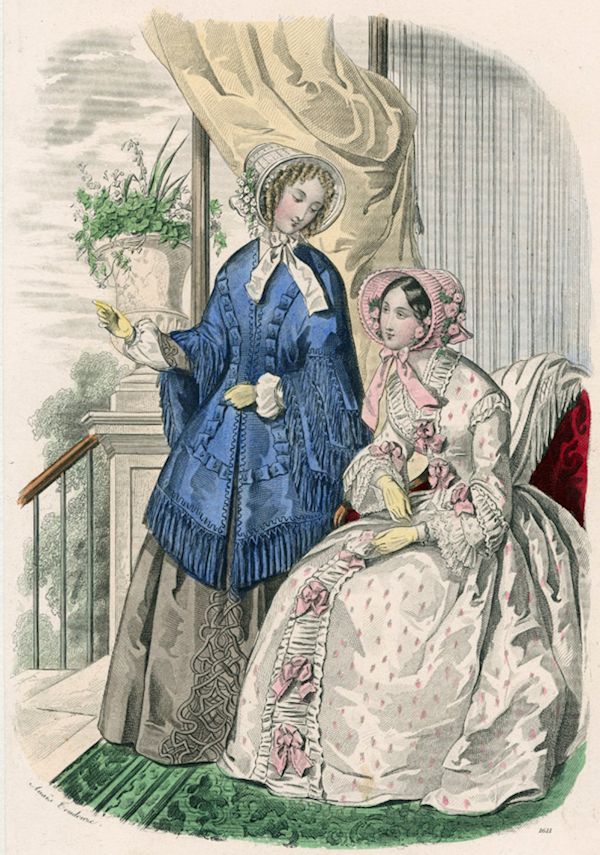
Anaïs Toudouze
LE FOLLET Paris, boult. St. Martin, 69.
Chapeaux Mlle Grafeton, r. de la Paix, 24—Fleurs de Chagot ainé, r. Richelieu, 73.
Pardessus de la maisn. St. Arnaud–Dentelles de Violard, r. Choiseul, 4.
The styles of Goods here represented can be had of Messrs. L. J. Levy & Co. Philadelphia
and at Stewart’s, New-York.
Graham’s Magazine, 134 Chestnut Street.
Transcriber’s Notes:
Archaic spellings and hyphenation have been retained as well as some spellings peculiar to Graham’s. Punctuation has been corrected without note. Other errors have been corrected as noted below. For illustrations, some caption text may be missing or incomplete due to condition of the originals used for preparation of the ebook.
page 202, and geologial descriptions ==> and geological descriptions
page 203, amidst the minosas ==> amidst the mimosas
page 204, when a bark ascending ==> when a barque ascending
page 212, conquest of of Shivas ==> conquest of Shivas
page 215, His bark stranding ==> His barque stranding
page 216, safe and and sound ==> safe and sound
page 225, there are Bachinalian ==> there are Bacchanalian
page 225, genii and faries ==> genii and fairies
page 226, within many degress ==> within many degrees
page 228, among the lowley ==> among the lowly
page 228, The hundreth psalm ==> The hundredth psalm
page 229, shame to doggrel ==> shame to doggerel
page 230, an argent bark ==> an argent barque
page 231, what commisseration he ==> what commiseration he
page 234, And now its ==> And now it’s
page 236, added: [To be continued.
page 239, laughed and teazed ==> laughed and teased
page 241, its splendid to be ==> it’s splendid to be
page 241, Blanch Forrester went ==> Blanche Forrester went
page 241, delicious Scottische ==> delicious Schottische
page 250, vaticanam Bodleianamgue ==> vaticanam Bodleianamque
page 250, Onicus est nobis ==> Unicus est nobis
page 253, As ambegris leaves ==> As ambergris leaves
page 258, fowl have the the power ==> fowl have the power
page 260, Pasiello, and other ==> Paisiello, and other
page 260, Old ’76 and Young ’47. ==> Old ’76 and Young ’48.
page 261, near the Piraus ==> near the Piræus
page 263, delight of themselvs ==> delight of themselves