THE GAME OF THE SEASON.
Reading edition
———
BY FRANK FORESTER.
———
BAY SNIPE SHOOTING.
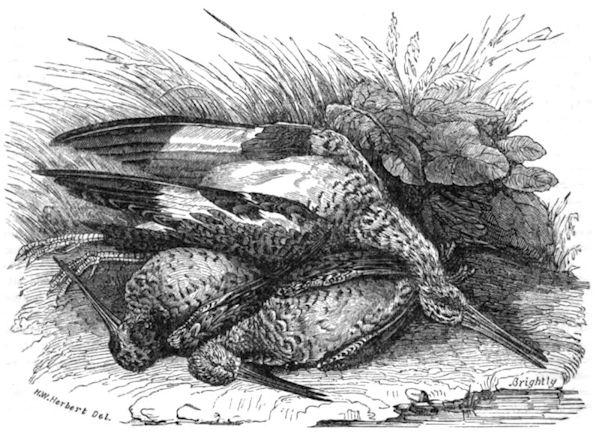
The Hudsonian Godwit. Limosa Hudsonica. Vulgo. Ring-tailed Marlin.
The Red-Breasted Snipe. Scolopax Noveboracensis. Vulgo. Robin-breast, Quail Snipe, Dowitcher.
Under the general, and very incorrect appellation of Bay Snipe, and sometimes of Plover, the sea-shore gunners, and city fowlers who accompany them for pleasure, are wont to include many totally distinct and different families of waders, each containing several varieties, and all, though in some sort connected, entirely dissimilar in characteristics, plumage, cry and flight, as well as in some peculiarities of habit.
Of these families, the most remarkable are the Curlew, numenius; the Godwit, limosa; the Sandpiper, tringa; the Tattler, totanus; the Plover, charadrius; the Snipe, scolopax; the Turnstone, strepsilas; the Sanderling, calidris; the Avoset, recurvirostra; and the Stilt, himantopus; all of which at some period of the year are visiters or temporary inhabitants of some portion of the Atlantic shores of North America, from the Bay of Boston to the Belize.
In the tepid waters of Florida, the great bay of Mobile, the sea lakes of Borgne and Pontchartrain, and all along the muddy shoals and alluvial flats of the lower Mississippi, these aquatic races dwell in myriads during the winter months, when the ice is thick even in the sea bays of the Delaware and Chesapeake, and when all the gushing streams and vocal rivulets of the Northern and Middle States, are bound in frozen silence. In the spring, according to the temperature of the season, from the middle of April until the end of May, these migratory tribes begin to visit us of the northern shores, from the Capes of the Chesapeake, along all the river estuaries, sea bars, lagoons, and land-locked bays, as they are incorrectly termed, of Maryland and Delaware, the Jersey shores and the Long Island waters, so far as to Boston Bay, beyond which the iron-bound and rugged nature of the coast deters them from adventuring, in the great flights with which they infest our more succulent alluvial shores and sea marshes.
With the end of May, with the exception only of a few loitering stragglers, wounded, perhaps, or wing-worn, which linger after the departure of their brethren, they have all departed, steering their way, unseen, at immense altitudes, through the trackless air, across the mighty continent, across the vast lakes of the north, across the unreclaimed and almost unknown hunting-grounds of the red man, to those remote and nearly inaccessible morasses of the Arctic Regions whither the foot of man has rarely penetrated, and where the silence of ages is interrupted only by the roll of the ocean surf, the thunderous crash of some falling iceberg, and the continuous clangor of the myriads and millions of aquatic fowl, which pass the period of reproduction in those lone and gloomy, but to them secure and delightful asylums. Early in the autumn, or, to speak more correctly, in the latter days of summer, the Bay birds begin to return in hordes innumerable, recruited by the young of the season, which, not having as yet indued the full plumage of their respective tribes, are often mistaken by sportsmen and gunners, unacquainted with the distinctions of natural history, for new species. During the autumn, they are much more settled and less restless in their habits than during the spring visit, when they are impelled northward by the irresistible æstrum, which at that period stimulates all the migratory birds, even those reared in confinement and caged from the nest, to get under way and travel, whither their wondrous instinct orders them, in order to the reproduction of their kind in the localities most genial and secure.
Throughout the months of August and September, they literally swarm on all our sand-bars, salt meadows, and wild sea marshes, feeding on the beaches and about the shallow pools left by the retiring tide, on the marine animalculæ, worms, aquatic insects, small crabs, minute shell-fish, and fry; after this time, commencing from the beginning of October, they move southward for winter quarters, although some species tarry later than others, and some loitering individuals of all the species linger behind, until they have assumed their winter garniture, when they are again liable to be mistaken for unknown varieties.
Of these misnamed Bay Snipe, the following are the species of each family most prized by the sportsman and the epicure, all of which are eagerly pursued by the gunner, finding a ready sale at all times, although, me judice, their flesh is for the most part so oily, rank and sedgy, that they are rather nauseous than delicate or palatable. Much, however, depends on the state of their condition, the nature of the food on which they have fattened, and localities in which they feed; and to some persons the very flavor, of which I complain as rank, sedgy and fishy, appears to take the guise of an agreeable haut gout.
The Red-breasted Sandpiper, Tringa Icelandica, known on the Long Island waters, among the small islets of which it is very abundant, as the “Robin Snipe,” by which name it is generally called, owing to the resemblance of its lower plumage to that of the Red-breasted Thrush, or Robin, Turdus migratorius, of this continent. In autumn this bird assumes a dusky gray upper, and white under, plumage, and is then termed the “White Robin Snipe.” In point of flesh it is one of the best of the Shore-birds. It is easily called down to the decoys by a well simulated whistle, and is consequently killed in great numbers.
The Red-backed Sandpiper, Tringa Alpina, generally known as the “Black-breasted Plover.” It is a restless, active and nimble bird, flies in dense bodies, whirling at a given signal; and at such times a single shot will frequently bring down many birds. In October it is usually very fat, and is considered excellent eating. In its autumnal plumage it is generally known to fowlers as the “Winter Snipe.”
The Pectoral Sandpiper, Tringa pectoralis. This is a much smaller, but really delicious species, particularly when killed on the upland meadows, which it frequents late in the spring and early in the summer, and on which I have killed it lying well to the dog, which will point it, while spring snipe shooting. On Long Island it is known as the “Meadow Snipe,” or “Short Neck;” on the Jersey shores, about Egg Harbor, where it sometimes lingers until the early part of November, it is called the “Fat Bird,” a title which it well merits; and in Pennsylvania, where it occurs frequently, is often termed the “Jack Snipe.” It is these blunders in nomenclature, and multiplication of local misnomers, which render all distinctions of sportsmanship so almost incomprehensible to the inhabitants of distant districts, and so perplexing to the youthful naturalist. During the autumn of 1849 I killed the Pectoral Sandpiper in great numbers, together with the American Golden Plover, Charadrius Marmoratus, and the Black-bellied Plover, Charadrius Helveticus, on the marshes of the Aux Canards river, near Amherstberg, in Canada West, in the month of September, and a month later at Montgomery’s Pool, between lakes Simcoe and Huron.
Of the Tattlers, three only are in repute as shore-birds, the best of the species, the Bartramian Tattler, Totanus Bartramius, better known as the “Upland Plover,” which is, in fact, with scarcely an exception, the most delicious of all our game-birds, being a purely upland and inland variety, and as such never, or but extremely seldom, shot on the coast.
These three are,
The Yellow-shanks Tattler, Totanus Flavipes, vulgo, “the lesser yellow legs”—a bird, in my opinion, of very indifferent qualifications for the table, but easily decoyed, and readily answering the fowler’s whistle, and therefore affording considerable sport.
The Telltale Tattler, Totanus Vociferus, vulgo, “greater yellow legs,” a less numerous species than the former, and more suspicious. Its flesh, when it feeds on the spawn of the king-crab, or “Horse-shoe,” is all but uneatable, but later in the season it is in better condition, and is esteemed good eating. A few are said to breed in New Jersey. In the neighborhood of Philadelphia, where these birds are shot in great numbers on the mud-flats of the Delaware from skiffs, with carefully concealed gunners, stealthily paddled down upon them till within close shooting distances, these birds are termed “Plovers,” and the pursuit of them plover shooting; of course wrongfully.
The last of this family is the Semipalmated Tattler, Totanus Semipalmatus, universally known as the “Willet,” from its harsh and shrill cry, constantly repeated during the breeding season, the last note of which is thought to bear some resemblance to that sound. It is a swift, rapid and easy flyer, and though rather shy when in exposed situations, can be allured to the decoys. When in good order the flesh of the Willet is very palatable, although not so greatly esteemed as its eggs, which really are delicious.
Next to these come the Godwits, two in number, known by the unmeaning title of Marlin.
The great Marbled Godwit, Limosa Fedoa, the “Marlin.” This bird, though not very abundant, is a regular visitant of the seashores and bays in the spring and autumn. It is very watchful, and will permit of no near approach, unless some of its fellows are killed or wounded, when it will hover over the cripples, with loud, shrill cries, affording an easy opportunity of getting several barrels in succession into the flock.
And the Hudsonian Godwit, Limosa Hudsonica, or the “Ring-tailed Marlin,” is a still rarer and smaller variety than the last, of very similar habits and of equal excellence in flesh. It is far more common in the Middle States than in the Eastern districts, and is abundant in the wild and barren lands far to the northward. I have seen it shot, likewise, on the swamps of the Aux Canards, to which I have already referred. This is the larger of the three birds, lying uppermost, in the group, at the head of this article; it was sketched from a fine specimen shot on the Delaware in the month of May. It is thus described by Giraud in his excellent work on the Birds of Long Island:
“Bill, blackish-brown, at base of lower mandible yellow; upper parts light-brown, marked with dull-brown, and a few small, white spots; neck all round brownish-gray; lower parts white, largely marked with ferruginous; basal part of tail-feathers and a band crossing the rump, white. Adult with the bill slender, blackish-brown toward the tip, lighter at the base, particularly at the base of the lower mandible; a line of brownish-white from the bill to the eye; lower eyelid white. Throat white, spotted with rust color; head and neck brownish-gray; lower parts white, marked with large spots of ferruginous; under tail coverts barred with brownish-black and ferruginous; tail brownish-black cast, a white band at the base; a band over the rump; tips of primary coverts and basis of quills white; upper tail-coverts brownish-black, their basis white; upper parts grayish-brown, scapulars marked with darker spots; feet bluish. Length fifteen inches and a half, wing eight and a half.”
Among the various families of birds, which are all known, as I have stated, by the general title of Bay Snipe, there is but one Snipe proper, and that is one of the most numerous, and perhaps the most excellent of the tribes.
The Redbreasted Snipe, Scolapax Noveboracensis—the “Dowitcher,” the “Quail Snipe,” the “Brown Back.”
A brace of these excellent and beautiful birds are depicted as thrown carelessly on the ground, under the neck of the Ring-tailed Marlin, in the preceding sketch.
This bird has the bill of the true snipe, Scolopax Americanus, excepting only that the knob at the tip of the upper mandible of the bill is less distinctly marked. The spring plumage of this bird, in which it is depicted above, is on the upper parts brownish-black, variegated with clove-brown, and light reddish-brown, the secondaries and wing-coverts tipped and edged with white. Lower parts bright orange colored ferruginous, spotted with dusky, arrow-headed spots. The abdomen paler. The tail-feathers and upper tail-coverts alternately barred with black and white; the legs and feet dull yellowish-green.
“At the close of April,” says Mr. Giraud, “the Redbreasted Snipe arrive on the coasts of Long Island. Invited by a bountiful supply of food, at the reflux of the tide, it resorts to the mud-flats and shoals to partake of the rich supply of shell-fish and insects which nature in her plenitude has provided for it. As the tide advances, it retires to the bog meadows, where it is seen probing the soft ground for worms. In the spring it remains with us but a short time. Soon after recruiting it obeys the unerring call of nature, and steers for the north, where it passes the season of reproduction. About the middle of July it returns with its young, and continues its visit during September, and if the season be open, lingers about its favorite feeding grounds until the last of the month.”
The specimens from which the above sketch is taken, were procured on the Delaware so late as the latter part of May; but it must be remembered that this spring, 1850, was unusually late and backward.
This snipe associates in large flocks, is very easily whistled, flies in dense and compact bodies over the decoys, and is so gentle that, after half the flock has been cut down by the volleys of the lurking gunner, the remainder will frequently alight, and walk about demurely among their dead companions and the illusive decoys, until the pieces are reloaded, and the survivors decimated by a fresh discharge.
Even when feeding on the open mud-flats, the Redbreasted Snipe is so tame as to allow itself to be approached by the sportsman, with little or no address, running about and feeding perfectly unsuspicious, until its enemy has come within short range, when it springs with its tremulous cry only to be riddled with the shot of the close discharge.
The other of these birds worthy of the most attention are,
The Sanderling, Calidris Arenaria, which, though very small, is fat and excellent.
The Black-bellied Plover, Charadrius Helveticus, “Bull-headed,” or “Beetle-headed Plover,” a shy bird, but frequently whistled within gunshot. On the coast it is apt to be fishy, but when shot inland, and on upland pastures, of superior quality.
The American Golden Plover, Charadrius Marmoratus, “the Frost bird;” a very beautiful species, and of rare excellence when killed on the upland, where it is found more frequently and more abundantly than on the shore.
The Long-billed Curlew, numenius Longirostris, “Sickle-bill,” a large, coarse-flavored bird, easily decoyed.
The Hudsonian Curlew, numenius Hudsonicus, “Short-billed Curlew,” or “Jack Curlew.” Similar to the latter in all respects, although smaller in size.
And last, The Esquimaux Curlew, numenius Borealis, “the Futes,” “the Doe Bird.” This bird feeds principally on the uplands, in company with the golden plovers, and on the same food, videlicet, grasshoppers, insects, seeds, worms, and berries. Its flesh is delicate and high flavored. It breeds far to the north, and winters far to the south of the United States, residing with us from early in August until late in November.
With this bird, although there are numerous other smaller species, the list of these tribes may be held complete.
From the commencement of the present month until late in the autumn, anywhere along the coasts and bays of the Northern and Middle States a bag may readily be filled to overflowing with these varieties by the aid of good decoys and skillful whistling, or of a skiff paddled by a cunning fowler; a gun of 8 to 10 pounds weight, of 12 gauge, with two oz. of No. 5 shot, and an equal measure of powder, will do the work. But when the work is done, comparatively the game is worthless, and the sport, as compared with upland shooting, scarcely worth the having.