A ROMANCE OF TRUE LOVE:
Reading edition
WITH FIDDLE ACCOMPANIMENT.
———
BY MRS. CAROLINE H. BUTLER.
———
Perched, like a large gray owl with folded wings, upon the summit of the very highest hill within a day’s journey from “our village,” but within half a mile of the old meeting-house, stands a narrow stone dwelling, with a narrow, pointed roof, narrow windows, or loop-holes, as they might be more properly termed, and one narrow door; the whole inclosed within a narrow yard, from which two slender poplars point their “tall columns to the skies.”
One would scarcely imagine from so unpromising an aspect that a heart-history could be gleaned from “lifting” that narrow roof. I must confess, too, that there is certainly very little romance in the appearance of the inmate whom it shelters—so gaunt and cadaverous—nearly as tall as the poplars, and with arms like the evolving sails of a windmill. Yet, as by searching there is gold to be found even amid the most rocky and unpromising defiles of California, so is there sterling mettle hid beneath the rough exterior of Apollos Dalrymple, and this having found I will disclose.
When I say that Apollos is the sole tenant of this owl-like habitation, I need not add that he belongs to the bachelor fraternity—but in justice to him I will say that he was not made a bachelor from any contempt or irreverence of the fair sex, but from “sweet love’s teen” having “loved not wisely, but too well.”
It is now many years since Apollos thus retired from the world. His hair is nearly silver white, and old age sits upon his shoulders, yet still he washes and mends his clothes, with his long, bony fingers knits his stockings, and cooks his own food from the little plat of vegetables behind the house—for Apollos is a Grahamite, as well as a Gray-eremite. I must retrace some twenty years in the life of Apollos, for the first record of the heart-history I have promised—I will even go still further back, and introduce him a “puling infant in the nurse’s arms.”
It was the misfortune of Apollos to be born with an ear—I mean an ear for music! Whether the euphonious name by which he was christened had any thing to do with the quaverings of his innocent cradle-dom I cannot say, but certain it is, his infantine warblings were loud and incessant—“prestissimo” and “fortissimo,” seldom allowing a “rest” either to himself or his poor worn-out mother. The period of infancy passed, Apollos was sent to school, where he was distinguished for the long drawn nasal tones in which he might be said to chant his lessons, and being moreover somewhat given to whistling and tuning up of jews-harps, the terrible ire of Schoolmaster Ferule vented itself in drawing long scales upon his tender flesh, to which Apollos composed the notes upon a high key.
As soon as he could read the tenth chapter of Nehemiah without drawing a long breath, his father made him ruler over countless heads of cattle, and set him to ploughing and planting, sowing and reaping the fertile acres which were one day to become his own. Even into the drudgery of the farm Apollos bore with him his musical mania, and while he sowed the seed and planted the corn it was all done to music, so that when the green grain burst through the ground there was no stiff regularity about it, but falling off into minims, crotchets, quavers and demi-semi-quavers, it swept through the broad fields like a living sheet of music, from which no doubt the little ground-sparrow and the glassy-winged grasshopper, learned many new variations.
Not “blest as the gods,” Apollos could strike no harp but the jews-harp, for his father had no music in his soul, though a very clever man, Shakspeare to the contrary, and would never allow his son to spend his earnings in cultivating so useless an art. The singing-school he tolerated, and there, in the long winter evenings, by the flickering light of tallow candles did Apollos luxuriate—also at all trainings, when “the spirit-stirring drum and ear-piercing fife” echoed through the streets, there was the tall, ungainly figure of Apollos to be seen, almost envying even the little fat drummer the powers of his rub-a-dub.
One day our musical hero purchased a cracked flute! How trilled his heart in joyful cadence as he held in his hand the precious bargain—with what ecstasy did he turn it over and over, and then, as soon as the cattle were foddered, and the shades of evening resting over the farm, he would nightly retire into the recesses of the forest, and there blow and puff, like Sam Weller’s “aggrawated glass-blower,” until his eyes almost started from their sockets—the rocks and trees to be sure kept their places in the firm earth, but the whip-po-wils and the owls peeped forth to listen, and more than once did he hear his notes re-echoed by some young, aspiring screech-owl.
The next musical adventure of Apollos was effected by exchanging a young and tender calf for a fiddle! Every muscle of his long arm, became as a separate fiddle-bow, giving forth such endless see-sawing and tweedle-dee-ing that every good wife in the neighborhood was tempted to complain of him as a nuisance, for waking up all the babies and disturbing them in their first sleep, for the strains of Apollos, like those of “sweet Philomela,” were only heard at night. But notwithstanding all this Apollos was a general favorite, for the spirit of harmony pervaded his bosom for all animate and inanimate objects—there was to him music in all created things. His heart was gentle—his hand ever ready to do a kindness, and therefore he was suffered to fiddle to his bent, little dreaming the anathemas which the deed, not the doer, nightly originated.
Side by side stood the cottages of Leonard Davis and Luther Howell, and side by side grew up the two lovely children Paul and Linda.
Neither Davis nor Howell were in good circumstances, although both owned the farms on which they lived; yet there was a great difference in the character of the two men, which in the end led to very different results. Leonard Davis was a thriftless, indolent man, who loved better to smoke his pipe under the tavern porch, and give forth his opinions upon the politics of the day, than to cultivate his land or keep his fences in order. Luther Howell, on the contrary, was a hard-working, industrious man. He loved money although he had but little of it—yet he resolved to have more; and upon the strength of that determination dug and delved away his days, almost begrudging even the Sabbath rest.
Linda was the youngest of his five children, all of which, to Mr. Howell’s great chagrin were daughters. Mr. Davis had but one child, little Paul, whose mother had died while he was but an infant, and Mrs. Howell feeling compassion for the motherless boy encouraged him to play with her children, so that by degrees the little fellow became nearly domesticated under the same roof with the five rosy-cheeked, happy little Howells. Paul was three years older than Linda, and was very proud of the confidence which Mrs. Howell reposed in his superior age and strength, by trusting to him the care of the little toddling girl, and repaid her confidence by deserving it. Linda soon became more fond of Paul than any one else, and Paul would at any time leave his play with the older girls, or throw down his bat and ball if he but heard the sweet voice of the little Linda calling his name. He would lead her into the woods, and with a natural love of the beautiful select a spot where the moss was the greenest and freshest, and where the golden sunlight quivering through the dense foliage danced in playful gambols around them—here he would carefully seat the little girl, and gather for her the pretty wild flowers which he found hid in the thick woods, or the bright scarlet berries peeping out from the dark, glossy leaves of the winter-green; and when the little Linda was old enough to go to school, Paul still enacted himself her champion and assistant.
Linda was ten years old when Mr. Howell received a letter from his brother, living in New York, offering to relieve him of a share of his burdens by adopting one of the five girls into his family. Imbued with the same money-getting spirit as his brother, Ansel Howell had left the village many years previous, to seek the fortune he was resolved upon amassing. He had been successful, and at the date of the letter which caused so much excitement in the humble residence of Luther, Ansel might be considered a rich man.
The offer was gladly accepted, and the question next arose which of the girls should go forth from the family hive. Prudence governed their decision. Bessie could spin her day’s work with any farmer’s daughter for miles around—Sophie was already capable of taking charge of the dairy, while Polly and Margaret not only could sew nearly as well as their mother, but could also make themselves useful in various ways about the house. Linda was of the least service in the domestic keep, and therefore the choice fell upon Linda, who was thus taken from her simple country pleasures, and from her dear friend Paul to a new home and new friends amid the ceaseless din of a city.
Luther Howell reaped the benefits of his industry. His farm throve—his stock increased—the old house was torn down, and a handsome, convenient two story dwelling erected on its site; and in the course of a few years Mr. Howell went as representative to the state legislature, and was reckoned one of the most substantial men in the village. But just in proportion as things had prospered with Howell had they gone adverse with his neighbor Davis, and about the time when the new tenement of the former was being raised amid the loud cheers of the workmen, the sheriff seized upon both house and land of the latter, and that being insufficient to meet his debts, for “the want thereof they took the body”—at that time imprisonment for debt was no uncommon thing. If Davis had not been so perfectly thriftless, in all humanity his townsmen would have bailed him out, but the fact is, it was pretty generally conceded that he might just as well smoke in jail as elsewhere—pipes and tobacco therefore were freely contributed, and in the course of a few months poor Leonard Davis evaporated—his soul taking flight in a whiff of tobacco smoke!
Before the affairs of his father became so desperate, Paul had worked his way to New York, and apprenticed himself in a large printing-office, trusting with all the confidence of youth that he should return ere many years to his native village, free his father from the shackles of debt, and perhaps set up an establishment of his own. Another and a brighter vision might have mingled with these day dreams, of which we may learn more hereafter.
Paul knew that his little friend Linda lived in the same city with him, and after a long search he was at length enabled to discover the dwelling which sheltered the pet flower of his boyhood. But there was such an atmosphere of grandeur around her now, that poor Paul had not courage to penetrate further, so for several weeks he contented himself with hovering around the house in the evening and on Sundays, hoping at least to obtain a glimpse of the little girl.
At length one day he met Linda with her governess. It was his own Linda—yet how changed! What a lovely young face! what grace—what innocence! and then how tall! Paul forgot that years mark their flight—he looked for the child, and he found a beautifully formed maiden of fifteen!
Ah, he dared not address her! he cast his eyes upon the ground and stood still for Linda to pass! and then as her little foot twinkled upon the pavement close to him, and her robe brushed his coarse garments, he involuntarily looked up. Linda turned her large hazel eye upon him. She started—a rosy blush mantled her sweet face! It seemed to the maiden that she was strangely transported back to the green grassy meadow and the play-grounds of her infancy! Again she looked at Paul:
“Linda!” he softly whispered.
“Paul!” responded the heart and the lips of Linda; and with all the innocence and gladness of a child she threw her arms around his neck, and pressed a kiss upon his sun-burned cheek!
Ah that kiss—happy, happy Paul!
But here Miss Lofty interposed. It was scandalous—kissing a young man in the street—good gracious, who ever heard of such a thing—a fellow, too, in a green jacket—monstrous!
“Why, dear Miss Lofty, it is Paul—only Paul!” cried Linda, earnestly; “how many times I have told you about my dear, dear Paul!” and then turning her back upon the horrified spinster, with her little hand clasped tightly in his, she begged of him again and again, to come and see her.
“Yes, you can call on Miss Howell, young man, if you please, but you must not stand here any longer, Miss Linda; I am really shocked at your want of delicacy. I can hardly answer to your aunt for such strange doings!” and so saying, Miss Lofty led off her young charge.
As Linda disappeared sunshine and daylight faded from the heart of poor Paul.
He felt there was now an immeasurable gulf between him and her; and, after all, why was it that he came to so sorrowful a conclusion? Was it because, as Miss Lofty had said, he wore a green jacket, and worked with his hands, while Linda sat in her delicate robes of muslin or silk, and with slender fingers wrought at her embroidery-frame, or airily swept the piano. Ah, Paul, be brave! Let not your heart fail you at mere external or worldly distinctions.
He called to see Linda. It was shortly after this first interview; she had become restrained, and her aunt sat stately in the room, and without being rude, yet was her manner so little removed from it, that Paul never went again. For two or three years Linda heard no more of the playmate and friend of her early childhood. But Paul saw her when she little dreamed what fond eyes were watching her! He saw her graceful, beautiful, and accomplished; and although he dared not whisper a hope that she might one day be his, he resolved to improve his mind by study and application, that he might at least raise himself above her contempt; and so, by the midnight lamp, the poor fellow went to work, and for two years every leisure moment was spent in study, and every penny he could save, employed in procuring books for his thirsting mind. His perseverance did not go unrewarded; his employer soon took note of his talents, and Paul became assistant editor of a popular weekly journal.
By some unforeseen calamity, Ansel Howell became a poor man, and Linda returned to her father’s roof.
Eight years previous her parents had gladly parted with her, and they now as gladly welcomed her back; her sisters were all married, and the old people quite alone, so that her presence was as the light of morning to their lonely fireside. Her city life had by no means spoiled Linda for the pleasures of the country; she felt like a bird who, after being caged a weary time, is suddenly permitted to flit at freedom amid its native bowers.
Linda retained a vivid impression of the early scenes of her childhood, and as she again revisited each nook and dell, the remembrance of her kind friend, Paul, also came back to her, and the present seemed incomplete without him whose tender care and ever ready invention to amuse her waywardness, had cast such brightness over the days of infancy. Where was he now? Had he forgotten her? She thought of him as she had seen him when he so suddenly appeared before her—those deep, tender eyes, regarding her with so much respect and affection; and then, when admitted into the stately dwelling of her uncle, he had come forward so modestly, yet with so much self-respect to greet her, and her heart reproached her, that, through fear of her aunt’s displeasure, she had, perhaps, treated him coldly.
“But, dear Paul, I am sure I did not mean to be unkind!” she mentally exclaimed.
Ah, if Paul, as he sat in his office in that narrow, confined street, bending so diligently over his desk, in the sultry breath of the city, could have known the thoughts of the fair girl, as she strolled through the summer woods, what rapture would have thrilled his bosom, and how would the dull atmosphere in which he toiled have become irradiate in the light of love and happiness.
Has the reader forgotten Apollos—the Apollo—the Paganini, whose witched fiddle-bow made both echoes and babies shriek in concert?
It chanced one evening that Apollos, out of resin, set forth for the village to supply that dire necessity. Whistling he went, when suddenly there were borne to his ear strains of most ravishing sweetness, now softly swelling on the evening breeze—now fainter and fainter dying away until even silence seemed musical, and then again bursting forth so free and joyous, that the very air around him vibrated with melody.
Spell bound stood Apollos. The doors of his great ears swung back to welcome in the harmony, and his mouth, too, opened as if to swallow it. Then, led on as it were by invisible spirits, his feet followed the bewitching sounds, and planted themselves under the large button-ball tree which stood near the window where Linda was thus unconsciously drawing both soul and body of Apollos magnetically unto her.
Conceive his perfect rapture as thus, so near the centre of attraction, the sweet strains encompassed him about. They ceased, and then to the window, still warbling, the young girl came, and leaning from the casement, stretched forth her little white hand, and began plucking the leaves from the very tree whose shadowing branches waved around the head of Apollos.
A sweet face becomes almost as the face of an angel, when seen in the calm moonlight; and as Linda stood there, her large, brown eyes, looking out into the holy night, her high, pure forehead clasped in the glossy braids of her dark hair, and her light, graceful figure folded in a snowy robe, no wonder she seemed to Apollos too pure, too beautiful, for a being of earth’s mould. But while he gazed and gazed, she turned away, and with her took the heart of Apollos. Again seating herself at the piano, Linda ran her fingers over the keys with the lightness of a bird upon the wing, and one of Beethoven’s exquisite sonatas awoke to life under her touch.
Poor Apollos! No volition had he of his own—he went whither the fates impelled him. Step by step did he approach the open casement, and as some poor bird is drawn, little by little, into the very mouth of its fascinating destroyer, even so was Apollos drawn head and shoulders into the window. The moon beams danced around him, as if enjoying the mischief they were about to disclose, and gleamed coldly but steadily upon him, his elbows resting on the sill, and his long legs, curved outward, like those of a grasshopper. At last, rising from the instrument, Linda closed it, and was about to approach the window, when the strange apparition of Apollos glared upon her. With a loud shriek she rushed from the room; as for Apollos, he bounded away like a madman—
“Swift on the right—swift on the left,
Sweeps every scene asunder—
Heaths, meadows, fields—how swift their flight,
And now the bridges thunder!”
That night Apollos Dalrymple was convicted of having seen a ghost.
And now, from that eventful evening, Cupid ensconced himself within the virgin heart of Apollos, and there the little rascal sat perched upon a hill of ancient ballads, delighted with the mischief he was doing, and every now and then beating up such a rub-a-dub as well-nigh drove poor Apollos distracted. For here were garnered up stores of the dainty food which the poets have appropriated exclusively to the little god—not, to be sure, the fastidious fare of a modern amateur, supping only on the tongues of Italian or Swedish nightingales, but the good, substantial fare our forefathers loved.
By the death of his father all those goodly acres had descended to Apollos; but this year the farm proved a losing concern, for the sheep died from starvation—the cattle from over-feeding—the hoe cut down both corn and weed—the grass luxuriated in freedom from the scythe, and the grain from the sickle, until both were over-ripe. The people all thought Apollos bewitched, and bewitched he certainly was. Even the fiddle was suffered to be mute, unless when seizing it with sudden furor he would strive to repeat some note which the voice of Linda had fastened upon his memory, but as sure as he did so, her image appeared at his working elbow, and Cupid, with a jog, jumped astride the fiddle-bow.
There was a beautiful simplicity in the heart of Apollos—an almost maidenly delicacy. He shrunk from intruding upon the fair object of his thoughts, never once did he speak with her, or seek to claim her acquaintance. She was to him something too divine to approach, and he worshiped her at a distance—a star whose beams blended with the music of his soul. There was no vanity hid away in his brain; he saw himself as others saw him—a rough, ungainly figure, without comeliness or proportion, and the more did he strive to cultivate those inward graces by which even his ugliness was made to be forgotten.
How little did Linda dream, as she sometimes passed him in her walks, what a great heart throbbed for her, and would have poured out its life-blood in her service.
The summer following Paul Davis revisited his birth-place, and for the first time for many years he and Linda met again. In form and feature both were changed—but in both the heart remained the same, and the same affinity which had in childhood bound them, now by a closer and dearer tie united them.
But Mr. Howell’s other four daughters had all married rich men; and as Linda was the fairest and most accomplished, he had planned for her a match which might be considered brilliant. When, therefore, Paul asked for her hand, it was refused with the contempt of one who feels that riches, not affection and kindness make up the summum bonum of life’s happiness, and with whom the weight of the purse out-balances the weight of both head and heart. And then Pride, too, put in her voice—what, his daughter marry the son of Leonard Davis, who died in a jail! To be sure, he understood that Paul was doing a very good business in the editorial line; but then a mere editor—a drudge for the public—bah!
And so Paul was scornfully dismissed, and returned to the city, yet bearing with him the sworn faith of her he loved.
Smiles faded from the cheek of Linda, and her voice now seldom sent its glad notes to cheer the heart of Apollos. He saw she was pale, and that her step was listless. He felt she was unhappy, and now, in addition to his own grief, he bore about with him the pain of knowing that she, too, had sorrows which he could not heal. He would have had her so happy. Around her path only thornless roses should have clustered, and how gladly would he have shielded her from all the storms of life.
Ah, poor Apollos! if it could have been; if, like the great branches of the oak which shelter the timid daisy from sun and rain, those great arms of thine would have enfolded this little flower—then, indeed, would thy big soul have leaped with gladness.
Months passed on.
Paul worked at his desk patiently, and hoping that by some favor of fortune he might yet claim the hand of Linda.
About this time the proprietor of the establishment in which he was employed, desirous of making a change in his business, offered to sell out at a price very advantageous for the purchaser. Paul would gladly have availed himself of this opportunity, but his means were insufficient, and he knew of no person of whom he could solicit the required sum. While the sale was pending Paul again visited the village, not with any idea of a second time subjecting himself to the rudeness of Mr. Howell by a further request for the hand of his daughter. He went, therefore, as on ardent lover may be supposed to go, impelled by a desire of seeing again the object of his affection, and of hearing from her dear lips a renewed assurance of her truth.
Now it chanced that the very afternoon of his arrival, Apollos strolled forth in somewhat melancholy mood, and took a path leading through a thick grove bordering upon his farm. It was one of those cold, gloomy days in March, when not a bud or a leaf has as yet betokened the grateful advent of spring. Little patches of ice and snow still clung around the decaying leaves, frozen into black heaps where the autumn winds had gathered in their many dead; the wind rattled the naked branches of the trees in the dull, chill atmosphere; flights of crows flew low with their dismal croak, and the squirrel now and then looked out timidly from the old brown trunks, as if to note the aspect of the weather, and feeling the biting wind upon his nose, turned nimbly back to his hole again. It was through these gloomy woods, therefore, that Apollos bent his way, and had nearly cleared the grove, when his reveries were suddenly interrupted by hearing the sound of voices from a thick cluster of young pines, whose green, spiral branches gave relief to the brown aspect of the surrounding trees. He recognized at once the accents of Linda; there was sadness in them, and he involuntarily paused, not with any intention of becoming a listener from curiosity, but only to drink in her beloved tones. His next impulse was to retreat softly; but the words which her companion spoke arrested his attention anew, and so he stood irresolute, anxious to learn more, and yet unwilling to steal thus into the secrets of the young pair.
“Well, dearest Linda, we must be patient and hopeful,” said Paul. “The assurance of your love will inspire me with fresh ardor in this struggle with fortune, and in the end, Linda, I am sure to come off conqueror. I wish not to reproach your father, but I flattered myself that wealth would not have been so great a consideration with him, and that as he has known me from my childhood, he would have preferred an honest, truthful heart, and the happiness of his child to the glitter of gold.”
“I hoped so, too, dear Paul; perhaps he will yet alter his determination; let us hope for the best,” answered Linda.
“A few thousand dollars would at this moment place me in a situation to demand your hand a second time, dear Linda,” continued Paul. “Mr. Neeland wishes to dispose of his establishment, and offers it at so reasonable an estimate that I would gladly become a purchaser if I had but the means—this, Linda, would remove the scruples of your father, and crown our happiness!”
“True, dear Paul. Ah! would that some kind friend might assist you. You have friends, I am sure—are there none of whom you can ask this favor?” said Linda.
“No—it is a kindness I do not feel authorised to ask from any one—it would involve me at once in obligations which I might not be able to fulfill—no, dearest Linda, I must toil on a few more years, and if my labors are followed with the same success which has heretofore crowned them, I shall have earned, even in your father’s estimation, the rich reward I would fain this moment call my own,” replied Paul.
Loving Linda as he did so faithfully, it was impossible that Apollos could listen to this conversation without a struggle between envy and the natural kindness of his heart. It is true, he knew before that his love was hopeless—that the young and fair object of his adoration could be no more to him than the distant planet shining so gloriously in the glittering dome of the heavens—but here stood one possessing that priceless gift, her heart, one on whom her first pure affections were bestowed—ah, poor Apollos—it was not in human nature to resist the workings of jealousy and envy—great drops of anguish stood on his pale brow, and he almost groaned aloud! Then better and nobler feelings stirred his bosom—he gave way to their healthful promptings, and a load seemed lifted from his breast.
Paul parted with Linda at her father’s gate and went home to his lodgings, where he had not been long seated, when an ill-written, almost illegible note was handed him. It was from Apollos Dalrymple, requesting earnestly to see him before he should leave the village.
“Some old debt, doubtless, of my poor father’s, which I am required to pay,” thought Paul. “Well, I will go and see him, and if in my power it shall be canceled.”
As he drew near the dwelling of Apollos, the strains of the fiddle seemed to welcome him on, and knocking at the door it was opened by the owner himself—his great chin holding firm to his breast the neck of the instrument, and his hand wielding the bow. Walking before him into a small back room, he made signs for him to be seated, and then taking up the air where the summons of Paul had interrupted it, he played it deliberately through!
Paul thought this proceeding very rude, to say the least of it—but if he could have read the heart of Apollos, he would have seen that he was only striving to lull into peace by the soothing powers of melody those rebellious and evil passions which the sight of his happier rival called forth.
At length, carefully hanging up the fiddle on a peg at his right hand, Apollos opened a small drawer, and taking out a pocket-book, put it into the hand of his astonished visiter.
“I reckon there is just two thousand dollars there—it is yours,” he said, bluntly. “I guess you’ll make a pretty straight bargain with that man that wants to sell out.”
Paul sat speechless with surprise at finding his affairs thus known to the strange man before him. Apollos arose, went to the window, and began to whistle, then added in a husky voice,
“I reckon old Howell wont object any longer; so you can—can marry—Linda!” and with another vociferous whistle, he again sat down.
By this time Paul, somewhat recovered from his first amazement, said, as he handed back the pocket-book,
“But, my dear sir, I cannot accept of your bounty I may never be able to repay you—”
“Put up the money, I say, put it up—it is yours,” interrupted Apollos; “I—I—overheard your talk with Linda, this afternoon—so you see I know all about you.”
“But why this interest for a stranger, Mr. Dalrymple—how can I ever repay—”
“Be kind to her—to Linda—that’s all the pay I want!” hastily interposed Apollos. “And you see, Paul, if you want any further help to get along, I conclude you are bound to come to me.”
Again Paul attempted to be heard.
“At least suffer me to explain my affairs to you, that you may know better the man upon whom your kindness has so liberally fallen.”
“I reckon I know you; you’re an honest, good lad—and—and Linda loves you—you need not say a word.”
And, indeed, had Paul been gifted with the eloquence of an Adams or a Webster, Apollos would not have listened to him, for no sooner did he see the money safe in the pocket of the young man, than he coolly arose, put on his hat, and taking his violin, walked out of the house; so Paul had no alternative than to do the same, yet leaving upon the table an acknowledgment of his gratitude, written with a pencil on the back of an old letter.
The next week three topics of interest were going the rounds of the village, and arousing the curiosity and wonder of its inhabitants.
The first was, that the son of Leonard Davis had become the sole proprietor of one of the largest printing offices in the city of New York—who would have thought it!
The second item was, that Apollos Dalrymple had offered his fine farm for sale—what could it mean?
The third and most wonderful was, that the said Apollos commenced building the identical narrow stone-house on the top of the hill—was the man bewitched, or going to be married!
In the course of the summer Paul again solicited the hand of Linda, which was no longer refused him—
“For money has a power above
The stars, and fate, to manage love.”
But Apollos refused to be present at the happy event which his noble kindness had so materially assisted to bring about; and little did either of them surmise the generous devotion which had called it forth.
As soon as his solitary dwelling was completed, Apollos, taking with him a few goods and chattels, removed thereto. And there he still abides with peace in his heart, and “good-will to all men.”
He admits no visiters—yet is his bounty never the less; for, like some forest rill, which has its source hidden among the rocks, yet whose presence revivifies and fertilizes all around it, so do the streams of his bounty, flowing silently and unobtrusively, gladden and refresh the hearts of the weary and destitute. He never goes out, except on the Sabbath, upon whose sacred services he is a constant attendant, and may always be seen in his suit of homespun gray, standing erect near the choir, and beating time with his long, bony hand, to the music of the psalms.
Upon the calm summer evenings, the notes of his violin are borne on the gentle breeze to the ears of the villagers, and as the plough-boy hies him to his task, with the early up-rising of the lark, he hears the morning hymn of the forest choristers, accompanied in their notes of praise by the music of Apollos’ violin.
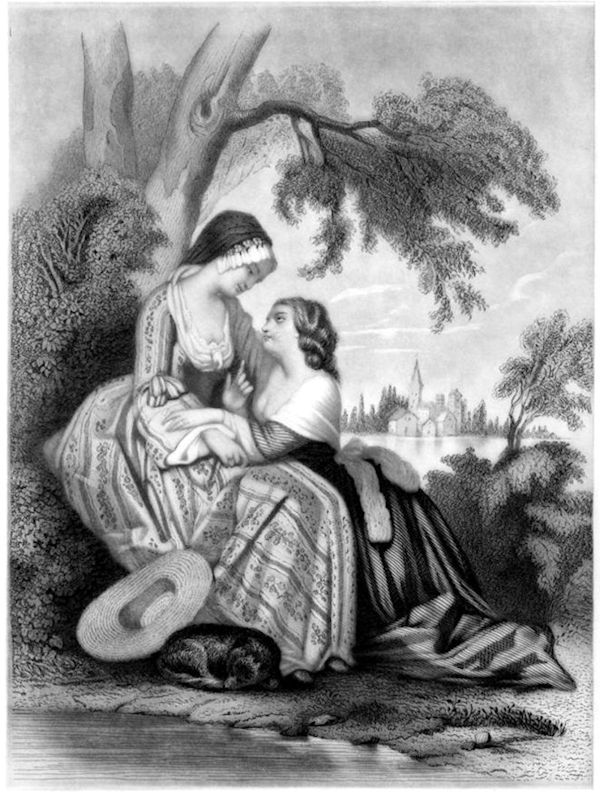
Painted by Compte Calix THE SISTERS. Engraved by T. B. Welch expressly for Graham’s Magazine