WOODCOCK AND WOODCOCK SHOOTING.
Reading edition
———
BY FRANK FORESTER.
———
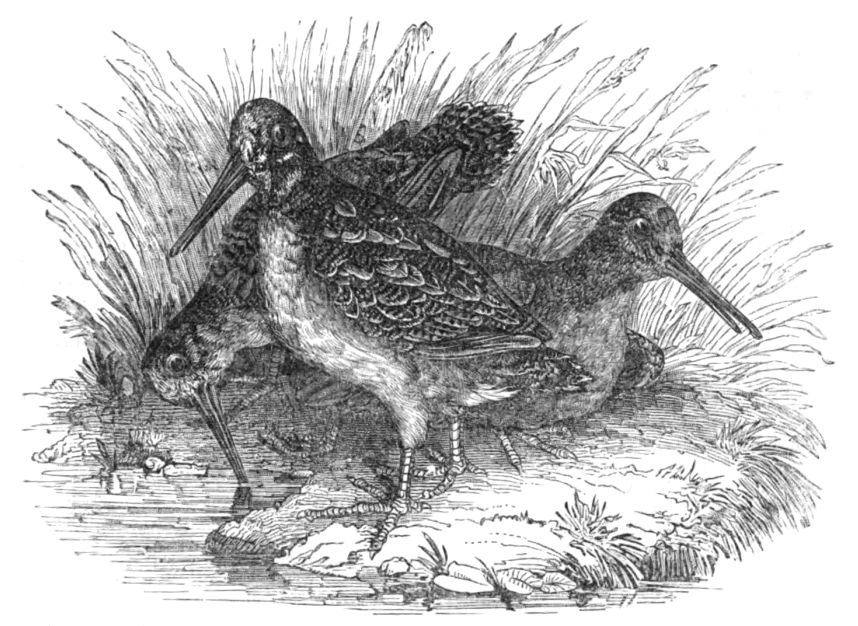
The American Woodcock, Scolopax minor, or, as it has been subdistinguished by some naturalists, from the peculiar form of its short, rounded wing, the fourth and fifth quills of which are the longest, Microptera Americana, is, as the latter title indicates, exclusively confined to this hemisphere and continent. It is much smaller than its European namesake, being very rarely killed exceeding eight or nine ounces in weight, and sixteen inches in extent from tip to tip of the expanded wings; whereas the European cock averages full twelve ounces, being often found up to fifteen, and measures twenty-five or twenty-six inches.
In general appearance and color they bear a considerable affinity each to the other; the upper plumage of both being beautifully variegated, like the finest tortoise-shell, with wavy black lines on a rich brown ground, mottled in places with bright fawn color and ash-gray; but the breast and belly of the American bird are of a deep fulvous yellow, darkest on upper part and fading to a yellowish white at the vent, while its European congener has all the lower parts of a dull cream color, barred with faint dusky waved lines, like the breast feathers of some of the falcons.
It has generally been believed that the large cock of the Eastern continent is never found in America; and all analogy would go to strengthen that belief, for neither of the birds range on their respective continents very far to the northward, whereas it is those species only which extend into the Arctic regions, and by no means all of them, that are common to the two hemispheres. Some circumstances have, however, come recently to my knowledge which lead me to doubt whether the large woodcock of the Eastern hemisphere does not occasionally find its way to this continent, although it is difficult to conceive how it should do so, since it must necessarily wing its way across the whole width of the Atlantic, from the shores of Ireland or the Azores, which are, so far as is ascertained, its extreme western limit.
A very good English sportsman resident in Philadelphia, who is perfectly familiar with both the species and their distinctions, assures me that during the past winter a friend brought for his inspection an undoubted English woodcock, which he had purchased in the market; it weighed twelve ounces, measured twenty-five inches from wing to wing, and had the cream-colored barred breast which I have described. The keeper of the stall at which this bird was purchased did not know where it had been killed, but averred that several birds had previously been in his possession, precisely similar to this in every respect. It is not a little remarkable that the same gentleman who saw this bird, and unhesitatingly pronounced it an European cock, was informed by a sporting friend that he had seen in Susquehanna county a cock, which he was satisfied must have measured twenty-five inches in extent, but which he unfortunately missed. There is likewise, at this time, in the city a skull and bill of a woodcock of very unusual dimensions, of which I am promised a sight, and which, from the description, I am well nigh convinced is of the European species.
It is possible that these birds may have been brought over and kept in confinement, and subsequently escaped, and so become naturalized in America; and yet it is difficult to conceive that persons should have taken the trouble of preserving so stupid and uninteresting a bird as the woodcock in a cage, unless for the purpose of transporting them from one country to another in order to the introduction of new species.
This might be done very easily with regard to some species, and with undoubted success; and it has greatly surprised me that it has never been attempted with regard to our American woodcock, which might unquestionably be naturalized in England with the greatest facility; where it would, I have no doubt, multiply extraordinarily, and become one of the most numerous and valuable species of game, as the mildness of the winters in ordinary seasons would permit the bird to remain perennially in the island, without resorting to migration in order to obtain food.
The woodcock and snipe can both be very readily domesticated, and can be easily induced to feed on bread and milk reduced to the consistency of pulp, of which they ultimately become extremely fond. This is done at first by throwing a few small red worms into the bread and milk, for which the birds bore and bill, as if it were in their natural muddy soil.
In all countries in which any species of the woodcock is found, it is a bird essentially of moderate climates, abhorring and shunning all extremes of temperature, whether of heat or of cold.
With us, it winters in the Southern States from Virginia, in parts of which, I believe, it is found at all seasons of the year, through the Carolinas, Georgia and Florida to Louisiana and Mississippi, in the almost impenetrable cane-brakes and deep morasses of which it finds a secure retreat and abundance of its favorite food, during the inclement season, which binds up every stream and boggy swamp of the Middle and New England States in icy fetters.
So soon, however, as the first indications of spring commence, in those regions of almost tropical heat, the woodcock wings its way with the unerring certainty of instinct which guides him back, as surely as the magnet points to the pole, to the very wood and the very brake of the wood in which he was hatched, and commences the duties of nidification.
I am inclined to believe that the woodcock are already paired when they come on to the northward; if not, they do so without the slightest delay, for they unquestionably begin to lay within a week or two after their arrival, sometimes even before the snow has melted from the upland. Sometimes they have been known to lay so early as February, but March and the beginning of April are their more general season. Their nest is very inartificially made of dry leaves and stalks of grass. The female lays from four to five eggs, about an inch and a half long, by an inch in diameter, of a dull clay color, marked with a few blotches of dark brown interspersed with splashes of faint purple. It is a little doubtful whether the woodcock does or does not rear a second brood of young, unless the first hatching is destroyed, as is very frequently the case, by spring floods, which are very fatal to them. In this case, they do unquestionably breed a second time, for I have myself found the young birds, skulking about like young mice in the long grass, unable to fly, and covered with short blackish down, the most uncouth and comical-looking little wretches imaginable, during early July shooting; but it is on the whole my opinion that, at least on early seasons, they generally raise two broods; and this, among others, is one cause of my very strong desire to see summer woodcock shooting entirely abolished.
Unless this is done, I am convinced beyond doubt, that before twenty years have elapsed the woodcock will be as rare an animal as a wolf between the great lakes and the Atlantic sea-board, so ruthlessly are they persecuted and hunted down by pot-hunters and poachers, for the benefit of restaurateurs and of the lazy, greedy cockneys who support them. There is, however, I fear little hope of any legislative enactment toward this highly desirable end; for too many even of those who call themselves, and who ought to be, true sportsmen, are selfish and obstinate on this point, and the name of the pot-hunters is veritably legion. Moreover, it is to be doubted whether, even if such a statute were added to our game-laws, it could be enforced; so vehemently opposed do all the rural classes, who ought to be the best friends of the game, show themselves on all occasions to any attempt toward preserving them, partly from a mistaken idea that game-laws are of feudal origin and of aristocratic tendency; and so averse are they to enforce the penalties of the law on offenders, from a servile apprehension of giving offense to their neighbors.
At present, in almost all the States of which the woodcock is a summer visitant, either by law or by prescription July is the month appropriated to the commencement of their slaughter; in New York the first is the day, in New Jersey the fifth, and in all the Middle States, with the single exception of Delaware, where it is deferred until August, some day of the same month is fixed as the termination of close time. Even in Delaware the exception is rendered nugatory, by a provision permitting every person to shoot on his own grounds, whether in or out of season, in consequence of which the birds are all killed off early in June.
It may now be set down almost as a rule, that in all the Atlantic seaboard counties, and, indeed, every where in the vicinity of the large cities and great thoroughfares, the whole of the summer hatching is killed off before the end of July, with the exception of a few scattered stragglers, which have escaped pursuit in some impenetrable brake or oozy quagmire which defies the foot of the sportsman; that few survive to moult, and that the diminished numbers, which we now find on our autumn shooting-grounds, are supplied exclusively by the northern and Canadian broods, which keep successively flying before the advancing cold of winter, and sojourning among us for a longer or a shorter period, ere they wing their way to the rice-fields of the Savannah, or the cane-brakes of the Mississippi.
If my method could be generally adopted, of letting the fifteenth day of September, after the moulting season is passed, and when the birds are beginning again to congregate on their favorite feeding-grounds, be the commencement of every sort of upland shooting, without any exception, the sport would be enormous; the birds at that season are in full vigor, in complete plumage, in the perfection of condition for the table, and are so strong on the wing, so active and so swift, that no one could for a moment imagine them to be the same with the miserable, puny, half-fledged younglings, which any bungling boy can butcher as he pleases, with the most miserable apparatus, and without almost as well as with a dog, during the dog-days of July.
The weather is, moreover, cool and pleasant, and in every way well-suited to the sport at this season; dogs have a chance to do their work handsomely and well, and the sportsman can do his work, too, as he ought to do it, like a man, walking at his proper rate, unmolested by mosquitoes, and without feeling the salt perspiration streaming into his eyes, until he can hardly brook the pain.
But no such hope existing as that state legislatures, dependent, not on rational but on brute opinion, should condescend to hear or listen to common sense, on matters such as game laws, are we, or are we not, to abandon our plan, to sacrifice our knowledge and enlightened views on this subject to obstinate ignorance; or shall we not take the better part, and decide, according to Minerva’s lesson in Tennyson’s magnificent Ænone,
. . . For that right is right to follow right
Where wisdom is the scorn of consequence.
We shall resist and persist; at least I shall—I, Frank Forester, who never in my life have killed a bird out of season intentionally, and who never will—who am compelled by sham sportsmen, cockney and pot-gunners to shoot woodcock in July; who have been invited, times out and over again, to shoot cock on men’s own ground, and therefore within the letter of the law, in New Jersey, Pennsylvania, Delaware, and Maryland, before the season; who have ever refused to take the advantages, which every one takes over me; and who still intend to persist, though not to hope, that there may be sense enough, if not integrity, among the legislatures of the free states, to prevent the destruction of all game within their several jurisdictions.
As the thing stands—and by the thing I mean the law—woodcock are to be shot on or about the first day of July; and if, dear reader, you try to shoot any where within fifty miles of New York, or twenty-five of Philadelphia, much later than the tenth of June, I am inclined to think that you will find wonderfully little sport; before the season, do not fire a shot, if you will take my advice, if poachers will violate the law, and the law will not enforce itself against poachers, abstain from becoming a poacher yourself, and do not shoot before the season fairly commences.
At this period of the year woodcock are almost invariably found in the lowlands; sometimes, as, for instance, at Salem, in New Jersey, and many other similar localities along the low and level shores of the Delaware, in the wide, open meadows, where there is not a bush or brake to be seen for miles; but more generally in low, swampy woods, particularly in maple woods, which have an undergrowth of alder; along the margin of oozy streamlets, creeping through moist meadows, among willow thickets; and in wet pastures trampled by cattle, and set here and there with little brakes, which afford them shade and shelter during the heat of the day.
Of the latter description is the ground, once so famous for its summer cock-shooting, known as “the drowned lands,” in Orange County, New York, extending for miles and miles along the margins of the Wallkill and its tributaries, the Black Creek, the Quaker Creek, and the beautiful Wawayanda. Many a day of glorious sport have I had on those sweet level meadows, enjoyed with friends long since dispersed and scattered, some dead, untimely, some in far distant lands, some false, and some forgetful, and thou, true-hearted, honest, merry, brave, Tom Draw; thou whilom king of hosts and emperor of sportsmen, thou, saddest fate of all, smitten, or ere thy prime was passed away, by the most fearful visitation that awaits mankind—the awful doom of blindness! never again shall I draw trigger on those once loved levels—the rail-road now thunders and whistles close beside them, and every man and boy and fool, now sports his fowling-piece; and not a woodcock on the meadows but, after running the gauntlet of a hundred shots, a hundred volleys, is consigned to the care of some conductor, by him to be delivered to Delmonico or Florence, for the benefit of fat, greasy merchant-princes; and if it were not so, if birds, swarmed as of yore in every reedy slank, by every alder-brake, in every willow tuft, the ground is haunted by too many recollections, rife with too many thick-succeeding memories to render it a fitting place, to me at least, for pleasurable or gay pursuits.
But, as I have said before, summer cock-shooting on the Drowned Lands of Orange County, is among the things that have been—one of the stars that has set, never to be relumed, in the nineteenth century; and the glory of “the Warwick Woodlands” has departed.
In Connecticut, in some parts, there is very good summer cock-shooting yet; and also in many places in the neighborhood of Philadelphia, in the rich alluvial levels around the Delaware, the Schuylkill, and their tributary rivers; but the sportsman, who really thirsts for fine shooting—shooting such as it does the heart good to hear of—must mount the iron-horse, whose breath is the hissing steam, and away, fleeter even than the wings of the morning, for Michigan and Illinois and Indiana, for the willow-brakes of Alganac, and the rice-marshes of Lake St. Clair; and there he may shoot cock till his gun-barrels are red-hot, and his heart is satiate of bird-slaughter.
It is usual at this season to shoot cock over pointers or setters, according to individual preference of this or that race of dogs; for myself, of the two, I prefer the setter, as in cock-shooting there is always abundance of water to be had, and this rough-coated, high-strung dog can face brakes and penetrate coverts, which play the mischief with the smooth satiny skin of the high-blooded pointer.
In truth, however, neither of these, but the short-legged, bony, red and white cocking-spaniel, is the true dog over which to shoot summer woodcock; and no one, I will answer for it, who has ever hunted a good cry of these, will ever again resort either to setter or pointer for this, to them, inappropriate service.
The true place for these dogs is the open plain, the golden stubble, the wide-stretching prairie, the highland moor, where they can find full scope for their heady courage, their wonderful fleetness, their unwearied industry, and display their miracles of staunchness, steadiness, and nose.
In order to hunt these dogs on cock, you must unteach them some of their noblest faculties, you must tame down their spirits, shackle their fiery speed, reduce them, in fact, to the functions of the spaniel, which is much what it would be to train a battle-charger to bear a pack-saddle, or manage an Eclipse into a lady’s ambling palfrey.
The cocking-spaniel, on the contrary, is here in his very vocation. Ever industrious, ever busy, never ranging above twenty paces from his master, bustling round every stump, prying into every fern-bush, worming his long, stout body, propped on its short, bony legs, into the densest and most matted cover, no cock can escape him.
See! one of them has struck a trail; how he flourishes his stump of a tail. Now he snuffs the tainted ground; what a rapture fills his dark, expressive eye. Now he is certain; he pauses for a moment, looks back to see if his master is at hand; “Yaff! yaff!” the brakes ring with his merry clamor, his comrade rushes to his aid like lightning, yet pauses ever, obedient to the whistle, nor presses the game too rashly, so that it rise out of distance. Up steps the master, with his thumb upon the dexter hammer, and his fore-finger on the trigger-guard. Now they are close upon the quarry; “yaff! yaff! yaff! yaff!” Flip flap! up springs the cock, with a shrill whistle, on a soaring wing. Flip flap! again—there are a couple. Deliberately prompt, up goes the fatal tube—even as the butt presses the shoulder, trigger is drawn after trigger. Bang! bang! the eye of faith and the finger of instinct have done their work, duly, truly. The thud of one bird, as he strikes the moist soil, tells that he has fallen; the long stream of feathers floating in the still air through yonder open glade, announces the fate of the second; and, before the butt of the gun, dropped to load, has touched the ground, without a word or question, down charged at the report, the busy little babblers are couched silent in the soft, succulent young grass. Loaded once more, “Hie! fetch!” and what a race of emulation—mouthing their birds gently, yet rapturously, to inhale best the delicate aroma, not biting them, each cocker has brought in his bird, and they and you, gentle reader, if you be the happy sportsman who possesses such a brace of beauties, are rewarded adequately and enough.
For the rest, a short, wide-bored, double-barrel, an ounce of No. 8 shot, and an equal measure of Brough’s diamond-grain, will do the business of friend microptera, as effectually, at this season, as a huge, long, old fashioned nine-pounder, with its two ounce charge; and it will give you this advantage, that it shall weigh less by three pounds, and enable you to dispense with a superfluous weight of shot, which, on a hot July day, especially if you be at all inclined to what our friend Willis calls pinguitude, will of a necessity produce much exudation, and some lassitude.
By the time these lucubrations shall be in thy hands, kind and gentle sportsman, the dog-days will be, and July cock-shooting; and that, where thou shootest soever, thou mayest find the woodcock lying as thick and as lazy as in the cut above, is the worst wish in thy behalf, of thy friend and servant at command,
Frank Forester.