THE SHARK.
Reading edition
A NEW PAGE OF NATURAL HISTORY.
———
BY L. A. WILMER.
———
Of all marine animals (except midshipmen and second-lieutenants in the navy) the shark is, perhaps, one of the most unpopular. In general, it is difficult to give reason for the unpopularity or popularity of any thing, but with reference to the shark, there is much reason to suppose that he has, by cruel misrepresentation, been exposed to unmerited dislike. Had he been altogether bad, it is most likely that he would have found a zealous advocate long ago; whereas, we are the first, we believe, who ever undertook to say a word in his defense. As a shark is thought to have many counterparts among the human species, we must be extremely careful how we launch our invectives at him, lest by direct implication we should abuse some of our most respectable fellow-citizens. But, without affectation, we have always felt a high degree of respect for this inhabitant of the deep, to whom we may justly ascribe some very estimable and admirable qualities. In the first place, he is the great controversialist of the watery world. “If he cannot always convince,” as some one said of a renowned American orator, “he never failed to silence his opponent;” and this, in the tactics of disputation, is almost as grand an achievement as convincing itself. We read that Tycho Brahe had his nose bitten off in a controversy with another distinguished mathematician. But, although the shark—provided as he is with a jaw as effective as a broad-axe—is well qualified to “chop logic,” we doubt if he would be satisfied with such a paltry exploit as that which has been accredited to Tycho’s snappish adversary; and, indeed, we see no use in mincing the matter when it becomes necessary to “use up” an opponent. The best advice we can give in such a case is to “go the whole hog” at once. But it is not with the controversial abilities of the shark that we have to deal at present. It was the chief design of this sketch to speak chiefly of his business habits—on which we intend to found a certain comparison that we have in our eye—and so (as Bottom, the weaver, says) “to grow to a conclusion.”
The shark is a great speculator in his way. He follows in the wake of the ship for days and weeks together, looking out for “a good chance.” His industry and perseverance are rewarded at last, if a poor Jack Tar happen to fall overboard; but if disappointed in his expectations of such an auspicious event, he is obliged to console himself with Jacob Faithful’s excellent maxim, “better luck next time.” If, in pursuit of his object, instead of catching a jolly fat sailor, he should be hooked or harpooned himself, he philosophically considers it as a fair business transaction; for, in every speculation, somebody must suffer—the great object of all speculating skill being to decide who is to be victimized. Speculation, therefore, is pretty much the same thing in substance, whether it be terrene or aquatic.
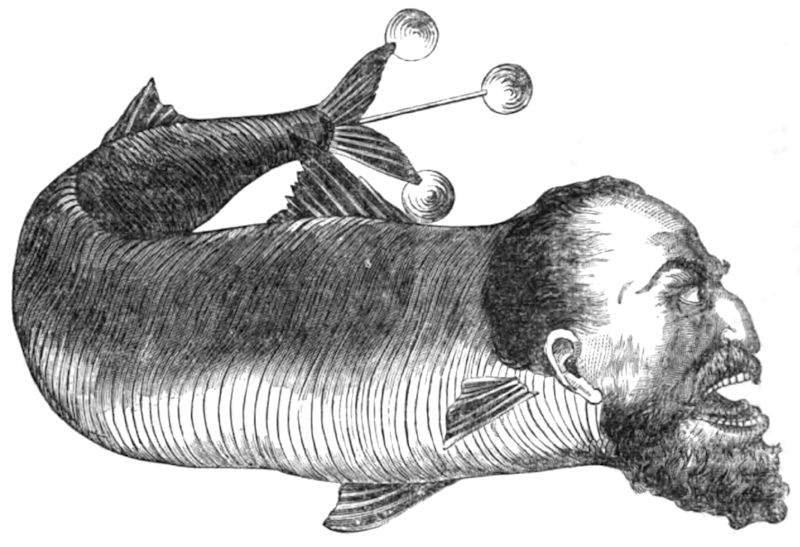
Shakspeare, with his customary acuteness of observation, declares that there are “both land-rats and water-rats.” Some other immortal genius has made the startling discovery that there are both water-sharks and land-sharks; and we find that in each of these generic divisions there is more specific arrangement than we have leisure or inclination to discuss. The engraver has supplied us with a specimen of one variety of the land-shark, which may be distinguished at a glance by the globular symbols at the end of the tail—the use or meaning of which has never been clearly explained, though the world has been favored with many ingenious hypotheses in relation to the subject. The common opinion is that the three balls are significative of the fact, that should the animal get possession of any of your property, it is two to one that you will never recover it. Others say that as balls have a remarkable facility in going down hill, they significantly point out the route you are likely to take should you venture to have any dealings with this formidable creature.
The least observation of the picture will convince you that there is speculation in the eye of this land-shark. Mark the eager expression! so much like that you may have observed in the glance of his maritime brother, as he ogled you from his billowy alcove. See the open mouth, and teeth displayed, as if prepared for a “bite.” Judging from the “valence” (as Hamlet calls it,) at the bottom of the visage, we opine that this animal does not shave himself—though he is said to shave his victims rather closely. The beard, by the way, is regarded as a hereditary characteristic of this devouring race—the origin of which is traced to Lombardy. The ancient inhabitants of that country were called Longobardi, which name some etymologists derive from Latin words, signifying long-beards. Among these unshaven gentry, it appears, pawn-broking, the most remorseless kind of shaving, was first established. From this seminary of shavers, the whole world was supplied with professors—fellows remarkable for great latitude of conscience as well as longitude of beard; benevolent fellows, too, always ready to accommodate the needy with a loan, “on the most agreeable terms”—as some of them promise to do, per advertisement, at the present day; the phrase, “most agreeable terms,” being understood to signify one hundred and fifty per cent. per annum! This moderate rate of interest is continued down to our own times, showing that the pawn-broker is piously attached to the usages of his ancestors, while others, in the race for improvement, are constantly trampling, with profane feet, on the ashes of the venerable dead.
“My Uncle,” as the pawn-broker is affectionately called by his customers, honors the assumed relationship by loaning out his dollars to every applicant who can comply with his stipulations. In this particular, some gay, frolicksome nephew would propose him as a model for uncles in general; especially because he never requires an exact account of how the cash loaned is to be expended, nor does he seem to take it for granted that you are on the direct road to ruin because you happen to stand in need of pecuniary assistance. On the contrary, he speaks of money-borrowing as one of the finest strokes of policy, and professes his willingness to lend any imaginable sum—if you are prepared to deposit some “collateral” worth about four times the amount. This being done, your generous creditor never harasses you for repayment, you may abscond, if you choose, and proceed to California, or any other remote region celebrated for gold, or brimstone—assuring yourself that your kind “uncle” will not interfere with your departure or inquire after you when you are gone.
With all this liberality and generous forbearance, the pawn-broker is regarded as one of the most voracious of predatory animals; but be it understood that there are land-sharks compared with which he is a mere minnow, inasmuch as his operations are all on a small scale, and the figure he makes among the speculating leviathans of the day is comparatively insignificant.