THE BATTLE OF TRENTON.
Reading edition
———
BY CHARLES J. PETERSON, AUTHOR OF THE “MILITARY HEROES OF THE WAR OF INDEPENDENCE.”
———
[Illustrated with a View of the Head-Quarters of Gen. Knox, where the Council of War was held previous to the Battle.]
The battle of Trenton was the turning point of the War of Independence. For months before, the prospects of the Colonies had been darkening, and but for this bold stroke, would soon have set in gloom forever. A brief review of the condition of affairs is necessary to a just comprehension of the battle.
When, in March, 1776, the British found themselves compelled to evacuate Boston, they resolved to carry their arms into the Middle States, and there strike at the very heart of the nation. Accordingly, Sir William Howe, after recruiting his forces at Halifax, sailed for New York. On the 28th of August, at the head of an army twenty-four thousand strong, he defeated the Americans on Long Island; and, a few days subsequently, compelled them to abandon the city of New York. Washington now retreated to White Plains, where an ineffectual engagement followed. Soon Fort Washington, at the upper end of the island of Manhattan, was stormed and carried by the royalist troops. Finding it impossible to maintain his hold upon the Hudson, the American general determined to retreat across New Jersey; and accordingly, abandoning all his positions, hurried over the North River, the British following in quick pursuit.
Thus, within two months after the battle of Long Island, the cause of the Colonies sunk into almost hopeless ruin. The enthusiasm which accompanied the first outbreak at Lexington, had given way before the privations of a protracted contest; and the soldiers, who in 1775 had flocked unsolicited to the flag of their country, in 1776 turned a deaf ear to the bounty offered by Congress. In the army, the spirits of both officers and men were broken by a long series of disasters. Before the end of November the force of Washington, by loss in battle, by the expiration of enlistment, by desertion, and by other casualties, had dwindled down to a little over three thousand men. With this remnant of an army he retreated across New Jersey, hotly pursued by Cornwallis, at the head of twenty thousand well appointed troops; nor could he save himself from utter ruin except by throwing the Delaware between himself and his foe. On the 8th of December, he crossed that river, and, having destroyed the bridges behind him, gained a momentary respite.
To the eyes of nearly every man but the commander-in-chief, this momentary relief seemed only an interval of additional agony between the sentence and execution, for ultimate escape appeared impossible. The most sanguine believed that Philadelphia would fall before the month was out. Congress, which had been in session there, hurried off to Baltimore. Meantime, the British, in secure possession of New Jersey, issued a proclamation, requiring every inhabitant to lay down his arms and take the oath of allegiance; and hundreds, who had been among the most enthusiastic for resistance, but who now despaired of success, hastened to purchase mercy by a timely submission. Even gentlemen high in rank on the side of the Colonies wavered in their patriotism. The panic was universal. The hurricane seemed about to prostrate every thing before it.
In the gloom of this awful tempest, Washington, almost alone, stood unappalled. Not for one moment did his constancy forsake him. He saw the full peril of his situation; but he brought to it the resources of his mighty genius, and the unshaken resolution of his giant soul. Never, in any period of his life, was he greater than in this. No hint of submission crossed his mind. “If Philadelphia falls,” he said in public, “we must retreat to the Susquehanna, and thence, if necessary, beyond the Alleghenies.” From the moment he had crossed the Delaware, he had been revolving in his mind a plan to change, by one bold act, the whole aspect of the war. The British, instead of being concentrated in some central point, were scattered in detachments over New Jersey, a proceeding they had adopted for the convenience of forage, believing their enemy utterly powerless for aggressive measures. Washington resolved to take advantage of this error, and to strike at several of these detachments at once. He learned that fifteen hundred men, principally Hessians, were cantoned at Trenton, and that smaller bodies lay at Bordentown, Burlington, Mount Holly, and neighboring villages. To cut off one or all of these from the main army was his design.
It has been said, by more than one interested writer, that this masterly idea did not originate with Washington, but was suggested by others; and various officers have been named as the real authors of the plan. But the very number of the aspirants destroys the exclusive claims of each, and strengthens the notion that the manœuvre sprung from the commander-in-chief alone. The letters of Washington, for a fortnight before the battle, point to the great thought he was maturing in his mind. He was encouraged in his plan by the alacrity with which the Pennsylvania militia, under the command of General Cadwalader, began to turn out; and by the reflection that, unless some bold stroke was promptly hazarded, the spirits of the people would sink into hopeless despondency. Accordingly, he called a council of war, before which he laid his daring scheme. As absolute secrecy was necessary to the success of the enterprise, only the very highest officers were admitted to this assembly, which met at the head-quarters of Gen. Knox, in Upper Makefield, Bucks County, Pa. The house is, we believe, still standing, an antiquated dwelling of two stories, faithfully depicted in our engraving.
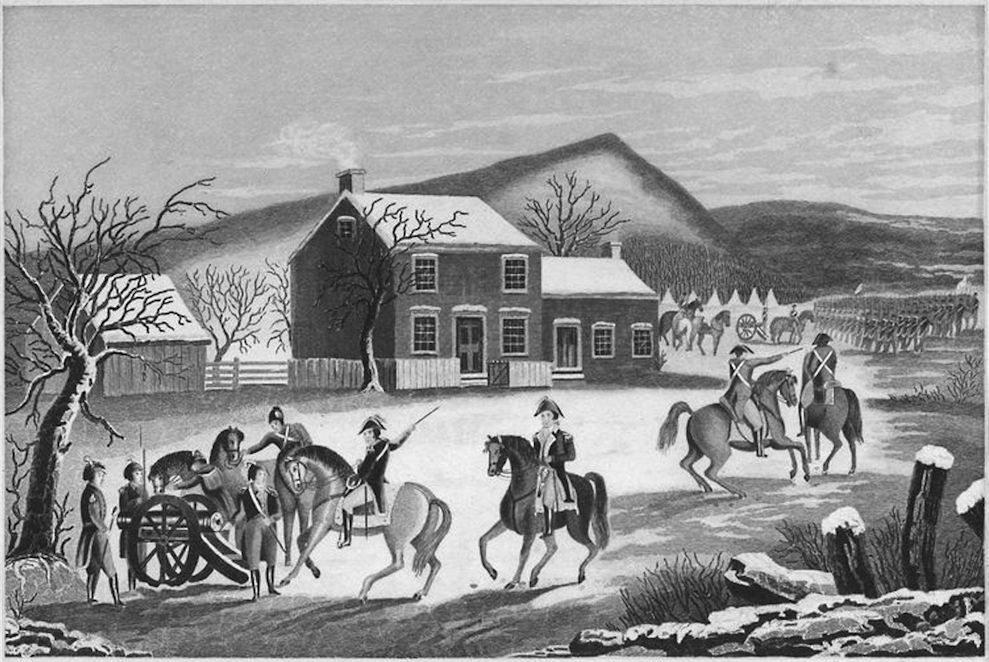
HEAD QUARTERS OF GEN. KNOX. The House in which the Council of War was held previous to the Battle of Trenton.
Little did those who met at that council of war, though aware that mighty results hung upon their decision, imagine a tithe of the truth. They knew that the success or defeat of the Colonies might possibly be involved, but they could not penetrate the future, and foresee that the existence of the greatest and most enlightened republic that ever lived, depended on their conclusion. To their eyes it was chiefly a question of preserving their little army, or at most of protracting the contest into another campaign, that they might have the benefit of whatever chances should turn up. But in reality they were determining whether the great problem of man’s capacity for self-government should be tested or not—whether twenty millions of people, as we now are, or one hundred millions, as we will be by the close of the century, should rise into freemen, or sink into slaves. Under God, all the progress that liberty has made since that hour, here or abroad, may be traced to the resolution adopted in that council of war! That we are a free people; that our wide-spread territories are filled with prosperity and happiness; that the United States is looked to by the whole world as the Mecca of the oppressed; and that every breeze that blows from Europe brings sounds of falling thrones, and nations breaking the chains which have galled them for centuries—we owe to the determination of that little assembly to sustain their commander-in-chief. We can imagine when the council rose, that the angel who watched over the youth of our republic, and who had trembled for the result, clapped his hands for joy, and that the exultant sound, taken up by messenger after messenger, passed from hierarch to hierarch, until all heaven rang with the acclaim.
The plan, as finally determined on, was that Washington, with the continental troops, should cross the Delaware above Trenton, and move down to the attack of that town; while Ewing, crossing the river below, should make an assault simultaneously from the lower side. Meantime, Cadwalader, with a strong detachment of militia, crossing at Bristol, was, if possible, to carry the posts at Burlington and Mount Holly. The night of the 25th of December was chosen for the surprise, as it was supposed that the enemy, on that festive occasion, would be more or less off his guard. The weather had been unusually warm for the season, and there was no ice as yet in the river to impede the crossing. Every thing looked promising until within forty-eighty hours of the appointed time. Suddenly, at this crisis, the weather set in cold, so that the Delaware became full of floating ice, which rendered navigation almost impossible. Nevertheless, Washington determined to persist in his enterprise. Boats had been collected for the transportation of his own detachment, at McConkey’s Ferry, on the west side of the river, about eight miles above Trenton. An express was sent to Cadwalader to inform him the attempt would be made, and to command him to cross, if possible, at Bristol.
As soon as evening came, the continentals, twenty-four hundred in number, with a battery of twenty light field pieces, were put in motion, and marched to the ferry. It was a wild and threatening night. The wind howled ominously over the landscape; a few stars only were seen in the dark and troubled sky; and the ice in the river, grinding and splitting as the tide moved its huge masses one against another, filled the air with foreboding sounds. In vain, for awhile, the boats struggled in the current. Now locked in the arms of apparently immovable fields of ice, and now in peril from floating blocks that threatened to crush them, they were borne hither and thither, and with difficulty reached the shore, where new dangers awaited them in cakes of the frozen material, which pushed end-wise toward the bank, frequently overlapped and almost engulfed them. At one time it was feared that the artillery would have to be left behind. At last, however, after almost incredible exertions, the little army was ferried over, but the task, instead of being achieved at midnight, as had been intended, was not completed until three hours afterward. During the suspense of this awful night, Washington, who had crossed early, sat, it is said, on a bee-hive by the shore, wrapped in his cloak, and watching the struggling boats by the light of the few stars which broke here and there through the stormy rack of heaven.
Two principal roads led from the landing-place to Trenton. One, following the course of the river, entered the town at its lower extremity; the other, called the Pennington road, made a circuit into the interior, and struck Trenton at its upper end. Dividing his force, Washington took the latter route with one detachment, while Sullivan, with the other, pursued the river road. The instructions of the commander-in-chief to the latter general were to push on until he had reached Trenton, which he would probably be the first to do, as his route was the shortest, and there wait until he heard firing at the upper end of the town, when he was to attack at once. By thus assaulting the British simultaneously on both sides, Washington hoped, in conjunction with the surprise, to render them an easy prey.
The march had scarcely been renewed when the storm, which had been threatening all night, burst upon the army. The snow, at first coming in squalls, finally fell unintermittingly, accompanied occasionally with gusts of sleet and hail. The two divisions moved in company for nearly three miles before separating, and Sullivan, remarking that the wet might spoil the powder, asked his chief what was to be done in that emergency. “We must fight with the bayonet,” was Washington’s stern reply. The tempest now rapidly deepened. The thick-falling flakes nearly obscured the way; the cold became intense, and the wind, moaning across the landscape, seemed to wail over the approaching ruin of America. Many of the soldiers being scantily clothed, were soon wet through and almost frozen. Others had no shoes, and their feet, cut by the icy road, left at every step a mark of blood. History presents no parallel to that eventful march. When still some distance from Trenton, two of the Americans, exhausted and chilled, dropped from their ranks and died. Yet still the remainder toiled on. No martial fife was there, no banner flaunting on high, no squadrons of cavalry to guard their flanks with triple rows of steel; but in silence, like the Spartans bound to Thermopylæ, the little band pursued its way. The inhabitants of the farm-houses on the route, half waking from sleep, fancied for a moment there were strange sounds upon the breeze; but imagining that what they heard was but the intonation of the tempest, they turned and slept again, little thinking that the destinies of America quivered that hour in the balance.
The anxiety of Washington, during this protracted march, rose to the highest pitch. He was aware that if the attack failed, escape would be impossible, with the wintry Delaware behind him. In deciding on this bold move, he had staked not only his own life, but the existence of his army, and with it the question of submission and independence for his country, then and forever after. He had put every thing “at the hazard of a die.” Yet the flight of a single deserter, the accidental discharge of a musket, or the occurrence of any one of a dozen possible contingencies might destroy success entirely. As the gray dawn approached, and the vicinity of Trenton became apparent, his heart, usually so calm, beat with terrible suspense. He rode forward to the head of his troops. Just at this instant the outpost of the enemy loomed up in front; a challenge was heard—a hostile answer was given, and a musket flashed across the breaking day. Fired by the scene, and by the mighty responsibilities of the hour, Washington rose in his stirrups, and pointing ahead with his sword, exclaimed, in a voice husky with emotion, but in words that will ever be immortal, “Soldiers, now or never—this is our last chance.”
On the instant the men broke into a cheer, carried away by the enthusiasm of the moment, and returning the volley of the retreating guard, dashed forward in pursuit. The British kept up a desultory fire as they fled, dodging from house to house. At their head was a young officer, who courageously exhorted them to stand their ground, until a ball mortally wounding him, he fell in the road, when they precipitately retired. The Americans now saw, a little in advance, the houses of the town; heard the alarm which was calling the British soldiery together, and immediately after beheld the enemy endeavoring to form a battery across King street, directly in front. Not a moment was to be lost. Six of Knox’s pieces immediately galloped into position, and unlimbering, opened a destructive fire down the street. When this discharge was over, the advanced guard rushed forward, charged up to the muzzles of the enemy’s guns, sabered some of the artillerists who were about firing, and drove the rest away, and capturing the pieces, turned two of them on the flying foe. This occurred near where the feeder crosses the street. Having thus destroyed the outworks of the enemy, the successful assailants advanced down Queen street, extending toward the left, across the fields, so as to cut off the Hessians from retreating toward Princeton.
Meantime, all was terror and confusion among the enemy. The night had been one of festivity in Trenton, the soldiers being in the beer-shops carousing, and the officers indulging in mirth. Col. Rahl had been occupied all night in playing cards at head-quarters, a house belonging to Mr. Stacy Potts, and still standing near the head of Greene street. When the firing at the picket occurred, he stopped and listened. The sleet driving against the window-pane, for a moment deceived him. But when the rattle of the first volley came to his ears, flinging down his cards, he rushed to the door. Here, through the misty dawn, he beheld some Hessians running down the street toward him, with the cry that Washington, with his entire army, was upon them. At this Rahl shouted to arms. The drums beat. In an instant all Trenton was in a tumult. The privates rushed from their quarters, some with, some without arms; the officers were heard calling to the men, or seen endeavoring to form the ranks; and the inhabitants, roused from sleep, hurried to their windows, and looking out for an instant on the uproar, hastened to conceal themselves in the recesses of their dwellings.
The main division of the array had scarcely unlimbered its battery in King street, when the sound of firing from the lower extremity of the town, announced that Sullivan had reached his position. Not three minutes had elapsed between the time when the two divisions came into action. The knowledge that the enemy had been surprised in front and rear at once inspired the Americans with fresh ardor, and they charged down the two principal streets, King and Queen, with an impetuosity that broke through every attempt at resistance. In vain Rahl galloped to and fro rallying his men; in vain the subordinate officers exerted themselves; in vain the privates, ashamed to be conquered without a blow, endeavored to make a stand;—the enthusiasm of the assailants was irresistible, the Hessians everywhere gave way, and when Rahl soon after fell mortally wounded, his troops broke into ignominious flight. A few threw themselves into a stone mansion, where they were speedily forced to surrender. The remainder fled precipitately toward the Assinpink river, which flows along the lower end of the town. Here, some endeavoring to swim across were drowned or frozen to death; but the greater portion, hemmed in on one side by Washington, and on the other by Sullivan, and finding escape hopeless, laid down their arms.
The victory was complete. The whole force of the British at Trenton fell into the hands of Washington, except a body of 500 horse, which fled in the direction of Bordentown early in the action. Even these, however, would not have made good their escape, if Gen. Ewing, who was to have crossed below, had been able to effect his purpose. The number of prisoners actually captured was 909, of whom 23 were officers. About a thousand stand of arms fell into the hands of the victors. This glorious success was purchased without the loss of a man, except the two who died on the march; and but two officers, and a few privates were wounded. The Hessians lost 7 officers and nearly 30 men killed. As Washington rode over the field after the conflict, he found Rahl, lying in the snow, weltering in blood. The dying commander, supported by a file of sergeants, tendered his sword to the victor, and in broken accents seemed to implore clemency. The American chief, touched by the spectacle, ordered his own physician to attend the sufferer. But medical assistance was in vain. Rahl, on being carried back to his head-quarters, died soon after.
The entire British army, west of Princeton, would have fallen a prey to Washington, if Cadwalader and Ewing had been able to cross at their respective places; but neither effecting this, the posts at Bordentown, Burlington, and Mount Holly, escaped. Meantime, aware that the royal generals might concentrate their forces and cut off his retreat, Washington decided to re-cross the Delaware that very day with his prisoners. Accordingly, before night, the captured Hessians were transferred to Pennsylvania. The news of this great victory spread with inconceivable swiftness; but such was the opinion of British invincibility, that, at first, few persons could be found to believe the tale. Aware of the general incredulity, Washington hastened to dispatch his prisoners to Philadelphia, where, on the day succeeding the battle, they were paraded through the streets, to the amazement, not less than to the delight of the inhabitants. The effect of the victory on the country was electric. The charm of British invincibility was broken forever. Men no longer regarded the cause of the Colonies as hopeless, but, encouraged by this decisive success, looked forward confidently to a glorious issue. In a word, the battle of Trenton changed the wavering into friends; made those who had been hostile, neutral; and convinced the patriot that God was on his side, and that his country would yet be free.
The victory struck terror to the heart of the British army. Cornwallis, who was about to embark for Europe, abandoned his voyage in alarm, and hurried back from New York to assume command of the troops on the Delaware. His first step was to withdraw his forces from the exposed points, and concentrate them at Princeton and toward New Brunswick. Nor was this precaution idle. Washington, having recruited his troops, and being reinforced, crossed the Delaware again on the 30th of December, and took post at Trenton. To drive him from thence Cornwallis advanced from Princeton, and, on the 2nd of January, 1777, assaulted the American lines, established on the south side of the Assinpink. Three times he endeavored to carry the bridge which separated him from his foe, and three times he was repulsed. At last night put an end to the contest. In the darkness, Washington abandoning his position, marched on Princeton, intending to cut off the royal general from his communications. A battle ensued at this place, which was scarcely decided in favor of the Americans, when Cornwallis, hurrying up from Trenton, compelled the victors to draw off to the high grounds in the direction of Morristown. The British general, completely baffled, fell back to the Raritan, abandoning all his posts on the Delaware. The result of this splendid series of operations on the part of Washington was to deliver New Jersey from the enemy, in the short space of ten days. Thus, when supposed to be annihilated, the American general, like some fabled genius, had suddenly risen up, saved Philadelphia, recovered all he had lost in the preceding two months, and given an impetus to victory which never ceased until the red cross of Great Britain sunk into dust on the plains of Yorktown.
When hereafter the military genius of Washington is called in question, let the story of Trenton be remembered. Napoleon always spoke of this ten days’ campaign as one of the most able on record. Botta, the Italian historian, said of it, “Achievements so astonishing gained for the American commander a very great reputation, and were regarded with wonder by all nations, as well as by the Americans; every one applauded the prudence, the firmness, and the daring of Washington; all declared him the saviour of his country; all proclaimed him equal to the most renowned commanders of antiquity.”