REVIEW OF NEW BOOKS.
Reading edition
Oliver Goldsmith: A Biography. By Washington Irving. New York: George P. Putnam. 1 vol. 12mo.
From no living person could we have expected a more delightful biography of Goldsmith than from Washington Irving, and, accordingly, we have one, written closer to the heart and brain of its subject, than any other in English literature. There are two biographies of Goldsmith with which it will naturally be compared, Prior’s and John Forster’s, both of them works of merit, but neither equal to Irving’s in respect to felicity in conveying to the reader a living impression of Goldsmith’s character and life; and of depositing his image softly in the mind, as an object of good-natured affection. Prior is invaluable for materials, not only in regard to facts but epistolary correspondence, and displays in his style of composition no sign of being word-forsaken; but he has little juice in him, is hard and dry of mind, and exhibits no vision into the soul of Goldsmith, no capacity to clutch the living lineaments of his character. Forster’s biography is a work of more intellectual pretensions; and the narrative of Goldsmith’s life, the criticism on his various works, and the numerous anecdotes relating to the politics and literature of the time, are done with an ability we could not but expect from a man of Forster’s mental powers and accomplishments: but unfortunately the subject was one in which his mind had little real sympathy, and, accordingly, the whole book, as far as it refers to Goldsmith, is pervaded by affectation and sentimentality. The style is made up of Carlylisms and Macaulayisms, and further depraved by a sickly cant of sympathy with the poor—which cant bears evidence of being written by a man in extremely comfortable circumstances. But Irving is, in intellectual constitution, sufficiently like Goldsmith to comprehend him thoroughly, and his biography, therefore, has the truth and consistency of dramatic delineation, without any parade of knowledge or sentiment. With exquisite refinement of thought, and simplicity of narrative, it exhibits the gradual growth of Goldsmith’s mind and disposition under the tutorship of experience, and so clear is the representation, that the dullest eye cannot miss seeing the essential features of the character, and the dullest heart admiring them.
It is almost needless to say that the style is lucid, graceful and pure, with that “polished want of polish” in the selection of the words, which indicates a master in diction. The spirit breathed over the work is genial and sympathetic, and while it throws a charm around Goldsmith, makes the reader in love with Irving. The selections from Goldsmith’s letters and writings, introduced as illustrations of events in his life, and qualities of his character, do not stand apart from the biographer’s text, but rather seem to melt into it, and form a vital portion of the work. Irving has avoided the fault of the other biographers, in not admitting extraneous matter, and rejecting every thing which does not strictly relate to Goldsmith. The sketches of men, and descriptions of English life and manners, which he introduces, are all illustrative of the circumstances and position of his author. Among these, the remarks on Johnson, Langton and Topham Beauclerc, and the account of the Literary Club, are the most felicitous.
In the last chapter of the volume, Irving sums up, with great delicacy and discrimination, the various qualities of Goldsmith, and presents, with a loving pen, his claims upon the reader’s esteem. We cannot refrain from quoting the concluding remarks, both for their beauty and justice. “From the general tone of Goldsmith’s biography, it is evident that his faults, at the worst, were but negative, while his merits were great and decided. He was no one’s enemy but his own; his errors, in the main, inflicted evil on none but himself, and were so blended with humorous, and even affecting circumstances, as to disarm anger and conciliate kindness. Where eminent talent is united to spotless virtue, we are awed and dazzled into admiration, but our admiration is apt to be cold and reverential; while there is something in the harmless infirmities of a good and great, but erring individual, that pleads touchingly to our nature; and we turn more kindly toward the object of our idolatry, when we find that, like ourselves, he is mortal and frail. The epithet so often heard, and in such kindly tones, of ‘poor Goldsmith,’ speaks volumes. Few, who consider the real compound of admirable and whimsical qualities which form his character, would wish to prune away its eccentricities, trim its grotesque luxuriance, and clip it down to the decent formalities of rigid virtue. ‘Let not his frailties be remembered,’ said Johnson, ‘for he was a very great man.’ But, for our part, we rather say, ‘let them be remembered,’ since their tendency is to endear; and we question whether he himself would not feel gratified in hearing his reader, after dwelling with admiration on the proofs of his greatness, close the volume with the kind-hearted phrase, so fondly and so familiarly ejaculated, of Poor Goldsmith.”
Bulwer and Forbes on the Water Treatment. Edited, with Additional Matter, by Roland S. Houghton, M. D. New York; Geo. P. Putnam. 1 vol. 12mo.
This volume is published especially for the benefit of literary and professional men, to whom the editor dedicates it. As it is addressed “to those who think,” there is a natural disposition on the part of the reader to think with the editor. The most entertaining piece in the volume is Bulwer’s letter, in which the author of Pelham, after describing the melancholy condition of his health under the regular practice, gives his experience as a Water Patient. The other articles are more elaborate and learned disquisitions on Hydropathy, written by physicians; and whatever may be the opinion of the reader as to the merits of the water cure as a medical science, he cannot fail to obtain much valuable information about bathing, and many strong inducements to look after the health of his skin.
Story of a Genius, or Cola Monti. New York: D. Appleton & Co. 1 vol. 16mo.
This is a little story somewhat after the manner of Miss Sedgwick’s delicious juvenile tales, evidencing not merely a laudable purpose in the moral, but no mean powers of characterization, and a considerable knowledge of practical life. Cola, the slight dark-eyed Italian boy, the genius of the story, and Archibald McKaye, the youth marked out for a mercantile profession, are both well delineated; and the idea of bringing them together as natural friends is an anticipation of that union between artist and merchant which we trust will soon be more common in real life.
The Child’s First History of Rome. By E. M. Sewell, Author of Amy Herbert, &c. New York: D. Appleton & Co. 1 vol. 16mo.
Miss Sewell has performed, in this little volume, a difficult task, showing throughout that she understands what few authors of children’s books seem to comprehend—a child’s mind. A series of histories, composed on similar principles, would be a positive and permanent addition to the literature of youth. The authoress, not being “above her business,” but having her audience constantly in her mind, has succeeded in avoiding every thing which would make her narrative obscure to children, and her style mirrors events in the light they ever appear to boys and girls. The account of the death of Cleopatra is one out of many examples of this felicity. In the following extract the very tone of a child’s mind is caught and expressed. “Shortly afterward an officer arrived from Octavius. The first thing he saw when he entered the room was Cleopatra, dressed in her royal robes, stretched lifeless upon a golden couch. She had killed herself by means of an asp, a kind of serpent, which was brought to her in a basket of figs, and the sting of which was deadly. Iras was lying dead at the feet of her mistress; and Charmian, scarcely alive, was placing a crown upon her head. ‘Was this well done, Charmian?’ inquired the messenger of Octavius. ‘Yes,’ replied Charmian, ‘it is well done, for such a death befits a glorious queen.’ ”
The volume, in addition to the simplicity of its narrative, bears evidence of having been compiled from good authorities; and if extensively read by the juvenile public, will be likely to make most children more informed in regard to Roman history, at least, than the majority of parents.
A Lift for the Lazy. New York: Geo. P. Putnam. 1 vol. 12mo.
Few readers will have modesty enough to acknowledge publicly that this brilliant volume is addressed to them, but doubtless a great many, convicted by conscience, will take a sly peep into it to see if it really meets their wants. In truth, the author has contrived to embody in it much curious information, which the most industrious scholars have either forgotten or never acquired. It contains about five hundred scraps of knowledge, collected from a wide field of miscellaneous reading, some of which are valuable, some quaint, some sparkling, and all entertaining. We have only space to extract one specimen of the author’s style, and that illustrative of his way of relating an anecdote. Under the head of “Congreve Rockets,” he remarks, “These destructive implements of war were invented in 1803, by Sir William Congreve. On a certain occasion, when visiting Westminster Abbey, in company with some ladies, his attention was directed by one of the party to the inscription on the great composer, Purcell’s monument: ‘He has gone to that place where only his music can be excelled.’ ‘There, Sir William,’ said the young lady, ‘substitute fire-works for music, and that epitaph will answer for yourself.’ ”
Scenes where the Tempter has Triumphed. By the Author of “The Jail Chaplain.” New York: Harper & Brothers. 1 vol. 16mo.
Here is a book, replete with morality and religion, in which a view of human nature is taken as it appears to an observer posted in a jail or on the gallows. There are nineteen chapters, each devoted to the narrative of a different person and a different crime, and each as interesting as one of Ainsworth’s novels, and as moral as one of Baxter’s Sermons. A book which thus addresses two large classes of readers can hardly fail to succeed. We should think it an admirable text book for Sunday-Schools in Texas. It places before every criminal’s eye a more or less distant view of the jail and gallows, and is thus really “an awful warning to the youth of America,” and differs essentially from the “Pirate’s Own Book,” “The Lives of Celebrated Highwaymen,” and other piquant books of the rascal department of letters.
The Stars and the Earth; or Thoughts upon Space, Time, and Eternity. Boston: Crosby & Nichols.
This is a small volume of eighty-seven pages crammed with thought. It appears to have excited much attention abroad, and to have passed rapidly through three editions. The speculations of the author are grand and original, having a solid basis on undoubted facts, and conducting the mind to results of “great pith and moment.” We have no space to make an abstract of what is in itself an epitome, but advise all our readers, who have thought on the subject of space and time, to obtain the work. Its style is a transparent medium for the thought, and its meaning stupidity itself can hardly miss. It requires neither a knowledge of mental or physical science to be comprehended, though it is an addition to both; and it removes some difficulties which have troubled all reflecting minds.
Retribution; or the Vale of Shadows. A Tale of Passion. By Emma D. E. Nevitt Southworth. New York: Harper & Brothers.
Judged by its own pretensions as a tale of passion, this work has considerable merit, and is worthy of a more permanent form than the pamphlet in which it is published. The mode which the Harpers have adopted of issuing all novels in this uncouth shape, in order to reduce their price to twenty-five cents, is an unfortunate one for the success of a new novelist like the accomplished authoress of the present story. No man of taste, who has regard for his eyesight, is likely to read pamphlet novels, unless the author be celebrated; and the circulation of a book like the present, is therefore likely to be confined to persons who are not in the habit of discriminating very closely between one novelist and another, provided both be readable, and consume a certain portion of leisure time. Whenever an American author produces a work of fiction as meritorious in respect to literary execution as “Retribution,” it ought to be issued in a form which will enable it to take its appropriate place in American literature.
History of the United States of America. By Richard Hildreth. New York: Harper & Brothers. Vol. 2. 8vo.
This volume ends at about the commencement of the Revolution. It is written in the same style, and on similar principles, as the first volume, which we noticed a short time ago. The work is, at least, worthy the praise of condensation, there being included in the present volume, a narrative of the events occurring in all “the Colonies during the period of a hundred years.”
Letters from the Allegheny Mountains. By Charles Lanman. New York: Geo. P. Putnam. 1 vol. 12mo.
The author of this agreeable volume is well known as an essayist and tourist. The present work is mostly made up of letters originally contributed to the National Intelligencer, and, as a record of first impressions of scenery and manners, has a raciness and truth which a more elaborate treatment of the subject might have wanted.
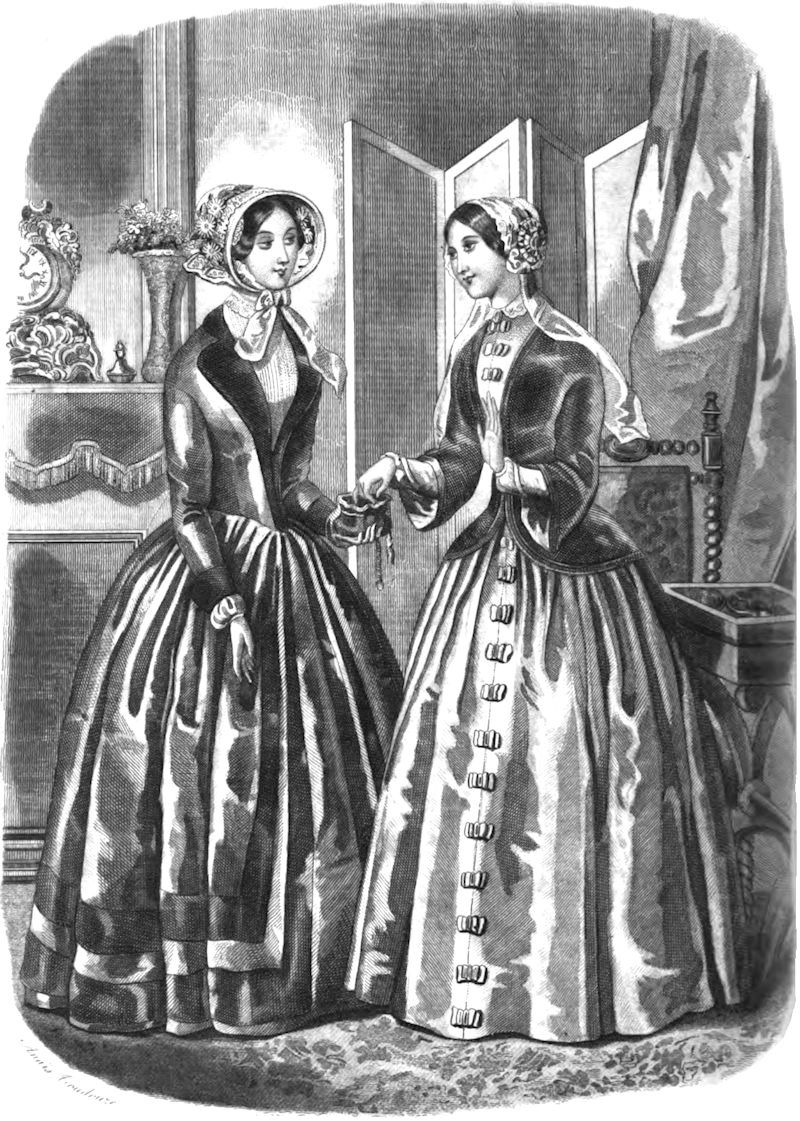
Anaïs Toudouze
LE FOLLET
PARIS, Boulevart St. Martin, 61.
Robes de Mme. Bara Bréjard, r. Laffitte, 5;
Chapeau et bonnet de Mme. Baudry, r. Richelieu, 87—Fleurs de Chagot ainé, r. Richelieu, 81.
Graham’s Magazine