ALICE.
Reading edition
———
BY THOMAS DUNN ENGLISH.
———
As in yonder woods I wandered,
By the river-side,
On the bitter past I pondered,
On the gladness I had squandered,
And upon my erring bride,
By her dying sanctified.
Pleasure from a crystal chalice
Once I gladly drained;
Lived we in a fairy palace,
Wildest passion, I and Alice;
Every object seemed attained,
Every joy my soul had gained.
While I trusted her, and thought her
Honest as she seemed;
While I fondest worship brought her,
And my glowing glances taught her
Of the love which from them gleamed,
I awoke—I had but dreamed.
After she became a mother,
Leaving me her child,
Fled she from me with another—
With a man I thought my brother.
Fate its mountain on me piled,
And my mind grew rapt and wild.
So it was, he treated vilely
One who trusted him;
Thus did she with action wily
Lull me, ere she left me slyly—
Left me for her passion’s whim,
With my life-lamp growing dim.
Sad I sat me by my lattice,
Where the faded flowers,
Withered poppies, seared clematis,
And the damp-mould which begat is
By the long-neglected hours,
Seemed in harmony with my powers.
Thus my life-lamp’s fitful shimmer
Faint and fainter shone;
Thus its fastly-fading glimmer,
Daily growing dim and dimmer,
As I brooded there alone,
Lit my happiness o’erthrown.
Day by day thus wrapt in sadness,
Sat I quiet there;
Desperately rejecting gladness,
Wooing the approach of madness,
Nursing wrongs with savage care,
Whose nurture would create despair.
Time at length it soothed me slightly,
Covering o’er my care;
Made me bear my woes more lightly,
Think my honor less unsightly;
But her absence made her fair,
Though criminal beyond compare.
Years had past, and in this Babel
Of continual din,
I had striven, as I was able,
Till the silver streaked the sable
Of my hair, which growing thin
Showed decay which must begin.
Years had past, but naught could fetter
Love I should have spurned;
Every day I loved her better—
Shame upon me! Then I met her,
In the wo that she had learned,
Under the blow which she had earned.
By her death-hour’s turbid river
Stood her trembling soul;
And she asked me to forgive her,
By her shame, which would outlive her,
By her anguish past control,
By the hell which was her goal.
Could I at such time refuse her
Such a sad request?
Could I then of crime accuse her—
At that moment harshly use her?
So I bade her pass to rest,
With forgiveness on her breast.
Smiled the Magdalen, and prayed me
With a feeble pride,
Prayed me by the God who made me,
That when in the earth they laid me
It should be her form beside—
Hers, my false and fallen bride.
As I stood in pity by her,
Looking in her face,
Could I this small boon deny her?
Pride revolted, but a higher,
Holier feeling took its place,
And I smiled the sought-for grace.
This thing won, another favor
From me she did pray;
That, forgetting her behavior,
Ere death’s rising waves would lave her,
I would bend and on that day
Kiss her chill lips as she lay.
This I did, and as she started
At my warm lip’s touch,
From her form the spirit parted,
Leaving me thus riven-hearted,
Held in Sorrow’s iron clutch,
Smiling never, suffering much.
In the dark-brown shade I wander—
Sadness at my side;
Growing of my sorrows fonder,
As upon the past I ponder,
And upon my erring bride,
Who, as I forgave her, died.
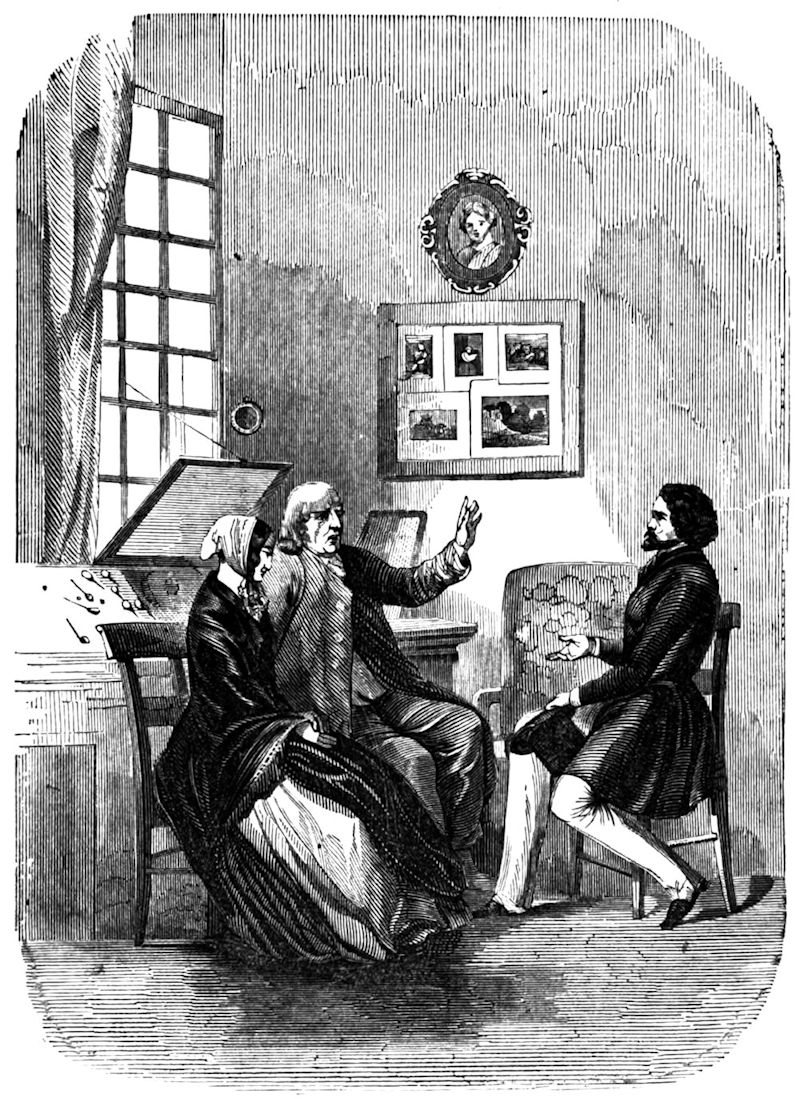
Engraved Expressly for Graham’s Magazine. THE ENGRAVER’S DAUGHTER.