Part 2 — A HARMLESS GLASS OF WINE.
Reading edition
———
BY KATE SUTHERLAND.
———
[SEE ENGRAVING.]
“Rose, dear,” said Mrs. Carleton to her daughter, whom she met at the door of the dining-room, with a decanter of wine and glasses on a waiter, “who is in the parlor?”
“Mr. Newton,” replied the young girl.
“The young man from New York?”
“Yes.”
“You are going to take him wine?”
“Yes. It is only hospitable to offer him some refreshment.”
Mrs. Carleton stood with her eyes resting on the floor for some moments, in a thoughtful attitude.
“I rather think, Rose,” said she, as she lifted her eyes to her daughter’s face, “that it would be as well not to hand him wine.”
“Why, mother?” inquired Rose, looking curious.
“We know nothing of the young man’s previous life and habits.”
“Why do you say that, mother?” asked Rose, who did not comprehend the meaning of what had been uttered.
“He may have been intemperate.”
“Mother! How can you imagine such a thing?”
“I know nothing of him whatever, my child,” replied Mrs. Carleton, “and do not wish to wrong him by an unkind suspicion. My suggestion is nothing more than the dictate of a humane prudence. I have recently had my thoughts turned to the subject of intemperance, and, by many forcible illustrations, have been led to see that the use of even wine, unrestrictedly, is fraught with much danger. We never can know whose perverted taste we may inflame, when we set even wine before guests of whose history we know nothing. It is, therefore, wiser to refrain. But you have left Mr. Newton alone, and must not linger here. Do not, however, present him with wine. After he is gone we will talk on this subject again; when I think you will be satisfied that my present advice is good.”
Rose left the wine on the sideboard, and went back to the parlor, wondering at what she had heard. After the young man had gone away, she joined her mother, when the latter said—
“You seemed surprised at my remarks a little while ago; and I was, perhaps, as much surprised when like suggestions were made to me. But when, from indisputable evidence, we become aware that our actions may wrong others, we are bound by every consideration to guard against such injurious results. You know how painfully afflicted the family of Mr. Delaney has been, in consequence of the intemperate habits of Morton?”
“Yes. Poor Flora! the last time I was with her, he passed us in the street so much intoxicated that he almost staggered. Her heart was so full that she could not speak, and when I left her, a little while afterward, her eyes were ready to gush over with tears.”
“Unhappy young man! So young, and yet so abandoned.”
“Until I met him, as just said, I thought he had reformed his bad habit of drinking,” said Rose.
“It was in order to refer to this fact that I mentioned his name just now,” returned her mother. “He did attempt to do better, and for some months kept fast hold of his good resolutions. But, in an evil hour, he fell, and his temptress was a young girl of your own age, Rose. A few weeks ago he went to New York on business. While there, he visited the house of a relative, where wine was presented to him by a beautiful cousin, and he had not the resolution to refuse the sparkling draught. He tasted, and—you have seen the result.”
“Oh, mother!” exclaimed Rose, “I would not have that cousin’s feelings for the world!”
“She acted as innocently as you would have done just now, my daughter.”
“Was she not aware of his weakness?”
“No. Nor had she ever been told that for one whose taste is vitiated, it is dangerous, in the highest degree, to take even a glass of wine.”
“I am so glad that I did not offer wine to Mr. Newton!” said Rose, drawing a long breath.
“Mr. Newton,” returned the mother, “may never have used intoxicating drinks to excess. He may not be in danger from a glass of wine.”
“But I know nothing of his previous life.”
“And, therefore, it is wisest to take counsel of prudence. This is just what I want you to see for yourself. To such an extent has intemperance prevailed in this country, that the whole community, to a certain extent, have perverted appetites, which are excited so inordinately by any kind of stimulating drink as to destroy, in too many instances, all self-control. Another case, even more painful to contemplate than that of Morton Delaney, occurred in this city last week. I heard of it a day or two since. A beautiful young girl was addressed by a gentleman who had recently removed here from the South; and her friends seeing nothing about him to warrant disapprobation, made no objection to his suit. An engagement soon followed, and the wedding was celebrated a few days ago. The father of the bride gave a brilliant entertainment to a large and elegant company. The choicest wines were used more freely than water, and the young husband drank with the rest. Alas! before the evening closed he was so much intoxicated that he had to be separated from the company; and, what is worse, he has not been sober for an hour since.”
“Oh, what a sad, sad thing!” exclaimed Rose.
“It is sad, sad indeed! What an awakening from a dream of exquisite happiness was that of the beautiful bride! It now appears that the young man had fallen into habits of dissipation, and afterward reformed. On his wedding night he could not refuse a glass of wine. A single draught sufficed to rekindle the old fire, that was smouldering, not extinguished. He fell, and, so far, has not risen from his fall, and may never rise.”
“You frighten me!” said Rose, while a shudder went through her frame. “I never dreamed of such danger in a glass of wine. Pure wine I have always looked upon as a good thing. I did not think that it would lead any one into danger.”
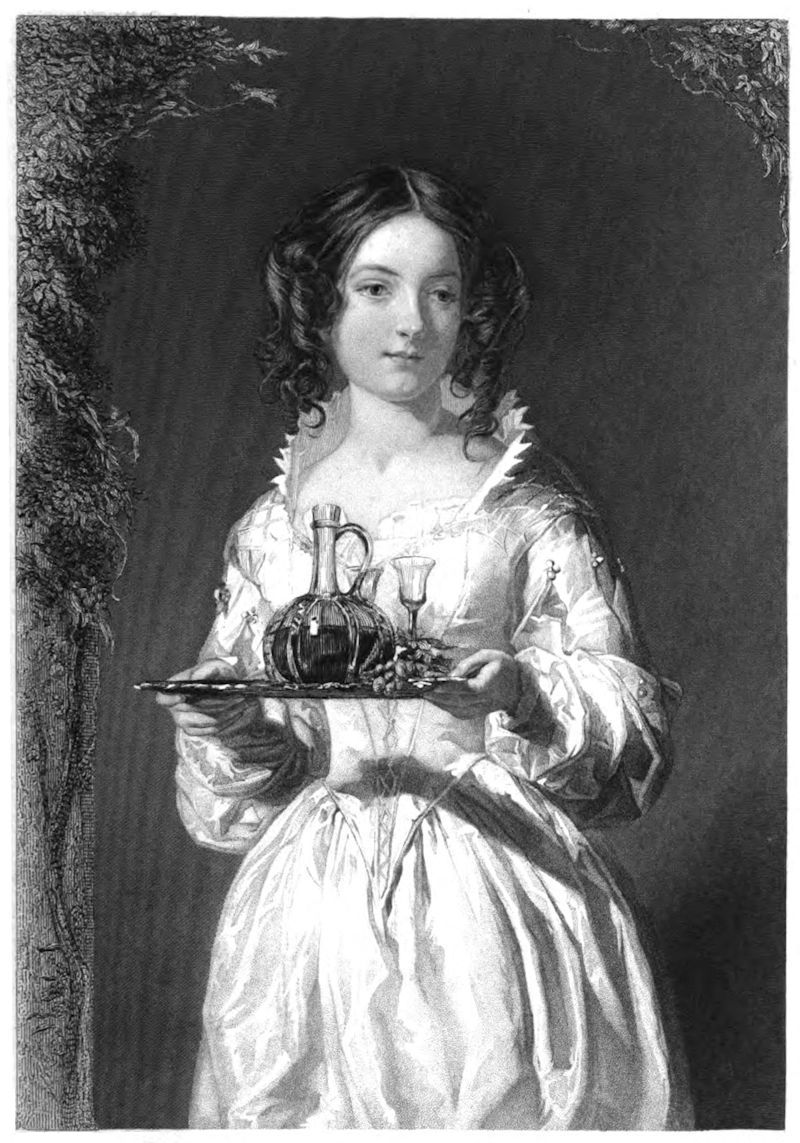
W. P. Frith W. H. Egleton ROSE CARLTON. Engraved expressly for Graham’s Magazine
“Even the best of things, my child, may be turned to an evil purpose. The heat and light of the sun is received by one plant and changed into a poison, while another converts it into healthy and nourishing food. Pure wine will not excite a healthy appetite, although it may madden one that has become morbid through intemperance. Here is the distinction that ought to be made.”
“Is it not dangerous, then, to serve wine in promiscuous companies?”
“Undoubtedly. I did not think so a little while ago, because the subject was not presented to my mind in the light that it now is. To this custom I can well believe that hundreds who had begun the work of restricting their craving appetites owe their downfall. Where all are partaking, the temptation to join in is almost irresistible; especially, as a refusal might create a suspicion against the individual that he was afraid to trust himself.”
“I will be very careful how I offer wine to any one again,” said Rose. “I would not have the guilt of tempting a man to ruin upon my conscience for all the world.”
“The more I ponder the subject,” remarked Mrs. Carleton, “the more surprised am I at myself and others. I invite some friends to an entertainment, or to spend a social evening, and I serve wine to my guests. Among them is a man who has fallen into intemperate habits at one time of life, and whose present sobriety is dependent upon his rigid observance of the rule of total abstinence. He is, it may be, the husband of my most cherished friend. I place wine before him with the rest. He is tempted to break his rule, and falls. Ah, me! How many hundreds of such cases occur in our large cities.”
Mrs. Carleton was a widow in easy circumstances, and moved in fashionable society. She entertained a good deal of company, and did it in the fashionable way. When gentlemen called at her house, wine was invariably set before them; and when she gave parties, wine was always served to her guests. But, suddenly startled into reflection, she saw that the practice was a dangerous one, and determined to abandon it. On this resolution she acted, much to the surprise of many of her acquaintances. Some said she was “queer,”—others decided that it was a foolish notion; while others pronounced her conduct positively absurd. But she did not in the least swerve from her purpose. Wine was no more placed before her guests.
The visits of Mr. Newton to Rose, which at first were only occasional, became more and more frequent. A mutual attachment ensued, which ended in marriage. No wine was provided at the wedding party—to many a strange omission—and Rose observed that at the parties given them by friends her husband invariably let the wine pass him untasted. Curious to know the reason for such abstemiousness, she one day, some months after marriage, said to him—
“Do you never drink wine?”
The question caused Newton to look serious; and he replied in a simple monosyllable.
“Don’t you like it?” inquired Rose.
“Yes; too well perhaps.”
The way in which this was said half startled the young wife. Newton saw the effect of his words, and forcing a smile said—
“When quite a young man, I was thrown much into gay company, and there acquired a bad habit of using all kinds of intoxicating drinks with a dangerous freedom. Before I was conscious of my error, I was verging on rapidly to the point of losing all self-control. Startled at finding myself in such a position, I made a resolution to abandon the use of every thing but wine. This, however, did not reach the evil. The taste of wine excited my appetite to such a degree that I invariably resorted to brandy for its gratification. I then abandoned the use of wine, as the only safe course for me, and, with occasional exceptions, have strictly adhered to my resolution. In a few instances young ladies, at whose houses I visited, have presented me with wine, and not wishing to push back the proffered refreshment, I have tasted it. The consequence was invariable. A burning desire for stronger stimulants was awakened, that carried me away as by an irresistible power. You, Rose, never tempted me in this way. Had you done so, we might not have been as happy as we are to-day.”
A shudder passed through the frame of the young wife, as she remembered the glass of wine she had been so near presenting to his lips. Never afterward could she think of it without an inward tremor. And fears for the future mingled with her thoughts of the past; but these have proved groundless fears, for Mr. Newton has no temptation at home, and he has resolution enough to refuse a glass of wine in any company, and on all occasions. Herein lies his safety.
“What! refuse a harmless glass of wine?” will sometimes be said to him. To this he has but one answer.
“Pure wine may be harmless in itself; so is light—yet light will destroy an inflamed eye.”