LOVE TESTS OF HALLOWEEN.
Reading edition
———
BY T. S. ARTHUR.
———
[SEE ENGRAVINGS.]
The eve of All Saint’s Day is memorable in Scotland as a time when the fairies hold a grand anniversary, and when witches and evil beings are abroad on errands of mischief. This superstition, modified in various ways, finds a place also among the peasantry of other nations. In the United States, Halloween used to be observed by country maidens as a time for trying sweethearts, and gaining such an intelligible peep into futurity as would enable them to find out whether they would be married or not; and if that happy event was to crown their lives, who would be the man of their choice. And even at this time, “Hallow-Eve,” as it is called, is not suffered to come and go without the effort of some loving maidens to penetrate the mystery of their matrimonial future. The modes of trying sweethearts, and the various love tests applied, are curious enough. Burning nuts, the love-candle, eating an apple before the looking-glass at midnight, the salt egg, and dropping melted lead through a key into a basin of water, are a few of them, and all must be accompanied by particular ceremonies or incantations, in order that they may have the desired power to lift the veil of futurity.
A few years ago we spent Halloween in the family of a friend who resides fifty miles away from any large town in the interior of Pennsylvania. He had three marriageable daughters, who, it may be presumed, felt as much interest in the great question of matrimony as is usual in girls of their ages; and, on the occasion referred to, something of what they thought and felt was clearly enough displayed. One member of this family was an old aunt, whose kind, gentle character and cheerful disposition, made her a favorite with all. She was a widow. Twenty years had gone by since the grass became green over the grave of her husband. She often referred to the past, but not in a spirit of sadness or regret. And when she spoke of her husband, the allusion seemed more to one who was living than dead. And living, in fact, he was to her. The deep affection that was in her heart, made him ever present to her thoughts, and she lived in full confidence of a re-union when she, too, should lay off the mortal robes that enveloped her spirit, and rise into a true and substantial life.
To be with Aunt Edith for half an hour, was to feel toward her as toward an old friend. In less than that time, on our first meeting, I was as much at home with her as if we had been acquainted for years. For her young nieces, Aunt Edith entertained the warmest affection. It is doubtful if she could have loved her own children more tenderly. She was ever ready to take an interest in what interested them; and entered into all their pleasures with a heartiness that made them her own. On the evening to which I have referred, as we sat pleasantly conversing before a bright fire in the parlor, almost the first of the season, Aunt Edith said, as if the thought had just occurred to her, addressing, as she spoke, the oldest of her nieces,
“Why, Maggy, dear, this is Hallow-Eve. Have you forgotten?”
“So it is!” cried Maggy, in return, clapping her hands together with girlish enthusiasm.
“Hallow-Eve!” chimed in Kate, the youngest of the three. “Oh, we must try sweethearts to-night!”
“Sweethearts!” said Mr. Wilmot, the father of the girls, in a grave voice. “Nonsense! Nonsense, child! What do you want to know about sweethearts?”
Kate slightly blushed, but her smile was so radiant, that it quickly extinguished the deeper hue that had come over her bright, young countenance. She did not, however, reply to her father’s question, but looked into the face of Aunt Edith for encouragement.
“Wait awhile, dear,” said Aunt Edith, “your father don’t understand these matters. But I was a young girl once, and know all about them.”
“Trying sweethearts! Why I thought that custom was peculiar only to the Scotch and Irish peasantry.”
Aunt Edith looked at me and smiled.
“In cities,” she replied, “these customs are hardly known, but here they have always prevailed among portions of the people. Halloween, though not kept with the formality attending the occasion in the rural districts of Ireland or Scotland, is yet remembered by hundreds of young maidens who live far away from the great towns, and who improve the occasion to get, if possible, a peep into futurity, and read therein an answer to their heart’s eager questions.”
“Can it really be,” said I, in return, “that superstition like this prevails in an age and among a people so enlightened. Fortune-tellers would find a rich harvest in these regions.”
“Not richer, I presume,” returned Aunt Edith, “than among your more enlightened dwellers in cities.”
“True, we have fortune-tellers and astrologers in abundance, and they appear to find enough silly people to encourage and support them. But what is the nature of these love tests that so many of your country maidens apply on Hallow-Eve?”
Aunt Edith smiled as she answered,
“They are of various kinds. Among the most common is burning nuts on the hearth. A young maiden will take two nuts, and naming one for the man who is, or whom she would like to have for her sweetheart, and the other for herself, she puts them in the fire, and accordingly as they burn quietly together, or start from beside one another, will be the future relation toward each other by the lad and lassie. Don’t you remember these verses in Burns’ “Halloween”:
The auld guidwife’s well hoordit nits
Are round an’ round divided
An’ monie lads’ an’ lassies’ fates
Are there that night decided;
Some kindle, couthie,[1] side by side,
And burn thegither trimly;
Some start awa’ with saucy pride,
And jump out ower the chimlie
Fu’ high that night.
Jean slips in twa wi’ tentie e’e,[2]
Wha ’twas she wadna tell;
But this is Jock, an’ this is me,
She says in to hersel;
He bleezed ower her, an’ she ower him,
As they wad ne’er mair part!
An’ Jean had e’en a sair heart
To see ’t that night.
The girls were all listening with fixed attention, and even Mr. Wilmot was interested.
“This, as I remarked,” continued Aunt Edith, “is one of the commonest modes of trying sweethearts. There are many others, and some of them involve ordeals that would make the stoutest nerves quiver.”
“Did you ever try any of them?” I inquired, half forgetting myself in asking so pointed a question.
“Perhaps I have,” replied Aunt Edith, smilingly. “A young maiden will go through a great deal, in order to get some kind of an answer to a question that so deeply involves her happiness. But you mus’n’t expect me to make any confessions.”
“Oh no, we wont ask that,” said I, “but you will not object to relating some experiments of this kind that you have known others make?”
“Certainly not. When I was a young girl, a great deal more attention was paid to the Eve of All Saints’ Day than at present, and love-stricken lasses would look forward for months for its arrival, in order to try their sweethearts. You remember Lizzie Wells, afterward Mrs. Jackson?”
“Oh, very well,” replied Mr. Wilmot, to whom the question was addressed.
“I shall never forget one of her attempts to raise the spirit of her future spouse. Poor girl! It turned out rather a serious matter for the time. She was a timid, bashful thing, and was particularly sensitive when any one jested with her about a sweetheart. It is usually the case, that love charms are tried by at least two, and sometimes three or four girls, in order that they may brace up each other’s courage. But Lizzie had no sister as a confidante, and there was no maiden of her acquaintance to whom she would betray the anxiety she felt on the momentous subject of love. So, on Hallow-Eve she must try her sweetheart all alone, or still remain in doubt. But doubt had pressed upon her bosom until it could be borne no longer. As the day that closed the month of October began to fade into twilight, Lizzie’s resolution in regard to a certain experiment, which had been strong when the bright sun looked down from the sky, began to waver. Clouds had heaved themselves up in the west, and the cold autumn wind began to moan among the old forest trees. The young girl felt a creeping shudder pass through her frame, as her imagination pictured the weird hour of midnight, and herself, alone, seeking by strange rites to conjure up the spirit of her lover. But the thought of one who, of all others she had yet seen, embodied in her eyes the highest human perfections, and the uncertainty that accompanied this thought, brought her mind back again to its first resolution. To have some sure knowledge on this subject, was worth almost any trial, and the strong desire she felt for its possession, nerved her heart for the task she had laid upon herself.
“As night closed in, the air became tempestuous. The wind rushed and moaned through the trees that were near and around her father’s dwelling. Every window rattled, and the shutters and gates seemed as if moved by some spirit-hands, for they were still scarcely a moment at a time. Lizzie saw in all this disturbance of the elements a sign that weird ones were abroad, and you may well suppose that her heart trembled when she thought of the experiment she was about to make. When Hallow-Eve occurred just one year before, she had tried one of the ordinary love charms; but its indications were not satisfactory to her mind.”
“What was it?” asked Kate.
“The salt egg,” replied Aunt Edith.
“Oh!”
“The salt egg?—what is that?” I inquired.
“One or two, or more young girls, as the case may happen to be,” said Aunt Edith, “sit up until the witching hour of midnight. Then in the ashes they roast each an egg, from which, after it is done, the hard yolk is taken, and the cavity made in the egg by this removal, filled with salt. Precisely at twelve o’clock at night, the white of the egg is to be eaten with this salt, and then, without drinking, the parties go to bed. Of course, they get very dry in the night and dream of water, and, it is averred that, in the dream, the spirit of the lover presents a cup of water. If the damsel dream that she takes the water and drinks it, the one by whom it is presented will be her future husband; but if she refuse to take it, she will not marry the man, and there are chances in favor of her dying a maid.”
“Did you ever try the salt egg, aunty?” inquired Kate, with an arch look.
“Nonsense, child! Don’t ask your aunt such a question,” said Mr. Wilmot, laughing.
“Yes, dear,” was the good-humored reply. “I’ve tried that charm.”
“And how did it come out?” asked Maggy, and Jane both at once.
“All right,” returned Aunt Edith, while a beautiful smile played about her features. “Well,” she continued, “as I was saying, Lizzie had tried the salt egg, but it had not proved so satisfactory as she had desired, and she resolved to work out a deeper charm, and to interrogate the future by a more earnest rite. What this should be, had for many days been a subject of debate in her mind. The most certain spell was that of the south running spring or rivulet. But not within half a mile was there such a stream in the right location. To make this trial of sweethearts a sure one, the person must go after dark, to a stream running south, and just where three estates meet, dip the left sleeve in the water. She must then sleep in a room where there is a fire, and on going to bed, hang the garment with the wet sleeve to dry. Of course, she must lie awake until midnight, at which time the spirit of the future husband will enter the room, go up to the fire, turn the sleeve as if to dry the other side, and then go away again. But, as I said, this ceremony was out of the question, for Lizzie, even if her nerves would have been strong enough for the trial, there being no southward running spring within a convenient distance. Other plans were next debated, and the final conclusion was to eat an apple before a looking-glass, just as the clock struck twelve, in the hope of seeing the apparition of her spouse to be, looking at her over her shoulder. At first thought this may seem but a little matter, but let any one try it, and she will find her courage put to a severe test.
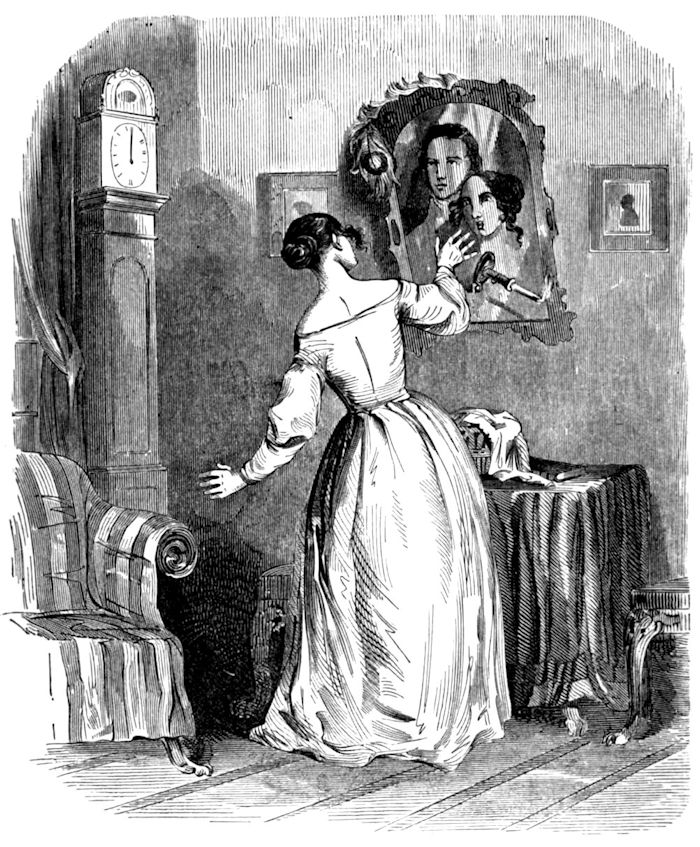
Engraved Expressly for Graham’s Magazine. THE LOVE TESTS OF HALLOWE’EN.—No. 1.
“A dozen times, as the lonely evening passed away and Lizzie hearkened to the troubled roar of the storm without—for the rain had begun to fall—did her heart fail her. But the intense desire she felt to know something certain in regard to her lover, brought back her wavering resolution. There was no one at home but her father and mother, and they retired to bed, as was their usual custom, about nine o’clock. Three hours yet remained before the all-potent love test could be tried, and there was full time for Lizzie’s already weakened nerves to become sensitive to the utmost degree. In order to make the time pass less wearily, she took up some work and tried to sew. But her hand was so tremulous that she could not hold the needle, and after a few trials, she was forced to abandon the attempt. She next tried to read, but with no better success. Her eyes passed from word to word over the open page, but there was not the slightest connection between the words in the book and the ideas that were passing through her mind. Half an hour was spent in this way, and then, startled by a noise as of some one trying to open the outside door, she looked up and listened intently, while her heart throbbed so heavily that she could distinctly hear every pulsation, and feel them as strokes upon her bosom. As she listened, other sounds became apparent. There was the noise, as of feet, walking around the house; voices were heard in the moaning wind, and cries from the distant forest. Now, there seemed to be a knocking at the window-pane, and she half turned herself to look, her heart shrinking lest some fearful apparition should meet her eyes. Even in the room the deep silence was broken by strange sounds—something rustled in one corner, and rattled in another; and even the fire blazed on the hearth with an unearthly murmur, while the sparks flew suddenly out, and darted across the room as if instinct with some living purpose.
“Thus it was that the hours crept slowly on. But still firm to her purpose, Lizzie, though her heart was almost paralyzed with superstitious fear, kept her lonely vigil. At length the clock, which had ticked with a louder and louder noise as time wore on toward midnight, pointed to the minute mark before twelve. Up to this tone the storm without had been steadily increasing. But now there came a sudden lull in the tempest, and the roar of the wind sunk into a low, sobbing moan, that sounded strangely human.
“The hour had come. Upon the table by which Lizzie sat, stood the candle, and near it the apple which must be eaten as a part of the spell that was to raise the spirit of her lover. Strongly tempted was Lizzie, at this crisis, to rush from the room and abandon the bold experiment. Both hands of the clock would be on the point that marked the close of Halloween in a few seconds, and if she did not act now, the secret she so ardently desired to penetrate would still be hidden from her eyes. She felt awful in that moment of deep suspense. Her heart ceased for an instant to beat, and then bounded on again in troubled throbbings. Then, with a kind of desperate energy, she caught up the candle and apple, and turned to the glass that hung against the wall. As she did so, the brief lull in the tempest expired, and the wind, as if it had gained new power, rushed past with a wilder sound, and shook the house to its very foundation.
“One glance into the mirror, as the hammer of the clock began to fall sufficed. A wild scream, thrilling through the house, accompanied by a noise as of some one falling heavily, aroused the sleeping parents. When they descended to the room below, they found Lizzie prostrate on the floor in a state of total insensibility.”
“Why, aunt!” exclaimed Kate, in a husky voice.
“What did she see?” asked Maggy, who had been listening with breathless attention.
“It was many hours before the frightened girl came back to consciousness,” said Aunt Edith. “I saw her on the day afterward, and she looked as if she had been sick for a month. We were intimate, and on my asking her some questions, she told me what she had done, and avowed that, as she looked into the glass, she distinctly saw the face of a man peering over her shoulder.”
“But you didn’t believe her,” said Mr. Wilmot.
“Did she know the person whom she saw?” asked Maggy.
“Yes. She told me who it was; and they were afterward married.”
“Nonsense!” exclaimed Mr. Wilmot. “I’m really surprised at you, sister! You will turn these silly girls’ heads. You surely don’t believe that she saw any face in the glass besides her own.”
“In imagination she did, without doubt. The fact of her fainting from alarm shows that.”
“But you say, Aunt Edith, that she afterward married the person she saw?”
“Yes, dear. But that is no very strange part of the story. Young ladies are not famous for keeping secrets, you know. I told a young friend, in confidence, of course, what Lizzie had told me. She, though bound to secrecy, very naturally confided the story to her particular friend and confidante, and so it went, until the young man came to hear of it. It so happened that both he and Lizzie were rather modest sort of young people, and, though mutually in love with each other, shrunk from letting any signs thereof become manifest. At a distance the young man worshiped, scarcely hoping that he would ever be, in the eyes of the maiden, more than a friend or acquaintance. But, when he heard of the love test, and was told that his face had appeared to the maiden, he took courage. The next time he met Lizzie, he drew to her side as naturally as iron draws to the magnet; and as he looked into her mild blue eyes, he saw that they were full of tenderness. The course of true love ran smoothly enough after that. On next Halloween they were made one, in the very room where, a year before, the never-to-be-forgotten love charm was tried.”
On the next morning neither of the sisters were very bright. Maggy was pale; Jane did not make her appearance at the breakfast table, and Kate looked so thoughtful as she sipped her coffee with a spoon, and only pretended to eat, that her mother inquired seriously as to the cause.
Kate blushed, and seemed a little confused, but said nothing was the matter.
“I hope you have not been so silly as to try sweethearts,” remarked Mr. Wilmot.
Instantly the tell-tale blood mounted to the brow of Kate. Maggy, likewise, found her color, and rather more of it than her cheeks were wont to bear.
“Why girls!” exclaimed the father, who had spoken more in jest than in earnest. “Can it be possible—”
But, before he could finish the sentence, both Kate and Maggy had risen from the table—their faces like scarlet—and were hastily leaving the room.
“Really,” said Mr. Wilmot, “I thought better of them girls! What nonsense! This is all your fault, sister. I shouldn’t at all wonder if you were up with them trying your sweetheart.”
Aunt Edith smiled, in her quiet, self-possessed way, as she replied—
“I hardly think, brother, you will find it any thing more serious than eating a salt egg on going to bed, or some trifling affair like that; for which I can readily excuse a young maiden.”
“To think they should be so weak as to believe in nonsense of this kind!” said the father. “I hoped that my daughters had better sense.”
“Don’t take the matter so seriously, brother,” replied Aunt Edith to this. “It has only been a little frolick.”
“It has been rather a serious one, I should think, to judge from the effects produced. Jane, I presume, is too much indisposed to get up; and I am sure both Maggy and Kate look as if they had been sick for a week.”
“They’ll all come out bright enough before noon. Don’t fear for that.”
The girls, however, were not themselves again during the whole day. Jane’s absence from the breakfast table was in consequence of a nervous headache, from which she suffered nearly all day. And Kate and Maggy continued to look thoughtful, and to keep as much away from the rest of the family as possible.
It out, before night, that each of the girls, on retiring at twelve o’clock, had eaten a “salt egg.” The consequence to Jane was a sick headache; and the others did not feel much better. As to their dreams, they wisely kept their own counsel. That these had some effect upon their spirits, was, no doubt correctly, inferred.
“That a young girl, after sitting up until twelve o’clock at night, thinking of a certain nice young man, and then eating half a cupfull of salt, should dream that she was thirsty, and that this certain young man came and offered her water to drink, is not a very wonderful occurrence, and might be accounted for on very natural principles.”
“Of course,” replied Aunt Edith, to whom the remark was made, as we sat, all but the girls, conversing before the parlor fire on the evening of that day. “And yet I have known of cases where the dreams that came were singularly prophetic. As for instance. A young friend of mine, when I was a girl, tried, though under engagement of marriage, this experiment. She dreamed that her lover came and offered her water, and that she declined taking it, which is considered an unfavorable omen. In a month afterward, although the time for the wedding was fixed, the young man deserted her for another.”
“All that may have occurred,” said Mr. Wilmot, “without there being any connection between the dream and the after event.”
“Oh, certainly. Yet you must own that the coincidence was a little singular,” returned Aunt Edith.
“There are hundreds of coincidences occurring daily that are far more remarkable.”
“Very true. But will you say positively that indications of things about to occur are never given? That no shadow of a coming event is ever projected upon our pathway as we move through life?”
“As I do not know, positively, any thing on the subject, I will assert nothing. But, as a general principle, we are aware that Providence wisely withholds from us a knowledge of the future, in order that we may remain in perfect freedom. If the knowledge of future events was given, our freedom would be destroyed, for the certainty of approaching calamity, or favorable fortune, would destroy our ability to act efficiently in the present. And as, for so good a reason, our Creator draws a veil over the future, I think it wrong for us to use any means for the removal of that veil.”
“To any one,” replied Aunt Edith, “whose mind is as clear on this subject as yours, all seeking after future knowledge would be wrong. But all are not so enlightened. All have not the intelligence or ability to think wisely on Providence and its operations with men. To such, in their weakness, the kind Providence that withholds as a general good, may grant particular glimpses into the future, as the result of certain forms which may determine spiritual influences; as was the case in ancient times, when oracles gave their mysterious answers.”
“I’m afraid, sister,” said Mr. Wilmot, “that you have a vein of superstition in your character.”
“No,” returned Aunt Edith. “I believe I am as free from superstition as one need wish to be. But I look upon the operations of Providence with man as designed for his spiritual good, and as coming down to meet him even in his lowest and most ignorant state, in order to elevate him. There may be a condition of the human mind that needs, for its aid, some sign from the world of spirits; and wherever that state exists, such signs will be given. In the barbarous times of any nation, we find a belief in supernatural agencies—in signs, tokens, and oracles—a prominent characteristic. This is not so much an accidental circumstance as a Providential arrangement, by which to keep alive in the mind the idea of a spiritual world. The same is true among the unenlightened classes at the present day; and the reason is of a similar character. To people who know no better than to seek, by certain forms, to penetrate the future, true answers may be permitted sometimes to their inquiries; and this for a higher good than the one they are seeking.”
At this point in the conversation the young ladies came into the room, and the subject was changed. During the evening allusion was again made to the topic upon which so much had already been said, when, in answer to some question asked of Aunt Edith, she related the following:
“Before I was married,” said she, “there was a certain young man who paid me many attentions, but whom, from some cause or other, I did not particularly fancy. He was an excellent young man, of a good family, and, as sober and industrious as any one in the neighborhood. Still, for all this, I felt more like repulsing than giving him encouragement. He saw that I avoided him when I could do so without appearing rude, and this made him more distant; yet I could see that his mind was on me. I would often meet his eyes when we were in company; and he would come to my side whenever he could do so without appearing to be intrusive. His many excellent qualities, and the manliness of character for which he was distinguished, prevented me from treating him otherwise than respectfully. As a friend, I liked him, but when he approached, as was evidently the case, in the character of a lover, I could not be otherwise than cold and reserved. There were two or three other young men who appeared fond of my company, any one of whom I would have accepted, had he offered himself, in preference to this one.
“Such was the state of my love affairs, when Halloween came round. A cousin, a young girl about my own age, was spending a few weeks in our family, and she and I talked over the matter of trying sweethearts. After looking at the subject in its various lights and shades, we finally determined to summon up the requisite courage, and burn a love-candle. So, after all the family were in bed, which was not until after eleven o’clock, we began to make preparations for this ceremony. Burning the love-candle is done in this way. A table is set with bread, cakes and fruit; or any other articles of food that may be selected. Plates for as many guests as are expected are also put upon the table; but no knives or forks, lest the guests should, by any accident, harm themselves. A little before midnight a candle, in which a row of nine new pins have been placed just below the wick, is lighted and set upon the table. The distance between the row of pins and the burning end of the candle must not be greater than will melt away by the time the hour of twelve strikes. When the candle burns down to the pins, they drop one after the other, and just as the last one falls, the apparitions of the future husbands of those who try the charm will enter, it is said, sit down to the table and eat, and then rise up and go away.
“Well, Lydia and I determined that we would try this love charm; so we arranged our table, placed upon it the candle in which were stuck the row of nine new pins, and sat down to await the arrival of the hour that was to open for us a page of the future. I shall never forget the deathlike stillness that reigned for a time through the room; nor how I started when the old house-dog suddenly raised, almost under the window, a long, low, melancholy howl. My heart seemed to beat all over my body, and I could feel the hair rising on my head. After a quarter of an hour had elapsed, we lit the candle and returned to our seats on the opposite side of the room to that in which the table was standing, almost crouching down in our chairs. As we did so, one of the shutters, which was merely drawn to without being fastened, flew open suddenly, and was slammed back against the side of the house, at the same time the wind began rushing and moaning through the trees. I felt awful. Spirits seemed all around me, and I looked every moment for some fearful apparition to blast our sight with its presence.
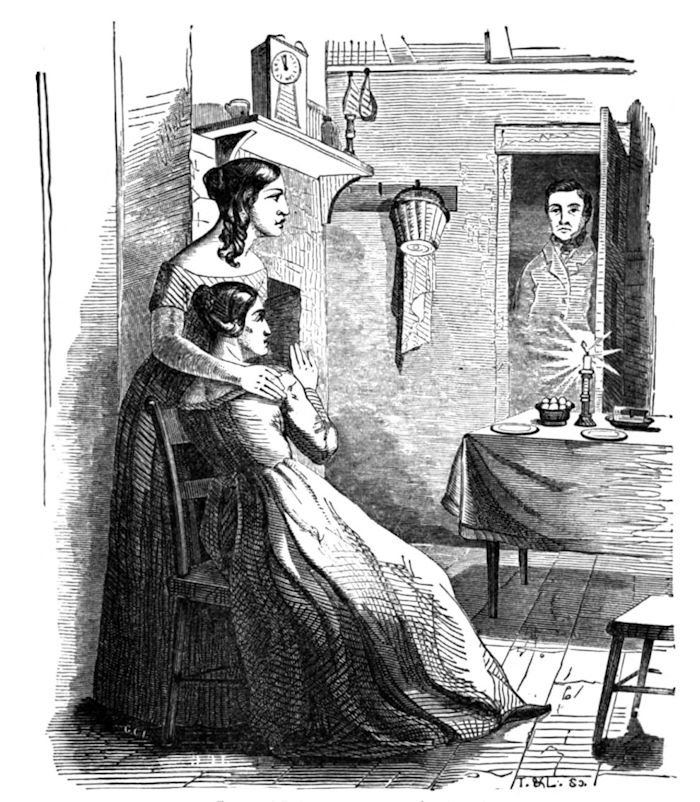
Engraved Expressly for Graham’s Magazine. THE LOVE TESTS OF HALLOWE’EN.—No. 2.
“Steadily the hand passed from point to point, and from figure to figure on the dial of the clock, my feelings becoming more and more excited every moment. At last came the warning that is given just before the striking of the hour, and the minute hand had but a point or two to pass before it was on the sign of twelve. My very breath was suspended. A few moments more, and then the hammer of the clock fell, and each stroke appeared as if made upon my heart. Suddenly there came a rush of wind past the house, and strange, wild, mournful tones it made; then the door swung open, and in came the apparition of a man. I saw in an instant that it was the one of whom I have spoken. His face had a fixed, dreamy, and, it seemed to me, troubled expression. He went up, slowly, to the table, and sitting down at my plate, took some fruit. For the space of nearly a minute it seemed to me, he remained there motionless; but did not eat. Then rising he turned away and left the room. During the brief period he remained, he manifested not the slightest consciousness of our presence. You may be sure we did not remain long after he had retired, but went tremblingly up stairs, half frightened out of our wits, and buried ourselves beneath the clothes without stopping to remove our garments, where we lay and shivered as if both of us had ague fits.
“Well, sure enough,” continued Aunt Edith, “it turned out as the sign had indicated. I was married to the young man, and my cousin died an old maid. It was all folly I thought to struggle against my fate, and so from that memorable ‘Hallow-Eve’ received my lover’s attentions with favor.”
“And were you so weak as to believe that any one did really come in?” said Mr. Wilmot.
“I was,” returned Aunt Edith.
“It was all your imagination,” said the brother, positively.
“No, I believe not. I don’t think it was possible for both of our eyes to be deceived.”
“Then your cousin saw it too?”
“So she would have averred, had you asked her the day before her death.”
Mr. Wilmot shook his head; while the girls looked credulous. I noticed that Kate glanced slightly around, every now and then, half fearfully.
“One day,” resumed Aunt Edith, “about two years after our marriage, something favoring an allusion to the subject, I said to my husband—‘There is one thing that I never could bring myself to mention, and I hardly like to do it now.’ ‘What is that?’ he asked. I then related to him, minutely, all that I have told you this evening. He looked grave, and was thoughtful for some time. Then he said—‘And there is also one thing about which I have never felt free to speak to you. I remember that night well, and shall have cause to remember it as long as I live.’ ‘Were you conscious of any thing?’ I asked eagerly. ‘Yes, of a great deal,’ he replied. ‘I saw, in fact, all that passed.’ ‘In a dream?’ said I. ‘No, while awake—as fully awake as at this time. To throw off all disguise, and speak without mystery, I happened on that night to be going home at a late hour, and in passing your house saw a light streaming through a small opening in the shutter. It instantly occurred to me that you might be up and engaged in some love experiments, as it was Hallow-Eve; so, stealing up softly, and peeping in, I saw that I was not in error. No very long time was spent in determining what to do. My decision I marked by suddenly jerking the shutter back, and slamming it loudly against the house. Concealed by the darkness, I perceived the effect of this. It was what I had anticipated. You did not in the least suspect the truth. As plainly as if I had been in the room, I could now see all that was passing; and, as I understood the particular charm you were trying, knew precisely what part I was to act in the ceremony. So, as I had all along believed myself to be the favored one, although you somehow or other appeared to think differently, I took the liberty of walking in, just as the clock struck twelve.”
At this part of Aunt Edith’s story she was interrupted by a burst of laughter from all in the room.
“And so that was the explanation of the great mystery?” said Mr. Wilmot. “The troubled spirit was a real flesh and blood visiter after all.”
“Yes. And in my heart I forgave him for the trick he played off upon me so adroitly.”
“Why, Aunt Edith!” exclaimed Maggy, taking a long breath. “How you frightened me! I really thought it was a spirit that had entered!”
“No, child. Spirits, I believe, are not apt to walk about and visit love-sick maidens, even on Halloween, for all that may be paid to the contrary. The instance given you is the best authenticated I have ever known.”
This relation furnished abundant food for merriment, as well as for some sage reflections during the evening, and even Maggy, Jane and Kate saw reason to join with the rest in laughing over the folly of Love Tests at Halloween.