RAFFAELLE D’URBINO.
Reading edition
———
BY W. H. WELSH.
———
’Twas night in Florence!
Pale the eve had come,
And flung o’er Nature’s form a sable shroud.
With step as light as joy the day had gone,
And sunk into his jeweled couch, o’erhung
With crimson canopy and crystal sheen.
The rosy-colored clouds, with emerald fringed,
That veiled the blushing sky, had faded far—
And as the night crept on with noiseless tread,
Bright starry eyes looked on the sleeping Earth,
And smiled that then it was so like their home.
Through latticed bower and tesselated hall,
The zephyr danced with wild and airy wing;
And spirit-songs sighed on the startled air
That blew as fragrant as in Araby!
The night was holy!
On the arching sky
The Painter turned and saw its thousand fires.
Around his peaceful form the breezes stole
With viewless pinions from Æolus sent,
While ever and anon a passing breath,
More eager than its fellow, rippled up
The curls that gathered on his glorious brow.
Like one whose spirit-form was not of Earth
He seemed that hour, for o’er him halos hung,
Such only as the vales of Paradise
Enclose around the beings of their birth.
And as he gazed upon the star-lit hall,
And then with straining sight looked on the sky,
As if to catch from it some angel glance,
He sat him down and buried up his face.
With agony oppressed, his very heart
Was shrunk and withered, e’en as when a bird
Whose little life has been a holyday,
Is overwhelmed as summer clouds have wept.
Why thus did shadows press upon his soul,
And with their awful wings fright hopes away?
Why thus disturbed? Fame in his way had strewn
With reckless hand, her fairest, proudest gifts—
Had taught his name to echo far amid
The ages yet unborn, as though a God
From high Olympus he’d been missioned forth!
And yet his heart was sad—for in his dreams
There broke upon his fancy such a form
As dwelleth only in the Elfin-land.
For her he pined—for her he breathed a sigh—
And prayed to God that she might come to him,
And in his waking moments bid him live.
And as, with gloom and darkness thick’ning round,
He sat and wept for joys that might not be,
From out the dim and mystic land of dreams,
There came to him entranced such visioned sights
As never mortal eye had seen before.
Back on the crumbling path of Time he went,
And stood amid the light of ancient days—
Amidst the treasures of the mighty dead!
The seal that held the past was shriveled up,
And from the breathing ruins wondrous forms
Swept by, and walked again the sea of Life.
The young and beautiful of olden time—
The giant habitants whose genius swayed
The visible creation at its dawn,
All gathered there in that fantastic realm,
To swell that ghostly throng!
And as they came,
One form arose so matchless in its grace,
That all, amazed, shrank tremblingly away.
With queenly step she trod the ravished turf,
And with her winsome foot the lovely buds
In very ecstasy of rapture played,
That one so gentle sought their perfumed home.
A veil of silver-tissue, mottled o’er
With sparkling stars, hung round her sylphid form,
And tresses, rich like Autumn’s golden grain,
Fell down, and nestled on her snowy breast.
Too exquisite for earth—of mould too fine—
She seemed a herald from the beaming sky,
Sent down to whisper of the spirit-land.
Such sight, I ween, had painter never seen;
And e’en the charméd breath of poesy,
Whose blissful cadences the enwrapt ear
Of wondering mortals caught with silent joy,
Had conjured up in wild and weird-like spell,
No face that ever was so fair and bright.
One look she gave the painter as he gazed,
That made to him a desert of the world—
A look so full of passion and of love,
It turned the memory of the past a blank,
And in the future left him naught but her.
His soul was all afire, and his brain
Swam round, as when the throbbing heart of man
Is burst for happiness it cannot hold;
And as he strove to break the mortal chain
That bound him where he lay, a mist arose
And envious bore that being from the spot.
Far from his sight she fled! and passed away
With floating witcheries of wildest song,
Into the twilight land where spirit forms
Like phantoms mingled with the swelling gale.
Far from his sight she fled! and like a barque
Whose guiding star has left its native sky,
The painter drifted on with heedless sail!
. . . . . .
The morning breeze crept in the painter’s hall!
And near the window ledge, with pallid brow,
He lay like one whose very pulse had gone.
With tips of gold the princely spires and domes
Of Florence gleamed, and on her throne she sat
A queen in pride—queen of the Tuscan land!
The morning grew apace, and fleecy clouds,
The children of the dawn, trailed o’er the sky.
Still Raffaelle slept.
Near by his side
Were rudely strewn the handmaids of his toil;
And on his easel hung a picture full
Of beauty as the glow on Dian’s front.
No human eye had ever turned its gaze
Upon that fair and sacred thing, save one,
And little recked he now of bliss in store.
The morning breeze crept in the painter’s hall,
And catching its fresh scent he woke and stared
Upon the sky that blazed with living light;
And then again around the hall he cast
A look that spoke of sorrow and of pain.
And while he tried to chase away the clouds
That brooded o’er him like a fearful spell,
The radiant image of that lovely one
That was his nightly dream, flashed on his sight;
With wonderment he stood and scarcely breathed,
For fear a lightsome sound might fright her far.
Ay! there she beamed—a rainbow in the storm—
For in his sleep his mighty genius woke,
And gave embodiment to face and form;
And joy clung round his overburdened heart,
Like sunlight on the drooping bud, when storms
Have rocked its tender petals in the breeze!
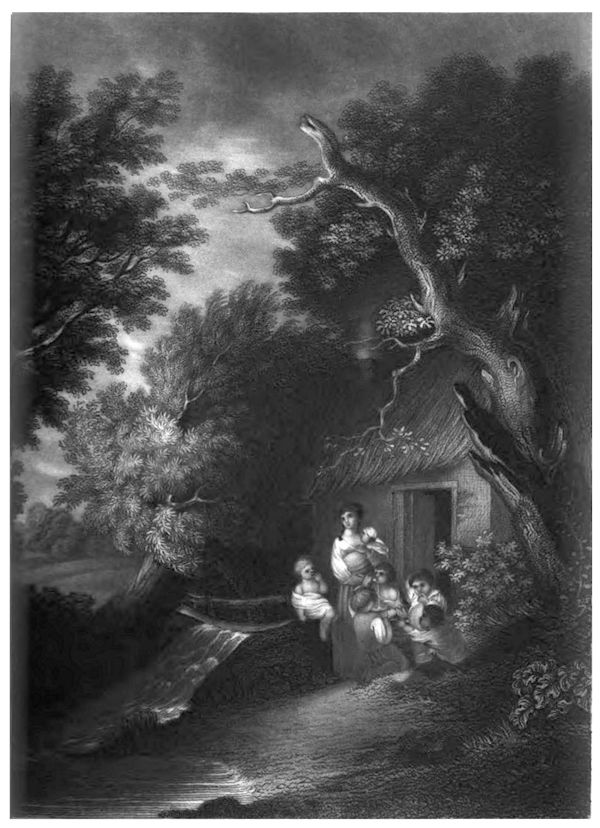
Painted by Gainsborough Engraved by F. Humphreys THE COTTAGE DOOR. Engraved Expressly for Graham’s Magazine