Part 11 — STOCK-JOBBING IN NEW YORK.
Reading edition
———
BY PETER PENCIL.
———
“Nothing venture, nothing win.”
There are comparatively few people, even in New York, who know, or have the most remote idea of, the amount of the daily transactions of various kinds that take place in Wall street. If the truth could be arrived at, it would appear, I doubt not, that the operations there, in the course of a year, exceed, in their aggregate amount, those of all other cities in the United States combined. This opinion may startle some, but it will not startle those who are in the practice of visiting that place, and seeing what is going forward among the countless capitalists, brokers, merchants, and others, whose vocation draws them to that vicinity. Nor can one who is a visiter merely, form a conjecture approximating to the truth, concerning the multiplicity and extent of Wall street affairs, any more than a man who travels straight through the middle of a state, can form an idea as to what quantity of corn is growing upon the whole surface. It would be necessary to penetrate the hundreds of offices, both great and small, public and private, and to see all that is done therein, before one could begin, as the boys say, to estimate the amount of business transacted in that short street, and its immediate vicinity, in the course of a single day.
The stock operations alone would stagger the credulity even of the initiated, who should keep an accurate account of the amount changing hands from day to-day, and sum the whole at the expiration of the year. Many millions’ worth of this species of property would be found to have been bought and sold, making some richer and some poorer, and leaving some, but, doubtless, very few, about the same in purse at the end of the year, as they were at the beginning.
If a person, standing on the steps of the exchange, were endowed with the faculty of reading the heart of every man that passed him, what numbers of agitated bosoms, what hopes, what fears, what emotions of vexation, sorrow, anger, and despair, would come under review; particularly after a panic among the speculators, and a consequent fall of stock!
There are a few fortunate individuals, who owe to Wall street all they possess—having speculated and staked high under the benign influence of Fortune, while that goddess was in a kindly humor; but there are hundreds, nay, thousands, who have seen their wealth melt away there, like snow in a sunny nook on an April morn. “Make or break—neck or no joint,” are the mottoes there; for when a man once gets into the spirit of speculating, as this species of gambling is mildly termed, he is not apt to back out till he has made a fortune, or lost what he possessed—won the horse, or lost the saddle.
The reader will see, in the course of this essay, to which of these categories I belong; for I, too, have been afflicted with the prevailing mania for stock-jobbing, and have shared in the hopes and fears, joy and sorrow, which are produced by the uncertainty of such operations, and the momentous consequences which often follow in their train. It is my purpose to give a short sketch of my doings in that line of business, (now so much in vogue,) for the amusement of those who never go into Wall street, and the benefit of such adventurous spirits as may be disposed to try their fortune at the same table.
It may not be known to the majority of my readers, that the prices of stocks, in New York, are very much influenced by the weather; indeed, I have sometimes thought that their value, as a marketable commodity, depended more on the state of the atmosphere than on their intrinsic worth. I have known a snow-storm cause a sudden fall of two to five per cent.; and an April shower, though it lasted but an hour, more or less, have the same effect to the extent of one or two per cent. I have myself suffered in my speculations by a change of weather; and the only fortunate hit I ever made, I ascribe entirely to the opportune clearing up of a long storm.
It is really surprising what effect the weather has upon the minds of stock-operators. Apparently, those enterprising fellows are as susceptible to the influence of the atmosphere, as poets; though in every thing else, it must be confessed, they are as different from the genus irritabile vatum, as Horace calls them, as the orange-water on a lady’s toilet is from the plain, unperfumed Croton in which she laves her hands. On a bright, sunny day their countenances wear a cheerful expression, their bosoms throb with joyful expectations of an advance or fall in prices, as may happen to suit their purpose; and, in a word, they feel richer and better, and are prepared to renew their operations with increased spirit. Hence the expression so often seen in the “Money Articles” of our daily papers, “there was a better feeling at both boards to-day;” and this stereotyped phrase has become equivalent to the announcement that the weather has become exceedingly fine.
In cloudy weather, on the contrary, particularly if it rains, their faces are generally augmented longitudinally to a very considerable extent; and so true an interpreter is a broker’s face of the state of the heavens, that one might safely depend on it for information without looking at the sky. I regard a speculator’s countenance as far more reliable than a weathercock, because I have known the latter to deceive me by pointing westward, when, according to the weather, it should have stood in the opposite stormy quarter. But the face of a stock-operator of New York was never known to play tricks of this kind, within the far-reaching memory of that most respectable, and often referred-to individual, the Oldest Inhabitant. No man ever saw a smile on his phiz, except when the sun shone.
There are some shrewd men in New York, who perfectly understand these “skyey influences,” and regulate their speculative movements accordingly—buying in a storm, especially if it be a long and severe one, and selling out whenever the succeeding clear weather has produced a favorable reaction in prices. One rich individual, living up town, the moment he rises in the morning, opens his window and looks at the vane on a neighboring steeple—the only part of the church, by the way, he cares a fig about—and if the wind happen to blow from a rainy point, he hastens down town, and orders his broker to dive deep into some of the “fancies.” If, however, the day be clear, he stays at home, his broker being already instructed to sell out some previous purchase, as soon as the weather should warrant.
But the weather, though a most powerful agent in the fluctuation of prices, is by no means the only cause of those great and sudden changes in the marketable value of “securities,” which take money from one pocket, and put it into another. An apprehension, well or ill founded, (it is the same thing in effect,) of an increased demand for money; a paragraph in a newspaper, announcing, mysteriously, that some sort of news, concerning nobody knows what, may be expected in a few days; wars, and rumors of wars; and reports about different matters, however trifling and uninteresting to the majority of the people; all these are sufficient to dash a broker’s spirits; and produce a panic in the market.
Stepping into the great room of the exchange one day, to see the doings at the public board of brokers, I, like the rest of the crowd that stood looking on, became interested in their proceedings, and was soon seized with a desire to try my luck in speculation. I had previously heard of this man and that, having realized their thousands in as many weeks; and as stocks were advancing, and likely, for aught that appeared, to have an “upward tendency” for some time to come, I saw no good reason why I, too, might not increase my little capital in the same rapid manner. “The prospect before us is cheering,” said I to myself, “the boundary question, thanks to the great Daniel, is settled; money is plentiful, and as cheap as dirt; and, in all human probability, Harry Clay, or somebody equally worthy, will be our next president. It follows, therefore, as a necessary consequence, that good dividend-paying stocks must advance.”
Now this seemed well reasoned, to say the least, and the conclusion a just one; but, alas! for human foresight! the good stocks, in which alone I ventured at first, like a balking horse, stood still, or if they moved at all, refused to budge an inch in the right direction. The bad stocks, those not intrinsically worth a fig, were those which I should have purchased. They went up like a rocket; but mine, from the moment that I bought it, seemed to have suddenly acquired one of the properties of lead, for it would go down, in spite of every effort made to keep it up—and the papers called it heavy. Heavy enough I found it, heaven knows! But I am anticipating, and running ahead of my story.
When I entered the exchange, I was the possessor of fifteen hundred dollars—the savings of many years of industry; but I was tired of work, and longed to make a fortune rather by the exercise of intellect, than by the labor of my hands. It promised me a fortune in a hundredth part of the time that it would take me to accumulate one in any other way; and then it was so fine, I thought, to be considered a heavy dealer in stocks, and to be regarded as a great, bold operator, and a capitalist. How could I, with such lofty ideas in my head, and with such a consciousness of possessing superior tact and talent, go back quietly to work! Pah! the very thought of such a thing sickened me.
I caught the eye of a broker with whom I was acquainted, and, having beckoned him to me, requested him to buy ten thousand dollars worth of Ohio sixes, at the market price, which happened, I remember, (and I shall never forget it the longest day I live,) to be one hundred and four. The day was pleasant, the room light, and well filled with cheerful spectators; the brokers were in good spirits, and disposed to go deep in their favorite game, and, to use a common expression, the steam was up to the highest point at both boards, and in the street.
Methinks I hear some one ask how so much stock was paid for by a man worth but fifteen hundred dollars, all told. Innocent one! I will tell thee. I borrowed the money, or about ninety per cent. of it at least, for a few days, and gave the stock itself as security. How simple! did I hear thee say? Truly the process was exceedingly simple; natheless I advise thee not to follow my example.
I considered myself uncommonly lucky in thus securing what I wanted at so low a price, as I then regarded it; for the broker assured me, and such seemed to be the prevailing opinion among the knowing ones, that the stock I bought would rise six per cent. at least within two or three months. I expected, so sanguine is my temperament, to sell at that advance in less than a fortnight; and already considered myself as six hundred dollars richer than I was before. “A nice little sum that,” thought I, “for a beginning, and will furnish the out-goings for a month, next summer, at Saratoga, and the disbursements of a trip to Niagara, returning by way of Montreal, Quebec, and Lake George.”
There is a proverb about counting the young of barn-yard fowls, before the tender chickens are fairly out of their shells; which proverb admonishes us never to make such a reckoning till the hatching is completed, lest we should be disappointed as to the number. Experience has taught me that this proverb, with some slight verbal alterations, would apply equally well to the expected profits from speculation in stocks. One should never count his gains, nor appropriate them to any specific purpose, until they be realized.
In a day or two I found, much to my chagrin, that the stock I had so fortunately purchased, instead of being on the high road to one hundred and ten, began to grow tired of advancing, as though it were leg-weary, and turning suddenly about, took, like a school-boy coming home, “cross lots” the shortest possible way back to its old position on the wrong side of par. I ascribe this sudden change to two causes; first, I was the owner of some of the stock, which reason was enough of itself to knock down that or any other security; as I never in my life touched any thing of the kind that did not immediately become “heavy,” and of less value than it was before. Tom Moore complained most beautifully of similar ill-luck, and said, in his own inimitable way,
“I never nursed a dear gazelle,
To glad me with its soft black eye,
But when it came to know me well,
And love me, it was sure to die.”
And I can and do say with more truth, (for Tom evidently fibbed, or rather made Hinda do so,) and with equally good rhymes, that
I never bought a single mill
Of stock, in that vile street named Wall,
That rose a peg, or e’en stood still;
Dod rot it!—it was sure to fall.
Secondly, a paragraph appeared in the Herald, saying something about England and war; and this circumstance, combined with the fact of my being a holder, was too much for Ohio sixes, and down they went. Nothing short of a miracle could have sustained them under such a pressure. But this was not all; for, in the incipient stage of the panic which followed, the wind suddenly veered round to north-east, and a storm came on to increase the difficulty. Such a scene as ensued has rarely been witnessed since Wall street became a theatre for speculation. Faces became elongated many hundred feet in the aggregate; eyes opened to their widest capacity, and seemed to be looking wildly about for that greatest of bug-bears, the British; and every speculator’s heart, like Macbeth’s, did
————“Knock at the ribs,
Against the use of nature,”
as though some terrible calamity, involving the annihilation of every thing in the shape of stocks and money, were impending.
If some giant from another globe had come upon the earth, and suddenly knocked the foundation stones from under that noble structure, the merchants’ exchange, the crash would hardly have been greater or more alarming than that which took place, on the day in question, among the stocks. I stood silently by, and saw my property vanish, as it were, before my eyes; but I will not attempt to describe my feelings, for I am sure that I should not be able to convey an idea of them to the reader’s mind. Suffice it to say that I was hurt—cut to the very soul. “Farewell, Niagara, Quebec, and Montreal,” thought I; “if I can keep out of the almshouse, the way things are going, I shall be remarkably lucky.”
After consulting with my friend, the broker, who, to do him justice, it must be confessed, gave me the best advice that his fears permitted, I concluded to sell out my stock at ninety-eight, while it was on the descent, and buy again the moment it should reach the lowest point, which the broker and I thought would be about ninety. Then, if our expectations should be realized, and the stock again reach what I had before given, namely, one hundred and four, it is clear that I should, beside recovering my loss, make eight per cent. profit.
Here was a most glorious opportunity for a speculation—one of those that occur about twice in a century. It was a happy thought in me to sell even at a great loss, with a view of repurchasing on better terms; and I could not help regarding it as a singularly bold move—one indicating great genius, and just such a one as Napoleon himself, under similar circumstances, might have conceived and made. I became elated at the prospect, and bade my friend sell out with all possible expedition. He did so at ninety-eight, being a loss to me of six per cent., or six hundred dollars—a pretty fair clip from the back of my little capital of fifteen hundred.
I should have been exceedingly annoyed by this docking of my fortune, had not the certainty which I felt of making good the deficiency, encouraged me; and but for the most perfect confidence I entertained in the success of my next adventure, I should, in all human probability, have retired from Wall street with much the same feeling that a fox has when he sneaks off to his hole, after parting with his tail in a trap.
But what short-sighted mortals we are, and how the blindfolded goddess loves to sport with human calculations!
————Heu, Fortuna, quis est crudelior in nos
Te Deus?—ut semper gaudes illudere rebus
Humanis!
exclaimed Horace; and depend upon it, if stocks were the subject of traffic in Rome, he had just been nicked when he wrote that passage. Most courteous reader, I was doomed to suffer another grievous disappointment; stocks took a different turn from what I had expected. The storm cleared away, and the panic abated. The sun again shone out bright, and smiles reappeared on the brokers’ faces. Prices had reached their lowest point, precisely at the moment that I sold out mine, and instead of going down to ninety, as they would have done had I continued to hold, they “rallied,” as the saying is, and rose to par. I looked and felt blue, and counted over my money again and again; I ciphered and calculated for half a morning, in endeavoring to make my loss less than it was. It was of no use, however, for the result of my counting and my ciphering were precisely the same, showing a deficiency of six hundred dollars and the brokerage. “O, if I could but get back my stock,” thought I, “I would hold it till doomsday, before I would again sell it for a less sum than it cost me.” That was an idle thought, for the money having been borrowed, I had not the power to do as I wished.
Well, I found that complaining would do no good, and it was plain that I could not recover my losses by sitting down and doing nothing; beside, it was very unlike a bold operator—a Napoleon of the exchange—to be disheartened by the first reverse or two; so I determined, as there was now a strong probability of an immediate advance of prices, to get back my Ohio stock at par. I was too late in deciding by a day, and was obliged to give one per cent. premium. That trifling difference, however, I did not regard; for what was one per cent., more or less, to a man who was sure of making ten of them?
I now felt certain that I had hit the nail on the head. “Rem tetigi acu,” said I; and what made me more confident of success was the fact, that the newspapers, disagreeing upon almost every other subject, were agreed upon one point, namely, that, in consequence of the “better feeling” that prevailed, stocks would certainly rise. I believed them, having naturally a strong inclination to credit what I see in print.
A good feeling unquestionably did exist at the time I bought, and the prices of stocks were likewise very good; but, as usual, when the time came in which I was compelled to sell, a very different feeling seemed to be rife, and symptoms of another panic began to make their appearance simultaneously with the approach of a storm. On the day I sold out, everything was at sixes and sevens; the rain came down in floods, the wind blew, and the whole army of brokers, like a flock of sheep that had lost their shepherd, were again in the greatest alarm and confusion. My poor stock, like the parting spirit of Napoleon, went off in a whirlwind, at ninety-eight; and I went home that day mad, and drenched with rain, (having mislaid my umbrella,) and a loser of three hundred dollars more. I felt exceedingly bad—I was disgusted.
The prospect of my going to Niagara was now unpromising; and I prudently resolved to postpone the visit for another year at least. Such a thing was not again to be thought of, till, in gambler’s phrase, I should be on velvet, that is, have some winnings over and above my capital; but so far from being on velvet, I was on the sharpest kind of paving-stones, nay, figuratively speaking, I was on spikes. I was now reduced to the point of struggling, not for victory, but for safety; and I was like a general who, having abandoned all hopes of conquest, would be too happy to save his own bacon, and get safe home. My discouragement, however, was of short duration, and with my reviving spirits, I resumed the hazardous business.
I made several other operations in what are technically called the “fancies”—stocks that pay no dividends, and the value of which is rather imaginary or fanciful, (whence their name, probably,) than real. I had enough of good stocks—they had well-nigh ruined me; and I resolved to try my luck among those that are good for nothing, except to be bought and sold. Ill-fortune still pursued me. What with stormy weather, increased demand for money, paragraphs containing bad news from Washington, and flying reports of some diabolical measure contemplated by England, all my adventures turned out unfavorably, and I was reduced in pocket to a very low ebb. My little capital was on its last legs.
One day, almost in despair, I took up a newspaper, (it was the Journal of Commerce,) and my eye alighted on a remark of the editor’s to the effect that a stock-speculator should be in no hurry either to buy or sell; but, waiting coolly and patiently for opportunities, with his feet elevated upon a stove, he should always buy when stocks are low, and sell out when they are high. I was struck with amazement at the wisdom displayed in this advice, and wondered why so obviously correct a course had not occurred to me in my deep cogitations upon this subject. It was perfectly plain—a child might see it—that if this recommendation were strictly followed, success would crown my efforts; and I forthwith determined to commence another career on this excellent and safe principle. Failure was impossible. “Buy when they are low,” I repeated, “and sell when they are high. How wonderful, yet, at the same time, how simple!” I had all along been pursuing the wrong track. My practice had been, whatever my intentions were, to buy when they were high, and sell when they were low; and this had been the result of a want of patience, and of too much precipitancy in my purchases and sales. I was now in possession of a grand secret, and that secret was to WAIT, BUY LOW AND SELL HIGH.
Well, I did wait, and that most patiently, for a fall of stocks—and a fall at length occurred, a greater one than had been known for a long time, and prices were depressed below what they had been in several months. “Now,” thought I, “is the time to take down my feet from the stove, and walk into the fancies;” whereupon I went into Wall street, and borrowed a considerable sum for a fortnight, pledging the stock as security, according to the modus operandi well understood in that region. Every thing promised well; and I felt encouraged, deeming it next to impossible that fortune should always fight against me. I bought the stock very low, comparatively, and went home to replace my feet upon the stove, and await patiently another rise.
No rise, however, occurred within the fortnight that I was able to hold my new acquisition. Prices moved, it is true, but they moved the wrong way for me; they “advanced backward.” I thought when I purchased, that they were low enough in all conscience; but it appears there were lower depths still to which they were destined to attain. I did not wait long enough. The principle on which I had acted was a good one—the fault was in me.
A man falling from the roof of a house, would not reach the ground more quickly than my stock tumbled to a point five per cent. below what I had given. A new element had arisen to produce this sudden, unlooked for, and extraordinary change. The Texas question came upon the brokers like a thunderbolt, knocking every thing into a cocked-hat; and the upshot was, that I sold my stock at a loss which swept away the remainder of my capital, and left me as penniless as a street-beggar.
This was the last of my operations; and thus the savings of several years disappeared like dew on a summer’s morning. Nor is that the worst feature of this unfortunate business; for the excitement of speculation, the handling of large sums of money, the high-wrought expectation of realising large profits in a short time, have totally unfitted me for the labors by which I accumulated what money I have lost. How can I go to work again on a mere salary, two-thirds of which I must spend in support of my family, the remainder being a petty sum only, which any lucky broker would make on a clear morning at a single throw? I am ready to die through pure vexation; but I’ll not leave the ground yet. I know a friend who will lend me five hundred dollars, and by hypothecating the stock I shall buy, I can borrow of Jack Little five thousand. Yes, I must have one more chance—one more—and then, if fortune favors me, as she always does the brave, (so the Latin grammar declares,) I shall soon be on my feet again; but if she should continue to frown, and disappoint my hopes, I will abandon speculation forever—perhaps.
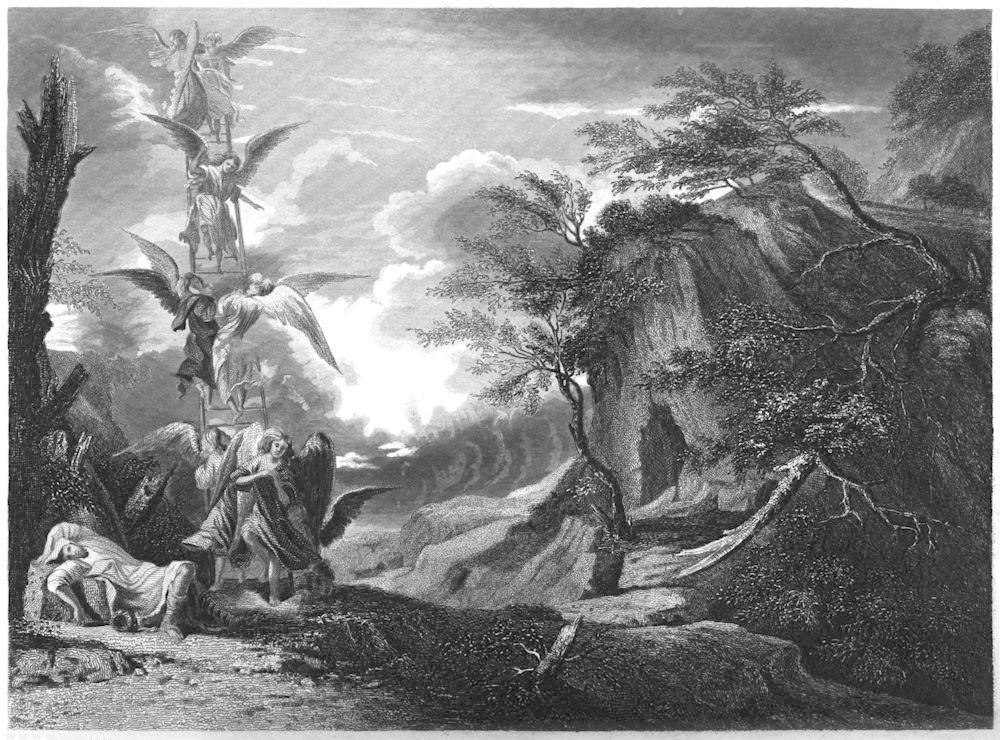
Salvator Rosa, pinx. A.L. Dick, sc.
JACOB’S DREAM.
GEN. XXVIII,
10, 11, 12
.