Part 11 — LOLAH LALANDE.
Reading edition
A PACKAGE FROM MY OLD WRITING-DESK.
———
BY ENNA DUVAL.
———
She can show art rules to astonish her.
How like the nimble winds, which play upon
The tender grass, yet press it not, or fly
Over the crystal face of smoothest streams,
Leaving no curl behind them.
She makes
Motion the god of every excellence,
And what the muses would with study find,
She teaches in her dancing——
To me
It must suffice only to say, ’tis she.
Beaumont & Fletcher.
“Here I am again, dear Miss Enna,” said my darling, pretty friend, Kate Wilson, to me the other morning.
I have already introduced Kate to you, dear reader; and if you had looked into the deep wells of her beaming, bright eye as often as I have, and heard the rich, gushing music of her laugh, you would hail her approach, even though she did plunge unceremoniously into your sanctum, and interrupt you in your studies, or your deep divings into your imagination for something particularly clever, out of which to form a “readable story” for “Mr. Graham’s next Monthly.”
I felt a little annoyed, I must admit, on the morning in question, for I was very earnestly engaged—not in writing, dear reader; oh, no! I spared you that one morning—but in looking over an old writing-desk, that I had not opened for years. It was one that belonged to my mother; and one part I had devoted to her treasured gifts, in the other, for it is a large, capacious, old-fashioned affair, not at all like the little rosewood, mother-of-pearl inlaid thing which has usurped its place on my writing-table; in the other part I have stored gifts, letters, and remembrances of my school-girl days; and this part I was exploring as Kate entered. I had just been sighing over a package, containing letters, a bracelet of hair, and a faded bunch of flowers—mementoes of a dear friend, long since laid in the cold grave, and was almost weeping over remembrances of the past. To me that is the only sad thing in growing old. If those we love could only live to cheer and comfort us, old age would have no terrors. A single woman feels this particularly; for if a woman marries, she forms new connections, and looks forward to a new life, and new interests, in the future of her children; but “we poor old maids” are oftentimes very lonely.
Brothers and sisters, and dear friends, will marry; and however pretty, fascinating, and agreeable a woman may have been, there comes a time when the little decided opinions and caprices that were deemed so pretty and cunning at eighteen, are pronounced by the saucy new-comers on life’s stage, “prim, old-maidish whimsicalities;” and even the fathers and mothers, who had formerly considered this same dear, single friend, the realization of womanly perfection when she was the belle of their young days, they also are often found, coinciding with their children in these saucy opinions. Now, members of my dear sisterhood, let me give you a little advice. True, I am but a new comer amongst you. I know I have not yet seen fifty summers—I only own to thirty-five, and scarcely to that, excepting when in company with those well “booked-up” on the subject of my age—I have no gray hairs or wrinkles, and yet I have experience; and my single-blessedness bids fair to be a happy state. Seek companions amongst the young. I do not mean for you to affect juvenile manners. Oh, heaven forbid! a youthful old-maid is, in truth, ridiculous. But mingle with the young; sympathize with them; cultivate their friendship and love; make your presence a sunshine to them; be to them a friend, a confidant, and an adviser. Keep your feelings, your heart, your spirit young—your mind, by pleasant, but regular study, in a healthful state; in this way you will secure happiness. Then, to escape ridicule—ah! that is the hardest task of all—admit your age; it is the only safe way, believe me. Walk up to the cannon’s mouth boldly. Show them you do not care any thing about it, and the saucy opinions and laughs of these young ones will be averted; and depend upon it they will flutter around you, love you, and almost imagine you still retain the youthful charms and agreeability with which your cotemporaries so kindly invested you. I have found this plan successful, and have surrounded myself with a troop of young things. With one who is a fanatic, a pretty devotee to the divine study of sweet sounds, I practice music; and instead of falling back upon the “music of my day,” I find beauties in the music of her day. Mozart, Hayden, and Beethoven, Steibell, Clementi, and Dessek, are now banished from my music-stand, and only cheer my solitary hours, to make way for Bellini, Donizetti, and Auber, Thalberg, Herz, and Litz. With another, a gentle, little, imaginative creature, whose transparent cheek, and brilliant eye, warns us she is not long to dwell with us, I read old poets. But of all my youthful friends, there is not one among them who loves me better, or who is more companionable to me, than dear Kate Wilson. I have known her from her babyhood. I knew her mother before Kate was born; true, I was a tiny girl when Kate’s mother was married. She is a beautiful, rich belle, “petted, fêted, courted, and caressed;” and yet she daily comes to her “dear Miss Enna,” as she calls me, as she did in her little girl days, and cheers many an hour that would otherwise be lonely. I find myself forgetting, when with her, as she so flatteringly does, that I am no longer young; and I very much fear Kate makes me a little too youthful in dress; but the darling, bewitching creature, has such a saucy, decided way with her, that I always yield to her wishes.
“What are you at?” she asked, as she closed the door; “looking over an old writing-desk, as I live. What piles of letters and old things—that is, indeed, delightful. Stores of love-letters, I’ll wager a bright, golden guinea. Come, let me help you toss it over, and tell me the love-history of each discarded one.”
Saucy girl! her mind seems only filled with lovers. But she would have her way, and the whole day passed in this occupation. She boldly untied each package, and resolutely determined I should tell her the little history appended to each in my memory. The one I held in my hand when she entered, was first taken up; and we both shed tears over the sad story it recalled of friendship, love, and a broken-heart. It is too sad a tale for me to relate to you now, dear reader, for I am not in the tearful mood. Some gloomy, “gray” day, as Kate says, I will again recall it, and see if you will sympathize with the past as did dear Kate Wilson. I have digressed so much already, that I will take up one of the smallest packages now, and relate to you the history of my school-girl friend, Lolah Lalande, as she was called then. Her name is now more famous; but I will keep that a secret until I arrive at the end of my story. It was a small packet, containing only a few French letters, a tress of long, glossy black hair, and a crayon sketch of a childish figure in Spanish costume, and in one of the attitudes of a Spanish national dance. It had a beautiful, girlish face, clear, dark eyes—long, sweeping hair—arched, delicately formed brows—and rich, full lips. That face has turned the head of a monarch, it is said—but I will not anticipate.
“Tell me this, dear Miss Enna,” said Kate, as she looked at the contents of the package. “It could not have been a friendship of long standing—so little remains of it; therefore you will only have a tiny, little story for me, and I will not teaze you again until—to-morrow, or the next gray, rainy day.”
Kate listened with affectionate interest; and I’ll never forgive you, reader, if you are not as indulgent as Kate. But I will seek your favor in the words of Spenser:
“Goe, little worke! thyself present,
As child whose parent is unkent,
To him that is the President
Of Noblenesse and Chivalrie;
And when thou art past jeopardie,
Come tell me what was said of mee,
And I will send more after thee.”
Surely, now, if I say to you such delicate words as these, which Spenser gave to that “noble and virtuous gentleman, most worthy of all titles, both of learning and chivalry, Master Philip Sidney,” you cannot but listen complacently.
When about twelve or thirteen years of age, I was placed at the fashionable establishment of Madame Lalande, to perfect my French pronunciation. Being a shy child, I drew away from the different cliques of the school, during my play hours, and gave myself up to sad recollections of home and my darling little brothers and sisters. The girls laughed at me, and called me “a mope,” which served only to increase my shyness. The Madame was exceedingly kind to me; but I only saw her in the evening, when we all assembled in the large drawing-rooms to dance, promenade, and converse sociably together under her superintendence. A few evenings after my arrival, while I was studiously endeavoring to make my petite figure still smaller, by hiding behind a harp-case which stood in a corner of the back drawing-room, to my exquisite terror, I saw the Madame approach me, holding by the hand a beautiful child, apparently about my own age.
“Mademoiselle Duval,” she said, “you must join in the dancing. You and my niece, Lolah, are about the same size; you will make good partners for each other. Lola, ma chère, I depend upon you to entertain our new pupil.”
The little girl approached me kindly, and taking my trembling hand, said,
“Will you not dance with me?”
I did not dare to refuse, but accompanied her to a quadrille, (cotillions, we called them in those days,) just forming near us, feeling as awkward and shy as a home-girl might be expected to feel, thrown, for the first time, in a crowd of nearly a hundred girls. The first figures of the quadrille I danced awkwardly enough, giving my little partner good reason to think I did not know my right hand from my left; but I soon forgot my mauvaise honte, in the pleasant chatting of the little Lolah, who told me of all the little enjoyments she had. Her “chère tante,” as she called Madame Lalande, had taken her the night before to an Opera, for the first time in her life; and, of course, her little head was filled with recollections of it. She described, with French volubility, and in a most graphic manner, the story of the Opera, the different scènas, and the dresses. I was so new to all such things, that I suppose she could not have found a more agreeable listener in the whole school; and we were mutually pleased with each other. We danced every quadrille together; and she most patronizingly waltzed with me in a corner of the drawing-room, until I could summon sufficient courage to venture in the large circle in the centre of the rooms. At ten o’clock we bade good night to each other, she promising, as her cherry lips kissed affectionately my mouth and cheeks, that she would persuade chère tante to take me some night with them to the Opera—a promise which she kept.
From that night I no longer felt lonely in the school—Lolah was my companion. Though a year or so my junior, she was quite as far advanced in mind; and we were thrown a great deal together in our studies, and with the easy confidence of childhood, we became bosom friends. Lolah was a great favorite in the school. The elder girls courted her for her influence with the Madame and the governesses, and the younger ones gathered around her because she was always merry, kind, and generous. She was a darling little creature—exceedingly pretty. She had full, large, dark eyes, an oval face, with a rich brunette complexion, and glossy hair, black as night. Her figure was slight, but perfectly formed; and she was the most graceful child I ever saw. The little queen of the Viennoise corps, darling little Fanny Prager, always reminds me of Lolah. She is not so pretty, but her graceful movements, her evident superiority over the rest of the troupe, her commanding little step, her apparent freedom from vanity, and her cleverness in forming the different tableaux and groups, bring Lolah to my mind; and while looking at her, I find myself loving the child as I used to love Lolah Lalande in my school days.
With the dancing-master Lolah was an especial favorite. She early gave evidence of a decided partiality for dancing; and Madame Lalande availed herself of every opportunity that offered to improve the child in her favorite accomplishment. Polkas, Redowas, and Mazurkas, were not known in those days; but the dancing-master, in those times, grew eloquent over Gavottes, Shawl Dances, and the expressive and graceful Spanish Waltzes. With delighted earnestness would Lolah go through her different dances; and Monsieur Neillet would almost expire with ecstacy. The Monsieur had been educated in the Parisian school, a pupil of La Conservatoire, and had even danced in a ballet before the august Emperor and Empress. With eager eloquence he would dilate upon Lolah’s wonderful gift to the Madame, and with great concern and grief, lament that she could not become a professional danseuse. Then he would give most tempting accounts of the immense sums of money made by the great danseuses of Europe.
“I trust, Monsieur,” the Madame would always reply, “I trust that my dear Lolah will never be forced to support herself by such a dangerous and exposed profession. While I live, she will be always sure of a home; and I earnestly pray I may have strength to collect for her before I die, a competency sufficient to place her above want.”
Lolah was called the niece of Madame Lalande, and went by her name. She loved the Madame passionately, who treated her with the greatest indulgence—indulgence that was never abused by Lolah, however, for she was an excellent, obedient child. Soon after my arrival, I noticed mysterious allusions made by some of the elder girls, when speaking of Lolah, which led me to question the relationship which Lolah bore to Madame Lalande. The curiosity excited in me was at last gratified by Lolah herself, who, after I had been some months at the school, told me that Madame Lalande had owned to her that she was not in truth her niece; that she was an orphan, whose parents had come from Ireland, before her birth, to settle in America; they had been in very humble circumstances. The mother of Lolah had been employed by Madame Lalande as a seamstress, and the Madame became very much interested in her. When Lolah was an infant, both parents were seized with an epidemic, and died within a few hours of each other. Madame Lalande promised them on their deathbeds she would adopt the infant Lolah, and take care of her so long as she lived. The Madame intended at first to bring up the child in a plain manner, and when old enough, have her taught some trade, by which she might support herself, and be independent; but Lolah proved so intelligent and beautiful, that she resolved to educate her well, and do her best by her, looking upon her as her own child.
“How can I ever repay ma chère tante for her kindness!” would the warm-hearted girl exclaim over and again, her fine, dark eyes dilating with emotion, and filling with tears, when with girlish frankness she would allude to the story of her birth.
When I had been about two years with Madame Lalande, she resolved, very much against the wishes of her friends, to remove to Paris. She had always pined for her home during the ten or twelve years she had resided in America. She had been fortunate, and laid up some little money, with which she fancied she could establish a large school at “home,” and realize larger profits. Her health was but indifferent. She was, in fact, suffering from maladie du pays; and she gave up the fine school she had been so lucky in establishing in America, to grasp at an uncertainty in her own beloved Paris. Her friends reasoned, but in vain; she said the letters she received from her friends in Paris, assured her that her circumstances would be infinitely improved by a removal there. Lolah and I parted with many tears and promises for the future. The long tress of her beautiful hair, and the crayon sketch which had been made of her by her drawing-master, were her little gifts to me—gifts which I have treasured carefully. After their arrival in Paris, she wrote to me, and a few letters passed between us; but only a few. I never received but two or three from Lolah, and then the correspondence on her side ceased. I continued writing for a year or more, but at last gave it up; and year after year passed without bringing any information to me of her. I remember well what sad tears I shed over that little packet, when I first put it away in my desk; for a year or more I could not bear to open it, so miserable did the little drawing and lock of hair make me feel. Some clever German writer says, “Children live in a world of imagination and feeling;” thus I at last soothed my aching heart by imaginings of the future, and dreaming happy day-visions of a reunion with my darling Lolah.
A year or two since, my father’s health grew delicate, and his physicians thought a sea voyage would prove beneficial. A visit to Europe was recommended, and I, of course, accompanied him. We spent some time abroad, traveling over those parts of the Continent most interesting to him, from early intellectual pursuits and associations. While we were at Munich, the Bavarian capital, we heard that the famous dancer, Lola Montes, was there, creating a great excitement. The strange stories we had heard of this remarkable woman, made us feel desirous to see her; and, accordingly, one evening we went to the theatre to gratify our curiosity. I could scarcely refrain from a loud exclamation when this danseuse appeared upon the stage. She was dressed in Spanish costume, as she was about to execute a favorite Spanish dance. A rich costly veil floated around her head, and her long, glossy hair hung in heavy, dark braids, looped, and bound with glittering gems. It was Lolah Lalande. Love could not be deceived; and tears sprung to my eyes as I recalled our girlish friendship. Had she been in any other dress, I might have failed to trace the resemblance so quickly; but I had so often seen her in that Spanish costume—it was similar to the crayon sketch—it was the dress she most affected at the dancing parties at school, because the Spanish waltzes were her favorite dances when a child; and she always danced them dressed in the beautiful, becoming national costume. How anxiously I noted every movement, traced every feature—it was Lolah herself I felt convinced, although changed. A fierté cold expression overspread her face, and her brilliant eyes flashed a little disdainfully at times, as she seemed to command and exact applause as a right. There was no glittering, set, stage-smile upon her face, but a cold, haughty recognition was all that she gave to any mark of approbation from the audience. Her style of dancing was different from any I had ever seen on the stage. I had admired the childish beauty of Carlotta Grisi’s dancing; the voluptuous Cerito’s; the fascinating, refined Ellsler’s, and the dignified, intellectual Taglioni’s; but Montes’—no, Lolah Lalande’s—seemed to me—it might have been from childish association—more entrancing than any other, although those who were with me, and who were, undoubtedly, good judges, better than I, condemned her style; but when woman’s heart begins to act, good-by to her judgment. Lolah had grown tall; and though still exquisitely graceful, as in childhood, she seemed remarkably strong and commanding. Other dancers, I thought, might be compared to a Hebe or a Venus, but Lolah seemed a Juno and Pallas united; and I quoted to my clever critic friends the lines with which I have headed this sketch, —
“She can show art rules to astonish her.
And what the muses would with study find,
She teaches in her dancing.”
I only saw her that night. The next day we left Munich, and I never saw her again. From a gentleman I met afterward in Paris, and who had known Montes from the time of her first appearance in public, I learned that extreme poverty had driven her to the stage. She had not been educated for it as a profession; and the touching account he gave me of her trials, united with my own knowledge of Lolah Lalande’s history, convinced me that Lolah Lalande and Lolah Montes were, as I had imagined, one and the same person.
Soon after their arrival in Paris, Madame Lalande discovered that her move had been an injudicious one. Success did not attend her as she expected; the château d’Espagne she had created was never realized; and she found herself, although in her “home,” the residence of her childhood, among strangers; old associates were dead, or had formed new connections. Day by day passed, and the little capital she had collected in America, and which was to establish the grand school in Paris for les jeunes demoiselles of the nobility, gradually melted away; and she at last resolved to bid an eternal farewell to Paris, and return, though with mortified feelings, to the school in America she had with such blind willfulness given up. But just as she had come to this conclusion, and Lolah was gladly making preparations for their return, sickness, caused by extreme chagrin and disappointment, attacked chère tante. This sickness was lingering, and at last, bitter, actual poverty stared them in the face.
“What am I to do?” exclaimed poor Lolah, one day, as she turned from the apothecary’s door, to whom she had just paid her last coin for medicine for chère tante. Gay equipages dashed past her; and the busy, bustling crowd moved by, unheeding the misery of that pale, friendless girl. “God help me,” she murmured, in a thick, hoarse voice. Sorrow and want had dried up her tears—the real poor seldom weep. She turned to seek her wretched home, which, miserable as it was, she knew not how long it might remain to them. Faint and exhausted with hunger and anxiety, she could scarcely drag her little feet along the pavé. Regardless of her movements, she stumbled over a stone; a kind person passing, caught her as she fell, and upon lifting her eyes to thank him, she recognized Monsieur Neillet.
“Ah, Mademoiselle Lolah! can this be you?” he exclaimed. “I have been seeking in vain for Madame Lalande’s residence ever since I reached Paris;” and then followed a host of questions and explanations.
The Monsieur had come over to Paris for new dances. A rival had appeared in the city, where he had so long been the favorite teacher; and the Americans were raving for new figures. His gavottes and shawl dances were voted obsolete, and out of date; and he had been dethroned by the children of his former pupils, to make way for the new teacher, who came over fresh from Paris with gallopes and figures of the newest fashion. He could scarcely realize it until he found his hours unoccupied, his school-list, that had formerly been filled to overflowing, without a single name; then, with laudable courage and energy, he resolved to take the little independence he had collected, return to chère Paris—but not as a sober Englishman or Scotchman would have done, live quietly on it for the rest of his days—oh, no! he pined for revenge. What was life to a Frenchman without a triumph? “Inglorious ease” he scorned. No! he, too, would learn new dances; he would return to the scene of his former power, but late discomfiture, and hurl the presumptuous usurper from his throne. He, too, would flourish in gallopes and new figures.
The sight of Lolah suffering from poverty and trouble, touched his warm heart, but gave a new impulse to his thoughts. Monsieur Neillet was kind and generous; but, like all Frenchmen, ambitious and enthusiastic. He aided the poor Madame, relieved their distresses, and asked but one return—to bring his pet pupil out upon the stage. She consented. Poverty and necessity had humbled Madame Lalande’s pride—and Lolah became a public danseuse.
Success attended her; and Monsieur Neillet had the satisfaction of seeing his little Mademoiselle Lolah ride in the grand carriage, and receive the intoxicating plaudits he had wished for her, when in Madame Lalande’s school, in America, she had executed à ravir his favorite gavottes and Spanish waltzes.
I never saw Lolah again. I struggled with my feelings in exercising this self-denial; but I knew we had both altered, and I felt that I had rather retain the recollection of our girlish, loving intercourse undimmed. She was a public danseuse, rich, courted, and, the world said, free in her morals—I, a plain, unknown woman, with tastes, associations, and opinions widely differing from hers. Better to retain the bright recollection of the past, and the uncertain knowledge of the present, than to risk coldness, or even a realization of what I feared—that Lolah Montes, the woman, was not the innocent, pure, guileless Lolah Lalande of school memory. Many may censure, and call this the cold reasoning of a woman bound down by conventional prejudices; but how else is a woman to be governed, if she wishes to secure, not her own happiness, but the happiness of those around her; and living in a conventional world, she be not directed and ruled by this same reasoning, which is called cold and cramping? The gentle graces of charity and indulgence to the frailties of others, are beautiful, and should be peculiar qualities of the feminine character; but they may be extended too far, and instead of giving a helping hand to suffering, oppressed virtue, encourage evil.
“After all,” said my father, one moonlight evening, as we sat on the deck of the vessel, “Homeward Bound,” watching the silver flood of light streaming down upon the billows, and discussing this same subject, “after all, Enna, she may not be Lolah Lalande, it may only be a woman’s fancy and imaginings.”
I did not reply; but the recollection of that lovely form, rich, dark, soul-subduing eyes, and flowing hair, with the delicate brow, and full, red, laughing lips, came before me strangely blended with the cold, fierté expression of the tall, beautiful danseuse I looked at in Munich with tearful eyes. . . .
“I’d have seen her,” said Kate, when I concluded; “I would at least have satisfied myself.”
“So would I, dear Kate,” I replied, “at your age; but when you are older, you will argue differently. A recollection of pleasure is better than a reality of pain.”
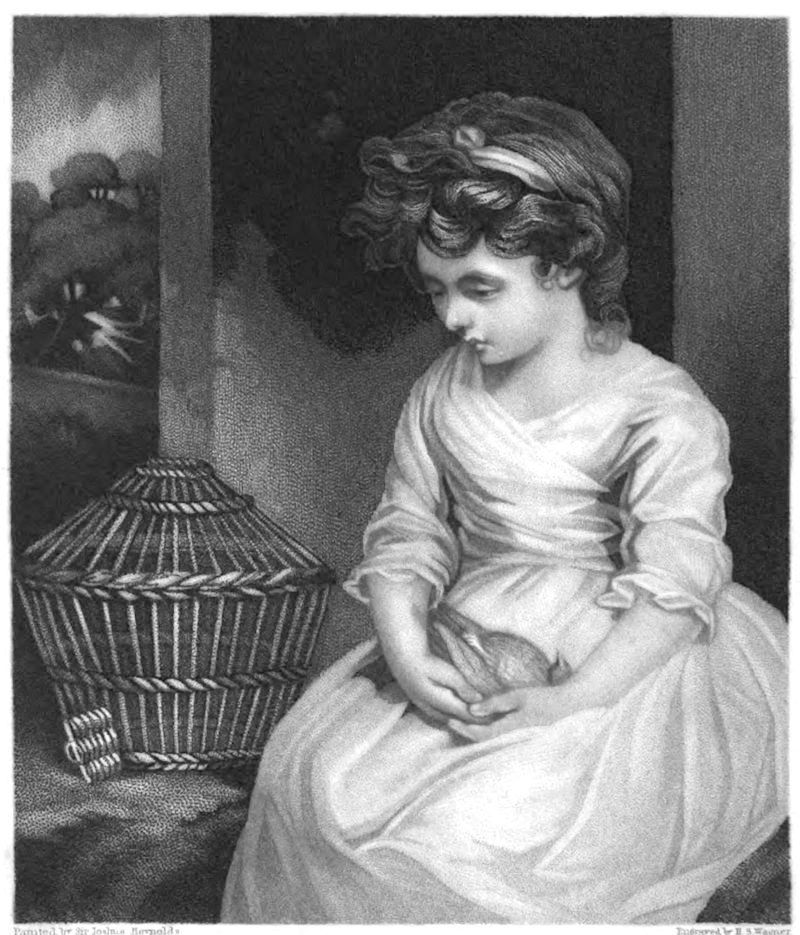
Painted by Sir Joshua Reynolds Engraved by H. S. Wagner
THE FIRST LOSS.
Engraved Expressly for Graham’s Magazine