THE LADIES’ LIBRARY.
Reading edition
———
BY W. A. JONES.
———
That admirable manual of “les petites morales,” and even of higher matters occasionally, the Spectator, contains a paper which we hesitate not to accept as a just specimen of cotemporary satire on female education; we refer to the catalogue of a Ladies’ Library. This heterogeneous collection embraces heroical romances and romancing histories, the ranting tragedies of the day, with the libertine comedies of the same period. In a word, it leads us to infer pretty plainly the insignificant pretensions the gentle women of Queen Anne’s day could lay to any thing like refinement of education, or even a correct propriety in dress and demeanor. Tell me your company, and I will disclose your own character; speak that I may know you, are trite maxims; but give me a list of your favorite authors is by no means so common, though at least as true, a test. The literary and indirectly the moral depravity of taste exhibited by the women of that age, is easily accounted for, when we once learn the fashionable authors and the indifferent countenance given to any authors but those of the most frivolous description. The queen herself was an illiterate woman, and we are told never once had the curiosity to look into the classic productions of Pope. King William, the preceding sovereign, was so ignorant of books and the literary character, as to offer Swift, with whom he had been agreeably prepossessed, the place of captain of a regiment of horse.
Indulging ourselves in a rapid transition, we pass from this era to the epoch of Johnson and Burke, and Goldsmith and Sheridan, we come to the reign of George III. Here we find the scene altered. From the gay saloon we are dropped, as if by magic, into the library or conversation room. We read not of balls, but of literary dinners and æsthetic teas, and we meet for company, not thoughtless, dressy dames of fashion and minions of the goddess of pleasure, but grave, precise professors in petticoats, women who had exchanged a world of anxiety for the turn of a head-dress, or the shape of a flounce for an equally wise anxiety about the philosophy of education, the success of their sonnets and tragedies, and moral tales for the young. The pedantry of authorship and dogmatic conversation superseded the more harmless pedantry of dress. Then we read of the stupidest company in the world, which arrogated to itself the claim of being the best. A race of learned ladies arose; bas bleus, the Montagues, the Mores, the Sewards, the Chapones, patronized by such prosing old formalists as Doctors Gregory and Aiken, and even by one man of vigorous talent, Johnson, and one man of real genius, Richardson. The last two endured much, because they were flattered much.
When we speak thus contemptuously of learned ladies, we intend to express a disgust at the pretensions of those who pass under that name. Genuine learning can never be despised, whoever may be its possessor; but of genuine learning it is not harsh to suspect a considerable deficiency where there is so much of display and anxious rivalry. Even where the learning is exact and solid, it is to be remembered that many departments are utterly unsuited to the female mind; where, at best, little can be accomplished and that of a harsh repulsive nature. We want no Daciers, no Somervilles, no Marcets, but give us as you will as many Inchbalds, Burneys, Edgeworths, Misses Barrett, as can be had for love or money.
From the ladies we seek literature, not learning, in its old scholastic sense. They certainly have received pleasure from books, and are bound to return the gratification in a similar way by delighting us. And this they can do in their legitimate attempts. It shall be a prominent object of the present general introduction to a short series of critical sketches, to attempt a definition of the limits which should bound those attempts, and also to endeavor at suggesting the proper studies for ladies, and the authors that ought to rank as favorites with the fair. In a list of the latter, female writers should bear a considerable proportion, and will assuredly not be forgotten.
We believe the question as to the relative sexual distinctions of intellectual character, is now generally considered as settled. There is allowed to be a species of genius essentially feminine. Equality is no more arrogated than superiority of ability, and it would be as wisely arrogated. The most limited observation of life and the most superficial acquaintance with books, must effectually demonstrate the superior capacity of man for the great works of life and speculation. It is true, great geniuses are rare and seldom needed, and the generality of women rank on a par with the generality of men. In many cases, women of talent surpass men of an equal calibre of mere talent, through other and constitutional causes—a greater facility of receiving and transmitting impressions, greater instinctive subtlety of apprehension, and a livelier sympathy. We cordially admit the female intellect, in the ordinary concerns of life and the current passages of society, has often the advantage of the masculine understanding. Cleverness outshines solid ability, and a smart woman is much more showy than a profound man. In certain walks of authorship, too, women are pre-eminently successful; in cases narrative of real or fictitious events, (in the last implying a strain of ready invention,) in lively descriptions of natural beauty or artificial manners; in the development of the milder sentiments, especially the sentiment of love; in airy, comic ridicule. On the other hand, the highest attempts of women in poetry have uniformly failed. We have read of no female epic of even a respectable rank: those who have written tragedies, have written moral lectures (of an inferior sort) like Hannah More; or anatomies of the passions, direct and formal, like Joanna Baillie; or an historical sketch, as Rienzi. We are apt to suspect that the personal charms of Sappho proved too much for the admirers of her poetic rhapsodies, otherwise Longinus has done her foul injustice; for the fragment he quotes is to be praised and censured solely for its obscurity. This would have been a great merit in Lycophron.
In the volume of British Poetesses, edited by Mr. Dyce, it is astonishing to find how little real poetry he has been able to collect out of the writings of near a century of authors, scattered over the surface of five or six centuries. It must be allowed that some of the finest shortest pieces by female writers have appeared since the publication of that selection. In the volume referred to, much sensible verse and some sprightly copies of verses occur; a fair share of pure reflective sentiment, delivered in pleasing language rarely rising above correctness; of high genius there is not a particle,—no pretensions to sublimity or fervor. The best piece and the finest poem, we think, ever composed by woman, is the charming ballad of Auld Robin Gray. That is a genuine bit of true poesy, and perfect in the highest department of the female imagination in the pathos of domestic tragedy. In the present century we have Mrs. Howitt and Mrs. Southey, but chief of all, Miss Barrett.[6] The finest attempts of the most pleasing writer of this class, do not rise so high as the delightful ballad above named. They are sweet, plaintive, moral strains, the melodious notes of a lute, tuned by taper fingers in a romantic bower, not the deep, majestic, awful tones of the great organ, or the spirited and stirring blasts of the trumpet. The ancient bard struck wild and mournful, or hearty and vigorous, notes from his harp—perchance placed “on a rock whose frowning brow,” &c. and striving with the rough symphonies of the tempest; but the sybil of modern days plays elegant and pretty, or soft and tender airs upon her flageolet or accordion, in the boudoir or saloon.
A poet is, from the laws both of physiology and philology,—masculine. His vocation is manly, or rather divine. And we have never heard any traits of feminine character attributed to the great poet, (in the Greek sense,) the Creator of the universe. The muses are represented as females, but then they are the inspirers, never the composers, of verse. So should be the poet’s muse, as she is often the poet’s theme. There are higher themes, but of an abstract nature, in general: ethical, religious, metaphysical. Let female beauty then sit for her portrait instead of being the painter. Let poets chant her charms, but let her not spoil a fair ideal image by writing bad verses. If all were rightly viewed, a happy home would seem preferable to a seat on Parnassus, and the Fountain of Content would furnish more palatable draughts than the Font of Helicon. The quiet home is not always the muses’ bower; though we trust the muses’ bower is placed in no turbulent society.
Women write for women. They may entertain, but cannot, from the nature of the case, become instructors to men. They know far less of life, their circle of experience is confined. They are unfitted for many paths of active exertion, and consequently are rendered incapable of forming just opinions on many matters. We do not include a natural incapacity for many studies, and as natural a dislike for many more. Many kinds of learning, and many actual necessary pursuits and practices, it is deemed improper for a refined woman to know. How, then, can a female author become a teacher of men?
Literature would miss many pleasant associations if the names of the best female writers were expunged from a list of classic authors, and the world would lose many delightful works—the novel of sentiment and the novel of manners, letter writing, moral tales for children, books of travels, gossiping memoirs—Mrs. Inchbald, Madame D’Arblay, Miss Edgeworth, Lady M. W. Montague, Miss Martineau, and Miss Sedgwick, with a host besides. Women have sprightliness, cleverness, smartness, though but little wit. There is a body and substance in true wit, with a reflectiveness rarely found apart from a masculine intellect. In all English comedy, we recollect but two female writers of sterling value, Mrs. Conley and Mrs. Guthrie, and their plays are formed on the Spanish model, and made up of incident and intrigue, much more than of fine repartees or brilliant dialogue. We know of no one writer of the other sex, that has a high character for humor—no Rabelais, no Sterne, no Swift, no Goldsmith, no Dickens, no Irving. The female character does not admit of it.
Women cannot write history. It requires too great solidity, and too minute research for their quick intellects. They write, instead, delightful memoirs. Who, but an antiquary or historical commentator, had not rather read Lucy Hutchinson’s Life of her Husband, than any of the professed histories of the Commonwealth—and exchange Lady Fanshawe for the other royalist biographers.
Neither are women to turn politicians or orators. We hope never to hear of a female Burke; she would be an overbearing termagant. A spice of a talent for scolding, is the highest form of eloquence we can conscientiously allow the ladies.
Criticism is for men; when women assume it, they write scandal. The current notion of criticism with most, is that of libelous abuse. From all such, Heaven defend us.
Women feel more than they think, and (sometimes) say more than do. They are consequently better adapted to describe sentiments, than to speculate on causes and effects. They are more at home in their letters, than in tracts of political economy.
The proper faculties in women to cultivate most assiduously are, the taste and the religious sentiment; the first, as the leading trait of the intellectual; and the last, as the governing power of the moral constitution. Give a woman a pure taste and high principles, and she is safe from the arts of the wiliest libertine. Let her have all other gifts but these, and she is comparatively defenceless. Taste purifies the heart as well as the head, and religion strengthens both. The strongest propensities to pleasure are not so often the means of disgrace and ruin, as the carelessness of ignorant virtue, and an unenlightened moral sense. This makes all the difference in the world, between the daughter of a poor countryman, and the child of an educated gentleman. Both have the same desires, but how differently directed and controlled. Yet we find nineteen lapses from virtue in the one case, where we find one in the other.
Believing that what does not interest, does not benefit the mind, we would avoid all pedantic lectures to women, on all subjects to which they discover any aversion. Study should be made a pleasure, and reading pure recreation. In a general sense, we would say the best works for female readers are those that tend to form the highest domestic character. Works of the highest imagination, as being above that condition, and scientific authors, who address a different class of faculties, are both unsuitable. An admirable wife may not relish the sublimity of Milton or Hamlet; and a charming companion be ignorant of the existence of such a science as Algebra. A superficial acquaintance with the elements of the physical sciences, is worse than total unacquaintance with them.
Religion should be taught as a sentiment, not as an abstract principle, or in doctrinal positions, a sentiment of love and grateful obedience; morality, impressed as the practical exercise of self-denial and active benevolence. In courses of reading, too much is laid down of a dry nature. Girls are disgusted with tedious accounts of battles and negotiations, dates and names. The moral should be educed best filled for the female heart, and apart from the romantic periods, and the reigns of female sovereigns, or epochs when the women held a very prominent place in the state, or in public regard. We would have women affectionate wives, obedient daughters, agreeable companions, skilful economists, judicious friends; but we must confess it does not fall within our scheme to make them legislators or lawyers, diplomatists or politicians. We therefore think nine tenths of all history is absolutely useless for women. Too many really good biographies of great and good men and women can hardly be read, and will be read to much greater advantage than histories, as they leave a definite and individual impression. The reading good books of travels, is, next to going over the ground in person, the best method of studying geography. Grammar and rhetoric,[7] (after a clear statement of the elements and chief rules,) are best learnt in the perusal of classic authors, the essayists, &c.; and, in the same way, the theory of taste and the arts. The most important of accomplishments is not systematically treated in any system—conversation. But a father and mother of education, can teach this better than any professor. Expensive schools turn out half-trained pupils. Eight years at home, well employed, and two at a good but not fashionable school, are better than ten years spent in the most popular female seminary, conducted in the ordinary style. Such is a meagre outline of our idea of female education, into which we have digressed unawares.
Female authors should constitute a fair proportion of a lady’s library—and those masculine writers who have something of the tenderness and purity of the feminine character in their works. The subjects and authors we propose for occasional consideration, will embrace specimens of each, in prose and poetry, fiction and reality, satire and sentiment. We think we may promise a less erudite paper for the second number, though to some readers all that is not very lively is proportionably dull.
A. L. Dick
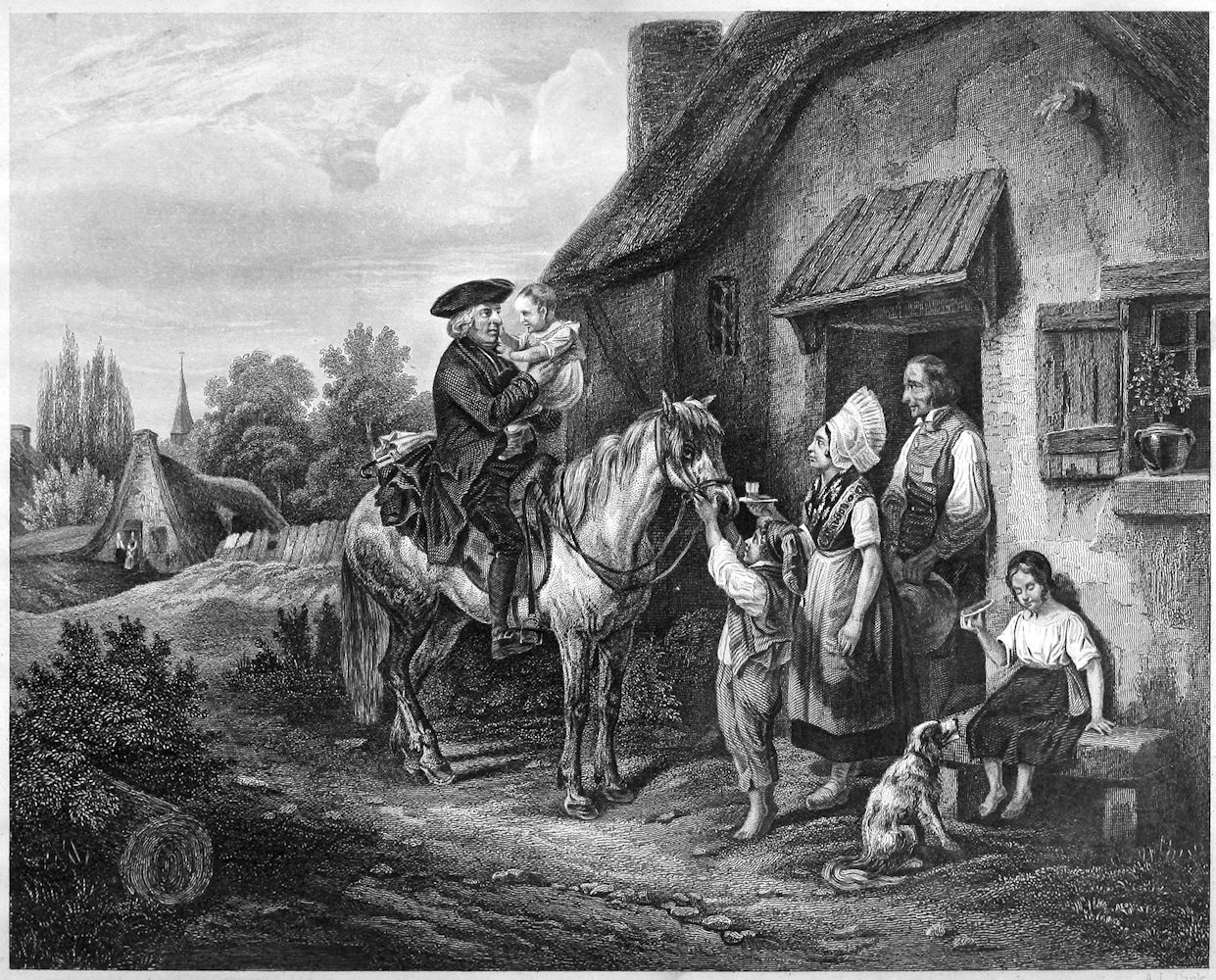
The Pastor’s Visit