Chapter III
Reading edition
THE PRIZE.
The exhibition day had arrived. Harriet had finished her story several days before, and read it to her mother. It was a simple, graceful, childlike effusion, with less of pretension and ornament, and more of spirit and originality than the compositions of most children of the same age contain.
Mrs. Carlton seemed much pleased; but Aunt Eloise had criticised it without mercy. At the same time she was observed to smile frequently with a cunning, sly, triumphant expression, peculiar to herself—an expression which she always wore when she had a secret, and secrets she had, in abundance—a new one almost every day—trivial, petty secrets, which no one cared about but herself; but which she guarded as jealously as if they had been apples of gold.
The exhibition day had arrived.
“Good bye, mother; good bye, aunty,” said Harriet, glancing for a moment into the breakfast-room.
She was looking very pretty in a simple, tasteful dress, made for the occasion. She held the story in her hand, neatly enclosed in an envelope, and her eyes were full of hope—the cloudless hope of childhood.
“Don’t be surprised, Harriet,” said her aunt, “at any thing that may happen to-day. Only be thankful if the prize is yours, that’s all.”
“If Kate Sumner don’t win it, I do hope I shall!” replied the eager child, and away she tripped to school.
At twelve o’clock Mrs. Carlton and her sister took their seats among the audience, in the exhibition room. The usual exercises were completed, and it only remained for the compositions to be read aloud by the teacher.
The first was a sentimental essay upon Friendship. Mr. Wentworth, the teacher, looked first surprised, then amused, then vexed as he read, while a gaily and fashionably dressed lady, who occupied a conspicuous place in the assembly, was observed to toss her head and fan herself with a very complacent air, while she met, with a nod, the conscious eyes of a fair and beautiful, but haughty looking girl of fifteen seated among the pupils.
“By Angelina Burton,” said the teacher, as he concluded, and laying it aside without further comment, he took up the next—“Lines to a Favorite Tree,” by Catherine Sumner.
It was short and simple, and ran as follows—
Thy leaves’ lightest murmur,
Oh! beautiful tree!
Each bend of thy branches,
The stately, the free,
Each wild, wavy whisper,
Is music to me.
I gaze thro’ thy labyrinth,
Golden and green,
Where the light loves to linger,
In glory serene,
Far up, till yon heaven-blue
Trembles between.
I shut out the city,
Its sight and its sound,
And away, far away,
For the forest I’m bound,
For the noble old forest,
Which ages have crowned!
I lean on its moss banks,
I stoop o’er its rills,
I see, thro’ its vistas,
The vapor-wreathed hills,
And my soul with a gush
Of wild happiness fills!
I pine for the freshness,
The freedom, the health,
Which Nature can give me—
My soul’s dearest wealth
Is wasted in cities;
Where only, by stealth,
The mountain-born breezes
Can fitfully play,
Where we steal but a glimpse
Of this glorious day,
And but by the calendar,
Learn it is May.
But away with repining,
I’ll study, from thee,
A lesson of patience,
Oh! noble, old tree!
’Mid dark walls imprisoned,
Thou droop’st not like me;
But strivest forever,
Still up, strong and brave,
’Till in Heaven’s pure sunshine,
Thy free branches wave!
Oh! thus may I meet it,
No longer a slave!
The next was a story, and Harriet Carlton’s eyes and cheeks changed color as she listened. It was the same, yet not the same! The incidents were hers, the sentiment more novel-like, and many a flowery and highly wrought sentence had been introduced, which she had never heard before.
She sat speechless with wonder, indignation, and dismay, and though several other inferior compositions were read, she was so absorbed in reverie, that she heard no more until she was startled by Mr. Wentworth’s voice calling her by name. She looked up. In his hand was the prize—a richly chased, golden pencil-case, suspended to a chain of the same material. The sound, the sight recalled her bewildered faculties, and ere she reached the desk, she had formed a resolution, which, however, it required all her native strength of soul to put in practice.
“Miss Carlton, the prize is yours!” and the teacher leaned forward to throw the chain around her neck. The child drew back—
“No, sir,” she said in a low, but firm and distinct voice, looking up bravely in his face, “I did not write the story you have read.”
“Not write it!” exclaimed Mr. Wentworth, “Why, then, does it bear your name? Am I to understand, Miss Carlton, that you have asked another’s assistance in your composition, and that you now repent the deception?”
Poor Harriet! this was too much! Her dark eyes first flashed, and then filled with tears; her lip trembled with emotion, and she paused a moment, as if disdaining a reply to this unmerited charge.
A slight and sneering laugh from the beauty aroused her, and she answered, respectfully but firmly,
“The story, I did write, was in that envelope yesterday. Some one has changed it without my knowledge. It was not so good as that you have read; so I must not take the prize.”
There was a murmur of applause through the assembly, and the teacher bent upon the blushing girl a look of approval, which amply repaid her for all the embarrassment she had suffered.
Aunt Eloise took advantage of the momentary excitement to steal unobserved from the room. Harriet took her seat, and Miss Angelina Burton was next called up. The portly matron leaned smilingly forward; and the graceful, little beauty, already affecting the airs of a fine lady, sauntered up to the desk and languidly reached out her hand for the prize.
“I cannot say much for your taste in selection, Miss Burton. I do not admire your author’s sentiments. The next time you wish to make an extract, you must allow me to choose for you. There are better things than this, even in the trashy magazine from which you have copied it.”
And with this severe, but justly merited reproof of the imposition that had been practiced, he handed the young lady, not the prize, which she expected, but the MS. essay on Friendship, which she had copied, word for word, from an old magazine.
The portly lady turned very red, and the beauty, bursting into tears of anger and mortification, returned to her seat discomfited.
“Miss Catherine Sumner,” resumed the teacher, with a benign smile, to a plain, yet noble-looking girl, who came forward as he spoke, “I believe there can be no mistake about your little effusion. I feel great pleasure in presenting you the reward, due, not only to your mental cultivation, but to the goodness of your heart. What! do you, too, hesitate?”
“Will you be kind enough, sir,” said the generous Kate, taking a paper from her pocket, “to read Harriet’s story before you decide. I asked her for a copy several days ago, and here it is.”
“You shall read it to the audience yourself, my dear; I am sure they will listen patiently to so kind a pleader in her friend’s behalf.”
The listeners looked pleased and eager to hear the story; and Kate Sumner, with a modest self-possession, which well became her, and with her fine eyes lighting up as she read, did full justice to the pretty and touching story, of which Harriet had been so cruelly robbed.
“It is well worth reading,” said Mr. Wentworth, when she had finished; “your friend has won the prize, my dear young lady; and, as she owes it to your generosity, you shall have the pleasure of bestowing it, yourself.”
Kate’s face glowed with emotion as she hung the chain around Harriet’s neck; and Harriet could not restrain her tears, while she whispered,
“I will take it, not as a prize, but as a gift from you, dear Kate!”
“And now, Miss Sumner,” said Mr. Wentworth, in conclusion, “let me beg your acceptance of these volumes, as a token of your teacher’s respect and esteem,” and presenting her a beautifully bound edition of Milton’s works, he bowed his adieu to the retiring audience.
“Will you lend me your prize-pencil this morning, Harriet?” said Mrs. Carlton the next day. She was dressed for a walk, and Harriet wondered why she should want the pencil to take out with her; but she immediately unclasped the chain from her neck, and handed it to her mother without asking any questions.
She was rewarded at dinner by finding it lying at the side of her plate, with the single word, “Truth” engraved upon its seal.
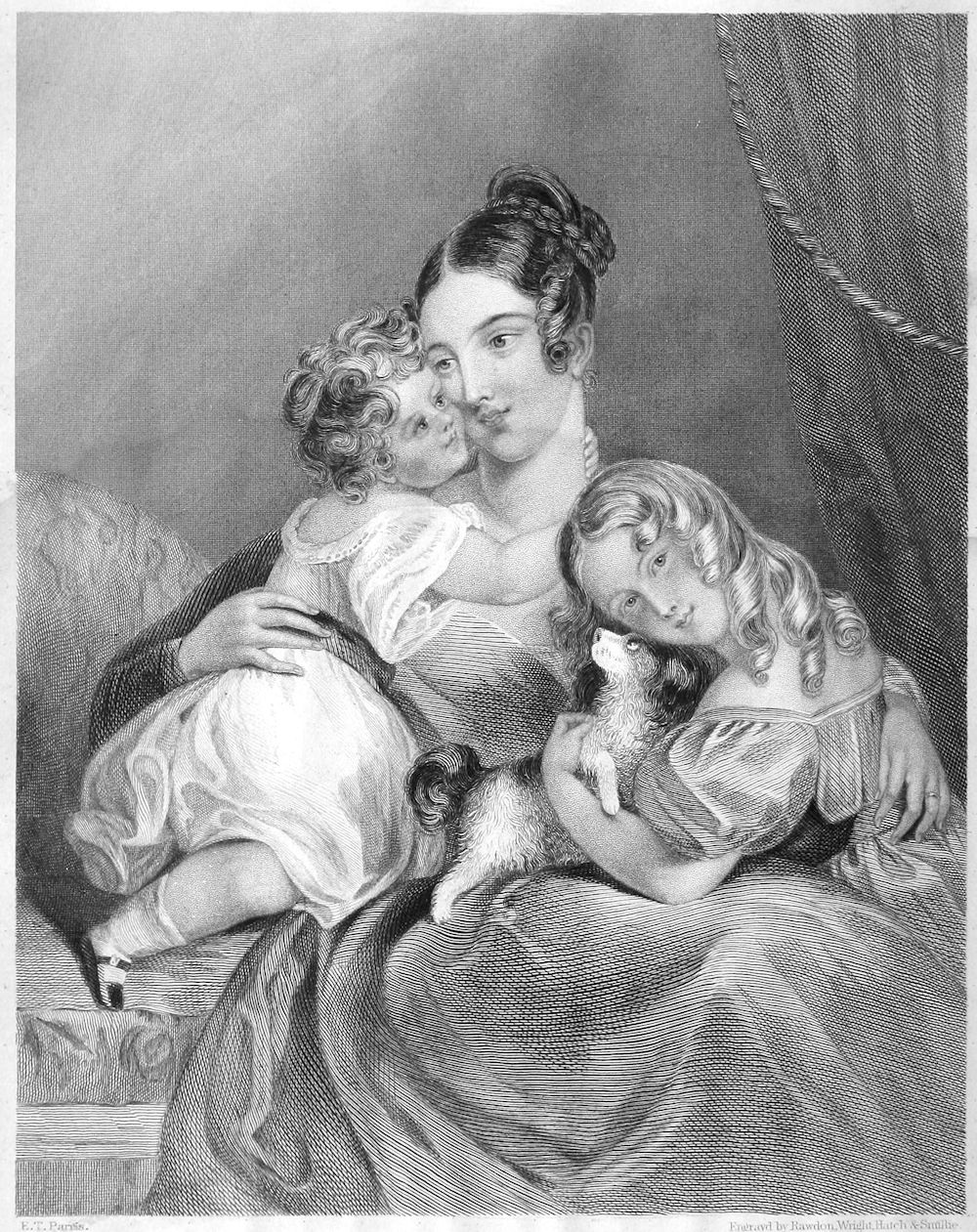
E. T. Parris. Engraved by Rawdon, Wright, Hatch, & Smillie.
True Affection.
Engraved expressly for Graham’s Magazine.