THE MISERIES OF MUSIC.
Reading edition
———
BY CALEB CROTCHET.
———
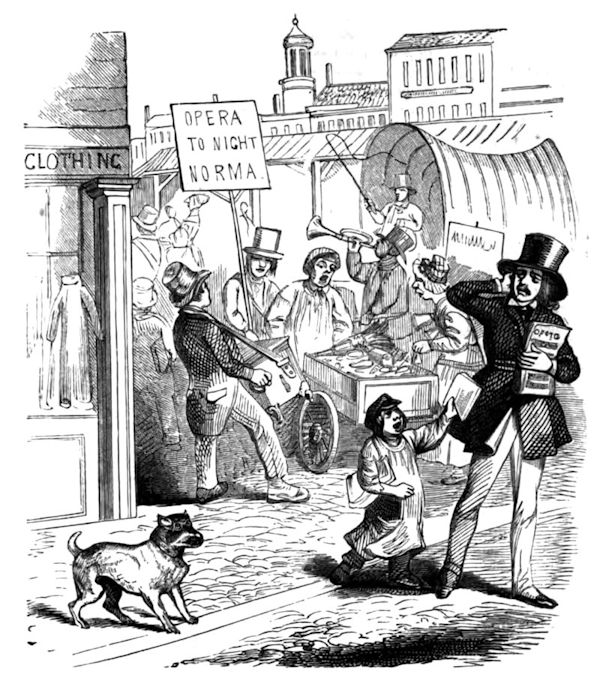
I am the victim of a fine ear. Talk of the miseries of the halt, the lame and the blind! Their condition is that of celestial beatitude as compared with mine; and as for the deaf and dumb, they must be the happiest mortals alive. They can neither inflict nor suffer the miseries of sound. Blessing and blessed, how shall I contrive to gain admission to their happy brotherhood?
Music has been the bane of my existence. My ear—the asinine organ that has since so extravagantly developed itself—was early noticed by a maiden aunt, and my first recollection is of her look of bland satisfaction as, with a shrill, little, piping, three-year-old voice, I edified an audience of spinsters, around a quilting-frame, with the strains of “Bonnie Doon.” Heaven pardon my poor old aunt for the wickedness of thus early encouraging a passion that has led to so many sins of temper, and, perhaps, to so many unuttered, but deep felt outrages upon her memory!
I shall not go over the years of probation that elapsed from these first exhibitions of infantile vocalization, to the period of my perfect development as a young gentleman of acknowledged taste and talent, and my introduction, as a full-fledged connoisseur into the fashionable circles of ——.
My passion for music clung to me. I had become learned in the science. If I walked of a warm evening with a young lady, it was, as I expressed it in upstart pedantry, in an andante movement. Slow and fast both became decidedly low terms, and I could only condescend to say in place of them, adagio and allegretto. I had all the Italian musical terms, as contained in the elementary treatises, at my tongue’s end, and, in a practical, common sense community, would have been written down the ass that I really was, for the ridiculous and constant use I made of them.
But in —— there was a fine field for my learned talk, and the obscurity and nonsense of my conversation got me up a reputation for musical science which at first flattered me, and engendered a vanity for which I have since suffered severe retribution.
The nine days allowed for opening the eyes of young puppies having elapsed, mine were opened to a sense of my folly, and I by degrees broke myself of the habit I had adopted.
At the period of my entrée into the society of ——, music was the great and leading idea. A religious and moral cycle had succeeded to a dissipated and drinking cycle, and dancing, wine, etc., being excluded from the leading houses, music was the only resource. At once I became a lion.
“How beautifully Mr. Crotchet plays!” “Emma, my dear, come and look on; I want you to study Mr. Crotchet’s exquisite touch!” “Oh, how sweet!” These and kindred sounds issued from the lips of the witches in curls, lace and artificials, who gathered around me as I sat at Mrs. Flambeau’s piano, on the occasion of her first soirée. It was my debut, and is therefore memorable. I was playing a sonata of Beethoven’s, which I soon found none of them comprehended. I thought of “pearls before swine,” but went on, working out the mysteries and the meaning of the composition for my own gratification.
The witches, at the close, seemed rather weary, and could do little but simper and say “beautiful,” but the chief of them, one Madame Hecate, to whom tradition attached French parentage and critical taste, approached me and said—
“Pray, Monsieur Crotchet, (she always spoke with a French accent to strangers) do you play the Battle of Prague?”
I can recollect nothing but an emphatic “No, madam”—a feeling as of a pail of iced water pouring down my back—a confused breaking up of the circle around the piano—a fruitless search for a glass of wine—a prestissimo movement to the entry—a successful search for my hat—a rush to the street, and as I shut the door, the martial strains of the Battle of Prague, drummed out by a more complaisant amateur than myself, for the benefit of Madame Hecate.
Oh, that Battle of Prague! Who shall ever pretend to give its official bulletin? Who shall describe the cries of the wounded and the groans of the dying, elicited from its auditors as it has been “fought o’er again” on countless pianos? Its victims are legion. Its progress is remorseless. It goes on and will go on to the end of time, murdering the peace of mind of every luckless owner of an ear such as mine. Its composer—if the writer of such a disturbing work can be called a composer—must have been possessed of an evil spirit from the fatal battle-field, condemned to roam this earth for the torment of the race, and seeking retribution for his own victimization by victimizing all that come after him.
My next essay of the musical life of the city, was at a soirée of Professor Millefiori, the fashionable Italian vocal teacher—a sort of compromise, in appearance, between a Paris petit maître and an American Figaro. His pupils were all to sing, and by the courtesy usually extended to amateurs, I was invited.
The first piece announced for the evening’s entertainment was Casta Diva. Of course it was. Was there ever an amateur soirée that it was not the first piece?
At the appointed time, a young lady of sixteen summers, with very bare neck and arms, hair done up in curls and furbelows by a French coiffeur, hands in white kid gloves, a variety of her mother’s jewels on head, hands and breast, a little pug of a nose beneath two very innocent-looking eyes, and, as was said, a splendid soprano voice, stood up by the professor’s piano to personate the Druid priestess.
“Ca-ha-ha-hasta Dee-e-evar,” she began, emphasizing each division of the words, and screaming them out as if she really thought she could make the Casta Diva—the moon—hear her vociferous appeal, and paying no regard to the fact that the chaste goddess was, at that particular time, enlightening the other side of the globe.
The whole of the andante was in this scream, which threw the audience into ecstasies. Then she began, “Ah bello, a me ritorna.” How she dashed through it—leaping over bars with a racer’s agility, plunging through barriers and ditches of sound—up hill and down hill—over ledger lines and under them—helter skelter—chromatics and ecstatics—flats and sharps—screech and scream—over and over—with face hideously distorted, the veins and muscles of her neck swelled to bursting, while Millefiori’s hands kept thundering at the piano and urging her on to louder labors.
Shade of Bellini! was there not one of your chords to stop the throat uttering these musical blasphemies?
At last she ended, amid a tumult of applause, for which she gave one of Monsieur Petitpas’ most graceful courtesies, bowing so as to show Monsieur Chevelure’s handiwork upon her head-works in the most effective manner.
She was followed by a dozen or more of soprani, mezzo-soprani, contralti, baritoni and bassi, of whose performances I have but a dim, obscure recollection as of so many contests for the palm of superior noise; all of them being exhibited in the tremendous screaming and shouting pieces of the modern Italians.
This was my last amateur soirée—and let me whisper a warning word to the world that remains behind me—“Beware of amateur soirées!”
But my musical sufferings did not end here. The noises of the streets are agony to me. The oyster and the apple-men; the strawberry and the shad-women—what are they to me but so many liberated fiends, placed on earth to persecute the owners of ears! And as for the news-boys—but I will not recapitulate my sufferings from them.
I have for some time been engaged in projects for the correction of these street evils. I leave in my executor’s hands the manuscript of the “Shad-woman’s Complete Musical Instructor,” “The Oysterman’s Apollo,” and “The News-Boys’ Guide to Parnassus.” In these I have arranged to the most beautiful melodies, the common cries of “Buy any Shad!” “Ho, fresh Oysters!” “Herald, Tribune, Ledgee, Ledgee,” “Evening Bulletin,” and the other favorite appeals of these as yet unappeased street demons. A variety of melodies is given to each phrase, and beautiful variations are arranged in the “Guide to Parnassus,” for extras, double-sheets, etc., with a special and elaborate composition arranged expressly for the familiar words, “Another Revolution in France!”
I shall not live to enjoy the fruits of my labors. But I shall die happy, since I have just learned that the Legislature is disposed to treat favorably my projected “Institution for the Musical Education of News Boys.”
As yet I endure more than the torments of the rack, whenever I venture out of doors; and even within doors, it is scarcely better. When I come in, with ears aching from the hideous cries of the street, to pore over the score of a new opera just received from Italy, how am I to provide a remedy for my home miseries?
The “quiet street” which I selected for its retirement, is infested with organ-grinders, who reap a daily harvest among the infantile population for which quiet streets are remarkable. My landlady—worthy Mrs. Squall—has six little Squallets, who delight in hand-organs, and who interrupt my musical waking-dreams of the twilight hour, every day, with appeals for sixpence to give “the new organ-grinder, with his sweet little monkey.”
Since I came into these quarters, a youth, with a pale face and a letter of introduction to recommend him to me, has established himself in the room above me. He has taken to flute-playing! His design is either suicide or murder; and unless the first soon takes place, and his brains are blown out through his instrument, I feel that murder will be the result, and myself the victim.
Across the way dwells a practitioner on the trombone, and twice a week a brass band meets in his room to practice, while again twice a week the choir of —— church assembles next door to me to rehearse for their Sunday performances. Was any one ever plunged into such a combination of horrors?
I have heretofore refrained from giving up this lodging among the fiends, by the presence of Mrs. Squall’s young niece, Rosalie ——. She is young and fresh, fair as a strain from La Dame Blanche, graceful as an air of Mozart, eloquent in speech as one of Mendelssohn’s Lieder Ohne Worte, and symmetrical in figure as a scena from Rossini. She has brown hair, blue eyes, a knowledge of French and Italian, a smattering of the German language, and a thorough knowledge of German wools, $5000 a year, an amiable disposition, and, as I fancy, a decided penchant for me.
I was already nearly on my knees to her this morning, when she suggested that we should sing together, and herself selected the duet “La ci darem la mano,” from Don Giovanni. Such a selection was divine, and I eagerly sought out the opera and began my part, feeling convinced that I should ratify the vows of the song in plain prose and good English as soon as it was over.
I held my breath as I waited for the first tones of what I felt must be an angel’s voice, but what mortal agony could equal mine, when I found her pretensions to divinity all a sham? She sung a full semi-tone above the piano, and with a hard, rasping, metallic voice that grated like a file, and fairly set my teeth on edge.
“Oh! false, false, false Rosalie!”
It is possible that I did not finish the duet as I began it. I had lost all consciousness, except of the horror of my situation, and a sense of a heart crushed in its first and purest affections by a false voice—far worse to me than a false heart.
We parted; she to her worsted work and her $5000 a year, I to seek another refuge, or to pursue my hopeless pilgrimage over the world, in search of harmony—to mourn over my blighted hopes, and the perfidious voice of my Rosalie, and to sink at last into an untimely grave. Let my epitaph be, not “Died of a Broken Heart,” as the world might construe the fact, but simply
“Died of a Discord!”