GRAHAM’S SMALL-TALK.
Reading edition
Held in his idle moments, with his Readers, Correspondents and Exchanges.
Among the agreeable letters we have received from many of our subscribers, upon the superior character of our June number, we make room for the following. The remark of our correspondent upon the value of newspaper notices we do not agree with, at least not in their valuelessness, except in cases where they are “paid for” or solicited. A frank expression of sentiment in regard to “Graham,” we invite, and try sometimes to provoke a little captiousness—but the 1340 editors with whom we exchange, will be honest in spite of us, and pronounce “Graham” a great Magazine; and as these opinions coincide with that of our correspondent, we must submit.
Cincinnati, May 23, 1852.
George R. Graham, Esq. }
Philadelphia: }
The reception of your Magazine for June, with “new type and paper,” and, I may add, new attractions in the shape of an increase of “solid matter,” reminds me of a promise made myself long ago—to write you a letter expressive of earnest sympathy in your efforts, and hopes of your ultimate success, in the publication of a journal worthy of our country and yourself.
From month to month, since you resumed the management of “Graham,” I have noticed a gradual yet sterling improvement in its pages, until the June number relieves me from all anxiety as to its future course and success. I congratulate you, my dear sir.
Now that “Opinions of the Press” are so profuse and so worthless, (especially to the book-buyer,) I have thought a word of unsought, unpaid for praise, might not be received unkindly from
A Subscriber.
A Fine Lithograph.—We have received from Messrs. Fetridge & Co., of Boston, one of the finest specimens of the lithographic art that ever commanded our attention. It is decidedly a credit to the artists and to Boston. The subject of the picture is a representation of Miss E. Kimberly, the celebrated Shaksperian reader and actress, in the character of Isabella in “The Fatal Marriage.” It is from a Daguerreotype by Southworth and Harvey, of Boston. Our readers will recollect that this gifted young lady made her debut as a Shaksperian reader in this city (Philadelphia) some two and a half years ago. Since that time she has appeared in various cities, before large and intelligent audiences, with entire success. Her reputation is fully established on a remarkably intellectual and correct delineator of the leading characters in the higher drama. She has now fully adopted the stage as her profession; for, with the approbation of such a veteran in histrionic matters as Thomas Barry, Esq., of the Broadway theatre, New York, (who was her instructor,) there can be no question of her fitness for the avocation. Her friends are sanguine that she will reach the highest round in the ladder of histrionic fame. The likeness of her, now before us, portrays the intensity of sorrow more vividly than the portrait of any female actress, in character, we ever beheld.
The writer of the following asks us to forgive him for venturing into the regions poetic, and begs us not to clip his wings. Well, we wont; and shall say in his defense that there is a very sober and serious vein of prose in his poesy, which it becomes some delinquents to study. Clapping our hand upon our pocket, we can say with the wag,—“You’ll find no change with us;” so, if the following only induces a few of our subscribers to “do better,” the change will be duly recorded.
“Dear Graham, how ‘heavenly-minded’ you seem,
Slicing your steel through the poet’s young dream,
For you off with his wings, as you say, with a sweep,
And then push him over the dangerous leap;
Where wingless he falls through the phantomy air,
Shrieking his wail o’er the gulf of despair.
“You’re ‘tender to poets,’ God grant it be true,
For what would they be if it wasn’t for you,
Who seem made to carve poets, by slicing away
The parts they need most when upward they stray,
For what, my dear sir, could one do without wings
To carry aloft every lay that he sings.
“There are those, or have been, who need none at all,
For their writings are far too ethereal to fall,
They soar of themselves to the regions on high,
In musical numbers that never can die.
But then there are those, dearest sir, who in song
Soar not thus aloft, but are plodding along.
“Perhaps you will say it is better at once
To slice off their legs, or even their sconce,
Than to be badly bored as you’ve been before:
If so, this will bore you at least one time more;
I know this is bad, your censure’d be just,
But bore you this once, I shall, for I must.
“You say ‘Mr. Reader, we make our best bow,
And stand with our cap in our hand even now;
If you don’t like our rig, don’t turn up your nose,
But suggest us a change, and what’s proper propose.’
The change that I’d wish I will give at a glance—
It’s I wish all subscribers would pay in advance;
Then the two dollar fashion-plates would surely swing clear,
Instead of nine forty-five per month by the year.
“If I bore you much more I shall have to be quick,
For a message has come to me now from the sick,
And wishing your readers with plenty of tin
To knock at your sanctum and walk boldly in,
And fork out the rhino, three dollars apiece,
’Tis the change that I wish you—may it daily increase.
“For nothing I’ve found in this vain world of trouble
Will suit Eds like having their subscription-lists double;
Not only in names, but that each one will pay
In advance for the paper, and take it away.
Now I wish you, dear sir, in all good to increase,
With plenty of readers, and money, and peace.
“Orion.”
Fitzgerald’s City Item.—The other day this beautiful and ably conducted weekly came to us clothed in a new suit of type, and printed upon white and firm paper. The Item is now one of the largest, handsomest, and certainly one of the ablest of our weeklies. All who take an interest in Business, Literature, the Fine Arts, Music, and the Drama, are recommended to subscribe to it. On these and kindred subjects, it has ever been regarded as first-rate authority. Every family, every gentleman and lady of taste and leisure in the country, should take Fitzgerald’s City Item. It is furnished at the moderate price of $2 a year, in advance. Address Fitzgerald & Co., 46 South Third street, Philadelphia. (Post paid.)
Graham’s Magazine for June is a capital one, as usual. Graham don’t get out any other kind but the best kind. He’s quiet, don’t brag; but he does better, by publishing the best Magazine in Philadelphia.—Perrysburg Star.
Well, yes, brother; we have learned the value of the adage as to “Brag and Holdfast.” Hence our 112 pages were announced and have been carried out in every number since January. Our wood-cuts are engravings.
Church, who has just enlarged his excellent Weekly, enlarges also upon the value of Graham’s wood-cuts.
Wood Engraving.—The beautiful specimens of wood engraving, now beginning to be seen in many of our modern publications, do, indeed, indicate a marked improvement in that branch of pictorial embellishment, over the rough unsightly cuts of a few years back, and at which now the growing taste of the public eye would hardly glance. Nor can we indulge these remarks without bestowing upon the printer his own success in doing full justice to the engraver by clear and beautiful impression, which surely depends upon him; and when he has the proper material in ink and paper, our fine publications compare well with those from across the water.
Our friend Graham has not been relax in his exertions to beautify his agreeable monthly with fine embellishments in wood, and his numerous patrons will be much more gratified with the results of Mr. Devereux’s prolific pencil, than the smoky mezzotints which have so long intruded upon the pages of magazinedom. We go for good legitimate line engravings, either steel or wood, and nothing else. One of “Mote’s” gems is worth a bushel of commonplace truck. We are right glad to see fine wood specimens interlarded in the pages of Graham. Onward, say we, with your well-stored monthly, rich in literature, beautiful in embellishment. A large list is your sure reward. “To him who wills there is no obstacle.”—Church’s Bizarre.
The New Volume.—The almost universal voice of the American Press, in the notices of our June number, encourages us to great hopes for the volume which commences with the present number. The elevated tone of the work seems to meet with the entire approval of our readers, so far as we can learn from letters received from all parts of the United States, giving us ample warrant for a continuance of our efforts to render “Graham” a Magazine of the very highest order.
If our friends will assist us in extending the circulation of “Graham” for the next six months in their respective post-towns, we flatter ourself that we shall open the volume in January next with a reputation and circulation unequaled by any former volume of this Magazine. A word to a neighbor may secure his co-operation; and as we send five copies for six months at half the yearly club rates, the outlay will be but small for each six months subscriber. Try it, friends!
The Family Friend.—Our friend Godman, of Columbia, S. C., has assumed, we see, the entire responsibility of the publishing, as well as the editorial department of his admirable weekly paper. That he may extend its circulation, with all the rapidity its manifest merits should insure, is our most sincere wish, and, to aid him, we offer Graham’s Magazine and The Family Friend, one year, for Four Dollars, in advance.
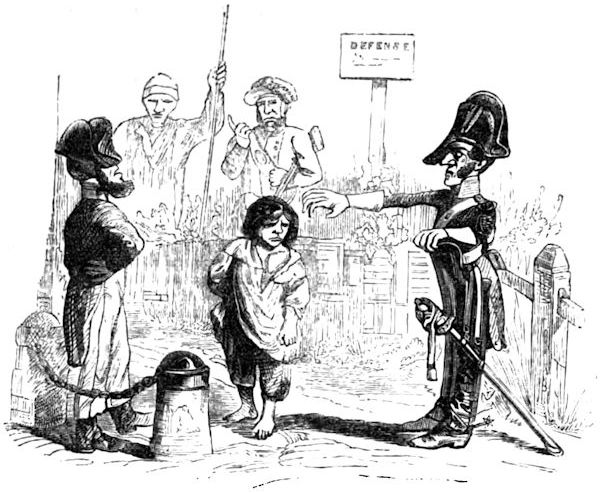
A FRENCH IDEA.
To keep the mind intently fixed
On number one alone—
To look to no one’s interest,
But push along your own,
With the slightest reference
To how, or what, or when—
Eh bien! c’est la première Idée.
Napoléonienne.
To sneak into a good man’s house,
With sham credentials penned—
To sneak into his heart and trust,
And seem his children’s friend—
To learn his secrets, find out where
He keeps his keys—and then
To bone his spoons—c’est une Idée
Napoléonienne.
Bon Gaultier.
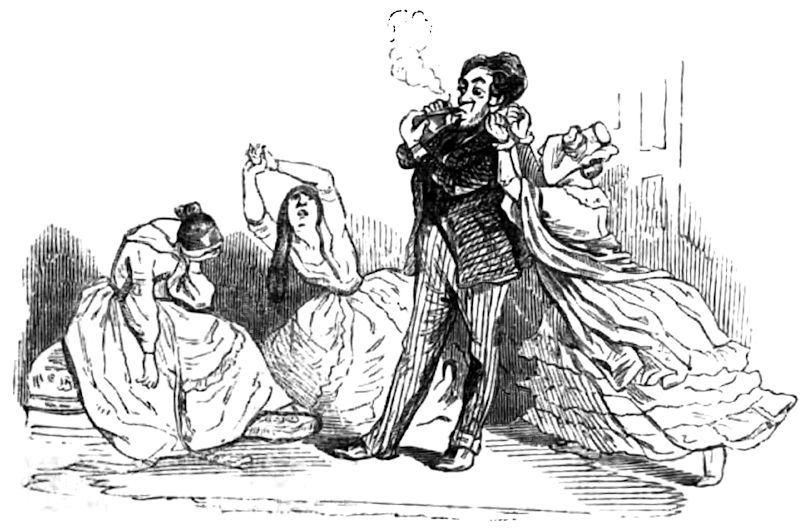
SMOKE NO JOKE!
Transcriber’s Notes:
Archaic spellings and hyphenation have been retained. Punctuation has been corrected without note. Other errors have been corrected as noted below. For illustrations, some caption text may be missing or incomplete due to condition of the originals used for preparation of the ebook.
Page iii, Race. By Bon Gualtier ==> Race. By Bon Gaultier
Page iv, By Bon Gualtier ==> By Bon Gaultier
Page 7, quick retrogade movement ==> quick retrograde movement
Page 11, the unparalled number ==> the unparalleled number
Page 11, a detatched segment ==> a detached segment
Page 24, your poor old kinsnam ==> your poor old kinsman
Page 24, Nothwitstanding ==> Notwithstanding
page 25, of Gaudalupé” is said ==> of Guadalupé” is said
page 25, out to Gaudalupé, ==> out to Guadalupé,
page 26, gates of Gaudalupé ==> gates of Guadalupé
page 26, otter of roses ==> ottar of roses
page 27, Gaudalupé. The building ==> Guadalupé. The building
Page 27, others appying a handful ==> others applying a handful
page 27, tired of Gaudalupé ==> tired of Guadalupé
Page 29, the but-end of a song ==> the butt-end of a song
Page 32, One one side ==> On one side
Page 37, his eyes fixed stedfastly ==> his eyes fixed steadfastly
Page 40, errant of mercy ==> errand of mercy
Page 41, it its true ==> it is true
Page 49, Countess De Salins ==> Countess de Salins
Page 50, came down again to day ==> came down again to-day
Page 51, but cbme and see me ==> but come and see me
Page 51, received intimatioes ==> received intimations
Page 52, will comprohend the passing ==> will comprehend the passing
Page 52, twelve hours te me. ==> twelve hours to me.
Page 55, accuse himself at any moment of feeling like a scoun-
Count de Salins Nor do I comprehend how he could ==>
Count de Salins. Nor do I comprehend how he could
accuse himself at any moment of feeling like a scoun-
Page 57, it was done, Jeneatte ==> it was done, Jeanette
Page 57, Noalles is his confessor ==> Noailles is his confessor
Page 63, Monsieur de Lacey,” he said ==> Monsieur de Lacy,” he said
Page 65, you were the second, Loius ==> you were the second, Louis
Page 67, render him comfotrable. ==> render him comfortable.
Page 68, it is quite honor ==> it is quite an honor
Page 70, stories of Goliah ==> stories of Goliath
Page 76, like to to know ==> like to know
Page 79, in his frendly glance ==> in his friendly glance
Page 83, disappeared frow his lips ==> disappeared from his lips
Page 86, her rose-colored boddice ==> her rose-colored bodice
Page 91, callous protruberances ==> callous protuberances
Page 101, Cops and Turks reposing ==> Copts and Turks reposing
Page 107, district of Nablons ==> district of Nablus
Page 107, Anadolian carpets ==> Anatolian carpets
Page 108, The Bride of Lamermoor ==> The Bride of Lammermoor
Page 111, too etherial to fall ==> too ethereal to fall