THE PHYSIOLOGY OF DANDYISM.
Reading edition
———
BY THOMPSON WESTCOTT.
———
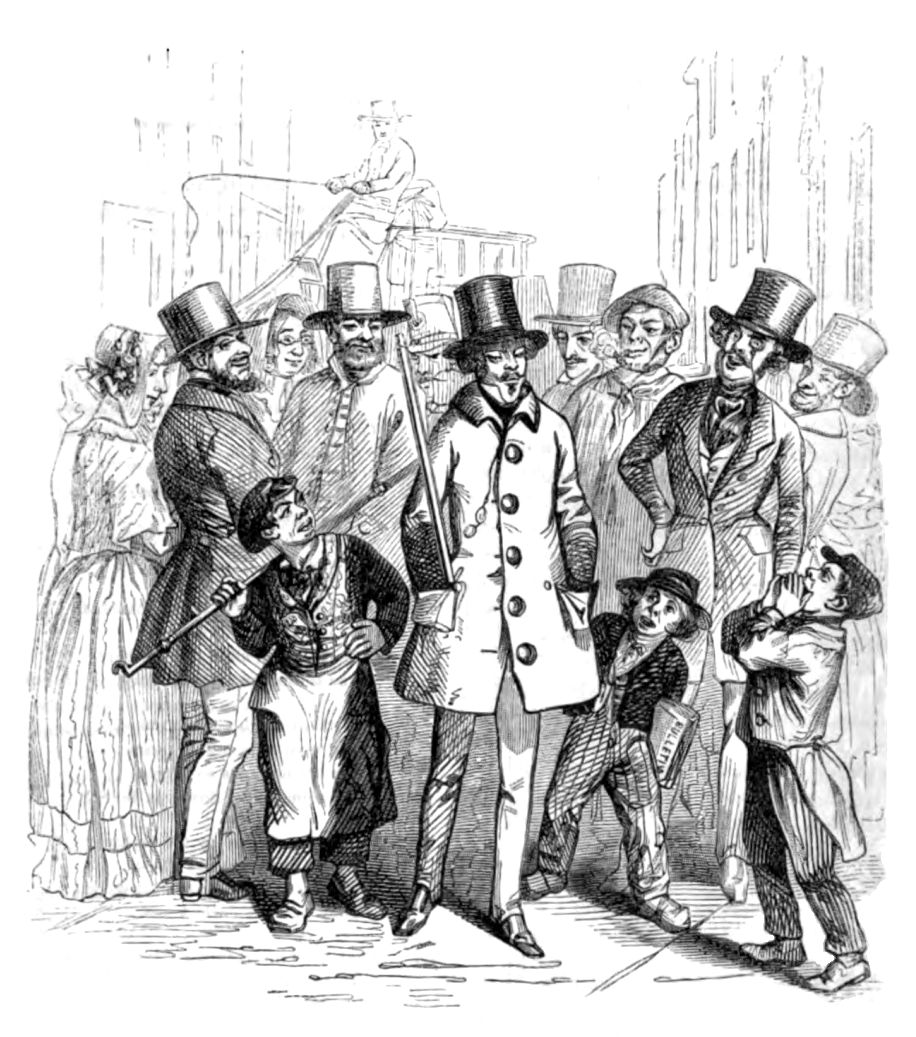
Like auriferous deposits in common quartz, the readers of Graham, the precious ore amidst duller literary encompassment, brighten the continent from Canada even to California. A few rich veins are to be found in large cities, but the valuable aggregate is scattered through the more rural portion of the country, where the free air whistles by, uncontaminated by the smoke of thousands of chimneys, and where night reigns in sable supremacy, and is not turned into decrepit day by blazing gas and brilliant illuminations. The great mass of Grahamites are, therefore, but slightly versed in the etiquette of towns, and know little of city follies and city pride.
In farm-houses midst pleasant valleys, in log-cabins which dot clearings midst western prairies, even in the unsubstantial tents of seekers in El Dorado, they turn to its pages for amusement, moral cultivation and instruction. These demands have been often attended to, though perhaps a trifle too gravely. The time has at length come, when the growing public taste bids us prepare to have a little fun. Human folly is the best and most natural subject for human ridicule. To laugh with the manes of the Jolly old Grecian philosopher, is more agreeable than to snivel with the lugubrious ghost of his weeping rival. We therefore must needs have a hearty guffaw together, and as the most appropriate subject for mirth, suppose we select that incarnation of vapid creation, but that idol of self-esteem—a City Dandy.
The assertion made by the ancient sage Socrates, that “a dandy is like a jackass, because he wears his Sunday-coat every day,” would scarcely fit a modern exquisite, whose diurnal attire varies with each revolution of the sun. The apothegm of Plato, that “a monkey owes his distinction to his tail and a fop to his tailor,” is not thoroughly apt, because the human ape owes something (generally a considerable sum) to his hatter and boot-maker. The well-known assertion of Virgil, “in squirtibus nihil sed aquæ lactissimus”—in squirts you will find nothing but milk and water—has about it the usual license taken by poets, inasmuch as if we examine our squirts, they will be pronounced empty. Bacon’s celebrated maxim in his Novum Organum, that “what are considered petty matters are often of importance, but there is no importance in a petit maître,” will probably be acquiesced in by common people, though those implicated by the serious pun may think it uncommonly impudent. Newton’s position taken in the Principia, that “in apples and men there is much specific gravity, but mushrooms and dandies are of trifling lightness,” may be disputed by the latter, who with some show might liken their weight to that of “some pumpkins.” Euclid’s celebrated rule, “a plane superficies is every where flat, e.g. a dandy who is plainly superficial is a flat every where,” has long been a fixture in geometrical lore, which may be doubted, though dangerous to dissent from. We, therefore, seek in vain in the lessons of ancient science and wisdom for competent authority to settle the question—“What is a dandy?” Hamlet, who being the “glass of fashion and the mould of form,” was of course a fop, did on one occasion confess that himself and some other leaders of the ton at that time, yclept Horatio and Marcellus, were “fools of nature,” and horribly shook their dispositions “with thoughts beyond the reaches of their souls.” His candid admission that exquisites are natural fools—“rather weak in the upper story,” and unable to stand the overpowering weight of grave thought—has long been admired as a fine picture of the mental condition of the dandies when something was “rotten in the state of Denmark.” But even this idea of the immortal bard will scarcely assimilate to a proper notion of our modern bucks, because the foppery natural to a Hamlet would not be similar to that of a large City.
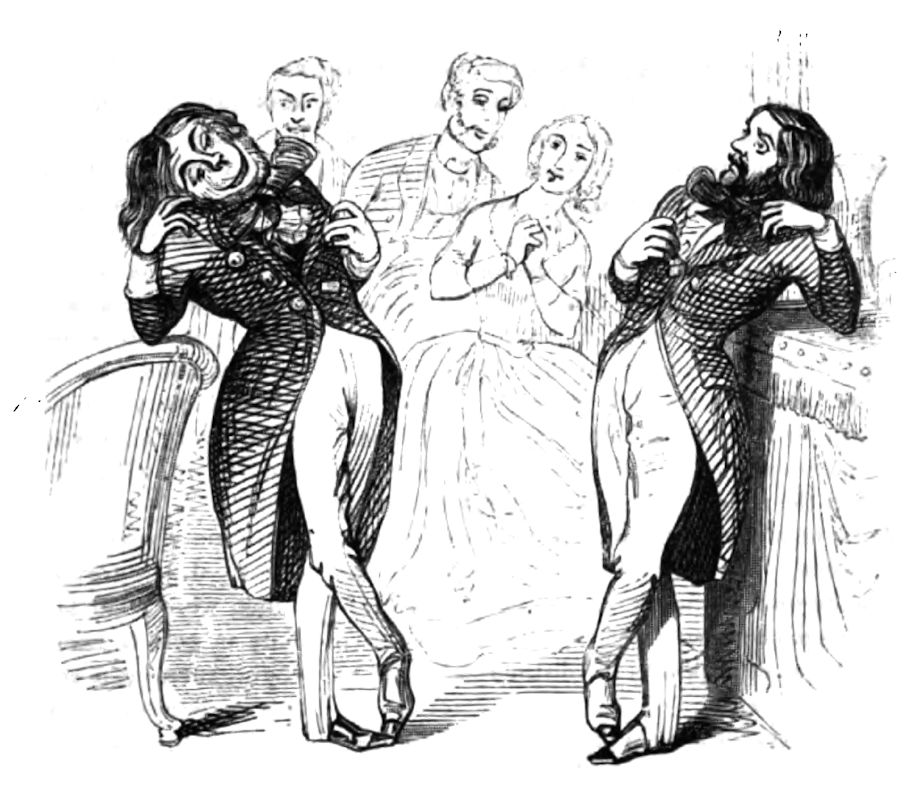
We therefore rummage the books with little success in search for authorities upon this subject. We are constrained to a belief that Linnæus has not classified the genera or Buffon discriminated the species. If exquisites, by reason of their sappiness, are vegetable, the Swedish naturalist has passed over the variety—if they are animals, the Frenchman has not given them a proper place among the mammalia. The history, habits and peculiarities of these mandrakes, these “forked radishes,” these nondescripts, who afflict the south side of Chestnut street, Philadelphia, or the west side of Broadway, New York, has not yet been written, but the subject has latterly assumed an importance which can be no longer disregarded. If the comic dissector, with scalpel in hand, were to desire the fop for a subject, he would have to wait until he was defunct, but the dandy never dies; he is a living example of the verity of the adage, true whenever made—“the fools are not all dead yet”—and it is therefore impossible to imagine the time when there will not be a dandy. We cannot consequently dissect. We may apply the stethoscope to the chest of the exquisite; we may feel his weak pulse, or examine his silly tongue. So may we make our diagnosis, and though we cannot “minister to a mind diseased,” we may, at least, “hold the mirror up to nature,” for the benefit of all gazers. Therefore, in pursuance of the task, come we to our first great inquiry: