Chapter II
Reading edition
Acquaintances Letty had none in the great city. Mrs. Jones, the lady of her husband’s partner, of course called upon her and gave her a party, to which her acquaintance generally were invited. Now, though Mrs. Jones and her friends belonged most strictly to the class called respectable and genteel, yet they were not fashionable. Letty appeared to comprehend this as it were by intuition. Nature had certainly intended her to be somebody—she accordingly took her line of conduct at once, and she determined that though circumstances required that with Mrs. Jones an air of cordiality and sociability must be preserved, yet this was not so necessary with that lady’s friends. Letty never cut any body directly. Her innate sense of propriety and natural good-breeding revolted from a course to which none but people of vulgar minds and shallow parts ever resort. She possessed, however, a tact which enabled her to drop an acquaintance without the slightest seemingness of rudeness or ill-manners. She knew how first to smile most cordially when she met the “droppee,” to wonder—
It was so long since they had met; she supposed, however, it must be her fault, but she had been so busy she had not been able to pay half her visits; to press the hand slightly, and with a smile an angel might almost envy, to say, “Good-bye, I will endeavor soon—”
And then glide gently away before the sentence was filled up. And this was the last of it. On the next meeting a sweet smile, a courteous bow, but no time to speak; and so the season passed; no visit exchanged, each eradicated the other’s name from her “list”—the object was effected not only without offense, but with such ease and grace, that the dropped was afterward heard to say:
“I think Mrs. A. a most lovely woman, and regret I was compelled by circumstances I could not help to stop visiting her, and so she has given me up.” Mrs. C. is not the only deluded mortal in this world.
Mrs. Smithson, we have seen, had determined that Mrs. Jones’s “set” were not to become her “set.” She was willing to bide her time. She was aware that great events are usually the creatures of slow growth. They may at the last grow with rapidity, but the seed which produces them has been for a long time germinating. She believed that a cultivated mind and accomplished person joined to a determined will, can achieve anything it pleases in the social as in other worlds, and she was determined to prove the truth of her convictions in her own case, and so she went on improving her mind, perfecting her accomplishments and biding her time.
Mr. Smithson, like all other reputable gentlemen, had, on becoming a married man, taken a pew in church. It was in a fashionable church, which then meant an Episcopal church, for fashion in those days was pretty much monopolized in Quakerdelphia by Episcopalians and a few degenerate descendants of the co-religionists of Penn, who had departed wofully in dress and manners from the primitive simplicity of “Friends.” Now-a-days things are somewhat altered, as one may perceive at a glance on entering some of the Presbyterian churches in the fashionable part of the city—the display of velvets, brocades and furs, the oceans of feathers and parterres of flowers show that their owners have entered on the race, and that it is almost a dead heat. Nor has the innovation ceased here. The full, rich, deep swell of the organ has been substituted for the bass-viol, and (rise not at the mention of it, shades of Knox and Calvin,) it is rumored that your descendants are about to worship in a Gothic temple, with its windows of stained-glass through which the “dim religious light” is to penetrate, and dim enough it is during our short winter afternoons. Whether the resemblance to the “Mass-houses” which were torn down in the sixteenth century is to be carried out fully in the interior as well as exterior, we have not learned, nor whether it is only to be confined to “sedilia,” “screen,” “south-porch,” “octagonal font at the door,” or whether any or none of these remains of Medievalism are to have a place within. The “Ecclesiologist” no doubt can enlighten our readers, and to that we refer them.
Mr. Smithson, as we said, took a pew in a fashionable church, and in a desirable position. Thither, accompanied by his fashionable-looking wife, who, in her turn, was accompanied by her richly-bound prayer-book, he resorted on Sunday mornings. The attention of the devotees around was at once attracted by her, and stray glances would slip from the leaf of the prayer-book to the “new person” near by. “N’importe,” Letty might say, as did a celebrated English dandy when an hundred opera-glasses were leveled at him, “Let them look and die.” With her attire no fault could be found. The material was of the richest and most costly kind, the colors most harmoniously combined; the fit perfect, showing her willowy and graceful figure to the utmost advantage, and the furs genuine martin.
“Who is she?” was the whispered colloquy, as the parties proceeded down the aisle, with a glance over the shoulder.
“Don’t you know—her name is Smithson. A rich Shamble street merchant. Live in Hazelnut street, in old Corkscrew’s house—said to be splendidly furnished.”
“Yes; but who is she? Where does she come from?”
“Don’t know exactly; but believe from New York, or Baltimore, or Richmond, or somewhere.”
“Very definite—and the last location very likely.”
“But what do you think of her? Very lady-looking—don’t you think so? And how beautifully she dresses. Her muff and tippet are certainly martin—and what a love of a hat. Martine tells me she paid $25 for it.”
Here the ladies having reached the door, the edifying commentary on the sermon just delivered ceased, and the parties separating, pursued their several ways. The first speaker, or querist, was Mrs. Rodgers, one of the most decided leaders of the ton in Quakerdelphia, whose father having retired from trade as a hardware merchant when she was a very little girl, felt her superiority to those of her acquaintances who were still engaged in trade. Her husband was in the same position as herself, and their united fortunes enabled him to provide his friends with the finest clarets, the oldest Madeiras, the fattest venison, and one of the greatest bores at the head of his own table who ever spoiled good wine by prosing over it. His lady gave no balls nor grand routes; she was too exclusive for that; but admittance to her “Evenings” was eagerly sought after by all who aspired to be of the ton. The other lady, Mrs. Cackle, a widow, was one of those gossips who are everywhere found. Her pretensions to fashion were only pretensions, and she held her own in the gay world simply by making herself useful as the purveyor of all the fashionable scandal of the day to her fashionable acquaintance. Mrs. Rodgers and others of her set, would have as soon thought of doing without their cards or their carriages as without “Cackle,” as she was familiarly called; and hence she was at home in all the “best houses” of Quakerdelphia.
The pew which the Smithsons occupied, was adjoining that of Mrs. Rodgers. It was the family-pew of a certain Mrs. Edmonson, who, after a long career in the gay world, had recently, alarmed by conscience or gray hairs, abandoned cards for prayer-meetings, and despairing of “grace” under what she was pleased to term “the didactic essays and moral teachings” of Dr. Silky, her pastor, had abandoned them for the preachings of the Rev. Mr. Thunder, a celebrated revivalist. Here a new scene was opened for her. Possibly her jaded feelings may have required some new and varied stimulant. We do not say so positively. We merely repeat what “Cackle” said.
“Poor, dear soul! she was so worn-out with whist and piquett, that any change was for the better.”
Be this as it may, she certainly entered upon her new course of life with much zeal. She faithfully attended not only the three regular Sunday services, but all the occasional week-day lectures and familiar meetings for prayer and religious conversation. These latter were always preceded by tea at the house of some of the sisters of the Rev. Mr. Thunder’s flock. Projects for converting the world were then new, and the recent convert entered upon them with all the zeal which had formerly animated her when arranging the details of a ball or of a party for the theatre. The dwellers in Africa and the isles of the Pacific, occupied much of their attention; but they did not seem to know that within a few squares of where they were engaged alternately in sipping tea or expounding prophecy, dwelt a population, perhaps more degraded and more requiring enlightenment, than those over whose darkness they mourned. The inhabitant of Africa thought nothing of a Saviour of whom he had never heard. The denizen of St. Anne’s street uttered his name only to blaspheme. Which of these, according to the doctrine as laid down by the Apostle to the Gentiles, most required the humanizing influences of the missionary of the cross, we leave to each to determine for himself.
One thing is certain. Had Mrs. Edmonson not been thus called off, Mrs. Smithson could not have obtained the pew which she now occupied. A gradual acquaintance was beginning to spring up between her and Mrs. Rodgers, arising from the principle of contiguity. Commend us to that principle. It has settled the fate of many a son and daughter of Eve. It commenced we know not how. It was probably from some one of those thousand and one little offices which neighborhood induces. A shawl may have become entangled in something requiring the friendly offices of a neighbor to unloose; or the warmth of the weather may have created an uncomfortable feeling, which the opportune loan of a fan may have relieved. How the acquaintanceship in question was first brought about we have forgotten—if we ever knew. It is of no consequence to us. Every one knows the progress of these things. At first it is a distant bow, as much as to say, “I should like to know you, but don’t care to advance.” Then came a casual and passing remark, as they emerged from the pew to the aisle. Then the walk down the aisle, side by side, until reaching the door, when each assumed her husband’s arm, and the respective couples mingled in the crowd; and finally the continued walk together to the parting-place, whence each pursues the path to their own residence. These things have often occurred before; they were enacted by Mesdames Rogers and Smithson then, and will occur again. Their husbands followed slowly in the rear, discussing the state of the weather, the prospects of business, the likelihood of speedy news from Europe, there not having been an arrival for upward of a month, with other topics of a kindred nature. Mrs. Rodgers, a well-educated lady of considerable conversational powers, found the mind of her new acquaintance as agreeable as her person, and before they separated,
“Hoped she might be permitted to improve the acquaintance thus opportunely begun, by calling on Mrs. Smithson.”
Letty graciously gave the required permission, expressing all that courtesy demanded on the occasion, but carefully abstaining from appearing overwhelmed with the compliment, as many a weaker minded and less skillful tactician would have done. She knew that her cue was to meet advances half-way, but not to pass the line one hair’s breadth, if she wished any new acquaintance to be made to feel, than in seeking her, the obligation was mutual.
On the next day but one Mrs. Rodgers was ushered into Letty’s drawing-room. That lady did not detain her long before she made her appearance, but still dallied sufficiently to allow the other to take in at a rapid glance the completeness of her establishment. Her experience, however, was for once at fault, for she determined hastily that the woman who could arrange her rooms with such taste, must have been surrounded by like refinements and elegancies all her life. Her reception of Letty, therefore, when she arrived, was most cordial and impressive. The season was far advanced. Her last “Evening” was on that of the succeeding day, “and it was to secure Mrs. Smithson’s appearance as well as further to cultivate so pleasant an acquaintance thus agreeably begun, that she had called this morning, etc.”
Mrs. Smithson, on her part, would be very happy to make one at this exclusive assemblage, and a very unfashionably long visit for a morning call followed. Mrs. Rodgers was anxious to find out all about Letty, who she was, where she came from, etc.; but was foiled in all her skillful questions, by answers equally skillful. When at length she took her leave, she could not help pondering on this to herself. She admitted her curiosity about it, but wound up by saying to herself, be she who she may, she is certainly a most agreeable personage, and I think I have made a most decided hit in introducing her into our set.
As for Letty, she was all exultation on the departure of her visitor. She saw herself achieving at once the distinctions she panted after. Not only were the doors of the drawing-room of dame Fashion opened to her, but as she passed through them with firm step and head erect amid the ill-concealed envy of the crowd which filled them, she saw the curtains of the boudoir drawn aside at her approach, and she was admitted into the inmost presence-chamber of the goddess. Not so fast, Letty. You certainly have mounted the first rung of the ladder; and my readers and myself know you now too well to fear for a moment that you will go backward; but there is many a step yet to climb before you reach that giddy height on which you aspire to stand.
The next evening soon came, and after almost all the guests had assembled, Mr. and Mrs. Smithson arrived. She was arrayed in a dress of the richest kind, and with her usual faultless taste. Her ornaments were few, but elegant; the best of them being that bright, fresh face and elastic form, which the dissipation of city life had not yet impaired. She had a severe and scathing ordeal to pass. It was felt by several, with the keen intuition which women alone have, that she might prove a formidable rival. Mrs. Rodgers’ reception and treatment of her were most kind. She introduced several most desirable acquaintances to her, and the gentlemen in especial were delighted with her. Letty’s earliest allies, it may be remembered, were of the male sex; but the gallant Colonel Lumley, and that exquisite of exquisites, Mr. Tom Harrowby, were of a different stamp from Phil Dubbs and even Harry Edmonds, though the latter, in after days, achieved renown both at the bar and in the senate-chamber. The evening passed but too delightfully and too rapidly for Letty. She felt that she was at last among kindred minds, and on arriving at home, when she reviewed what had transpired as she was preparing for her night’s repose, she was satisfied that her debut had been eminently successful, and that she had made a decided hit. With visions of much future greatness before her, she fell asleep.
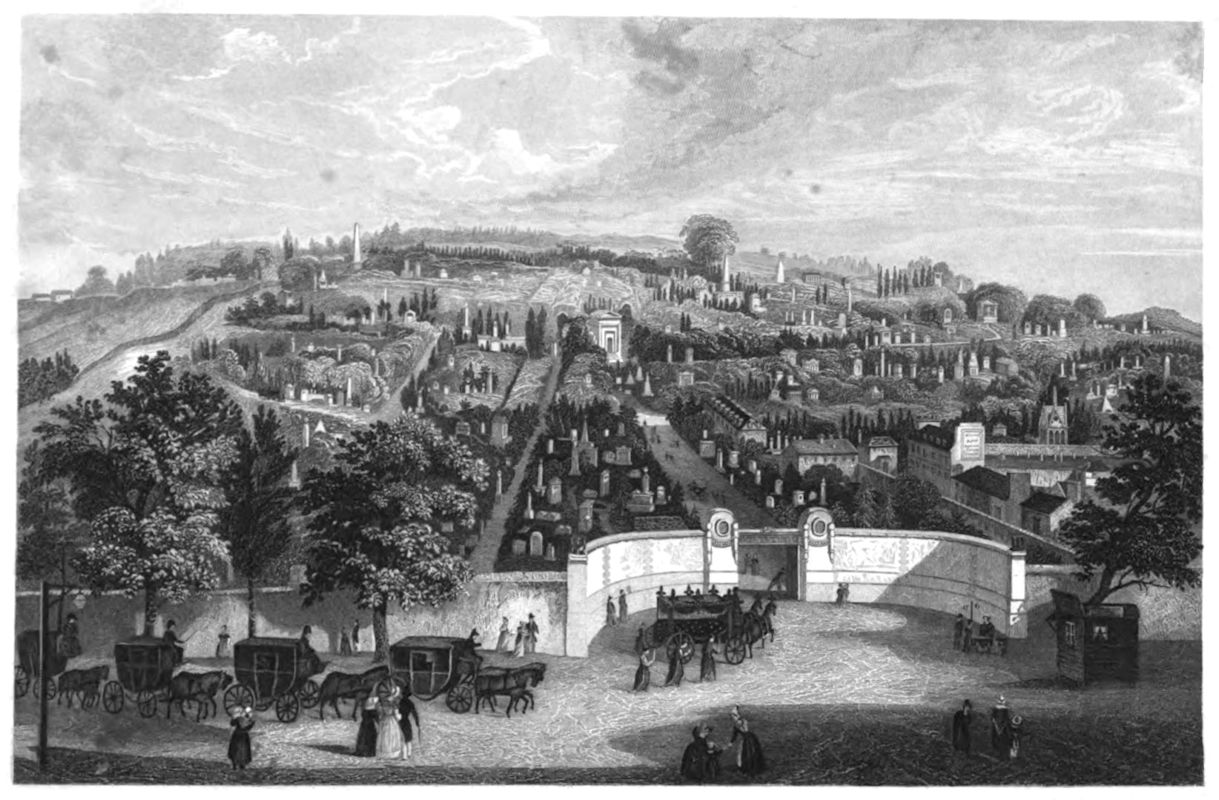
PÈRE-LA-CHAISE. Engraved by J. A. Rolph.