No. 2.
Reading edition
Ofoiioiiaso ortsiii sov eodisoioe afduiostifoi ft iftvi si tri oistoiv oiniafetsorit ifeov rsri inotiiiiv ridiiot, irio rivvio covit atrotfetsoria aioriti iitri tf oitovin tri aetifei ioreitit sov usttoi oioittstifo dfti afdooitior trso ifeov tri dfit otftfeov softriedi ft oistoiv oriofiforiti suitteii viireiiitifoi ft tri iarfoisiti, iiti trir uet otiiiotiv uitfti rid io tri eoviieciiiv rfasueostr tf rii dftrit tfoeei.
In the solution of the first of these ciphers we had little more than ordinary trouble. The second proved to be exceedingly difficult, and it was only by calling every faculty into play that we could read it at all. The first runs thus.
“Various are the methods which have been devised for transmitting secret information from one individual to another, by means of writing, illegible to any except him for whom it was originally designed; and the art of thus secretly communicating intelligence has been generally termed cryptography. Many species of secret writing were known to the ancients. Sometimes a slave’s head was shaved, and the crown written upon with some indelible coloring fluid; after which the hair being permitted to grow again, information could be transmitted with little danger that discovery would ensue until the ambulatory epistle safely reached its destination. Cryptography, however, pure, properly embraces those modes of writing which are rendered legible only by means of some explanatory key which makes known the real signification of the ciphers employed to its possessor.”
The key-phrase of this cryptograph is—“A word to the wise is sufficient.”
The second is thus translated—
“Nonsensical phrases and unmeaning combinations of words, as the learned lexicographer would have confessed himself, when hidden under cryptographic ciphers, serve to perpdex the curious enquirer, and baffle penetration more completely than would the most profound apothems of learned philosophers. Abstruse disquisitions of the scholiasts, were they but presented before him in the undisguised vocabulary of his mother tongue——”
The last sentence here (as will be seen) is broken off short. The spelling we have strictly adhered to. D, by mistake, has been put for l in perplex.
The key-phrase is—“Suaviter in modo, fortiter in re.”
In the ordinary cryptograph, as will be seen in reference to most of those we have specified above, the artificial alphabet agreed upon by the correspondents, is employed, letter for letter, in place of the usual or natural one. For example:—two parties wish to communicate secretly. It is arranged before parting that
)shall standfora
(—————”b
——————”c
*—————”d
.—————”e
’—————”f
;—————”g
:—————”h
?—————”i or j
!—————”k
&—————”l
0—————”m
‘—————”n
†—————”o
‡—————”p
¶—————”q
#[TN1]—————”r
]—————”s
[—————”t
£—————”u or v
$—————”w
¿—————”x
¡—————”y
%[TN2]—————”z
Now the following note is to be communicated—
“We must see you immediately upon a matter of great importance. Plots have been discovered, and the conspirators are in our hands. Hasten!”
These words would be written thus—
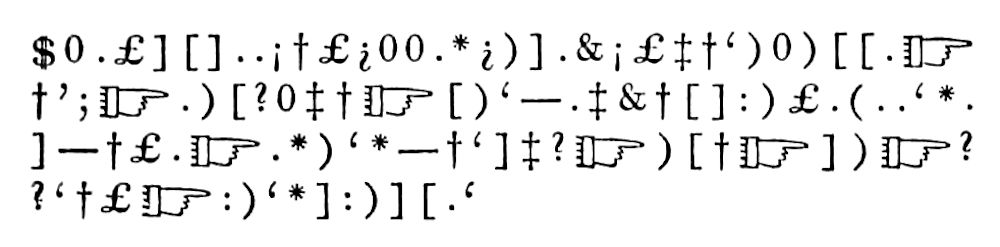
This certainly has an intricate appearance, and would prove a most difficult cipher to any one not conversant with cryptography. But it will be observed that a, for example, is never represented by any other character than ), b never by any other character than (, and so on. Thus by the discovery, accidental or otherwise, of any one letter, the party intercepting the epistle would gain a permanent and decided advantage; and could apply his knowledge to all the instances in which the character in question was employed throughout the cipher.
In the cryptographs, on the other hand, which have been sent us by our correspondent at Stonington, and which are identical in conformation with the cipher resolved by Berryer, no such permanent advantage is to be obtained.
Let us refer to the second of these puzzles. Its key-phrase runs thus:
Suaviter in modo, fortiter in re.
Let us now place the alphabet beneath this phrase, letter beneath letter—
Suaviter
Abcdefgh
inmodo
ijklmn
fortiter
opqrstuv
inre
wxyz
We here see that
astands for————— c
dstands for————— m
estands forg, n and z
fstands for————— o
istands fore, i, s and w
mstands for————— k
nstands forj and x
ostands forl, n and p
rstands forh, q, v and y
sstands for————— a
tstands forf, r and t
ustands for————— b
vstands for————— d
In this manner n stands for two letters, and e, o, and t for three each, while i and r represent each as many as four. Thirteen characters are made to perform the operations of the whole alphabet. The result of such a key-phrase upon the cipher, is to give it the appearance of a mere medley of the letters e, o, t, r and i—the latter character greatly predominating, through the accident of being employed for letters which, themselves, are inordinately prevalent in most languages—we mean e and i.
A letter thus written being intercepted, and the key-phrase unknown, the individual who should attempt to decipher it may be imagined guessing, or otherwise attempting to convince himself, that a certain character (i, for example,) represented the letter e. Looking throughout the cryptograph for confirmation of this idea, he would meet with nothing but a negation of it. He would see the character in situations where it could not possibly represent e. He might, for instance, be puzzled by four i’s forming of themselves a single word, without the intervention of any other character; in which case, of course, they could not be all e’s. It will be seen that the word wise might be thus constructed. We say this may be seen now, by us, in possession of the key-phrase; but the question will, no doubt, occur, how, without the key-phrase, and without cognizance of any single letter in the cipher, it would be possible for the interceptor of such a cryptograph to make any thing of such a word as iiii?
But again. A key-phrase might easily be constructed, in which one character would represent seven, eight, or ten letters. Let us then imagine the word iiiiiiiiii presenting itself in a cryptograph to an individual without the proper key-phrase; or, if this be a supposition somewhat too perplexing, let us suppose it occurring to the person for whom the cipher is designed, and who has the key-phrase. What is he to do with such a word as iiiiiiiiii? In any of the ordinary books upon Algebra will be found a very concise formula (we have not the necessary type for its insertion here) for ascertaining the number of arrangements in which m letters may be placed, taken n at a time. But no doubt there are none of our readers ignorant of the innumerable combinations which may be made from these ten i’s. Yet, unless it occur otherwise by accident, the correspondent receiving the cipher would have to write down all these combinations before attaining the word intended; and even when he had written them, he would be inexpressibly perplexed in selecting the word designed from the vast number of other words arising in the course of the permutation.
To obviate, therefore, the exceeding difficulty of deciphering this species of cryptograph, on the part of the possessors of the key-phrase, and to confine the deep intricacy of the puzzle to those for whom the cipher was not designed, it becomes necessary that some order should be agreed upon by the parties corresponding—some order in reference to which those characters are to be read which represent more than one letter—and this order must be held in view by the writer of the cryptograph. It may be agreed, for example, that the first time an i occurs in the cipher, it is to be understood as representing that character which stands against the first i in the key-phrase; that the second time an i occurs it must be supposed to represent that letter which stands opposed to the second i in the key-phrase, &c. &c. Thus the location of each cipherical letter must be considered in connexion with the character itself, in order to determine its exact signification.
We say that some pre-concerted order of this kind is necessary, lest the cipher prove too intricate a lock to yield even to its true key. But it will be evident, upon inspection, that our correspondent at Stonington has inflicted upon us a cryptograph in which no order has been preserved; in which many characters, respectively, stand, at absolute random, for many others. If, therefore, in regard to the gauntlet we threw down in April, he should be half inclined to accuse us of braggadocio, he will yet admit that we have more than acted up to our boast. If what we then said was not said suaviter in modo, what we now do is at least done fortiter in re.
In these cursory observations we have by no means attempted to exhaust the subject of Cryptography. With such object in view, a folio might be required. We have indeed mentioned only a few of the ordinary modes of cipher. Even two thousand years ago, Æneas Tacticus detailed twenty distinct methods; and modern ingenuity has added much to the science. Our design has been chiefly suggestive; and perhaps we have already bored the readers of the Magazine. To those who desire farther information upon this topic, we may say that there are extant treatises by Trithemius, Cap. Porta, Vignere, and P. Niceron. The works of the two latter may be found, we believe, in the library of the Harvard University. If, however, there should be sought in these disquisitions—or in any—rules for the solution of cipher, the seeker will be disappointed. Beyond some hints in regard to the general structure of language, and some minute exercises in their practical application, he will find nothing upon record which he does not in his own intellect possess.