COTTAGE LIFE.
Reading edition
The summer is here!—here with its fragrant mornings and its noonday heats, its mellow twilights and its moonlight evenings, its days of glory and its nights of starry beauty. It is summer. Let us go out into the country, away from the stifling air and dull brick walls of the town, into the far, pure, breezy, unsurpassable country. There we shall breathe the fresh air of Heaven. We will lie down on some shady knoll; or stretch ourselves beside the cooling stream; or wander off among the breezy woods; or perchance sit in some quiet arbor of the garden, listening to the low humming of the bees, or the far-off tinkle of the brooklet on the stones. Ay! we will go out into the country. We will gaze on the green grass, the growing flowers, the cloudless azure of the skies. But we will do more. We will gaze on our fellow man such as God made him, and not on the too often mean, grovelling and short-sighted denizens of the town. We will go out into the country. We will go into its stately palaces, secluded among sombre trees; into the airy, fantastic dwellings of retired citizens; into sunny old farm-houses, with their wide porches inviting us to enter; and—oftener than all—into the smiling cottages, which, peeping out from amid overspreading honeysuckles, dozing under willow trees by the brook-side, or nestling beneath the shadow of a green and fragrant hill, are scattered all over the land, in hill and in dell, studding it, as it were, with loveliness. And wherever we go we shall still find beauty. God hath left his impress on the green fields and running brooks, and every leaf that quivers in the breeze, and every bird that carols on the air, speak out His praise.
We are in the country; and yonder is a cottage nestled close under the hill-side, like a dove in the bosom of a young and innocent girl. Hear you not the brook, low pattering before its door; that brook which at eve and morning, ay! in the still watches of the night, may be heard murmuring mysteriously, as if it were angels’ voices conversing on the quiet air? Let us go into that cottage. There are flowers before the house and honeysuckles around the door, and everything, even to the garden flags, is white-washed. There are roses under the window—how fragrant! And yet the owner of that little tenement has a hand horny with labor, and not a day passes, summer or winter, but that he is up before dawn, toiling for his richer neighbor. How does he live? Would you know what cottage life is? Come with us, then, into the fields, and let us sit together by this brawling brook, while we recount the history of a cottage life.
All over this land there are spots like this, of bewildering beauty; where toil and rest, and wo and happiness, have struggled together for years. There are thousands, ay! tens of thousands, of humble cottages, the lives of whose inmates have never won a thought from the rich and proud, and yet in those cottages beat as true hearts as in the most gorgeous mansions of the realm. The rich are born, and great is the rejoicing thereat; they live, and crowds shout triumphs wherever they go; they die, and they are laid by obsequious hands in proud mausoleums; but the poor come and go like the leaves of the forest, and no man careth for their fate. Their childhood of early toil; their youth of premature sorrow; their lives of hard, unyielding, grinding poverty, what does the world care for these? Yet the poor are not without comfort. They have within their own circle as kindly bosoms as the rich; they have dear ones, loved with a fervor wealth can rarely win, to cheer them in distress; they have a fireside, humble, indeed, but still a fireside around which to gather with their prattlers, and smile and be merry after the toils of the day are done.
With early dawn the cottager is up and afield. If he labors at the soil, you will find him with the plough in hand, keeping his monotonous track to and fro, regardless, apparently, of the stifled air, or the sultry rays of noon-day. He may pause an hour or so at dinner, but he is soon at his labor again. The cattle may be dozing under the trees, the birds may be carolling gaily around, the woods, and streams, and all nature may be full of merry play, but still he must keep up his weary toil, until twilight at length releases him, and he hurries home to spend a few hours of fleeting happiness among his little ones, to sleep, and again to resume his toil.
But there is a bright side to the picture. The Cottager was not always a man, he was once a happy child, and in gazing on the frolicks of his little ones, his own youth appears to be renewed. And where do the domestic affections exist with more purity than in our cottages? From the love of a child for its little brother or its sister, up to the love of a mother for her first-born, there is nothing purer, deeper, or more enduring than the affections of those who inhabit our cottages.
We see now two beings at that cottage door, a mother and her boy. The child hath fallen asleep upon her lap, and he reposes with a grace so careless, and there is such an innocent joy upon his face, that one cannot but feel that he is supremely happy. How he nestles on that mother’s knee. The vine that gaily winds around the gentle sapling, or hangs so airily over the little group, is not more beautiful than he. And she!—is not the book held to shade his countenance, and the holy, contemplative emotions which light up her face as with the divinity of an angel, beyond comparison, ay! almost beyond imagination. God be thanked that there are thousands all over this broad land as happy as they!
Sunday is the time for cottage life. Then the new coat is taken out, carefully brushed, and put on—the little ones are clad in their tidy, well-kept Sabbath clothes—and the good house-wife attires herself in her best, adding, often, some little piece of finery, which a month’s savings have tempted her to buy. Directly the bell is heard calling them to church. Away at the signal they go, with a quiet decorum even in the children; and soon they meet others trooping over the hills to the white-steepled meeting house in the glen. And when the sermon is over, and they pass out of the house of God, there are greetings among neighbors, inquiries after old friends, and perchance here and there long conversations betwixt good house-wives, which seem like the fairy’s dream, never to come to an end. And in the afternoon some one is sure to drop in, when the best tea-cups are brought out from the corner cupboard, and the best hot cakes, and such tempting coffee are prepared by the good dame, that your mouth fairly waters until you have tasted thereof. And how merry all are—not with a boisterous mirth, but with a calm happiness, reminding you continually of the day. And all this time the children are playing on the lawn, or gathering buttercups to hold under each others chins, or laughing in their own innocent way so joyously, that their mothers will pause awhile, and look on them and smile. And by and by night will come, and the company will depart, and so, after reading a chapter of the bible, the cottagers will go to bed. Though the stars, on a Sabbath night, look down on many a quiet, happy home, they smile on none where there is more happiness than there. And such is Cottage Life.
J. S.
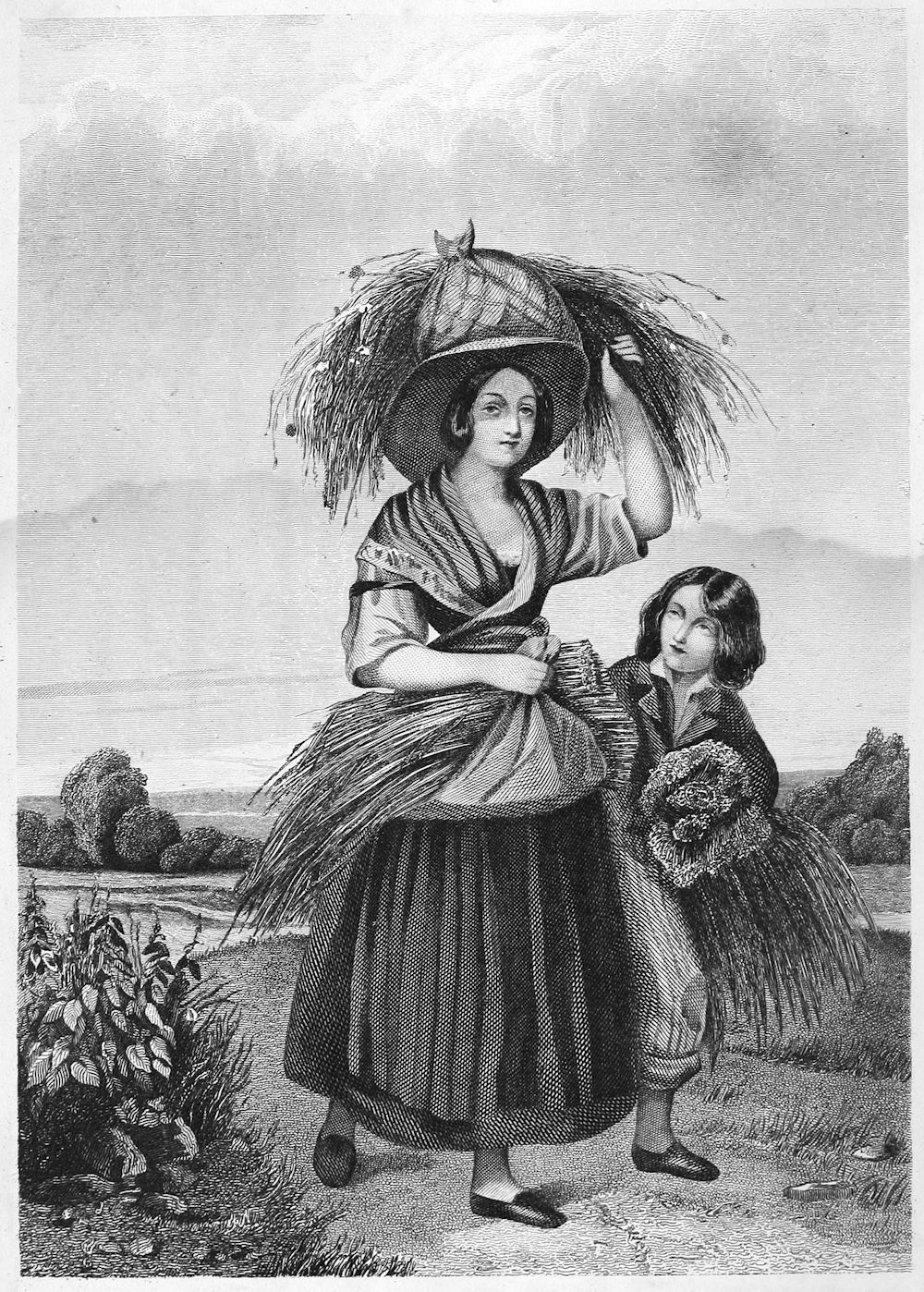
The Gleaners Engraved by Eldridge expressly for Graham’s Magazine.