I (continued 2)
Reading edition
Don Juan de Dios de la Rada y Delgado, who supplied the text for the volume of aquafortis engravings of these frescoes which D. José Moria Galvan y Candela executed in 1897, tells us that they were wholly in accord with the conditions of the time. But the sentiment of Mr. Rothenstein is nearer to the truth when, in speaking of these frescoes, he says that he can remember nothing which gave him so clear an idea of Goya’s cynicism. ‘Imagine,’ he writes, ‘a coquettish little church with a white and gold interior, more like a boudoir than a shrine, but furnished with altar, and seats, and confessionals. One’s nostrils expect an odour of frangipane rather than incense, and it must be admitted that Goya’s frescoes do not strike a discordant note in this indecorously holy place.’
The subject of the main composition covers the cupola, and contains upwards of a hundred figures considerably over life-size. The picture illustrates the miracle ascribed to St. Anthony of Padua, who restored to life the corpse of a murdered man in order that he might reveal the name of his assassin and rescue an innocent man who was about to be executed as the perpetrator of the crime. The scene is enclosed by a painted railing which surrounds the entire composition. We see the saint standing on an eminence against a luminous background. His life-giving words have just restored the corpse to consciousness. The man leans forward, supported in the arms of a companion, with his hands clasped in an attitude of profound veneration, his expressive face looking fixedly upon the saint with a gaze of surprise and gratitude. The central figures are surrounded by a motley crowd of men, women, and children, some of whom express their astonishment by eloquent gestures, while others appear indifferent to the miracle that is being performed, and one or two frolicsome boys are seen astride the figured railing. On the spandrils, the intrados, the curvilineal triangles of the arches, and behind the high altar, are groups of angels and cherubs. The angels are beautifully clothed and almost wanton in their human loveliness, the babes are entirely without the illusion of divine origin. It has been said that in this composition Goya perfectly interpreted the spirit of the Church de la Florida; certain it is that these angels with ‘the skin of a camellia, eyes of fire, and the beauty of a harlot,’ which move with audacious freedom of attitude, ‘not in pure spheres of blessedness, but in an atmosphere of atoms of gold illuminated by an Asiatic sun, are the strangest and most beautiful creatures that ever adorned a consecrated house.’
‘The frescoes of la Florida,’ comments C. Gasquoine Hartley, ‘are yet another witness of the truthful humour of Goya’s insight, but not one of his countrymen realised the irreverent irony of his work.’ ‘The figures are as full of piquant intention,’ declared Richard Muther, ‘as can be found in the most erotic paintings of Fragonard.... It is an artistic can-can; it is Casanova transferred to colour. All that the Church painting of the past had created is despised, forsaken; and this satire upon the Church and all its works was written in the land of Zurbarán, of Murillo.’ The Conde de la Viñaza alludes to Goya as an artist who painted pictures with religious subjects, but not religious pictures. ‘I do not know,’ he says, ‘a more profane master than this Velazquez, Rembrandt, Vicelli and Veronese rolled into one.’ And he instances his monumental painting at la Florida to illustrate his contention: ‘An admirable energy, the most splendid scale of tones. What relief! What a magic of colour! What a beautiful lesson the light of nature receives there! On the other hand, what lack of religious feeling and spirituality in those frescoes!’ And having denounced in the angels the silkiness of their skins, the brilliance of their eyes, and the wantonness of their beauty, he adds, ‘the miracles of the exemplary man of Padua are familiarly treated as a spectacle of wandering rope-dancers might be!’
It has been said that the King was incensed against the artist for introducing renowned ladies of his court in the faces of the winged archangels, and it is generally believed that the most aristocratic persons of the capital are represented in the frescoes, but if Charles IV. resented his choice of models, he had a most amiable way of expressing his displeasure. Goya himself, writing to Zapater, admitted that ‘the King and Queen are mad on your friend Goya,’ but the madness took the form of a royal order, dated October 31, 1799, which reads: ‘H.M. wishing to reward your distinguished merit and to give in person a testimony that may serve as a stimulus to all professors, of how much he appreciates your talent and knowledge of the noble art of painting, has been pleased to appoint you his chief painter of the Chamber, at a yearly salary of 50,000 reals, which you will receive from this date free of rights, and also 500 ducats a year for a carriage: and it is also his pleasure that you occupy the house now inhabited by Don Mariano Maëlla should he die first,’ etc.
Certainly the frescoes in his own day were extolled as the most important work ever done by Goya’s marvellous brush; he closed the eighteenth century with creations that won for him his greatest contemporary fame and raised him to the summit of his art. If nothing could be further removed from religious inspiration, nothing human could reveal more enchanting beauty, more exquisite grace. These frescoes were praised as ‘an inimitable symphony of light and colour.’ It is not in our province either to accept or to refute the claim that ‘they raise the most common things of Goya’s time to the high spheres of Spanish mystic realism.’ Goya’s contemporaries did not realise that the paintings outraged the canons of propriety and probability, and in later times Señor Rada finds that the painter, in this work, rises always to the regions of mystery, where only genius can penetrate, and responds to the peculiar influence of a temple which seems rather to inspire loving human aspirations, than mystic thoughts of infinite abstraction. ‘Apart from the fact that Goya was a believer and respectful to all that pertained to religion,’ urges Señor Rada, ‘in the principal subject of this painting (the “Cupola”) he is as manifestly mystic and delicate as any painter of the spiritual school. In the central group the risen man partakes of both realism and religious unction. The expression could not be better, nor could the attitude of the saint be more dignified. Apart from this in the other groups, he copied what he was wont to observe in popular gatherings, as he saw it, as it was, as it always will be.’
Goya’s Spanish apologists may well be justified in their contention that his originality forced him to disregard the classic rules and mannerism of traditional Spanish religious art. They see no impropriety or extravagance in surrounding the figure of a revered saint with a crowd of roysterers, prostitutes, cut-purses and Manzanares rascals. And, after all, the point is scarcely worth arguing. Again, when it is protested that Goya’s archangels and seraphim were rather beautiful women than angelic spirits—well! what better conception could there be of angels than the perfections of a charming woman? That is Señor Rada’s retort: ‘The naturalist Goya, surrounded by the seductive beauty of his time, could not conceive or even presume that the chosen beings who sing eternal praises in the ethereal regions of celestial glory were any different. More in accord doubtless, with our pious traditions and with Christian spiritual belief are the glories of Juan de Juanes and Murillo; but each artist has his peculiar temperament as well as his special gamut of colour, and to ask Goya to paint angels like those great Christian artists would be the same as asking the painters of a previous epoch to paint pictures of popular scenes like Goya’s.’
The logic of the foregoing is presumably sound, although the conclusion seems to us to support those who contend that Goya’s temperament rendered him an unsuitable person to translate religious episodes into colour. We remember, as Señors Rada and Pedro de Madrazo assert, that Goya was ‘a believer’ and ‘respectful in everything pertaining to religion,’ and we recall also that in their joint will the painter and his wife describe themselves as ‘firmly believing and confessing the mystery of the Holy Trinity ... and all other mysteries and sacraments, believed and confessed by our Holy Roman Catholic Apostolic Mother Church, in whose true faith and belief we have lived.’ But we cannot, at the same time, forget that Goya’s detestation of the priesthood was violent and unresting. If he caught the spirit of ecstasy in his picture of San José de Calasanz receiving the Host at the hands of a priest, he also painted a representation of Santas Justa and Rufina. This picture has been described as the most profane and inappropriate work of the Aragonese genius. It is stated that he selected as his models a pair of well-known cocottes of Madrid, giving, it is said, the caustic, uncanonical explanation, ‘I will cause the faithful to worship vice!’ Goya may have called himself an orthodox conformer to the national church, but his contempt for his ecclesiastical patrons and those who practised the devotions which he mechanically professed, is avowed.
But apart from their religious significance, or their lack of it, these frescoes of the Church of San Antonio de la Florida reveal Goya at his best as a daring draughtsman and fine colourist. The energy, the spontaneity, the light and the relief, the magic of his paint—all are revealed in this work, which occupied him only three months. And what better proof could one desire of the truth of his own contention: ‘In nature colour exists no more than line—there is only light and shade.’ Goya knew how to produce abundant life with simply white lead, the black of smoke, green and vermillion. Richness of colour does not consist in an infinite variety of tints, but in the harmonious variety of tones and in the skilful selection of the key in which the picture is painted. Here Goya surpassed himself in the effect he produced with a palette that was severe in its simplicity, but the processes employed by the master to obtain his wonderfully vivid and charming tones were so varied that they cannot be exactly determined. Of the result, Paul Lafond writes, it is ‘as true as Velazquez, as energetic and as light as Rembrandt, as delicate as Titian, as spiritual as Tiepolo, with infinite perspectives like those of Tiepolo and Veronese, and as refined as Watteau.’
The painting of the frescoes of San Antonio de la Florida won for Goya, as we have seen, the coveted office of first painter to the Court. It was at this same time he began to paint less and to take up the needle as a new force of expression. His first work was the series of designs known as ‘Los Caprichos’ in which the spectator is transported into some ‘unheard of, impossible, but still real world’—a world peopled with dapper majas, handsome hidalgos, hideous old men and hags more horrible than the witch of Endor, gluttonous priests, spectres and sorceresses, devils and desperadoes and corpses, all the myriad diabolical and terrifying shapes and phantasies in which Goya set down his vision of humanity. The origin, the inspiration and the object of these etchings are still matters of speculation. It is generally agreed that the painter executed the first drafts for these plates after his return from San Lucar. His deafness aggravated by a serious illness, from which he made a slow and painful recovery, obliged him to give up the fatiguing work with palette and brush, and it may well be that he, whose spirit never rested and whose hand was never idle, fell into a habit of preserving his impressions on paper in order to distract his tormented imagination from brooding over his sufferings. It was at a later date that he transferred these drawings on to the copper plates. It may be reasonable to assume, as some have done, that the part of philosopher which he had developed leisurely during his days at Court, as well as the vein of moralist and castigator of vice, was quickened in him by satiety and physical pain. The Conde de la Viñaza appears to believe that Goya suddenly awakened to his power as a caricaturist, and that, irritated at the moral ugliness of his contemporaries, and at the vile coterie which surrounded the King and Queen, he began to inveigh unflinchingly against lasciviousness, covetousness, rapacity, hypocrisy, and ignorance, against the court parasite and the court harlot, the miser and the monk, the women who sold their daughters and the monsters who bought them, against insolent pomp, ecclesiastical rottenness and venal stupidity. Yet probably the view of Gautier is nearer the truth. He assumes that the now popular painter was ‘merely producing so many capricious sketches, when he was in truth drawing the portrait and writing the history of Spain of former days, under the belief that he was serving the ideas and creed of modern times. His caricatures will soon be looked upon in the light of historical monuments.’
Extraordinary as these pictures are by reason of their fancy, their beauty, their saturnine wit, their ‘Gargantuan spirit,’ as well as by the technical skill and originality they display, they are even more extraordinary by reason of the favour with which they were at first received by the people against whom they were directed. At first the plates were issued separately and were passed from hand to hand among the etcher’s friends. But in 1799, probably the year in which the series was completed, a prospectus was issued, advertising the publication of an edition of seventy-two plates. Goya, for unknown reasons, objected to this edition, and the issue was never made. In the meantime the satire of these tumultuous cartoons was discovered by the objects of his ridicule. Godoy, the old Duchess of Benavente, the Queen’s favourites, were the first to be identified, then effigies of the Queen herself and her illustrious lord were recognised upon the plates. The scandal of these allusions aroused an outburst of indignation, instigated, in great measure, by the caricatured and crucified clergy. The office of the Inquisition was moved to take action, and Goya’s popularity and influence were powerless to avert the inevitable catastrophe. Rescue came from the most unexpected quarter. In 1803 the King caused an edition of 240 copies of 80 plates, which had already been printed, as well as the plates themselves, to be acquired by the state, with an order that he had commanded their publication.
It is difficult to account for this splendid action from such a King as Charles IV. Was he so impressed by the merits of these etchings that he was prompted to rescue them from the Inquisition in the interests of art—a magnanimity of spirit ‘of which his character gives no promise’? Probably he was merely insensible to the satire of the pictures. The ‘Caprichos’ were dedicated to the monarch by the artist—a subtle jest on the stupidity of the King, who, Muther concludes, ‘was not even in a position to grasp the meaning of the plates.’ We learn that Charles remunerated Goya by granting his son a pension of 12,000 reals. A reproduction of the letter from the painter referring to this arrangement is as follows:—
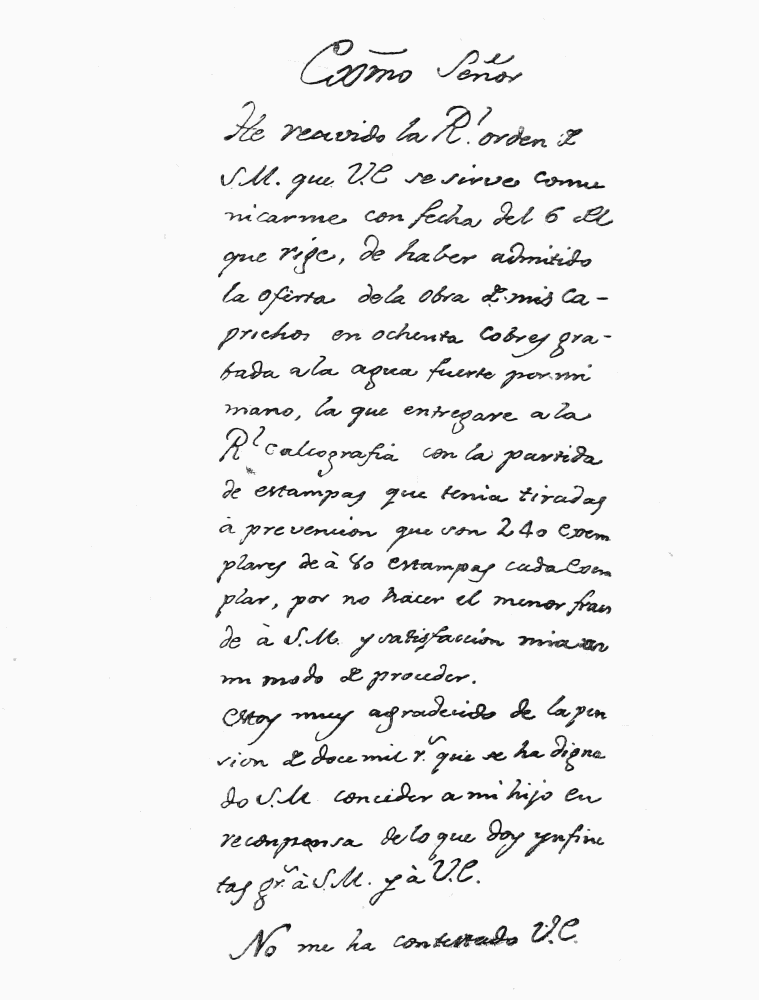
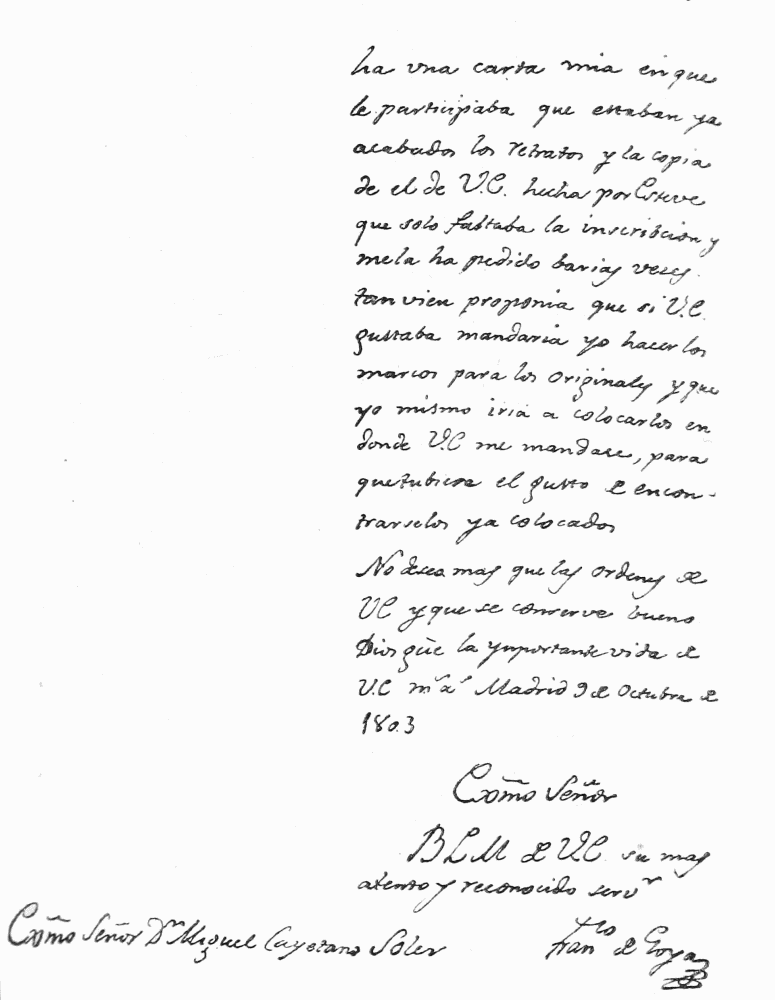
TRANSLATION
Your Excellency,—I am in receipt of H.M. Royal Order which your excellency communicated to me on the 6th inst., accepting the offer of my work, the caprices on eighty copper plates engraved with aquafortis by my hand, which I will hand to the Royal Calcografia with the lot of prints which I had printed by way of precaution amounting to 240 copies of 80 prints each copy, in order not to defraud H.M. in the least and for my own satisfaction as to my mode of procedure.
I am very grateful for the pension of twelve thousand reals which H.M. has been pleased to concede to my son, for which I give my best thanks to H.M. and to your excellency.
Your excellency has not replied to a letter of mine, in which I said that the portraits were finished, and also the copy of your excellency’s by Esteve which only lacked the inscription for which he has asked me several times. I also suggested that if your excellency approved I would get the frames made for the originals and would myself go and put them where your excellency might order, so that you might have the pleasure of finding them in their places.
I only desire your excellency’s orders and that you keep well. May God preserve your excellency’s valuable life for many years.—Madrid, October 9, 1803.—Your excellency’s obedient and grateful servant,
Francisco de Goya.
To his Excellency Señor Don Miguel Cayetano Soler.
The technical excellence of the Caprichos makes them comparable with those of Rembrandt, while in their meaning and character they may be likened to the work of Daumier. There are the peculiar qualities of Goya’s etching, which recall the truth and naturalness of Fernando Boll, the movement and life of Lievens and Konninck, and the expression and charm of Von Vliet? These artists, whose best individual qualities are all combined in Goya, were pupils of Rembrandt. ‘Only Hokusai,’ writes Mr. Rothenstein, ‘was capable of such monstrous gaiety, such stinging satire, and he alone could have lent probability to such monstrous phantasy; Hogarth was too sermonising, Rowlandson too rollicking; a certain diabolical side of his nature, which Goya allowed to be seen both in the “Caprichos” and “The Disasters,” has probably prevented his etchings gaining a footing in England.’ Certain it is that Goya’s prints are rarely to be met with in this country—a fact that caused the writer of this book to spare no effort in order to include in the illustrations, reproductions of every etching and lithograph, as well as of every portrait or picture of Goya’s, of which he could secure an impression.
It is one thing to admire, even to understand, the technique of the ‘Caprichos,’ but to understand the precise significance of many of the plates is almost impossible. Perhaps the titles printed by Goya beneath the plates are the best guide to their meaning. The only reward to be derived from reading ingenious meanings into the prints is the personal interest one finds in the exercise. The series may be divided into three classes; the first are humorous satires of the foolishness and rottenness of the life of the period; the second are scathing assaults upon the ignorance and greed of the priesthood and the corruptness of the civic institutions; and the last are visions of witches and demons, which may be classed as pure phantasies. There is a depth of meaning in every plate, for Goya reproduces for us in them not only what he has seen, but what he has felt. The first plate illustrates a marriage of convenience, and we are shown the girl-bride being presented to her hideous suitor by her more hideous mother. Over and over again we are presented with this type of the ‘complaisant mother,’ which has been described by Théophile Gautier in illuminating prose. ‘It is impossible’ he writes, ‘to fancy anything more grotesquely horrible, more viciously deformed. Each of these frightful old shrews unites in her own person the ugliness of the seven capital sins; compared to them the Prince of Darkness himself is pretty. Just fancy whole ditches and counterscarps of wrinkles; eyes like live coals that have been extinguished in blood; noses like the neck of an alembic covered with warts and other excrescences; nostrils like those of an hippopotamus rendered formidable by stiff bristles; whiskers like a tiger’s; a mouth like the slit in the top of a money-box, contracted by a horrible and convulsive grin; a something between the spider and the multiped which makes you feel the same kind of disgust as if you had placed your foot upon the belly of a toad.’ The description is horrible even as Goya’s engravings are horrible, and as excellently true as the work by which it was inspired.
It is not possible in the space at our command to review these ‘Caprichos’ in detail, and fortunately it is not necessary. The reader can examine the plates for himself and study their details. He will remark the skill with which the engraver endows ‘The Garroted Man’ with its sombre, gruesome tone; the sense of the unavailing, despairing effort with which the living skeleton in ‘And yet they do not go’ (Plate 369) supports the slab of stone which must inevitably fall and crush the crouching, scarcely human wretches who anticipate their fate with expressions of such lurid horror. One can feel the violence of the wind that buffets the women in ‘A Bad Night’; we enter into the terror of the woman who is employed in her hideous task in ‘Tooth Hunting.’ Here indeed, ‘horror confronts us; corruptness is imagined with an unapproachable depth of grotesqueness.’ In all the realm of art there is nothing to compare with the horror and grotesquerie of these Caprices.
Goya’s next work was the thirty-three plates of ‘The Tauromachia.’ This series of engravings was so brilliant in execution and appealed so strongly in their theme and treatment to the Spanish national affection for the bull-ring, that doubtless they would have brought the etcher even greater contemporary fame than the larger series, but for some unexplained reason, they were not publicly issued until after his death and the death of his only surviving legitimate son. In the ‘Tauromachia’ Goya made less use of aquatint and aquafortis, and, as in his later etchings, relied more and more upon the needle to produce his effects. These scenes of the bull-ring represent the different phases of the combat and the surpassing feats of its most famous exponents. The ‘Caprices’ may appeal more strongly in some respects, but the drawing in the plates of the ‘Tauromachia’ is extremely light and facile, and the illusion of vigorous movement is seen in them all.
In 1803 Goya was fifty-seven years old. The corruption in high places, against which he had hurled his darts, was fast driving Spain into the grasp of the world-power which was menacing all Europe. Napoleon’s ambitious designs embraced the mastership of the Peninsula, and he was already maturing his plans to that end. In 1803 the English and French were again at war. Napoleon demanded, under the treaty of St. Ildefonso, that Spain should declare war against England. Godoy strove fiercely to resist the will of the tyrant. Napoleon ordered the dismissal of Godoy. Spain purchased her neutrality in hard cash, and Godoy was retained. In 1804 Napoleon was proclaimed Emperor, and the neutrality of the Spaniards was reduced to such a farce beneath the grinding importunities of the imperial ally that Pitt declared war against Spain in December of that year. The battle of Trafalgar was fought on October 21, 1805, but before the end of the year Napoleon had entered Vienna and won the battle of Austerlitz. Before the awful menace of his growing power, Godoy sued for the favour of the conqueror in gold drawn from the Spanish funds. The Emperor accepted the money without relaxing his animus against the despised favourite, who was forced to approach England with proposals for an anti-French coalition. His overtures were ignored. The Queen and the King heaped new honours upon the Prince of the Peace, but his end and that of his august patrons was near. Ferdinand’s party was working the country into a ferment of hatred against Godoy, and Napoleon’s inflexible aversion sealed his doom. In 1807 Ferdinand truckled to the ‘Scourge of Europe’ by asking for a lady of Napoleon’s family for a wife, while Godoy urged upon Napoleon the occupation of Portugal as a preliminary to the introduction of French troops into Spain. In October 1807 Portugal proving refractory, Junot and a strong force encamped on Spanish soil and were made welcome by the Prince of the Asturias and the Prince of the Peace, both of whom regarded the invasion of the French as a friendly move, in support of their respective interests.
In the same month the Court was stricken by the exposure of the plot and counterplot planned by the rascally favourite and the intriguing Crown Prince. Godoy was charged by Ferdinand with the intention of killing the King and his family and seizing the throne; Ferdinand was surprised in a plot which embraced the imprisonment if not the death of his father. The Prince of the Asturias was placed under arrest, and the King applied to Napoleon for his advice. Junot marched into Portugal; French troops poured into Spain; the Portuguese Regent, at the advice of Lord Strangford, transferred his court to Brazil. On March 17, 1808, the troops, in favour of Ferdinand, prevented Godoy from leaving Aranguez, and two days later threw him, bruised and bleeding, at the feet of the Prince of the Asturias, who gave his father to understand that, by virtue of the presence in the capital of his friends the French, he was absolute master of the situation. Charles IV. signed a decree which made Ferdinand VII. sovereign of Spain. A few days later he put his name to a private withdrawal of his abdication; and this document was forwarded to Napoleon, with a letter offering to conform to whatever the Emperor might order with regard to him, his queen, and the Prince of the Peace. Napoleon came south towards Spain. Ferdinand, who hastened north to meet him, entered Bayonne to find himself a prisoner. Charles IV., with Maria Luisa and Godoy, followed to Bayonne, and Ferdinand was compelled to restore the crown to his father, who transferred it to Napoleon. The cash consideration the King was to receive for his sovereignty was never paid.
While these base traffickings were occupying the King and his family, the gallant loyalists of Madrid had risen against the French and suffered massacre on the terrible Dos de Mayo. Once again the country was in arms; the Spaniards fought—to instance only the sieges of Zaragoza and Valencia—with superb valour, but the Junta continued its servile negotiations with Napoleon, and Joseph Buonaparte, King of Naples, was summoned by his brother to rule over Spain. On July 9, 1808, Joseph I. set foot in his new kingdom. On the 17th the French were defeated in the battle of Baileu, and the victorious Spanish troops advanced over the Sierra Morena to Madrid. The new king fled the capital. Napoleon in person took command of the army which was to reconquer Spain, and advanced into the heart of Castile. The left division of the Spanish army was defeated on November 11, the right was driven into the mountains of Aragon, the centre was completely crushed at Tudela on November 26. A fortnight later the Emperor entered Madrid, and Joseph I. was restored to the throne of Spain.
Goya’s position was rendered acutely difficult by these drastic changes. The first painter of the exiled King, the favourite of his dispersed courtiers, what could he do in the court of the hated Joseph Buonaparte? It may be surmised that ‘the good old Goya,’ as Gautier familiarly styles him, hated the new order of things, but he was no visionary patriot burning with the fire of useless sacrifice. His love of country was not love of Charles IV. or his son; he loved Spain not less because Maria Luisa and Godoy were out of it. And as he asked himself what action he should take, he saw the Prince of the Asturias submit himself to the new ruler, and with him Jove-Llanos, Mazarrado and Urquijo, the Dukes of Fernan Nuñez and del Parque, the Count of Santa Colonna, the Cardinal of Bourbon—to mention a few only among the nobles. Goya’s comrades also, the Court painters, Mariano Maëlla, Francisco Ramos, and Pablo Racio, acknowledged the ‘intrusive king’! Goya hesitated no longer. He took the oath of allegiance to Joseph I. He was made a knight of the Legion of Honour. He painted the usurper’s portrait, and some time later accepted, with Napoli and Maëlla, the commission to select from the treasures of the royal gallery fifty of the most beautiful pictures which were to be sent to the Louvre.
But though the old order had changed and Goya had changed with it, his spirit was full of bitterness. He had witnessed the butchery and slaughter of the French soldiers; he hated the sound of the clanking of the spurs of Murat’s hussars on the pavements of Madrid.
Already he had painted two pictures, the ‘Dos de Mayo’ and ‘Un Episodio de la Invasión Francesca.’ One has only to study these two pictures of realised terror, in the Prado, to understand the painter’s hatred of the French and the brooding melancholy which the events of the rising in Madrid had fastened upon his soul and darkened his life. De Amicis, the Italian author, writes, with a fine appreciation of the stirring realism of these works: ‘Nothing more tremendous can be imagined: one can give no more execrable form to power, nor frightful aspect to desperation, nor a more ferocious expression to the fury of a fray. In the first one there is a dark sky, the light of a lantern, a pool of blood, a pile of bodies, a crowd of men condemned to death, and a line of French soldiers in the act of firing; in the other are horses with their veins cut, and horsemen dragged from their saddles, stabbed, trodden upon, and lacerated. What faces! What attitudes! One seems to hear the cries and see the blood running: the veritable scene could not cause more horror. Goya must have painted these pictures with his eyes glaring, foam at his mouth, and with the fury of a demoniac; it is the last point which painting can reach before being translated into action; having passed that point one throws away the brush and seizes the dagger; one must commit murder in order to do anything more terrible than those pictures; after those colours, comes blood.’
Goya retired to the seclusion of his house outside the gates of the capital, only opening his doors to a few old friends, among whom were Cean Bermudez the art critic, Carnicero the illustrator of Don Quixote, Castillo the painter, and Selma the engraver. The old painter had become completely deaf, and, in these dark days of change and violence, the bitterness of his spirit found further expression in the ‘Desastres de la Guerra’—‘the cry of a just soul against the iniquity of warfare.’ With passionate vigour he depicted the horrors of the French invasion and lashed with his satire the barbarities of the conquerors. The new series was begun in the year 1810. They reproduce all the sad and abominable events which had culminated in the accession of Joseph Bonaparte. Callot, in his scenes of the barbarities of the Thirty Years’ War, did not attain the fire, the power, or the purpose of these plates. All the horrors of warfare and its heroism and the stupidity of war are depicted here with searching truth. The technique of the plates is unsurpassed. We see starving men made bestial with terror, dead bodies stripped and mutilated, women outraged, and children butchered before the eyes of their frenzied mothers. And again we are shown the superb heroism of the women who, armed only with hatchets and stones, withstood the onslaught of the dragoons; we are made to realise the intrepid loyalty of those men and women who fought side by side on the terrible Dos de Mayo; we witness the masculine daring of the women who took the match from the hands of the dead artillerymen and continued to work the guns. Every phase of warfare, its famine and desolation, its hunger and disease, its heroism and its savagery, are depicted in this impeachment of Militarism. The utter uselessness of war is emphasised in the haunting echo which runs through all the plates—‘To what end?’ The wasteful sacrifice of human lives is forced upon Goya’s audience by an engraving in this series inscribed with the word ‘Nada’ (Nothingness). Gautier in his rare volume, Travels in Spain (so rare that I need make no apology for again quoting from it), writes of this plate: ‘Among these drawings which admit of an easy explanation, there is one fearfully terrible and mysterious, the meaning of which, that we can dimly understand, fills you with horror and affright. It is a corpse, half-buried in the earth; it is supporting itself on its elbow, and, without looking at what it is writing, traces with its bony hand, on a paper placed near it, one word—“Nothingness”—which is alone worth the most terrible things Dante ever penned. Around its head, on which there is just enough flesh left to render it more frightful than a mere skull, flit, scarcely visible in the darkness of the night, a number of monstrous spectres, lighted up here and there by flashes of vivid lightning. A fatidical hand holds a pair of scales, which are in the act of turning upside down. Can you conceive anything more sinister or more heartrending?’
The ‘Disasters’ were not published in a series until 1863, when the Academy of San Fernando acquired eighty plates and issued the engravings with a brief introductory note. In this introduction the writer says: ‘The collection which Goya designated by the name of Ravages or Disasters of War, is indisputably one of the most notable of the kind that he produced. In it is all the strength of his lively imagination, exalted and excited by a deep patriotic feeling in those terrible moments when an unjust foreign invasion essayed to humiliate the pride and hauteur which are a characteristic of the Spaniard. What matter for surprise then that a Spaniard, an Aragonese, a man with the stern independent character of Goya, should allow himself to be carried away very often by exaggeration and caricature?... On the other hand, this work breathes novelty in the subjects, originality in the types, fire in the composition, boldness and firmness in the colouring, decision and even fineness in the design.... In order that nothing shall be lacking in this collection, there is given on each plate the inscriptions which afford another proof of the artist’s genius. These inscriptions, concise, incisive, and piquant, add character, if that be possible, to what the pencil had already accomplished; the brief phrases, at times a single word, reveal by their sense of rapidity the fugitive idea which his mind had conceived in a moment, and which, in little more than another moment, his hand had represented.’
A very interesting series of drawings and etchings are preserved in the Print Room of the British Museum. Of these ten are reproduced in this book for the first time. The Goya collection in the Museum consists of eight original drawings, a holograph letter of Goya and no fewer than two hundred and eighty-one separate works, comprising etchings and lithographs of the Proverbs, Caprices, Tauromachia, and Disasters of War, and the subjects after Velazquez. They are all in a splendid state of preservation. Of the selection made for the present volume (Nos. 601-12), the portrait of the Duke of Wellington (601) and ‘A Lost Soul’ (605), have been reproduced by Mr. Rothenstein. The sketch of the Duke, whom Goya in the letter referred to, writes ‘Weelingthon,’ served the painter in executing the large portrait. It was made on the day following the battle of Salamanca (1812), when Marmont was defeated on the field of Arapiles. The ‘Lady and Gentleman on Horseback’ (No. 602) have not been identified, although the picture is evidently a portrait. The head of Fray Juan Fernanez (No. 603), drawn at the moment of his last breath, is a very powerful sketch. In No. 609 the artist depicts misery in a few masterly touches, and in Nos. 607, 608, and 609 he illustrates proverbs with his peculiar freakish fancy. The study of bulls (610) is another spirited sketch. The remaining plates represent scenes of the bull-ring.
Goya still brooded over the misfortunes which the Royal family and their hated favourite between them had brought about by folly, ignorance, and baseness; and over the sufferers, the common people, who still sacrificed their lives to reinstate their corrupt but accustomed oppressors. But the end was near. The leading patriots, assembled at Cadiz, were engaged in framing a constitution which was to mark the commencement of modern Spain. Meanwhile Wellington was driving the French troops before him—Olivenza, Fuentes de Oñoro, Almeida, Albuera, Ciudad Rodrigo, and Badajoz indicate the line of their retreat. The country was being drained and devastated to provide money for continuing the war. Joseph was providing bull-fights and shows to divert the mind of the Madrileños from the national misery. Napoleon was overwhelming his brother with blame for a state of affairs which was neither of his making nor controlling. Madrid, cut off from supplies, was wasted by an appalling visitation of famine which lasted from September 1811 to August 1812, when Wellington’s liberating army reached the capital to find that Joseph had already beaten a retreat. The Napoleonic rule was over. Joseph returned to Madrid, but it was only to pack up his belongings, to loot churches and palaces and retire with the plunder to France. On June 21, 1813, Wellington met the retiring intruders at Vittoria, and Joseph, with a greatly diminished burden of treasure, barely escaped with his life. Thereafter Napoleon abandoned his schemes of Spanish conquest; Ferdinand, the prisoner of Valençay,—who had danced in captivity while his country bled, who still sought a marital alliance with the house of Buonaparte, who had slobbered his felicitations on the birth of the King of Rome and congratulated the Emperor upon his victory over the Spaniards—Ferdinand was now free to receive the welcome which his loyal countrymen were eager to give him.
Ferdinand ‘the desired,’ after swearing to respect the new constitution, re-entered Spain in March 1814 amidst an incredible outburst of popular enthusiasm. Two days before he reached Madrid every member of the Cortes and every known friend of the constitution was thrown into prison. By the publication of the decree of Valencia he proclaimed himself an autocrat, by his acts he proved himself a tyrant. He re-established the Inquisition, he decreed the ancient taxes; the country, desolated by war waged on his behalf, was thrown into lamentable disorder by the greed of the coarse and ignorant bloodsuckers whom the King gathered around him. Charles IV. was a paternal sovereign, and Joseph I. was an enlightened ruler beside Ferdinand VII. Neither Liberals nor Conservatives were safe. He imprisoned the men who had striven and bled to effect his return; he persecuted without mercy those who had sworn allegiance to Joseph. Goya was one of the first and fiercest, according to Lafond, to acclaim the return of the King. For a time he sought refuge from his sovereign in the house of his friend José Duaso y Latre, who kept him in hiding for three months. At the expiration of that time he found that Ferdinand was inclined to condone his defection. It is reported that he pardoned him with the words, ‘In our absence you have deserved exile, nay worse, you have merited death; but you are a great artist, and we will forget everything.’
So ‘the good old Goya’ was reinstated as Court painter, and he executed several portraits of the new sovereign. It is evident from these likenesses that the painter recognised the weakness and worthlessness of Ferdinand. He viewed his sitter in the same clear, critical, uncompromising spirit with which he had gazed on his royal parents; he painted the weak, shifty, uncultured despot as he was. The equestrian portrait of Ferdinand VII. is commonplace. His portrait of the monarch in his gorgeous mantle is almost a caricature of royalty, and in his other likenesses he betrays his antipathy to the restored Bourbon. That Goya’s palette still emitted ‘rays of prodigious art’ when he painted people who were congenial to him, is shown by many of the portraits of this period; for instance, by that of the Marquis de San Adrián, of Don Ignacio Garcini and his wife, of Don Evaristo Pérez de Castro, and by the beautiful study of Goya’s little niece, La Felicianæ, which is one of the tenderest and most delicate of all his portraits.
Another royal commission entrusted to Goya was to paint episodes of the war, especially of the siege of Zaragoza. Accompanied by his pupil Luis Gil Ranz, he set out to obtain studies. Owing to the exaltation of the populace the journey is said to have abounded in incidents and perils. The language of signs which Ranz employed in conversing with his deaf master caused them to be mistaken for spies. They were forced to seek sanctuary at Renales, the pupil’s native town, where they waited until a favourable opportunity offered for their return to Madrid.
The melancholy which had settled upon Goya after the accession of the intrusive King increased with advancing age. In the seclusion of his house (the house in which he had entertained the noblest of the Court circle—the Deaf Man’s House, as it came to be called by the Madrileños) he beguiled the time by painting the walls with fantastic and gruesome visions which gave it an awesome and startling appearance. But the brilliant fancy had been obscured by the national vicissitudes he had witnessed and the haunting memories of the war obsessed his imagination. These paintings, which are now preserved in the Prado, produce a painful impression; they would seem to be the creations of a fevered brain.
In 1817 Goya visited Seville to paint the picture of Santas Justa and Rufina for the Cathedral, to which reference has been made. On his return he designed a new series of Caprices, and executed many portraits and miniatures on ivory. It was at this time, too, that he made his first essay in lithography. The earliest of these lithographs is a fine brush drawing of an old woman spinning. It is signed and dated February 1819. Among the drawings upon stone that were executed about this period, the two most important are ‘Los Chiens,’ a bull attacked by dogs, and the splendid diabolical scene of a man being dragged along by demons. This last, which is in the Print Room of the British Museum, has special interest, as it is the first known wash drawing made upon the stone. M. Lefort mentions six other lithographs which were executed at Madrid before the journey to France: a duel between two people, a young woman reading to two children, a monk, a girl sitting on the knee of an old woman with other women in the background, a drunkard and a woman, and a peasant assaulting a girl.
The date of the execution of ‘Los Proverbios,’ the fourth series of Goya’s etchings,—‘the last thunderbolt of his genius,’—is uncertain. Probably they belong to those years when, under the weight of distress of spirits in his lonely home on the Manzanares, he sketched the world within him as it appeared to his gloomy imagination. The plates are without explanatory titles, and their meaning is obscure. Mr. Rothenstein finds in the larger size and broader execution of the plates themselves the reason for his belief that these are the last etchings by Goya’s hand before his failing eyesight forced him to lay aside the needle. The plates were first printed in 1830. This edition was edited with little care, and in 1864 a second edition was undertaken by the Academy of San Fernando. There were eighteen of these plates, but three more, reproduced much later in L’Art, may be placed among them.
There remain several important etchings; among them the three fine and impressive plates of ‘The Prisoners’ come first in importance. In these, as Mr. Rothenstein has said, ‘Goya’s powers as an etcher and his sympathy for suffering are demonstrated in a striking and singularly direct manner.’ Beneath the prints he has written in three sentences, his last protest against injustice: ‘The safe guarding of a prisoner does not necessitate torture’; ‘If he is guilty, why not kill him at once?’ ‘So much barbarity in the treatment equals the crime committed.’ The first proofs of these prints Goya gave to his friend, Cean Bermudez. The plates known as Obras Sueltas were not, as far as we know, printed in Goya’s lifetime. They show a man swinging a woman on a swing, with a cat watching her from the bough of a tree; a bull-fighter with a bull lying down behind him; and two representations of majas. They were first etched at Bordeaux, and from the somewhat crude style of the work, probably were the last prints executed by Goya.
Among several unconnected prints we may mention the superb engraving of ‘The Colossus,’ which seems like an etching at first glance and has defied the attempts of experts to explain the highly complicated process of its execution. As an illustration of Goya’s resources for producing a marvellous impression, this piece constitutes a veritable tour de force. The giant is placed in a vast landscape, and beside his uncouth might and Herculean muscles, cities and villages seem diminutive and insignificant atoms of the soil on which he rests. He is frightened into wakefulness by the morning sun which touches his mighty head and shoulders; they seem as if the summit of a mountain, while his feet are yet in the shadow of night. A mysterious, pale, fantastic effect of moonlight throws a peculiar atmosphere about the figure. As we have already remarked, the process by which the effect is obtained remains inexplicable. According to a statement made by Goya’s grandson, the engraver employed a very soft metal plate from which only three impressions could be taken. One of these impressions is in the National Library of Madrid. A brilliant and rare old engraving of ‘A Blind Guitar Player,’ a large but inferior plate of a popular scene, and three etchings of religious subjects, complete the list of Goya’s miscellaneous etchings.
In June 1824, at the age of seventy-six, Goya set out for France. Before starting he painted his ‘San José de Calasanz receiving the Sacrament’—perhaps his finest religious composition. The work was scarcely dry when he sought and obtained the King’s permission to take the mineral waters at Plombières in France. The remainder of his life’s story is soon told. In Paris he made the personal acquaintance of Vernet, and found delight in the works of Gros, of Géricault, and of Delacroix. The last master did honour to Goya by copying every plate of the ‘Caprichos.’ But the full life of Paris was too overwhelming for the old painter, and having obtained in January 1825 a six months’ extension of leave from the King, he settled down in Bordeaux with his devoted friends, Mme. Weiss and her daughter. In the little Spanish colony on the pleasant banks of the Garonne, he had for companions Joseph de Carnerero, the marine painter, Antonio de Brugada, the members of the family of Goicoechea, and Pio de Molina, and Moratin, whose portraits he painted. But these pictures do not represent his full powers; the colours are heavy and sometimes crude; he worked with double magnifying glasses and a stout lens. But in his engraving, and especially in his series of lithographs, ‘Les Taureaux de Bordeaux,’ which Mr. Rothenstein describes as ‘the most remarkable compositions of his life, certainly the greatest and most significant lithographs in the history of the art,’ his old powers shine forth again in undimmed brilliance.
In 1826 the feeling of home-sickness drew him back to Madrid. At Court he was received with every mark of respect. The King granted him a superannuation salary of 50,000 reals and permission to return to France, ‘in order that he may again take the baths which have done him so much good.’ His Majesty requested him to sit to Vicente López y Portaña, in order that he might possess a picture of ‘the greatest painter Spain has seen since Velazquez.’ López painted ‘the good old Goya’ life-size, seated full-face, palette in the left hand, brush in the right, and wearing an unbuttoned frockcoat. The portrait was executed in a few hours, for at the second sitting Goya carried away the portrait, assuring the painter that he would only spoil the likeness if he persevered any further with ‘his niggling brush.’ It is said that he took palette and brush and essayed a portrait of López, but his hand, cold and trembling, refused to respond to the call made upon it, and the attempt was a failure.
The royal pension and permission to return to France is dated July 17, 1826. Accompanied by his grandson, Mariano, he betook himself again to Bordeaux. His declining years were cheered by the affectionate attentions of his young compatriot, Antonio de Brugada, who attended him in his infrequent strolls, suffered patiently his querulous moods, and even played to him on the piano the national airs which the old man could not hear. In one last flash of his genius Goya painted an admirable portrait of Juan Maguiro. It was his last work, and beneath the signature he inscribed his age—eighty-one years.
In March 1828 a premonition that his end was near filled Goya with a strong desire to see his son once more before he died. When he heard that his wish was to be realised he wrote to his son: ‘Dear Xavier,—I can only tell you that this great pleasure has somewhat indisposed me and I am in bed. God grant that I can see you when you come, and then I shall be quite satisfied. Good-bye.—Your father, Francisco.’ Xavier reached Bordeaux on March 13. Three days later Goya had a paralytic seizure, and surrounded by his family and his intimate friends, ‘the greatest painter that Spain has seen since Velazquez,’ breathed his last.
On the following day the remains of Goya were buried in the Goicoechea family vault in the Grand Chartreux Cemetery of Bordeaux, and the following inscription was engraved on the stone:—
✝ SEPULTURA DE LA FAMILIA DE GOICOECHEA —— AL MEJOR DE LOS PADRES —— EL AMOR FILIAL ELEVA ESTE MONUMENTO A LA MEMORIA DE Dn MARTIN MIGUEL DE GOICOECHEA DEL COMMERCIO DE MADRID NACIO EN ALSASUA REYNO DE NAVARRA EL 27 DE OCTUBRE DE 1755 Y FALLECIO EN BURDEOS EL 30 DE JUNIO DE 1825 —— ROGAD Á DIOS POR SU ALMA —— HIC JACET FRANCISCUS A GOYA ET LUCIENTES HISPANIENSIS PERITISSIMUS PICTOR MAGNAQUE SUI NOMINIS CELEBRITATE NOTUS DECURSO, PROBE, LUMINE VITAE OBIIT XVI. KALENDAS MARCII ANNO DOMINI M.DCCC.XXVIII. AETATIS SUAE LXXXV. —— R. I. P.
Goya’s remains were removed to Spain at the end of the nineteenth century. On the afternoon of May 11, 1900, the body was placed in the San Isidro Cemetery, Madrid, by the side of his old friends Menéndez Valdés and Leandro Moratin. Already in 1888 the Cortes had voted a sum of money for the creation of a suitable monument, and a magnificent cenotaph now marks the resting-place of the last great Spanish painter.
Printed by T. and A. Constable, Printers to His Majesty at the Edinburgh University Press