Puzzledom.
Reading edition
No. 663
Original contributions solicited from all. Puzzles containing obsolete words will be received. Write contributions on one side of the paper and apart from all communications. Address ‘Puzzle Editor,’ Golden Days, Philadelphia, Pa.
ANSWERS TO LAST WEEK’S PUZZLES
No. 1. Tied, diet, tide
No. 2. C A L A M U S A V E R I L L L E G A L L Y A R A M E A N M I L E A G E U L L A G E S S L Y N E S S
No. 3. Eve r
No. 4. A B A A B J U R E S A U G U R Y R U M O R E R O T I C S Y R I N G E C G E
No. 5. Beta, bet, be, bate, bat, at.
No. 6. S I S N E T G E N E R A T E S E M I N A L R E C O R D D E N T S
No. 7. F-all
No. 8. P A D P I L E D P I C A M A R A L A L I T E D E M I S E D D A T E R R E D
No. 9. O we go
No. 10. S P A S P E C T R E A C T I O N T I N T S R O T A T E E N S T A M P E M P
No. 11. Edmund Dantes
No. 12. R C A R C A M E L R A M B L E R R E L A T E D L E T T E R S R E E N A C T D R A G O O N S C O R N E D T O N E D N E D D
NEW PUZZLES
No. 1. Charade Whate’er my one has brought to light It never was a whole, To think of it brings down my pride And cuts me to the soul. My principles will not allow That I am “obs.” should two Three any word that Webster calls Not just exactly new. For those of course who patronize Antediluvian lore ’Tis easy quite to build completes And such like by the score.
New York city Lucrezius Borgers
No. 2. Square
1. Pain in the ear. 2. Town of France. 3. A body reflecting light brightly. 4. A purchaser. 5. A sharp, shrill, harsh sound. 6. P.O. Ontario N.Y. 7. Placed in regular form before a court.
Brooklyn N.Y. Moonshine
No. 3. Double Word Enigma In “pine-clad hill,” In “harvest home,” In “cider mill,” In “star-lit dome.” Indulged and spoiled in tender years He grew a wicked youth He early learned to curse and steal And never spoke the truth. He did not love his books. He said, “Catch me sitting on a stool The livelong day! I’d rather be A dunce than go to school.” Instead of going to school, he’d hide His books and run away, With other bad boys like himself, Into the fields to play. Or take his gun into the woods The harmless birds to shoot, Or climb the farmer’s orchard trees, And steal and eat their fruit. On Sundays, when he should have gone To Sunday school or church, He’d take his fishing rod and go To fish for trout and perch. One day while fishing all alone Down by the river side, He tripped, and with a headlong plunge Fell in the river wide. In vain he cried aloud for help, No one was near to save, The waters closed above his head— He found a watery grave. Now let this bad boy’s fate teach us Complete is wicked in God’s sight And let us all henceforth resolve To try and do what’s right!
Charleston, S.C. Osceola
No. 4. Right Star
1. A letter. 2. A pronoun. 3. A spectre. 4. Quadrupeds of the genus Equus. 5. Defensive arms. 6. Unsweet (Obs.). 7. Startles (Obs.). 8. A bone. 9. A letter.
Pontiac, Ill. Can’t Tell
No. 5. Syncopation A one arose between some bees— Indeed of them ’twas very wicked— They fluttered in about the trees, Among the grass and in the thicket Some thoughtless bees within the hive A scheme upon the drones were working, To make them labor they did strive But “drones” were only made for shirking The queen now on the scene appeared, A fine her coming quickly making For she among them all was feared— Their hearts were filled with fear and quaking Said she “A ’drone’ can never toil, A ’sinecure’ is his position He lives on those who till the soil, Like any other politician.”
New York city Jejune
No. 6. Half Square
1. Clairvoyance. 2. Computation. 3. Parts of a flower consisting of the stalk and the anther (Bot.) 4. Buffoons. 5. A hard amorphous mineral. 6. Open thefts (Rare.) 7. Belonging to it. 8. To see (Obs. Word Supp.) 9. A letter.
Rochester N.Y. Theo Logy
No. 7. Charade An old man sat in his easy chair, The firsts of his life almost done How thankful am I, in this world of care, That my course is nearly run. My second is waiting to greet me In mansions so bright—far away In the glorious house I shall soon be, Where all is eternal day. This would have been a hard total From its cares I hope soon to be free With me I think all things will be well When the Son in His glory I see.
Iowa City, Iowa Tanganika
No. 8. Octagon
1. To destroy. 2. A venomous reptile inhabiting the East Indies. 3. The bleak. 4. Little wheels. 5. Comely. 6. A friend. 7. An Arabian prince, military commander and governor of a conquered province. 8. Drives together (Obs.).
Louisville, Ky. X Actly
No. 9. Beheadment Palm tree boughs are lacing Through which the moonlight steals, And bathes the spot like silver Where India’s daughter kneels Her white robes round her falling Her hair as black as night Has its coil of richest rubies Like a crown of crimson light. A lamp on the shining water It is a simple test, Does he prime live, her lover— Lone star on the river’s breast? See it nears the turning Now it’s rocking to and fro In a splash, like liquid silver, Then it flickers and grows low. India’s white-robed maiden Clasps her hands so tight Her face grows pale with anguish, Fine brighter grows the light, Then on through the lily masses, Like a spark amid the blue, Floating safely onward— Floating slowly from her view
Philadelphia, Pa. Snowball
No. 10. Newark Icosahedron
1. A small cask. 2. A genus of climbing shrubs. 3. A kind of cover for the finger. 4. Exemption from oblivion. 5. To dye. 6. Images. 7. A genus of acanthopterygious fishes. 8. A house whose walls are composed of logs. 9. General figure. 10. To stir. 11. One who mingles. 12. A surgeon’s instrument for scraping bones. 13. To plow.
Newark, N.J. Jo Hooty
No. 11. Numerical Edith, dear, do you not recall How we stood long years ago 2, 1, the bridge, one cold, bleak all Looking at the pool below? How we watched the dry leaves sailing, 2, 3, 4, 8 its cold breast While the breeze was softly wailing, As it bore them to their rest? How you wondered, were they happy Now their life was 2, 8, 4 last? How can they 6 and 7 happy When their summer life is past? Ah! the years have fallen round me Since we stood beside the stream And I have shown the hopes that found me Then to earth were but a dream. Oh, were you and I together On that bridge, once 5, 2, 8, 4 I would give a different answer, Than I did in days of yore I would tell of summers fading— How the sun must set at night And of all the thick mists shading, Sun and summer from the sight I would tell of that deep yearning Springing from the fading years For a sun that has no turning— For a life that has no tears Yes! those little leaves that we recall, Drifting on the streamlet’s breast They were glad, that bleak and chill all— They were glad for they had rest.
Charleston, W. Va. R E Flect
Answers will appear in our next issue solvers in six weeks.

SOLVERS.
Puzzles in Puzzledom No. 657. were correctly solved by Madora Carl, Hello Ian, Ran-de Ran, Night Owls, Lowell, Weesle, Charles Goodwin, Crovit, Willie Wimple, Romulus, Night, Windsor Boy, Osceola, Flora Nightingale, Addie Shun, Jejune, Stanna, Carrie Wolmer, Mary McK., Lucrezius Borgers, Claude Hopper, Katie O’Neill, Tweedledum and Tweedledee, John Watson, Dovey, Fleur de Lis, Rosalind, Little Nell, Spider, C. Saw, Legs, Joe-de Joe, Flare, Dorio, Marcellus, Maxwell, Louise M. Danforth, Cora Denham, Woggins & Co., Herbie O., Brig, War Horse, Essie E., B. Gonia, Mary Roland, Theresa, Mary Pollard, Uncas, Duchess, Olive, Coupay, May De Hosmer, Al Derman, Meandhim, Beta, Tanganika and Arcanum, V. I. Olin, Lib Bee and A. L. Vin.
Complete List—Madora.
EASY METHODS OF
Making Slides for the Magic Lantern,
BY JOHN BOYD.
The new three-wick and four-wick magic lanterns which are now made are so good, and give so much better results than the old oil lanterns, that they are coming largely into use, and for ordinary purposes they do remarkably well. The better class of them stands comparison even with the oxy-hydrogen light, although of course they are excelled by it. They are so easily manipulated that many boys now possess them and work them with good effect. The more expensive ones are fitted with first-class lenses, and can be used also with the oxy-hydrogen light.
Two years ago my boys became the happy owners of one, and many a pleasant evening has been passed since, looking at photographs and pictures by its aid.
It has been used with good effect, even in large rooms, to show diagrams, to illustrate lectures and to exhibit pictures to the Sunday-school children.
No sooner had the lantern been obtained, however, than a demand arose for pictures to show with it. In most large towns they can be hired from the opticians, but they cost at least twenty-five cents a dozen per night and, apart from the expense, it is not always convenient to get them; then to purchase them is more than most boys can afford, as the commonest, full-sized chromolithographed slides cost from two and a half to three dollars a dozen, while hand-painted pictures or photographs vary from three to ten dollars a dozen.
Accordingly we determined to try if we could not make slides for ourselves, and, as our efforts were crowned with a fair measure of success, I think it will interest the boy-readers of Golden Days, many of whom, I feel sure, own lanterns, to hear what systems we found to be the best and easiest. I shall confine myself to those pictures that can be made entirely by hand, and accordingly will leave photographs out altogether.
Bought hand-painted slides are usually first photographed on to the glass from a large outline drawing, and then colored; but so few boys have the means of making their slides in this manner that it will be best to pass this system by, especially as I shall describe a method of making the sketch which answers as well, and is much easier.
At the very outset, we were met with a difficulty that we feared would be insurmountable, and that was that it was almost impossible to make a neat, fine-lined sketch with a brush and paint on plain, smooth glass; and, even when this last had been managed, the coloring process often washed out the outlines and made unsightly smudges, and, as every little line, spot or smear shows with painful distinctness when magnified on the sheet, we soon saw that amateur work on these lines would never do. Fortunately I remembered a process, which I once saw used by a microscopist, to make diagrams for the lantern to illustrate his lectures, which answered admirably.
This was simply to draw, with a very hard lead pencil, on ground glass, then to cover the ground surface with varnish, which rendered the glass perfectly transparent.
I tried this plan, and got such good results from it that I can strongly recommend it. By following out the instructions and hints I shall give, any boy can readily and rapidly make a large series of excellent pictures for his lantern, which will answer his purpose quite as well as the most expensive bought slides.
This system has four great advantages: 1. Pictures can easily be traced on the ground glass, and to those who, like myself, would find it difficult to invent their own pictures, or to copy them, this counts for a great deal. 2. The outline can be made very fine, but still very distinct. 3. The paint will not take on the lead-marks; this renders it much easier to prevent the color going over the edge of an outline. 4. It is also very much easier to paint on the slightly rough surface of the ground glass.
There should be no difficulty in procuring this glass at any glazier’s. It need not be plate glass; ordinary ground glass will do, care being taken to select that with a sufficiently fine and smooth surface, and not too thick.
I have found water colors for lantern slides the best for painting with. They are very much easier to use than the oil colors, and are quite as transparent. Ordinary paints will not do, as some of them come out perfectly opaque, but a box of the special paints can be procured for a dollar. A camel’s-hair brush, however, is of no use; you must have a stiff sable brush. One No. 3 or No. 4 will be a handy size, and will answer for all purposes, even for the finest lines.
In selecting subjects, use those where the outlines are clear and of a size adapted to the usual sort of slides, which are invariably made now three and a quarter inches square.
First rub a dozen ground glasses perfectly clean with a wash-leather that has been washed in water in which a little soda has been dissolved, to make it quite free from grease. During this cleaning process, the surface of the glass can be sufficiently moistened by breathing on it.
Trace the entire series of outlines on the ground glasses with an H. H. H. pencil, making the lines even lighter than the original, for it will be found most convenient to have a number of slides, say a dozen, in process at one time. Brush off any loose fragments of black lead, taking care that they do not mark the glass.
You are now ready to proceed with the coloring, but, as you will wish to be sure as you go on that you are keeping them sufficiently transparent, it will be found to be a great help if you can always see through them, even while painting them.
FIG. 1
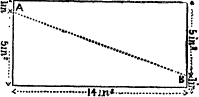
You had better, therefore, make an inclined stand, and this can easily be done, the only tools really required being a knife, a brad-awl and a screw-driver. Procure one piece of wood 14 inches by 6 inches, one piece of wood 12 inches by 6 inches, one piece of wood 14 inches by 12 inches, all ? inch or ¼ inch thick.
Divide the first piece along the dotted line A to B, by cutting right through it with the point of your knife. These two pieces will make the sides of your stand. The piece 14 inches by 12 inches will make the bottom.
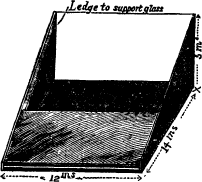
Cut two laths 14 inches long, ½ inch wide, out of wood ¼ inch thick, and tack them along the upper inner edges of the two sides a quarter of an inch below the top. These will form two ledges. Now fasten the piece 12 inches by 6 inches to rest on these ledges, which will serve to support the hand. The upper portion remaining must be filled up by a piece of strong, clear glass, 14 inches by 8 inches, which will rest on the ledge at each side, and need not be fastened in, as it will sometimes have to be removed to be cleaned.
Fasten all the parts together with screws, so that you can take it to pieces and pack it away flat when not in use. Those screws with a ring at the end instead of a head, such as are used to fasten into the backs of picture frames to hang them by, are the handiest, as they can be put in with the fingers, and cost hardly any more than ordinary screws.
This stand will be large enough to hold six slides at once, and enables the light to shine right through them. A sheet of white paper should be placed underneath to throw the light up.
Should the light be too strong it can easily be modified by spreading a sheet of thin, white tissue-paper between the glass and the slides.
Of course daylight is best to work by, but I find you can get on very nicely with an ordinary oil lamp, if placed at a convenient distance from the stand.
An ordinary paintbox will contain twelve colors—namely, two blues, neutral, crimson, brown, yellow, scarlet, burnt sienna, orange, two greens and black, all but the last being quite transparent. These will be found sufficient for ordinary work, as they can be greatly varied by judicious mixing.
First of all the skies should be painted in on all twelve slides. As long as you do not go over the outlines, great care need not be taken about laying the color on evenly.
Now cut off a small piece of clean washleather, which has an even, smooth surface. Let the color become nearly dry, then proceed to dab it all over with the washleather, held on the end of the finger, breathing on the slide when necessary, in order to keep it sufficiently moist.
This process must be continued carefully until the whole painted surface is perfectly even and shows no mark of the brush, and only sufficient paint must be left on to give a blue tint.
You must always remember that if too darkly painted the pictures will be too opaque. Clouds can be put in nicely also with the bit of washleather, but extra work of this sort is hardly worth while.
Then proceed to tint the other portions of the pictures with suitable colors, doing one color at a time right through the set of slides, but after applying each color, immediately dab with the washleather, to render the color even and light.
You will find that by keeping to one color at a time you will get along much quicker, and will also make the pictures more uniform.
When you have completely tinted all the pictures and “dabbed” all the colored portions, you may then go over them all again and shade them up where required with rather stronger colors, taking care, however, not to overdo this.
You will find for faces yellow, with a very slight addition of crimson, answers the best. It may not look all right on the slide, but it will when thrown on the sheet.
You will need to consider the effect of the various colors, as some show much more strongly than others. The next process is to varnish the glasses to render them transparent.
With most color boxes for painting magic lantern slides a bottle of varnish for this purpose is supplied, which answers fairly well. It has to be painted on, after the slides are thoroughly dry, with a large camel’s-hair brush.
Lay one coat on by drawing the brush right across from one side to the other, taking care that the lines of varnish so deposited slightly over-lap one another. When this coat of varnish is perfectly dry and hard, another and sometimes even a third coat must be applied, and it is best to lay it on at right angles to the previous coat, so that all the surface is sure to be covered.
Make each coat as thin as possible, and to facilitate this keep the brush soft by occasionally applying a little turpentine to it. This, however, is a slow and tantalizing process of varnishing, and there is an easier and better one. Procure a bottle of Canada balsam in benzole. It is used for mounting microscopic objects in, and can be got from any optician’s. It should be quite fluid. Get a large wide-mouthed bottle and pour the balsam and benzole into it. Then add to it as much again pure benzole. It should now be nearly as fluid as water. This is your varnish. Apply it just as a photographer coats his glass plate with collodion. That is done in this manner. Take hold of the slide by one corner and pour on to it a sufficient quantity of the balsam and benzole to cover it.
You may need to encourage it to flow by slightly tilting the slide, and sometimes it may even be needful to take a clean quill toothpick and direct it into some corners that otherwise would be missed. Then pour back all the superfluous varnish into the bottle from one corner of the slide; the varnish remaining will rapidly harden, as the benzole evaporates quickly, and the hardening may be hastened by applying a little heat, but while hardening the slides should be protected from dust.
FIG. 2.
I make mine perfectly hard by baking them on a thin iron plate fixed a few inches above a small spirit lamp, but you need to take care not to make the slides too hot, or they may crack. I can easily varnish and harden a dozen slides in less than an hour.
A thin plate of iron, such as is used for an oven plate, can be arranged on blocks of wood, a sufficient height over the spirit lamp. One coat of this varnish is usually sufficient to render the slides perfectly transparent, but a second coat can be applied as soon as the first is hard if necessary.
The slides are now finished, but the varnished surface will easily scratch, and must be protected by a piece of clean glass. Between the glasses a thin paper mount should be laid, which may be a circle, an oval, or a square, according to which is most suitable to the pictures, and then the two glasses must be fastened together by narrow slips of paper gummed round the edge. These mounts, and slips of paper ready gummed, can be procured from any optician, and will save labor, especially in fixing up the edges.
Before you join the glasses together insert at the right hand top corner a number, so that by looking at this number you can readily arrange the pictures in their proper sequence, and also tell which is the right side up when putting them into the lantern carrier.
Sometimes you may wish to copy some other slides, but owing to their having the covering glasses on you cannot trace them readily direct on to your ground glasses.
This difficulty is overcome by using tracing paper, making the lines with a fine crow-quill and ink. Then you can easily trace from these copies through the ground glass. We also made some very good sets of shadow pictures by cutting out suitable sketches in paper from the comic and other illustrated journals, and mounting them between two sheets of glass. These answered admirably, and when carefully cut out, no one would believe, when thrown on the sheet, that they had not been painted.
We also made some sets of tracings on plain glass, of sketches in black and white. Of course ink would not do, as a fine line could not be drawn with it, and it was too transparent, but we found that, by using black water color, in which a drop or two of thin gum had been mixed, it was quite easy to draw upon plain glass with a fine pen, and then the solid parts could be filled in with a sable brush.
Comic sets copied from the illustrated papers were very easily made, and came out exceedingly well on the sheet and afforded great amusement. This system, and the cutting out in paper, is very simple, and of course takes much less time than the colored and varnished drawings on roughened glass.
THE AKHOOND OF SWAT.
BY J. H. S.
A number of years ago there came over the cable an announcement that the Akhoond of Swat had died, and immediately there was an outburst of merriment in the newspapers. No one could tell who or what he was, many believed him to be a myth, and for a long time the Akhoond was a standing joke among paragraph writers all over the world.
But the Akhoond was a real personage and no joke, and it is only recently that we have found out what a really great man he was.
Swat itself is a considerable province of Afghanistan, bordering on India, and just southwest of the Pamirs. The Akhoond was not, however, its civil ruler. At any rate, he was not nominally so. The title Akhoond merely means “teacher,” and he was, primarily, a religious teacher and nothing more.
He lived in the town of Saidu, and he reached manhood and began to teach the people more than half a century ago, when Dost Mohammed was Ameer of Cabul.
An intense fanatic and a mystic, he exerted a marvelous sway over the people of Swat, who like all the Afghan tribes, are nervous, imaginative, and given to mysticism. So he became not only their spiritual prophet, but their military leader as well.
He led the hosts of Islam against the Sikhs, in the days when Dost Mohammed planned to conquer all India, and many are the stories told of his prowess.
Nor did he fight alone against the Indians, but in 1863 he led the Afghans in their battle with the British at Umbeyla, and made himself the most feared man in all the Afghan empire.
When not busy in the wars, the Akhoond was always to be found at Saidu. From sunrise to sunset he sat in his mosque, reproving the erring, comforting the mourners, encouraging the faithful, and cursing the obstinate unbelievers.
Disputes of every sort were brought to him for settlement. Troubles of all kinds were brought to him to be made right. Hundreds of miracles were performed by him every day. The sick were made well in an instant.
A man would come, lamenting that his horse was lost, and would find it the next moment at the door of the mosque. A carpenter was bewailing that a beam was three feet too short for the needed purpose, and in a twinkling it grew to exactly the length required.
A visitor in the city wished to return speedily to his home in Constantinople, thousands of miles away. He was bade to close his eyes, and the next moment opened them in his home.
To tell the people of Swat that these things were not so, would have been equivalent to telling them that light was darkness. No wonder, then, that the Akhoond was a power in the land, and that Ameer after Ameer sought his assistance.
Shere Ali was the last. When he began his last struggle with the British, he begged the Akhoond to lead his armies as of old. But death stepped in, and the Akhoond passed into history.
Yet still his virtues abide. The mosque in which he taught is the holiest place in all Swat, and miracles are daily wrought there. The Akhoond’s son does not succeed him as a teacher, but he inherits the worldly possessions of the Akhoond, and these are enough to make him the richest man in all Swat.
[This Story began in No.44.]