INSTRUCTIONS FOR MAKING ORNAMENTS IN RICE-SHELL-WORK.
Reading edition
The term "shell-work" may, perhaps, suggest to our readers those gay, and sometimes gaudy, but often very striking groups of brightly-tinted shell-flowers, which we meet with at most watering-places. These certainly form showy ornaments for the table or mantle-piece, but are scarcely adapted for ladies' work; the plaster, stiff wire, rough colors, and actual hard work, being matters by no means fitted for
"Delicate and dainty fingers!"
The shell-work we propose to teach is a very different affair, its lightness and purity of look adapting it peculiarly for wreaths, or sprays for the hair or dress; and the materials of which it is composed, rendering it an elegant drawing-room occupation, as well as one calculated to call forth the artistic taste and inventive powers of the worker; for it is capable of infinite variety.
We shall divide our instructions into two branches—viz., the "Simple," and the "Composite Rice-Shell-Work." The former will exclusively occupy our first article.
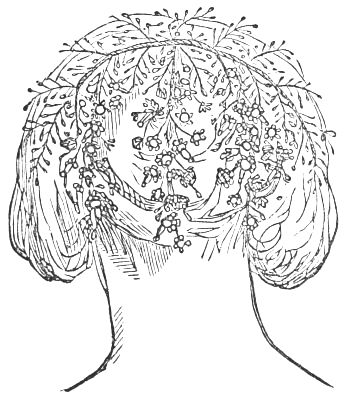
HEADDRESS, OR RICE-SHELL-WORK.
The shells we use are called "rice-shells," from their resemblance to the grains of rice; they are brought from the West Indies, and sold by measure, or by the box, at most conchological repositories. Their Latin name Voluta Nivea. Those who would study economy will often obtain them very cheaply from those miscellaneous dealers who purchase the foreign shells and curiosities brought from abroad by sailors. A pint of these shells will go a great way.
Before we can set to work, the shells must be cleaned and prepared. For this purpose, the first thing to be done is, with a strong yet fine-pointed pin, to free each shell from any grit or dirt which may have accumulated in the interior. Next, with a strong, sharp pair of scissors, a bit of about the size of a pin's point is to be clipped off from the extreme tip of each shell, so as to leave a tiny hole there, not larger than the eye of a middle-sized sewing-needle. This is a manipulation requiring care, as, if it is roughly done, too large an opening will be made, and the symmetry of the shell will be destroyed. Neither should the worker stoop over the shell while clipping it, for, if the bit of shell snipped off were to fly into the eyes, it would occasion much irritation and pain. Practice will soon enable any one to clip the shells rapidly and evenly.
In order to set about rice-shell-work tidily and systematically, it will be necessary to have a dozen little square card-board trays or boxes, about three or four inches square, and two inches deep. These can be easily made from white or colored card-board, and should be so contrived that they may fit into one another, and all be contained in one large tray or box of similar material, and covered over by one cover.
As the shells are cut, let them be sorted into three divisions, the small, the middle-sized, and the large shells. When all are clipped, put them into three separate basins; pour over them cold water enough to cover the shells, and to stand about an inch above them. Into this water put soda and mottled soap, in the proportion of half an ounce of each to a full pint of water; the soap should be shredded. Cover the basins, and set them on a hob, or in an oven, near a good fire; stir up the whole occasionally, and let it remain until the water is scalding hot, not longer. Then rub the shells gently with the hands, and pour off that water; and having rinsed the shells, add a fresh supply of water, and put in only soap this time. Let it again stand by the fire until hot, stirring it occasionally; then again rub the shells gently between the hands, pour off the soapy water, and rinse them thoroughly with clear, cold water.
Now lay a soft, folded towel on the table; put about a tablespoonful at a time of shells on this towel, and turning another fold of it over, rub them gently, but sufficiently to free them from moisture. Have ready a silk handkerchief, and remove them to this, and polish them with it, and then transfer them to one of the boxes, and setting it on the hob, let it stand there until the shells feel warm, shaking it occasionally in order that all may be equally dried. They will now be ready for use, and ought to have a pearly, white, polished appearance.
Take notice that too much soap or soda, or too great a degree of heat in the water, or too long a soaking, will make them look yellow; while too much heat when drying will crack them or render them brittle, and too little will leave a moisture about them which will tarnish the other parts of the work.
The next important item to the shells is the silver wire. This is bought on reels, by the ounce, and can be obtained of any of the large gold and silver bullion fringe-makers and wire-drawers in this city. As "Evans's Derby Crochet Cotton" is doubtless well known to most of our readers, we will compare the different sized wires required to the different numbers of this cotton of similar size. The coarsest silver wire we ever need would be about the calibre of No. 10 "Derby Cotton;" the next about that of No. 16; and the finest about the size of No. 24 or 30. The two latter are those chiefly used for leaves, flowers, &c., the coarsest being generally only employed for the stem on to which the various component parts of a wreath or spray are to be grafted, or for baskets, or ornamental groups; our aim being lightness, not only of appearance but of weight, we use the thinnest wire we can consistently with firmness.
The largest shells are chiefly used for baskets; the middle-sized and small ones for flowers and leaves. Each kind is to be contained in its own box.
Into another of the boxes cut some two or three hundred lengths of the middle-sized wire, each piece measuring about two and a half inches.
Having now made all our preparations, we will set to work, and see how all the various separate portions of the headdress given at the commencement of this article are made, and how they are put together.
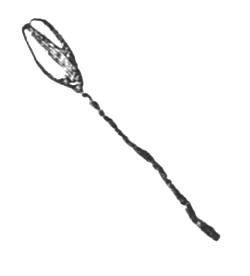
The following cut shows the manner in which every shell required for leaves or flowers must be prepared. We call it "wiring the shells." In order to effect it, the shell must be taken between the finger and thumb of the left hand, with its point towards the tip of the finger, and its opening turned upwards; then one of the two-and-a-half-inch lengths of wire, which we directed should be prepared, must be taken in the right hand, and one end of it passed in at the point, and out at the opening of the shell, and a third of it drawn through, and then turned over on itself; the folded wire being then held between the thumb and finger of the right hand, the shell must be turned round and round until the wires are sufficiently twisted together, to hold the shell firmly. In a very short time this manipulation will become so familiar that it will be performed with astonishing ease and dispatch.
Keep the wired shells sorted, laying the smaller ones in a box to themselves, and the middle-sized ones also in a box to themselves, and with the shells all towards one end; for, when we come to make up the flowers, &c., it is astonishing how much time will be saved by our being able at once to put our hands on the portion we need.
Having thus wired a hundred or two, or more of shells, according to the purpose we have in view, we next proceed to make them up.
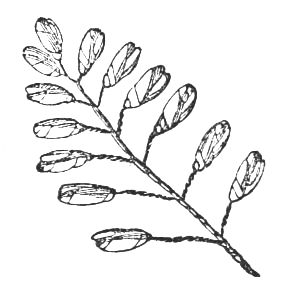
A leaf, like the one represented, may be made of any number of shells, from five to fifteen, or even twenty-five. A very small shell should be chosen for the apex, and then the pairs graduated so as to increase in size towards the stem. They should all be picked out, and laid ready for use before we begin to form the leaf.
Take the small central, or top shell between the finger and thumb of the left hand, allow the shell itself and about an eighth of an inch of the twisted wire to project above the finger, and have the opening of the shell turned towards you. Take the first pair of shells and insert one on either side of the central one, leaving about the tenth of an inch of twisted wire between the shells and their junction with the wire of the middle shell; then, with the finest wire, bind them all together by twisting the fine wire neatly round and round the stem, for the distance of nearly a quarter of an inch, when the second pair of shells are to be added, arranged, and bound on in like manner and for a similar distance; continue thus all the way down, leaving the wires between the shell and the stem a little longer at each pair, keeping all the openings one way, and taking care to bind the stem firmly and compactly, and especially to avoid leaving any projecting ends or points of wire, as these not only look untidy, but are excessively inconvenient if the work is intended for wear.
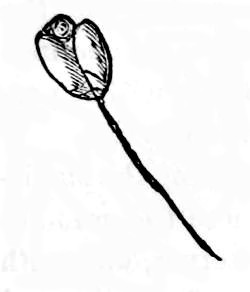
The flower bud is formed by taking one of the lengths of wire, threading a shell on it, and then a small Roman pearl bead, and then a second shell, and twisting the wire to keep them all firm. It will be perceived by the engraving that the bead comes between the two points of the shells, and that both openings lie the same way.
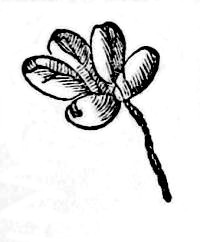
This is what we term a "single," or "simple flower." It is composed of five wired shells of equal size; the openings are all turned inwards, and the wires bound together immediately below the points of the shells firmly and compactly, all the way down to the very extremity.
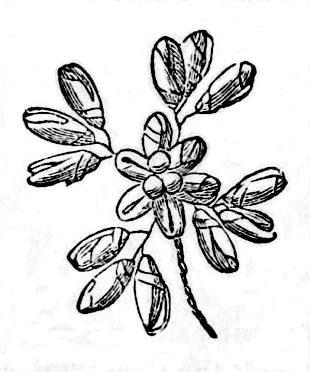
This double flower is composed of seventeen shells—viz., twelve small ones, and five of a middle size. The five are arranged as in the single flower, and the twelve are made up into four leaflets of three each, put together in the way a leaf is commenced; these leaflets are bound on to the flower, being arranged evenly round it, and so as to leave about a quarter of an inch of its stem above their junction with it, and the same length of wire between the pair of shells in each leaflet and the stem. Bend them into their places when the flower is completed.
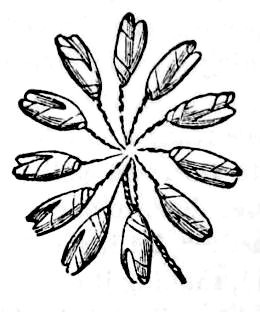
Another variety of flower is here given, composed of twelve small shells, so arranged as to leave half an inch of wire between the point of each shell and the place where we begin to bind it; all the openings face upwards. The shells are to be arranged like the spokes of a wheel.
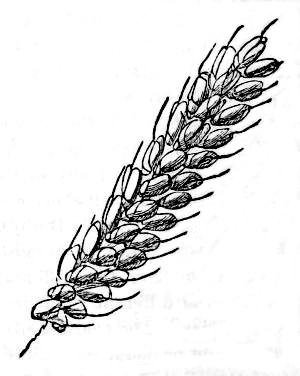
Wheat-ears may be made of any number of shells, from eighteen to thirty, and of either small or middle-sized shells. One is taken as an apex, then a pair set one on either side of it, then one in the centre; then another pair, and so on, binding them on, almost close to the point of each shell, and putting in here and there three-quarter-inch lengths of the middle-sized wire, to resemble the beards.
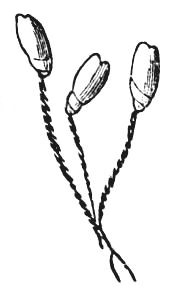
This is a representation of an ornamental group; the shells chosen for it should be the large ones. Three lengths of wire (middle-sized), measuring about four or five inches, must be cut off. A shell is threaded on each wire, the wire folded double, a twist or two given to it just to maintain the shell in its place, and then the double wire wound round a good sized pin to give it that spiral form. The three, when done, are bound together at the bottom for about a quarter of an inch, and mounted on an inch or two of the coarsest wire.
In binding leaves, flowers, &c., the fine wire should not be cut off until the leaf, or whatever it may be, is complete, as it is desirable to avoid ends and roughnesses.
We could amplify these notices, but we consider that the engravings will be sufficient to show our readers the kind of groups that can be arranged, and suggest to inventive and tasteful minds a multitude of other combinations.
With regard to their adjustment into sprays, or wreath, we can say but little, because that is so much a matter of taste. A light and graceful appearance should be aimed at, and the work neither crowded too closely together, nor left too straggling. It will often be advisable to mount a flower on a couple of inches of the coarse wire, in order to lengthen the stem, and it may then be grouped with a bud, or with spiral shells; but no rules can be laid down in an optional matter like this. The foundation stem, or that from which all the sprays of the headdress given at the commencement of this article, hangs, should be of double coarse wire; and the stems of the sprays of single coarse wire. All are to be bound on with the finest wire, and as neatly and as lightly as is consistent with firmness.
Care must be taken not to tarnish the wire by too much handling, especially with warm hands, or by unnecessary exposure to the atmosphere. When not in use, the reels should always be kept enveloped in silver paper.
The leaves of various sizes, the flowers of different kinds, and the other portions, should be consigned each to the boxes appropriated for them, as fast as they are made, and not all heaped together in one inextricable mass.
In our next article we shall describe the "Composite Rice-Shell-Work," which will present to our lady pupils a variety of ornamental arrangement.
This pleasing art is well worthy the pains and patience of all
"Who in work both contentment and happiness find."

DRESS—AS A FINE ART.
BY MRS. MERRIFIELD.
REMARKS ON PARTICULAR COSTUMES.
We must now offer a few brief remarks upon certain costumes which appear to us most worthy of our attention and study, for their general elegance and adaptation to the figure. Of the modern Greek we have already spoken. The style of dress which has been immortalized by the pencil of Vandyck is considered among the most elegant that has ever prevailed in this country. It is not, however, faultless. The row of small curls round the face, how becoming soever to some persons, is somewhat formal, and although the general arrangement of the hair, which preserves the natural size and shape of the head, is more graceful than that of the time of Sir Joshua Reynolds, we think it would have been more pleasing had it left visible the line which divides the hair from the forehead. With regard to the dress itself: in the first place, the figures are spoiled by stays; secondly, the dress is cut too low in front; and thirdly, the large sleeves sometimes give too great width in front to the shoulders. These defects are, in some degree, counterbalanced by the graceful flow of the ample drapery, and of the large sleeves, which are frequently widest at their lower part, and by the gently undulating line which unites the waist of the dress with the skirt. The Vandyck dress, with its voluminous folds, is, however, more appropriate to the inhabitants of palaces than to the ordinary occupants of this working-day world. The drapery is too wide and flowing for convenience.
Lely's half-dressed figures may be passed over without comment; they are draped, not dressed. Kneller's are more instructive on the subject of costume. The dress of Queen Anne, in Kneller's portrait, is graceful and easy. The costume is a kind of transition between the Vandyck and Reynolds styles. The sleeves are smaller at the shoulder than in the former, and larger at the lower part than in the latter; in fact, they resemble those now worn by the modern Greeks. The dress is cut higher round the bust, and is longer in the waist than the Vandycks, while the undulating line uniting the body and skirt is still preserved. While such good examples were set by the painters—who were not, however, the inventors of the fashions they painted—it is astonishing that these graceful styles of dress should have been superseded in real life by the lofty headdresses and preposterous fashions which prevailed during the same period, and long afterwards, and which even the ironical and severe remarks of Addison in the "Spectator" were unable to banish from the circles of fashion. Speaking of the dresses of ladies during the reigns of James II. and William III., Mr. Planché, in his History of British Costume (p. 318), says: "The tower or commode was still worn, and the gowns and petticoats flounced and furbelowed, so that every part of the garment was in curl;" and a lady of fashion "looked like one of those animals," says the "Spectator," "which in the country we call a Friesland hen." But in 1711 we find Mr. Addison remarking: "The whole sex is now dwarfed and shrunk into a race of beauties that seems almost another species. I remember several ladies who were once nearly seven feet high, that at present want some inches of five. How they came to be thus curtailed, I cannot learn; whether the whole sex be at present under any penance which we know nothing of, or whether they have cast their headdresses in order to surprise us with something in that kind which shall be entirely new: though I find most are of opinion they are at present like trees lopped and pruned that will certainly sprout up and flourish with greater heads than before."
The costume of the time of Sir Joshua Reynolds, as treated by this great artist, though less splendid, appears to us, with the exception of the headdress, nearly as graceful, and far more convenient than the Vandyck dress. It is more modest, more easy, and better adapted to show the true form of the shoulders, while the union of the body of the dress with the skirt is effected in the same graceful manner as in the Vandyck portraits. The material of the drapery in the latter is generally silks and satins; of the former, it is frequently muslin, and stuff of a soft texture, which clings more closely to the form. That much of the elegance of both styles of dress is to be attributed to the skill and good taste of the painters, is evident from an examination of portraits by contemporary artists. Much also may be ascribed to the taste of the wearer. There are some people who, though habited in the best and richest clothes, never appear well-dressed; their garments, rumpled and untidy, look as if they had been pitched on them, like hay, with a fork; while others, whose dress consists of the most homely materials, appear well-dressed, from the neatness and taste with which their clothes are arranged.
Leaving now the caprices of fashion, we must notice a class of persons who, from a religious motive, have resisted for two hundred years the tyranny of fashion, and until recently have transmitted the same form of dress from mother to daughter for nearly the same period of years. The ladies of the Society of Friends, or as they are usually called "Quakers," are still distinguished by the simplicity and neatness of their dress—the quiet drabs and browns of which frequently contrast with the richness of the material—and by the absence of all ornament and frippery. Every part of their dress is useful and convenient; it has neither frills nor flounces, nor trimmings to carry the dirt and get shabby before the dress itself; nor wide sleeves to dip in the plates, and lap up the gravy and sauces, nor artificial flowers, nor bows of ribbons. The dress is long enough for decency, but not so long as to sweep the streets, as many dresses and shawls are daily seen to do. Some few years back, the Quaker ladies might have been reproached with adhering to the letter, while they rejected the spirit of their code of dress, by adhering too literally to the costume handed down to them. The crowns of their caps were formerly made very high, and for this reason it was necessary that the crowns of the bonnets should be high enough to admit the cap crown; hence the particularly ugly and remarkable form of this part of the dress. The crown of the cap has, however, recently been lowered, and the Quaker ladies, with much good sense, have not only modified the form of their bonnets, but also adopted the straw and drawn-silk bonnet in their most simple forms. In the style of their dress, also, they occasionally approach so near the fashions generally worn, that they are no longer distinguishable by the singularity of their dress, but by its simplicity and chasteness.

PREPARATIONS FOR COMPANY.
A hostess who wishes that her friends should enjoy their dinner, and that she also should enjoy it with them, must see that all is ready and at hand before her guests arrive. If her servants are well trained, and accustomed to do things regularly, when there is no company, there will be little difficulty when there is; and if there is that pleasant understanding between the head and the hands of the household which should always exist, any casual mistake will easily be rectified; an accident itself will occasion more fun than fuss; and although no host and hostess should feel as unconcerned or indifferent at their own table as elsewhere, the duty of seeing that nobody wants anything will be manifestly a pleasant one, whilst the simple cordiality, which delights in good appetites and cheerful countenances, and the domestic order which is evidently, but unostentatiously, the presiding genius of the family, will go far to enhance the flavor of the simplest fare.