GODEY'S COURSE OF LESSONS IN DRAWING.
Reading edition
Drawing has been generally looked upon as an accomplishment, not considered as an essential—as ornamental rather than indispensable in the education of the rising generation. The pleasures and advantages of its pursuit have been almost solely enjoyed by the rich; while they have been, to a certain extent, as a sealed book to the great majority of those now designated emphatically the people. So far from looking upon a knowledge of the art of drawing as necessary merely to the artist or designer, we hold that it should form an essential part of general education; that its proper place is in the daily school; that its principles and practice should be inculcated in the daily lessons; in short, that equally with reading or writing, drawing should be deemed one of the branches of everyday tuition. We are now fully alive to the importance of cultivating what are designated "habits of taste," and the appreciation of the beautiful in art; and this chiefly—if for nothing else—from the practical value derivable therefrom in the improvement of our arts and manufactures. By a thorough understanding of the details of drawing, an accuracy of perception and a facility for marking and retaining forms and arrangements are readily available. It is, then, of importance to place within the reach of all a means by which the art in its varied branches may be easily communicated. The design of the present article is to contribute to this desideratum. We shall make our remarks as plain as possible, and as concise as the nature of the subject will admit of; and shall give unsparingly well-digested illustrations, believing that in this subject, at least, much is to be imparted to the pupil through the medium of the eye. It is to be hoped that this union of the pen with the pencil will be of great utility in quickly imparting a knowledge of the subjects under discussion. Before proceeding to our more immediate purpose, we shall offer a few remarks elucidatory of the plan or bearing of the system, by which we mean to be guided in presenting the requisite knowledge to the student.
On the supposition that the pupil at the outset is utterly ignorant of the art, we commence our instructions by elucidating FIRST PRINCIPLES. As all drawings are reducible to certain lines and figures, we hold it necessary to enable the student to draw these elementary parts with the utmost facility; leading him, by a series of examples, from the drawing of a simple line up to the most complicated sketch or object which may be offered to him; and then, by an advance to the more intricate rules, making plain the laws of vision (the foundation of perspective), so as to delineate correctly the various views in which they may be presented to his notice; the aim of the introductory lessons being to enable the student thoroughly to understand the reason why every operation is performed as directed, not merely to give him a facility for copying any determined object without reference to principles.
The student may, by dint of practice, acquire a facility for this merely mechanical style of imitation or copying; but, unless he is well grounded in fundamental principles, his operations will be vague and uncertain. It may be considered true that the better we are acquainted with the first principles of an art, its basis or foundation, so much more intimately conversant shall we be with all the intricacies of its diversified practice, and the less easily damped by its real or apparent difficulties. Students too frequently expend much time almost entirely in vain, from want of attention to this truth, trite and commonplace as it may be deemed. In acquiring the practice of this art, they are too eager to pass from the simple rules, the importance of which they think lightly of. A sure and well-laid foundation will not only give increased security to the building, but will enable the workmen to proceed with confidence to the proper carrying out of the design in its entirety; on the contrary, an ill-laid foundation only engenders distrust, and may cause total failure. We are the more inclined to offer these remarks, being aware that students at the commencement of a course of tuition are apt, in their eagerness to be able to "copy" a drawing with facility, to overlook the importance of the practice which alone enables them satisfactorily to do so. It is the wisest course of procedure to master the details of an art before proceeding to an acquaintance with its complicated examples.
We would, then, advise students to pay particular attention to the instructions in their ENTIRETY which we place before them; if they be truly anxious to acquire a speedy yet accurate knowledge of the art, they will assuredly find their account in doing so. Instead of vaguely wandering from example to example, as would be the case by following the converse of our plan, yet copying they know not how or why, they will be taught to draw all their combinations from simple rules and examples, we hope as simply stated; and thus will proceed, slowly it may be, but all the more surely, from easy to complicated figures, drawing the one as readily as the other, and this because they will see all their details, difficult to the uninitiated, but to them a combination of simple lines as "familiar as household words."
LESSON I.
OUTLINE SKETCHING.
Before the apparent forms of objects can be delineated, it is absolutely necessary that the hand shall be able to follow the dictation of the eye; that is, the pupil must, by certain practice, be capable of forming the lines which constitute the outlines and other parts of the objects to be drawn; just as, before being able to write or copy written language, the hand must be taught to follow with ease and accuracy the forms which constitute the letters; so in drawing, the hand must be tutored to draw at once and unswervingly the form presented to the eye. Thus the handling of the pencil, the practice to enable the hand to draw without hesitation or uncertainty, and the accurate rapidity essential in an expert draughtsman, may be considered as part of the alphabet of the art of free pencil sketching. Nothing looks worse in a sketch than the evidences of an uncertainty in putting in the lines; just as if the hand was not to be trusted, or at least depended upon, in the formation of the parts dictated by the eye. The eye may take an accurate perception of the object to be drawn, yet its formation may be characterized by an indecision and shakiness (to use a common but apt enough expression), which, to the initiated, is painfully apparent. In beginning, then, to acquire a ready facility in free sketching, in which the hand and eye are the sole guides, the pupil should consider it well-spent time to acquire by long practice an ease and freedom in handling the pencil, chalk, or crayon with which he makes his essay.
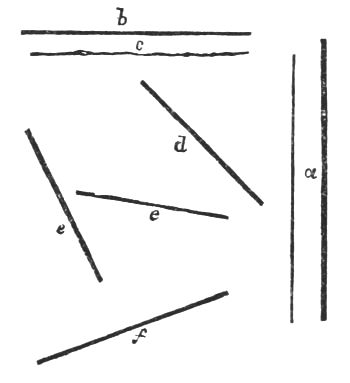
Fig. 1.
The first lessons may be performed with a piece of pointed chalk on a large blackboard; some of our celebrated artists have not in their early days disdained the use of more primitive implements, as a piece of burnt stick and a whitewashed wall or barn door. The larger the surface on which the lessons are drawn, the better, consistent, of course, with convenience. If a blackboard cannot be obtained, a large slate should be used. Until the pupil has acquired a facility for copying simple forms, he should not use paper and pencil; as, in the event of drawing in a line wrong, it is much better at once to begin a new attempt, than try to improve the first by rubbing out the faulty parts and piecing the lines up. As the pupil must necessarily expect to make many blunders at first starting, it will save paper if he will use a board or slate, from which the erroneous lines can be at once taken out, a damp sponge being used for this purpose. By this plan any number of lines may be drawn.
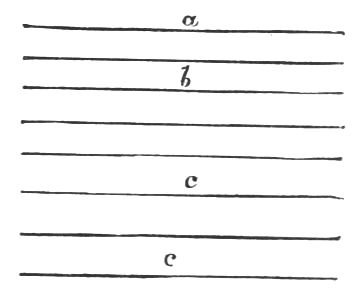
Fig. 2.
Having provided themselves with the necessary materials, pupils may begin by drawing simple lines. These must be drawn without the assistance of a scale or ruler, by the hand alone. The line a, Fig. 1, will be parallel to the side of the board or slate, and perpendicular to the ends. Pupils should endeavor to make the line as regular as possible, and to run in one direction—-that is, inclined neither to the right nor left. They should next draw horizontal lines, as b, beginning at the left and going towards the right hand. In drawing lines as a, pupils should begin at the top and go towards the bottom; in a more advanced stage they should try to draw them from either end. The oblique lines, d, e, and f, should next be drawn. In all these exercises the lines should be drawn boldly, in a length at a time, not piece by piece; the hand should not rest on the board or slate while drawing, but should be free, so that the line may be drawn in at one sweep, as it were, of the arm or wrist. Irregular or "waved" lines should next be drawn, as at c; this style of line is useful in drawing broken lines, as in old ruins, trees, gates, stones, &c. &c. Pupils must not content themselves with drawing a few examples of the lines we have given. They must practise for a long time, until they can at once with ease draw lines in any direction correctly; they ought to progress from simple to difficult, not hastily overlook the importance of mastering simple elementary lessons. With a view to assist them in arranging these, and to afford not only examples for practice, but also to prove by a gradation of attempts the connection—too apt to be overlooked by many—between simple lines and complex figures, simple parallel lines, as a, b, c, Fig. 2, should be drawn; but not only must pupils endeavor to keep each line straight from beginning to end, free from waviness and indecision, and also parallel to one another, but another object must be kept in view; that is, the distance between the lines; hitherto they have drawn lines with no reference to this, but merely to their position and direction. No mechanical aids must be allowed to measure the distances, this must be ascertained by the eye alone; and a readiness in this will be attained only by practice. The eye is like the memory; it must be kept in constant training before it will do its work. By inspecting the diagram, it will be perceived that the lines marked c c are farther apart than those above. All gradations of distances should be carefully delineated; and if, after the lines are drawn, the eye should detect, or fancy it detects, any error in this respect, let the lines be at once rubbed out, and a new trial made; and let this be done again and again until the lines appear to be correctly drawn, both as regards boldness and correctness and distance apart. After drawing the horizontal lines, the student may then proceed to perpendicular lines. It may here be noted, to save future explanation, that when we use the term perpendicular, we mean it to be that applied to a line or lines which run parallel to the side of the board or slate; and horizontal, those parallel to the ends. Strictly speaking, both lines thus drawn are perpendicular to others which may be drawn parallel to their opposite sides. We, however, suppose the surface on which the pupil is drawing to be in the same position as this book while held open for reading; the sides to represent the sides, and the ends, the ends of the drawing-board or slate. Lines are horizontal when parallel with the lines of type, and perpendicular when parallel with the sides of the page; it is in this sense, then, that we shall use the terms horizontal and perpendicular. Perpendicular lines, as in Fig. 3, may next be drawn, close to one another at the sides, at a and c, and farther separate at b; they may also be drawn horizontally in the same way; this practice will be useful in more advanced stages. As the pupil will observe, the lines thus drawn give the appearance of roundness; it is, in fact, the way by which engravers obtain this effect: the pupil will find it useful in fine pencil drawing.
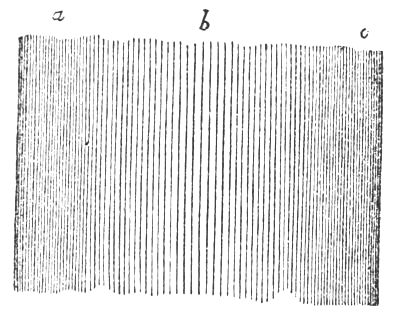
Fig. 3.
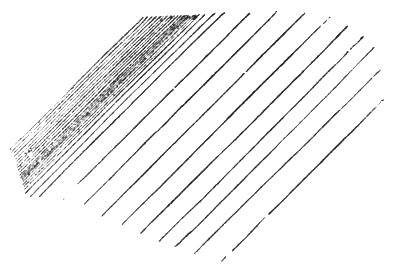
Fig. 4.
The drawing of diagonal or oblique lines may next be practised, as in Fig. 4. In all these examples, the board or slate should never be moved or reversed; the end forming the topmost one should always remain so. We are aware that some parties have greater facilities for drawing lines in one direction than in another; thus, the majority of beginners would draw lines sloping from right to left with much more ease than in the reverse position. We have seen cases where, in lessons like the foregoing, the lines sloping from right to left were drawn first, the board reversed, and lines to represent those sloping the reverse way drawn in the same direction exactly; the board was then turned to its original position, when the sets of lines appeared sloping different ways, while, in reality, they were done both in the same manner. This practice is not honest either to the teacher or pupil, and should at once be discarded.
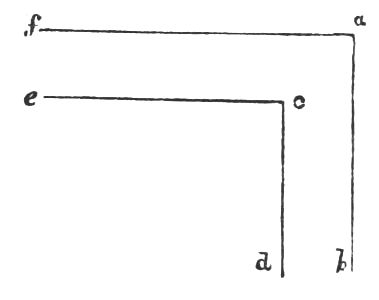
Fig. 5.
The examples now given have had reference only to one peculiar position of the lines to be drawn; that is, they have all been horizontal, or all perpendicular or oblique; placed in the same relative position to one another. We now give an example where the lines go in different directions with respect to one another. Thus in drawing the lines b a, a f, d c, and c e, Fig. 5, care must be taken to have the lines perpendicular to one another; that is, supposing the lines a b, c d, to be drawn first, the horizontal lines a f, c e, must be drawn so that the points or ends f e shall be neither above nor below the ends or points a, c—that is, f and e must be exactly opposite a and c. In the present case, no mechanical aid is allowable; the eye is to be the only guide. Attention should also be paid to keeping the exact distance between the lines a b, a f, and c d, and c e. The pupil must not imagine that all these modifications of lines are worthless; a little patience and reflection will suffice to show him that they are, in truth, part of the groundwork, without which he can never hope to rear the superstructure of perfect drawing. We now proceed to a little more interesting labor, where simple figures are to be drawn; these, however, being neither more nor less than the lines already given variously disposed. Draw the lines a c, b c, Fig. 6, meeting in the point c; these form a certain angle; care should be taken to draw the lines as in the copy. Next draw the horizontal line a b, Fig. 7, and a figure is formed which the pupil will at once recognize. Draw the horizontal line a b, Fig. 8; perpendicular to it, from the ends a b, draw the lines a c, b d, taking care that they are of the same length as a b; draw the line c d, a square is at once formed. As it is an essential feature in this form that all the sides are equal, if the pupil, after drawing it, perceives any inequality therein, he should rub it out and proceed to another attempt. Some little practice should be given to the delineation of squares, angles, &c. If a parallelogram or oblong—vulgarly called an oblong square—is wished to be drawn, it may be done by making two opposite lines shorter than the others; the line e denotes the fourth outline of an oblong, of which the side is a b. If two oblongs be drawn, care being taken to have the inner lines the same distance within the outer ones all round, by adding a narrow line outside these, as in Fig. 9, the representation of a picture-frame is obtained; the diagonal lines at the corners, as at a and b, being put in to represent the joinings at the corners of the frame, the "mitre" joints, as they are termed. By first drawing the simple outlines, as in Fig. 10, the foundation of a door is obtained by filling in the extra lines, as in the figure.
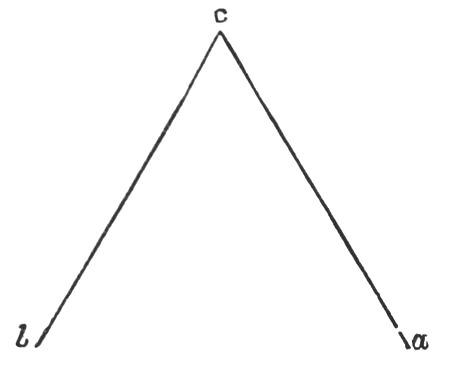
Fig. 6.
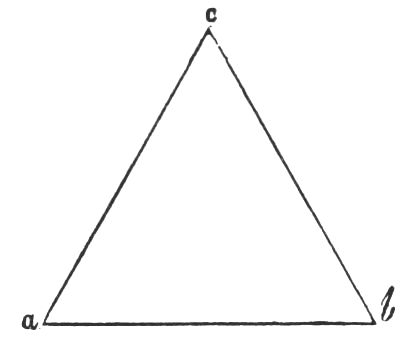
Fig. 7.
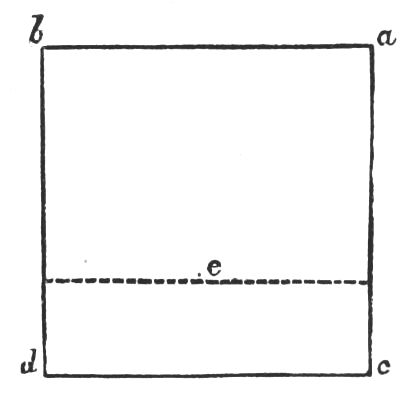
Fig. 8.
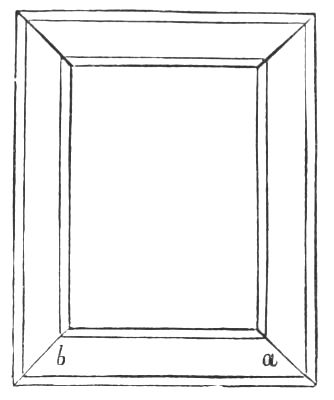
Fig. 9.
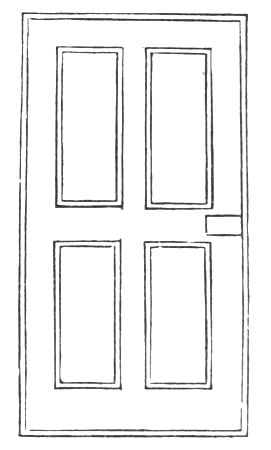
Fig. 10.

OH, LAY HER TO REST!
BY FLORUS B. PLIMPTON.
Oh, lay her to rest where the myrtle can grow, Among the green grass that shall over her wave, That not only in summer, but in winter's cold snow, 'Twill be green as the love that encircles her grave Her heart was a treasure of trust to a friend, A mirror reflecting warm sympathy's glow; It was patient to anger, and feared to offend, And suffered in silence what no one can know. Oh, lay her to rest! let no monument tell That she dwells with the perfect, the good, and the just, Nor let flattery's homage emblazon her cell, But bear her in silence and tears to the dust. Oh, lay her to rest! of earth hath she known Sufficient of sorrow, sufficient of pain; She pined for the world where her spirit hath flown, Though she wept for the love that recalls her in vain.