INSTRUCTIONS FOR MAKING ORNAMENTS IN RICE SHELL-WORK.
Reading edition
In our January number we described the whole process of preparing the shells, and making all those separate portions necessary to form a wreath; the same instructions apply equally to the present branch of our subject; but then we only spoke of the "simple" form of this work, or that composed merely of shells and silver wire. It is doubtless the most chaste, from its extreme purity; but it is also the most perishable, for we all know how quickly silver tarnishes; it likewise is not so convenient for wear, especially in the hair, for, be as careful as ever we will, we cannot entirely avoid roughness and projecting points.
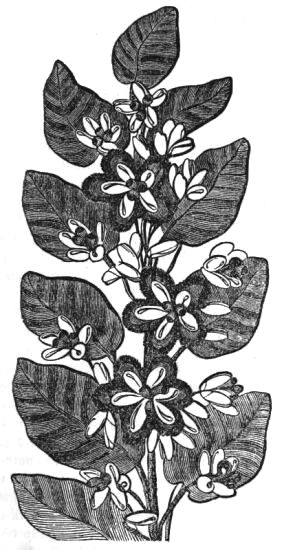
SPRAYS IN RICE SHELL-WORK.
[See larger version]
The "composite form," which we are now about to describe, admits of the ornaments being made to match, or contrast with, or set off, any hue of dress or complexion. In the making of composite rice shell-wreaths, &c., various materials are brought into use, as floss-silk; fine wire-chenil; Roman-pearl beads, and beads of a similar kind of coral color, turquoise, pink, green, or yellow; flower-seeds; velvet or satin, or silver leaves; and silver bullion.
To make a wreath, and a set of sprays for a bridal-dress, we should use white floss-silk, white chenil, and silver bullion. The shells are to be "wired," as directed in our former article; but, in making them up into leaves and flowers, instead of using the fine wire, we use the floss-silk to wind or bind them; and thus, instead of the wires being all exposed, they are hidden, and the stems present a smooth silken surface.
For making a simple, or single flower, we use the five shells as before, but we cut half an inch of silver bullion, thread it on one of the cut lengths of wire (of which we directed there should always be a supply), fold it into a loop, twist the wire to keep the bullion firmly in form and place, and put this in the centre of the flower, arranging the five shells round it, and binding the stem with the silk.
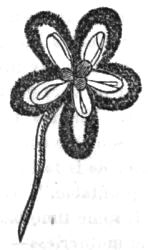
DOUBLE FLOWER.
In making the "double flower," we use twenty instead of the seventeen shells before directed; viz. five for the flower, and fifteen for the five leaflets of three shells each; in the centre of the five shells we put the loop of bullion just described, and between the flower and the leaflets we arrange five loops of fine wire-chenil at equal distances, as in this cut, allowing each loop to project nearly half an inch, and binding them on with the fine wire; the leaflets are then arranged round the stem so that the centre shell of each one appears between, and just beyond each two loops; the whole is bound together with silk, and the stem covered to its extremity. The "bud" may either have a loop of chenil standing up on each side of the shells of which it is composed, or it may be formed solely of two or three loops of chenil bound on to a stem of wire with floss-silk. When the flowers are colored, by adding chenil and beads, or seeds to them, green leaves and green buds have a very pretty effect.
The leaves for the bridal ornaments we were speaking of, may either be composed of shells and wound with white silk or silver, or white satin or velvet, or crêpe leaves may be used. We need scarcely add that silk must be used to bind all the parts together.
Let us imagine, now, that a brunette desires to dress her hair, and decorate her snowy ball-dress with wreaths, and sprays, &c., of scarlet or coral color.
The shells must be prepared, and wired in the ordinary way, and half a dozen reels of floss-silk, and a knot of chenil of the desired hue, and four strings of small coral-colored beads, and two of beads about the average size of peas, got. These beads must each be threaded separately like the shells, but on rather shorter lengths of wire, and the wire folded and twisted to make it hold its beads firmly. One of the larger beads should be put in the centre of every double flower, and three of the small ones in the centre of every single flower. The flowers may be made simply with the five shells and five loops of chenil, omitting the leaflets. If the leaves are to be made of shells, the stems must be bound with this colored silk; but velvet, or satin, or tinsel leaves of the same hue may be substituted for or intermixed with the shell leaves with good effect.
Ornaments for blue, pink, green, or maize toilettes may in like manner be formed en suite by substituting beads, silk, and chenil, of the chosen shade, for the color we have given. Mourning-wreaths, &c., may likewise be made by using black silk, chenil, and beads; or gray silk and chenil with pearl beads, and gray or white satin leaves.
When once our readers have begun to carry our directions into practice, they will perceive how possible it is to create an infinite variety of tasteful articles, all differing in style, form, and hue. Coronets, wreaths, and headdresses of every conceivable pattern may be made; sprays for the dress of any size, length, or shape; bouquets for the waist or bosom; trimmings for the corsage; tiny wreaths to put between quilled ribbon or blonde for the purpose of ornamenting gloves, or sleeves, or the top of the dress; flowers for caps; studs or buttons for the front of a dress; in short, more things than we have time or space to name. And all these may be made very economically, for less than one-third of the ordinary cost of such decorations.
We have given, at the commencement of this article, a cut of a spray, or rather of a portion of one, for want of space compelled us to shorten it; it has green velvet leaves; the flowers are surrounded by chenil loops, and have in their centres flower-seeds; it is wound with silk.
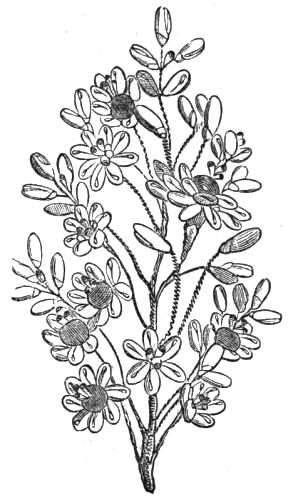
BOUQUET IN RICE SHELL-WORK.
[See larger version]
This cut represents a small bouquet to be worn brooch-fashion in the bosom of the dress; it is composed of shells and turquoise beads, and wound with light blue silk. The leaves are of shells, and gradually increase in size towards the end of it.
The advantage of using silk instead of the fine silver wire for binding the stems, &c., is, that not only are all points and inequalities thus smoothed over, but, with ordinary care, the articles wear much longer—for even if the small portions of silver wire left exposed do tarnish, they cannot mar the beauty of the whole, forming then so very trifling a portion of it, instead of the leading feature, as they do in "simple rice shell-work."
We said just now that studs or buttons could be formed with shells; we will now explain how this may be done.
Cut out a set of circular pieces of white cartridge-paper, or very thin card-board of the size it is wished the buttons should be; from the diameter of a dollar to that of a twenty-five cent piece is the ordinary scale. Have ready wired some middle-sized and small shells, and a pearl or colored bead the size of a pea for each button.
With a good-sized pin perforate a circle of holes, about a third of an inch in, all the way round, and pass the wire of a middle-sized shell through each, bending the shells down, so that they lie evenly round with their backs upwards, and their points projecting just beyond the edge of the card-board. Without disturbing the wires on the wrong side, now make another circle of perforated holes, and put in another round of shells, bending them so as just to overlap the outer ones. Still leave the ends of wire, and pierce a third circle of holes, and into these put small shells, and bend them in like manner, to fit on the former rounds. Three circles will generally be sufficient for a good-sized button. Pierce a hole in the centre, and put in the wired bead, which will fill up and complete the surface. Now carefully flatten down the wires at the back, and cover the back with silk, arranging any shell which may have become misplaced afterwards.
The floss-silk may be obtained at any large Berlin wool shop; it is sold on small reels, of which from two to six or eight will be required, according to the quantity of work which has to be wound.
The chenil is procurable at the same place; one knot goes a great way. It is the small wired chenil we use, not the fine embroidery chenil.
The beads are sold at most fancy repositories. It is not the crystal glass, or the seed bead which we use, but those French colored glass beads that have lately been so much worn. It is not absolutely necessary they be only round; for there is a long, or rather an oblong variety, which is very effective.
The leaves and flower-seeds may be bought at any artificial florist's; but the best way is to obtain them from the makers, then they can be ordered of any color or pattern.
A circular wreath of simple daisy-flowers, like the third flower cut given in our last article, has very chaste and graceful appearance; or these flowers may be combined with the wheat-ears with good effect.
But we have said enough to open the path to our readers; and once entered therein, they will find the work infinitely suggestive, and offering scope for every graceful and tasteful vagary. So we will only add a little word of advice—aim at lightness, not only of appearance, but of actual weight, and never crowd or load any ornament with too much work. The leading principle of artistic excellence in every department of art is simplicity; and this may be attained by close and severe attention. The eye is most pleased when it can retain at a glance the chief points of attraction.
In our third article, we shall give instructions for making baskets, &c.
