GODEY'S COURSE OF LESSONS IN DRAWING.
Reading edition
LESSON II.
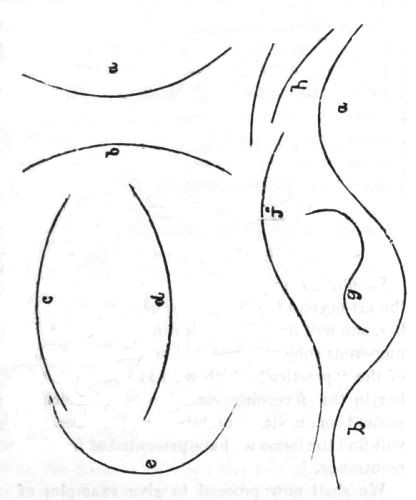
Fig. 11.
We now proceed to the drawing of curved lines, as in Fig. 11. And as these are the basis of innumerable forms, the pupil must not rest satisfied with a few attempts at forming them; she must try and try again, until she is able, with a single sweep, to draw them correctly. They must be done in one stroke, no piecing being allowed. Let the curved line a be first produced; beginning at the top, bring the arm or wrist down, so that at one operation the form may be traced; do this repeatedly, until the correct outline is attained at every trial. The pupil may next proceed to the curved line b, which is merely the line a in another position; then, after repeated trials, the lines c, d, e, g, and h may be drawn. These curves should be attempted to be drawn in all manner of positions, beginning at the top, then at the bottom, and making the curve upwards, and so on, until the utmost facility is attained in drawing them, howsoever placed. The curved line, generally known as the "line of beauty," f a b´, must next be mastered; it is of the utmost importance to be able to do this easily and correctly. In all these and the future elementary lessons, the pupil must remember that when failing to draw a form correctly, she should at once rub it out or destroy it, and commence a new attempt.
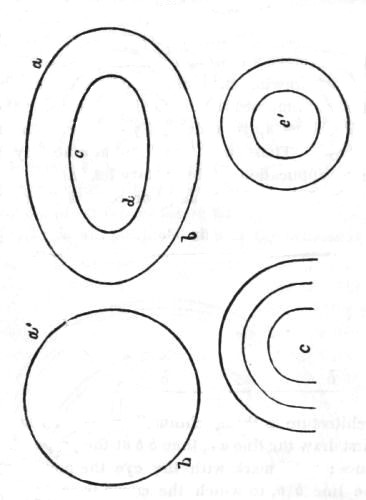
Fig. 12.
Having, then, acquired a ready facility in drawing the simple elementary curved lines, the pupil may next proceed to the combination of these, as exemplified in simple figures, as circles and ellipses, or ovals. First attempt to draw the circle a´ b, Fig. 12; beginning at a´, sweep round by the right down to b, then from b towards the left and up to a´, where the circle was first begun. The pupil may also try to draw it by going the reverse way to the above. We are quite aware that it will be found rather a difficult matter to draw a circle correctly at the first, or rather even after repeated attempts; but the pupil must not be discouraged; by dint of practice she will be able to draw circles of any size very correctly. We have seen circles drawn by hand so that the strictest test applied could scarcely point out an error in their outline, so correctly were they put in. Circles within circles may be drawn, as at c´; care should be taken to have the lines at the same distance from each other all round. The ellipse a b must next be attempted; this is a form eminently useful in delineating a multiplicity of forms met with in practice. Ovals within ovals may also be drawn, as at c d.
At this stage, the pupil ought to be able to draw combinations of straight and curved lines, as met with in many forms which may be presented to her in after-practice. The examples we intend now to place before her are all in pure outline, having no reference to picturesque arrangement, but designed to aid the pupil in drawing outlines with facility; and to prove to her, by a progression of ideas, that the most complicated forms are but made up of lines of extreme simplicity; that although in the aggregate they may look complicated, in reality, when carefully analyzed, they are amazingly simple. Again, although the pupil may object to them as being simple and formal—in fact, not picturesque or decorative enough to please her hasty fancy—she ought to recollect that, before being able to delineate objects shown to her eye perspectively, she must have a thorough knowledge of the method of drawing the outlines of which the objects are composed, and a facility in making the hand follow aptly and readily the dictation of the eye. These can be alone attained by a steady application to elementary lessons.
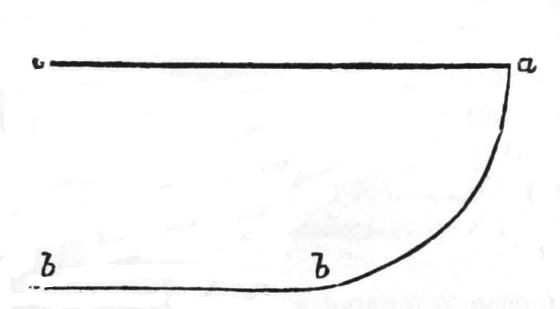
Fig. 13.
Fig. 13 is the moulding, or form known in architecture as the "echinus," or quarter-round. First draw the line a c, then b b at the proper distance; next mark with the eye the point b on the line b b, to which the curve from a joins; then put in the curve a b with one sweep. The curved portion of the moulding in Fig. 14, known as the "ogee," must be put in at one stroke of the pencil or chalk, previously drawing the top and bottom lines.
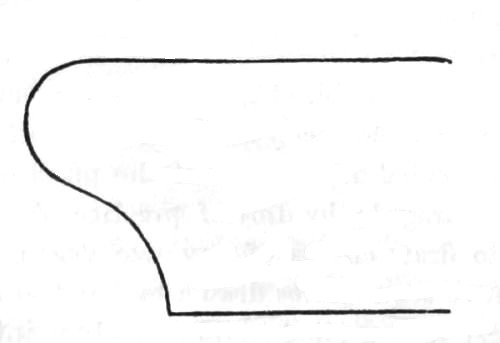
Fig. 14.
Fig. 15 is the "scotia;" it is formed geometrically by two portions of a circle, but the pupil should draw the curve at once with the hand. It is rather a difficult one to draw correctly, but practice will soon overcome the difficulty.
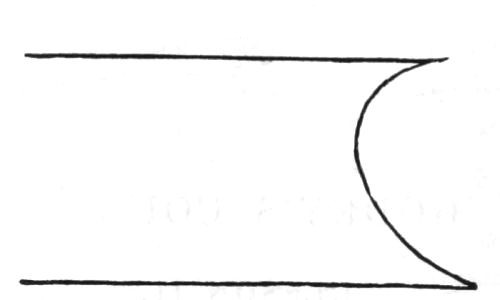
Fig. 15.
Fig. 16 is termed the "cyma recta;" it affords an exemplification of the line of beauty given in Fig. 11.
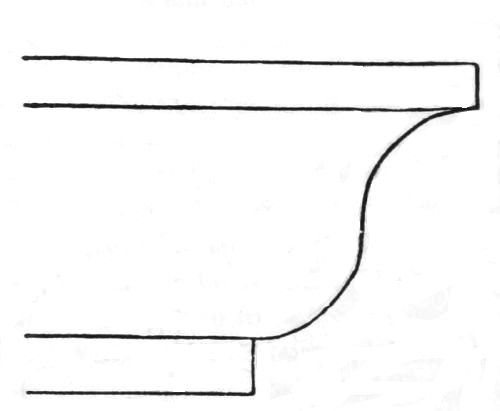
Fig. 16.
Should the pupil ever extend the practice of the art beyond the simple lessons we have given her, she will find, in delineating the outlines of numerous subjects presented her, the vast utility of the "practice" which we have placed before her in the foregoing examples. In sketching ancient or modern architectural edifices, she will find the forms we have presented of frequent recurrence.
We shall now proceed to give examples of the combinations of the forms or outlines we have just noticed.
Fig. 17 is half of the base of an architectural order frequently met with, called the "Doric."
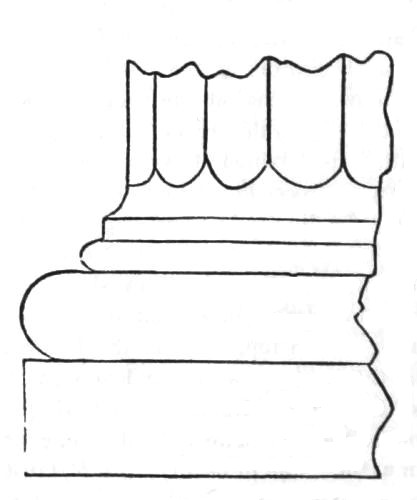
Fig. 17.
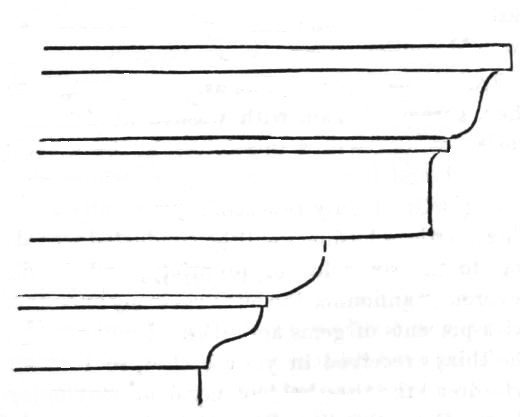
Fig. 18.
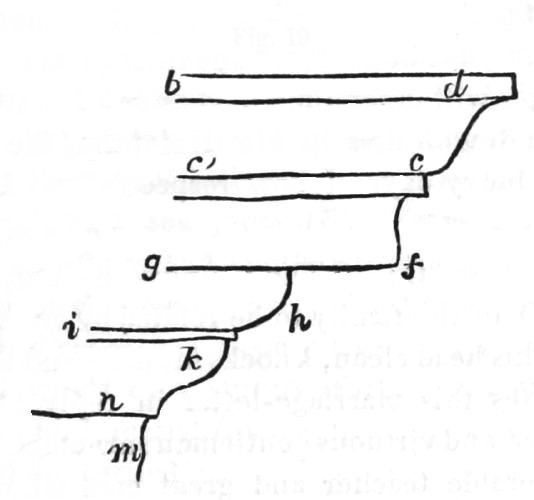
Fig. 19.
Fig. 18 affords an exemplification of the outline of part of a "cornice" belonging to the Tuscan order. Let us slightly analyze the supposed proceedings of the pupil in delineating this. Suppose Fig. 19 to be the rough sketch as first attempted. On examining the copy as given in Fig. 18, the pupil will at once perceive that the proportions are very incorrect; thus, the distance between the two upper lines, as at d, is too little, the fillet being too narrow; again, the point c, which regulates the extent of the curve from a, is too far from a, while the line c c´ is too near the line d; the space between c c´ and the line below it is too wide, and the line f is not perpendicular, but slopes outwards towards f; the distance between the line f g and the one immediately above it is also too narrow by at least one-third. Again, the point h, where the portion of the circle begins, is too near the point f; the line i is also too near that of f g; the outline of the curve is not correct, it being too much bulged out near the point k; the line n is not straight, and that marked m is too far from the extreme end of the line. The pupil has here indicated a method of analyzing her proceedings, comparing them with the correct copy, which she would do well, in her earlier practice, to use pretty frequently, until she is perfectly at home in correct delineation of outlines. It may be objected that this analysis is hypercriticism utterly uncalled for, from the simplicity of the practice; but let it be noted that if the pupil is not able, or unwilling to take the necessary trouble to enable her to draw simple outlines correctly, how can she be prevented, when she proceeds to more complicated examples, from drawing difficult outlines incorrectly? We hold that if a thing is worth doing at all, it is worth doing well; and how can a pupil do a thing correctly, unless from correct models or rules? and how can she ascertain whether she is following them, unless by careful comparison and examination? How often are the works of painters and artists found fault with, from the incorrectness of outline, and the inconsistency of measurement observable, which might be obviated by a more careful attention to the minute details, but are too frequently spurned at by aspiring artists; but of which, after all, the most complicated picture is but a combination? Thus the outline in Fig. 19 presents all the lines and curves found in Fig. 18, but the whole forms a delineation by no means correct; and if a pupil is allowed to run from simple lessons without being able to master them, then the foundation of the art is sapped, and the superstructure certainly endangered. Correct outlining must be attained before the higher examples of art can be mastered.
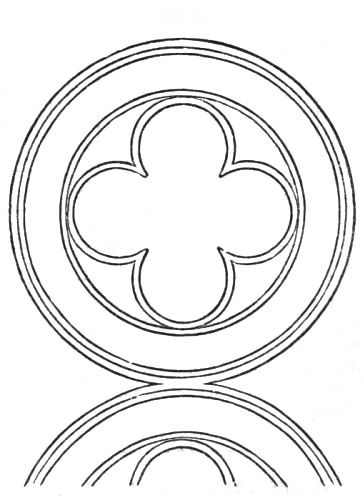
Fig. 20.
Fig. 20 is an outline sketch of the ornament called a quatre-foil, frequently met with in architectural and artistic decoration. It will be a somewhat difficult example to execute at first, but it affords good and useful practice.
Fig. 21 is part of the arch and mullion of a window.
Fig. 22 is an outline sketch of a Gothic recess in a wall.
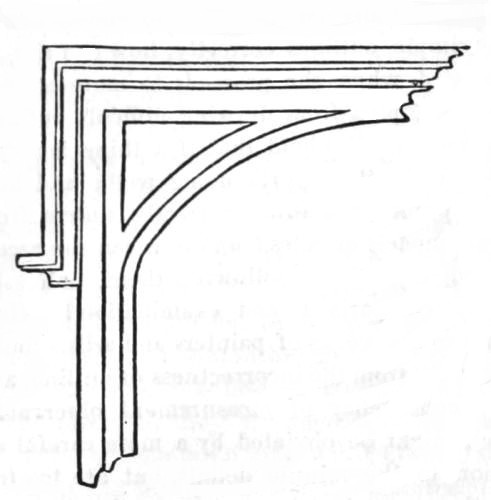
Fig. 21.
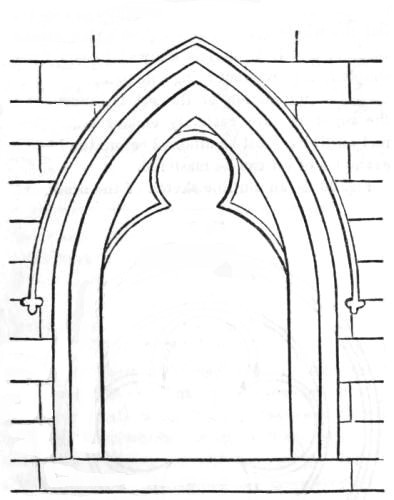
Fig. 22.
The reader will perceive that in all the foregoing designs, although consisting of pure outline, there exists a large amount of practice, which, if she has carefully mastered, will be of eminent service to her in the higher branches of the art.

CELESTIAL LOVE LETTERS.
In the Celestial Empire, love matters are managed by a confidant, and the billets-doux written to one another by the papas. At Amoy, a marriage was recently concluded between the respectable houses of Tan and O; on which occasion the following epistles passed between the two old gentlemen:—
From Papa Tan: "The ashamed young brother, surnamed Tan, with washed head makes obeisance, and writes this letter to the greatly virtuous and honorable gentleman whose surname is O. I duly reverence your lofty door. The marriage business will be conducted according to the six rules of propriety, and I will reverently announce the business to my ancestors with presents of gems and silks. I will arrange the things received in your basket, so that all who tread the threshold of my door may enjoy them. From this time forward the two surnames will be united, and I trust the union will be a felicitous one, and last for a hundred years, and realize the delight experienced by the union. I hope that your honorable benevolence and consideration will defend me unceasingly. At present the dragon flies in Sin Hai term, the first month, lucky day. I bow respectfully. Light before. Tan."
From Papa O: "The younger brother, surnamed O, of the family to be related by marriage, washes his head clean, knocks his head and bows, and writes this marriage-letter in reply to the far-famed and virtuous gentleman surnamed Tan, the venerable teacher and great man who manages his business. 'Tis matter for congratulation the union of 100 years. I reverence your lofty gate. The prognostic is good, also the divination of the lucky bird. The stars are bright, and the dragons meet together. I, the foolish one, am ashamed of my diminutiveness. I for a long time have desired your dragon powers: now you have not looked down upon me with contempt, but have entertained the statements of the match-maker, and agree to give Kang to be united to my despicable daughter. We all wish the girl to have her hair dressed, and the young man to put on his cap of manhood. The peach-flowers just now look beautiful, the red plum also looks gay. I praise your son, who is like a fairy horse who can cross over through water, and is able to ride upon the wind and waves; but my tiny daughter is like a green window and a feeble plant, and is not worthy of becoming the subject of verse.
"Now, I reverently bow to your good words, and make use of them to display your good breeding. Now, I hope your honorable benevolence will always remember me without end. Now the dragon flies in the Sin Hai term, first month, lucky day. Obeisance! May the future be prosperous. O."