Centre-Table Gossip.
Reading edition
MAY FIRST
is signalized, in the annals of New York housekeepers, as a time of change.
Boarders go to housekeeping; old housekeepers, tired of the wear and tear of servants and marketing, give up their comfortable homes for the confinement of a parlor and bed-room in some fashionable hotel or lodging house. Or it may be that only a removal is contemplated, and Mr. Leeds is called in to superintend the sale of furniture that has got behind the times, like the street or square in which it has been used, and carpets much too small for the enlarged views of the wife of the successful merchant. Months before, the young married people have been going from house to house, peering into closets and dumb waiters, measuring floors with an accurate eye, or halls by sober, long-reaching strides, and taking the altitude of windows for shade or curtain. They stop at Berrian's, on their way to business, and pause before Haughwout's huge windows of china and glass. Peterson & Humphrey's carpets are more attractive than the prints at Goupil's or the landscapes at Stevens's. They notice the price of flour in the morning paper, and consult about the wet linen goods "from the Humboldt"—a cargo that would seem as inexhaustible as the furniture of the Mayflower. By and by, the mornings are passed at auctions, and "bargains" begin to crowd their rooms, as heterogeneous in manufacture as in use. All at once, they find their purchase brought to a stand-still by lack of funds, and the house is not half furnished. Ah, they had forgotten to make a calculation beforehand, and purchase actual articles of necessity before matters of luxury!
Now they go on as they should have commenced, cautiously and economically; still, the kitchen and chamber departments show reprovingly for some time to come how they have been robbed for the sake of the parlor curtains and mantle ornaments.
They should have had some good old friend, like ourselves, to say, "Now, my dears, I like your plan of housekeeping; you will find it the most comfortable and economical in the end, if you will only go the right way to work. You have made a fortunate selection in your house. It is neither too large for your means nor your family. How many rooms in it? How have you disposed of them? Now take a spare scrap of paper, and write them down in order.
"Begin with your kitchen, end with your parlor. Reverse the usual plan, if your aim is comfort and not show. Only Mrs. M. or N. will notice whether you have shades or curtains. If your family lack comfortable bedding, or your kitchen needful conveniences, you certainly incommode those you care most to please. Take the kitchen, for example. How large is it? Will you have it covered with carpeting or oil-cloth? How many yards, and at what price? Have you a range? If not, count the cost of stove and boilers. How many chairs and tables? At what price? The dresser, and delf necessary for cooking and servants' use." Fortunately, the lists of the furnishing warehouses save an endless amount of thought and trouble, especially in the matter of cooking utensils. Those unlearned in such research will find one of them in our answers to correspondents the present number.
As for the kitchen, so for the dining-room, the china-closet, the linen-press, store-room, chambers, and finally the parlor. Make your calculation as accurately as possible, to come within the limit you have set yourself, remembering in all cases to take from articles of mere adornment or show, rather than essential comforts, and that infinite petty mortifications and care can be saved to a house-keeper by making plenty, not superfluity, her rule.
A LESSON WORTH REMEMBERING.
THERE are very few of our readers—we take it for granted—who have not met with the little book, "A Trap to Catch a Sunbeam." A longer story, by the same author, has made its appearance in England, prettily illustrated by Gilbert. The title is "Influence," neither more nor less; and the object in view is to show the weight good or bad influence will have on the character, even from the nursery.
As most appropriate to our "Centre-Table Chat," which unites gayeties and gravities, we give as a sample of the new book. Speaking of the education of Cyril, its hero's sister—
"Yes, Julia was improving in every knowledge but one of the most important, the knowledge which a mother's example could best have taught her, to know and perform her mission here, the proper exercise of woman's paramount influence over man."
There would be fewer wretched marriages, fewer dissipated, degraded men, if this lesson were included in a woman's education; if they were taught to feel the angel duty which devolves on them—to keep the wandering steps of those who are tempted so much more than they in the paths of virtue and peace; to make them feel that in the busy world are noise and confusion; that at home there are order and repose; that there "eyes look brighter when they come, that the smile of welcome is ever ready to receive them, the work, the books are ever ready to be laid aside to minister to their pleasure"—they would find amusement then at home, nor strive to seek it elsewhere.
And not alone to the higher classes of society should this be taught. It should be a lesson instilled into the minds of all, high and low, rich and poor. Duty has seldom so strong a hold on men as women; they cannot, they will not, for duty's sake, remain in a dull, tedious, or ill-managed, querulous home, but leave it to seek elsewhere the comfort and amusement which fail them there; and, when riot and revelry have done their work, the wives and sisters who have done so little to make them otherwise are pitied for their bad husbands and brothers.
FOR THE LOVERS OF JEWELRY.
THE great Koh-i-noor diamond displayed in the English Exhibition, and shown by a model in the New York Crystal Palace, has a rival in one now deposited in the Bank of England by the consignees, Messrs. Dory & Benjamin, of London. It comes from Rio Janeiro, and weighs 254½ carats, of the purest water. When cut and polished, it is expected to surpass the Indian diamond in size and brilliancy. It has been shown to the queen, and is the subject of general remark in the English prints.
Ball & Black, of New York, have still in their window the celebrated necklace of pearls displayed at the Crystal Palace. It consists of a single string of pure pearls, threaded like the gold beads of our grandmothers, and about the same size. The cross attached is of diamonds, in a rich and tasteful setting. The pearls are of such unusual size and purity that at first it seems almost impossible that they can be real.
Necklaces are worn much more than they have been, for full dress especially. The most fashionable and costly style is of diamonds, and quite flat, either set in a pattern or a single row of brilliants. Ladies who cannot afford this costly appendage to their toilets adopt a very fine Venetian gold chain, to which is suspended a medallion of precious stones set with diamonds.
OUR FASHION DEPARTMENT.
WE do not often allude to what we have done or intend to do in this department, keeping the even tenor of our way, and letting our chitchat speak for itself. But of late we have noticed that other publications assume to have been the first to give detailed directions, in addition to the meagre description of the fashion plates at first offered to the public. Hailing as we do from the Quaker City, we shall "mildly remonstrate," and only assert that this is not the case.
The present fashion editor was the first to originate the monthly letter or record of the fleeting changes of the season, and since that time has been engaged in collecting, with more or less research and difficulty, from foreign journals des modes, the importer, the mantuamaker, and the milliner, such items as will be of practical or suggestive use, and setting these before our readers in a simple, reliable style, differing from the French raptures of the "Moniteur," or the meagre descriptions of American prints, where the fashions are a last consideration with the publisher—tacked on, because some one else had set the example. To us it seems as consistent with the scientific and professedly critical character they assume, as a lady's French bonnet would appear as the crowning-point of costume on "a potent, grave, and reverend seignior." But we have no quarrel with them for assuming our especial badge as a "Lady's Book," nor are we at all particular in demanding credit of them for our borrowed plumes; we would only suggest that modesty might be a becoming addition to them, and truthfulness an equal grace.
Now, any of our lady readers who have been invited by friends in the country to "let them know what is worn this season," will at once understand the time and trouble it takes to answer such a request satisfactorily. To relieve them from this task is what we have undertaken, at the same time giving variety to our chat by the description of any new manufacture, article of jewelry, fashionable shops, furniture, etc. etc. We did not plan or even dream of exciting emulation or envious remark, nor do we feel the slightest malice or ill-will towards those who thus confess their inferiority. Only, as the school children say, "will they please to let us alone," as we do them.
TO CORRESPONDENTS.
"A YOUNG AMATEUR GARDENER" will find the following effectual in keeping the birds from his freely planted seeds. Mix together one pound of gas tar, quarter of a pound brown spirits of tar, and quarter pound of melted grease. Dip twine in this mixture, and weave it backwards and forwards over the beds, on sticks firmly planted at the side, a few inches high.
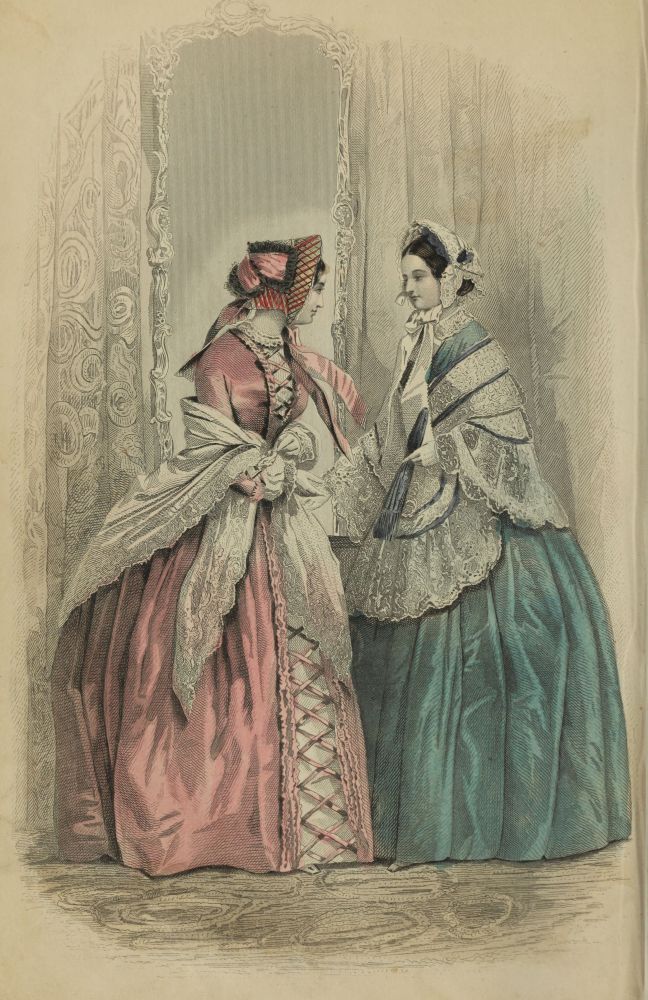
GODEY'S MODEL COLORED FASHIONS.
We have heard of "cherries without stones." Here is a French horticultural receipt for producing them, which we have never seen tested, however: "In the spring, before the circulation of the sap, a young seedling cherry-tree is split from the upper extremity down to the fork of its roots; then, by means of a piece of wood in the form of a spatula, the pith is carefully removed from the tree, in such a manner as to avoid any excoriations or other injury; a knife is used only for commencing the split. Afterwards the two sections are brought together, and tied with woollen, care being taken to close hermetically with clay the whole length of the cleft. The sap soon reunites the separated portions of the tree, and, two years afterwards, cherries are produced of the usual appearance, but, instead of stones, there will only be small soft pellicles."
"MRS. LOUISE M. C." will find farina boiled in milk the best food for an infant, next to its natural substance. It is well to change with arrowroot, in case of sickness; but, as constant food, it will fatten, but not strengthen the child.
"MISS J."—We do not think the acceptance of a bouquet objectionable from any gentleman admitted to the family as a visitor. Flowers, books, and music are the most suitable gifts. Any article of dress or jewelry given or accepted by persons with no other tie than ordinary visiting acquaintance, is not in good taste, to say the least.
"MRS. S. D.," of Mobile.—Dress caps are of the lightest possible description, a mixture of blonde, flowers, and ribbon. Much blonde is used in trimming everything. The gold and silver embroidered ribbon is only suitable for evening, or for dress bonnets.
"MILTON, Pa."—The "Dress Book" has been sent; the directions are all practical.
"A YOUNG WIFE" has our best wishes in her new undertaking. If she is at all systematic, she will not find furnishing so difficult as she anticipates. We subjoin the desired list:—
Kitchen Furnishing List for $30.
1 Kitchen Shovel, Tongs, and Poker.
1 Iron Tea-Kettle.
1 Tinned Iron Pot.
1 Tinned Iron Saucepan.
1 Soap-stone Griddle.
2 Tin Bake-Pans.
1 Tin Dripping Pan.
1 Tin Saucepan.
1 Small Tin Kettle.
1 Pepper and Flour Dredge.
3 Tin Pie Plates.
1 Tin Wash-Basin.
1 Dish Pan.
3 Table and Tea-Spoons, Iron.
1 Chop-Knife and Bowl.
1 Tea and Coffee Canister.
2 Japanned Lamps.
1 Match Safe.
1 Chamber Pail.
2 Smoothing Irons.
2 Large Cedar Wash-Tubs.
1 Wash-Board.
3 Doz. Clothes-Pins.
1 Pint Measure.
1 Set Table Mats.
1 Britannia Coffee Pot.
1 " Tea Pot.
6 Knives and Forks, Stag Handles.
1 Pair Carvers to match.
1 Spice Box.
1 Rolling Pin.
1 Corkscrew and Tunnel.
1 Large Waiter.
2 Painted Pails.
1 Coal Hod.
1 Gridiron.
1 Fry Pan.
1 Cullender.
1 Coffee Boiler.
1 Tea Pot.
1 Grater.
1 Tin Dipper.
1 Egg-Whip.
1 Basting-Spoon.
1 Skimmer.
1 Ladle.
1 Meat Fork.
1 Meat Knife.
1 Knife Board.
2 Scrub Brushes.
1 Dust Pan.
1 Dust Brush.
2 Brooms.
1 Coffee Mill.
1 Clothes Horse.
1 Flour Sieve.
1 Oil Filler.
1 Knife-Box.
1 Door Mat.
1 Kitchen Table.
1 Potato Masher.
1 Flour Pail.
1 Pastry Board.
1 Clothes Line.