OUR PRACTICAL DRESS INSTRUCTOR.
Reading edition
A LADY'S WALKING-DRESS.
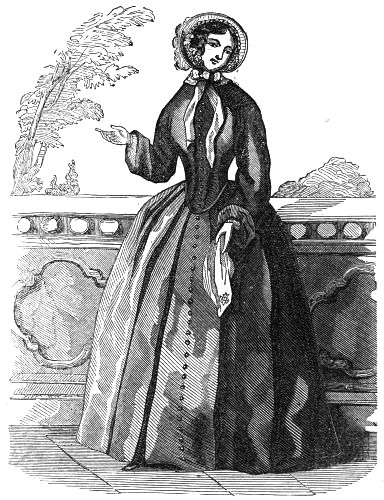
LADY'S WALKING-DRESS.
The above is a pattern of a fashionable lady's walking-dress, made of either velvet or cloth. It is closed down the front, and ornamented with gilt buttons.
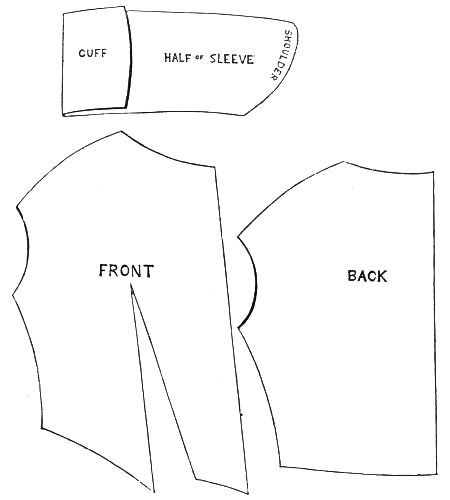
DIAGRAMS OF LADY'S WALKING-DRESS.
[See larger version]

COTTAGE FURNITURE.
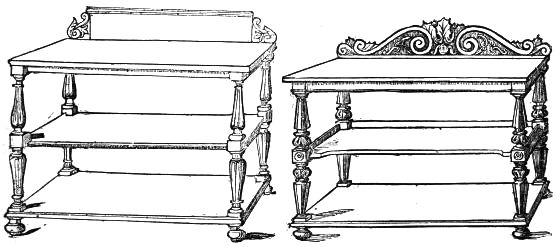
Fig. 1 is a small sideboard-table, very convenient for holding the dessert, the glasses, the plate, and other things in use. It is placed on castors concealed in the legs.
Fig. 2 is another pattern for a sideboard-table, used for the same purpose as that represented in Fig. 1.
CHEMISETTES AND SLEEVES.
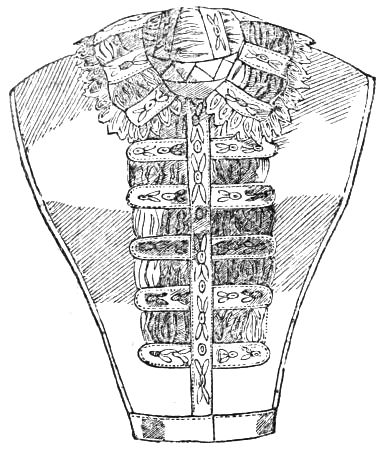
Fig. 1.
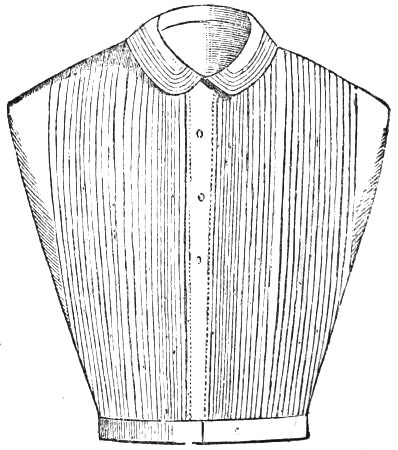
Fig. 2.
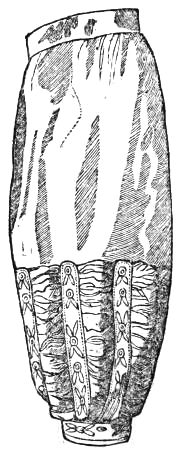
Fig. 3.
Open dresses are still the order of the day; and as the spring comes in, we select two very neat and ladylike styles, both of which are easily followed.
Fig. 1 is composed of alternate rows of insertion and muslin puffs; the collar is rather large and square, the favorite style at present.
Fig. 2 can be made either of Swiss muslin, cambric, or linen, and is suitable for mourning, when black studs should be used to close it.
Fig. 3 is a sleeve to correspond with Fig. 1. As we have before remarked, chemisettes and undersleeves now come in sets to match, and make a favorite and most acceptable holiday or bridal gift. A plain sleeve, with band of the same, will match Fig. 2. Lace will be worn the coming season; but, at present, muslin and cambric are most appropriate, except in evening-dress.
MADAME CAPLIN'S CORSETS.
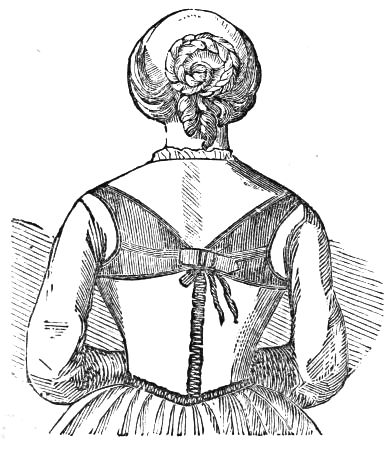
No. 1.
We have before alluded to the establishment of this lady, at 58 Bemers Street, Oxford Street, London, and have now procured some cuts of those peculiar inventions, founded on physical investigations and principles, which have made her so famous.
No. 1.—The Registered Coporiform Child's Bodice offers many advantages, and is valuable for infants and children, affording ease and comfort, supporting the frame, and directing the growth. It is arranged so as to follow the prominent and receding lines of the body; a smooth and comfortable fit is thus obtained, but without the slightest pressure. A pair of straps passes over the shoulders, which cross in the back, and are fastened similarly to a gentleman's brace. We can at once accord the advantages that this bodice possesses over those usually made for children—namely, the straight-corded bodice, which Madame Caplin states, from a want of shape and adaptation, slips off the shoulders on to the arms, causing the head and shoulders to bend forward; thus producing a stooping position, round shoulders, contraction of the chest, and a flattening of the ribs.
No. 2.
Madame Caplin has introduced another invention, called "The Invisible Scapula Contractor." (No. 2.) This we were very much pleased with, and consider it an ingenious contrivance. She explained its use by stating that, in many cases, the child's bodice has not sufficient power of itself to counteract the stooping of the body, and particularly where this evil has been of long standing. In such instances, the contractors cannot fail to be of the greatest utility. We were also much gratified in inspecting the models and numerous inventions which were exhibited by Madame Caplin at the Great Exhibition, and where she received the only prize granted in the United Kingdom for adaptations of this kind. They are twenty-three in number, commencing with infancy, and following the different phases of woman's life up to old age.
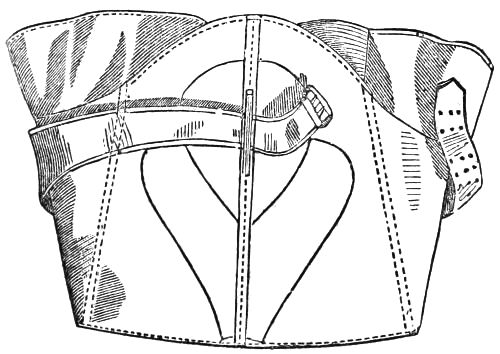
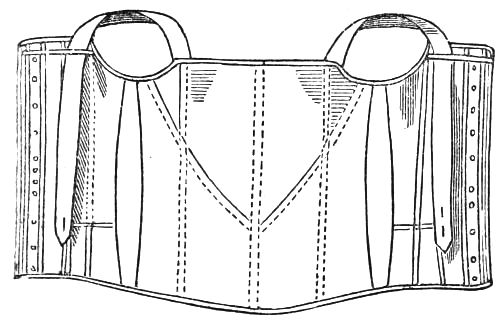
No. 3.
The Contracting Belt (No. 3), among others, is strictly anatomical in its construction. The front is composed of elastic materials, in which are inserted medical plates, thus combining perfect support and elasticity.
TAPER STAND.
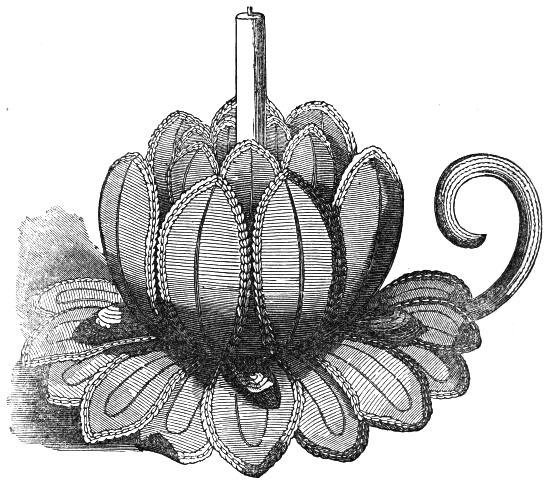
Materials.—5 skeins of pink single Berlin wool, 3 shades of green, 2 skeins of each shade; 2 balls of silver twine, and a skein of wire, No. 24, bell gauge; Penelope needle, No. 2. The stand is made of mill-board, and may be had for sixpence.
THE FLOWER. The Centre Divisions.—Commence with the pink wool, *, work 17 chain, take the wire, and, leaving an end of about 3 inches, place it between the wool and the loop on the needle, work 1 chain across the wire; then fold the wire back even with the other piece, and holding them along the foundation chain, miss the 1 plain that crosses the wire, and work 16 plain on the foundation chain, keeping the doubled wire under the stitches; then leave the wire, as it will not be required in the next round, turn; 1 chain to cross, and up the other side work 3 plain, 3 treble, 5 long, 3 treble, 3 plain, turn, and down the other side, 2 plain, 3 treble, 5 long, 3 treble, 3 plain. Repeat from * 6 times more, and in working the next 17 chain, leave the same length of wire as the chain. When the 7 divisions are made, work 1 single on the 1st plain of the 1st division to make it round; then join on the silver twine, and work the wire under the following stitches: 15 plain up the 1st division, 2 plain in one at the point, * *, 15 plain down the other side; miss 3, 1 plain on the 2d plain stitch of the next division; 7 plain more, join to the 7th stitch of the last 15 plain; 7 plain, 2 plain in one. Repeat from * *, 5 times more; then 7 plain, join to the opposite stitch of the 1st division, 8 plain, then work a plain row along the bottom of the division, and fasten off.
The Inner Divisions.—Commence with the pink wool, make 15 chain; turn, miss 1, and down the foundation chain, 1 plain, 2 treble, 1 long, 6 extra long, 1 long, 1 treble, 1 plain. Repeat 6 times more, then 1 single on the 1st plain stitch of the 1st division to make it round, join on the silver twine; take the wire and work it under the following stitches: 12 plain, 2 plain in one, †, 12 plain down the other side; miss 3, work 7 single up the next division, join to the 5th stitch of the last 12 plain; then 5 plain, 2 plain in one. Repeat from †, 5 times more, then 5 plain, join to the opposite stitch of the 1st division, 7 plain; then work a plain row along the divisions. Fasten off; and for
THE LEAVES.—With the green wool, work 16 chain, turn, miss 1, 2 plain, 13 treble; 2 chain, 1 single in the same stitch as the last; 3 chain, turn, and up the other side, work 3 long in one, 8 long, 4 treble, 3 plain, turn, and down the other side, 2 plain, 4 treble, 8 long, 3 long in one, 3 chain, 1 single in the same stitch as the last. Fasten off; and for
THE STEM.—Commence with the silver twine, work 10 chain, 1 single on the 1st stitch of the 3 chain of the leaf. Take the wire and work it under the following stitches: 34 plain round the leaf; then 10 plain on the stem and fasten. Work 12 leaves more the same with the 3 shades of wool; and for
THE BUD.—With the silver twine, work 15 chain, turn, miss 5, 1 single.
1st round.—3 chain (2 treble in one stitch, 5 times), 1 single on the 1st treble stitch.
2d round.—3 chain, 10 treble, 1 single on the 1st treble stitch; join on the pink wool, then miss 1 and 1 treble, 7 times. Fasten off, and work 2 buds more the same.
THE HANDLE.—With the green wool, work 7 chain, make it round, and work plain round and round for about 4 inches. Fasten off, and place the handle through it. The upper part of the stand should be covered with dark green velvet or cloth; place the leaves and buds around the sconce and sew them to the stand, then put the large and small divisions of the flower over the sconce, and sew them to the stand.

EMBROIDERY.—DESIGN FOR SCREEN.
(See Plate in front of Book.)
Materials.—Drab or black satin, three shades of crimson, two of brown, three of green, three shades of amber, and two of blue embroidery silk or chenille.
Frame the satin, and draw the pattern with a white crayon; work, in embroidery stitch, the flowers with the shades of crimson, the leaves with the greens, the stems with the browns, and the birds with the shades of blue, amber, and green, blending the colors as may be suggested by the taste and judgment of the worker. The above design is well adapted for a cheval-screen, but in drawing the pattern, it will be necessary to considerably magnify the whole. The easiest method of drawing a design on satin for embroidery is to make use of a pounced pattern. This is prepared in the following manner: Trace the outline of the pattern on thin paper, then neatly pierce it with a steel point. Fix the pattern thus prepared firmly on the material, rub the pounce over the paper so as to penetrate the perforated outline; afterwards trace it over with a white crayon. Finely-ground pumice forms the best kind of pounce. Embroidery in chenille, though rather expensive, if neatly worked, is extremely rich and elegant in appearance; it is well adapted for screens, provided when made up the work is protected by glass from the dust. In working on satin, a long-eyed needle is preferable. Chenille à broder is used for embroidery; and much unnecessary waste may be avoided if the needle is brought up close to the preceding stitch.

THE ARROGONESE AND THE VALENCIA.
(See Plates in front of Book.)
The cloaks we illustrate this month are made respectively of cloth and velvet, and, although differing widely in style, are perhaps equal in their claims upon the favor of our gentle readers.
THE ARROGONESE.
The first, the "Arrogonese," is of black velvet, and is very simple in construction, it being merely a circular back, which extends in a half yoke in front; to this the front portion of the cloak is attached; it is box-plaited in four plaits. These, however, are only continued to the waist, from thence they escape confinement, and the material droops in graceful freedom. A collar, narrow at the throat, but with two scallops upon each side springing boldly to greater width, adorns the neck; from the point formed by the scalloped cut of the collar depends a fancy tassel at the back. The cloak is elaborately adorned with a rich design in needle-work.
THE VALENCIA.
The companion to this, in our pages for this issue, is the "Valencia," a very graceful cloak of drab cloth; it is, however, made of this material in all colors which are favorites this season. The cloak is constructed by box-plaiting the back upon a plain or smoothly-fitting yoke, which extends upon the back only from shoulder to shoulder; the points are quite plain, and fall from the neck smoothly. The peculiarity of this style of garment chiefly consists in the mode of the cutting of the sleeve, which is, as reference to the illustration will demonstrate, a turning over of the cloth upon itself at the elbow, the edge of this portion being cut scalloped, and all the borders of the cloak most beautifully ornamented in embroidery. Both cloaks are lined with quilted taffetas in colors to match.
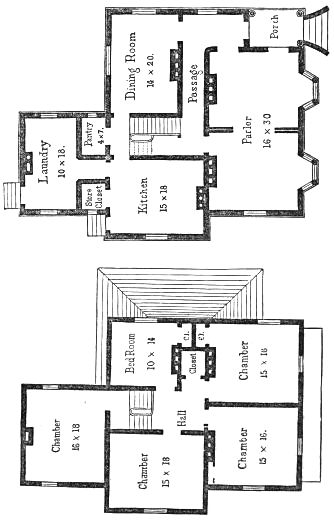
PLANS OF THE ORNAMENTAL COTTAGE.
AN ORNAMENTAL COTTAGE.
(See Plate in front of Book.)
This design cannot strictly be termed a Gothic building, but by the term we only intend that the principal features are taken from the Gothic style. The walls are of brick or stone, roughcast, without pointing. The roof is of slate, and the chimney-stacks are of brick, also roughcast.
On the second floor are four large chambers and a bedroom, furnishing ample room for a family of five or six persons exclusive of servants. On the first floor, if the size of the family required it, the dining-room might be used as a back parlor or sitting-room, the present kitchen as a dining-room, and the laundry, being removed to an out-house, might be used as a kitchen. The hall is to receive additional light by a window in the roof immediately over the well of the stairs. Beneath these stairs is a flight descending to the cellar.

EMBROIDERED ANTIMACASSAR.
(See Plate in front of Book.)
Materials.—One and a quarter yards of book muslin, three skeins of Shetland wool, and twelve skeins of Berlin wool. The Shetland wool is to be of three different shades, and the Berlin may match any one of them; or mohair braid may be used instead of Shetland wool.
This antimacassar is a sort of bag, slipped over the top of the chair. The front is ornamented either with braid run on, or with chain stitch, the latter being rather the most work; but having a far better effect than the former. The initials we have selected are given to show the way in which any initials may be arranged for the centre. The pattern for the border is given in the engraving with the utmost accuracy, but requires, of course, to be greatly enlarged, and marked on the muslin.
The width of the antimacassar, at the widest part, is 26 inches; a margin is left beyond the border, of about one inch, and the depth is eighteen inches. The back of the antimacassar may be of either worked or plain muslin. The two tucks are run together, near the edges, on the wrong side, then turned on the right, and a row of chain-stitch worked at the extreme edge. All the border is done with one shade of the Shetland wool; but the monogram should be in two or three shades, according to the number of letters, each letter being done in one shade. When the muslin is braided, one shade only need be employed. The Russian mohair braid is the best adapted for this purpose; it washes well, and is easily put on; but the chain-stitch is certainly prettier. Marked muslin may be readily finished for either oblong or oval antimacassars; and those who wish it, can have any initials marked for them.
THE BORDER.—Take a bone mesh half an inch wide, and do a strip of common diamond netting, wide enough for the border of the antimacassar. Do four plain rows, and in the fifth work three stitches in one. In the sixth row, take three stitches together. Repeat these two rows, and knot a handsome fringe in the loops of the last.
The border is composed entirely of Berlin wool; the depth of the fringe is four inches.
Our readers will be glad to learn the proper way of knotting fringe. Wind the wool on cotton as often as you may wish, round a card of any given width, and slip it carefully off, without cutting either end. Draw all the loops of one edge through the loops of netting, sufficiently far to allow the loops of the other edge to be drawn through them, and tightly pulled. The ends must then be cut.

WATCH-POCKET.
BRODERIE EN LACET.
(See Plate in front of Book.)
Materials.—One-quarter of a yard of maroon satin; two yards of ribbon to match, an inch and a quarter wide; a knot of the narrowest blue silk Russia braid; a hank of gold beads; four knots of gold thread, No. 0; and some blue sewing silk.
BRODERIE EN LACET is the term applied to the new kind of embroidery. The outlines are done with silk braid, in the ordinary braiding style, and then the flowers, leaves, &c., are filled in with point lace stitches, usually done in silk the color of the braid. In the design before us, a fine gold thread is laid on the outer edge of the braid, and some of the spots are also worked in this material.
Each watch-pocket has two patterns, one for the front, which forms the pocket, the other for that part of the back which is seen above the pocket.
The pattern may be drawn from the engraving, or a pounced paper may be purchased. The design being marked on the satin, is to be braided and then worked according to the engraving. At the edge, a row of sorrento, in blue silk, with a gold bead dropped in every long stitch, makes a very pretty finish. The lining of the pocket must be wadded, and the back must have a piece of card-board between the satin and the lining. Finish with satin ribbon bows.
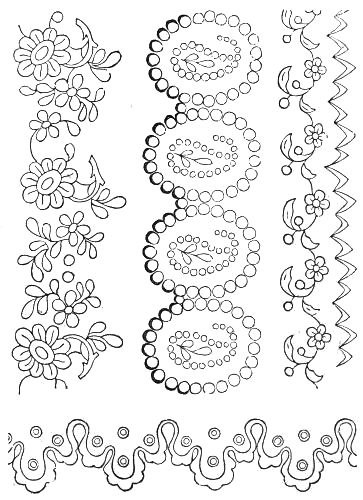
PATTERNS FOR EMBROIDERY.
[See larger version]