INSTRUCTIONS FOR MAKING ORNAMENTS IN RICE SHELL-WORK.
Reading edition
[THIRD AND CONCLUDING ARTICLE.]
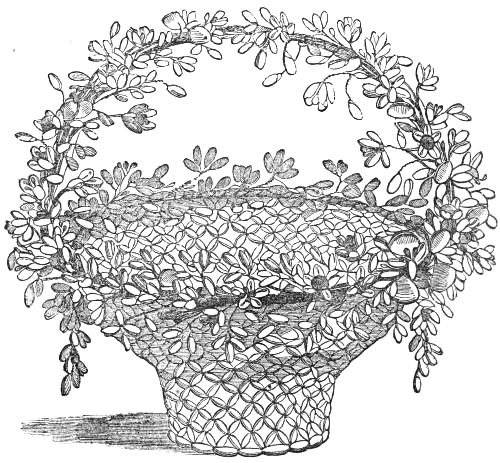
BASKET IN RICE SHELL-WORK.
We have hitherto only described those rice-shell ornaments which are adapted for wear. It is time we proceed to describe some of those ornamental articles for the drawing-room which can be manufactured, and which, from their delicacy, lightness, and rarity, are admirably adapted for presents.
Baskets of various kinds and forms may be made, either of the shells only, or of shells and card-board. Perforated card-board is the best when that material is used, as it saves trouble, and forms the pattern more evenly.
If we would make a card-basket or tray, for the reception of visitors' cards, the requisite number of pieces to form the article must be shaped out from the colored perforated card-board, and the pattern or arabesque, which is to be worked on it with the shells, pencilled. Colored card-board should be used, because that throws up the pure white of the shells. Having joined the different pieces together which form the basket, by sewing them with fine chenil, or silk twist, we take about half a yard of the finest silver wire and attach it to the basket at the place we purpose commencing the pattern, and bring it through one of the holes or perforations just there. We then thread a shell on it, and pass the wire through another hole so situated as, when the wire is drawn tight, to cause the shell to lie in that direction which will make it fall into its right position in the pattern. The wire must then be returned to the right side again, and another shell threaded on it, and the same manœuvre gone through; or, if it be intended to work a shell pattern inside and outside the basket, a second shell must be threaded on the wire before it is returned to the right side, and that adjusted into its place by a proceeding similar to the one just described. It is, however, difficult to manage the two patterns at once; one is sure to mar the other to a greater or less extent; therefore, it will always be best either to make the basket very open and tray-shaped, and to work the pattern on the inside, which will then be the only one much seen; or else to make it rather close and upright, so as to show chiefly the outside, and to work the pattern there.
Baskets may be made of unperforated card-board by gumming the pattern with a very thick solution of gum-dragon, and then sticking the shells on in their proper places.
In all kinds of baskets made with rice-shells, the back of the shell is to form the surface, and the opening to be turned inwards.
The basket, of which we have given a cut, is composed of shells, and the coarsest of the three sizes of silver wire. It is made in lattice-work, or squares, and requires some art to mould or shape it into form.
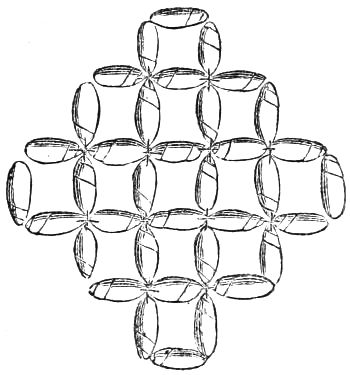
We commence at the bottom, and with the central square. A length of wire, measuring twelve or fourteen inches, must be taken, and the small shells used. Thread four shells on the wire, arranging them so that the point of the first meets the point of the second, and the end of the second meets the end of the third; while the point of the third meets the point of the fourth. Push them along the wire to within about an inch of the end, then bend them into a square, and twist the short end of the wire firmly and neatly with the other, and cut off the superfluous bit. Now thread three shells on the wire, so arranged that the end of the first and the point of the third shall meet the corresponding end and point of that shell of the square already formed, which, when these three are bent into their positions, will constitute the fourth side of this second square. Loop the wire through the corner of the foundation square, and we have the second completed.
A certain firmness, divested, however, of tightness, is requisite in performing these manipulations; for, if the shells are jammed too closely together, the work will have an uneven, stiff appearance, whereas, if they are left too loose, the fabric will never set in form, and will look slovenly. The drawing the wire through the corners of the preceding squares, in order to complete the one which is being worked, too, is a nice operation, which must be gently done, or we may crack the work; and securely and neatly managed, or the squares will not be firm and compact.
Three shells are now again to be symmetrically threaded, and formed into a square, and fastened down to the central one. Two other squares are then to be formed in like manner, and we now have five, or one on each of the four sides of the foundation square. All the sixteen shells used for this should be small, and as nearly as possible of a size.
The wire is now passed up through the inside of the shell nearest to it, and it will be found that the next round of squares will be formed, first, by threading two shells, and bending them into position, and fastening them down at the corner, over the place where the preceding round has left us two sides of a square, and then by threading three shells, and bringing them into shape, where we have only one side ready for us. The two shells, and the three shells, used alternately, will produce another round, consisting of eight squares. Care must be taken to use shells of equal size for a round, although in each fresh round the size of the shells should be in a slight degree increased. The backs of the shells must all lie one way, and the openings the other; the latter constitutes the inside of the basket, as they do not look so uniform and handsome.
The following engraving will give an idea of the appearance of the fabric in an early stage.
When it is necessary to take a fresh length of wire, it must be joined on close to the corner of a completed square, by twisting it firmly and neatly with the end of the length just used up, and cutting up the superfluous point.
The third round is formed as the second, by using alternately the two and the three shells as required to complete the squares.
The number of rounds which are to be worked for the bottom depends entirely upon the size which we design to make the basket. In general, these three, or at any rate four rounds, will be sufficient to make a very pretty sized one.
The next round is to be worked exactly in the same way and with exactly the same sized shells as the last one of the bottom, and, after it is worked, it is to be turned up like a rim all round. This commences the basket itself.
These rounds are now to be added with the small shells, and shaped into form; and then the middle-sized shells, in rounds of gradually increasing size, are to be used for about six rounds; and then the large shells, in gradually increasing size, are to be brought in use and continued until the basket is finished.
It will soon be perceived, while working, that it will occasionally be necessary to miss a square, or to add one or more here and there in order to preserve the raised, and opened, and rounded form requisite for the oval of a basket. The symmetrical arrangement of the points and ends must be carefully attended to, or else the star-like combinations, which add so materially to the appearance of the fabric, will be marred or lost.
A pair of tweezers, or very small nippers, may be used for twisting the wire when fastening on a fresh length, as the fingers will thus be saved, and additional firmness obtained.
Having raised the basket-work to the required height, which, when the bottom consists of four rounds, should be about six inches, a piece of round silk wire, either white or colored, and exactly the size, but not larger than the circle of the top of the basket, must be taken, and firmly attached to the edge of the basket with middle-sized wire; this is to give shape and firmness to the work, and to this another piece of wire is attached, to form the handle.
The basket must now be trimmed, and for this purpose we make two light and graceful wreaths, one long enough to go round the top of the basket, and the other as long as the handle. The single flower, the bud, the spiral group, and leaves of seven or nine shells each, are what will be required for an ordinary-sized basket. When the wreath is made in simple rice shell-work, the stems must be twisted, and the wreath bound together with fine silver wire, and attached to the handle and to the circular wire with the same; the silk wire used must be white.
If, however, the wreath is to be made in the "composite" style, light flower-seeds or small glass beads may be introduced into the centre of the flowers, and the stems may be wound, and the wreaths put together with floss silk, and then they are to be attached to the handle and circular wire with fine chenil. The following combinations are pretty and effective: beads or seeds of pink, or yellow, or coral, or blue, and the stems of the flowers and buds wound with silk to match, the stems of the leaves wound with green, and the wreaths attached in their places with green chenil. There should not be more than two colors, the green and one other, used at a time, and these should be delicate shades; for the shells have so pure and light an appearance, that anything in the least degree showy or gaudy spoils the effect of the whole.
Pendent from below each end of the handle, should be a grape-like bunch of shells, not set on so closely together as in the wheat-ear, or so far apart as in a leaf, and reaching about half way down the basket.
When completed, the article should be placed under a glass case to preserve it from dust and injury, and a few wax or artificial flowers may be tastefully arranged in it with advantage.
A square basket, or a long, straight-sided one, or one in almost any given shape, may be made in this lattice-work, by manufacturing each piece separately, and in the required shape, and then lacing them together with silver wire, chenil, or twist. There is, however, no trimming more graceful, or better adapted for them, than the wreath.
If thought fit, the wreath, however, need only be put round the top of the basket, and the handle made of a succession of squares of the kind we have described.
Light wreaths, either of "simple" or "composite" rice shell-work, may, with very pretty effect, be entwined around alabaster vases or baskets.
For wedding-cakes, rice-shell wreaths and bouquets, with silver bullion in the flowers, are both tasteful and appropriate.
Intermingled with groups of the wax, or artificial, or feather, or paper flowers, the shell-leaves and double and daisy flowers look very pretty.
As the shells never wear out, when any ornament is crushed, or soiled, or tarnished, it can be cut up, the wires picked out, and the shells, when washed and dried, will be ready to be used again and again.
But we are sure that we have suggested quite enough to our readers to enable them to devise for themselves many other pretty and fanciful uses for this work, and we feel convinced that, when once they have overcome the first difficulties of learning it, they will find pleasure in seeing the graceful articles that will, as it were, develop themselves under their busy fingers.
And so we now take our leave of this subject for the present, commending it to the favorable attention of those who may have taken the trouble to peruse what we have written.