VIII AN ERRING CHILD OF GOD
Reading edition
It is my purpose this morning to discuss the case of an erring child of God in contrast to that of an alien sinner. An alien sinner is one who has never been baptized into Jesus Christ, one who has never become a member of the Lord’s church, one who has never become a citizen of the kingdom of our Lord and Saviour, Jesus Christ. The plan of salvation for such an one is clearly revealed in the Bible. It has been proclaimed from this pulpit numbers and numbers of times. It needs to be repeated over and over again, and to be kept constantly before the minds of the people.
Not only should those who are not Christians know the plan of salvation in order to become Christians, but those who have already obeyed the gospel ought to know what an alien must do to be saved well enough to teach others effectively. The alien must know the gospel well enough to obey it. The Christian must have a working knowledge of the gospel in order to help save others.
The Bible clearly teaches that in order to become a child of God one must believe that Jesus is the Christ, the Son of the living God; that he must then repent of his sins (Acts 2:38 and 3:19); that he must confess with his mouth the faith which he has in his 133 heart; and finally he must be baptized for remission of sins (Acts 2:38; 22:16, and many other places which might be cited). These are the conditions of salvation for an alien sinner. Obedience to these commandments makes one a child of the Lord.
I A Word of Encouragement
But suppose one errs from the truth after having obeyed these commandments. That would make him an erring child of God. The case of such an one deserves our consideration. Is there a plan of salvation for one who errs from the truth after having been baptized into Christ—into the family of God? If so, what are the conditions of his salvation? On this topic there seems to be some confusion and misunderstanding. Occasionally we meet someone who thinks that there is no way for him to be saved, if he sins after he has been baptized—that his case is hopeless, if he turns away from the church after having once been a member thereof. I would like to speak a word of encouragement to all such.
There’s only one thing which can keep any person on this earth from being saved, and that is unwillingness to repent and obey God. I believe it is true that no matter how far one may have strayed away, if he wants to come back, if he will repent, and if he will obey the commandments which God has given, God is willing to forgive. This is the divine encouragement 134 and inducement which is held out to all by the word of God (1 John 1:9; 2 Pet. 3:4).
I believe we can say that anyone who has been a Christian very long has at some time or other been an erring child of God, for there are none of us who live perfect lives. I presume there are none here who even claim to live perfectly. In 1 John 1:8 we read: “If we say that we have no sin, we deceive ourselves, and the truth is not in us.” Everyone, then, who has been in the church any appreciable length of time has been, at some time, an erring child of God. If it were not possible for an erring child of God to be saved, then none of us would have a chance, and the whole scheme of redemption would be vain. Of course, we know that such is not the case.
II God’s Willingness To Forgive
That an erring child of God may be saved is clearly taught by James 5:19-20, “Brethren, if any one of you do err from the truth and one convert him, let him know that he which converteth a sinner from the error of his way, shall save a soul from death and shall hide a multitude of sins.” That’s a clear-cut reference unto an erring child of God, for this statement is addressed unto the brethren. It teaches that if a brother errs from the straight and narrow way, there is a chance for him to be restored by another brother. The one who restores him renders a 135 very valuable service which covers a multitude of sins and saves a soul from death. That is, he saves a soul from the lake of fire and brimstone, which is the second death, for Christians as well as sinners are appointed unto physical death. Of course, if the erring brother refuses to obey, he will be lost. He will be lost because of his unwillingness to obey, and not because of God’s unwillingness to forgive.
We have another reference to erring children of God in the third chapter of Revelation, in the letter addressed unto the church at Laodicea. In this church there were some lukewarm members. Lukewarm church members are erring children of God. Of them, Jesus says, “I know thy works, that thou are neither cold nor hot. I would thou wert cold or hot. So then because thou art lukewarm and neither cold nor hot, I will spue thee out of my mouth.” Surely these people were in a bad spiritual condition, even to the extent of making our Savior sick at his stomach; but their case was not a hopeless one. There was still opportunity for them to repent and to be saved.
This letter itself represents an effort on the part of God through his Son, Jesus, to lead these people to repentance, in order that he might forgive them. He pleads with them as follows: “I counsel thee to buy of me gold tried by the fire; that thou mayest be rich, and white raiment that thou mayest be clothed, and that the shame of thy nakedness do not appear; and anoint thine eyes with eyesalve that thou mayest see. As many as I love, I rebuke and 136 chasten: be zealous therefore and repent. Behold I stand at the door and knock: if any man hear my voice, and open the door, I will come in to him and will sup with him and he with me. To him that overcometh will I grant to sit with me in my throne, even as I also overcame and am set down with my father in his throne. He that hath an ear, let him hear what the Spirit saith unto the churches” (Rev. 3:14-22). From this, we not only learn that it is possible for the erring children to be saved, but that their salvation is conditioned upon their repentance.
III Unwillingness To Repent
The characters mentioned in the first part of the sixth chapter of Hebrews were lost not because they were incapable of being saved, but because they were unwilling to repent. Of them we read, beginning with verse 4; “For it is impossible for those who were once enlightened and have tasted of the heavenly gift and were made partakers of the Holy Ghost, and have tasted the good word of God and the powers of the world to come, if they shall fall away, to renew them again unto repentance; seeing they crucify to themselves the Son of God afresh, and put him to an open shame.” Please note that it does not say that these people could not be saved; it does not say that it was impossible for them to repent; but it says it was impossible to get them to repent, that no 137 one could persuade them to repent, that they persistently refused to do so.
These were not characters who were still striving to live the Christian life, but making mistakes along the way. They were men who had completely turned their backs upon that which was right. They were crucifying to themselves the Son of God afresh, and putting him unto an open shame. And one could not persuade them to repent. They were not lost because of God’s unwillingness to forgive, but because of their unwillingness to repent.
It is possible for one to turn so completely away from the Lord that you cannot get that person to repent, but please remember that the trouble still lies with the man himself. Even such an one as that could be saved if he would repent, but he won’t repent. Whosoever will may come, but there are some who won’t. Jesus says, “Ye will not come unto me that ye may have life.”
There is nothing in the Bible, then, which teaches that it is impossible for any individual to be saved, provided he will repent and obey the Lord. There are simply some who refuse to obey. Anyone can repent, but there are some who will not. Of such characters 2 Peter 2:21-22 says: “For it had been better for them not to have known the way of righteousness, than after they have known it to turn from the holy commandment delivered unto them. But it is happened unto them according to the true proverb, the dog is turned to his own vomit again; and 138 the sow that was washed to her wallowing in the mire.”
IV Simon the Sorcerer
In the eighth chapter of Acts we have another example of an erring child of God. His name was Simon and he was a sorcerer by profession. Of him verse 13 says, “Then Simon himself believed also: and when he was baptized, he continued with Philip, and wondered, beholding the miracles and signs which were done.” Jesus said, Mark 16:16: “He that believeth and is baptized shall be saved.” Simon believed and was baptized, therefore, Simon was saved. Simon was a child of God because he had believed and been baptized. That he was afterwards in error is plainly taught by Peter in the verses which follow. Beginning with verse 18: “And when Simon saw that through the laying on of the apostles’ hands the Holy Ghost was given, he offered them money, saying, Give me also this power, that on whomsoever I lay hands, he may receive the Holy Ghost. But Peter said unto him, Thy money perish with thee, because thou hast thought that the gift of God may be purchased with money. Thou hast neither part nor lot in this matter; for thy heart is not right in the sight of God. Repent therefore of this thy wickedness, and pray God, if perhaps the thought of thine heart may be forgiven thee. For I perceive that thou art in the gall of bitterness, and in the bond of iniquity. 139 Then answered Simon, and said, Pray ye to the Lord for me, that none of these things which ye have spoken come upon me.”
Simon was a child of God because he had believed and had been baptized. Afterwards he erred. That made him an erring child of God. His condition was serious. He had so sinned as to be aptly described as being in the bond of iniquity, and in the gall of bitterness. But his case was not hopeless. Peter’s admonition to him shows clearly that there was still a chance for him to be saved.
Peter commanded him to repent and to pray. The commandment to pray for forgiveness implied a commandment to confess his sins. One cannot consistently pray for forgiveness until he admits, at least to himself and to God, that he has sinned. One cannot even repent until he first admits to himself that he has done wrong. The commandment to confess implied by Peter is clearly stated elsewhere in God’s word. For instance, James 5:16: “Confess your faults one to another, and pray one for another that ye may be healed.” Again we read in I John, chapter 1, verses 9 and 10, “If we confess our sins, he is faithful and just to forgive our sins, and to cleanse us from all unrighteousness. If we say that we have not sinned, we make him a liar and his word is not in us.”
These Scriptures not only teach the possibility of an erring child of God’s being saved, but also the condition upon which his salvation depends. These conditions are: repentance of his sins, confession of his 140 sins, and prayer unto the Lord for forgiveness. Any erring child of God who conforms to these conditions will be readily and freely forgiven by our Father who is in heaven. One who refuses to conform to these simple conditions assumes full responsibility for his own destruction. Having put his hand to the plow, and looking back, he is not fit for the kingdom of God (Luke 9:62). He must repent or perish (Luke 13:3).
V The Prodigal Son
The story of the prodigal son very beautifully and accurately illustrates the plan we are discussing. The prodigal son does not represent an alien sinner. He was a son. He represents an erring child. He went away from home contrary to his father’s will, and he wasted his father’s goods in riotous living. He was a wayward child. He was a disobedient son of his father; and finally, when he had tasted the bitter dregs of sin, he resolved to go back home.
The Bible says that he came to himself. He recognized that he had sinned. That was the first step in his restoration. When he thought about the good things back in his father’s home in contrast with his own suffering, he recognized that he had made a mistake. Then he made a resolution. He said, “I will arise and go unto my father.” And the very minute he made up his mind to go to his father, that was repentance. Repentance is a change of purpose. 141 A determination to quit doing wrong and to begin doing right. And so when the young man said to himself, “I will go, I will return to my father, and to my father’s house,” that resolution constituted repentance. Then the story says that he arose and came to his father. That was the fruit of his repentance.
He had planned his confession. He said, “I will say unto my father, Father, I have sinned against heaven and before thee, and am no more worthy to be called thy son: make me as one of thy hired servants.” The young man expected to plead his case with his father. He didn’t even hope to be reinstated as a son. But he was going to beg that he might be allowed to come back as a servant. Imagine his surprise when his father ran to meet him and welcomed him back into the family circle. The boy started to make his confession, but before he had had time to finish, the father interrupted him and said: “Bring forth the best robe and put it on him; and put a ring on his hand, and shoes on his feet: and bring hither the fatted calf and kill it and let us eat, and be merry. For this my son was dead, and is alive again, he was lost and is found.”
Now this not only illustrates what an erring child of God must do to be saved, but it also represents God’s willingness to forgive him. This young man repented, he reformed, he confessed, and he prayed. He prayed to his father to take him back into his home. (He had planned his confession in his heart even if he were not allowed to express it all.) That 142 is just exactly what an erring child of God must do. As we learn from Peter, James and John, he must repent, confess his sins, and pray for forgiveness. Just as the father of that prodigal son was eager to receive him back into his home, so our heavenly Father stands waiting to receive unto the bosom of his love all of his wayward children who will come back to him in humility, penitence, confession and prayer. Just as that father showered his son with blessings, so Jehovah will shower his wayward children who return to him with the blessings of forgiveness, protection, and encouragement.
VI The Church’s Duty
In conclusion it might be well to mention the duty of the church in reference to an erring child of God. It is the duty of the church and of all its spiritually-minded members to warn those who are living in error, to rebuke them, to reprove them and to exhort them with all long suffering and teaching, to admonish them to do these three things which are required of them in order to be forgiven by the Lord. When we do so, we shall in no wise lose our reward.
I close then by calling attention once more to these verses in James, “Brethren, if anyone of you do err from the truth, and one convert him; let him know that he which converteth a sinner from the error of his way, shall save a soul from death and shall hide a multitude of sins.” Now, there may be some erring 143 children of God in this audience this morning. I want to do just what the Bible teaches me to do. I want to admonish you, urge you, and beseech you to take advantage of God’s goodness and God’s mercy and God’s willingness to forgive.
The alien sinner must believe, repent, and be baptized. The erring child of God must repent, confess his sin, and pray for forgiveness. But I don’t care how black your past may have been, how many ugly things you may have done, if you will confess to men, to yourself, and to God that you have sinned; if you will resolve in your heart that you will turn away from your evil doing, and ask God to forgive you, He will certainly do so. He never goes back on His promise. He’s not only willing, but is eager to have you come. He will welcome you back into the fold of those who are redeemed.
All of those evil things which you have done will not only be forgiven, but they will be forgotten. They will never be remembered any more, and you can start all over again to live the Christian life, with a perfectly clean, white record; all the blots having been wiped away by the all-powerful blood of Jesus Christ, the Son of God. Don’t you want to do that? We urge you to do so, while together we stand and sing.
144
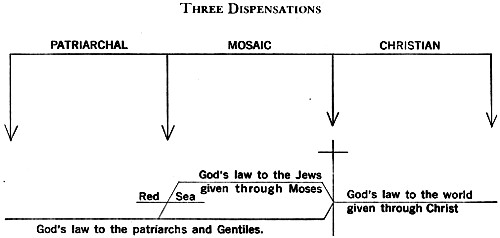
Three Dispensations
PATRIARCHAL
God’s law to the patriarchs and Gentiles.
Red Sea
MOSAIC
God’s law to the Jews given through Moses
{Cross}
CHRISTIAN
God’s law to the world given through Christ
145