Origin of Things Familiar.
Reading edition
MIND YOUR P’S AND Q’S.
It would be a curious thing, if they could be traced out, to ascertain the origin of half the quaint old sayings and maxims that have come down to the present time from unknown generations. Who, for example, was “Dick,” who had the odd-looking “hat-band,” and who has so long been the synonym or representative of oddly-acting people? Who knows any thing authentic of the leanness of “Job’s turkey,” who has so many followers in the ranks of humanity? Scores of other sayings there are, concerning which similar questions might be asked. Who ever knew, until comparatively late years, what was the origin of the cautionary saying, “Mind your P’s and Q’s”? A modern antiquarian, however, has put the world right in relation to that saying. In ale-houses, in the olden time, when chalk “scores” were marked upon the wall, or behind the door of the tap-room, it was customary to put the initials “P” and “Q” at the head of every man’s account, to show the number of “pints” and “quarts” for which he was in arrears; and we may presume many a friendly rustic to have tapped his neighbor on the shoulder, when he was indulging too freely in his potations, and to have exclaimed, as he pointed to the chalk-score, “Mind your P’s and Q’s, man! mind your P’s and Q’s!” The writer from whom we glean this information mentions an amusing anecdote in connection with it, which had its origin in London, at the time a “Learned Pig” was attracting the attention of half the town. A theatrical wag, who attended the porcine performances, maliciously set before the four-legged actor some peas,—a temptation which the animal could not resist, and which immediately occasioned him to lose the “cue” given him by the showman. The pig-exhibitor remonstrated with the author of the mischief on the unfairness of what he had done; to which he replied, “I only wanted to ascertain whether the pig knew his ‘peas’ from his ‘cues!’”
332
ALL FOOLS’ DAY.
April the First stands marked by custom’s rules,
A day of being, and of making, fools.
The First of April, as is well known, is distinguished in the calendar by the singular appellation of “All Fools’ Day.” It would be a curious exception to common experience, if, on the recurrence of this memorable epoch in the division of time, multitudes were not betrayed into a due observance of its peculiarities. Many grave and unsuspecting people have been sent upon the most frivolous and nonsensical errands. Many a passer-by has been told that there was something out of his pocket, which was his hand; or something on his face, which was his nose. Many a school-boy has been sent to the shoemaker’s for stirrup-oil, which he would get from a strap, across his shoulders; or to ask a schoolmistress for the biography of Eve’s mother; or to an old bachelor to purchase pigeon’s milk. Many a printer’s “devil” has been sent to a neighboring editor for a quart of editorial, and received in return a picture of a jackass; and many a pretty girl despatched to the handsome druggist round the corner for the essence of tulips (two-lips,) which she would sometimes box the pharmaceutic ears for offering to give her. Some would be summoned, upon the most unfounded pretexts, out of their warm beds, an hour or more before the accustomed time. Others were enticed to open packages, promising ample remuneration, but full of disappointment; and others again, as they passed along the streets, were captivated by the sight of pieces of spurious coin, which, when they essayed to lift, they found securely fastened to the pavement,—together with various other whimsicalities, which under other circumstances would have been deemed highly offensive, but, happening on the First of April, were considered, if not agreeable, at least comparatively harmless. The origin of this strange custom is shrouded in mystery. It has been traced by some to the scene in the life of Jesus when he was sent from Pilate to Herod, and back from Herod to Pilate, which occurred about this period.
333Brady’s Clavis Calendaria, published in 1812, mentions that more than a century previous the almanacs designated the First of April as “All Fools’ Day.” In the northern counties of England and Scotland, the jokes on that day were practised to a great extent, and it scarcely required an apology to experiment upon the gravest and most respectable of city or country gentlemen and women. The person whose good nature or simplicity put him momentarily in the power of his facetious neighbor was called a “gowk”—and the sending upon ridiculous errands, “hunting the gowk.” The term “gowk” was a common expression for a cuckoo, which was reckoned among the silliest and simplest of all the feathered tribes.
In France, the person made the butt upon these occasions was styled “un poisson d’Avril”—that is, an April fish—by implication, an April fool—“poisson d’Avril,” the familiar name of the mackerel, a fish easily caught by deception, singly and in shoals, at this season of the year. The term “April fool” was therefore, probably, nothing more than an easy substitution of that opprobrious epithet for fish, and it is quite likely that our ancestors borrowed the custom from France, with this change in the phrase peculiar to the occasion. It is possible, however, that it may have been derived from poison, mischief. Among the French, ridicule is the most successful weapon for correcting folly and holding vice in terrorem. A Frenchman is more afraid of a successful bon mot at his expense than of a sword, and the First of April is a day, therefore, of which he can make a double application: he may gratify his love of pleasantry among his friends, or inflict a severe wound on his enemies, if he possess the art and wit to invent and perpetrate a worthy piece of foolery upon them. One of the best tricks that ever occurred in France was that of Rabelais, who fooled the officers of justice, when he had no money, into conveying him from Marseilles to Paris on a charge of treason got up for the purpose, and, when arrived there, showing them how they were hoaxed. For this purpose he made up some brick-dust and ashes in different packets, labelled as poisons for the royal 334family of France. The bait took, and he was conveyed to the capital as a traitor, seven hundred miles, only to explain the joke.
There is a very common practical joke on fools’ day in the British metropolis: it consists in despatching a letter by an unlucky dupe, who is to wait for an answer. The answer is a second note, to a third person, “to send the fool farther.” A young surgeon, a greenhorn in practice, fresh from St. Bartholomew’s, his instruments unfleshed on his own account, and his surgery bottles full to repletion, was called a few years ago from the Strand to a patient in Newgate Street, very rich, named Dobbs. It was the First of April, and it was his first patient. The young Esculapius was ushered into the presence of the supposed patient, who was busy writing in his counting-house. The surgeon explained his errand, and Mr. Dobbs, having an excellent mercantile discernment, soon saw through the affair. He bowed and said, “It is a mistake, sir: my name is Dobbs, but I am, thank God, hale and hearty. It is my brother, the sugar-baker, on Fish Street Hill, that has sent for you, [carriage or horse he had none,] three-fourths of a mile farther.” He entered among the pyramids of snowy sweets, and found Mr. Dobbs, the sugar-baker, of Fish Street Hill, as hale as his brother of Newgate Street. The refiner of saccharine juice understood his brother’s note, stammered out a pretended apology for the mistake, and said he supposed, as the young man’s directions were to Mr. J. Dobbs, and not Mr. Jeffry Dobbs, that was intended; that his name was Jeffry, but his brother John, a third member of the family, and in his business, lived at Limehouse, whither he thought, if our surgeon proceeded, he would find the person he sought. An address was handed the young tourniquet at the extreme end of Limehouse, which address, it is needless to say, was false. What will not a surgeon do to obtain his first patient, and a rich one too? Away he posted to Limehouse, and soon found how far he had travelled for nothing. Tired and disappointed, and scheming vengeance on the authors of the hoax, he set off on 335his return home, cursing the Dobbs family every step he went. As he passed along Upper Shadwell, he saw a horse gallop furiously down Chamomile Street and fling its rider a heavy fall on the pavement. He ran and lifted the fallen man, whom he found insensible. He conveyed him to a shop hard by, bled him, and had the satisfaction of seeing him open his eyes. Suffice it to say that, on being conveyed home, our young surgeon attended him until he was restored to health; and so gratefully were his exertions received by the stranger, who was a rich East India merchant, far advanced in life, that he took him into his house as a medical attendant and friend, and ultimately left him the bulk of his property. Thus, out of an intended Fools’ Day hoax, by the inscrutable caprice of fortune, a frolic led its dupe to wealth. This anecdote, according to the London Athenæum, may be depended on as true, nothing in the story but the name adopted, to conceal the real actors in the drama, being fictitious.
A day of fooleries, the Huli Fest, is observed, also, among the Hindoos, attended with the like silly species of witticism.
By many it is believed that the term “all” is a corruption of auld or old, thereby making it originally “Old Fools’ Day,” in confirmation of which opinion the following observation is quoted from an ancient Roman calendar respecting the 1st of November:—“The feast of old fools is removed to this day.” The oldest almanacs extant, however, have it all (and not old) fools’ day. Besides the Roman “Saturnalia” and the Druidical rites, superstitions which the early Christians found in existence when they commenced their labors in England, was the Festum Fatuorum, or Fools’ Holiday, which was doubtless our present First of April. In some of the German classics frequent mention is made of the Aprilen Narr, so that even the Germans of the olden time understood how to practise their cunning April arts upon their neighbors quite as well as we of the present day.
Enough has been here quoted to prove that the custom is of very ancient existence; but the precise origin thereof remains 336undiscovered, and will have to be dug from some of the musty chronicles of gray antiquity. But, be the origin of the custom what it may, we cannot avoid the conclusion that it is one “more honored in the breach than in the observance.”
CARDS.
About the year 1390, cards were invented to divert Charles IV., then King of France, who was fallen into a melancholy disposition. That they were not in use before appears highly probable. 1st, Because no cards are to be seen in any paintings, sculpture, tapestry, &c. more ancient than the preceding period, but are represented in many works of ingenuity since that age. 2dly, No prohibitions relative to cards, by the king’s edicts, are mentioned; although some few years before, a most severe one was published, forbidding by name all manner of sports and pastimes, in order that the subjects might exercise themselves in shooting with bows and arrows and be in a condition to oppose the English. Now, it is not to be presumed that so luring a game as cards would have been omitted in the enumeration had they been in use. 3dly, In all the ecclesiastical canons prior to the same time, there occurs no mention of cards; although, twenty years after that date, card-playing was interdicted the clergy by a Gallican Synod. About the same time is found in the account-book of the king’s cofferer the following charge:—“Paid for a pack of painted leaves bought for the king’s amusement, three livres.” Printing and stamping being not then discovered, the cards were painted, which made them dear. Thence, in the above synodical canons, they are called pagillæ pictæ, painted little leaves. 4thly, About thirty years after this came a severe edict against cards in France, and another by Emanuel, Duke of Savoy, only permitting the ladies this pastime, pro spinilis, for pins and needles.
Of their designs.—The inventor proposed by the figures of the four suits, or colors, as the French call them, to represent the four states or classes of men in the kingdom. By the 337Cæsars (hearts) are meant the Gens de Chœur, choir-men, or ecclesiastics; and therefore the Spaniards, who certainly received the use of cards from the French, have copas or chalices instead of hearts. The nobility, or prime military part of the kingdom, are represented by the ends or points of lances, or pikes; and our ignorance of the meaning or resemblance of the figure induced us to call them spades. The Spaniards have espadas (swords) in lieu of pikes, which is of similar import. By diamonds are designated the order of citizens, merchants, and tradesmen, carraux, (square stone tiles, or the like.) The Spaniards have a coin dineros, which answers to it; and the Dutch call the French word carreaux, stieneen, stones and diamonds, from the form. Treste, the trefoil leaf, or clover grass, (corruptly called clubs,) alludes to husbandmen and peasants. How this suit came to be called clubs is not explained, unless, borrowing the game from the Spaniards, who have bastos (staves or clubs) instead of the trefoil, we gave the Spanish signification to the French figure.
The “history of the four kings,” which the French in drollery sometimes call “the cards,” is that of David, Alexander, Cæsar, and Charles, names which were, and still are, on the French cards. These respective names represent the four celebrated monarchies of the Jews, Greeks, Romans, and Franks under Charlemagne.
By the queens are intended Argine, Esther, Judith, and Pallas, (names retained in the French cards,) typical of birth, piety, fortitude, and wisdom, the qualifications residing in each person. “Argine” is an anagram for “Regina,” queen by descent.
By the knaves were designed the servants to knights, (for knave originally meant only servant; and in an old translation of the Bible, St. Paul is called the knave of Christ,) but French pages and valets, now indiscriminately used by various orders of persons, were formerly only allowed to persons of quality, esquires, (escuiers,) shield or armor bearers. Others fancy that the knights themselves were designed by those cards, because 338Hogier and Lahire, two names on the French cards, were famous knights at the time cards were supposed to be invented.
SUB ROSA.
But when we with caution a secret disclose,
We cry, “Be it spoken, sir, under the rose.”
Since ’tis known that the rose was an emblem of old,
Whose leaves by their closeness taught secrets to hold;
And ’twas thence it was painted on tables so oft
As a warning, lest, when with a frankness men scoft
At their neighbor, their lord, their fat priest, or their nation,
Some among ’em next day should betray conversation.
British Apollo, 1708.
The origin of the phrase under the rose implies secrecy, and had its origin during the year B.C. 477, at which time Pausanias, the commander of the confederate fleet of the Spartans and Athenians, was engaged in an intrigue with Xerxes for the subjugation of Greece to the Persian rule, and for the hand of the monarch’s daughter in marriage. Their negotiations were carried on in a building attached to the temple of Minerva, called the Brazen House, the roof of which was a garden forming a bower of roses; so that the plot, which was conducted with the utmost secrecy, was literally matured under the rose. Pausanias, however, was betrayed by one of his emissaries, who, by a preconcerted plan with the ephori, (the overseers and counsellors of state, five in number,) gave them a secret opportunity to hear from the lips of Pausanias himself the acknowledgment of his treason. To escape arrest, he fled to the temple of Minerva, and, as the sanctity of the place forbade intrusion for violence or harm of any kind, the people walled up the edifice with stones and left him to die of starvation. His own mother laid the first stone.
It afterward became a custom among the Athenians to wear roses in their hair whenever they wished to communicate to another a secret which they wished to be kept inviolate. Hence the saying sub rosa among them, and, since, among Christian nations.
339
OVER THE LEFT.
The earliest trace of the use and peculiar significance of this phrase may be found in the Records of the Hartford County Courts, in the (then) Colony of Connecticut, as follows:—
At a County Court held at Hartford, }
September 4, 1705. }
Whereas James Steel did commence an action against Bevell Waters (both of Hartford) in this Court, upon hearing and tryall whereof the Court gave judgment against the said Waters, (as in justice they think they ought,) upon the declaring the said judgment, the said Waters did review to the Court in March next, that, being granted and entered, the said Waters, as he departed from the table, he said, “God bless you over the left shoulder.”
The Court order a record to be made thereof forthwith.
A true copie: Test.
Caleb Stanley, Clerk.
At the next court, Waters was tried for contempt, for saying the words recited, “so cursing the Court,” and on verdict fined £5. He asked a review of the Court following, which was granted; and pending trial, the Court asked counsel of the Rev. Messrs. Woodbridge and Buckingham, the ministers of the Hartford churches, as to the “common acceptation” of the offensive phrase. Their reply constitutes a part of the Record, and is as follows:—
We are of opinion that those words, said on the other side to be spoken by Bevell Waters, include (1) prophaneness, by using the name of God, that is holy, with such ill words whereto it was joyned; (2) that they carry great contempt in them, arising to the degree of an imprecation or curse, the words of a curse being the most contemptible that can ordinarily be used.
T. Woodbridge.
T. Buckingham.
March 7th, 1705–6.
The former judgment was affirmed on review.
340
KICKING THE BUCKET.
The tradition among the slang fraternity as to the origin of this phrase is that “One Bolsover, having hung himself to a beam while standing on the bottom of a pail, or bucket, kicked the vessel away in order to pry into futurity, and it was all UP with him from that moment—Finis!”
BUMPER.
When the Roman Catholic religion was in the ascendant in England, the health of the Pope was usually drunk in a full glass immediately after dinner—au bon père: hence the word “Bumper.”
ROYAL SAYING.
It was Alphonsus, surnamed the Wise, King of Aragon, who used to say, “That among so many things as are by men possessed or pursued in the course of their lives, all the rest are baubles, besides old wood to burn, old wine to drink, old friends to converse with, and old books to read.”
DUN.
This word, generally supposed to be derived from the French donnez, owes its origin, according to the British Apollo of September, 1708, to one Joe Dun, a famous bailiff of Lincoln in the time of Henry VII. He is said to have been so extremely shrewd in the management of his rough business, and so dexterous in the collection of dues, that his name became proverbial; and whenever a man refused to pay his debts, it grew into a prevalent custom to say, “Why don’t you Dun him?”
HUMBUG.
Among the many issues of base coin which from time to time were made in Ireland, there was none to be compared in worthlessness to that made by James II. at the Dublin Mint. It was composed of any thing on which he could lay his hands, such as lead, pewter, copper, and brass, and so low was its intrinsic value that twenty shillings of it was only worth twopence 341sterling. William III., a few days after the battle of the Boyne, ordered that the crown-piece and half-crown should be taken as one penny and one half-penny respectively. The soft mixed metal of which that worthless coin was composed was known among the Irish as Uim bog, pronounced Oom-bug, i.e. soft copper, i.e. worthless money; and in the course of their dealings the modern use of the word humbug took its rise, as in the phrases, “That’s a piece of uimbog,” “Don’t think to pass off your uimbog on me.” Hence the word humbug came to be applied to any thing that had a specious appearance but which was in reality spurious. It is curious to note that the very opposite of humbug, i.e. false metal, is the word sterling, which is also taken from a term applied to the true coinage of Great Britain, as sterling coin, sterling worth, &c.
PASQUINADES.
At one corner of the Palazzo Braschi, the last monument of Papal nepotism, near the Piazza Navona, in Rome, stands the famous mutilated torso known as the statue of Pasquin. It is the remains of a work of art of considerable merit, found at this spot, in the sixteenth century, and supposed to represent Ajax supporting Menelaus. It derives its modern name from the tailor Pasquin, who kept a shop opposite, which was the rendezvous of all the gossips in the city, and from which their satirical witticisms on the manners and follies of the day obtained a ready circulation.
Misson says in his Travels in Italy,—The tailor had precisely the talent to head a regiment of satirical wits, and had he had time to publish, he would have been the Peter Pindar of his day; but his genius seems to have been satisfied to rest cross-legged on his shop-board. When any lampoons or amusing bon-mots were current in Rome, they were usually called, from his shop, Pasquinades. After his death, this statue of an ancient gladiator was found under the pavement of his shop. It was soon set up, and by universal consent was inscribed with his name; and they still attempt to raise him from the dead, 342and keep the caustic tailor alive, in the marble gladiator of wit.
The statue of Marforio, which stood near the arch of Septimus Severus, in the Forum, was made the vehicle for replying to the attacks of Pasquin; and for many years they kept up an incessant fire of wit and repartee. When Marforio was removed to the museum in the capitol, the Pope wished to remove Pasquin also; but the Duke di Braschi, to whom he belongs, would not permit it. Adrian VI. attempted to arrest his career by ordering the statue to be burnt and thrown into the Tiber; but one of the Pope’s friends, Ludovico Sussano, saved him, by suggesting that his ashes would turn into frogs, and croak more terribly than before. It is said that his owner is compelled to pay a fine whenever he is found guilty of exhibiting any scandalous placards. The modern Romans seem to regard Pasquin as part of their social system: in the absence of a free press, he has become in some measure the organ of public opinion, and there is scarcely an event upon which he does not pronounce judgment. Some of his sayings are extremely broad for the atmosphere of Rome, but many of them are very witty, and fully maintain the character of his fellow-citizens for satirical epigrams and repartee. When Mezzofanti, the great linguist, was made a cardinal, Pasquin declared that it was a very proper appointment, for there could be no doubt that the “Tower of Babel,” “Il torre di Babel” required an interpreter. At the time of the first French occupation of Italy, Pasquin gave out the following satirical dialogue:—
I Francesi son tutti ladri.
Non tutti—ma Bonaparte.
The French are all robbers.
Not all, but a good part; (or
Not all—but Bonaparte.)
Another remarkable saying is recorded in connection with the celebrated bull of Urban VIII., excommunicating all persons who took snuff in the Cathedral of Seville. On the publication of this decree, Pasquin appropriately quoted the beautiful 343passage in Job,—“Wilt thou break a leaf driven to and fro? and wilt thou pursue the dry stubble?”
BOTTLED ALE.
The hop for his profit I thus do exalt;
It strengtheneth drink and it flavoreth malt;
And being well brewed, long kept it will last,
And drawing abide, if ye draw not too fast.
Tusser, 1557.
Alexander Newell, Dean of St. Paul’s and Master of Westminster School in the reign of Queen Mary, was an excellent angler. But, (says Fuller,) while Newell was catching of fishes, Bishop Bonner was catching of Newell, and would certainly have sent him to the shambles had not a good London merchant conveyed him away upon the seas. Newell was fishing upon the banks of the Thames when he received the first intimation of his danger, which was so pressing that he dared not go back to his own house to make any preparation for his flight. Like an honest angler, he had taken with him provision for the day, and when, in the first year of England’s deliverance, he returned to his country and his old haunts, he remembered that on the day of his flight he had left a bottle of beer in a safe place on the bank: there he looked for it, and “found it no bottle, but a gun—such the sound at the opening thereof; and this (adds Fuller,) is believed (casualty is mother of more invention than industry) the origin of Bottled Ale in England.”
THE POTATO.
Although Sir Walter Raleigh was unexpectedly prevented from accompanying Sir Humphrey Gilbert to Newfoundland, he eventually proved one of the greatest benefactors to his own country, by the introduction of the potato on his return from America, in the year 1584. This root was first planted on Sir Walter’s estate at Youghall, which he afterward sold to the Earl of Cork; but not having given sufficient directions to the person who had the management of the land, the latter mistook the flowers for the fruit and most valuable part of the plant, 344and, on tasting them, rejected them as a pernicious exotic. Some time afterwards, turning up the earth, he found the roots spread to a great distance, and in considerable quantities; and from this stock the whole kingdom was soon after supplied with this valuable plant, which gradually spread throughout Europe and North America. Its name, potato, in Irish paitey, and in French patate, is said to be derived from the original language of Mexico, of which it is supposed to be a native.
Anspach’s History of Newfoundland.
TARRING AND FEATHERING.
Anquetil, in his Histoire de France, 1805, has the following passage in reference to this mode of chastisement:—
They (the two crusading kings, Richard Cœur de Lion and Philip Augustus) afterwards made in concert the laws of police which should be observed in both their armies. No women, except washerwomen, were to be permitted to accompany the troops. Whoever killed another was, according to the place where the crime should be committed, to be cast into the sea, or buried alive, bound to the corpse of the murdered person. Whoever wounded another was to have his hand cut off; whoever struck another should be plunged three times into the sea; and whoever committed theft should have warm pitch poured over his head, which should then be powdered with feathers, and the offender should afterwards be left abandoned on the first shore.
STOCKINGS.
It is stated that Henry the Second, of France, was the first who wore silk stockings, and this was on the occasion of his sister’s wedding to the Duke of Savoy, in 1509. Howell, in his History of the World, says that, in 1550, Queen Elizabeth was presented with a pair of black silk knit stockings by her silk-woman, Mrs. Montague, and that she never wore cloth ones afterward. He also adds, that Henry the Eighth wore ordinarily cloth hose, unless there came from Spain, by great chance, a pair of silk stockings. His son, Edward the Sixth, 345was presented with a pair of long Spanish silk stockings by Sir Thomas Gresham. Hence it would seem that knit stockings originally came from Spain. It is stated that one William Rider, an apprentice on London Bridge, seeing, at the house of an Italian merchant, a pair of knit stockings, from Mantua, took the hint, and made a pair exactly like them, which he presented to the Earl of Pembroke, and that they were the first of that kind worn in England. There have been various opinions with respect to the original invention of the stocking-frame; but it is now generally conceded that it was invented during the reign of Queen Elizabeth, in the year 1589, by William Lee, M.A., of St. John’s College, Cambridge. In the London Magazine, it is related that Mr. Lee was expelled from the University for marrying, contrary to the statutes of the college. Being thus rejected, and ignorant of any other means of subsistence, he was reduced to the necessity of living upon what his wife could earn by knitting stockings, which gave a spur to his invention; and, by curiously observing the working of the needles in knitting, he formed in his mind the model of the frame. Mr. Lee went to France, and, for want of patronage there and in England, died of a broken heart, at Paris. In the hall of Framework Knitters’ Company, incorporated by Charles the Second, in 1663, is a portrait of Lee, pointing to one of the iron frames, and discoursing with a woman, who is knitting with needles and her fingers.
THE ORDER OF THE GARTER.
When Salisbury’s famed countess was dancing with glee,
Her stocking’s security fell from her knee.
Allusions and hints, sneers and whispers, went round;
The trifle was scouted, and left on the ground.
When Edward the Brave, with true soldier-like spirit,
Cried, “The garter is mine; ’tis the order of merit:
The first knights in my court shall be happy to wear—
Proud distinction!—the garter that fell from the fair;
While in letters of gold—’tis your monarch’s high will—
Shall there be inscribed, ‘Ill to him that thinks ill!’”
346
DRINKING HEALTHS.
The drinking of healths originated during the Danish occupation of Britain. The Danes frequently stabbed Englishmen while in the act of drinking, and it finally became necessary for the English, in view of the constant repetition of this dastardly mode of assassination, to enter into a compact to be mutual pledges of security for each other’s health and preservation. Hence the custom of pledging and drinking healths.
A FEATHER IN ONE’S CAP.
In the Lansdowne MS., British Museum, is a Description of Hungary in 1599, in which the writer says of the inhabitants, “It hath been an antient custom among them that none should wear a fether but he who had killed a Turk, to whom onlie yt was lawful to shew the number of his slaine enemys by the number of fethers in his cappe.”
THE WORD BOOK.
Before paper came into general use, our Teutonic forefathers wrote their letters, calendars, and accounts on wood. The Boc, or beech, being close-grained and plentiful in Northern Europe, was generally employed for the purpose; and hence the word book.
NINE TAILORS MAKE A MAN.
The following humorous account of the origin of this saying is from The British Apollo. “It happened (’tis no great matter in what year) that eight tailors, having finished considerable pieces of work at the house of a certain person of quality, (whose name authors have thought fit to conceal,) and received all the money due for the same, a virago servant-maid of the house, observing them to be but slender-built animals, and in their mathematical postures on their shop-board appearing but so many pieces of men, resolved to encounter and pillage them on the road. The better to compass her design, she procured a 347very terrible great black pudding, which, having waylaid them, she presented at the breast of the foremost. They, mistaking this prop of life for an instrument of death, at least a blunderbuss, readily yielded up their money; but she, not contented with that, severely disciplined them with a cudgel she carried in the other hand, all which they bore with a philosophical resignation. Thus, eight, not being able to deal with one woman, by consequence could not make a man; on which account a ninth is added. ’Tis the opinion of our curious virtuosos, that their want of courage ariseth from their immoderate eating of cucumbers, which too much refrigerates their blood. However, to their eternal honor be it spoken, they have often been known to encounter a sort of cannibals, to whose assaults they are often subject, not fictitious, but real man-eaters, and that with a lance but two inches long; nay, and although they go armed no further than their middle finger.”
An earlier authority than the preceding may be found in a note in Democritus in London, with the Mad Pranks and Comical Conceits of Motley and Robin Goodfellow, in which the following version of the origin of the saying is given. It is dated 1682:—
There is a proverb which has been of old,
And many men have likewise been so told,
To the discredit of the Taylor’s Trade:
Nine Taylors go to make up a man, they said;
But for their credit I’ll unriddle it t’ ye:
A draper once fell into povertie,
Nine Taylors joined their purses together then,
To set him up, and make him a man again.
VIZ.
The contraction viz. affords a curious instance of the universality of arbitrary signs. There are few people now who do not readily comprehend the meaning of that useful particle,—a certain publican excepted, who, being furnished with a list of the requirements of a festival in which the word appeared, apologized for the omission of one of the items enumerated: he informed the company that he had inquired throughout the town 348for some viz., but he had not been able to procure it. He was, however, readily excused for his inability to do so. Viȝ. being a contraction of videlicet, the terminal sign ȝ was never intended to represent the letter “z,” but was simply a mark or sign of abbreviation. It is now always written and expressed as a “z” and will doubtless continue to be so.
SIGNATURE OF THE CROSS.
The mark which persons who are unable to write are required to make instead of their signatures, is in the form of a cross; and this practice, having formerly been followed by kings and nobles, is constantly referred to as an instance of the deplorable ignorance of ancient times. This signature is not, however, invariably a proof of such ignorance. Anciently the use of the mark was not confined to illiterate persons; for among the Saxons the mark of the cross, as an attestation of the good faith of the persons signing, was required to be attached to the signature of those who could write, as well as to stand in the place of the signature of those who could not write. In those times, if a man could write, or even read, his knowledge was considered proof presumptive that he was in holy orders. The clericus, or clerk, was synonymous with penman; and the laity, or people who were not clerks, did not feel any urgent necessity for the use of letters. The ancient use of the cross was therefore universal, alike by those who could and those who could not write: it was, indeed, the symbol of an oath, from its sacred associations, as well as the mark generally adopted. Hence the origin of the expression “God save the mark,” as a form of ejaculation approaching the character of an oath.
THE TURKISH CRESCENT.
When Philip of Macedon approached by night with his troops to scale the walls of Byzantium, the moon shone out and discovered his design to the besieged, who repulsed him. The crescent was afterwards adopted as the favorite badge of the city. When the Turks took Byzantium, they found the crescent 349in every public place, and, believing it to possess some magical power, adopted it themselves.
The origin of the crescent as a religious emblem is anterior to the time of Philip of Macedon, dating, in fact, from the very beginning of history.
POSTPAID ENVELOPES.
M. Piron tells us that the idea of a postpaid envelope originated early in the reign of Louis XIV., with M. de Valfyer, who, in 1653, established (with royal approbation) a private penny-post, placing boxes at the corners of the streets for the reception of letters wrapped up in envelopes, which were to be bought at offices established for that purpose. M. de Valfyer also had printed certain forms of billets, or notes, applicable to the ordinary business among the inhabitants of great towns, with blanks, which were to be filled up by the pen with such special matter as might complete the writer’s object. One of these billets has been preserved to our times by a pleasant misapplication of it. Pélisson (Mdme. de Sévigné’s friend, and the object of the bon mot that “he abused the privilege which men have of being ugly”) was amused at this kind of skeleton correspondence; and under the affected name of Pisandre, (according to the pedantic fashion of the day,) he filled up and addressed one of these forms to the celebrated Mademoiselle de Scuderie, in her pseudonyme of Sappho. This strange billet-doux has happened, from the celebrity of the parties, to be preserved, and it is still extant,—one of the oldest, it is presumed, of penny-post letters, and a curious example of a prepaying envelope, a new proof of the adage that “there is nothing new under the sun.”
OLD HUNDRED.
The history of this old psalm-tune, which almost every one has been accustomed to hear ever since he can remember, is the subject of a work recently written by an English clergyman. Luther has generally been considered the author of 350“Old Hundred,” but it has been pretty satisfactorily ascertained that it was composed in the sixteenth century, and certainly previous to 1546, by William Franc, a German. In the course of time its arrangement has undergone repeated alterations; and it is said that, as it originally appeared, it was of a more lively character than at present. Many of these alterations have been carefully preserved and may be seen by reference to Moore’s Encyclopædia of Music. The oldest copy of it that has been preserved was published in France, in Marot and Beza’s Psalms, 1550. Subjoined is a faithful transcript of its original adaptation to the 134th Psalm. It contrasts as broadly with the present style of musical notation as does the English of Chaucer with that of Noah Webster.
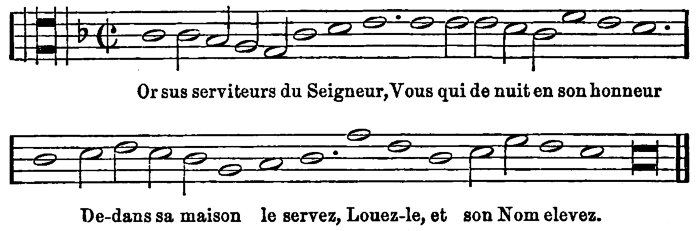
LA MARSEILLAISE.
Rouget de Lisle was a young officer of engineers at Strasbourg. He was born at Lons-le-Saulnier, in the Jura a country of reverie and energy, as mountains commonly are. He relieved the tediousness of a garrison-life by writing verses and indulging a love of music. He was a frequent visitor at the house of the Baron de Diedrich, a noble Alsacian of the constitutional party, the Mayor of Strasbourg. The family loved the young officer, and gave new inspiration to his heart in its attachment to music and poetry, and the ladies were in the habit of assisting, by their performances, the early conceptions of his genius. A famine prevailed at Strasbourg in the winter of 1792. The house of Diedrich was rich at the beginning of the 351revolution, but had now become poor under the calamities and sacrifices of the time. Its frugal table had always a hospitable place for Rouget de Lisle. He was there morning and evening as a son and brother. One day, when only some slices of ham smoked upon the table, with a supply of camp-bread, Diedrich said to De Lisle, in sad serenity, “Plenty is not found at our meals. But no matter: enthusiasm is not wanting at our civic festivals, and our soldiers’ hearts are full of courage. We have one more bottle of Rhine wine in the cellar. Let us have it, and we’ll drink to liberty and the country. Strasbourg will soon have a patriotic fête, and De Lisle must draw from these last drops one of his hymns that will carry his own ardent feelings to the soul of the people.” The young ladies applauded the proposal. They brought the wine, and continued to fill the glasses of Diedrich and the young officer until the bottle was empty. The night was cold. De Lisle’s head and heart were warm. He found his way to his lodgings, entered his solitary chamber, and sought for inspiration at one moment in the palpitations of his citizen’s heart, and at another by touching, as an artist, the keys of his instrument, and striking out alternately portions of an air and giving utterance to poetic thoughts. He did not himself know which came first; it was impossible for him to separate the poetry from the music, or the sentiment from the words in which it was clothed. He sang altogether, and wrote nothing. In this state of lofty inspiration, he went to sleep with his head upon the instrument. The chants of the night came upon him in the morning like the faint impressions of a dream. He wrote down the words, made the notes of the music, and ran to Diedrich’s. He found him in the garden digging winter lettuces. The wife of the patriot mayor was not yet up. Diedrich awoke her. They called together some friends, who were, like themselves, passionately fond of music, and able to execute the compositions of De Lisle. One of the young ladies played, and Rouget sang. At the first Stanza, the countenances of the company grew pale; at the second, tears flowed abundantly; at the last, a delirium of enthusiasm 352broke forth. Diedrich, his wife, and the young officer cast themselves into each others’ arms. The hymn of the nation was found. Alas! it was destined to become a hymn of terror. The unhappy Diedrich a few months afterwards marched to the scaffold at the sound of the notes first uttered at his hearth, from the heart of his friend and the voice of his wife.
The new song, executed some days afterwards publicly at Strasbourg, flew from town to town through all the orchestras. Marseilles adopted it to be sung at the opening and adjournment of the clubs. Hence it took the name of the Marseillaise Hymn. The old mother of De Lisle, a loyalist and a religious person, alarmed at the reverberation of her son’s name, wrote to him, “What is the meaning of this revolutionary hymn, sung by hordes of robbers who pass all over France, with which our name is mixed up?” De Lisle himself, proscribed as a Federalist, heard its re-echo upon his ears as a threat of death as he fled among the paths of Jura. “What is this song called?” he inquired of his guide. “The Marseillaise,” replied the peasant. It was with difficulty that he escaped.
The “Marseillaise” was the liquid fire of the revolution. It distilled into the senses and the soul of the people the frenzy of battle. Its notes floated like an ensign, dipped in warm blood over a field of combat. Glory and crime, victory and death, seemed interwoven in its strains. It was the song of patriotism; but it was the signal of fury. It accompanied warriors to the field and victims to the scaffold!
There is no national air that will compare with the Marseillaise in sublimity and power: it embraces the soft cadences full of the peasant’s home, and the stormy clangor of silver and steel when an empire is overthrown; it endears the memory of the vine-dresser’s cottage, and makes the Frenchman, in his exile, cry, “La belle France!” forgetful of the sword, and torch, and guillotine, which have made his country a spectre of blood in the eyes of nations. Nor can the foreigner listen to it, sung by a company of exiles, or executed by a band of musicians, without feeling that it is the pibroch of battle and war.
353
YANKEE DOODLE.
The good the Rhine-song does to German hearts,
Or thine, Marseilles! to France’s fiery blood;
The good thy anthemed harmony imparts,
“God save the Queen!” to England’s field and flood,
A home-born blessing, Nature’s boon, not Art’s,
The same heart-cheering, spirit-warming good,
To us and ours, where’er we war or woo,
Thy words and music, Yankee Doodle!—do.—Halleck.
The origin of Yankee Doodle is by no means so clear as American antiquaries desire. The statement that the air was composed by Dr. Shackburg, in 1755, when the colonial troops united with the British regulars near Albany, preparatory to the attack on the French posts of Niagara and Frontenac, and that it was produced in derision of the old-fashioned equipments of the provincial soldiers as contrasted with the neat and orderly appointments of the regulars, was published some years ago in a musical magazine printed in Boston. The account there given as to the origin of the song is this:—During the attacks upon the French outposts in 1755, in America, Governor Shirley and General Jackson led the force directed against the enemy lying at Niagara and Frontenac. In the early part of June, whilst these troops were stationed on the banks of the Hudson, near Albany, the descendants of the “Pilgrim fathers” flocked in from the Eastern provinces. Never was seen such a motley regiment as took up its position on the left wing of the British army. The band played music as antiquated and outré as their uniforms; officers and privates had adopted regimentals each man after his own fashion; one wore a flowing wig, while his neighbor rejoiced in hair cropped closely to the head; this one had a coat with wonderful long skirts, his fellow marched without his upper garment; various as the colors of the rainbow were the clothes worn by the gallant band. It so happened that there was a certain Dr. Shackburg, wit, musician, and surgeon, and one evening after mess he produced a tune, which he earnestly commended, as a well-known piece of military music, to the officers of the militia. The joke succeeded, 354and Yankee Doodle was hailed by acclamation “their own march.”
This account is somewhat apocryphal, as there is no song: the tune in the United States is a march; there are no words to it of a national character. The only words ever affixed to the air in this country is the following doggerel quatrain:—
Yankee Doodle came to town
Upon a little pony;
He stuck a feather in his hat
And called it macaroni.
It has been asserted by English writers that the air and words of these lines are as old as Cromwell’s time. The only alteration is in making Yankee Doodle of what was Nankee Doodle. It is asserted that the tune will be found in the Musical Antiquities of England, and that Nankee Doodle was intended to apply to Cromwell, and the other lines were designed to “allude to his going into Oxford with a single plume, fastened in a knot called a macaroni.” The tune was known in New England before the Revolution as Lydia Fisher’s Jig, a name derived from a famous lady of easy virtue in the reign of Charles II., and which has been perpetuated in the following nursery-rhyme:—
Lucy Locket lost her pocket,
Kitty Fisher found it;
Not a bit of money in it,
Only binding round it.
The regulars in Boston in 1775 and 1776 are said to have sung verses to the same air:—
Yankee Doodle came to town,
For to buy a firelock;
We will tar and feather him,
And so we will John Hancock, &c.
The manner in which the tune came to be adopted by the Americans, is shown in the following letter of the Rev. W. Gordon. Describing the battles of Lexington and Concord, before alluded to, he says:—
The brigade under Lord Percy marched out (of Boston) 355playing, by way of contempt, Yankee Doodle: they were afterwards told that they had been made to dance to it.
It is most likely that Yankee Doodle was originally derived from Holland. A song with the following burden has long been in use among the laborers who, in the time of harvest, migrate from Germany to the Low Countries, where they receive for their work as much buttermilk as they can drink, and a tenth of the grain secured by their exertions:—
Yanker didel, doodel down,
Didel, dudel lauter,
Yanke viver, voover vown,
Botermilk und Tanther.
That is, buttermilk and a tenth.
THE AMERICAN FLAG.
A resolution was introduced in the American Congress, June 13, 1777, “That the flag of the thirteen United States be thirteen stripes, alternately red and white; that the union be thirteen stars, white in a blue field, representing a new constellation.” There is a striking coincidence between the design of our flag and the arms of General Washington, which consisted of three stars in the upper portion, and three bars running across the escutcheon. It is thought by some that the flag was derived from this heraldic design. History informs us that several flags were used by the Yankees before the present national one was adopted. In March, 1775, a Union flag with a red field was hoisted in New York, bearing the inscription on one side of “George Rex and the liberties of America,” and upon the reverse, “No Popery.” General Israel Putnam raised on Prospect Hill, July 18, 1775, a flag bearing on one side the motto of the commonwealth of Massachusetts, “Qui transtulit sustinet,” on the other, “An appeal to Heaven,”—an appeal well taken and amply sustained. In October, 1775, the floating batteries of Boston bore a flag with the latter motto, and a pine-tree upon a white field, with the Massachusetts emblem. Some of the colonies used in 1775 a flag with a 356rattlesnake coiled as if about to strike, and the motto “Don’t tread on me.” On January 18, 1776, the grand Union flag of the stars and stripes was raised on the heights near Boston; and it is said that some of the regulars made the great mistake of supposing it was a token of submission to the king, whose speech had just been sent to the Americans. The British Register of 1776 says, “They [the rebels] burnt the king’s speech, and changed their colors from a plain red ground to a flag with thirteen stripes, as a symbol of the number and union of the colonies.” A letter from Boston, published in the Pennsylvania Gazette, in 1776, says, “The Union flag was raised on the 2d, a compliment to the United Colonies.” These various flags, the Pine-Tree, the Rattlesnake, and the Stripes, were used, according to the tastes of the patriots, until July, 1777, when the blue union of the stars was added to the stripes, and the flag established by law. At first a stripe was added for each new State; but the flag became too large, and Congress reduced the stripes to the original thirteen, and now the stars are made to correspond in number with the States. No one, who lives under the protection of the Stars and Stripes, will deny that “the American flag is one of the most beautiful that floats upon any land or sea.” Its proportions are perfect when it is properly made,—one-half as broad as it is long. The first stripe at the top is red, the next white, and these colors alternate, making the last stripe red. The blue field for the stars is the width and square of the first seven stripes, viz., four red and three white. The colors of the American flag are in beautiful relief, and it is altogether a splendid national emblem. Long may it wave untarnished!
BROTHER JONATHAN.
The origin of this term, as applied to the United States, is as follows. When General Washington, after being appointed commander of the army of the Revolutionary War, went to Massachusetts to organize it, he found a great want of ammunition and other means of defence; and on one occasion it 357seemed that no means could be devised for the necessary safety. Jonathan Trumbull, the elder, was then Governor of the State of Connecticut; and the general, placing the greatest reliance on his excellency’s judgment, remarked, “We must consult Brother Jonathan on the subject.” The general did so, and the governor was successful in supplying many of the wants of the army; and thenceforward, when difficulties arose, and the army was spread over the country, it became a by-phrase, “We must consult Brother Jonathan;” and the name has now become a designation for the whole country, as John Bull has for England.
UNCLE SAM.
Immediately after the declaration of war with England, in 1812, Elbert Anderson, of New York, then a contractor, visited Troy, where he purchased a large quantity of provisions. The inspectors of the articles at that place were Ebenezer and Samuel Wilson. The latter gentleman (universally known as “Uncle Sam”) generally superintended in person a large number of workmen, who, on this occasion, were employed in overhauling the provisions purchased by the contractor. The casks were marked “E. A.—U. S.” Their inspection fell to the lot of a facetious fellow, who, on being asked the meaning of the mark, said he did not know, unless it meant Elbert Anderson and Uncle Sam, alluding to Uncle Sam Wilson. The joke took among the workmen, and passed currently; and “Uncle Sam,” when present, was often rallied by them on the increasing extent of his possessions.
THE DOLLAR MARK, $.
Writers are not agreed as to the derivation of this sign to represent dollars. Some say that it comes from the letters U. S., which, after the adoption of the Federal Constitution, were prefixed to the Federal currency, and which afterwards, in the hurry of writing, were run into one another, the U being made first and the S over it. Others say that it is derived from the contraction of the Spanish word pesos, dollars; others, from the 358Spanish fuertes, hard,—to distinguish silver from paper money. The more plausible explanation is, that it is a modification of the figure 8, and denotes a piece of eight reals, or, as the dollar was formerly called, a piece of eight. It was then designated by the figures 8 8.
ORIGIN OF VARIOUS INVENTIONS AND CUSTOMS.
The Saxons first introduced archery in the time of Vortigern. It was dropped immediately after the conquest, but was revived by the Crusaders, they having felt the effects of it in their combats with the Saracens, who probably derived it from the Parthians. The Normans brought with them the cross-bow, but after the time of Edward II. its use was supplanted by that of the long-bow, which became the favorite national weapon. Bows and arrows, as weapons of war, were in use with stone cannonballs as late as 1640. All the statutes for the encouragement of archery were framed after the invention of gunpowder and firearms, the object being to prevent this ancient weapon becoming obsolete. Yew-trees were encouraged in churchyards, for the making of bows, in 1642. Hence their generality in churchyards in England.
Coats of arms, or armorial bearings, came into vogue in the reign of Richard I. of England, and became hereditary in families about the year 1192. They took their rise from the knights painting their banners with different figures to distinguish them in the Crusades.
The first standing army of modern times was established by Charles VII. of France, in 1445. Previous to that time the king had depended upon his nobles for contingents in time of war. A standing army was first established in England in 1638, by Charles I., but it was declared illegal, as well as the organization of the royal guards, in 1769. The first permanent military band instituted in England was the yeomen of the guards, established in 1486.
Guns were invented by Swartz, a German, about 1378, and brought into use by the Venetians, in 1382. Cannon were invented 359at an anterior date: at Amberg may still be seen a piece of ordnance inscribed 1303. They were first used at the battle of Cressy in 1346. In England, they were first used at the siege of Berwick, in 1405. It was not until 1544, however, that they were cast in England. They were employed on shipboard by the Venetians in 1539, and were in use among the Turks about the same time. An artillery company was instituted in England for weekly military exercises in 1610.
Dating from the Christian Era was commenced in Italy in 525, and in England in 816.
Pliny gives the origin of glass-making thus. As some merchants were carrying nitre, they stopped near a river issuing from Mount Carmel. Not readily finding stones to rest their kettles on, they used some pieces of nitre for that purpose: the fire gradually dissolving the nitre, it mixed with the sand, and a transparent matter flowed, which, in fact, was glass.
Insurance of ships was first practised in the reign of Cæsar, in 45. It was a general custom in Europe in 1494. Insurance-offices were first established in London in 1667.
Astronomy was first studied by the Moors, and was introduced by them into Europe in 1201. The rapid progress of modern astronomy dates from the time of Copernicus. Books of astronomy and geometry were destroyed, as infected with magic, in England, under the reign of Edward VI., in 1552.
Banks were first established by the Lombard Jews, in Italy. The name is derived from banco, a term applied to the benches erected in the market-places for the exchanges of money, &c. The first public bank was at Venice, in 1550. The Bank of England was established in 1693. In 1696 its notes were at twenty per cent. discount.
The invention of bells is attributed to Paulinus, Bishop of Nola, in Campania, about the year 400. They were originally introduced into churches as a defence against thunder and lightning. They were first hung up in England, at Croyland Abbey, Lincolnshire, in 945. In the eleventh century and later, it was the custom to baptize them in churches before they were 360used. The curfew-bell was established in 1068. It was rung at eight o’clock in the evening, when people were obliged to put out their fire and candle. The custom was abolished in 1100. Chimes, or musical bells, were invented at Alost, in Belgium, 1487. Bellmen were appointed in London, in 1556, to ring the bells at night, and cry, “Take care of your fire and candle, be charitable to the poor, and pray for the dead.”
How many are aware of the origin of the word “boo!” used to frighten children? It is a corruption of Boh, the name of a fierce Gothic general, the son of Odin, the mention of whose name spread a panic among his enemies.
Book-keeping was first introduced into England from Italy by Peele, in 1569. It was derived from a system of algebra published by Burgo, at Venice.
Notaries public were first appointed by the Fathers of the Christian Church to make a collection of the acts or memoirs of martyrs in the first century.
The administration of the oath in civil cases is of high antiquity. See Exodus xxii. 11. Swearing on the Gospels was first used in 528. The oath was first administered in judicial proceedings in England by the Saxons, in 600. The words “So help me God, and all saints,” concluded an oath, till 1550.
Signals to be used at sea were first contrived by James II., when he was Duke of York, in 1665. They were afterwards improved by the French commander Tourville, and by Admiral Balchen.
Raw silk is said to have first been made by a people of China called Ceres, 150 B. C. It was first brought from India, in 274, and a pound of it at that time was worth a pound of gold. The manufacture of raw silk was introduced into Europe from India by some monks in 550. Silk dresses were first worn in 1455. The eggs of the silk-worm were first brought into Europe in 527.
Paulus Jovius was the first person who introduced mottoes; Dorat, the first who brought anagrams into fashion. Rabelais 361was the first who wrote satires in French prose; Etienne Jodelle, the first who introduced tragedies into France. The Cardinal of Ferrara, Archbishop of Lyons, was the first who had a tragicomedy performed on the stage of Italian comedians. The first sonnet that appeared in French is attributed to Jodelle.
Guido Aretino, a Benedictine monk of Arezzo, Tuscany, in 1204 designated the notes used in the musical scale by syllables derived from the following verses of a Latin hymn dedicated to St. John:—
UT queant laxis REsonare fibris,
MIra gestorum FAmuli tuorum,
SOLve pollutis LAbii reatum.
O Pater Alme.
By this means he converted the old tetrachord into hexachords. He also invented lines and spaces in musical notation.
The invention of clocks is by some ascribed to Pacificus, Archdeacon of Verona, in the ninth century; and by others, to Boethius, in the early part of the sixth. The Saracens are supposed to have had clocks which were moved by weights, as early as the eleventh century; and, as the term is applied by Dante to a machine which struck the hours, clocks must have been known in Italy about the end of the thirteenth or beginning of the fourteenth century. The most ancient clock of which we have any certain account was erected in a tower of the palace of Charles V., King of France, in 1364, by Henry de Wyck or de Vick, a German artist. A clock was erected at Strasbourg in 1370, at Courtray about the same period, and at Speyer in 1395.
Watches are said to have been made at Nuremberg as early as 1477; but it is uncertain how far the watches then constructed resembled those now in use. Some of the early ones were very small, in the shape of a pear, and sometimes fitted into the top of a walking-stick. As time-keepers, watches could have had very little value before the application of the spiral spring as a regulator to the balance. This was invented by Hooke, in 1658.
362The use of the pendulum was suggested by a circumstance similar to that which started in Newton’s mind the train of thought that led to the theory of gravitation. Galileo, when under twenty years of age, standing one day in the metropolitan church of Pisa, observed a lamp, which was suspended from the ceiling, and which had been disturbed by accident, swing backwards and forwards. This was a thing so common that thousands, no doubt, had observed it before; but Galileo, struck with the regularity with which it moved backwards and forwards, reflected upon it, and perfected the method now in use of measuring time by means of a pendulum.
A monk named Rivalto mentions, in a sermon preached in Florence in 1305, that spectacles had then been known about twenty years. This would place the invention about the year 1285.
Quills are supposed to have been used for writing-pens in the fifth century, though the conjecture rests mainly on an anecdote of Theodoric, King of the Ostrogoths, who, being so illiterate that he could not write even the initials of his own name, was provided with a plate of gold through which the letters were cut, and, this being placed on the paper when his signature was required, he traced the letters with a quill. The date of the earliest certain account of the modern writing-pen is 636. The next notice occurs in the latter part of the same century, in a Latin sonnet to a pen by Aldhelm, a Saxon author. The reeds formerly employed are still used in some Eastern nations. Steel pens were first made by Wise, in England, in 1803.
The first known treatise on stenography is the curious and scarce little work entitled “Arte of Shorte, Swifte, and Secrete Writing by Character, invented by Timothe Bright, Doctor of Phisike.”
The art of printing, according to Du Halde and the missionaries, was practised in China nearly fifty years before the Christian Era. In the time of Confucius, B.C. 500, books were formed of slips of bamboo; and about 150 years after Christ, paper was first made; A.D. 745, books were bound into leaves; 363A.D. 900, printing was in general use. The process of printing is simple. The materials consist of a graver, blocks of wood, and a brush, which the printers carry with them from place to place. Without wheel, or wedge, or screw, a printer will throw off more than two thousand five hundred impressions in one day. The paper (thin) can be bought for one-fourth the price in China that it can in any other country. The works of Confucius, six volumes, four hundred leaves, octavo, can be bought for twelve cents.
Stamps for marking wares, packages, &c. were in use among the Roman tradesmen; and it is highly probable that had the modern art of making paper been known to the ancients, they would have diffused among themselves, and transmitted to posterity, printed books.
From the early commercial intercourse of the Venetians with China, there is reason to believe that the knowledge of the art and of its application to the multiplying of books was derived from thence; for Venice is the first place in Europe, of which we have any account, in which it was practised, a Government decree respecting it having been issued October 11, 1441. Previous to the year 1450, all printing had been executed by means of engraved blocks of wood; but about this period, the great and accumulating expense of engraving blocks for each separate work led to the substitution of movable metal types. The credit of this great improvement is given to Peter Schœffer, the assistant and son-in-law of John Faust, of Mentz, (commonly called Dr. Faustus.) The first book printed with the cast metal types was the “Mentz Bible,” which was executed by Faust and Guttemberg, between the years 1450 and 1455.
The Dutch claim to have originated stereotyping. They have, as they say, a prayer-book stereotyped in 1701. The first attempt at stereotyping in America was made in 1775, by Benjamin Mecom, a printer of Philadelphia. He cast plates for a number of pages of the New Testament, but never completed them.
The first printing-press in America was established at Cambridge, Mass., in 1639.
364
COCK-FIGHTING.
Themistocles, marching against the Persians, beheld two gamecocks in the heat of battle, and thereupon pointed out to his Athenian soldiery their indomitable courage. The Athenians were victorious; and Themistocles gave order that an annual cock-fight should be held in commemoration of the encounter they had witnessed. No record of this sport occurs in England before the year 1191.
TURNCOAT.
The opprobious epithet, turncoat, took its rise from one of the first dukes of Savoy, whose dominions lying open to the incursions of the two contending houses of Spain and France, he was obliged to temporize and fall in with that power that was most likely to distress him, according to the success of their arms against one another. So being frequently obliged to change sides, he humorously got a coat made that was blue on one side, and white on the other, and might be indifferently worn either side out. While in the Spanish interest, he wore the blue side out, and the white side was the badge for the French. Hence he was called Emmanuel, surnamed the Turncoat, by way of distinguishing him from other princes of the same name of that house.
INDIA-RUBBER.
Caoutchouc was long known before its most valuable qualities were appreciated. One of the earliest notices of its practical use occurs in Dr. Priestly’s Theory and Practice of Perspective, printed in 1770. “I have seen” says he, “a substance excellently adapted to the purpose of wiping from paper the marks of a black lead-pencil. It must, therefore, be of singular use to those who practice drawing. It is sold by Mr. Nairne, mathematical instrument-maker, opposite the Royal Exchange. He sells a cubical piece, of about half an inch, for three shillings; and, he says, it will last several years.”
365
FRICTION MATCHES.
In 1836 the subject of friction matches attracted the attention of Mr. L. C. Allin, of Springfield, Massachusetts. At that time a clumsy phosphoric match, imported from France, had come into limited use in the United States. It was made by dipping the match-stick first into sulphur, and then into a paste composed of chloride of potash, red lead, and loaf sugar. Each box of matches was accompanied by a bottle of sulphuric acid, into which every match had to be dipped in order to light it. To abolish this inconvenience, and make a match which would light from the friction caused by any rough surface, was the task to which young Allin applied himself. He succeeded, but took out no patent. On being urged to do so, he found that a patent had already been obtained by one Phillips of Chicopee, a peddler, who had probably picked up through a third party the result of Mr. Allin’s study. Mr. Allin’s legal adviser thought that he (Allin) would do better to have the right to manufacture under Phillips’ patent (which Phillips gave him without charge, in consideration of the waiving of his claim,) than to bear the expense of the litigation which was feared to be necessary to establish his claim. So the inventor of friction matches became simply a manufacturer under another man’s patent.
THE FLAG OF ENGLAND.
On the 12th of April, 1606, the Union Jack—that famous ensign—first made its appearance. From Rymer’s Fœdera, and the Scottish Annals of Sir James Balfour, we learn that some differences having arisen between ships of the two countries at sea, the king ordained that a new flag be adopted with the crosses of St. Andrew and St. George interlaced, by placing the latter fimbriated on the blue flag of Scotland as the ground thereof. This flag all ships were to carry at their main top; but English ships were to display St. George’s red cross at their stern, and the Scottish the white saltire of St. Andrew.
366
BLUE-STOCKING.
It was the fashion in London, in 1781, for ladies to have evening assemblies, where they might participate in conversation with literary men. These societies acquired the name of Blue-Stocking Clubs,—an appellation which has been applied to pedantic females ever since. It arose from the custom of Mr. Stillingfleet, one of the most eminent members, wearing blue stockings. Such was the excellence of his conversation, and his absence was so great a loss, that it used to be said, “We can do nothing without the Blue Stockings;” and thus the title was gradually established. In Hannah More’s poem, Bas bleu, many of the most conspicuous members are mentioned.
SKEDADDLE.
This word may be easily traced to a Greek origin. The verb σκεδαννυμι, of which the root is σκεδα, is used freely by Thucydides, Herodotus, and other Greek writers, in describing the dispersion of a routed army. From the root σκεδα the word skedaddle is formed by simply adding the euphonious termination dle and doubling the d, as required by the analogy of our language in such words. In many words of undoubted Greek extraction much greater changes are made.
The Swedes have a similar word, skuddadahl, and the Danes another, skyededehl, both of which have the same signification.
An old version of the Irish New Testament contains the passage, “For it is written, I will smite the shepherd, and the sheep of the flock shall be sgedad ol.” This compound Irish word sgedad ol (all scattered or utterly routed) was probably used by some Irishman at Bull Run, and, being regarded as felicitous, was at once adopted.
FOOLSCAP PAPER.
The term of “foolscap,” to designate a certain size of paper, no doubt has puzzled many an anxious inquirer. It appears that Charles I., of England, granted numerous monopolies for the support of the Government, among others the manufacture of paper. The water-mark of the finest sort was the 367royal arms of England. The consumption of this article was great, and large fortunes were made by those who purchased the exclusive right to vend it. This, among other monopolies, was set aside by the Parliament that brought Charles I. to the scaffold; and, by way of showing contempt for the King, they ordered the royal arms to be taken from the paper, and a fool with his cap and bells to be substituted. It is now over two hundred years since the fool’s cap was taken from the paper, but still the paper of the size which the Rump Parliament ordered for their journals bears the name of the water-mark placed there as an indignity to King Charles.
THE FIRST FORGED BANK-NOTE.
Sixty-four years after the establishment of the Bank of England, the first forged note was presented for payment, and to Richard William Vaughn, a Stafford linen-draper, belongs the melancholy celebrity of having led the van in this new phase of crime, in the year 1758. The records of his life do not show want, beggary or starvation urging him, but a simple desire to seem greater than he was. By one of the artists employed (and there were several engaged on different parts of the notes) the discovery was made. The criminal had filled up to the number of twenty and deposited them in the hands of a young lady to whom he was attached, as a proof of his wealth. There is no calculating how much longer bank-notes might have been free from imitation had this man not shown with what ease they could be counterfeited. From this period forged notes became common. His execution did not deter others from the offence, and many a neck was forfeited to the halter before the late abolition of capital punishment for that crime.
THE FIRST PIANO-FORTE.
A play-bill of the Covent Garden Theatre, dated May 16, 1767, after setting forth the performance of The Beggar’s Opera, contains the following notification:—“End of Act First, Miss Brickler will sing a favorite song from Judith, accompanied by Mr. Dibdin on a new instrument called Piano-Forte.” 368The first manufacturer is believed to be a German named Backers, as there is still in existence the name-board of a piano inscribed “Americus Backers, Factor et Inventor, Jermyn Street, London, 1776.”
THE FIRST DOCTORS.
The title of Doctor was invented in the twelfth century, at the first establishment of the universities. The first person upon whom it was conferred was Irnerius, a learned Professor of Law, at the University of Bologna. He induced the Emperor Lothaire II., whose Chancellor he was, to create the title; and he himself was the first recipient of it. He was made Doctor of Laws by that university. Subsequently the title was borrowed by the faculty of Theology, and first conferred by the University of Paris on Peter Lombard, the celebrated scholastic theologian. William Gordenio was the first person upon whom the title of Doctor of Medicine was bestowed. He received it from the college at Asti, in 1329.
THE FIRST THANKSGIVING PROCLAMATION.
The first proclamation of Thanksgiving Day that is to be found in a printed form is the one issued by his Excellency Francis Bernard, Captain-General and Governor-in-Chief in and over His Majesty’s province of the Massachusetts Bay, in New England, and Vice-Admiral of the same, in 1767. It is as follows:—
A Proclamation for a Public Thanksgiving.
As the Business of the Year is now drawing towards a Conclusion, we are reminded, according to the laudable Usage of this Province, to join together in a grateful Acknowledgement of the manifold Mercies of the Divine Providence conferred upon Us in the passing Year: Wherefore, I have thought fit to appoint, and I do with the advice of His Majesty’s Council appoint, Thursday, the Third Day of December next, to be a day of public Thanksgiving, that we may thereupon with one Heart and Voice return our most humble Thanks to Almighty 369God for the gracious Dispensations of His Providence since the last religious Anniversary of this kind: and especially for—that he has been pleased to preserve and maintain our most gracious Sovereign King George in Health and Wealth, in Peace and Honour; and to extend the Blessings of his Government to the remotest Part of his Dominions;—that He hath been pleased to bless and preserve our gracious Queen Charlotte, their Royal Highnesses the Prince of Wales, the Princess Dowager of Wales, and all the Royal family, and by the frequent Encrease of the Royal Issue to assure to us the Continuation of the Blessings which we derive from that illustrious House;—that He hath been pleased to prosper the whole British Empire by the Preservation of Peace, the Encrease of Trade, and the opening of new Sources of National Wealth;—and now particularly that he hath been pleased to favor the people of this province with healthy and kindly Seasons, and to bless the Labour of their Hands with a Sufficiency of the Produce of the Earth and of the Sea.
And I do exhort all Ministers of the Gospel, with their several Congregations, within this Province, that they assemble on the said Day in a Solemn manner to return their most humble thanks to Almighty God for these and all other His Mercies vouchsafed unto us, and to beseech Him, notwithstanding our Unworthiness, to continue his gracious Providence over us. And I command and enjoin all Magistrates and Civil Officers to see that the said Day be observed as a Day set apart for religious worship, and that no servile Labour be permitted thereon.
Given at the Council Chamber in Boston, the Fourth Day of November, 1767, in the Eighth Year of the Reign of our Sovereign Lord George the Third, by the Grace of God, of Great Britain, France and Ireland, King, Defender of the Faith, &c.
Fra Bernard.
By his Excellency’s Command.
A. Oliver, Sec’ry
God save the King.
370
THE FIRST PRAYER IN CONGRESS.
In Thatcher’s Military Journal, under date of December, 1777, is a note containing the first prayer in Congress, made by the Rev. Jacob Duché, rector of Christ Church, a gentleman of learning and eloquence, who subsequently proved traitorous to the cause of Independence:—
O Lord our heavenly Father, high and mighty King of kings and Lord of lords, who dost from thy throne behold all the dwellers on earth, and reignest with power supreme and uncontrolled over all the kingdoms, empires, and governments; look down in mercy, we beseech thee, on these American states, who have fled to thee from the rod of the oppressor, and thrown themselves on thy gracious protection, desiring to be henceforth dependent only on thee; to thee they have appealed for the righteousness of their cause; to thee do they now look up for that countenance and support which thou alone canst give; take them, therefore, heavenly Father, under thy nurturing care; give them wisdom in council, and valor in the field; defeat the malicious designs of our cruel adversaries; convince them of the unrighteousness of their cause; and if they still persist in their sanguinary purposes, O let the voice of thine own unerring justice, sounding in their hearts, constrain them to drop the weapons of war from their unnerved hands in the day of battle. Be thou present, O God of Wisdom, and direct the counsels of this honorable assembly; enable them to settle things on the best and surest foundation, that the scene of blood may be speedily closed, that order, harmony, and peace may be effectually restored, and truth and justice, religion and piety, prevail and flourish amongst thy people. Preserve the health of their bodies and the vigor of their minds; shower down on them and the millions they here represent, such temporal blessings as thou seest expedient for them in this world, and crown them with everlasting glory in the world to come. All this we ask in the name and through the merits of Jesus Christ, thy Son, our Saviour. Amen!
371
THE FIRST REPORTERS.
In Sylvester O’Halloran’s History and Antiquities of Ireland, published in Dublin in 1772, is the curious entry subjoined. Bille, a Milesian king of a portion of Spain, had a son named Gollamh, who “solicited his father’s permission to assist their Phœnician ancestors, then greatly distressed by continual wars,” and having gained his consent, the passage describing the result proceeds thus:—
With a well-appointed fleet of thirty ships and a select number of intrepid warriors, he weighed anchor from the harbor of Corunna for Syria. It appears that war was not the sole business of this equipment; for in this fleet were embarked twelve youths of uncommon learning and abilities, who were directed to make remarks on whatever they found new, either in astronomy, navigation, arts, sciences, or manufactures. They were to communicate their remarks and discoveries to each other, and keep an exact account of whatever was worthy of notice. This took place in the year of the world, 2650.
These twelve youths were reporters, and if this story be true, the profession constituting “the fourth estate” may boast of an ancient lineage.
THE FIRST EPIGRAM.
Among “first things,” the following is worth preserving, as it is believed to be the first epigram extant in the English language. It was written by Sir Thomas Wyat, who in some of his sonnets did not hesitate to intimate his secret passion for Anne Boleyn.
Of a new married student that plaid fast or lose.
A studient at his bok so plast,
That wealth he might have wonne,
From bok to wife did flete in hast,
From welth to wo to runne.
Now who hath plaid a feater cast,
Since jugling first begonne?
In knitting of himself so fast,
Himself he hath undone.
372
NEWS.
The word news is commonly supposed to be derived from the adjective new. It is asserted, however, that its origin is traceable to a custom in former times of placing on the newspapers of the day the initial letters of the cardinal points of the compass, thus:—
N
│
│
W──────┼──────E
│
│
S
These letters were intended to indicate that the paper contained intelligence from the four quarters of the globe, but they finally came to assume the form of the word news, from which the term newspaper is derived.
THE EARLIEST NEWSPAPERS.
The Englishe Mercurie, now in MS. in the British Museum, has been proved to be a forgery. The oldest regular newspaper published in England was established by Nathaniel Butter, in 1662.
The oldest paper in France was commenced by Theophrastus Renaudet, in 1632, during the reign of Louis XIII. It was called the Gazette de France.
The first Dutch newspaper, which is still continued under the name of the Haarlem Courant, is dated January 8, 1656. It was then called De Weeckelycke Courante van Europa, and contained two small folio pages of news.
The first Russian newspaper was published in 1703. Peter the Great not only took part personally in its editorial composition, but in correcting proofs, as appears from sheets still in existence in which are marks and alterations in his own hand. There are two complete copies of the first year’s edition of this paper in the Imperial Library at St. Petersburg.
The first newspaper established in North America was the Boston News-Letter, commenced April 24, 1704. It was half 373a sheet of paper, twelve inches by eight, two columns on a page. B. Green was the printer. It survived till 1776,—seventy-two years. It advocated the policy of the British Government at the commencement of the Revolution.
From a copy of this paper printed in 1769 is obtained the following announcement:—
“The bell-cart will go through Boston, before the end of next month, to collect rags for the paper-mill at Milton, when all people that will encourage the paper-manufactory may dispose of their rags:
Rags are as beauties, which concealéd lie,
But when in paper, how it charms the eye!
Pray save your rags, new beauties it discover;
For paper truly, every one’s a lover:
By the pen and press such knowledge is displayed
As wouldn’t exist if paper was not made.
Wisdom of things mysterious, divine,
Illustriously doth on paper shine.”
THE FIRST PRINTING BY STEAM.
The first printing by steam was executed in the year 1817, by Bensley & Son, London. The first book thus printed was Dr. Elliotson’s second edition of Blumenbach’s Physiology.
THE FIRST TELEGRAPHIC MESSAGE.
Professor Morse, having returned to his native land from Europe, proceeded immediately to Washington, where he renewed his endeavors to procure the passage of the bill granting the appropriation of thirty thousand dollars. Towards the close of the session of 1844, the House of Representatives took it up and passed it by a large majority, and it only remained for the action of the Senate. Its progress through this house, as might be supposed, was watched with the most intense anxiety by Professor Morse. There were only two days before the close of the session, and it was found, on examination of the calendar, that no less than one hundred and forty-three bills had precedence to it. Professor Morse had nearly reached the bottom of his purse; his hard-earned savings were almost spent; 374and, although he had struggled on with undying hope for many years, it is hardly to be wondered at that he felt disheartened now. On the last night of the session he remained till nine o’clock, and then left without the slightest hope that the bill would be passed. He returned to his hotel, counted his money, and found that after paying his expenses to New York he would have seventy-five cents left. That night he went to bed sad, but not without hope for the future; for, through all his difficulties and trials, that never forsook him. The next morning, as he was going to breakfast, one of the waiters informed him that a young lady was in the parlor waiting to see him. He went in immediately, and found that the young lady was Miss Ellsworth, daughter of the Commissioner of Patents, who had been his most steadfast friend while in Washington.
“I come,” said she, “to congratulate you.”
“For what?” said Professor Morse.
“On the passage of your bill,” she replied.
“Oh, no: you must be mistaken,” said he. “I remained in the Senate till a late hour last night, and there was no prospect of its being reached.”
“Am I the first, then,” she exclaimed, joyfully, “to tell you?”
“Yes, if it is really so.”
“Well,” she continued, “father remained till the adjournment, and heard it passed; and I asked him if I might not run over and tell you.”
“Annie,” said the Professor, his emotion almost choking his utterance, “the first message that is sent from Washington to Baltimore shall be sent from you.”
“Well,” she replied, “I will keep you to your word.”
While the line was in process of completion, Prof. Morse was in New York, and upon receiving intelligence that it was in working order, he wrote to those in charge, telling them not to transmit any messages over it till his arrival. He then set out immediately for Washington, and on reaching that city sent a note to Miss Ellsworth, informing her that he was now ready 375to fulfill his promise, and asking her what message he should send.
To this he received the following reply:—
What hath God wrought!
Words that ought to be written in characters of living light. The message was twice repeated, and each time with the greatest success. As soon as the result of the experiment was made known, Governor Seymour, of Connecticut, afterwards United States minister at St. Petersburg, called upon Professor Morse and claimed the first message for his State, on the ground that Miss Ellsworth was a native of Hartford. We need scarcely add that his claim was admitted; and now, engraved in letters of gold, it is displayed conspicuously in the archives of the Historical Society of Connecticut.