"Gil the Gunner" (continued 7)
Reading edition
“Yes; you are quite correct,” I said eagerly. “It gives him firmness in the saddle, and he never notices their weight. The tunic, too, should be fairly loose and light, so that the men have perfect freedom for their arms. Our lads were too tightly trussed up, and stiff. A man wants to be so that every muscle is free to play.”
“Quite right,” he said; and in imagination I saw a troop of men uniformed as he proposed, and thought how admirably suited the dress would be.
“Then, for their arms,” he continued, “a long light lance, without pennon.”
“Nonsense!” I cried. “They must not carry lances.”
“Well, then,” he continued, “short guns—carbines.”
“No, no,” I said impetuously, for he had led me on so that I was thoroughly interested. “The carbine would only be in the men’s way.”
“Ah! What, then—pistol?”
“No,” I said; “artillerymen want no pistols. They have their guns, which can deal with their enemies a mile away.”
“Then you would not give them any arms but the cannon?”
“Yes,” I cried, “certainly; swords.”
“Ah, yes; swords,” he said quietly; “like your men had.”
“No!” I said emphatically; “not those heavy, clumsy, blunt sabres, but well-made, keen-edged cutting and thrusting swords, something like your tulwars, but with a better hilt and grip. I would make the men perfect with their blades—thorough swordsmen. Let them use them well, and be clever with their guns; that is all that a horse artilleryman needs—except, of course, the power to ride anywhere at full speed, and stop at nothing.”
“But I like the lance,” said the rajah, thoughtfully. “It is a grand weapon well managed.”
“Of course,” I said; “but you must keep that for your light horse regiment; well trained, mounted, and officered, they would be a most valuable force.”
“I think you are right,” he said thoughtfully.
“I am sure I am,” I cried. “The mounted artilleryman must be light and active, a good horseman, perfectly daring; and as to the dress, such a one as you proposed might be made to look smart and handsome, while it gave the men freedom to move.”
“Yes,” he said thoughtfully; “and the officers’ uniforms might be made very striking with gold ornaments and silver caps.”
I was silent, for it had suddenly occurred to me that I had allowed my enthusiasm for military matters to carry me away.
He smiled. “It is of no use to draw back,” he said; “your heart is in it, and you know that you must accept the position.”
“Must?” I said sharply.
“Oh, we will not talk about ‘must,’” he replied, laughing; “we are friends, and you have been showing me what a thorough soldier you are, with bright original thoughts of your own. Why, even if you could go back to your people, you would never have such an opportunity as this. Gil, you must make me an army that shall carry everything before it.”
“No,” I said gravely; “it is impossible.”
He frowned slightly, but his face was calm directly.
“Oh no, it is not impossible; you have shown me that your heart is in it, but you naturally shrink from so great a work, and feel, too, that you must not forsake your people. But it will not be so. If anything, they will have forsaken you. Come, Gil,” he continued, with a smile, “you have held out as you should, but it is now time to give way, and take my hand, meaning to be my faithful friend and follower to the last.”
“No,” I said firmly, “I cannot.”
“Suppose I tell you that you must?” he said.
“It would make no difference,” I replied. “I must do my duty as a soldier.”
“You have done it, boy. Now come and do your duty by me.”
I shook my head.
“It is of no use for you to try and tempt me,” I said.
“I am not tempting you, only trying to show you that your fate has thrown you with me, and that you can do good here.”
“As a renegade,” I said hotly.
“No,” he rejoined; “I have not asked you to change your religion. But we will say no more to-day. You are angry, and an angry man makes more. I should be sorry to say harsh things to one who is weak, and whom I have made my friend.”
He smiled, and held out his hand.
“I must go, Gil,” he said. “I have much to do. I have to fight with enemies, and to see to the ruling of my house. I could sit down and let things go, but I wish mine to be a country of which a man may be proud, and that means work for us.”
I made no reply, and he looked at me gravely.
“Good-bye; I am not angry. You are behaving very well, boy. I respect and esteem you the more. But be reasonable; try and see what is before you, and do not trifle with the great opportunity of your life.”
He nodded pleasantly to me, and we walked on together to where his horse had been led.
“I will send you some clothes,” he said. “I cannot send you an English uniform; but, whenever you like, men shall come to make that of my horse artillery according to your wish.” I made a quick gesture.
“When you like,” he said quietly. “I am not hurrying you, for you’re still too weak. When would you like your horse?”
“Directly,” I said, so eagerly that he smiled. “To try and escape,” he said sadly. I started and drew back.
“Yes,” I said firmly. “I shall try to escape, and as soon as I possibly can.”
He held out his hand again, and I gave mine reluctantly to be held in a firm grip.
“You make me like you, Gil,” he said, “even when you cause me most anger. I like that; it is so frank and honest. You must come to me. I shall never meet with another whom I can trust as I do you.”
I shook my head, but he smiled. “It is your fate,” he said. “Now come and see some of my men. They are drawn up outside. You shall see then what stuff there is for making good regiments when you begin.”
He glanced at my dress and saw that I noted it. “It does not matter,” he said; “you are my friend. They will not think of your dress. Englishmen are careless, and do not mind how they look. Come.”
I hesitated, but his will was stronger than mine, and I gave way, following him through the opening, and passing the twelve fierce-looking troopers who had formed the advance, and one of the men who was holding the beautiful Arab, which looked so perfect in its rich trappings that, lover of a horse as I was, I could not help going up to caress it, and pat its graceful arched neck, and pass my hand over its velvety nose.
“Mount,” said the rajah, who had followed me. “You will like his paces.”
“You wish it?” I said eagerly.
“And so do you,” he said, smiling. “Mount; and as a gentleman, I ask you to remember your honour to your host. You will not run away. It would be useless. You would surely be captured again.”
“I give you my word,” I said coldly.
“Then mount.”
I hesitated for a moment or two, and then mounted, for a thrill of delight to run through me as I felt the quivering muscles of the beautiful beast, and its eagerness to be off.
“Now try a short canter,” he said; and at a touch the graceful, thoroughly docile beast moved off, and my pulses began to bound as the wind played round my cheeks; for it was glorious. There was the open country before me, and I had but to slacken the rein, and the spirited Arab would have borne me off, far beyond pursuit; but I had given my word, and I turned just as we were increasing our speed, and I saw that the rajah was watching me intently.
“Wondering whether he can trust me,” I said to myself, as we rapidly approached.
Then, all at once, I found that I had overtaxed my strength. There was a curious mistiness before my eyes which blotted out the rajah and his men, and two companies of troops which I saw off to my left. Then I felt that I was falling, and made a clutch or two at vacancy. The next moment my sound arm was caught in a strong grip, and I heard the rajah’s voice say—
“Help him down. Too ill and weak yet for so much exertion.”
Then all was blank, and when I came to, the doctor was with me.
“Only beginning a little too soon,” he said pleasantly. “It takes long to grow strong.”
He left me after a short time to the care of Salaman, from whom I learned that the rajah had been very anxious about me, and had given orders that every care was to be taken, and that I was to be told how sorry he was that he could not stay.
“I am glad he is gone,” I said to myself; and then I turned cold with the thought which struck me.
“Suppose my note had been found!”
For a few moments I was afraid to try whether it was still where I had placed it, lest it should have been taken; but in thrusting my hand down into my pocket, there it was quite safe, and I drew a long deep breath full of satisfaction. For though I could not make it out, the rajah or the doctor would probably have guessed its meaning in an instant.
As I lay there I half determined to destroy it at once, but I gave up the idea, thinking that perhaps, after all, I might yet read it with ease.
“Did the rajah say when he was coming again?” I said to Salaman, as he was about to go.
“No, my lord; he—”
“Don’t say ‘my lord’ to me,” I cried pettishly. “I am only an English officer.”
Salaman smiled.
“I will obey in everything; but you are his highness’s greatest friend, and he said I was to treat you as if you were his brother. How can I call you less than ‘my lord’?”
“Well, what did he say?”
“That he would be back soon, and that I was to make you strong enough to ride away with him upon your horse.”
Chapter Thirty Seven.
That night passed away slowly as I lay listening, expecting at any moment to have some visitation before morning, and three times over I heard faint footsteps outside the tent, but they only proved to be those of my watchful attendants; and once more, sick at heart, I began to think that my case was hopeless, because I had not grasped the meaning of the message, which, for aught I knew, might mean that I was to leave my tent as soon as it was dark, to trust my would-be rescuers.
The next night I determined to put this plan in force; and soon after dark I left the tent, and began to stroll up and down, as if enjoying the cool night air, ending by walking slowly, straight for the opening by which the rajah always entered the forest glade.
I was just thinking that I had nothing to do but quietly walk away at any time I chose, when I suddenly came upon a white-robed figure, bearing shield and naked sword.
The sentry was standing directly in my way, but he moved instantly to let me pass, and, so as not to excite suspicion by showing any alarm, I walked on by him; but the next minute there was another armed sentry just ahead, and on glancing back, there, dimly seen, was the first sentry, and with him another man, who I fancied was Salaman.
“Hopeless,” I thought to myself; and after walking as far as the second sentry, I quietly turned and began to walk slowly back, coming directly upon Salaman, who, I now saw, was armed with curved sword and shield like the others.
He drew half to one side of the path, the first sentry to the other, for me to pass between them.
“A fine night, Salaman,” I said.
He salaamed at my condescension, and I went on.
“There’s no occasion to attend upon me so closely.”
“My lord must forgive his servant, but there is need. My lord is weak and unarmed, and there are tigers sometimes in the forest. Should one spring upon my lord, I should pray that he would then spring upon me, for I could never face his highness again. Hark! That is six times I have heard one cry these last few days. And there are budmashes, too, journeying about, evil men who have been robbing and murdering after the fights. If they saw my lord’s white face, they would fall upon him, and then when his highness came and said, ‘Where is my lord?’ how could I face his fierce wrath?”
I made no reply, but strolled back to the wide opening in front of my tent, passed it, and found myself face to face with another sentry, to whom I paid not the slightest heed, but bore off to the right, to find another and another.
After this, pretty well satisfied that I was well guarded, and seeing here the reason why I had had no visitor again, I returned to my tent, encountering Salaman on the way.
“Why, Salaman,” I said, “you keep pretty good guard.”
“It is his highness’s orders, my lord.”
“How many men have you on sentry?”
“Twenty, my lord; and there are forty in the guard-tent, waiting to go on duty in turn.”
“What?” I cried. “I thought you only had about six men here.”
“Only six by day, my lord; these others march over every night to go on duty.”
“Then there is no one on guard in the day?”
“Oh yes, my lord; but they are mounted men with lances; they watch the roads here for a mile round.”
I went into the tent, just as a low distant cry told of the proximity of a tiger somewhere on the border of the forest.
I was vexed with myself, for my conduct was, I felt, so transparent that my guardian must be sure to see that I was meditating escape.
“How carefully he guards me!” I thought, as I threw myself on my couch. “No wonder the bearer of the letter has not been here again.”
And there I lay thinking of my position—of the rajah’s offer, and, tempting as it seemed, the more I thought, the more I felt how impossible it was to turn from my duty as an English officer, to become the servant and aide of one of our deadliest enemies.
“It can’t be,” I muttered. “I would sooner die.”
And, as I said this, I thought of how likely it would be that this would be my fate; for, under the smooth velvety ways of the rajah, I could see that there were sharp feline claws, and that, however great his liking for me might be if I yielded and acted as he wished, there was all the fierceness of the Eastern semi-savage, ready to spring out with volcanic fury if I persisted in thwarting him to the end.
I could not help pitying myself as I lay there, for I was growing stronger again, and that mounting of the horse had, short as the enjoyment was, revived in me all my love of exciting action; and was I—so young as I was—a mere boy, to give up all this when forced, as it were, by circumstances? I had but to say “yes,” and become the greatest man in the rajah’s domains.
“But I can’t do it. I won’t do it,” I said passionately. “I was not trained in a military school by brave, honourable gentlemen, to give up and become a renegade. And I will not believe, either, that England is so beaten that the native rajahs are going to have all their own way.”
Somehow, in spite of my desperate position, fully expecting that, at my next refusal, the rajah would flash out and try force to bring me to his way, I felt after my calm, quiet, nightly prayer, out there in the silence of that forest, more at rest and full of hope.
“Things generally mend when they come to the worst,” I said, with a sigh; and now, giving up all expectation of any visitor making his way to my couch that night, I lay listening to the faint calling of the huge cat that was prowling about, gazing the while at my shaded lamp, round which quite a dozen moths were circling, and finally dropped off to sleep.
It was late in the morning when I opened my eyes, to find the white figure of Salaman patiently in attendance, waiting for me to get up.
He smiled as soon as he saw that I was awake, and threw open the folds of the tent door to admit the sunshine. Then, with all the skill and cleverness of the native valet, he carefully waited on me, relieving me of all difficulties due to my wounded arm, which was painful in the extreme if I attempted to move it, and when I was nearly dressed, turned silently to the door to signal to his men to be ready with my early coffee.
“The morning is very hot, my lord,” he said; “and I have told them to place the breakfast under the tree. It is a fresh spot, which I hope my lord will like.”
At that moment there was a low moaning cry, as of some one in pain, hurried steps, loud voices, and then a dull thud, as if some one had fallen.
Salaman ran out of the tent, and I followed, to find that, some twenty yards away, a figure in ragged white garments was lying on the ground, his face covered with blood, which literally dyed his garments; and as he lay there upon his breast with his arms extended, one hand held a little round shield, the other grasped a bloody sword.
“What is it?” cried Salaman to four of his men, who were standing about the prostrate figure.
“As we live, we do not know,” said one of them. “He came running up, crying for help, and when we spoke, he looked back as if frightened, and struggled on till he fell, as you see.”
“He has been attacked by budmashes,” said another.
“No,” said the first. “Look at his long beard; he is a holy man—a fakir.”
At that moment the poor fellow tried to raise himself, and groaned out the words, “Bagh, bagh!”
“Ah!” cried Salaman, bending down over him.
“Quick! some cotton—some water,” I said; “the poor fellow has been attacked and mauled by a tiger.”
“Bagh, bagh!” groaned the man again, and he struggled up now to rest upon his shield-hand, gazing wildly round, and, shuddering before seeming satisfied that the danger was passed, he raised his curved sword and looked at it.
By this time one of the men had fetched some strips of cotton, and another brought fresh water, a portion of which the fakir drank heartily, but resented the attendant’s action, as he sought to bathe his face, but submitted willingly to having his arm washed and the wounds tied up.
They proved to be only superficial; but, all the same, they were four ugly scratches down the fleshy part of the man’s left arm, while over his right shoulder there were three more marks, which had bled pretty freely; and now, as I stood by helpless myself, I listened as he told the attendants how he was slowly journeying, thinking of staying by the first well, as the sun was growing hot, the tiger suddenly sprang out at him, alighting upon his back, and sending him down insensible. That he had come to, struggled up, and was on his way again, sick, but eager to get away from the edge of the forest, when the tiger had appeared again, creeping from tuft of grass to bush, tracking him, he said, as a cat does a mouse, and always threatening to spring.
For long enough this continued, till at last it sprang, after the poor fellow had suffered that most intense agony of dread. As the tiger sprang, he in turn had involuntarily crouched, holding the sword before him, so that the savage beast leaped right upon it, as it struck him down, deluging him with blood, and then uttering a snorting yell as it bounded away again amongst the low growth of the forest-side.
He rose and continued his retreat, but the beast appeared again, still skulking along near the track, and threatening to spring, but with a rush back it had plunged into some dry grass; and had not reappeared as he staggered on, faint with terror, till he had caught sight of one of my attendants, and run on here, to fall completely exhausted.
They led the poor fellow away as, after seeing that he was out of danger, I turned from him in disgust, and soon after was seated at my morning meal.
“How is the old man?” I asked Salaman. “Have you given him a bath?”
“Oh no, my lord.”
“A few chatties thrown over him ought to do him good.”
“But he is a holy man, my lord. He would be ready to curse us, if we did so. He has not washed for years.”
“He looked it,” I said. “But why?”
“Who knows, my lord? Perhaps he had sworn an oath. He is one of the blessed.”
“Will he go on to-day?”
“No, my lord. He will stay till he is strong enough to go. It is a blessing on our camp for him to be here, and the tiger must have been possessed of the evil spirit to dare to attack a fakir.”
“Well, don’t let him come near me,” I said. “I believe that cleanliness is next to godliness, Salaman. You are strange people: if I, a Christian, drink out of one of your vessels, you would say it was defiled, and break it. But you go and handle that nasty, dirty old man, and say it is a blessing for him to come.”
“Yes, my lord; he is a fakir.”
“Very good,” I said; “but, I repeat, don’t let him come near me.”
“He will not, my lord. We could not have it. He might curse my lord, because he is an unbeliever.”
“Well, never mind that,” I said. “He knows no better. I trust he was more frightened than hurt.”
“Yes, my lord; but those are ugly wounds.”
“Yes,” I said. “But what would the rajah say at your having people so near?”
“His highness may not know. He would be angry if he knew that the fakir was here. But if he does know—well, it was fate.”
“Will he come to-day?”
“Thy servant knoweth not. It would be better that he stayed till the holy man has gone his way.”
Chapter Thirty Eight.
The rajah did not come that day, nor the next, and it troubled me sadly, for it made me feel that he thought he was sure of me, and the more I led that solitary life, and satisfied myself that I was most carefully watched, the more I dreaded my firmness.
For, in my greatest fits of despondency, I began asking myself why I should hold out. If the English were driven out of India, who would know or care anything about me?
But I always came back to the dirty slip of paper with the characters on that I could not read. They meant hope to me, and friends coming to help me, and this gave me strength.
The second day after the dirty old fakir came, I went for a walk, for my horse had not arrived; and, as I expected, the sentries were at hand, but they did not follow me, and I soon found out the reason. About a quarter of a mile from my tent, I came upon a fierce-looking man, sitting like a statue upon his horse, grasping his lance, and, whichever way I went, there were others.
To test this, I turned in several directions—in amongst the trees, and out toward the slope leading to the plain; but everywhere there were these mounted sentries ready to start out quietly from behind some tree, and change their position so as to be a hundred yards ahead of me wherever I went; and it was all done so quietly that, to a casual observer, it would have appeared as if they had nothing whatever to do with me, but were simply watching the country for advancing foes, an idea strengthened by the way in which signals were made with their tall lances.
They took no notice of me, and apparently, as in their case, I took no notice of them, but finished my stroll, after gathering in all I could of the aspect of the beautiful slope, the forest at its head, and the far-spreading plain below, thinking what a splendid domain the rajah owned, and then made for my tent, with the mounted men slowly closing in again.
I could only escape by night, I remember thinking, and I was getting close up to the trees that hid our little camp, dolefully pondering over my position and the hopelessness of succour from without, when all at once a hideous figure rose up from beneath a tree and confronted me; and as I stopped short, startled by the foul appearance of the man, with his long tangled hair and wild grey beard, I saw Salaman and two of his helpers come running toward us, just as the old fakir—for it was he—raised his hands, and in a denunciatory way poured forth a torrent of wild abuse. His eyes looked as if starting out of his head; he bared his arms, and, as it seemed to me, cursed and reviled me savagely as an infidel dog whom he would deliver over to the crows and jackals, while he hoped that the graves of my father, mother, and all our ancestors, might be defiled in every possible way.
And all the time he looked as if he would spring upon me, but I did not much fear that, for he was very old, and as weak as could be from his wounds. This and his passion, which increased as Salaman and the men came up, forced him to cling to a tree for support, but his tongue was strong enough, though his throat grew hoarse, and his voice at last became a husky whisper, while Salaman and the others tried to calm him, though evidently fearing to bring the curses down upon their own heads, and shrinking from the old wretch whenever he turned angrily upon them, as they tried to coax him away.
These efforts were all in vain, and as I stood there quite firm, not liking to appear afraid, and caring very little for his curses, his voice grew inaudible, and he began to spit upon the ground.
“I pray my lord to go,” said Salaman at last.
“Why should I go?” I said pettishly. “Drive the reviling old rascal away.”
“No, no, my lord,” he whispered; “we dare not.”
“Then I shall complain to the rajah. I am sure he would not have me annoyed in this way if he knew.”
“No, my lord,” said Salaman, humbly; “but what can thy servant do?”
“Do? Send the dirty old madman off.”
“Oh, hush, my lord, pray,” whispered Salaman. “Thy servant loves to serve thee, and his highness is thy friend. If aught befel my lord from the holy man’s curses, what should I do?”
“Do?” I repeated. “Send him about his business.”
“But he will not go, my lord, until he pleases.”
“Then I shall send one of the sowars with a message to the rajah,” I said firmly. “I am not going to be insulted by that old dog.”
“My lord, I pray,” said Salaman, imploringly. “His highness would punish me, and my lord knows it is no fault of mine his coming.”
“Look here, Salaman,” I said; “if you call me ‘my lord’ again, instead of ‘sahib,’ I will send to his highness. There, get rid of the old fellow as soon as you can. We should have such a man put in prison in England. Come and give me some food, and let him curse his voice back again. I don’t wonder that the tiger wanted to kill him.”
Salaman shrugged his shoulders.
“Do you know why the fierce beast did not eat him?”
“Because he found out that he had made a mistake in striking down a holy man, my—”
“Ah!”
“Sahib,” cried Salaman, hurriedly.
“That’s better,” I said. “No! The tiger did not touch him afterwards, because he was so dirty.”
I walked away, hearing the fakir whispering wishes of evil against me to the attendants, and spitting on the ground from time to time, while Salaman followed me to my dinner under the tree, and brought me a cool, pleasant draught of lemon and water and some fresh fruit, leaving me afterwards to moralise on the difference between my religion and his, and afterwards to sit dejectedly waiting for my wound to heal, and to hope that the rajah would not come.
He did not come, and as I sat thinking, I was obliged to confess that I was too weak to make any attempt at escape for some time yet; and even when I grew stronger, the chances appeared to be very small.
“Never mind,” I said at last, trying to be cheerful. “Some chance may come yet.”
But my spirits did not rise, for there was always the black cloud which I could not pierce, behind which was hidden the fate of my friends, and all that were dear to me.
The next day I heard that the old fakir had not gone. His wounds were bad, and he had taken up his abode about a hundred yards away, amongst the roots of a large tree.
“Have you doctored his scratches?” I asked.
“No, my lor—sahib,” said Salaman; “he will not have them bathed, and he has torn off all the bandages, and he made me guide his finger along them.”
“Dirty finger?”
“Yes, sahib, it is a very dirty finger. At least it would be if it was mine; but his fingers are holy. They cannot be unclean, and he says that the touch will heal the wounds.”
“I hope it will,” I said; “but, I say, look here, Salaman, have you washed your hands since you touched him?”
“Oh yes, sahib, many times,” he cried eagerly.
I laughed heartily for the first time for long enough, and Salaman looked puzzled, and then smiled.
“I know why, my—sahib laughs,” he said. “These things are a puzzle. I cannot make them out.”
“Never mind; only don’t let the old fakir come near me.”
That day passed as the others had gone. Everything about me was beautiful, and I was treated like a prince, but the word “renegade” was always in my mind’s eye, and I went to my rest at last as despondent as ever, after another attempt to decipher the writing, but all in vain.
It was a very hot night, and for a long time I could not sleep; but at last I was dozing lightly, when I woke with a start to listen.
But all was still for a time. The lamp burned with its soft shaded light, and there was not a sign of anything startling, but, all the same, I had awakened suddenly, in a fright, and with an instinctive feeling that something was wrong.
All at once, from the back of the tent, there was a low, sharp hiss, and I felt that my enemies, the snakes, were about again, trying to get in, and I wondered at my folly in not insisting upon having some weapon at hand, though I knew it was doubtful whether I should have been so favoured.
I lay listening, and then rose up quickly, meaning to rush to the tent opening, and call for whoever was on the watch, when a soft voice whispered—“Hist, sahib!”
“Ah!” I ejaculated, with my heart beating as if I had been running.
“Hist! Friends near.”
I was on my way to the side of the tent whence the voice came, when I heard hurried steps, and had just time to throw myself back on my couch, as the tent door was thrown open and Salaman appeared.
“The sahib called,” he said.
I was nearly speechless with emotion, which I dared not show, and I knew that my duty was to keep the man there, and engage him in conversation so as to give my nocturnal visitor a chance of escape. Mastering myself as well as I could, I said in a fretful, angry way—
“Come here.”
He was at my side in an instant.
“Take off these bandages. They hurt my arm.”
“My lord, no. The doctor would be angry.”
“So shall I be, if you do not take them off,” I cried. “My arm is like fire.”
It was quite true, for the excitement at my sudden movement had started the wound stinging and aching.
“It might bleed horribly,” said Salaman, humbly. “Let me loosen the bandage, sahib.”
“Very well,” I replied sulkily, quite satisfied now that whoever had been outside the canvas had had plenty of opportunity to get away; and I lay patiently enough, while my attendant loosened and re-tied my bandages before leaving me once more to lie wondering whether I should have another visitation that night, and fervently hoping that whoever it was would take care not to be seen.
I lay awake for hours, but there was not another sound; and at last exhaustion had its way, and I slept till quite late, angry with myself for my drowsiness, and determined not to close my eyes that night.
In the course of the day I sought an opportunity to examine the tent in the direction from which the sound had come, and had there been any doubt in my mind as to whether I had dreamed I had heard a voice, it was now dispersed, for about the height of my shoulder there was a slit about an inch long just sufficient for any one to apply his lips to the opening and speak.
No rajah that day, which was, I think, the longest I ever spent. Toward afternoon I summoned Salaman.
“Look here,” I said. “I am sure the rajah does not wish me to be treated as a prisoner.”
“No, sahib.”
“Then give me my sword again.”
“Thy servant has it not,” replied Salaman.
“Then fetch me another.”
“His highness gave me no commands.”
“But I do,” I said simply. “Let me have one at once.”
“Thy servant grieves that he must disobey my lord,” said the man humbly. “He cannot do this thing.”
“Go!” I said angrily, though I knew the man was not to blame.
“My lord is angry with his servant,” he said humbly. “If he brought him a sword, he might cut his servant down, and try to escape; but it would be vain, for every part is strictly watched.”
I turned away in misery, for, with the place so firmly watched, how were my friends to reach me?
Toward evening, when it was cooler, I went for a stroll, but soon turned back, for the loathsome figure of the filthy old fakir rose from among some bushes with his hands raised, cursing me volubly, and I was glad to get back to my tent and lie down to have a good rest before night, ready to keep awake for the visitor who might come.
Salaman now came to say that my dinner was ready, and had been waiting two hours, but my appetite was very poor, and I got on badly. Still I ate, feeling that I needed all the strength I could get up, and at last my regular retiring hour came, and I lay down once more to listen to the trampling of my attendants and their low murmuring voices; then to the noises in the forest, and twice over I heard in the distance the low howl of a tiger.
But how slowly the time passed before all was silent in the camp, and I waited for the whispering voice at the canvas! The moment it came I meant to creep to the side silently, and then I could hear the news of the friends who were near, and what they proposed to do.
Can you imagine the misery and weariness of waiting hour after hour in the midst of this silence, broken only by the calls of the wild beasts and nightbirds, the slightest sound being turned into a footstep or voice? A hundred times over I must have thought that I heard Salaman or his men listening, and I grew hot with anxiety as I wondered whether they suspected anything.
Then I turned cold as ice and shivered, for a shriek rang out from somewhere among the trees, and immediately I pictured the messenger transfixed by the lance of one of the sowars on guard.
But I heard no further sound, and by degrees grew calmer, as I recalled hearing such a cry before, and knew that it was made by a night-bird.
There, stretched out on the cushions upon my back, gazing at the lamp, and with my ears all attent for the slightest sound—the right for danger, the left for my friends—thus I lay listening, till the lamp grew dim. The sounds of the forest were distant; and then I was at Brandscombe, busy with the notes of lectures, and in great trouble about something, but what I could not tell, only that the old professor of Sanscrit, with a long grey beard and much tangled hair, was leaning over me, his eyes wild and strange, his cheeks hollow, and a horrible look of fierce anger in his voice as he whispered hoarsely, evidently in disgust with my knowledge of the subject he taught. But what it was he whispered I could not tell, only that it chilled me and paralysed me when I wanted to struggle and get away from him. I tried hard, I knew, but it was all in vain, and an interminable time passed on, during which I lay helpless there, with the old professor whispering to me, and his face growing more and more terrible, till, to my terror, I saw that it was not the professor of Sanscrit, but the old fakir who had taken such a dislike to me; and, fully awake now, I found myself gazing up in his fierce eyes.
For the nightmare had passed off, and in the reality I was gazing up at my enemy, who had evidently stolen into my tent, knife-armed—for there it was, gleaming in his hand—to rid himself and his country of an enemy of his religion and his race.
And I could not move, even when I felt his left hand steal once into my breast, which hardly heaved, so utterly paralysed was I by my nightmare dream; ten times it seemed to me more terrible than the serpent I had found where the fakir’s hand now lay.
Chapter Thirty Nine.
In my horror, as I saw the knife flash, and as my senses became under my control, I was about to cry aloud for help, but grasping this, the hideous-looking being clapped his hand over my mouth, pressing it down tightly, while he quickly bent down his head till he could place his lips close to my ear, and whisper in English—
“Not a word, sahib! Don’t you know me! I am Dost.”
I uttered a low sigh, and then gazed at him, sick and dizzy, but with my heart beginning to beat wildly with a strange delight.
For at last help had come, and my task now was first to warn my faithful follower of the peril he had incurred, as I lay in mute admiration of the skill with which he had played his part, and, after struggling in vain to reach my well-watched tent, had by his ruse contrived to have himself brought to my side by my guards. The rest he had managed by himself.
I could not speak for some minutes. I dared not even try, lest he should hear how my voice trembled. At last, though, after lying quite still, holding my faithful follower’s hand, I whispered—
“How did you get here?”
“Cut the bottom of the tent, sahib,” he said in the same hard tone, “with this knife, and scrambled through.”
“But they will see the opening, and you will be taken.”
“Yes; they will see it,” he replied, “but you must make the hole larger, and fasten it open. They will think you have cut the tent to make it cool. You are the master here, and can do as you please.”
“Yes; but tell me—Captain Brace?”
“Quite well, sahib.”
“Then he was not beaten and driven away?”
“No, sahib; but the fight went against him and the white colonel. They were obliged to draw back. Their enemies were too many. As fast as they killed, others came to take their place.”
“And Lieutenant Haynes, the doctor, and Sergeant Craig?”
“All well when I left them, sahib. I came away many days ago, and reached here, finding you, after a long, long search. Then I gave you a letter, telling you to be hopeful, for your friends were near, and went away again to tell the captain sahib, and ask him what I should do, for he was waiting to find out whether you were alive, and how we could help you.”
“Yes; and what did he say?” I asked.
“Nothing, sahib.”
“Nothing?”
“I could not find him. I had been away so long that he must have supposed that I was killed, and he had gone.”
“But where?”
“How can I tell, sahib? He was gone, and, as I could not find him, I said I would come back and help you to escape without, but I could not get near you. There were men watching everywhere at night, and all day there were evil-minded budmashes of sowars for miles round. Oh, sahib, they take great care that you shall not escape.”
“Yes; I am watched in every direction.”
“Yes, sahib, and I was in despair till a few days ago I was in a village where a tiger sprang on a man, and mauled him, and then let him go, and hunted him again till he got away at last. And then I said I would be that man, and come here as soon as the tiger let me go.”
“What! you ran that risk on purpose?” I said excitedly.
“Hush! not a word, sahib,” said the man laughing. “I meant a sham tiger to fly at me and claw me. They would not know that it was not a real one.”
“But the wounds—the clawings?”
“I made those, sahib, with a hook fastened in a tree.”
“Dost!”
“Oh, it hurt a little, sahib; but there was no other way to come. And even then, when I was ready to tear and wound, I stopped, for I said to myself, ‘If I run there for help and refuge, they will not let me stay, and I was ready to pull my hair and bewail myself.’ But that would not help me, and I sat down and thought all one day and all the next night, and no help came, till it was gaining light, when I jumped up and shouted, for I could see the way.”
“To disguise yourself as a fakir?”
“Yes, sahib, for I said that no one would dare to say no to a holy man. And you see I am here, and can stay, and—”
“Hist!” I said; and in a few moments he was lying beside my couch with the light coverlid and two of the cushions tossed over him, effectually hiding him as he lay on the side of the tent farthest from the lamp.
It was only just in time, for the tent door opened, and Salaman came in softly, peering in my direction as I lay pretending to be asleep, but I jumped up on the instant.
“Yes? What is it?” I cried. “Ah, Salaman, is it morning?”
“No, my lord. Thy servant came to see if he could bring anything.”
“No,” I said with a yawn; “nothing. But call me quite early, as soon as it is light. I shall walk while it is cool.”
Salaman bowed and drew back softly, whilst, after waiting till he had been gone some time, I turned to Dost, and was about to speak, but his hand was laid upon my lips by way of warning.
For at that moment, unheard by me at first, there was a light step outside, followed by one that was heavier, and I knew, though I could not see, that some one was making the rounds of the little camp, and anything I might have said would have been heard.
There was no time to lose when the rounds had been made, and after listening patiently for some minutes, I urged Dost to go, though I would gladly have kept him.
“There is no need for haste,” he replied. “If I can get out of the tent, it will not matter much if I am met. They would not stop me, and they will never think that we are friends.”
“But I could not bear for you to be found out,” I said. “It would be like depriving me of all hope.”
“Leave it to me, sahib,” he replied. “You shall not be deprived of hope. I have no plan ready yet, but very soon I shall have made one, and you and I will return to the troop and gladden the captain sahib’s heart.”
“Then you must make haste, Dost,” I said, “for the rajah will soon be taking me away to his town.”
“Ah!” he said, “I am glad you told me that. But you have been wounded. Are you strong enough to walk or run with me many days?”
I was silent, for I could not say “yes.”
“No, you are not, sahib. Then we must wait. For the land is full of enemies. Troops of budmashes roam everywhere robbing and slaying. We might have to fight. Who knows, and the young sahib must be able to use a sword.”
“Dost,” I whispered, “my horse will soon be here.”
“Ah? Then we must wait and take that—wait until the sahib is quite strong.”
“And suppose the rajah takes me away?”
“I shall follow you, sahib; never fear.”
“But tell me this,” I whispered. “I hear that the English are being driven out of the country, and that the rajahs and begums are going to call the land their own once more.”
Dost laughed silently.
“Yes; they may call the land their own once more, but it never will be again.”
“You believe that, Dost?” I said.
“Yes, I believe that, sahib, for the rajahs will never hold together, and fight as one man. The English will. The budmashes have won some fights where they were many against few, but the English will come again and drive them back, as you know. No; the rajahs will never hold the land again. Now I must go.”
“But when will you come again?”
“Soon, sahib, but when I cannot tell. We must wait and see. I shall be near you even when you do not know it, and sooner or later I shall set my master free.”
“But let it be soon, Dost,” I said, “for the rajah is trying to make me promise to enter his service, and drill his men.”
“But you are not strong and well yet.”
“No, but he is trying to make me give my word, and he promises me great rewards.”
“But the young sahib does not want his great rewards?”
“No, of course not; but I expect him directly to ask me again.”
“Well, you must promise him, sahib, to gain time.”
“What?” I cried indignantly.
He made no reply, and I repeated my question, but still he was silent.
“Do you think an English gentleman would make such a false promise, knowing that he could not keep it?”
He was silent.
“Do you hear me, Dost?” I said indignantly.
He still made no reply, and feeling that he was repentant for having made so base a proposal, I went on whispering.
“It is impossible, Dost,” I said. “You are a good, brave fellow, but you do not understand these things as an English officer would. If I gave my word to the rajah, I should be obliged to keep it, and it would be a disgrace. I might have a grand position in the rajah’s army, but I should be degraded from my own, and be a traitor in training men to fight against our flag. No; I cannot promise the rajah, and I shall have to refuse him again. The next thing will be that he is fiercely angry, and I shall be imprisoned—if he spares my life,” I said sadly. “You will have a harder task to set me at liberty then. Better wait till my horse comes, and then we can both make a rush for liberty, and try and find out the captain. If the horse comes to-morrow, shall we try and escape at night?”
He did not answer.
“Dost! Shall we try and escape to-morrow night?”
There was no answer, and I stretched out my hand to touch him as a curious suspicion flashed through me.
I touched carpet, cushion, the coverlid. That was all, and hurriedly creeping to the canvas opening, I found that it hung loose, so that a man could easily pass through.
While I had been trying to teach my faithful follower the value of an English gentleman’s word, he had glided silently out of the tent, leaving me to wonder at his skill, and to fasten open the canvas wall, so as to make it seem as if I had done it for ventilation. But I could not do that till morning.
To have opened it now was to invite some savage beast of the forest to enter therein, so I left it as it was, and returned to my couch to wonder when it was that Dost had gone.
Chapter Forty.
“The tent is cut, my lord,” cried Salaman, as I awoke the next morning.
“Fasten it up,” I said sharply. “No, no, not close it. Open it so that I can get air. The tent is too hot.”
He looked at me searchingly, and I made an effort to throw him off the scent by effrontery.
“Well,” I said, “do you hear me? Quick, or get somebody else.”
He turned sharply and went for help while I congratulated myself on my power there. For it seemed that in most things I really only had to order to be implicitly obeyed.
Then, as the tent was pinned open, I wondered whether they would suspect me, and whether the rajah would come that day, not fearing his coming much, for I felt that I had help now at hand.
The doctor came, and looked quite pleased at my condition. He said it was a sign that his management of my “terrible” wound, as he called it now, had been excellent. He little thought of how great an impetus to my recovery the coming of the dirty old fakir had been. For as soon as the learned doctor had gone, I went back into my tent, so that I might indulge in something that had now grown quite strange—that is to say, as soon as I was quite out of sight, I indulged in a good hearty laugh, and then revelled in the thought that however bad some of the Hindus might be, here was one as faithful to his master as man could wish, and risking his life to come to my help.
Then I laughed again, as I recalled the scene when the ragged-looking old saint had reviled and cursed and spat at me, thinking, too, of how wonderfully he had carried out the disguise, and what pain he must have suffered from his wounds.
Then I began to think more seriously of Dost’s risk, for if he were discovered it would mean instant death at the hands of the rajah’s men.
“He’ll come to-night,” I thought, and I waited patiently. But the night had nearly passed as I sat watching by the opening cut in my tent, before my heart began to beat, and I felt that he was near, for there was a low rustling sound, a short distance off, beneath the great tree.
“Poor old Dost!” I said to myself; “he is a brave, true fellow;” and then it was on my lips to say in a whisper, “Quick! this way,” when I turned cold, for there was a low muttering, and I awoke to the fact that Salaman was talking to some one away there in the darkness.
Acting on the impulse of the moment, I said aloud, “What’s that? Who’s there?”
“It is I, my lord,” came in Salaman’s voice.
“Is there anything wrong?” I said hastily, vexed with myself now for speaking.
“No, my lord;” he would call me my lord; “but I dared not leave the new opening to the tent unwatched. There might be serpents or a leopard or tiger prowling near.”
“Poor Dost!” I said to myself, and I might have added, “poor me!” for mine seemed to be a very pitiable case, and after a minute or two’s thought, I called to Salaman, who came at once to the freshly cut opening.
“It is cooler to-night,” I said sharply, as I turned now upon my couch, to which I had crept silently. “Fasten up the place.”
“Yes, my lord,” he said eagerly, and summoning his people, he soon had the hole closed up.
“It does not matter,” I said to myself, “a sharp knife would soon make another way out or in.”
I felt that it was of no use to expect Dost that night, or rather early morning, and so I went to sleep, awaking fairly refreshed and ready to turn my thoughts to the invention of a plan to get into conversation with Dost.
But try as I would, no ideas came, and the day had nearly gone by, when, as I sat beneath my canopy tree where the divan had been formed, expecting at any moment to hear the trampling of horses heralding the coming of the rajah, to my astonishment I saw Dost coming across the opening, straight for where I sat.
He was stalking toward me slowly, and using a stout bamboo, about six feet long, to support his steps, while in his left hand he carried a bowl formed of a gourd, and this he tapped against his stick at every stride, while he went on half shouting, half singing, a kind of chant, and turning his head, and swaying it from side to side.
“How well he acts his part,” I thought, but I shivered at his daring, as I saw Salaman come from behind my tent watching him, and following closely as he saw the fakir making for where I was seated.
“He will be found out,” I thought, but directly after it struck me that Salaman was coming for my protection, and I sat watching the progress of the scene.
Dost came on mumbling and shouting his wild song, thumping down his staff and swaying his body from side to side while Salaman followed close up now; but, in his character of fakir, Dost ignored his presence entirely, and came on till he was not above a couple of yards from where I sat. Here he stopped short, scowling at me fiercely for some time before raising his staff and waving it in the air, as he burst forth into a fierce tirade against the English usurpers of the land, and me in particular, while I sat as if on my guard, but keeping a keener watch on Salaman, whose face was a study, I could not catch a tenth of what Dost said, far it was delivered in a peculiar way in a low, muttering tone for a long sentence, whose last two or three words he shouted, bringing down his staff with a bang, and then beginning again; but I found there was a great deal of repetition and comparison of my relatives to pigs and pariah dogs, and there were threats of what he would do, I think, to my great-great-grandfather if ever he came into his hands.
But he did not come a step nearer, only grew fiercer in his final utterances; and at last Salaman stepped forward, just as I was trying hard to keep from laughing, and plucked the supposed fakir by the garment.
Dost swung round and raised his staff threateningly, as if to strike, but contented himself with waving my attendant away, and turned and went on with his abuse.
“Let him be, Salaman,” I said quietly. “I’m not afraid of the old fellow. He will not hurt me.”
“I do not think his curses will hurt, my lord,” he replied, “but he might strike.”
“He had better not,” I said sharply, in Hindustani, as if for the fakir to hear. “If he does, holy man or no, I’ll knock him over. I’m growing stronger now.”
Salaman came close behind me, and whispered, “No, no, my lord, don’t strike him; push him away, he is very old and mad; but he must not be hurt.”
At that moment Dost began in a very low voice and went on, with his declamation growing louder, till it was a roar, when he suddenly ceased, and dropped down on the ground with his legs under him in the position of an Indian idol, and, with his chin upon his breast, sat there perfectly silent, and as if in rapt contemplation.
Salaman seemed puzzled, and Dost looked like a statue that had been very much knocked about.
“What shall I do, my lord?” he whispered. “I do not like to touch him; he would begin to curse again.”
“Then pray don’t touch him,” I said testily. “He will go to sleep now; he is tired.”
“It is not sleep,” whispered Salaman. “He goes into a state that may last for hours or days. Will my lord come to his tent?”
“No,” I said emphatically; “if I move, perhaps it will set him off again. Let him stay and curse the rajah when he comes.”
“I pray he may not,” said Salaman hurriedly; “his highness is soon angry. But, no: he would not curse him.”
“Never mind,” I said; “get me a melon. I am thirsty.”
Salaman glanced at the motionless figure with its head bent down, and then hurried away to obey my command.
Dost did not stir, but sat there staring hard at the ground, and I saw his ears twitch. Then, in a quick whisper, he said—
“I could not come near your tent. Watched, sahib. Was obliged to do this. Turn your head away, and do not look at me, but hiss, hiss, like a snake, when you see him coming.”
“Yes,” I said, as I threw myself sidewise on the pillows. “Tell me what you propose doing.”
“Going away to-day to find the captain, and tell him all. He may come to your help at once. If he does not, it is because the country is full of enemies.”
“Can’t you take me with you, Dost?”
“No, sahib, you are growing stronger, but you could not sit a horse for long enough yet, and you have not strength enough to fight and defend us both. I am not a fighting man.”
Hiss!
Salaman was on his way back with a silver dish, on which lay a melon and knife, while one of the bearers carried a plate and sugar.
The former glanced at Dost, as he paused, and then placed the melon before me.
“It is beautifully ripe, my lord,” he said, “and will quench your thirst.”
I laughed.
“It is good to see my lord smile,” said Salaman, “he is better, and it makes my heart glad.”
“I was laughing,” I said, “because the old fakir must be thirstier than I. All those hot words must have burned his throat.”
Salaman smiled, but became solemn again directly.
“Truly his words were hot, my lord,” he said.
“Then cut him a big piece of the melon, and give him, before I touch it, and he thinks it is defiled.”
Salaman looked pleased, and obeyed my words, placing the melon in Dost’s lap; but the latter did not move or unclose his eyes, but sat there perfectly motionless, with the piece of the fruit in his lap, while I partook of mine, which was delicious in the extreme, and I enjoyed it as I saw how completely the people about me were deceived.
Salaman and the bearer stood humbly close at hand till I had finished, and then took plate and tray with the remains of the melon.
“Will my lord return to the tent?” asked Salaman.
“Oh, I don’t know,” I said indifferently.
“But my lord might be sleeping when the holy man comes back to himself. You see, he is not there now. It is only his body.”
“How these old impostors of fakirs do deceive the people,” I thought, as I glanced at Dost; then aloud—
“Well, suppose I were sleeping?”
“The holy man might harm my lord.”
“Not he,” I said, in a voice full of contempt. “Words do no harm whatsoever.”
Salaman bowed and went his way, and I took up a palm-leaf fan, and began to use it, not as a wafter of cool wind, but as a screen to hide my face when I spoke to Dost, and from behind which I could keep an eye on the tents, and see when any one was coming.
As soon as I gave him a signal, Dost began again, but without stirring a muscle; in fact, so rigid did he look that it would have puzzled any one to make out whence the low muffled voice came with such a peculiar whispered hiss, caused by its passing through the thick beard which muffled his lips.
“You understand, sahib,” he said. “I shall be gone before morning, and if you do not hear anything, be not afraid, for if I get safely to the captain sahib, he will be making plans to come and save you as soon as he can.”
“Tell me one thing,” I said quickly. “What about Major Lacey?”
“Ah! at Rajgunge, sahib. I do not know. I was not able to go there again, but he will be well. Those with whom he was placed would not let him come to harm.”
“And Sergeant Craig?”
“His wounds were healing fast, sahib. But now listen. When I come back to you to get you away to your friends, who will be waiting close by, I shall let you know I am there by making a hiss like a snake—so—in a quick way, twice.”
He gave the imitation, but so softly that it could not have been heard.
“Now,” he said, “go, and take no more notice of me. If the servants suspect anything, my work must be begun all over again, and it is hard to deceive them.”
“But have you nothing more to say?”
“Nothing, sahib; there is no time, and this is not the place. Be patient, and grow strong. The captain sahib will save you, and all will be well. Go.”
I hesitated for a few minutes, being reluctant to leave, but satisfied at last that Dost’s advice was right, and that I must wait patiently for my release, I covered my face with the great palm fan, and said in a low tone—
“Mind and tell Captain Brace that the rajah may have taken me to his city.”
“Yes, yes; but go, sahib, pray. I must wake up now. It is too hot here to bear it much longer.”
In spite of my trouble, I wanted to laugh, but I managed to control it, and rising slowly, I said in a low voice—
“Good-bye, old friend. I trust you, for you are a true, brave man. Tell Captain Brace I will be patient, and that I am nearly well.”
I could say no more, but sauntered slowly away under the shade of the trees, to find that my guards sprang into sight, ready to follow me, the first one so near that I was startled. I had not known of his proximity, and I trembled for Dost’s safety. This man might have heard us talking, and he would of course repeat it to his head.
But I could only go on hoping and trying to be patient, and when at last I slowly started back to the tent, and glanced over toward the divan, my excitement increased, for the fakir was no longer seated in the hot sunshine.
Where was he? Back in his place by the great tree, or a captive taken away and condemned at once as a spy?
I could not tell; I must wait, and my brain was so active that my fears hourly increased.
Chapter Forty One.
I was spared one trouble to add to my others that day, for the rajah did not come. If he had, I fear that he would have noticed my manner as being peculiar and strange. I dreaded, too, his encountering Dost, for, though Salaman and his companions had been easily imposed upon, now that I was in the secret, I forgot all about my having also been deceived, and felt that the rajah would see through the disguise at once.
It was then with a feeling of the most intense relief that I saw the nightfall, and felt now that he would not visit me that day.
Of course I lay listening that night in the tent, wondering whether Dost would make an attempt to visit me again, and then whether he was making his way back to where he expected to meet my troop, and “Oh!” I mentally ejaculated, “if I could only have been with him.”
The desire brought with it a despondent feeling and weary loneliness. I was very weak and miserable, thinking that perhaps I should never grow strong again, never mount my beautiful horse as of old. And then I fell a wondering for the first time in my life at myself; thinking what a weak, helpless creature a human being was, if he received a wound, for there seemed to be little reason for my long illness. I had had a blow on the head, and a cut on the arm—that was all. It never occurred to me then that my injuries were such as would have killed many men, and that it was my youth and vigorous health alone which had enabled me to bear all I had gone through.
The morning broke dull and lowering. My spirits were quite in the same key, and I trembled when I first encountered Salaman, looking at him sharply, to see if his eyes told tales of any particular excitement.
And they did; there was no mistaking their import; he was evidently in high glee, and that, I felt, could only mean one thing—the discovery and making prisoner of poor Dost, whose fate must be sealed.
But still Salaman made no communication; he only busied himself about his work, waiting on me, seeing to my tent, and then adjusting the sling for my wounded arm.
My breakfast was ready beneath the tree; and I walked to it feeling certainly stronger, while every day I passed I could not help noticing how beautifully clean and well prepared everything was, and how pleasant the life beneath the tent would have been, if my mind had only been at peace.
Salaman waited upon me with more than his usual ease, and twice over I saw him smiling, as if with greater satisfaction than ever; but still he did not speak, but appeared to avoid my eye, till I could bear it no longer. Feeling that something had occurred—a something which could only mean the discovery of Dost, and the credit he would get with the rajah—I at last asked him sharply what he was laughing at.
“I have good news for my lord,” he said eagerly; and to me his manner seemed to be full of sneering triumph.
“Well, what is it?” I said huskily.
“The holy man has gone?”
“To prison!” I exclaimed involuntarily, for that was my first thought.
“Oh no, my lord; away upon his long journey.”
“Dead!” I ejaculated.
Salaman looked at me wonderingly.
“Oh no, my Lord; that kind of old man very seldom dies. They live on and on and on, they are so hard and strange. I have seen many fakirs so thin and dry that they hardly seemed to be alive, but they were, and they went on living. I never saw a fakir die.”
“Then you mean that he has gone away on his travels—pilgrimage, we call it?”
“Yes, my lord, and he will not be here to curse you again.”
“When—when did he go?” I asked, taking up my coffee, so as to seem indifferent.
“Who knows, my lord? No one saw him leave. They come and they go, and some of them are always coming and going. They have no home. Perhaps he went in the night, perhaps as soon as it was day. And with all those wounds not healed, it is wonderful.”
I was already beginning to enjoy my breakfast at this glorious news, for Dost had evidently got away in safety, and his disguise would no doubt enable him to pass easily through the land.
“Well,” I said, speaking cheerfully now, “what is your other news?”
“Ah, that coffee has done my lord good,” said Salaman. “He smiles and looks brighter and better for his highness to see. I made that coffee myself, and it is fresh and good.”
“Beautiful, Salaman,” I said, emptying my cup, and longing for some good honest English milk; “but your news—your other news.”
“His highness is coming to-day.”
“How do you know?” I cried, the aroma departing from my coffee, and the chupatties beginning to taste bitter.
“A horseman rode over to bid me have refreshments ready for his highness this afternoon, which he will partake of with you, and afterwards the tents are to be taken down, bullock-waggons will come, and we shall sleep at the palace to-night. But my lord does not seem glad.”
“Glad?” I said bitterly. “Why, this means that I, too, am to go.”
“Yes, my lord; thy servant said so, and it is right. The great doctor spoke to me, and said that you wanted a change from here.”
“Oh no,” I cried.
“But the great doctor said so, my lord. He knows. My lord was nearly dead when he was brought here, but the good medicine brought him back to life, and now he is nearly strong. This place is good, and it was made ready for my lord, but it is very lonely, and the wild beasts are always about the tents at night.”
Salaman said no more, but walked away. He had already said too much.
I was in agony, and could think no more, for it appeared as if my chance had been thrown away. Only a few hours back, and Dost was talking to me, there, where my meal was spread, and I, his master, had let him go, instead of ordering him to take me away with him.
I bitterly reproached myself for what I looked upon as my weakness in giving way, though I know now that I did quite right, for of course I could not foresee so sudden a change. I had expected it, and we had discussed its probability, but I had hoped that there would be time for my rescue first.
“Once inside the city, Brace will not have much chance of getting me away,” I said to myself despondently; and then, as I sat thinking over my unhappy lot, and of the coming interview with the rajah, there was only one way in which I felt that I could help myself, and that was to seem worse instead of better when my captor came.
But I threw that idea aside directly; it was too contemptible.
“I must act like an English officer,” I said. “It would be despicable to sham, and he would see through it all at once.”
Like many another one in such a position, I gave up thinking at last, and prepared myself for the inevitable.
“After all,” I mused, “he may not think me well enough, and then there will be a respite. If he does say I am to go, well, I suppose it will be to a prison.”
I could not help feeling low-spirited, and the more so that on the other hand there was the temptation offered to me of going straight to a palace, and taking up at once my position, boy as I was, as the rajah’s most trusted leader of his troops.
The time went slowly on, and I sat expecting to hear the jingling of the escort’s accoutrements; but hour after hour passed, it would soon be sundown, and then there would be another day’s respite.
Salaman had made great preparations, and I was astonished at their extent, for I had not thought it possible so elaborate a meal could be prepared out there in the forest; but when I made some remark thereon, he only smiled and said—
“I have only to give orders, my lord, and messengers bring everything I want; but it is all in vain, the sun will sink directly, and his highness has given up coming to-day.”
Almost as he spoke, my heart beat, for in the distance there was the sound of a horse galloping.
“A messenger,” cried Salaman, excitedly, “to say his highness cannot come.”
I felt that he must be right, for, though I listened, I could hear no more. It was evidently only one horse. He was not coming that day.
I uttered a sigh of relief, and strained my eyes to watch the opening between the trees, through which directly after a handsomely dressed horseman cantered, sprang from his steed, and threw the rein to an attendant, after which he marched up to me, and bowed low as he approached, to say only two words, which drove away all the hopes I had been nursing.
“His highness!” he said, and I knew then that he was the avant-courier who had galloped on to announce his lord’s coming. After which he stepped on one side and drew his sword, to stand on guard waiting for the rajah’s entry.
For a time, as I strove hard to be firm and ready to meet the greatest enemy I had, I listened vainly for some sign of his drawing near, but for a long space there was nothing but the customary bird-cries from the forest. At last, though, there was the unmistakable sound of approaching cavalry, and feeling firmer, I still sat with my eyes fixed upon the narrow opening, schooling my lips to utter the final word, “No,” when he should come and repeat his offer.
“He will not kill me,” I said to myself, “only put me in prison to make me weary and glad to accept his offer; but he does not know how obstinate I can be.”
The open space surrounded by trees was now flooded with the rich orange light of sundown, and as I listened to the approach of horse, and saw a troop of showily dressed men ride in, I could not help a lingering sensation coming over me, and the temptation would, I felt, be a hard one to battle.
But first one and then another party rode in, till quite a hundred men had formed up, with their dress looking brilliant in the sun’s horizontal rays. But there was no rajah, and I had begun to wonder at his non-appearance on his favourite Arab.
The wonder passed away directly after, for all at once there was a peculiar soft tread and rustling that was very familiar, sounding quite distinct from the heavy sharp trampling of horse, and directly I saw the painted head and gilded tusks of an enormous elephant come from among the trees. Its head was covered with a scarlet cloth, heavily fringed with gold, upon which sat its white-robed mahout, and the rest of the housings were also of the same brilliant red, embroidered and fringed most heavily with gold, the trappings completely hiding the huge animal’s sides, while the ropes which secured the massive silver howdah were also twisted and tasselled with the rich yellow metal, much of which was used to compose the rails and front of the canopied structure in which the rajah was seated, completing what was a dazzling object towering far above the magnificently dressed spearmen who marched by the elephant’s side, and the army of richly uniformed bodyguards who rode behind.
The rajah had been lavish enough in his dress before, but on this occasion he far outshone all previous display. Pearls and diamonds encrusted his breast, and his draped helmet, with its flowing white aigrette, was a perfect blaze of jewels, from whose many facets the setting sun flashed in a way wonderful to behold at every movement of the ponderous beast he rode.
But the gorgeous procession was not yet complete, for, as the rajah advanced, two more splendidly caparisoned elephants appeared, bearing a couple of venerable-looking officials simply dressed in white, their marks of distinction being their noble presence, and what seemed to be stars of emeralds and diamonds in the front of their large white turbans.
I at once supposed these grey-bearded old men to be a couple of the rajah’s counsellors, but I had no time for further examination of the gorgeous retinue, for, with the exception of the rajah and his nearest attendants, all halted, while the great elephant came forward, till, at a word from its sedate-looking mahout, it stopped just before where I stood, curled up its trunk, uttered a loud trumpeting sound, and then softly knelt down.
As it subsided, and rested there, motionless, with its gorgeous trappings now touching the ground, there was a quick movement amongst the spearmen, who formed up on either side, four of them raising their arms to enable their august master to descend.
But he did not avail himself of their help. Stepping lightly out of the howdah, and slowly placing one foot on a kind of step, suspended by gold cords, he sprang to the ground, and then advanced towards me with a grave smile, his followers prostrating themselves on either side of the noble-looking figure, while I alone stood erect, and gave him my hand, thinking the while how plain and shabby I looked in the face of all this grand display.
Chapter Forty Two.
I remember feeling a kind of angry contempt for the magnificently dressed men who bowed down before this eastern potentate, and I believe I drew myself up stiffly in face of all this abject humility. I suppose it was pride—the pride of race; of one who knew that these were a conquered people, men of an old-world, barbaric civilisation, which had had to bow before the culture and advance of England; and in the midst of all the gorgeous display of show and wealth, I could not help, as I clasped hands with the rajah, thinking of the syce, Ny Deen, standing patient and humble by our barracks at Rajgunge, ready to spring forward obediently at Lieutenant Barton’s call.
As the rajah grasped my hand with friendly warmth, I glanced round at his followers, expecting to see looks of contempt directed at me; but every face was fixed in one solemn, respectful stare, and all drew back, so as to form a half-circle before us, while the rajah led me to the tent, making way for me to enter first, and then following.
I could feel my face flush a little, and it was impossible to help a kind of self-consciousness at the honour paid me; for it was plain enough that the rajah was not only treating me before his followers as his friend, but as one whom he was seeking to place next him in authority.
“Hah!” he said, smiling, as he seated himself, after making a sign that I should follow his example; “I am glad there are refreshments. I am hungry after a long, tiring day. You are better?”
“Yes,” I said; “much better and stronger.”
“Your face tells it before your lips,” he said, as we began our meal, with half a dozen attendants gliding rapidly about us, but so silently that we hardly realised their presence till they handed curry, or some other carefully prepared dish.
For some time scarcely anything was said beyond matters relative to the dinner, the journey he had made, and the elephant he had ridden; but I was holding myself ready for what I knew must follow as soon as the servants had left the tent; and as soon as we were alone it came, as I anticipated.
“Well, Gil,” he said familiarly, as he leaned back and began to smoke from the great pipe Salaman had ignited and placed ready to his hand, “what do you think of those of my people whom you saw this evening?”
“They make a good display,” I replied, “and seem to hold you in great reverence.”
“They do,” he said, without a shadow of conceit. “They believe in me because they know that for their sakes I suffered a kind of martyrdom, going, as I did, amongst your people to serve in the lowest state, and all to help free my country.”
I was silent.
“You do not share their admiration,” he said, with a laugh.
“How can I?” was my reply. “You tried to rise by the downfall of me and mine.”
“And I have risen, and they have fallen,” he said firmly. “But you have not—you rise with me.”
I was silent.
“I am going to present you to my people this evening, by-and-by, when they have eaten and rested. My servants are waiting for you in the little tent at the back.”
“Waiting? What for?” I said in surprise.
“You will see,” he said, smiling. “Oh, well, there need be no reserve or form between us. You have been badly wounded, and you are dressed as one who has suffered. I have had more worthy garments brought for the great chief and brave young warrior, my friend.”
“My own uniform?” I said sharply.
“Yes; of your own design,” he said quietly.
“No, no; I mean my own—the Company’s uniform.”
“A noble uniform,” he said warmly; “because it is stained with a brave swordsman’s blood. I have it still, but it is cut, torn, and spoiled, Gil. It is something to have—to treasure up as one would a good weapon that has done its duty.”
“I must wear that or none,” I said firmly.
“No,” he replied gravely, as he leaned toward me; “you will never wear the Company’s uniform again. The great Company has passed away, as other great powers have passed before.”
The fierce words rose to my lips to say that this was nothing, for my people were; fighting hard to recover lost ground, but I checked myself. I did not want to insult a brave man who was my friend, neither did I wish to show that I had had news of the state of the country, so I said quietly—
“I told you last time that what you wish is impossible.”
He frowned, but smiled again directly.
“Yes, when you were weak and suffering. You are stronger now, and have thought better of my proposal.”
“I have thought it a great honour, Ny Deen—rajah—your highness, I mean.”
“No, no; Ny Deen always to you, Gil Vincent,” he said warmly. “I am a maharajah, but only a man. I have not forgotten.”
His words, and the way in which they were uttered, moved me, and I held out my hand, which he grasped and held as I went on excitedly—
“Yes, I know you are my friend,” I cried. “You love me, and you are great and noble and chivalrous. You would not wish to see me degrade myself?”
“By becoming my greatest officer?” he said, in a low, reproachful voice.
“No,” I cried; “that would be a great honour, far too great for such a boy as I am.”
He shook his head.
“You are only a boy yet, but you have had the training of a man, and you have the knowledge of a great soldier growing in you rapidly. The boyhood is going fast, Gil, and life is very short. You will make a great soldier, and I hold you in honour for that, as I love you for a brave, true gentleman—my friend.”
“Then you would not wish me to degrade myself by becoming false to my oaths—to see me, for the sake of promotion, turn from my duty to those I have sworn to serve—see me become a renegade. You would never believe in me or trust me again. No, rajah—no, Ny Deen—my friend; you think so now, but by-and-by, in some time of danger, you would say, ‘No; I cannot trust him. He has been false to his people—he will be false to me.’”
“No,” he said, looking at me earnestly, “I shall never doubt you, Gil, and it is vain to resist. Every word you say, boy—every brave piece of opposition makes me more determined. You are proving more and more how worthy you are of the great honours I offer you. Come, you have fought enough. You are conquered. Give up your English sword, and take the tulwar I will place in your hands.”
“No,” I cried passionately. “I am the Company’s officer.”
“There is no Company,” he cried. “You have fought to crush down a conquered people; now fight to raise them up into a great nation; to make me into one of the greatest kings who ever ruled in Hindustan. It will be a great work.”
“I cannot,” I said passionately.
He turned a furious look upon me, and dashed away my hand.
“Ungrateful!” he cried fiercely.
“No,” I retorted. “I must do my duty to my Queen.”
“I tell you that you are mine now,” he cried furiously. “You must obey me. I am your maharajah and your king.”
“No; you are the great chief who has made me his prisoner, sir. I am English, and you will have to give account to my people for my life.”
“Pish! Your life! What are you among so many? I tell you my purpose is fixed. You are my officer, and—”
“You will have me killed?”
“Killed!—imprisoned till you grow wiser. I should not kill you yet.”
“Very well,” I said, trying to speak calmly; but a crowd of faces seemed to come before my eyes, and I believe my voice shook.
“What?” he raged out.
“I said ‘Very well,’” I replied. “I am ready.”
My words only drove away his anger; and he sat gazing at me for some moments before bursting out into a merry laugh.
“My dear Gil!” he cried, rising and coming closer to plant his hands upon my shoulders, giving me such pain that I felt faint, for one was over my wound, “it is of no use to fight. I tell you that everything you say makes you more mine. Come, my brave, true lad, accept your fate. Go into the next tent, and come back my chief. I have brought many of my best officers over to be presented to you—noble men who will place their swords at your feet, for they know what you have done, and they are eager to receive you as their brave young leader. There, I cannot be angry with you, boy. You master even me, and make me quite your slave. Kill, imprison you! It is impossible. You accept?”
I shook my head.
I thought he was going to flash cut again in his anger; but though his brow wrinkled up, it was only with a puzzled look; and then he looked alarmed, for I sank back half fainting, and for a few moments everything before me was misty.
But it passed off as I felt a vessel of cold water at my lips; and directly after I came quite to myself.
“What is it?” he said anxiously. “You are ill.”
“Your hand was pressing my wounded shoulder,” I said rather faintly.
“My dear Gil!” he cried, as he took and pressed my hand, “I did not know.”
“Of course not,” I said, smiling. “It is long healing. I’m better now. It was very weak and cowardly of me to turn so. There,” I cried, with an attempt at being merry; “you see what a poor officer I should make.”
“You cowardly!” he cried. “It is wonderful how you have recovered so quickly. But, come, it is getting late, and we have a long journey back. Go and put on your uniform.”
“I cannot,” I said sadly.
“I am not asking you to say ‘Yes’ now,” he continued calmly. “I only wish you to appear before my people worthily dressed as my friend, and ready to enter my city.”
“You want to take me with you?” I said quickly.
“Yes; you will share my howdah. It is you I care for as my friend. I do not care for your clothes; but my people would think it strange.”
I sat frowning and thinking of Dost and Brace, but I was helpless.
“If I put on the uniform you have brought, it is accepting your proposal and promising to serve you.”
“No, I shall want a better promise than that, Gil. I shall wait. You do not know Ny Deen yet. Some day you will come to me and say ‘Yes. I know you now as a brave, good man, who is seeking to do what is right.’ You think of me now, and judge me by what savage men have done everywhere at a time when I only wished that they should fight as soldiers. When you know me well, you will place your sword at my service. I am going to wait.”
“Then leave me here,” I said eagerly.
“I cannot. You must come with me to-night; and I promise you that at present you shall only be my guest.”
“You promise this?” I said.
“I do. You do not wish for my guest to look—there as you do now?”
“No,” I said, for I felt that I must yield.
“Go, then, and come back, not as my officer, but as the friend in whom my people’s rajah delights.”
He held out his hand again, and weakly, or diplomatically, whichever it may have been, I grasped his hand, rose, and went into the outer tent, to find Salaman and one of my attendants patiently awaiting my arrival.
Chapter Forty Three.
As I saw the two attendants waiting there, and by the light of a lamp caught sight of a glittering uniform wonderfully like my ideas as given to the rajah in conversation, I felt as if I must retreat and go back to the other tent and announce my determination, but I had several thoughts to combat now—shame and inclination among others, for I felt as if I could go back to the rajah and argue with him again; and I tried to convince myself that wearing the clothes spread out before me need make no difference. I should no doubt be armed, and that would help me in my escape; besides, he had promised me that I should go with him only as a friend.
To sum up, I was compelled to own that resistance was out of the question, and I had better appear before these people dressed in a way worthy of a British officer than reduced to the slight, well-worn shirt and trousers I had persisted in wearing all through my sojourn in the tent.
“It’s of no use,” I muttered; “and I must make a virtue of necessity.”
As I said this, I turned to Salaman, who eagerly began to hand me the various articles of attire; and in spite of my determination to be calm and stoical, I could not help feeling a glow of satisfaction as my eyes lit upon Russia leather boots, with gold spurs, a handsomely braided and corded tunic, helmet with handsome plume and puggaree of glittering gold-embroidered muslin wound lightly round, after the fashion of a slight turban.
And as I put on article after article, I began to marvel at the accuracy of the fit until I felt that the rajah must have given instructions for the clothes to be made exactly like the cut and torn uniform I had worn when I was made prisoner.
I could not help it, for I was still a boy, and one of the youngest officers in the Company’s service: a warm glow of satisfaction ran through me. I forgot the pain in my arm as I passed it through the sleeve of the loose tunic, and buttoned it across my breast, which seemed to swell as I drew myself up, feeling as if, in spite of the Eastern cut of my uniform, I was an English officer once more.
I had turned to the second man, who was holding my gauntlet gloves and helmet, when Salaman produced something I had not before seen, and I flushed a little more with pleasure, for it was a magnificent cartouch-box and cross-belt, which I felt must have belonged to the rajah; and while I was hesitating about passing the belt over my head, Salaman forestalled me, and then drew back as if to admire me. Then, looking at me with a peculiar smile, he passed his hands behind a purdah, and produced the gorgeously jewelled tulwar and sheath which the rajah had offered me before.
I shrank from it, for it seemed like a bond to link me to the rajah’s service, but Salaman fastened the magnificent belt, and, for the life of me, I could not refrain from drawing the flashing blade from its sheath, and holding it quivering in my trembling hand, from which it sent a thrill right to my heart.
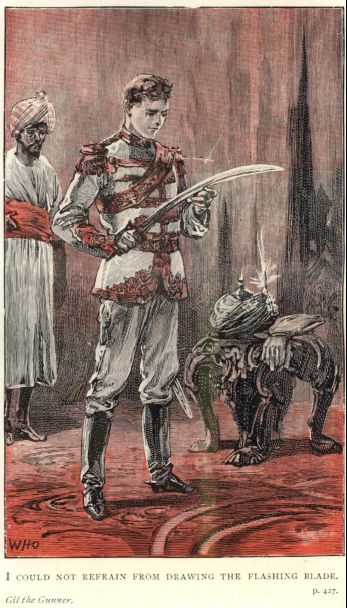
“If it is a bond between us forced upon me,” I thought, “this can cut us apart;” and at this I thrust it back into its sheath, allowed Salaman to alter the buckle a little, and then took the helmet and gloves, putting both on, and involuntarily turning to see if there was a looking-glass.