"Gil the Gunner" (continued 6)
Reading edition
After a few moments, and from a desire to say something less weak than my last poor feeble utterance, I said—
“Was it not you who saved my life when that sowar was going to cut me down?”
“Yes,” he cried excitedly. “If he had killed you, he should not have lived another hour.”
“Why?” I said, with a smile. “I was his enemy fighting against him.”
“But you were my friend,” he said, in a soft low voice, full of emotion; “almost the only one who treated me as if I were something more than a pariah dog. Yes, always my friend, who softened those bitter hours of misery and despair when I was suffering for my people, that some day we might cast off the heel which held us crushed down into the earth. My friend, whom I would have died to save.”
“Ny Deen!” I cried, for his words moved me, and I stretched out my hand to him.
“Hah!” he cried, seizing it tightly between his own. “I could not ask you to give me the hand of friendship, but it has come from you.”
“And yet how can I shake hands with you, rajah?” I said sadly; “we are enemies.”
His eyes flashed with pride as I called him rajah, and he retained my hand firmly.
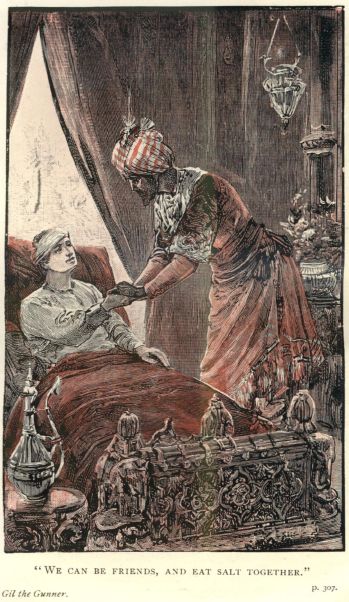
“Enemies?” he said. “Yes, in the field, when face to face; but you are wounded, and there is a truce between you and me. We can be friends, and eat salt together. You are my guest, my honoured guest. This tent is yours; the servants are yours; order them, and they will obey you. As soon as you are well enough, there is a palanquin waiting with willing men to bear you. When you are better still, there is your elephant and a horse.”
“My horse, my Arab?” I cried. “Is he safe?”
He smiled.
“Yes, quite safe, with two syces to care for him; the horse of their rajah’s friend. What can I get you? Ask for anything. I am very rich, and it shall be yours.”
“You can only give me one thing,” I cried. “No; two things.”
“The first, then?” he said, smiling.
“News of my troop, of Captain Brace, and our men; of the officers of the foot regiment. Tell me,” I cried excitedly, “how did the fight end?”
“How could it end?” he replied, with a smile full of pride. “What could that poor handful of men do against my thousands?”
“Defeated?” I cried excitedly.
“Yes; they were defeated; they fled.”
My countenance fell, and there must have been a look of despair in my eyes, which he read, for he said more quietly—
“Captain Brace is a brave man, and he did everything he could; but he had to flee—and you were left in my hands a prisoner,” he added, with a smile.
“He had to flee,” I said to myself; and that means that he had escaped uninjured from a desperate encounter. There was something consoling in that; and I wanted to ask a score of questions about Haynes and the infantry officers, but I could not. For one thing, I felt that it would be like writing a long account of a list of disasters; for another, I was not sure that I could trust an enemy’s account of the engagement. So I remained silent, and the rajah asked me a few questions about my symptoms, and whether there was anything he could get for me.
I shook my head, for, though gratified by the warm liking and esteem he had displayed, my spirits had sunk very low indeed, and I wanted to be alone to think.
Seeing that I was weak and troubled, the rajah soon after rose, and moved to the doorway of the tent, where he summoned one of the attendants, and uttered a few words, the result being that a few minutes after the tall, grave, eastern physician appeared at the doorway, and salaamed in the most lowly way before his prince.
“Go to him,” said the rajah in their own tongue, and the doctor came across to me and began examining my injuries, while the rajah stood looking on, watching everything attentively.
I could not help noticing how nervous and troubled the doctor seemed, performing his task with trembling hands, as if in great awe of the chief his master. He ended by rising and salaaming again.
“Well?” said the rajah quickly; and I knew enough Hindustani now to be able to snatch at the meaning of their words. “You must make him well quickly.”
“I will try, your highness.”
“No, sir; you will do,” said the rajah, sternly.
“He must be made strong and well soon. I want him; he is my friend.”
He turned from the doctor, who took this as his dismissal, and bowed and left the tent, while the rajah seated himself on the carpet by his sword, and stayed there in one position as if deep in thought, making probably more plans.
I lay watching him wonderingly, asking myself whether he had ever grasped the fact of how much I had had to do with the recovery of the guns, and if he did not, what would be his feelings toward one who had utterly baulked him, and robbed him of the prize he went through so much to win.
I certainly did not feel disposed to enlighten him, but by watching his troubled face, and thinking of how valuable, if he had succeeded in well training his men, a troop of horse artillery would be, and how different our position would have been during that encounter if he had had half a dozen six-pounders well-served.
“But he has no guns,” I ended by saying to myself; “and we—I mean our people—have, and I cannot believe in our—I mean their—being swept away, so long as they hold such a supremacy as the guns afford to them.”
I was stopped short by the rajah re-buckling his sword-belt, and a minute later he was bending over me.
“Make haste,” he said in Hindustani. “I shall not be at peace till you are well once more.”
He pressed my hand warmly, and bade me order anything I wished, for I was in my own tent, and then, after smiling at me, and telling me to grow strong, he strode to the purdah, drew it aside, turned to look back, and then the curtain fell between us, and I was alone once more.
I lay listening to the stamping and plunging of horses, and in imagination could picture the whole scene with the restless, excitable animals, shrinking from being backed, and pretending to bite, but calming down the moment they felt a strong hand at the bit.
Then came an order, followed by the jingling of weapons and the snorting of the horses and their heavy trampling upon the soft earth, the sound gradually growing fainter, till it was like a distant murmur, one which had the effect of sending me, tired as I was, off into a heavy sleep.
Chapter Thirty.
It was night when I awoke, refreshed and ready to ask myself whether it was a dream, one of the many vivid sleep scenes which I had conjured up since I had been there, wounded and a prisoner.
But I knew directly that it was no dream, and I began thinking of how sadly some of the natives must have been treated for the simple civilities which I had bestowed upon Ny Deen to be appreciated as they were.
From that I began thinking of Brace and Haynes, about the colonel of the foot regiment, and of Ny Deen’s words that they were beaten and had fled.
“I don’t believe it,” I said, half aloud. There may have been thousands against our hundreds; but our fellows would not study that. It would only make them fight the more fiercely. I suppose that was his idea of it; but I felt sure that it would not be Brace’s, or that of his brother in arms. I thought then of our tremendous charge with the guns, and I could not keep from smiling.
“That does not seem to be the work of a man who wants to retreat,” I said to myself. “If Brace has retired, it is only to act like a wave of the sea, so that he can come back with greater force, and sweep everything before him.”
Yes; I was sure of that, as I lay there gazing at the lamp, whose soft light seemed to look dreamy and pleasant. I was in better spirits, and the old depression and feeling of misery had gone.
Then I began to plan what I should do as I grew stronger. I would make use of the palanquin and the elephant’s howdah; but at the first opportunity I decided that I would escape. I did not want to be ungrateful to Ny Deen, and it was very pleasant to feel that he liked me; but I must get back to my own people, I felt, and he would know that it was quite reasonable.
A faint rustling sound drew my attention just then, somewhere near the head of my bed; but it ceased directly, and I attributed it to the servants.
To prove this, I made up my mind to clap my hands, but at the first movement such a keen pain shot through my shoulder that I contented myself by calling, “Who waits?”
There was a quick rustling sound at once, and the purdah was drawn aside by a shadowy figure, and held while three men in white entered with trays so quickly and silently that I felt as if I were going through some scene from the “Arabian Nights,” when the four men came up to my couch, and the chief attendant pointed out places on the carpet for the various things to be placed, and then signed to the men to go, which they did without word or look.
“I suppose I shall not be allowed to eat and drink what I like,” I thought, and I laughed to myself, for it was such a good sign even to think about food at all. Directly after I found I was right, for my attendant poured me out something warm which smelt savoury, and as he raised me carefully and propped me up with cushions, I smiled again, for I felt as if I were a baby about to be fed.
My amusement was quite justified, for I was as weak as an infant, and was glad to let the calm, silent man supply my wants, holding me so that I could drink what tasted like a strong preparation of chicken; after which he gave me a very delicious and sweet preparation which I recognised as cocoanut cream. Lastly, he gave me some curious-looking bonbons, helping me to lie back first, so that I need not grow weary while I partook of the preparations, which were nice, but possessed a peculiar aromatic taste, which was new to me.
I had eaten three of these, and then half uneasily told myself that, without doubt, the doctor ordered these preparations because they contained the medicines he wished me to take.
I think so now; for in a short time a pleasant drowsiness stole over me, and I fell asleep to awake with a start, as it seemed to me; but it must have been only a slight one, for I could not have moved more than my eyes, which were at once directed to the lamp on its stand, some ten or a dozen feet from me, and I wondered why my breath came so short, and grasped at once the fact that I had a heavy weight upon my chest.
It appeared simple enough. I had hardly taken anything of late, and my meal on the previous night had been fairly liberal. Consequently, being a sick or delicate man, I was suffering from the consequences—that of a heavy weight at my chest.
I lay thinking that I had not taken much, and that it was very hard that I should suffer so much inconvenience for so trivial a meal, when the weight on my chest moved, and I felt something cool touch my neck.
I was still not clearly awake, and I did not feel any very great surprise at this; for during what must have been my delirium, I had in imagination had stranger adventures than this, and consequently I lay perfectly still, waiting for the sensation to pass off before closing my eyes and enjoying another pleasant, restful, strength-giving sleep.
I had just arrived at this pitch of reasoning, and I was considering how long it would be before the sensation passed away, when, as I stared with half-closed eyes at the lamp, I fancied that I saw something gleam only a short distance before me; and this exciting my curiosity, I looked again, felt startled, my heart began to beat painfully, and a cold chill ran through me, as I realised the horrible fact that, consequent upon my bed being made up on the ground, instead of upon the native bedstead known as a charpoy, a serpent had crept in beneath the side of the tent—the rustle I had heard—and, attracted by the warmth, coiled itself upon my chest, where it now lay with its cool head upon my neck.
I was awake now fully, and, above all, to the terror of my situation. What shall I do? I asked myself, as the icy feeling of horror increased. I dared not move or attempt to call, for the reptile’s head was close to my chin, and the slightest stir might cause it to bite; for at the first alarm I felt certain that it must be one of the poisonous cobras which infested the land.
As I lay there, I could feel the perspiration streaming out of my pores, and the weight upon my chest increasing rapidly, till I began to fancy that if I were not soon relieved I should be suffocated.
How long I lay like this I cannot say; but it felt to me almost an eternity, and the more painful from the fact that there was help close at hand, so near that a call would bring in one if not more of the servants instantly.
One moment my lips parted ready to utter a cry; but that cry, in spite of several attempts, was not uttered. For the idea of being bitten, of receiving the two sharp fangs of the monster in my flesh, was so horrible that, cowardly or no, I could not call. I had heard too much of the results of a cobra bite, and the thought of the insidious poison making its way rapidly through the veins, and ending one’s life by arresting the pulsations of the heart in a few minutes, or at most hours, was too terrible for me to run any risk.
I think I must have nearly fainted away, for I was very weak; but I never quite lost my senses, but lay looking with misty eyes across the gleaming scaly skin there upon my heart, and feeling from time to time a peculiar movement, as if one coil were passing over another.
Then I tried hard to call up my courage, and wondered whether by a sharp movement I could heave the reptile from me, while I tried to roll myself off on the other side of the bed. But I knew that it was impossible, for I was weak as a child, and, setting aside the pain such a movement would have caused, it was in my then state impossible.
At last, when the stress upon my mind was enough to make me feel that, at any cost, I must try and call for help, I heard a movement outside the tent, and my lips parted once more to speak, but no sound came. I could only lie in expectancy, with my eyes fixed upon the gleaming scales, which were now certainly in motion.
There was another faint noise outside, and I felt that help was coming—one of the men, to see whether I required anything. But, no; it ceased once more; hope died out of my breast, and at all costs I was going to utter a hoarse cry, for I could bear the suspense no longer, when there was a louder rustle outside, and this time my flesh seemed to creep, for the serpent was all in motion, and it had raised its head to look in the direction of the sound, and I could see its bent, spade-like shape, and the bright gleaming eyes.
Suddenly the purdah was softly drawn aside; and as I strained my eyes sidewise to try and catch a glimpse of the man who entered, I saw him approach silently, till he was near my couch, when he suddenly caught sight of the serpent, uttered a faint cry, and fled.
I shuddered in my despair as I saw him sweep back the purdah and dart through, and then I mentally called him a coward for not coming to my help.
But I was premature in judging him, for all at once he darted back, armed with a stout bamboo, and came cautiously toward where I lay now nearly freed from my burden; for, at the sight of the men who came swiftly in, the serpent’s coils began to pass one over the other till it was all in motion; and it was evidently gliding off me, to retreat to the hole beneath the canvas through which it had found its way.
But it had not made sufficient haste. Just before it had reached the canvas, the man was upon it, bringing the bamboo down with so terrible a blow that the serpent twisted itself up, writhing and struggling in a perfect knot, the tail flogging the carpet, and the head rising and falling convulsively, till the man struck at it again and again, crippling the tail with one blow; and, after watching his opportunity, succeeded in delivering so fierce a cut at the head that the neck was broken, and it fell back upon the writhing knot perfectly inert, a few more blows making the body as helpless as the head and neck.
This done, the man seized the creature by the tail, and drew it out to its full length, which seemed to me to be eight or nine feet; but the creature was very thick.
The man had turned to me with a scared face, and spoke almost for the first time since he had been my attendant, saying in Hindustani—
“I pray that my lord will not tell my master the maharajah!”
“Not tell him you killed the snake?”
“No, my lord. He would say thy servant did right to slay the serpent; but he would punish him for not keeping guard, and seeing that no serpent came.”
“Would it have bitten and poisoned me?” I asked.
“No, my lord. This kind does not bite and poison, only twists round and crushes. It is very strong.”
“How did it come in?” I said.
He went down on his hands and knees and examined the edge of the tent, looking for a hole where the creature could have crept under; but every part was secure, and the man rose, and his face wore a puzzled look.
“Thy servants have done their work well,” he said. “There is no hole where the serpent could have crept under. I do not know.”
He was peering about in silence, while I lay gradually recovering my equanimity, and congratulating myself on the fact that my nocturnal visitor had been a serpent of the boa kind, and not a deadly cobra, when the man suddenly held up his finger, and pointed to a spot beyond the lamp, where the roof and canvas wall of the tent joined.
As I tried to penetrate the dim, warm twilight of the room, I could hear a faint rustling sound, and I saw my attendant stoop cautiously and go, without making a sound, toward the spot where his stick lay on the carpet, not far from the still heaving body of the reptile he had slain.
As I gazed hard at the place whence the rustling came, I suddenly caught sight of something behind the lamp, something shadowy or misty, swaying gently to any fro, and I at once grasped the fact that it was another serpent entering the tent by the way in which the first must have found its way.
I had hardly arrived at this point when my attention was taken up by the action of my attendant, who was stealing round like a black shadow close to the side of the tent, and the next minute he raised his stick, and made a sharp blow at the intruder.
There was a sharp crack, a loud rustling, and the man darted back with only half his staff in his hand, to run out of the tent, and leave me alone with the body of the first serpent, which I half fancied was moving slowly toward where I lay helpless, if it happened to have still vitality enough left in its shattered length to come and wreak its vengeance on one who could not defend himself.
But while I was watching the slowly writhing creature, which in the dim light looked of far greater proportion than before, I could hear trampling and voices outside, then loud rustling as if men were hurrying about through bushes, and at last, to my great relief, the man came back.
“Thy servant struck the snake,” he said, “and broke the staff; but so much of it was outside that it darted back and crawled away before we could get to the spot and find it. The creature has gone away to die.”
“And now others will come, and that one too, if you have not killed it.”
“No, my lord,” he said. “That was the mate of the snake I killed. They go two together, and there is no fear. I struck it so hard that it will die, and the hole up there shall be fastened tightly.”
To my great satisfaction, he bent down and took the serpent by the tail and drew it out of the tent, and I heard him give orders to his companions to drag it right away into the forest, and to bury it as soon as it was day.
As he was talking, I was conscious of a peculiar, slightly musky odour pervading the tent, and I was wondering what it could be, when the man returned with two or three burning splints of some aromatic wood, which gave forth a great deal of smoke, and he walked about the tent, waving the pieces and holding them low down near the carpet where the serpent had lain, and also along a track leading past the lamp to the side of the tent where I had seen the shadowy form of the second serpent.
He busied himself in this way till the matches were pretty well burned down, and then placed the ends in a little brass vessel, which he stood on the carpet not far from my couch.
Then approaching me, he said humbly, and with a low reverence—
“Will my lord grant his servant’s prayer?”
“What do you mean?” I said, rather testily, for his excessive humility worried me. I hated to be worshipped like that. “Not tell the rajah about the snakes?”
“If my master the rajah knows, thy servant may be slain.”
“What! for that?” I said.
“Yes, my lord. His highness bade me take as great care of your life as I would of my own. Thy servant has tried to do his duty, and serve my lord. He has done everything the great physician, the rajah’s own doctor, bade him do, and cared for my lord as if he had been thy servant’s own son. It would be hard to die because a serpent of the forest came in after seeing the light.”
“Hard? Yes,” I said quietly. “There, mind no more of the brutes get in. I shall not say a word to the rajah or any one else.”
“Ah,” he cried joyfully. And before I could remove it, he had gone down on his knees and kissed my hand. “Thy servant goes back with joy in his heart. He did not love to serve him, for the white sahibs are cruel to their servants, and are hated; but they are not all so, and thy servant seeth now why his master the rajah loveth my lord, and careth for him as one who is very dear.”
“How I do hate for any one to fawn upon me like that!” I said to myself as soon as I was alone and I lay thinking about all my troubles, and being a prisoner, wondering how long it would be before I was strong again and able to escape; for I meant to do that. It was very pleasant to find that Ny Deen liked me, and recalled my civility to him sufficiently to make him wish to save my life; but all the same, I felt that I did not like him, for there was the treachery of a man who had come under false pretences to our cantonments, waiting, with others in his secret, for the time when they could throw off the British yoke.
And as I lay thinking, though I felt ready to acquit him of the atrocities that had been committed, I felt that he had opened the awful door and let loose the tide of miscreants who had raged through the cities, murdering every one whose skin was white.
“No,” I thought, “whatever cause Ny Deen and his people might have had for retaliation, it had not been by an open declaration of war, but by treachery.” And then I went to sleep, to dream about snakes.
Chapter Thirty One.
I suppose it was through being weak, and having passed through a feverish state, which made me dream to such a tremendous extent, with everything so real and vivid that it was horrible. It comes natural to a man to dread snakes. It is as part of his education, and the dread was upon me terribly that night.
For I was pursued by them in all kinds of grotesque shapes: now they were all sowars in white, but with serpents’ heads, galloping down upon me in a mad charge; now they were slimy monsters, creeping round my tent, trying to crawl in and murder me because the rajah had taken me under his protection. Then Ny Deen himself came to me, all glittering with gold and gems, but in a confused way. He did not seem to be any longer a man, for his face looked serpent-like and treacherous, and one moment there were glittering jewels, the next it was the light shimmering upon his brilliant scales.
And so on for the rest of the night, till I dreamed that the serpent slain by the attendant had revived, and crept back through the hole between the two portions of the canvas, after heaving off the earth and sand in which it had been buried. And then it came gliding and writhing its way over the carpet, nearer and nearer to where I lay, not with the graceful, gliding motion of an ordinary serpent, but clumsily, with its neck broken and a portion of its tail bent almost at right angles. But, all the same, as I lay there, it came on nearer and nearer, till it was close to my couch in the full light of the lamp, and then, to my horror, it raised itself up, bent its broken neck over me, and glared down with its horrible eyes threatening to strike.
I awoke then, and it was quite time, for the agony was greater than I seemed to be able to bear. And there was the bright glow of light, and the eyes gazing down into mine, not with the malignant glare of a serpent, but in a pleasant, friendly way.
It was morning, and on one side the tent wall had been lifted, so that the place was flooded with the clear, soft, early sunshine, and the place was sweet with the fresh, cool air which came with the dawn even in that hot land.
It was my attendant bending over me, and he said quietly—
“My lord was restless, and sleeping ill. The tent was hot, and the great drops were on his face, so I opened the side to let in the light.”
He ceased speaking, and I uttered a sigh of relief as all the feverish vision of the night passed away, the sensation of rest and comfort growing stronger as he clapped his hands, and the other men came in bearing a large brass basin full of cool fresh water, with which my face was bathed with all the care and solicitude that would have been shown by a woman.
Then followed my medicine, and, soon after, coffee and sweet cakes, preparatory to a real breakfast later on, to which I found that I could pay greater attention, eating so that the man smiled with satisfaction.
“My lord is getting well,” he said. And I gave my head a feeble nod.
“Tell me whereabouts we are,” I said at last.
He shook his head. “I am only to tell you that you are in my lord the rajah’s care,” he replied.
“Well, I can guess,” I replied. “I can hear nothing of people; there is no town near; and I know from the noises made by birds and beasts, and by the coming of those serpents, that we must be in the forest. I am at some hunting-station, I suppose. Look here,” I continued, as the man remained silent, “tell me where the English soldiers are.”
“I cannot, my lord. I do not know,” he replied.
“It is of no use to ask you anything,” I cried pettishly. “Yes, it is; you can tell me this—what is your name?”
“Salaman, my lord,” he replied, with a smile.
“Humph!” I said sourly, for I was getting into an invalid’s tetchy, weary state. “Salaman! why couldn’t they call you Solomon? That’s the proper way to pronounce it.”
“My lord can call me Solomon,” he said quietly.
“Of course I can,” I said, “and I will. Then look here, Solomon, did you bury that great snake?”
“Yes, my lord, as soon as it was light, and the others found and killed its mate. They are now dead, and covered with the earth.”
“That’s right. No fear of their getting out?” I added, as I remembered my dream.
He laughed and shook his head.
“Tell me this too; the rajah, will he be here to-day?”
“Who can say, my lord? His highness is master, and he goes and comes as he pleases. Perhaps he will come, perhaps he will not. I never know.”
“The doctor, then; will he be here?”
“Oh yes, my lord, and soon.”
He left the tent, and I lay thinking again, ready to quarrel with everything, for my arm pained me, and my head felt stiff and sore.
“I wish he’d speak in a plain, matter-of-fact way,” I grumbled to myself. “I’m sick of being ‘my lorded’ and bowed down to. I always feel as if I could kick a fellow over when he bows down to me as if I were one of their precious idols.”
Then I laughed to myself long and heartily, for I knew that I must be getting better by my irritable ways. And now I forced myself into thinking about our position as English rulers of the land, and wondered whether it would be possible for our power to be overthrown. Then came on a feverish desire to know where Brace was, and in what kind of condition his men were, and those of the colonel.
“It seems hard that they do not come and try to rescue me,” I thought. “Brace would come fast enough,” I added spitefully, “if I were a gun.”
This idea seemed so comic in its disagreeable tone, and so thoroughly due to my state of weakness and unreason, that I laughed silently.
“How precious ill-tempered I am!” I said to myself.
A moment later I was wondering about the fate of those dear to me at Nussoor—whether my father was still there, and whether there had been any rising in his neighbourhood.
Directly after I came to the conclusion that his regiment would certainly have been called away, and I hoped that he had made arrangements for my mother and sister to go back to England; and then I was marvelling at the rapid way in which my thoughts ran excitedly from one subject to the other.
“It is all through being so weak, I suppose,” I said to myself; and then I began eagerly to listen, for I could hear trampling.
Feeling certain that it was the rajah, and making up my mind to speak quietly to him, and ask him to try and exchange me for some other prisoner, I lay with my eyes fixed upon the open side of the tent, to see directly after the tall, stately figure of the grey-bearded physician, who came to my side in his customary sedate fashion, and knelt down to examine and dress my injuries, which he declared to be in a perfectly satisfactory state. But, all the same, they pained me a great deal during the time he was unbandaging and covering them afresh.
I plied him with questions all the time—as to how long it would be before I was well; how soon I might sit up; how soon I might go out in a palanquin, and the like; all of which he answered in the same grave way, but when I turned the question to the state of the country, and asked for information about our troop, and the late battle, he shook his head and smiled gravely.
“I am the rajah’s physician,” he said, “and my duties are with the sick. I can tell you no more.”
“But tell me this,” I said eagerly; “where are our people now?”
“I only know about my own people,” he replied, with a smile. “You are one of them, and you are troubling your brain about matters that you cannot deal with now, so be at rest.”
I made an impatient gesture, and he laid his hand upon my brow, saying gently—
“Be at rest. You will learn all these things in time. You have but one duty now—to get well.”
There was only one other resource left to me—to get an answer somehow from the rajah when he came; and upon the doctor leaving, I lay there impatiently listening for the visitor who would, I was sure, come before long, though whether I should get my information appeared doubtful indeed.
Chapter Thirty Two.
The days passed slowly by, and one hour I was horribly dejected by the dulness of my existence, the next cheery and in high spirits, as I felt that I was getting stronger, and in less pain. It was very lonely lying there, but many things put me in mind of the “Arabian Nights”—the fine tent, with the shadows of the trees upon its roof; the silent servants who might very well have been slaves, so eager were they to respond to the slightest call, and so silent in their obedience; the soft glow of the lamp on the rich curtain and carpets; and the pleasant little banquets which were spread for me with silver vessels to drink from, and gilded baskets full of rare fruits or flowers.
At times, as I sat propped up, able now to feed myself, I used to begin by enjoying the meal, but before I had half finished the flowers looked dull, and the fruit tasted flat, for I told myself that, after all, I was only a prisoner, a bird in a gilded cage, broken winged and helpless.
The doctor came nearly every day, and told me that I was to ask for everything I wished for, as he preferred that I should wait until the rajah had been again before I went out.
“And when is he coming again?” I asked impatiently.
“I can only say when his highness pleases,” replied the doctor, with a grave smile. “But I will give orders for something to be done to please you; to-morrow a couch shall be made for you outside the tent.”
That was something, and only one who has been wounded and lain hot and restless upon a couch alone can judge of the eagerness with which I looked forward to the next day.
It came at last, and after trying very hard to comport myself with the dignity becoming a British officer, the fact that I was almost the youngest in the Company’s service would come out, and I suddenly burst out with—
“I say, Salaman, when is this couch outside to be ready?”
“It is ready, my lord,” he said. “I was awaiting your commands.”
“Oh!” I mentally exclaimed, “what a fool I am! Why don’t I act like a real ‘my lord,’ and order these people about more?”
Then aloud, with importance—
“Is it shady where you have placed it?”
He shook his head.
“What!” I cried angrily. “You have put it in the sun?”
“No, my lord; it is under a great tree.”
“Why, I asked you if it was shady,” I cried; and then it occurred to me that, in spite of my studies at Brandscombe and out here, my Hindustani was very imperfect, for the man smiled in a deprecatory way which seemed to mean that he hoped my lord would not be angry with him for not understanding his words.
“Take me out now,” I said.
Salaman clapped his hands softly, and the two men I knew by sight entered at once, followed by two more whom I had not previously seen. These four, at a word from my attendant, advanced to stand two at the head, two at the foot of my couch.
“Tell them to be very careful how they lift me,” I said; “and have some water ready in case I turn faint.”
For I had a painful recollection of the horrible sensation of sickness which attacked me sometimes when the doctor was moving me a little in dressing my wounded arm; and, eager as I was to go out in the open air, I could not help shrinking at the thought of being moved, so as the four men stooped I involuntarily set my teeth and shut my eyes, with a determination not to show the pain I should be in.
To my astonishment and delight, instead of taking hold of me, the four men at a word softly rolled over the sides of the rug upon which my couch was made, until it was pretty close to my side, when they seized the firm roll, lifted together, and I was borne out through the open side of the tent, so lightly and with such elasticity of arm and hand, that instead of being a pain it was a pleasure, and I opened my eyes at once.
I was very eager to see where I was, and what the country was like all round. In fact, I had a slight hope that I should be able to recognise some point or another, even if it were only one of the mountains.
But my hopes sank at once, for as we passed from out of the shadow of the tent and into the beautiful morning sunshine I could see trees, and trees only, shutting me in on every side, the tents being pitched partly under a small banyan, or baobab tree, and standing in an irregular opening of about a couple of acres in extent, while the dense verdure rose like a wall all around.
I could not help sighing with disappointment; and, at a sign from Salaman, the bearers stopped while he held the cup he had taken from a stand to my lips.
“No, no,” I said; “not now. Let them go on.”
He signed to the bearers, and they stepped off again all together, and the next moment almost they stopped in a delightful spot beneath the spreading boughs of a tree, where carpets were spread and pillows already so arranged that the men had only to lower down the rug they bore, and I was reclining where the soft wind blew, and flowers and fresh fruits were waiting ready to my hand.
In spite of my disappointment, there was a delightful feeling of satisfaction in resting down there on the soft cushions, able to see the bright sky and drink in the fresh air which seemed a hundred times better than that which floated in through the side of the tent; and when Salaman bent over me anxiously with the cup of cool water in his hand, the smile I gave him quieted his dread lest I should faint.
The four men glided away into the shadow of the trees, but after a minute I saw them reappear in front and glide silently into a long, low tent, standing at a little distance from the one I had left, and beyond which I could see another.
But my eyes did not rest long on the tents, for there were the glistening leaves of the trees and the clustering flowers which hung in wreaths and tangles of vines from their spreading boughs, all giving me plenty of objects of attraction without counting the brightly plumaged birds, which flitted here and there at will; while just then a flock of brilliant little parrots flew into the largest tree, and began climbing and hanging about the twigs, as if for my special recreation.
I had seen such places scores of times, but they never attracted my attention so before, neither had I given much consideration to the brilliant scarlet passion flowers that dotted the edge of the forest, or the beautiful soft lilac-pink cloud of blossoms, where a bougainvillea draped a low tree.
So lovely everything seemed that I felt my eyes grow moist and then half close in a dreamy ecstasy, so delicious was that silence, only broken by the cries of the birds.
I must have lain there for some time, drinking in strength from the soft air, now rapidly growing warmer, when I started out of my dreamy state, for I heard a familiar sound which set my heart beating, bringing me back as it did to my position—that of a prisoner of a war so horrible that I shuddered as I recalled all I had seen and heard.
The sound was coming closer fast, and hope rose like a bright gleam to chase away the clouds, as I thought it possible that the trampling I heard might be from the horses of friends; but as quickly came a sense of dread lest it might be a squadron of bloodthirsty sowars, and if so my minutes were numbered.
“What folly!” I said to myself, with a sigh; “it is the rajah’s escort.” And a few minutes later the advance rode in through an opening among the trees at the far end, bringing the blood rushing to my heart as I recognised the long white dress of a native cavalry regiment, one that had joined the mutineers, and, as I fancied then, that which had been stationed at Rajgunge. Immediately after, as they drew off to right and left, the rajah himself rode in, turning his horse toward the tent, dismounting and throwing the rein to one of his escort, he was about to enter, but Salaman and the four bearers stepped up salaaming profoundly, and the chief turned in my direction, to stride across the opening, with the sun flashing from the jewels and brilliant arms he wore.
By the time he reached my couch, the men, horse and foot, had withdrawn, so that we were alone as he bent down, offering his hand, but without any response from me, and the smile on his handsome face died out to give way to a frown.
That passed away as quickly, and with his countenance quite calm, he said in excellent English—
“Not to the enemy, but to your host.”
“I beg your pardon, rajah,” I said; and I could feel the colour coming into my cheeks as I felt how ungrateful I was to the man who had saved my life, and was sparing nothing to restore me to health.
My hand was stretched out as I spoke, but it remained untouched for a few moments.
“It will not be a friendly grasp,” he said coldly.
“Indeed it will,” I cried; “for you have saved those who love me from a terrible time of sorrow.”
“Those who love you?” he said, taking my hand and holding it.
“Yes; mother, father, sister.”
“Ah, yes,” he said; “of course. You have friends at home in England?”
“No: here,” I said.
He did not speak for a few moments, and still retaining my hand, sank down cross-legged on the carpet close to my pillow, gazing at me thoughtfully.
Then, with the smile coming back to light up his face in a way which made me forget he was a deadly enemy, he said cheerfully—
“I am glad to see this. I knew you were better, and now you must grow strong quickly.”
He held my hand still, and let the other glide on my arm, shaking his head the while.
“This will not do,” he continued. “You always were slight and boyish, but the strength has gone from your arm, and your cheeks are all sunken and white.”
“Yes, I am very weak,” I said faintly, and with a bitter feeling of misery at my helplessness.
“Of course. Such wounds as yours would have killed many strong men. It was a terribly keen cut. The wonder is that it did not take off your arm. As it is, you nearly bled to death.”
“Don’t talk about it,” I said, with a slight shudder; “it is healing now, and after lying so long thinking, I want to forget my wounds.”
“Of course. Let us talk about something else. Tell me,” he said gently, “do your servants attend you well?”
“Yes; they do everything I could wish for.”
“Is there anything you want? I have been a long time without coming.”
“Yes,” I said; but hesitated to make the request that rose to my lips, and deferred it for the moment; “where have you been?”
His eyes brightened, and he gave me a curious look. Then, gravely—
“Fighting.”
I winced, for his manner suggested that he had been successful, and I knew what that meant.
“Don’t look like that,” he said kindly. “You are a soldier, and know that only one side can win. You and yours have carried all before you for many years; it is our turn now.”
“But only for a little while,” I said quietly. “You must be beaten in the end.”
“Indeed!” he said, frowning, but turning it off with a laugh. “Oh no; we carry everything before us now, and we shall be free once more.”
My brows knit, and I tried to say something, but only words which I felt would anger him seemed to come to my lips, and after watching me, he smiled.
“You do not agree with me, of course?” he said. “How could you? But you did not tell me if there was anything you wanted,” he continued pleasantly.
I looked in his eyes, then my own wandered over him and his dress; and as he sat there by my pillow, looking every inch an Eastern king, the scene once more suggested some passage out of the “Arabian Nights,” and there was an unreality about it that closed my lips.
Just then my eyes rested upon the beautiful tulwar that he had drawn across his knees when he sat down. It was a magnificent weapon, such as a cunning Indian or Persian cutler and jeweller would devote months of his life in making; for the hilt was of richly chased silver inlaid with gold, while costly jewels were set wherever a place could be found, and the golden sheath was completely encrusted with pearls. It must have been worth a little fortune; and, while my eyes rested upon the gorgeous weapon, he smiled, and drew it nearly from the sheath, when I could see the beautifully damascened and inlaid blade, upon which there was an inscription in Sanscrit characters.
“There is no better nor truer steel,” he said, turning it over, so that I could see the other side of the blade. “Get strength back in your arm, and you could kill an enemy with that at a blow. You like it?”
“It is magnificent.”
He quickly unfastened the splendid belt, twisted it round the weapon, and held it to me.
“It is yours, then,” he said. “You are weak from your wound, but you are still a soldier at heart. I give it gladly to my dear friend.”
“No, no,” I cried excitedly, surprised now at the strength of my voice, as startled by the richness of the gift, and ashamed that he should think I wanted it, I thrust it back, and he frowned.
“You refuse it?” he said. “Is it not enough?”
“You do not understand me,” I said. “I could not take such a rich present.”
“Not from your friend?” he cried, interrupting me.
“Well, yes, if he had thought of giving it to me,” I said; “but you fancied I wanted it, and I did not. It was not that; it was something else.”
“Ah,” he cried eagerly, “something else. Well, ask. I am very rich; I am a prince now, not your brother-officer’s syce. Tell me, and it is yours.”
I was silent, and after a few moments’ thought, he continued—
“I know; it is my horse. Well, I love him, but I give him gladly. He is yours. Get well quickly, and you shall ride.”
“No, no, rajah,” I cried, unable to repress a feeling of emotion at his generosity, which was indeed princely; “indeed it was not that.”
He looked at me gently, and said slowly—
“Name what you wish;” and he passed his hand over the great emeralds and diamonds sparkling about his throat, breast, and turban.
I involuntarily followed his hand as it played about the gems, conscious the while that, in spite of his gentle smile, he was watching me very keenly.
“Is it any or all of these?” he said. “I will give them freely to my friend.”
“No,” I cried eagerly; “it is something greater to me than all you have offered.”
“And what is that?” he said, with his eyes half-closed.
“Give me my liberty, and let me go to my friends.”
He took my extended hand and held it, as he said softly—
“I have been told that some of you English are great and good. Men who cannot be tempted by riches; who would not take from another any gift unless it was some little token—a ring of silver or plain gold; but I never met one before. I called you my friend; I felt from the first that you were noble and great of heart; now I know it ten times more, and I am glad. I should have given you everything I wear if it would have pleased you; but I should have felt sorry, for my friend would not have been so great as I wished.”
“Then you will give me what I ask?”
“Your liberty?” he said, smiling. “My poor brave boy, you do not know what you ask.”
“Yes,” I cried. “As soon as I am strong. I am grateful, and will never think of you as an enemy; always as a friend. You will let me go?”
“No,” he said gravely, “I could not lose my friend.”
“No?” I cried passionately. “Is this your friendship?”
“Yes,” he said, holding the hand firmly which I tried to snatch away, but with a poor feeble effort. “Say I gave you leave to go. Where would you make for? The country is all changed. Our men scour it in all directions, and your freedom would mean your death.”
“Is this true?” I cried piteously, as his words told me that our cause was lost.
“I could not lie to my friend,” he said. “Yes, it is true. The Company’s and the English Queen’s troops are driven back, while our rajahs and maharajahs are gathering their forces all through the land. No; I cannot give you liberty. It means sending you to your death; for I am, perhaps, the only chief in this great country who would take you by the hand and call you friend.”
He ceased speaking, and I lay back, feeling that his words must be true, and that hope was indeed dead now.
“There,” he said, “I have done. Your bearers are coming. I will go now, and return soon. Come, you are a soldier, and must not repine at your fate. Give me your hand, and accept your fall as a soldier should. Rest and be patient. Good-bye, more than ever my friend.”
I believe I pressed his hand in return as he held it in his, and laid his left upon my brow, smiling down at me. Then in a low whisper he said, as softly as a woman could have spoken—
“You are weak, and need sleep.” He drew his hand over my eyes, and they closed at his touch, a feeling of exhaustion made me yield, my will seeming to be gone, and when I opened them again, Salaman was kneeling by me, waiting with two of the attendants standing near holding trays of food. “Have I been asleep?” I said. “Yes, my lord. Long hours.”
“And the rajah? Did he come, or was it a dream?” I added to myself.
“The great rajah came, and went while my lord slept. It is time he ate and drank, for he is still weak.”
“Yes,” I replied, as I recalled all that had passed—“so weak, so very weak, that this man seems to master even my very will.”
Chapter Thirty Three.
The doctor came the next day, and did not seem satisfied; the fact being that, on awakening, my mind was all on the fret. For I was always face to face with the thought of what had become of my mother and sister at Nussoor. Of course I sorrowed, too, about my father’s fate; but I was not so anxious about him. He was a soldier, with some hundreds of trusty Englishmen at his back, and I knew that he would be ready to meet any difficulties.
Then there was Brace to fidget about, and my other friends of the troop. I wanted to know whether they had been scattered, as Ny Deen had assured me, and whether the English rule really was coming to an end.
“He thinks so,” I said; “but I will not believe it yet.”
Then I worried about being a prisoner, and with no prospect of getting free. It was very pleasant to be waited on, and treated as the rajah’s friend, and there were times when I almost wondered at myself for refusing the costly gifts he had offered. But I soon ceased wondering, and began to feel that jewelled swords and magnificent horses were worthless to one who was a prisoner.
The days passed drearily by in spite of bright sunshine and breezes and delicious fruits, with every attention a convalescent could wish for. By degrees I reached the stage when I was borne out through the shady edge of the forest in a palanquin, plenty of bearers being forthcoming when needed, and then disappearing again, leaving me wondering whence they came, and how far away the rajah’s principal city might be.
Everything I asked for was obtained directly; but I was a prisoner, and not the slightest information could I get. The only inkling I had of my whereabouts was obtained one day when I was being borne along in the shade by my bearers, with Salaman at my side. They halted at the edge of what was almost a precipice, to give me a view through an opening of a far-spreading plain at a considerable depth below; and this taught me at once that I had been placed, of course by the rajah’s command, in the shady forest somewhere on a mountain slope, where the air was comparatively cool, and where I was far more likely to recover than in some crowded city in the broiling plains.
That was all that the view down the precipitous slope taught me. I could not recognise a single landmark, and returned to my prison-tent as low-spirited as ever.
It must have been a day or two after, when I was making my first essays in walking, that, unexpectedly as usual, the rajah came riding in among the trees quite alone, and as he drew rein, smiling, close to where I was standing, I could not help envying him the strength and ease with which he managed his splendid charger.
He was quite simply dressed on this occasion, and his appearance indicated that he must have ridden far.
As we shook hands, I was wondering that he should have come without any escort, but just then I heard the snort of a horse at some distance, which made the beautiful arab by my side throw up his head and challenge loudly, when two more horses answered, and I felt that I had been premature in thinking the country so peaceful and free from troops that the rajah could ride alone.
He swung himself down, and a man sprang forward to lead away the horse, while, taking my arm, the rajah led me to the cushioned carpets spread beneath the tree, looking at me smilingly the while.
“Come,” he said; “this is better; up and walking. You look different, too. Why, I might venture to send your horse over for you to try and mount, but not yet.”
“Why not yet?” I said, as we sat down among the cushions.
“For several reasons,” he replied, smiling at me. “I want to see you stronger.”
“But I think I could mount now; and, at a gentle walk, the exercise would do me good.”
“Perhaps,” he said; “but we must see.”
He clapped his hands, and Salaman glided up.
“Bring coffee and a pipe,” he said.
Salaman bowed and retired.
“I have ridden far,” he said to me, “and am tired.”
“Tell me about the state of the country,” I said eagerly, after we had sat some moments in silence.
“It is not peaceful yet,” he replied. “The English are making a little struggle here and there. They do not like to give up the land they have held so long.”
We were silent again, and Salaman and the two servants I had seen most often, came up, bearing a tray with coffee, a long snake pipe, and a little pan of burning charcoal. A minute after the pipe was lit, and the great amber mouthpiece handed to the rajah, who took it after sipping his coffee, and the men retired as he began to smoke, gazing at me the while.
“It is useless,” he said at last. “A lost cause.”
I sat frowning and thinking that he did not understand Englishmen yet, or he would not talk of our cause being lost.
“Well,” he said at last, “I am very glad to see you getting so strong. In another fortnight you will be well enough to come back to the city.”
“What city?” I asked.
“Mine. To my palace,” he replied proudly; but he turned off his haughty manner directly, and continued. “I have had rooms set apart for you, and a certain number of servants, so that you will be quite free, and not dependent upon me.”
“Free!” I cried, catching that one word; it had such a delightful ring. “Then you will let me go as soon as I have visited you at your palace.”
“To be cut down—slain, after I have taken such pains to save your life?” he said, with a smile.
“Oh, I am very grateful for all that,” I cried hastily; “but you must feel that even if they are unfortunate, my place is with my own people.”
“No,” he said quietly, as he went on smoking and gazing straight away at the densely foliaged trees. “I cannot feel that. For I know that it would be folly for you to return to meet your death. It would be impossible for you to get across the plains to the nearest place where your people are trying to hold out. Even if you could get there, the army besieging them would take you, and no one there could save your life.”
“Let me try,” I said.
He shook his head.
“It would be madness. If I let you have your horse now, you would try some such folly.”
“You call it a folly,” I replied. “I call it my duty.”
“To rush on your death? Look here, my friend; why do you want to get back? To take up your old position as a junior officer?”
“Yes, of course!”
“I thought so,” he said, with animation, and his eyes flashed as he went on. “You are young and ardent. You wish to rise and become the chief of a troop of artillery?”
“Of course,” I said.
“And some day a general, to command others?”
“I hope so—a long way ahead,” I replied, smiling.
“Of course. I knew it,” he said, as he let fall the tube of his pipe, and grasped my arm. “It would be long years before you could command a troop?”
“Oh yes—long, long years.”
“And you would be quite an old man before you became a general?”
“Perhaps never,” I said, wondering at his eagerness, and yet feeling something akin to a suspicion of his aim.
“Then why wish to go?” he said, with a smile.
“Why wish to go?” I replied. “I do not understand you.”
“I say, why wish to go and compete with hundreds of others who would not understand you, and any one of whom might carry off the prize—when you can stay with me?”
“Stay with you! What for?” I faltered.
“I will make you a general, now—at once,” he said excitedly, “and ten thousand men shall bend down before their Moslem rajah’s friend, who, from this time forward, will lead and direct my artillery.”
“Rajah!” I exclaimed, surprised but not surprised, for I had half expected some such proposal, but of course only in a very minor form.
“Look here, Vincent,” he continued, bending forward, and speaking excitedly. “When I came to your barracks as a humble syce, it was to learn everything about your guns, and the way in which the horse artillery was trained. In those days, beaten, kicked, trampled upon, I always had you in my mind, and I watched you, how quick, how clever, and how brave you were. My heart warmed to you even then; but as I have grown to know you better and seen what you are in the field in action with your men, I have said again and again that there could be no one better for my trusted friend and general.”
I laughed, though a curious feeling came over me that the man who would make me such a proposal must be mad.
“Why do you laugh?” he said. “Are you pleased at what I propose?”
“Pleased? No,” I said frankly. “You are laughing at me—making fun of me.”
He frowned.
“Is it so trifling a thing, that I should laugh over it?”
“No, it is not a trifling matter; but it seems to be trifling with me to propose such a thing. You cannot be in earnest.”
“I am in earnest, and it is wise,” he said sternly.
“But it is an appointment for an old, experienced man, and I suppose that I am a mere boy.”
“The great Company thought you old enough to take charge of their guns,” he said gravely.
“Yes, but with older officers over me.”
“Well; I shall be over you; but you will have full charge of all my cannons. You understand them thoroughly.”
“Of course I know a little about them.”
“Little!” he cried. “It is magnificent. Have I not seen you often? Did I not see you carry them off after I had captured them, and was training my men? but slowly—oh, so slowly.”
“You forget that I was only a junior officer acting under my captain’s orders. It is nonsense, and you are saying all this to make me vain, to flatter me.”
“I never stoop to flatter,” he said coldly. “It is the truth. Yes, you are young, but you will soon grow older and more experienced, and train my men till they have all the speed of yours. Do you tell me that you could not drill and teach my soldiers?”
“Oh no, I do not tell you that,” I said frankly, “because I could.”
“Yes; of course you could, and it will be a proud position for you.”
“What! as a British officer in the service of a rajah?”
“Yes; I could tell you of a dozen cases where an English soldier has drilled his master’s forces as you will drill them, for I must have large troops of horse artillery like you had. You shall be in command.”
I looked hard at him, for even then I felt that he must be joking with me, the proposal seemed to be so out of all reason, and I had so small an estimate of my own powers, that there were moments when I felt ready to laugh, and felt sure that if Brace, serious as he was, had heard it, he would have burst into a hearty fit of mirth.
But the rajah’s face was grave and stern, and his words were full of the calm conviction that I was the very person to take the command of his men and train them as he wished.
As he sat gazing at me, waiting for me to accept his proposal, I tried to treat it in all seriousness, as if quietly discussing the matter with him.
“Do I understand you rightly?” I said; “that you wish me to be your chief artillery officer?”
“Yes, that is it,” he said, “to arrange everything, and above all to get up as quickly as possible three or four troops of horse artillery. You know exactly how it should be done, and could teach the men till they were as quick and dashing as your own.”
“It would require Englishmen then,” I thought, for I could not see that it was possible with Indians.
“Would it take very long?” he said. “You could start with men from the cavalry, and so only have to teach them gun-drill.”
“Yes, it would take very long,” I said.
“Never mind; they would get better every day. I should be satisfied, for I know what you can do.”
“Why do you wish to have these troops?” I said, more for the sake of keeping back my reply than for anything else.
“Why? To make me strong,” he cried excitedly. “With men like that, and the quick-firing guns, I shall be more powerful than any of the rajahs near. But you hesitate; you do not say yes.”
I looked at him sadly.
“Come,” he continued, “at your age there should not be any hanging back. Have you thought what it means?”
“You have taken me so by surprise,” I replied.
“Oh yes; but can you not see that I make you at once a great man? one whom I trust in everything, and who will be next in my country to myself? Come, speak. You will accept?”
His eyes were fixed upon me searchingly, and I felt that I must speak now, though I trembled for the effect my words would have upon such a determined, relentless man, accustomed to have his will in all things.
“There are plenty of men more suited to the task than I am,” I said with a last attempt to put off the final words.
“Where?” he said, coldly. “Bring me a thousand older and more experienced than you, and I should refuse them all.”
“Why?”
“Because I like and trust you, and know that you would be faithful.”
“Then,” I cried, snatching at the chance of escape, “if you knew I should be faithful, why did you propose such a thing?”
“I do not understand you,” he said coldly.
“I am one of the Company’s officers, sworn to be true to my duties. How can I break my oath? I should be a traitor, and worthy of death.”
“You have been faithful,” he said quietly. “I knew you would say that. But the tie is broken now.”
“No; not while I am in their service.”
“You are no longer in their service,” he said, watching me intently the while. “The great Company is dead; its troops are defeated, scattered, and in a short time there will hardly be a white man left in the land over which they have tyrannised so long.”
I sank back staring at him wildly, for his words carried conviction, and setting aside the horrors that such a state of affairs suggested, and the terrible degradation for England, I began thinking of myself cut off from all I knew, separated from my people, perhaps for ever, asked to identify myself with the enemies of my country—become, in short, a renegade.
“It sounds terrible to you,” he said gravely; “but you must accept it, and be content. It is your fate.”
“No,” I cried passionately, “it is impossible. I cannot.”
“Why?” he said coldly. “Have I not promised you enough?”
“Yes, more than enough,” I cried; and nerved myself with recollections of all my old teachings, and my duty as an officer and a gentleman. “It is not a question of rewards, but of honour. You ask me to train your men, who have risen up against their rulers, to fight against my people.”
“No,” he said; “your people are conquered. It is more to strengthen me against those who will be jealous of my power—to make me strong.”
“Oh, I could do that.”
“Then you accept?” he said eagerly.
“No; I could not, unless it was by the command of those whose commission I hold.”
“Wait. Think about it,” he said gravely, as he rose with an impatient gesture, and a heavy frown upon his brow.
But it passed off quickly, and he turned and offered me his hand.
“Good-bye,” he said quietly. “I am not angry; I like you the more. If you had said ‘yes’ quickly, and been dazzled by the thoughts of becoming a great officer, with show, and grand horses, and attendants, I should have shrunk within myself, and said, ‘You are wrong. He is only mean and vain like others. He is not worthy of your trust.’ I know now that you are worthy, and you must come to me and be more than friend—my brother and chief counsellor. For I mean to be great among my people here, and raise up a grand nation from those who have been trampled down so long. This is a mighty country, Vincent, and should be ruled over by one who can make himself great.”
He shook hands and left the shelter of the tree, while as he stepped out into the sunshine the man who had been holding his horse ran forward quickly as if he had been on the watch, and the rajah mounted and rode away, the trampling I heard directly after telling my educated ears that he must have a pretty good escort after all.
Chapter Thirty Four.
I went back to my tent directly after, glad to lie down and think of my position, and to try and work out some course to follow when the rajah came back, as I felt convinced he would in a very few days.
I felt that he must like me. His manners proved that; but the liking might be very shallow, while beneath it all the reasons—the true reasons—were very deep.
This, then, was why he had brought me here, and had me so carefully nursed back to life. It was because I was young, and could easily weld myself into the life of those about me, and with my knowledge, and whatever adaptability and knowledge I possessed as a gunner, I was to be henceforth devoted to his service—to use his expression—to make him strong.
I don’t think I was vain, for my thoughts had agreed here, as I said to myself that I was clever as an artilleryman. No, it was not vanity, for I was strong in my drill, for the simple reason that I was ready to ride anywhere at anything, when I joined, and because I was so devoted to my profession, and thoroughly gloried in keeping those with whom I had to do perfect in every evolution they had to perform.
And as I lay there—a mere boy, suddenly called upon to undertake such a tremendous task, I calmly said to myself—
“Yes; I suppose I could drill up a lot of his men, who can ride, into decent gunners in time; and it would be very pleasant to be a great man, and the rajah’s favourite; but it is impossible. I could not undertake it. I should deserve to have the lace stripped from my uniform before all the men, and then to be kicked out of the service.
“What shall I do?” I said, as I lay there. “He will try first to persuade me; then he will threaten, in spite of his smooth way, for he can be fierce enough, that’s plain. If he does, shall I have strength enough to hold out, and refuse to promise; or shall I, at last, quite in despair, give way and act as he wishes?”
I lay, going over it all, for a long while, and at last came to the despairing conclusion that there was only one way out of the difficulty, for, in my position, I doubted my powers of holding out—only one way, and that was to escape.
This idea roused me for a few minutes, but I felt despondent again very soon, as I recalled all that he had said about the white man being driven from the land; and I asked myself, as I thought of escaping, “Where to?”
Hope came directly after, and I knew enough of the eastern character to say that these people exaggerated and talked in flowery language; and why should not the rajah, Ny Deen, be acting in the same way?
“It isn’t true,” I said half aloud. “He thinks it is, or wishes it may be; but England will not give up like that. She is too strong, and has too much at stake. He cannot tell. For aught he knows, poor Brace may be a few miles away with our brave lads ready to knock his palace about his ears, and make him prisoner in turn.”
I was just thinking that I should not like him to be made prisoner in turn, for I knew that it meant death, and I was beginning to plan how I should set about making my escape as soon as I felt sufficiently strong, when the heat and my weakness combined to send me off into a heavy sleep, one of the many that I indulged in during those days, not from idleness, for I suppose it was natural while my nerves and muscles were slowly building themselves up once more.
Chapter Thirty Five.
I worried and fretted a great deal about that proposal of the rajah’s, but I firmly declared that it was quite impossible, however tempting to my vanity. How could I become officer over a set of cowardly, mutinous, murderous scoundrels, even if I had been set free to undertake the task; and in my most bitter times I told myself that I would far rather turn the guns upon such a crew than teach them to work them.
I fully expected the rajah to come to me the next day, but he did not, and a week had gone by, during which time, although I was growing stronger, it was not so fast as it would have been had I felt free.
And then came a night when I was very low indeed. The monotony of my life in that solitary place affected my spirits terribly. They were already weak enough, consequent upon my hurts; but that time I was so depressed that I prayed that the rajah might not come, lest I should accept his proposal as a means of escape from a life which, in spite of the constant attention I received, had grown unbearable. It made me so irritable to the attendants that they shrank from coming near more often than they could help, and I saw Salaman look at me sometimes as if he thought that I should develop into a tyrant also, or would be a danger to those who served.
“I know what it is,” I muttered to myself that night. “He is waiting on purpose so as to catch me in some weak moment, when I am utterly tired out of this wretched prison, and ready to say yes.”
My wretched prison, be it remembered, was a luxurious tent, with men who were like so many slaves about me ready to obey my slightest wish; but I was miserable, of course, all the same.
It had grown dark rapidly that evening, and there was a curious sensation of heat in the air, great puffs coming as if from off heated metal. Then there were distant flashes of lightning, and faint mutterings which I knew portended a storm; and, as it drew near, I felt a kind of satisfaction in wishing that it would be very bad, for I was just in the frame of mind, no doubt from being weak and easily affected by the electricity in the atmosphere, to welcome anything for a change.
“I hope it will come a regular roarer,” I said to myself as I lay on my back with my wounds aching, and the faint blue of the lightning making my lamp look dim.
“Wish it would blow the tents all down, and scare the black scoundrels right away.”
A sensible wish, for in my weak state it meant exposure, a drenching, and probably a feverish attack; but I was in an unreasoning fit, and ready for anything absurd just then.
After a time, there was the rush of wind through the trees, and the side of the tent flapped like a filling sail on board ship.
“It’s coming,” I said, with a laugh; and then I thought of the torrents of rain that would now begin to fall, and called to mind that twice over there had been very heavy rains, but that the double canvas roof had turned it all away.
Then there was a lull, followed by a pattering of rain, and I heard the men go round and tighten the cords, while Salaman came in and secured the tent door, pausing to ask me if he should bring me anything, but I was too ill-tempered to answer him, and I suppose he thought I was asleep, for he went out very softly.
Then, with a rush, down came the storm, with the water rushing in sheets, and beating against the tent, off which I could hear it streaming, while it was lit up almost constantly by the blue glare of the lightning. Next came the thunder, deafening roar after roar, to which I listened with satisfaction, for it was a change.
But the change soon grew as monotonous as my prison life. The rain poured down, there were fierce rushes of wind, blinding flashes of lightning, and deafening peals of thunder; but the tents were not blown down, they were too well sheltered by the huge trees around, and as the rain brought a feeling of coolness, I began to grow more sensible, and to feel glad that no catastrophe had happened. I must have dropped asleep, to wake up with a start and the recollection of my visitation from the serpents. I could see nothing, and my heart seemed to cease beating as I recalled the habits of the creatures, how, drowned out of their holes by such a storm, they would seek shelter in houses, and here was one wet, cold creature with its head playing over my face, and from there gliding down my arm to my hand, which it seized, the jaws closing upon my fingers while I lay, unable in my horror to call for help.
Then my confusion and horror mingled passed off, and a curious sensation of exultation came over me, for it was all fancy about the serpent. The lamp was out, the tent in total darkness, and that which I had felt was a hand gliding over my face, and from thence to my hand, into which it had pressed something.
At that moment I heard a rustling to my left, and sounds to my right, the tent door was thrown open, and I could just make out the figure of Salaman, as he uttered an ejaculation at the darkness, and hurried across to the stand, where he paused to strike a light, the lamp having by some accident gone out.
The light of the match he had struck illuminated the tent, and I glanced sharply round, but no one else was visible; and as I lay wondering, and ready to believe it all fancy, there was what felt like a note crushed in my hand, and Salaman was busy about the tent.
“Is my lord asleep?” he said softly.
“No,” I replied.
“When my lord wishes the lamp to be turned out, so that he may look at the lightning, if he calls his servant will come.”
“Yes; thank you,” I said. And then I lay thinking, my heart thumping heavily the while.
Somebody—a friend, then—had crept into the tent and turned out the lamp, before trying to give me the note.
But was it a note?
It felt like it, as I held it tightly in my hand, longing now for the man to go, but afraid to say a word to send him away, for fear I should raise his suspicions in the slightest degree, and induce him to rouse his companions and watch, or go round the tent at a time when I felt sure that the bearer of the note was hiding just outside.
Oh, how long it seemed, and what a number of petty, trifling little things Salaman did before he moved toward the doorway of the tent!
I do not think he did more than was his custom; but this time I fancied he suspected something wrong, and was watching me.
I was quite right. He was watching me intently; and I turned hot and trembled, for it would be horrible, I felt, if help was near, to have it discovered by this man, who was thoroughly devoted to the rajah’s interests, and who would, I felt sure, have to answer with his head if I escaped through his neglect.
He came nearer to me, and I was afraid he would read the anxiety in my face; and yet I dared not turn it round and away from him, for fear of making him suspect me more, so I lay gazing straight at him.
“Would my lord like a cool drink?” he asked.
“No,” I replied; “not now.”
“My lord’s voice is changed!” he cried excitedly. “He is not worse?”
“Oh no;—better,” I said.
“But my lord speaks strangely—as he did that night when the serpent crawled into the room. He has not been alarmed? Yes, I know—by the terrible storm.”
“Think—think it was that?” I faltered.
“Yes, my lord,” he said eagerly; “but it is gone now. Can I get anything for my lord?”
“No; not now,” I said. And at last he left the tent.
I was lord and master, according to Salaman; but I felt quite a slave as I lay there, afraid to move lest he should come back. And as I listened, I heard him go round the tent to try all the ropes, two others being with him, as I judged by the voices. While they went quietly round, I listened with eager ear, fully expecting some alarm to be raised, and my messenger, whoever he was, to be discovered.
But I heard the men go right round, and return to their own tent; and then, as soon as I felt it to be safe, I crawled from my couch and made my way to the lamp, trembling with eagerness to read the message that had been sent, I hoped, by Brace.
The paper was a mere scrap doubled up quite small, and, as I opened it, and held it close to the light, my eyes fell on these characters, scrawled in a very feeble hand, with some kind of pencil which left a very uncertain mark—
There were faint traces of similar lines above and below, but they were so rubbed as to be undecipherable; while, as to the above, fancy my chagrin and disappointment as I turned the paper over, then back, and scanned the crabbed shorthand-like characters over and over again, but only to grow more and more confused, for I could make no sense of it whatever. Even if the upper and lower lines had been plain, I am afraid that I should have been no wiser. Certainly I had gone through a long study of the Eastern languages, and this bore a strong resemblance to some of the characters; but what it meant, I had no more idea than a babe.
I remained by the lamp, puzzling over that scrap of paper till my brain began to swim; and at last, wearied out, and in utter despair, I went back to my couch and threw myself down, to lie and think. And all the time I knew that this might be a message bidding me be quite ready, for an effort was to be made, perhaps that very night, to rescue me and restore me to my friends.
That it must be something of the kind, I had no doubt; but how foolish it seemed to be of Brace to trust another to write his message! He might have anticipated that it would be badly written.
But perhaps it was not Brace’s doing, and it might be a communication from some friendly chief.
At any rate, I could not make it out, and there was nothing to be done but keep on the qui vive, and wait for what was to come. For that something would result from the missive I was sure, but what it would be I could only imagine; and my mind played strange pranks, possibly because I was still so weak.
Chapter Thirty Six.
The rajah came upon me suddenly the next day, just when I was most disturbed, and had been lying down here and there, poring over that note with the strange characters till my head ached, and yet I was no nearer a solution. It was, I knew, a warning to be ready to escape, or to tell me that my friends were near, but not a bit nearer could I get.
I was under the big tree, still puzzling it out, and abusing the Brandscombe professors for not teaching me better, and making me able to decide whether this was modern Hindustani, Sanscrit, or Persian. I felt that I ought to know, but not a word could I make out, so as to be sure, when all at once I heard the familiar trampling of horses in the distance, and hurriedly thrust the scrap of paper into my pocket, before leisurely changing my position; for I always felt that some one was watching me.
This was a fact; for whenever Salaman was off that duty, one or other of his men took it up, though, to do them justice, it was as much to be on the alert to see whether I wanted anything as to mind that I did not escape.
There was a good deal more noise and jingling of accoutrements this time; and as I listened eagerly, but assuming perfect unconcern, the trampling increased to such an extent that, from thinking first that it was a troop which formed the rajah’s escort, my estimate rose to a squadron, a regiment, two regiments; and then I gave it up, wondering and in doubt whether my captor had come to make one of his calls.
At this I began to feel a little excited. Perhaps this was, after all, the meaning of the message I had received, and friends were coming. This idea was strengthened by a show of excitement among my attendants, who were hurrying here and there. But it was an excitement which calmed down directly, for they stood ready to receive the visitor, who was preceded by a party of about a dozen fierce-looking mounted men on splendid horses. They were well set up military-looking fellows, fully armed, and having lances, but were evidently not ordinary soldiers, their turbans being of rich stuff, and one and all wearing handsome shawls.
They formed up on either side of the opening among the trees, through which they had ridden, reining back their horses so as to allow room for their leader to ride into the place; and as he cantered quickly in, and threw himself lightly from his horse, I stared at him in amazement, he looked such a magnificent object glittering in the sun.
Upon one other occasion he had been splendidly dressed, and the precious stones he wore must have been of great value; but now the display was wonderful, and at every movement the rays of light flashed from him, and I could not help thinking that he must be a prince of vast wealth.
Directly after, though, it struck me that all this show was to impress me, and I smiled to myself as I thought that he could not have chosen a worse time for trying to convert me. For the piece of paper was within touch, and, though I could not read it, I felt sure that it meant help and freedom.
He dismissed his followers before coming up to me smiling, and as I advanced to meet him I could not, suspicious as I was, doubt for a moment the look of pleasure that came into his face as he took my hand and held it firmly.
“Hah!” he cried; “this is more like my young officer. What a great change for the better! You feel much stronger?”
“Oh yes,” I said. “I think I could ride now.”
“I am sure you could—a little; but you must not try much yet. We must not have the wound reopened by too much exertion. Let us sit down. It is hot.”
We went to the temporary divan beneath the tree, and as soon as he was seated he said, smiling—
“It is time you dressed better, more like my officer. You must not play the sick man any longer.”
My cheeks felt a little warm for the moment. Up to that time I had not given a thought to my costume, which was simple—a shirt and trousers, the former clean and white enough, thanks to Salaman; but I must have looked a very pitiable object by the side of the gorgeous prince at my side.
He was keen-witted enough to see the effect of his words, and he laid his hand on my arm.
“It is not this I mind,” he said quietly. “I do not judge one by his dress. I know you; but I want to see my friend, who is henceforth to be a great chief, held in reverence by the people. My subjects are not like your English, who care so little for show; they judge a man by his appearance.”
“Yes; I know that,” I said, warming toward him, for his words were kindly meant.
“I don’t care for all these that I wear. They are tiresome, hot, and in the way. But I am the maharajah, and if I did not impress my subjects by my dress and grandeur, as well as by the strength of my arm and the sharpness of my sword, they would despise me.”
“I can quite understand that,” I said eagerly; for I was anxious to keep him conversing about everything but the one subject which I feared.
“Well,” he said gravely, “have you no questions to ask—about your fellow-countrymen?”
“No,” I said.
“That is right. I am glad you are growing so wise and sensible. It is useless to regret the past. They had their reign. They are conquered, and all is at an end.”
I crushed the paper in my pocket with almost feverish joy.
“And now,” he continued, “I hope that a brighter and better day is rising for my land.”
I looked at him, and saw that his face was lighted up, and that he was in thorough earnest.
“But we’ll talk about that another time, Gil,” he said.
I stared at this familiar usage of my name, and he smiled.
“Yes, Gil,” he said; “my friend Gil, who will be my counsellor, and help me to rule over my people with strength and justice.”
“But—”
“No, no,” he said; “don’t speak yet. You are going to decide hastily, and a great judge is slow, and thinks much before he speaks. We were talking about your dress. I did think of taking you back with me to my city.”
“No, no,” I cried excitedly, and completely thrown off my guard; “not yet.”
I felt that I had made a mistake, for I saw his eyes flash, and a curious watchful look in his face.
“Very well,” he said; “there is no need for haste. You find that you are steadily growing strong up here?”
“Yes; fast,” I replied. “It is cooler than it would be in a town.”
“Quite right. Then I will not hurry you away to-day. Perhaps to-morrow. Let us talk about your dress. I want you to help me think out a suitable uniform for my gun regiment. Not like yours. It is too hot and wearisome for the men. The helmet is too heavy, and shines too much. What do you think of a little steel cap, something like mine, with a white puggaree round it, and a little plume in front?”
“It would be excellent,” I said.
He looked pleased.
“Then a white tunic, with gold binding across the chest. Light, not heavy, like yours.”
“That would be quite right,” I said.
“And then they shall wear boots like your men. They are heavy, but a man rides so much better in boots.”