VI The Properties of Organized Wholes
Reading edition
THE dawn of the gestalt problem in modern psychology was not the idea of dynamical self-distribution as opposed to order enforced by arrangement; nor did it begin with the discovery that segregated wholes represent highly important sensory phenomena. The starting point was the observation that sensory fields are replete with qualities and properties which one neglects if one takes “sensations” as their sole content and which, indeed, may have a mysterious aspect when first viewed in this way. It was von Ehrenfels who, preceded by some casual observations of Mach, directed the attention of psychologists toward the fact that a great many, and perhaps the more important, properties of sensory fields do not fit into the scheme of concepts which is centered around the idea of “sensation.”
If it is natural for a “sensation” independently to fill its local place in the field, determined by one local stimulus alone, the characteristic and surprising feature in those other qualities (which are usually neglected) is their existence only as properties of somewhat extended regions. From this fact it seems to follow that those qualities of von Ehrenfels cannot be determined by single local stimuli; their existence, then, depends upon several stimuli having a specific effect in a certain area as such.
As an example we may take a glass of water in which soap is dissolved. The aspect of such a liquid is called “trübe” in German, which in English means something like “dim” or “turbid.” Now look at it through a little hole made in a piece of cardboard and you will see the hole filled with a certain hue of gray (perhaps a little bluish or reddish), but the quality of “dimness” or “turbidness” will have disappeared. It is the property of a more extended field and depends upon more than local uniform stimulation. Exactly the same is true of the dimness or diffusedness which appears as a quality of things seen in a dark corner. Again no local impression, “isolated” artificially, shows any dimness, but the extended area does so in a striking manner. “Clearness” and “definiteness” as qualities of a field or of parts of it, have the same supralocal character. I may also mention the property of a surface which we perceive by touch as “rough” (the German “rauh”). There is no character like “roughness” in purely local experience of touch. And further we see that von Ehrenfels’ peculiar qualities occur in temporal extension as well as in space in that the German word “rauh” is used for certain acoustical phenomena, as it is for “rough” surfaces. When listening to rather rapid beats or to the “R” of human speech we get that peculiar sensory quality, which seems to be intrinsically similar to the “roughness” of a surface. Again, as this quality depends upon rapid beats, if stimulation is shortened below a certain limit, it disappears, whereas other acoustical qualities will subsist. In passing we may remark that in most cases words like “homogeneity” and “continuity,” whether applied to optical or to other experiences, mean properties of extended sensory fields.
From a functional point of view, these observations are less surprising than was the general opinion at the time of von Ehrenfels’ discovery. The processes directly underlying our experience of a color will be a certain chemical reaction, i.e., certain molecules are built up or destroyed. Now the chemist may analyze such a reaction, but there is a natural limit to his analysis, because at least one whole specimen of each atom or molecule taking part in the reaction, and the whole dynamical event thus comprised, must be included. Beyond that limit what is called “this specific reaction” will lose its meaning for the chemist and, therefore, for psychophysical theory which associates one definite color with one definite kind of reaction. Therefore, even before parting with the theory of “local sensations” we are obliged to accept dynamical realities existing only in somewhat extended areas of space. If that is so in chemistry, the same fact should not frighten us when we face it in direct experience.
According to the theory of dynamical self-distribution color as a quality is dependent upon chemical reactions in a brain-field, although the production of local chemical reactions in a certain distribution is only one side of the total process. There is much more that is characteristically spatial and dynamically real in such a coherent distribution than in the mosaic of local sensation-processes which are the “dynamical realities” of machine theory.
From the new viewpoint the Ehrenfels-qualities, corresponding to more extended dynamical realities than color, would be physiologically produced at the same time as color, since each is a phase of the same total “process-in-distribution.”[32] In machine theory there must be “sensations” first of all, if upon this basis something else shall be founded as a secondary product. It would have been a superhuman achievement for von Ehrenfels to have gone so far as to sacrifice at once the machine theory and its sensations. To him his peculiar qualities remained new bits of experience simply added to the sensations, and in the school of Graz (v. Meinong, Witasek, Benussi) there was much discussion about the fundierte Inhalte (qualities founded upon the basis of sensation) as the product of intellectual faculties working upon the sensations. So, with regard to the fundamental concepts applied to the sensory field, not much was changed.
An enormous number of the new qualities discovered for psychological theory by von Ehrenfels are properties of those segregated wholes which were discussed in the last chapter. “Simple,” “complicated,” “regular,” “harmonious,” are words which may have a meaning when applied to an experience occupying a point in space and time, though in most cases they refer to products of organization. But when we call something “symmetrical” this something is certainly a segregated whole. Similarly, “slender,” “round,” “angular,” “clumsy,” “graceful” are specific properties of definite wholes. And from these there is only one step to the more particular “form-qualities” given in the characteristic aspect of a circle, a triangle, a pear, an oak-tree, and so forth, all of them existing exclusively in their corresponding wholes. In German the word “gestalt” may be used as a synonym for “form,” or perhaps “shape.” So von Ehrenfels, taking the case of specific shape as the most important and evident among his qualities, applied the name of “gestaltqualitäten” to all of them. Therefore it will be clear that not only the different forms or shapes of objects and figures are included, but also qualities like “regular.” Furthermore, we have seen that there are temporal gestaltqualitäten as well as spatial ones, since the definition applies to the specific properties of a melody, to its “major” or “minor” character, for instance, in the same way it does to the “angularity” of a figure. Finally, seen movement as a whole may have a gestaltqualität which is temporal and spatial at the same time. This is the case in the aspect of a definite form of dancing and in the characteristic movements of animals, such as “jumping” or “creeping.”
At this point a general remark about terminology may be useful. For von Ehrenfels the new characteristic properties themselves were objects of outstanding importance; he was more interested in them than in those segregated parts of the field which exhibit the best examples of gestaltqualitäten as their properties. In the German language however—at least since the time of Goethe, and especially in his own papers on natural science—the noun “gestalt” has two meanings: besides the connotation of “shape” or “form” as a property of things, it has the meaning of a concrete individual and characteristic entity, existing as something detached and having a shape or form as one of its attributes. Following this tradition, in gestalt theorie the word “gestalt” means any segregated whole, and the consideration of gestaltqualitäten has become a more special side of the gestaltproblem, the prevailing idea being that the same general type of dynamical process which leads to the formation and segregation of extended wholes will also explain their specific properties.[33] Here the main stress is laid upon a characteristic type of process. This, indeed, is the most general concept of gestalttheorie: wherever a process dynamically distributes and regulates itself, determined by the actual situation in a whole field, this process is said to follow principles of gestalttheorie. In all cases of this type the process will have some characteristic which exists in an extended area only, so that a consideration of local points or local factors as such will not give us full insight into the nature of the process. From this viewpoint, even the segregation of circumscribed wholes becomes one more or less particular, though highly important, case among the various possibilities which are included in the most general idea of self-distribution and self-regulation, and in consequence the concept of gestalt may be applied far beyond the limits of sensory fields. According to the most general definition of gestalt, the processes of learning, of reproduction, of striving, of emotional attitude, of thinking, acting, and so forth, may be included as subject matter of gestalttheorie insofar as they do not consist of independent elements, but are determined in a situation as a whole. Quite apart from psychology the same will be true of ontogenetic development, and other biological events, wherever they show the definite marks of self-distribution and self-regulation. And this extension of the term does not mean vagueness, as many seem to believe. If prior to detailed investigation the general use of concepts belonging to machine and mosaic theory has prevailed for such a long time and so widely, it cannot be forbidden to discuss the opposite principle of dynamical order and regulation, which certainly is less known among psychologists though equally well established by physical theory. By no means do we believe, however, that any problem is really solved by the application of the general principle as such. On the contrary, when the principle seems to apply the concrete task of research is just beginning because we want to know the manner in which each special kind of process regulates itself under the conditions of each particular case.[34]
If in the treatment even of sensory fields the real solution remains a task for the future, at least the first step may be made at once. Here, as everywhere, it will consist in the recognition of the reality and the concreteness of the problem. No one fails to see that there is a problem in visual depth as a property determined by conditions on the two retinæ, or—more generally—by stimulation on a two-dimensional surface. To see the real problem in the case of “form,” as a property of segregated wholes, seems to be much more difficult. The reason is the same as in the case of segregated wholes themselves (cf. pp. 175–177). When we consider retinal stimulation, for instance, our thinking operates with ready-made wholes which already have definite forms as we know them from perception. So we say innocently that “the form” of our pencil or of a circle is projected upon the retina. These words contain the experience-error. There is no factor in retinal stimulation which might pick out of the geometrical distribution of all local stimuli that circumscribed whole which will appear in the form of our pencil or of a circle, only after such a segregated whole has become a functional reality. On the retina we have the indifferent mosaic of millions of local stimuli, and nothing else. By arbitrary geometrical thinking, we may select and combine certain retinal spots; thus we may imaginatively impose all possible forms upon the retina, including, if we like, those of the pencil and of the circle. We must not forget, however, that this is mere play when compared with retinal reality and that the form of these objects is at this moment not more really there physiologically than that of an angel or of an Arabic letter.
Some concrete examples will show us what is meant by “concrete, real form” better than any amount of general discussion. Sometimes we look upon the map of a country the general form of which we have seen thousands of times on other maps. But what we really see remains a foreign and completely unknown figure for a long while, until finally something happens in our field of vision and the known form suddenly appears, the unknown figure disappearing completely at the same time. Excellent cases for this observation are the charts of ship captains, whereon the sea and its bordering regions are represented as land and the coast are on common maps. Now, the general contour of the land is the same on the maritime chart as it is on the usual map; the geometrical line separating land and water “is projected” upon the retina as always.[35] Notwithstanding that fact, when looking at such a map of the Mediterranean I may fail completely to see Italy; instead I see some “funny” figures (corresponding to the Adriatic and so forth) which are new to me but nevertheless “have a concrete form” in my visual field, whereas on the usual map it is the peninsula that “has a concrete form.” So “to have form” as a concrete property is a peculiar feature distinguishing certain areas of our actual visual field from others which have no form. In our example, so long as the Mediterranean “has form,” the area corresponding to Italy is formless and vice versa. One is tempted to say that even a form existing on the retina does not necessarily determine a corresponding form in vision. But we have to insist upon the fact that no form at all is given on the retina as a functional reality, neither that of Italy nor that of the Mediterranean. There is only a certain geometrical constellation of different local stimuli. Whether the physiological process starting from the retina under these conditions will lead to a simple “line” as real form, or to the form of the peninsula with the contour as its border, or to that of the Mediterranean, the contour now being its boundary-line, whether it will produce any other or no form whatsoever, all this cannot be deduced from the constellation of retinal stimuli before we know by visual experience what area is segregated, and distinguished as having real visual form.
As a second example the following variation of Fig. 8 (or Fig. 8 itself) may be taken: Fig. 9. With exactly the same constellation of stimuli we may have two different forms, either a cross consisting of four slender arms or a cross (like that of an order) containing four large sectors. So long as we really have the first one, i.e., as existing in vision, the other will be absorbed in the general surroundings, which optically have no real form at the time. When the second form becomes a visual reality, the first disappears.[36] The observer will remark that the oblique lines are boundary-lines of the real form in both cases. They belong to the slender cross as its contours, in the first case, and to the large cross, in the second.
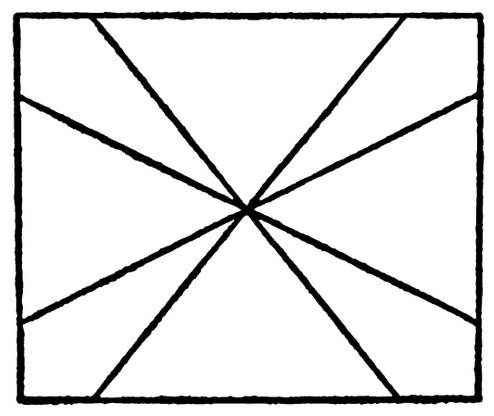
Fig. 9
Simple observations of this kind were first made by Rubin,[37] who has given us a great many examples. That only definite special parts of the field have “real form” (as their most characteristic property) was shown conclusively by the fact that subjects who had seen one definite form at the first presentation of such an “ambiguous” pattern, did not recognize the pattern, if later on, at the second presentation, the other form happened to be seen. This second form had not existed as a visual reality when, previously, the first one was experienced; so the second one was something completely new when seen in the later presentation. Again, when one of the two crosses (Fig. 9) is “real,” one does not see other forms which are quite as real (or unreal) geometrically on the retina. So one does not see the form 9a or 9b or 9c.
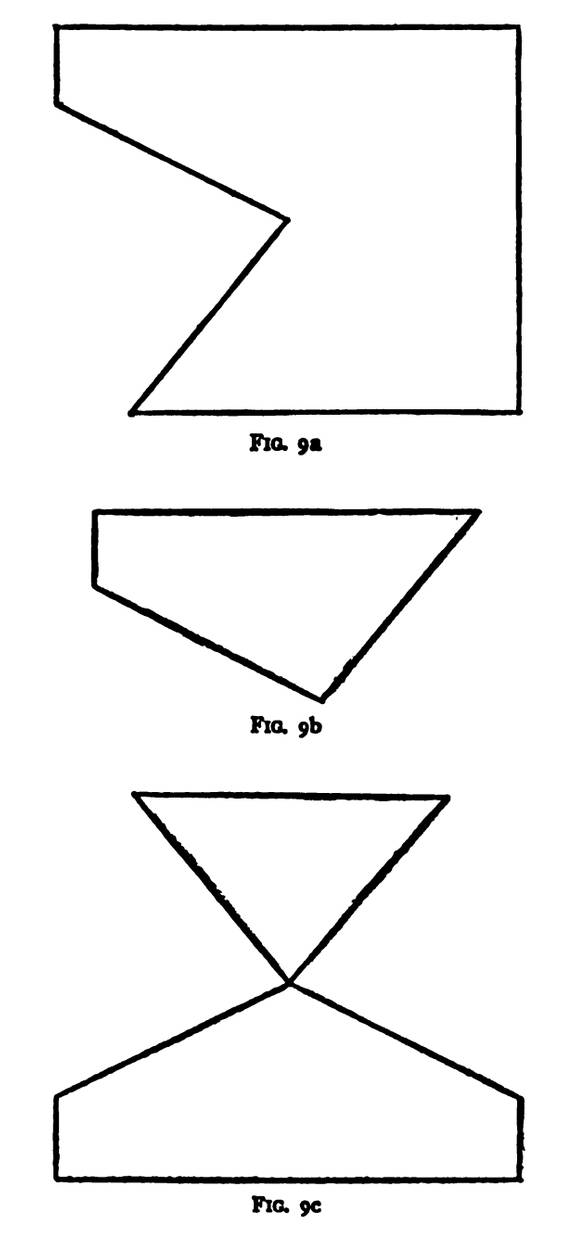
Fig. 9a, Fig. 9b, Fig. 9c
In the case of Fig. 10 two unknown forms will be seen as a group through which a horizontal line is laid. When I tell the reader that the number 4 is before him in the field, he will undoubtedly find it; but if he is not influenced by theoretical prejudices, he will confess that the form of the 4 did not exist as a visual reality at first and that, if it began to exist later on, that meant a transformation of visual reality.
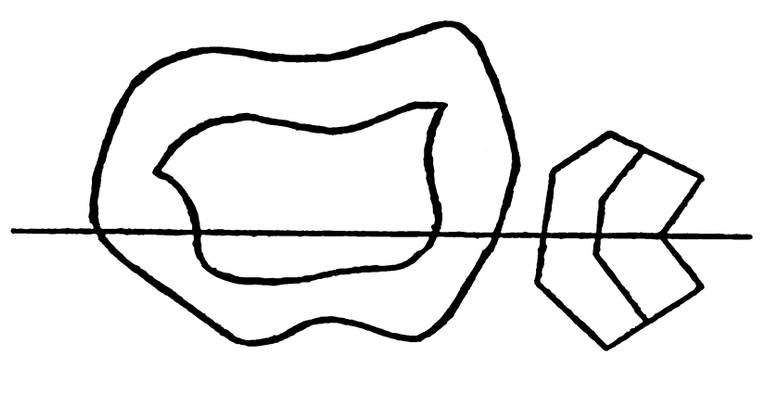
Fig. 10
In the last example it will be obvious that the reality of a form depends upon the existence of a definite whole which, when segregated as such, has that real form, others, which would correspond to other wholes, being excluded from visual existence. So when we first look at Fig. 10 we have a definite organization, consisting of two unknown wholes with the horizontal line running through them. Consequently one part of the geometrical constellation of the 4 is absorbed by the whole on the left side, a second fraction by the angular whole to the right and the rest by the horizontal. And the destruction of the 4 as a whole also destroys its form. When after instruction, the observer really gets the 4 as a form in his visual field, a corresponding whole is produced at the same time. We formulate the general theorem that real form depends upon the segregation of corresponding wholes. This statement is confirmed by all observations of puzzle pictures, of camouflaged objects, and so forth. The existence of visual form presupposes the existence of wholes which, then, have a real form as their specific property. The reader will be able to convince himself that even the reality of partial forms depends upon the existence of corresponding sub-wholes.
The objects around us are, in most cases, very stable wholes; therefore, we regularly see them with their definite forms, excepting in those rare instances in which the wholes and their real forms are disguised by chance conditions or by intentional camouflage. This is the reason why we so easily fail to see the problem of form and why we remain satisfied by “the form given objectively in retinal projection.” There is, however, no visual form in the world to which our last considerations do not apply. Wherever we have “real form” in the visual field, we must assume a specific property of functional process in that area. But the processes do not have this special property in all parts of the field. If you walk along a street between high houses on a bright day, the sky is seen above you surrounded by darker contours of houses and towers. Do you see that bright area as a form? Generally not; it has no form, it is indifferent “background,” though on your retinæ there does exist a homogeneous area surrounded by contours. These contours remain borders of the houses; the houses have forms, but the sky has not. If you wish to see a certain area of the sky as a definite visual form, look at it through a little hole cut into a box which you then put over your head. If the hole is cut like the letter H you will see an area of the sky in the corresponding form as a bright figure on a black ground. And now this ground has no visual form.
Who wishes to judge about the problems of gestalt theory ought to be well acquainted with these observations and with the consequences to be deduced therefrom. Exactly as we may either have color in a definite part of our visual field, or mere brightness of a certain nuance, so a definite area may have a certain form or it may be formless, i.e., merely extended.
Since “real form” presupposes a segregated whole, the existence of “form” depends upon factors of stimulation similar to those upon which the segregation and organization of wholes depend. Again, definite relations in the total constellation of retinal stimuli are found to be decisive for the existence of real form. But no abstract consideration of all the logical relations that might possibly obtain among local stimuli would make us able to forecast where or when a specific form will be seen. As for the existence of segregated wholes, i.e., organization, certain special relations again are important and others indifferent; which are the important ones can only be discovered by the observation of real forms appearing under a given set of conditions.
Since for some time to come it will be impossible to observe physiologically the inner dynamics of optical processes, we cannot do more at present than draw conclusions from the properties of the visual field in comparison with given retinal constellations. In the course of this attempt we find that “form,” wherever it exists, is a supralocal property of that part of the field; so the property of the underlying process must be a supralocal phase of it. We find also that “form” is a property exclusively of segregated wholes; so, with or after the organization of these wholes, that special supralocal property of physiological process must develop which is the basis of “real form” in direct experience. As it is an attribute of detached wholes, this phase of the process exists only in definite areas, which are determined by certain relations of stimulation. These relations must be decisive dynamically for “form,” as they are for “wholes” which have “form” as their most important visual property. Evidently, one cannot understand “form” from the viewpoint of mosaic theory; dynamical self-distribution with its functional coherence and structure of process is the only principle known at present, which may give us an explanation of “form” in the future.[38]
I shall not try to demonstrate with the same care the concrete reality of definite forms in time. What has been said would have to be repeated more or less in the case of melodies, of rhythms, of seen movements and so forth. The “form” of a musical motif begins at a definite point and ends at another; then another motif may follow. But there is no real form extended from the second tone of the first figure to the third of the second figure; and between the two figures there is what is called a “dead” interval (corresponding, as “empty” time, to the mere extension or ground outside a visual form). Again when in the dark room a bright spot in motion describes the path of Fig. 6, we see certain definite forms of movement, 1 → 2, 3 → 4, 5 → 6, for example. We do not see other forms, such as, for instance, a form corresponding to a fraction of 1 → 2, the horizontal, and a fraction of II, taken together. Real form coincides with the wholes and sub-wholes segregated in this case as in that of melodies and rhythms. In passing we may remark that the behavior of others is continually seen in forms of events which correspond to the natural grouping of what we see or hear of them.
As form is a property of segregated wholes, what has been said against the explanation “by meaning,” or other indirect explanations, in the case of segregated wholes, will be more or less to the point with respect to their forms, though, probably, for most readers this is yet a rather critical issue. Therefore, the problem shall be treated once more in the following paragraphs.
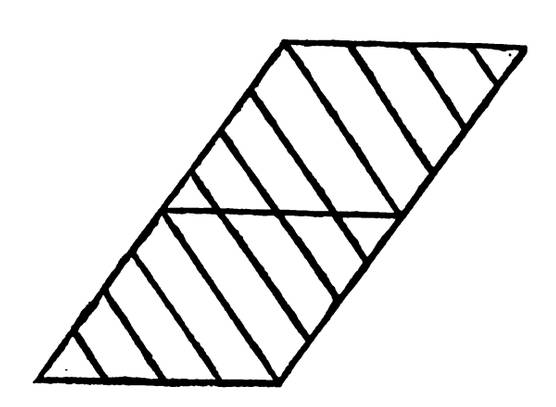
Fig. 11
1. What is the effect of our past experience of certain definite forms upon visual experience in subsequent life? Drawings like Fig. 11 and Fig. 12 contain a great many geometrical lines the outline of which, when given alone, would make us see other forms than those which we see naïvely. Thus, in both of them the outline of Fig. 13 is present geometrically. If now we have a large number of drawings, seen naïvely in a certain way, and besides them certain other figures geometrically contained in the first, will training or repeated experience with regard to the latter change the way we see the first, so that the learned forms become “real” when the larger drawings are shown? Gottschaldt has recently made such experiments.[39] Since past experience is supposed to have its effects upon form independently of our knowledge about the presence of corresponding outlines, i.e., automatically, the subjects were not told to analyze or to look for the “learned” forms. The larger drawings were given them simply for description. Under these circumstances, with three previous exposures of the smaller forms, the training had no effect upon subsequent perception of form in more than 90 per cent. of the cases. When the number of previous exposures of the smaller forms was increased to 520 with new subjects, the result was still the same, the drawings being seen unchanged by the training in 95 per cent. of the trials. Not even the few cases, which showed a positive result, can be explained by the mere fact of previous training, because all those subjects, who occasionally saw the “learned” forms in the larger drawings, had some suspicion about the aim of the experiment and asked the experimenter whether they should look for the “learned” forms in the larger drawings. Though they were not instructed to do so, of course they went into the test with an attitude of definite expectation. So the few positive results do not prove an automatic after-effect of past experience upon forms seen subsequently, since, apart from training as such, there was this other factor of expectation.
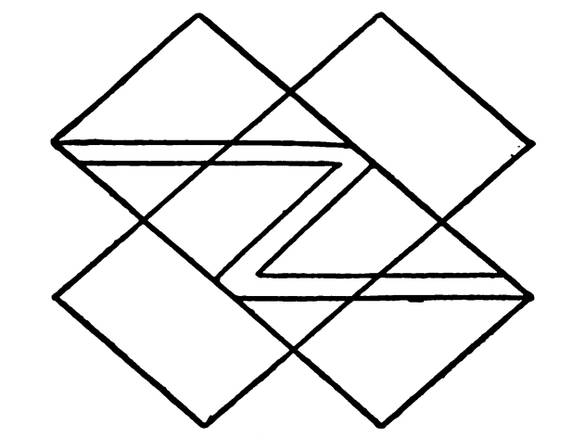
Fig. 12
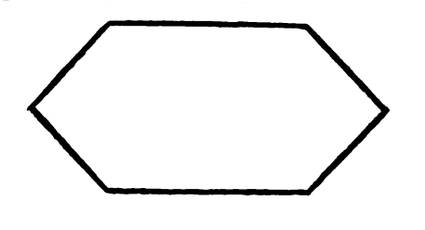
Fig. 13
Gottschaldt’s larger drawings were “difficult,” i.e., of a highly stable organization. In some of them, in spite of strong efforts, I cannot really see the smaller form, even when I know about its geometrical presence and position. However, if any one criticizes this “difficulty,” by his own argument he recognizes the reality of stable visual form as something stronger in such cases than a very large amount of previous experience. Furthermore, the larger drawing (Fig. 12) cannot be said to have its stable organization in consequence of much experience in previous life outside the laboratory. What we naïvely see there is not better known from previous experience than the small figure 13. After these results, whoever defends the automatic influence of past experience upon our seeing definite forms, will have incumbent upon him the task of supporting his theory by other experiments. If such an influence exists, it must be restricted to rather special cases.
2. Where “form” exists originally, it acquires a meaning very easily. But here a whole with its form is given first and then the meaning “creeps into it.” That meaning automatically produces a form where beforehand there is none, has not been shown experimentally in a single case, as far as I know. It may be that in a very unstable constellation, in which a certain form can be seen or organized, past experience of such a form will tend to produce it really, whereas without that previous experience, this would not happen. Even in this case, however, we should still have to explain what factors produced that form in previous life. It is only assumed, then, that conditions were more favorable, and the question remains open whether they were not favorable for its originating directly. In any case, even granting that previous experience of a certain form favors its appearance in the future, we ought to realize that such an occurrence will be limited to definite cases, namely those in which the actual constellation does not tend decidedly toward other more stable wholes and forms. The number 4, for instance, is certainly a well-known form; but when Fig. 10 is shown to hundreds of people without any special instruction or warning, only a few of them will see the 4 and mention it in their description of the figure. If any one protests that we have never seen the 4 in such an environment before, he misses the point, because no explanation in terms of previous experience is needed when 4 is given upon a homogeneous ground, as it usually is. If past experience has an influence, it is exactly in such a case as that of Fig. 10, in which its influence ought to be effective. And after all, it is not the “unusual” environment as such which prevents our seeing the 4 immediately. In the following figure (14) the 4 is seen at once, though in my judgment the environment is not less unusual than in the first case. Why, then, is it seen now? Because the relation between the added lines and the geometrical parts of the 4 is not such that these parts are absorbed in the formation of other wholes. But this is a principle of original organization. So we may say that any influence of past experience upon the organization of forms in the future depends upon the degree and the stability of sensory organization in the actual case. I shall give a few more examples which show the absorption or destruction of a well-known form by actual organization into other less known forms.
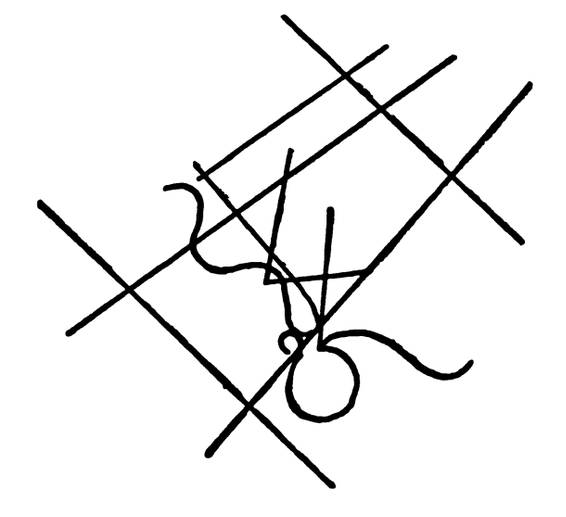
Fig. 14
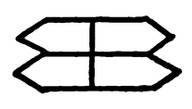
Fig. 15
Look at Fig. 15 before you read the next lines. No one would use the name of letter E in describing it as long as he is a naïve observer, though the well-known E is present geometrically, and the form really seen is less known. Fig. 16 may be beheld as an ornament for months before one first finds two H’s in it. Similarly the letter K is hidden in Fig. 17. If the reader is already a little sophisticated, he would be wise to show these figures to some of his more naïve friends, for five seconds perhaps, asking them only to give a spontaneous description of them. I do not think the enormous experience we all have with respect to these letters will produce any considerable effect upon the result, as long as the subjects do not begin to look for hidden forms. If they do, of course, the result will be produced by actual attitude apart from previous experience. When we give our subjects a hint about the camouflaged form, we create in them what the physicist might call a “special vector,” favoring that concrete form. But when our subject, adopting an indifferent attitude, looks unaided at some of the unknown figures, this vector does not exist, despite a great deal of “past experience.” Without it, the hidden forms do not appear.
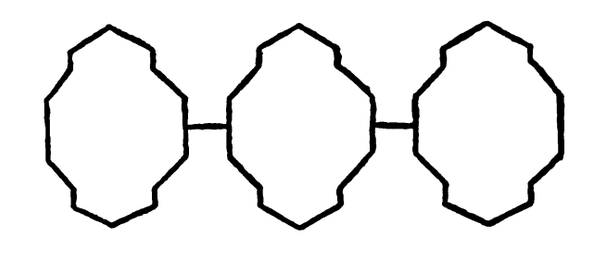
Fig. 16
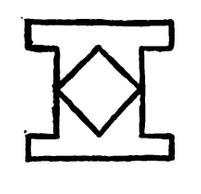
Fig. 17
3. Again, some psychologists will go so far as to derive all form in the visual field from tactual or motor experience. Our answer in this case is once more simple enough: Real form is a concrete property of certain things. If its history is to be traced to other than visual experiences, we must have concrete real form in those other regions in which it has its origin. Nothing can be imported from other fields into vision without having originally occurred in these other fields. So the whole problem would only be shifted from one sensory field to another, and the explanation would have to assume original forms in the latter. This reasoning applies also to our sensations of eye-movements. If visual form shall be derived from them, real form must be a property of some of these kinesthetic experiences. Therefore, such an hypothesis does not seem to be a scientific gain, and we may as well acknowledge the problem of visual form as such.
4. I find a decisive argument against explanations of form in terms of past experience, in the following consideration. No doubt, parts of the visual field can reproduce past experiences associated with them in previous life. But when we ask what factors are the main reproductive properties in these cases, we see that in 99 out of 100 cases reproduction depends upon the form of a segregated whole in the field. Take the concrete real form away, so that reproduction can be aroused by only the color or the place or, perhaps, the size of an area, and you will realize that for the most part, without form, visual realities are not specific enough to reproduce definite experiences. When we talk about the automatic influence of past experience upon actual vision, we are tempted to extend this idea to the creation of definite “form” by reproduction. But then we forget that there is not much reproduction without form itself as a reproductive factor, and that, from the viewpoint of such an hypothesis, form as such must be strictly excluded from the sensory field and, therefore, from the reproductive features of the situation, supposedly being present in the field only by way of the reproduction of past experience. The curious result is that we presuppose “form,” erroneously and unawares, in order to get form reproduced from past experience! A naïve observer does not see the 4 in our example, although it is such a well-known figure. Why? Past experience cannot work if there is no specific factor present which might reproduce that definite part of past experience under the circumstances of the case. In our example the ever so well-known 4 will not be reproduced, as, in other examples, countless other well-known forms are not reproduced either, there being nothing in the actual optical processes which might effect that definite reproduction. I suspect that a great many explanations in terms of meaning and past experience fail completely to realize this side of the question. It is easy to say: This, of course, is so because in earlier life certain things have happened. But the time has come for more concrete thinking in this field. Reproduction does play a highly important rôle in mental life and in behavior. It can play it only if the sensory world is sufficiently endowed with concrete properties in those areas which are said to reproduce our previous experience. If it is not, because we regard it as a mosaic of sensations, by what factors can a definite reproduction be determined? “Transposing” shows that a form will remain the same independently of the color, the place and the size of its area. If, now, a definite form is said to appear in the field by reproduction, I do not see what characteristic of the mosaic can possibly determine the right reproduction, since we cannot rely upon color, place and size for it.
In order to show that “form” can never be explained by the existence of “sensations,” von Ehrenfels laid great stress upon this very fact—mentioned previously by Mach—that a form can be “transposed,” i.e., will remain the same as a visual property, after its brightness, color, size and place are changed. Of course, when shifted too far toward the periphery of the field, a form will change its character more or less, but, excepting this case, the possibilities of transposing a form are very numerous. Again in this respect temporal form behaves like spatial form, since a melody may be rendered in different keys and still remain the same, so far as its musical form is concerned. Indeed, nothing can show better than these facts that the specific supralocal organization of the processes underlying form as a sensory experience must be a physiological reality, certainly as much as are the processes underlying chroma as a quality of sensory experience. Since, in the case of vision, we can change not only chroma, but brightness, localization and size of a form, without disturbing the form itself, the usual categories of quality, intensity, position, extension do not help us when real form is to be explained. There is only one thing we cannot change too much without influencing form itself, viz., that special set of relations of stimulation which seem to be decisive for the segregation of a definite whole and for the specific dynamical structure underlying form.[40] We do not normally experience these relations in the sensory field. But in the determination of self-distribution of process, in the segregation and “formation” of wholes, they must become almost all-important somewhere between the retinæ and the psychophysical field.
Up to the present time there has been a tendency to regard the remarkable properties of wholes, especially the possibility of transposing their translocal properties, as the achievement of “higher” processes. From the viewpoint of gestalt theory sensory organization is as natural and primitive a fact as any other side of sensory dynamics. If, for von Ehrenfels and the Grazer Schule, Gestaltqualitäten and form are treated as a superstructure built upon the foundation of sensations, this assumption would fail to account for the evident rôle of gestalt in such biological processes as ontogenesis. In psychology, too, the influence of gestalt has been demonstrated by Hertz (cf. Chapter V) in very primitive behavior, in which no one would assume the operation of “higher” processes. Lashley seems to have been the first to find that an animal, trained to react positively to one of two “stimuli,” will shift his reaction spontaneously when he finds himself before two other stimuli of the same class, the new reaction being directed to that stimulus which plays the same rôle in the new pair as a whole, which another specific stimulus played in the pair used during the learning process. I wonder why these experiments failed to exert their due share of influence upon current theoretical formulations. Without knowing Lashley’s work I have repeated the same experiments on apes and chicks, with special care to exclude all possibilities of indirect explanation. There is no doubt, now, that a chick, trained with two grays, I and II (II being darker than I), always to choose II, will, after a while, when II and the new (darker) gray III are given, in the majority of the trials not choose II but the unknown nuance III. The same experiments were performed on apes with size, and also with different hues of color. Several investigators have been able to confirm these experiments. We may conclude that animals react to such pairs as to wholes, either side of which has a definite character depending upon its “position” in the whole. So II is “the dark side” of the first pair; then, in the new pair, III assumes this rôle, and since the animal has learned to choose the dark side of the pair rather than a more or less definite gray, it tends to avoid the specific gray of the learning period and to choose the new gray after the transposition. Again it does not matter at all in such a case, whether or not we assume that the chick has direct experience. The difference between choice depending upon a more or less definite intensity of light and reaction depending upon one definite side of a structure, is the same for either assumption. Once more the formula of “stimulus and response” becomes altogether misleading, since it neglects the fact that between the stimuli and reaction there is the organization of definite wholes with specific properties, upon which the reaction so obviously depends.
In order to prove that dynamical self-distribution will explain “transposition,” we have to show that “transposition” is possible in self-balanced physical systems. Nothing can be easier! First of all, if under certain conditions all forces of a dynamical distribution are in equilibrium with regard to each other, it is evident that the equilibrium is not disturbed if the intensity of all those forces decreases or increases in the same proportion. All forces being reduced to one-half of their first value or increased to three times that amount, they will balance each other as before. The supralocal dynamical structure is largely independent of absolute intensities. Now let the dynamical structure be the self-distribution of current in an electrolyte, depending upon the total form of the electrolytic conductor. Again the intensity of current has no influence upon its distribution. Also, if instead of ions like Na and Cl, K and Br or any others carry the electric charges, the distribution of current will not be changed. Or, take as an example the electromotive phenomena developed when two solutions (I and II) of different ionic concentration are in contact. Those phenomena, existing only in the pair of solutions as a whole, depend upon the relation of the ionic concentrations, the absolute concentrations being indifferent. If, in a definite case, the solution II with a concentration of 1/20 n is the electropositive side of the pair, as against I with a concentration, say, of 1/4 n, in a new pair with the concentrations 1/20 n (II) and 1/100 n (III) the new solution III becomes the electropositive side. To be “the electropositive side” of such a physical system is no less a gestalt property in a definite electrochemical whole than to be “the dark side” is a gestalt property in a sensory pair.
In some respects form is the most important property which a whole may have; the introduction of it as a specific reality will help us to understand certain of the properties which occur only in wholes. In Figs. 8 and 9 we observed a change of form, now one cross or star being present as a form, and then the other. But something else changes at the same time. When we see the slender cross, the area of this cross has a character of solidity and coherence; we may even say that this slender cross has the substantiality of a “thing,” whereas the environment appears as comparatively “empty” and “loose.” Exactly the contrary is true when the other cross dominates the field; the large cross becomes “solid” and “substantial,” whereas the narrow angles have become “loose” and “empty,” like the environment. Because an area becomes “solid” when appearing as “form” or “figure,” Rubin, who was the first to describe the difference, has called the “solid” quality the “figure” character, whereas to the “looseness” of the environment he gave the name of “ground” character. This term “ground,” or “background,” is the more appropriate since we find the “figure” protruding a little, as if in three-dimensional space, and the environment localized behind it, so that the solid “figure” appears as something apart, behind which the “ground” seems to extend without interruption like a simple homogeneous plane. The sky above the houses (cf. p. 202) has the character of ground.
I do not think we ever find that character of “solidity” where we do not have a segregated whole. That character, then, is a typical property of segregated wholes and belongs to von Ehrenfels’ qualities. Some psychologists will try to derive this character from touch or other previous experiences which we have had with things, in the practical meaning of the word. We find that all visual things, which as such are clearly perceived in the field of vision, have the same character of “solidity.” But as it appears as a visible quality, it may be such a quality originally; it may even belong, independently of other experiences, to the primary constituents of the meaning of the term “thing” in common life. Whether the empiristic explanation is justified or whether this quality is founded directly upon the specific dynamics of seen form, will be decided by further research. As yet it has been shown that, functionally, “figure” and “ground” behave differently. Constancy of color has been shown to be more striking for “figure” than for “ground” (Rubin); the limen for a patch of color projected upon the “figure” was found to be higher than upon “ground” of the same objective intensity (Gelb and Granit); after-images are more vivid when observed upon a “figure” than they are upon “ground” (Frank).
After all these considerations the reader will be prepared to accept some statements as concrete which, in consequence of their more general character, he, without that preparation, might be tempted to despise as “mere philosophy.” If in our experiment on animals “the dark side” is something which, as such, exists only in a definite whole, the same thing is implied in a great many terms which we are continually using as trivial words in common life. We do not realize generally that all their meanings presuppose definite wholes in which something plays that rôle to which the words apply, as “the dark side” applies to the rôle one gray plays in a pair of grays. I give the following few examples, selected from a large store: The German “Rand” (English “brink” or “edge”) is such a word; again “Anfang” (beginning), “Ende” and “Schluss” (“end” and “close”), “Stück” and “Teil” (“piece” and “part”), “Rest” (“rest” or “remnant”); and even “Loch” (“hole”) and “Störung” (“disturbance”), which presuppose a definite experienced whole, with respect to which an area may appear as a “hole,” or some factor as a “disturbance.” Intentionally I do not restrict my examples to those cases in which the words apply to sensory facts. There is not the slightest reason why I should do so. And the reader will easily understand that talking about a “disturbing” factor in the case of “thinking” presupposes a definite dynamical whole, as it does in sensory experience. There is no meaning in the word without it. Whoever is slightly acquainted with musical theory will recognize at once that a tone cannot have the character of the “tonic” without belonging to a larger musical whole, in which it plays a definite rôle; of course, the same is true of the leading-tone, which has its strong dynamical properties in the definite key of a sequence of tones, and not independently.
Obviously we must have similar cases in the world of adjectives and verbs. Indeed, “hohl” (“hollow”) and “offen” (“open”), “complete” and “incomplete” belong in the same group, as terms referring necessarily to specific wholes. Finally, in the realm of activities and events we might give a long list in which there ought to be included: “starting” or “beginning,” “ending” and “finishing” or “closing,” “desisting” and “interrupting,” also “proceeding” and “continuing,” even “deviating,” “bending,” “retarding” and so forth. If we try to find out what we mean when we use terms like “hesitating” or “deviating” with reference to the activities of others or to heard music or to our own stream of thought, we shall find that their meaning depends upon extended dynamical structures, the change of which is described by those words. They may be applied to sensory experience, but their essential meaning remains the same in other fields of experience, because the principal aspects of gestalt are found in all of them. To say that they are imported into these other fields from the region of sensory experience, in a merely analogical way, would be no more than another vicious circle of the kind described above (cf. pp. 212–214).
BIBLIOGRAPHY
W. Köhler: Psychol. Forschung 4. 1924.
W. Köhler: Die physischen Gestalten. 1920.
E. Rubin: Visuell wahrgenommene Figuren. 1921.
W. Sander: Bericht ü. d. 9. Kongress f. exper. Psychologie. 1927.
M. Wertheimer: Psychol. Forschung 4. 1924.