IX Reproduction
Reading edition
PSYCHOLOGY knows three main topics which are to be investigated in the field of memory and habit: (1) learning and those processes the traces of which make reproduction and recognition possible, (2) the career of these traces in the time between their formation and recall, and (3) the processes of reproduction and recognition themselves. In some degree reproduction or recognition will be needed in the investigation of all these problems, to give us evidence of either the laws of learning, or those of retention, or those of recall itself. Nevertheless, in the first case we can keep conditions constant with respect to retention, and also with respect to the circumstances of reproduction, while the conditions of learning are varied; in the second case, the conditions of learning and those of reproduction will remain constant, those of the interval between learning and recall being varied; and in the last case, we vary only the circumstances of reproduction or recognition. So we are able practically to separate the three classes of problems. In this chapter our attention will be directed mainly to questions of retention and recall, though we shall also have to treat one highly important feature which may as well be regarded as belonging to the topic of learning and the formation of traces.
In the sixth chapter I mentioned certain experiments in which, after learning to choose one side of a pair, for instance the darker of two grays, animals had to react to a new pair, consisting of the “right” object of the learning period and a new object, which had more or less the same relation to the “right” object as this had had to the “wrong” object during learning. The result was that in the majority of the trials the animals chose that side which, in the new pair, played the same rôle which the right object had played during learning. This means that they chose the new object which, in our example, was now “the dark side of the pair.”
This result is not quite general, however. It depends upon what interval of time elapses between the training with the old pair and the first trials with the new one. Occasionally, after the learning period, a chick was given the new pair in between choices on the old one; and this procedure was repeated until the single trials with the new pair, each of them distributed between trials with the old one, could be regarded as numerous enough. It was found that, under these circumstances, the animal chose the “right” object of the learning period quite as often as the new object, which would now be the right side in the pair. Obviously, this must be explained in the following manner: When the chick reacts to the group before him, the chick sees[59] it as a pair in which either gray plays a definite rôle as the dark or the bright side of it; but at the same time the first is seen as a more or less definite dark gray and the second as a bright one. Both ways of seeing them are altogether compatible with each other as long as the pair is not “transposed.” If during learning the chick reacts to the right object as one side of the pair and also as a more or less definite gray, there must be two products of training which will become opposed to each other as soon as we introduce the new pair, because now the first product of learning will favor the choice of one object, and the second the choice of the other. Let us suppose, now, that these different effects of learning do not fade equally fast with time; an increase of the interval between trials with the old pair and trials with the new one will favor those reactions which depend upon the more enduring product of training. From our experiment it follows, then, that the habit depending upon the pair as a whole is more enduring than the habit depending upon the nuance as such, since the pair as a whole is relatively less decisive when the animal reacts to the new pair immediately after some trials with the old one. But the two habits are alike with the exception only that one of them depends upon the organization of a trace whereas the other depends upon the trace of a certain nuance of brightness. Hence, in the course of time, the traces of organization remain much more stable than do the traces of a more or less definite gray. This may be a more general fact. It has been remarked by several psychologists that we are frequently able to remember the general structure of something at a time when we cannot get the more particular content of it at all. It would be worth while to test this statement by appropriate experimentation, particularly since we might get some insight thereby into the nature of so-called “concepts.” In the case of the chick it was very easy to examine the hypothesis by having the same animal react to the new pair once more, after some minutes had elapsed since his last trials with the old one. The result was that the “relative” reactions predominated.
There is much to discover in this field. At the beginning of the last chapter we noticed one way of studying the career of traces by investigating successive comparison. Here we have a second way. A third one, somewhat similar to the second, is also to be found in certain observations on animals. I shall treat it as an example of what new problems gestalt psychology raises in a concrete case. When Yarbrough[60] investigated delayed reaction in cats he found them able to react correctly after no more than four seconds if they had to choose between three objects, whereas in the case of two objects the delay could be increased to more than four times that amount. Why is the result so much greater in the second case? An explanation may be derived from the examination of a human subject in a similar, though more difficult, task. If I have 25 objects, all of which have the same properties, before me in a semicircle, they play very different rôles in the semicircle as a whole; the rôle of two of them is particularly well defined and characteristic, namely, that of the first to the left and that of the first to the right side, which are the “ends” of the whole; in some degree, but much less, a third one will be characterized as a special member of the group, i.e., the central one. The rest will be more or less like an indifferent filling. Suppose now that the experimenter points to one of the objects, and that, after a delay in which I do not fixate that object carefully, I am told to go toward it; my reaction will always be correct if one of those three objects had been pointed to. However, as long as I do not mark the right object in an indirect way by counting at the first presentation, in order to find it again by counting after the delay, wrong reactions will occur rather often when the designated object has an indifferent position. Thus I may choose the sixteenth instead of the seventeenth, or the eighth instead of the ninth, rather easily, and, if the delay is increased or my attitude is slightly dreamy at the first presentation, such errors may become rather frequent. Of course, this is the same dependence of delayed reaction upon the more or less specific position of a member in a group, which was demonstrated by Hertz in certain birds (cf. pp. 158–162), so that we may apply the same idea to the case of a cat which must choose between three objects after a delay. If the cue which the cat has acquired before the delay refers to the first object (for instance, at the left), the cue will be connected with a very definite place in the whole group; and the same will be true if the third object (the first to the right) becomes connected with the cue. If, however, the second object is connected with the cue before the delay, this cue will refer to a place which, for the cat, is much less definitely characterized in the group. At the time when that object is marked out (by a light, for instance) among the others, its rôle in the whole may be sufficiently clear for some moments; but chances are that after some time the cue will lose its rather unstable localization, the whole becoming just an undifferentiated stretch, only the ends of which remain well-characterized places. Consequently, the animal will react correctly less often when, instead of two objects, the experiment is made with three. The cat might begin to react more correctly again, perhaps, if the experimenter gave the three objects another distribution in space so that all of them would have well-characterized locations. The reader will be inclined to say that such an explanation appears somewhat artificial to him, since, with three objects, the probability of error is increased anyhow and the cue cannot be fixed so easily in a more complicated situation. This objection should be examined by introducing that change of conditions to which I have just alluded. From the viewpoint of organization, “complication” is not simply a matter of number, but also of distribution in space. If, therefore, the three objects are distributed in a way which characterizes each one equally well, we may be able to decide whether or not we should accept the explanation in terms of mere increase of number. There is one result in Yarbrough’s experiments which makes me more inclined toward the other hypothesis: If mere number, as against lack of definite rôle in the group, were the decisive condition producing failure, the false reactions of the animals should be distributed in a haphazard manner among the three objects. But this is not the case. After a long delay (beyond 4 seconds) some of the cats did not go to the second object at all. All their reactions were directed toward the first or the third object! This is just what we should expect in terms of our explanation, whereas one cannot understand it at all without taking account of organization. We may say, then, with some confidence that in cats the traces of past events undergo a rapid transformation which destroys the minor or less stable characteristics of groups as wholes, so that subsequent behavior depends upon a more simplified organization than existed in the traces at first.
A somewhat similar observation was made by Mr. Tinklepaugh and me when, using another method, we performed some experiments on delayed reaction with a monkey. A very large square on the ground was covered with sand some inches high. Before the animal certain marks were made on the sand, as, for instance, a hill of the same material or, in another experiment, a straight line which we drew on the surface with a finger. After this preparation, food was buried in the sand in a place which, for the human subject, was characterized at once as having a rather definite position near the mark. We wished to see whether the animal would use the mark in fixing the place of the food because, without a mark in the homogeneous sand, his previous reactions to buried food had not been very clear. The monkey who had observed those preparations was not released from his place until some time had elapsed. When allowed to approach the sand he would go to the mark at once and search for the food in it. As far as I can remember now, he never searched near, i.e., around the mark. Though further observations would be desirable, one explanation seems probable at once: As in the last case where delayed reaction was investigated in cats, the reaction of the animal depends upon a trace and upon the actual organization of the field. This field is well organized, the hill or the line forming an outstanding feature in it. The localization of the place of the hidden food, however, is much less definite. Therefore, we may assume that a simplification occurs in this case similar to the one which determines the reactions of the cats in Yarbrough’s experiments with three objects. The trace which remains in the monkey will be transformed during the delay to the disadvantage of its less defined regions and the result will be that the monkey’s cue is absorbed by the outstanding mark just as, after some delay, the cats react only to the well-characterized parts of the situation. It may be that the method used by us in this preliminary way will be developed some day into a more accurate instrument for investigating the career of traces in animals.[61]
Traces are not rigid, then; there are definite dynamical tendencies in them; and in animals the traces may be transformed more easily than in man. That being the case, the study of delayed reaction in animals becomes highly important for general psychology because it may show us the working of those tendencies in a measure which could not be observed in man.
There can be no doubt that, in principle, we find similar changes in man also. Koffka and Wulf[62] have observed these changes by making their subjects draw figures which they had seen previously for a few seconds, first after a delay of some minutes and then after days or even weeks. The figures had not simply lost details at the time of graphic reproduction. The changes were much more interesting since they showed two opposite directions: In reproduction the figures were either more regular than the original ones or some traits which might be taken as characteristic of their organization were considerably exaggerated in the drawings. The authors give the explanation that, during the first presentation, the figures could be seen in somewhat different kinds of organization. If this organization was a rather simple and regular form, the change of the trace would be in the direction of increased regularity; if, however, some articulation, irregularity or lack of symmetry was seen as the main characteristic of the figure, the transformation would enhance this property. Therefore, in both cases the change seemed to produce an approach toward something like an extreme type or the ideal of the first organization.
In all these cases behavior depending upon the actual properties of the traces is used as an indicator of their changes. Still there are other cases where the traces can be shown to be practically unchanged, although reproduction is difficult or even impossible under the circumstances in question. In the last chapter we mentioned some examples of this kind. Now we have to treat others which will show us that the possibilities of reproduction are much more restricted than one might expect.
If association as a basis for reproduction is just another expression of the fact that the traces of functional wholes are themselves detached wholes, one might somewhat rashly deduce from this theory that, after a trace is formed, any group of stimuli which represents a considerable fraction of the original constellation of stimuli will reproduce those parts of the original process the stimuli for which are not actually given. However, this would mean a complete misunderstanding of gestalt theory, because from what we have seen in the sixth chapter, it follows that between the properties of an organized whole and the actual constellation of stimuli, let us say on the retina, there does not exist a correspondence as to parts, as though one region of the organized whole separately depended upon some definite fraction of that constellation, a second one upon another and so forth. On the contrary, upon a large group of stimuli and their “relative properties” depends the organized process as a whole in a manner which cannot be analyzed into independent local or partial effects of stimulation. Therefore, in general, if an organized process has left its trace in the nervous system, some fraction of the original group of stimuli will not determine a partial process which occurred in that functional whole, but something different and new, a picture of which is not contained in the trace of that whole. Consequently this new process will not be able to reproduce anything on the basis of that trace; just as some other group of stimuli which we might choose in an altogether arbitrary manner would determine a new process and consequently would be foreign to that trace. For instance, Fig. 20 will not reproduce the missing lines of an H normally, though, geometrically, that figure is the larger part of an H. Neither will Fig. 21 reproduce the missing lines of an R, and so forth, because, when we have seen an H or an R, we have never had the given figures as real experiences. There is nothing in the traces of an H and an R, which might correspond to the processes of Figs. 20 and 21, and reproduction does not occur. We shall conclude, then, that reproduction will be restricted to those cases where the process intended as the excitant of reproduction is sufficiently similar to a partial process of the original whole. This will be the case if the process intended as an excitant corresponds to a natural member or sub-whole of the original organization, because under these circumstances the trace of that sub-whole, though not identical with the exciting process, will be similar to it, at least. If this similarity is marked enough, reproduction will occur under favorable conditions. So U. S. will reproduce an A. rather easily, and the stars the rest of the American flag, because here we give as an excitant what was present in the original organization as a relatively independent region. This is the chief requirement. If we draw a profile from the nose downwards to the chin, this line does not correspond to a complete sub-whole of a face. Nevertheless, since the influences exerted upon that outline by the organization of a complete profile are not so very strong, the process determined by that line will be sufficiently similar to the corresponding process in the whole profile and to the corresponding trace, so that reproduction can occur.
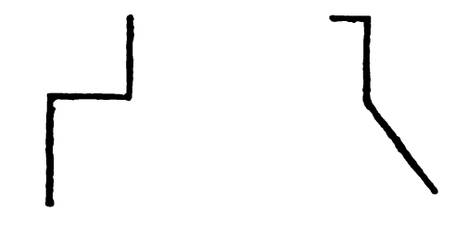
Fig. 20 Fig. 21
Even so, we find reproduction much more difficult than is supposed in current empiristic theories. It seems to be restricted to a rather narrow path between a Scylla and a Charybdis. Association is necessary for reproduction, and association means a sufficient degree of organization. Reproduction, however, presupposes a certain degree of similarity between an actual process as an excitant and some region of the organized trace. The more a region is absorbed by a larger organization, the less will corresponding stimulation be able to effect reproduction. We have already described the narrow path that any possible reproduction must take between these limiting conditions.
To demonstrate the foregoing contentions I made the following experiment: The subjects are shown simultaneously pairs of figures for a short time. After a while parts of those drawings are presented to them with the instruction to reproduce the missing lines. Now, in a case like that of Fig. 22, for instance, either the vertical at the left was presented or Fig. 23, which represents geometrically a much larger part of the original. With the first as an excitant, however, we get many more correct reproductions than with the second. Of course! The “larger part” is something which in the first exposure did not occur as a real form. Even the first vertical to the left has now lost its reproducing power, because in the original pair it had been segregated as something apart, whereas now it has become the left limiting end of a regular series of parallels.
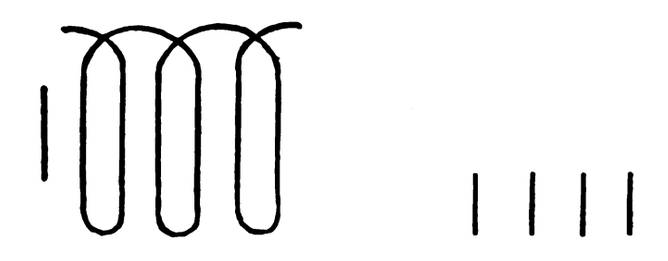
Fig. 22 Fig. 23
If this last point proves that a trace does not respond by reproduction if the organization of the excitant becomes foreign by being embedded in a somewhat different environment, reproduction will be even much more restricted than we should have previously supposed. Evidently, in problems of memory and habit, not only the organization given at the time of first “association” will be decisive for reproduction, but organization existing in the actual field will be equally important in determining or preventing reproduction. When given in a certain environment a certain process may be an excellent incentive to reproduction on the basis of some trace existing in the nervous system. But it will not occur regularly again in just that environment which was given when the trace was formed. Hence the chances are that, quite apart from the rather crude obstacles considered above, even a slight change of the surrounding field may make an excitant unable to reproduce what has been “well connected” with it in the past. That this is true can be deduced from Nagel’s experiments (cf. above p. 283). In a well-learned series of nonsense syllables each member, though embedded in the whole series, would certainly seem to be a thing by itself. But if one of them is given alone as an incentive to reproduction, this change of environment is sufficient in the majority of cases to make reproduction impossible.
The same influence of actual organization upon reproduction has been demonstrated in a rather surprising form by Shepard and Fogelsonger.[63] These psychologists made their subjects learn pairs of syllables. Some of these pairs had identical second members. (Between the first occurrence of such a syllable and its repetition in another pair there was an interval of 25 minutes.) At the time of testing the product of learning, the first syllable of a pair was given as the excitant of reproduction; but where two syllables had been followed by the same second member at different times, both were given together as incentives to reproduction of their common partner. If it were not for organization one should expect that, both excitants working in the same direction, the syllable associated with them would be more easily reproduced than a syllable for which there was only one excitant. But the contrary was observed; it seemed as though some inhibition were in the way of reproduction when it was aroused by two excitants. The disturbance was particularly striking when both syllables were presented simultaneously, but it also existed when they were given in rapid succession. The explanation seems to be that during learning the subjects had always had a single first syllable together with its partner, and that when, in the critical cases of reproduction, two syllables appeared before them, both would look so foreign at first in this new grouping that neither could immediately reproduce the common partner. This explanation has been confirmed by observation. The subjects reported that reproduction became possible through an attitude of analysis which would sufficiently isolate one of the syllables. Furthermore, from this explanation it follows that any extraneous syllable, one which never appeared in the learning series, would have the same effect when presented together with the first member of a learned pair. The authors have found this to be the case, in fact. Thus the explanation seems to be quite verified. Our conclusion is that even a very slight alteration of circumstances, if only it influences the organization of the excitants, or incentives, will make reproduction difficult or impossible.
A similar result was obtained by Frings in his work on inhibitions,[64] though his problem refers to learning more than to reproduction. In the classical experiments it had been shown that, if a syllable A has become associated with a syllable B, the same A can not be as easily associated with a third syllable C as could any indifferent syllable. Also, after A has become associated with C as well as with B, when A is used as an excitant of reproduction, the competition of the two different tendencies to reproduction will have an inhibiting effect. Frings was able to show that under certain circumstances these inhibitions may completely disappear. His subjects were made to learn series of syllables, the instruction being that the syllables should be read and memorized as groups of the anapest rhythm in which, after two less accentuated members, the third one follows with the main accent. In such a group the first two members will form a sub-whole. When after a while the product of learning is tested, these two members are given as an excitant, and the last one is to be reproduced. If now, in a given case, a group like (ac)d occurs in one series and a group like (bc)e in another series, we should expect the association between c and e to be inhibited, because c was first followed by d, and later followed by e. Similarly, after associating (bc)e as well as (ac)d, in spite of that inhibition, the subjects should have difficulty in reproducing e, if bc is given, or d, if ac is given. From the viewpoint of organization, however, we must realize that in (ac)d the syllable c is a member of the sub-whole (ac), whereas in (bc)e it is a member in a different sub-whole (bc), and that therefore c is not quite the same thing in both cases. We might also say that in the first case not c, but rather the sub-whole (ac), has been associated with d; and again that in the other case (bc), not c, becomes or has become associated with e. Considering this, we should predict that there will be inhibition neither in learning nor in reproduction. Experimentation has confirmed this view. Wherever c figured as a member of two different sub-wholes, no inhibition occurred. It is particularly interesting, however, that inhibition occurred immediately if a subject had been very fatigued at the time of learning, and therefore had not been able to grasp the syllables in rhythmic complexes, according to the instructions.
Though the reader will have already noticed that, in consequence of varying organization, experimental findings may differ considerably from what ought to occur according to the classical laws of association and reproduction, the most radical restriction of these rules remains to be considered. We cannot proceed, however, without first discussing a certain more general topic.
In one of the preceding chapters we laid some stress on the point that our “self” occurs as an experienced whole in the same field which contains our experiences of surrounding objects and events. Consequently, that field of our brain, as a physical system which is the locus of the processes underlying objective experience, will also contain processes corresponding to the experience of the “self.” In many respects, the processes belonging to this particular whole are different from those corresponding to “outside” experiences, though, with regard to dynamical interrelation, the processes corresponding to the “self” prove to be true members of the total field. Two examples will suffice to corroborate this point.
If a certain thing moves objectively in the visual field, I shall, under the usual conditions, see that thing as moving. But we know many instances in which, objectively, one thing being in motion and another at rest, the first remains at rest while the second moves. This is not an “accidental illusion,” moreover. It depends upon definite circumstances and necessarily prevails whenever these are present. Every one has occasionally seen the moon in rapid motion when clouds were passing it in the opposite direction. When a point on the window of a moving railroad carriage is fixated, the objects outside at once begin to glide in the opposite direction. We may say, then, that any change of spatial relations in a part of the field may have dynamical effects upon those parts of the whole field which objectively are not moved. With regard to the spatial relation of the “external” environment and the “self,” precisely the same observation is frequently made, as we all know. If our environment is, objectively, turned around us with appropriate speed, the result in experience will be that we feel ourselves turning around in the opposite direction. Michotte and Gatti have recently shown that the same effect may be produced by moving two handles toward one side, the subject’s hands being turned passively with the handles: once more the body (as an experience) seems to turn in the opposite direction. We may draw the conclusion that under adequate conditions a change of spatial relations between the processes underlying our objective experience and those corresponding to the experience of our own self, will have dynamical effects upon the latter processes, just as the processes corresponding to the experience of moving clouds exert a dynamical influence upon the processes underlying our experience of the moon. It becomes obvious, therefore, that we must include the self in the dynamical interrelation of the whole field.
As a second example, I refer to the fact that just as things or spots frequently appear before me as grouped in a definite manner, the self is very often experienced as a member of such a group. Of course, if I put my hands on a desk before me and another person does the same on the opposite side of the desk, I have two pairs of hands before me as visual groups. But the whole self may enter a group just as easily: If somebody accompanies me along a street and, ahead of us another pair is walking, I feel (and partially see) myself as a member of one of two groups.
Until now the reader may have restricted the concept of organization more or less to the region of external experiences. From the last examples it seems to follow that organization is an affair involving the whole field and that the “self” is included as the most interesting member of this larger organization. At first one may feel opposed to this treatment of the “self” because, in a great many respects, it remains something particular and apart. During all the radical changes which the outside field undergoes in the course of time the “self” under normal conditions does not lose its identity. At the same time, and notwithstanding that identity, inner experiences will generally be felt as much more lively and dynamical than the average objective experiences. Although these differences may exert an enormous influence upon the actual organization of the whole field, nevertheless they do not place the self beyond organization as such. Sometimes they confer upon the self a central position in the field. But for a great many persons not even this is permanently the case, especially since objective experience contains other persons in social life, who may occasionally become the center of our total field instead of the “self.”
With this remark, however, we have gone far beyond the discussions of the previous chapters. We have enlarged our view of dynamics as determining the field and its changes.
In objective experience grouping may be “static” as, for instance, in the case of indifferent patches, a group of which would seem to correspond to a state of equilibrium in the nervous system. On the other hand, we have seen that nothing is more likely to determine grouping and organization in general than the direction of attitude and of visible behavior. Even a behaviorist like Watson describes the behavior of a child as being directed to or away from an object. In some situations a barking dog will be experienced by any observer as barking at something definite in his surroundings. If, therefore, we apply the term “dynamical” here in a more special meaning, we may say, perhaps, that the most compulsory organization which can occur in experience is a dynamical event or attitude, consisting of one member from which it issues, and another one toward which it is directed. Sometimes, as in the case of “avoiding” or “yielding,” it would be a better description to say that one member exhibits an attitude directed away from the second member of such a whole. In both cases the type of organization remains the same, the main feature being the bipolar structure and the dynamical directedness of the whole.
This type of dynamical structure occurs not only in merely objective experience but also between the experienced self and parts of the experienced environment. We may even say that, apart from drowsiness and similar states of low vitality, the organization of the total field will almost always have just that bipolar character, the self being directed to something else or away from it. The reader will remember our discussion of visual organization. Some diagrams were presented as examples of it. Organization was considered as a property of the visual field. This account, however, was not a complete description of the total field, since it included neither the self as a member of the field nor that particular attitude of so-called attention or interest which, as it were, was a direction in the field from the self to the diagrams. All psychologists know that, normally, this direction will coincide with that of fixation. It becomes particularly striking, however, if, while fixating a given point, we “direct ourselves” successively toward the other objects to be seen in the vicinity of that point.
Obviously, bipolar organization varies in more respects than in direction and in the type of external object. All the nuances of emotional attitude toward objects and events are phases of it. When we like or dislike, when we hate or admire something, that bipolarity as such remains the same. Sometimes, the direction is opposite: an explosion occurs in our neighborhood and we feel ourself frightened away; when confronted with a particularly imposing or overbearing man, we may also feel thrown back.
Bipolar organization reminds one of those cases in physics in which either lines of force, or a process with a definite direction, develops between two parts of a field, depending upon the actual properties of those parts in their relation to each other. In gestalt theory the varieties of directed attitude are not considered as the operation of preëxisting drives or instincts, but rather as the effects of actual situations. In this connection, however, the term “situation” has to be used with some care. Evidently it is not only the external situation which in a great many cases has to be considered, but the internal situation of the organism as well. This is so well known through recent studies on hunger, sexual behavior, and so forth, that I scarcely need mention the fact. Even after the adult has developed well-established preferences and forms of conduct in relation to these internal forces the corresponding attitudes will not appear unless the inner situation of the organism requires it. This does not mean that the intensity of those forces is independent of the external situation. But we may say, at least, that without any appropriate objects the internal situation will often produce very strong effects corresponding to it, whereas, on the other hand, when complete “saturation” is reached, even the most adequate object will not produce a corresponding attitude.
If we compare bipolar organization with a field of force or a stress existing between regions of different potential, these words may contain more than a superficial analogy. What we experience as our “self” depends first of all upon the inner situation of our organism as a physiological system. We may also say that the particular processes underlying the experience of our “self” are determined by the ever-changing activities of the organism. Perhaps it is not too bold an hypothesis to suggest that, according to the actual nature of those processes, in the first place, and the properties of processes underlying objective experience, in the second place, something like a field of force or stress originates between them. Since, in terms of our general principle, the organization of experience is a picture of underlying physiological organization, we can hardly find a more fitting assumption. In some cases, however, the directed attitude of the self toward external experience does not seem to depend upon the inner situation of the organism, as much as it does in the case of hunger and sex. After being alone for some weeks most persons will feel an all but insuperable “drive” toward social contact, even with strangers. It is difficult to understand, at the present time, how this directed attitude should depend upon the physiological situation of the organism as, for instance, hunger depends upon it. Nevertheless, for the most part, this attitude is quite similar to the need for food, and I do not hesitate to interpret it as a stress in the field between the self and those particular surrounding processes which are the physiological correlate of our experience of other persons.
The play of all these stresses, their origins, the strain exerted by them upon different parts of the total field, the changes which may be the consequence of that strain, and the cessation of stresses and strains which follows certain of those changes—this is the major study of psychology, as it is the major content of our life.[65] As yet experimental psychology has little information for us on this theme, and in these chapters we have not given it its due place, either. The reason for this neglect is my wish to introduce the concept of dynamical organization by applying it to simpler problems. Since we have become acquainted with the concept in the realm of sensory experience we may now extend its use to the total field—and even beyond it. It is expedient, however, to return to sensory organization time and again so that a feeling of continuity and scientific prudence may accompany us on our way.
For instance, if the reader should feel a break between what has been discussed in previous chapters and our present statements, let him consider the following point with me. In the sensory field segregation and grouping have been regarded as products of dynamical intercourse. If directed attitude, as occurring between the self and the environment, is to be regarded as belonging to the same general class of physiological dynamics, we can expect it to have similar effects. This is the case, indeed, for, in the total field including the self, we find grouping dependent upon those directed attitudes. If in discussion two scientists argue against a third one, the field of each of them is organized according to this particular social situation and the direction of attitudes in it. They are not simply “three” men; they are a group of two, with one man external to, or rather opposed to, it. At the same time another grouping might be more natural from the viewpoint of purely visual organization, because, spatially, the third man may be nearer to one of his opponents than this opponent is to the second opponent. Nevertheless, if in the middle of the discussion one of the three happened to perceive this other, visual grouping, for some reason, he would realize that what he had previously experienced as the organization of his field was quite as real as now the new grouping is. Grouping based upon social forces is much more interesting than purely visual organization, however, because their members experience definitely directed attitudes which do not generally appear in the same lively manner when a number of things are seen as two groups solely for optical reasons. The reader will easily find similar examples in his daily life. Four people sitting symmetrically at a desk may experience themselves in several kinds of grouping. When they are playing bridge, however, two groups, consisting of two members sitting opposite in space, will immediately originate in the field of each of the four. A great many problems of social psychology, some of them much more important and serious than these, will acquire a new aspect as soon as we consider them in such a concrete manner. For the present our examples must suffice as a demonstration of the fact that directed attitudes influence organization and grouping quite as much as visual factors do. Therefore we are justified in applying the concept of organization to the total field including the self and the stresses occurring between it and its environment.
With the concept of the total field in mind we return to the discussion of association and reproduction.
First of all, we realize that it is incorrect to treat the problems of learning and memory as though they referred only to sensory experience. What is called an “association” has been found to be the trace of organized processes. If now we see that in the total field, including the self and its attitudes, we have as much organization as in mere sensory experience, one consequence will be that all the actual total fields which occur in the course of a lifetime may leave organized traces. Obviously we can remember our attitudes as well as those experiences toward which they were directed; and reproduction may proceed from an attitude toward its object, or vice versa, just as one objective experience may remind us of another.
But something more important seems to follow from our concept of the total field. The following experience is common: I have a task which, perhaps, I do not like, but which is urgent. In the course of the day I find myself occupied by a great many other things. I talk with friends, read a book, and so forth. But time and again something like a dark pressure appears somewhere in the field and, if I examine it, it will be found to issue from that task. Here we have a persistent tendency toward reproduction, or reappearance in the actual field, and this perseveration seems to depend upon the particular nature of the trace in question. It is in connection with this experience that we can understand certain important experiments made by Lewin and Zeigarnik.[66]
The subject is given a number of little tasks, one after the other, as, for instance, to copy some lines from a book; to continue an ornament, the principle of which is given in a sample; to solve a simple mathematical problem; to find twelve towns, the names of which begin with the letter L; and so forth. In some cases the subject is allowed to finish his work, in others the experimenter interrupts him before he has fully accomplished it. After a series of twenty-two tasks, one-half of which is finished, the subject is asked what tasks were given to him. In most cases the report is very characteristic. The first tasks which the subject recalls are those which were interrupted, and the total number of this class which is recalled is much larger than that of the other. When 32 subjects were examined in this way, 26 recalled more interrupted tasks than finished ones; in 16 subjects the superiority of the former was more than 60 per cent., and in the average of all subjects the superiority was 90 per cent.[67] Care was taken to eliminate the influence of particular properties of the different tasks; all tasks were interrupted exactly as often as they were finished in the case of different subjects. Of 22 tasks, 17 were more frequently recalled after interruption than after completion. When the same experiment was repeated with 47 students, the superiority of recall for interrupted work was again 90 per cent., in the average; in a third experiment with 45 children, it was 110 per cent.
The most plausible explanation points to the fact that, when solving a task, the subject is in a state of stress which usually will not disappear until the solution is accomplished. If the work is interrupted before the solution, the trace of this situation contains that stress. Moreover, just as during the work the stress may be considered as the force which keeps the work going, it seems to have a somewhat similar tendency in the trace. Since recall would be the first step toward finishing the task, we cannot be surprised by the result of this interesting investigation.[68] If this explanation is correct, several consequences may be deduced from it. I shall not mention more than one. Under normal conditions we do not expect the stress in a trace to be preserved indefinitely. It is altogether more probable that it should disappear with time. Indeed, when recall was examined after a delay of 24 hours, the superiority of the interrupted tasks had considerably decreased.
The experiments of Lewin and Zeigarnik refer to recall as depending upon the properties of the original situation. A much more difficult problem which we have to discuss is concerned with how far reproduction depends upon the actual total field in which something might operate as an excitant of reproduction. In this connection, almost all experiments on memory should be subjected to serious criticism. Just as we are not investigating automatic associations in experiments in which our subjects are instructed to learn nonsense material, we are not examining spontaneous reproduction in experiments in which we give our subjects one nonsense syllable out of the learned series, and then ask them to reproduce the next one. In this case, again, the procedure does not fit the meaning of the rule of association and reproduction. Were we to follow this rule more accurately, we should give the first syllable unexpectedly in some situation and wait for an automatic reproduction of the second. The usual experiment differs absolutely from such a procedure for obvious reasons. If a subject can be directed in several ways toward a part of his actual field, he can also assume very definite attitudes toward something which lies beyond that field, and primarily toward something in the past. We know this attitude very well from instances in which we try to remember the name of an author or of a place. We are certain that such an attitude has an influence upon reproduction. But although the law of association does not mention this condition, the classical investigation of that law quite generally and rather innocently introduces precisely this special condition. Therefore we are not justified in applying the results of that experimental work either to the concept of automatic recall or to reproduction as it may occur spontaneously under other conditions in the total field.
Some time ago almost all psychologists would have said that automatic reproduction in consequence of previous association is the prime motor of mental life and of behavior. Here caution seems to be highly advisable. As yet experimental evidence is strictly opposed to such a view, since it shows that reproduction will not occur unless very special conditions are fulfilled. The most important work in this field has been done by Lewin.[69] Among his experiments there is one in which the problem is examined directly. He made his subjects learn pairs of syllables either in the usual manner or by some new procedure, which I shall not describe here. After a large number of repetitions, distributed over several days, the subject was given single syllables with the instruction to read them and then to wait passively. If under these circumstances some of the learned syllables are presented among others, one should expect the second members of the learned pairs to be reproduced automatically. In general, however, this was not the case. Even when the instruction was changed to “Tell me the first thing occurring to you after reading each syllable!”, the result remained negative, with a few exceptions. It is interesting to examine those cases where the reproduction of the associated syllable did occur. Obviously the subject’s attitude is not well defined by the instruction to wait passively. After some “waiting” a particular attitude will almost always be assumed unintentionally. If a syllable appears as a familiar one to the subject, for instance, his attitude may become one of identifying and examining the learned material. However, as soon as he begins to be directed to the old context, in consequence of this attitude, reproduction will occur. Of course, such reproduction cannot be called automatic, since it depends upon a special attitude of the subject.
It does not suffice as a basis for reproduction for the subject to be directed somehow to the presented syllable itself. In these experiments he had to be directed to it as to a member of a known pair or series; otherwise, there was no reproduction. In everyday life we may observe the same fact whenever we like. Certainly, well-known objects are sufficiently associated with their names. Nevertheless when we walk along a street, we are successively directed to a great many things. But we are far from reproducing their names. If you say that objects are associated with a great many things besides their names, and that these diverse associations inhibit each other, you admit by this very argument that almost no associations lead normally to appropriate reproductions. When will they do so? If, as a psychologist, you have just stated that you did not reproduce the names of the car, the tower, the door, the window when you noticed them, in keeping with your normal attitude in walking along the street, this statement itself will very probably change your attitude. During the next minute you will probably assume the attitude of naming, and whatever you look at will at once reproduce its name. Therefore, the mutual inhibition of several associations does not seem to be the main factor that prevents reproduction. As soon as your attitude coincides with the direction of existing associations, reproduction occurs at once and without any appreciable effect of inhibition.
It may be a wholesome occupation for a psychologist to make more observations along this line. If he does, it will seem altogether strange to him that our science should have regarded automatic reproduction as the main motor of mental life and behavior for so long. We may congratulate ourselves on the fact that, in this case, unprejudiced experience is strictly opposed to theory. At any given moment in our normal lives we find ourselves occupied with some work, some problem, the subject-matter of some conversation, and so forth. Under these circumstances the total field is well organized; dynamical relationships between the self and its objects form one functional whole, the development of which we call our “working,” our “solving” the problem, our “expressing” our own opinion, and so on. I admit that this is a somewhat optimistic description of life. If I return to this manuscript after an interruption of a week my “working” at first does not quite correspond to the description given. At one moment a faint noise will suffice to give me a direction irrelevant to the task, at another something else will affect me similarly. If, even then, I am occupied with a given thing at a given moment, a great many “deflections” of attitude will occur in the course of time until finally the work itself begins to be the development of one functional whole. What about reproduction during such a happy period of work? All the words and concepts occurring in the work itself are associated with other words, concepts and situations which have nothing whatever to do with the development of the work in question. These associations belong to very different epochs and interests in my life. If each of them automatically led to the appropriate reproduction, the field would become a chaos of incoherent stuff in a few moments, instead of one identical whole transforming itself in an orderly manner toward the solution of my one actual task. Excluding states of insanity, that evidently does not happen. Even if my attitude is deflected a few times before I become completely absorbed in the work, I am somehow so well directed toward my real task that “distractions” remain precisely what this term means, and instantly, in spite of them, my attitude is bent back to the main task. Automatic reproduction might account for some distractions and disturbances, just as do noises and other foreign experiences, but it cannot explain the normal continuity and persistency of our working, thinking and doing. On the contrary, if there are automatic and independent reproductions, they must be factors of little weight in comparison to the stresses and dynamical tendencies existing in an actual situation. Some of us, it is true, would be inclined to explain the order and continuity of actual work entirely by the force of associations. Originally, they would say, there was indeed a chaos of ever-changing attitudes and reproductions. But in the development from childhood to adult life, some of our attitudes, experiences, and so forth, have become so well associated that, now, continuous currents of them will predominate over a great many disturbances and reproductions of lesser importance. I cannot accept this theory, however. If my writing in English about a problem I have very seldom discussed even in my own language could be pictured as the reproduction of thousands of well-established associations, I might agree with the theory. Unfortunately, no such current of associations is ready-made in me which would produce what I have to write in these very pages. Nevertheless, I persist in writing about one subject-matter and, I hope, coherently. Therefore, when comparing the relative importance of automatic reproductions with the stresses of the actually developing organization of the field in such a case, the balance will undoubtedly be in favor of the latter. Habit has been enormously overrated in the theoretical treatment of life.
In some of Lewin’s experiments this has been demonstrated quite convincingly.[70] I shall describe them in a simplified manner. To begin with, his subjects had to learn pairs of nonsense syllables. Afterwards they were shown certain other syllables serially, the instruction being that in each syllable the first letter should be put in the place of the last and vice versa; whereupon they had to pronounce the result. The time required for this operation was measured. The reader will notice that here we have the situation I was just describing. The subject is working on a definite task. If, among the second series of syllables, the first one of a learned pair is given, automatic reproduction should either bring about a wrong reaction or, at least, inhibit the right one so that, in such a case, the time of reaction would be increased. On the other hand, if a syllable presented for reaction is the first member of a learned pair and if the syllable to be formed by the subject is identical with the second member of that learned pair, previous association should facilitate the reaction, and the time of reaction should be decreased. To the author’s surprise nothing of the kind was observed. There were no wrong reactions caused by reproduction on the basis of previous association. Where reproduction should have inhibited the subject’s response, the time of reaction was usually not raised above the average; where reproduction should have accelerated it, the time was the same as in the case of “neutral” or control syllables.[71] It is obvious then that, under these circumstances, the dynamical development of the total field will follow its own ways or laws, practically independent of the strong associations which some of its parts may have acquired in the past.
Recently Dr. Lewin told me that this fact might be explained, partially at least, in terms of a principle which I discussed at the beginning of this chapter. If A has been associated with B, A will not reproduce B, if the properties of A are changed. We know that such a change will occur when, the stimuli corresponding to A being given, A becomes part of a new organization. If during learning a syllable A is read naturally, it is taken simply as a whole. However, if the subject later obeys the instruction to interchange the first and the last letters of the syllable A, he will view the syllable in terms of this task. Consequently, it will appear in a new organization, the first and the last letters being seen as outstanding members of the syllable, or whatever else may be changed by its entrance into a new total field. This might suffice to make A unable to reproduce B. The explanation seems to be corroborated by the observation that in most cases the subjects did not even notice the presentation of known syllables among the new ones. In any case, it is advisable to make similar experiments using other material, the properties of which would be more characteristic and less likely to be changed in a new total field. Neither Dr. Lewin nor I yet feel convinced that an adequate theory of the whole matter has been formulated. In some of his experiments the subject’s attitude towards the syllables was practically the same during learning as it was during the subsequent testing, but it did not lead to reproduction either, so long as other circumstances remained as I have described them. If objects normally do not effect the automatic reproduction of their names (cf. above pp. 333–335), it would be a bold assumption to make in every case that reproduction did not occur because the properties of the objects had been altered too much by our actual attitude.
In certain very interesting experiments Lewin has finally succeeded in creating reproductions or inhibitions on the basis of previous associations, against the task given by the experimental instruction. This was achieved by arranging the whole situation in a special manner. If, in the case of certain syllables, reproduction will effect the same result as would the procedure strictly corresponding to the instructions, and if, then, the subject is seduced into relying upon reproduction as the easier way, his attitude may unintentionally become completely one of reproducing. The total field having now acquired this direction temporarily, the next syllable will tend to reproduce its partner, though in this case reproduction may be absolutely wrong with respect to the experimental task. Both erroneous reproduction and inhibition of the correct performance were demonstrated by Lewin in these neat experiments. This would almost seem to show that reproductive tendencies cannot influence a given total field before the actual attitude has been transformed into one of reproducing.
Still I hesitate to adhere to such a radical assumption. I take it as definitely established that psychology has gone much too far in admitting the free play of independent and automatic reproductions. But shall we suppose that during our whole lifetime no reproduction will occur without our attitudinal direction being one of reproducing? It may be so. Until much more is known about the matter through further experimentation, however, we should hold our judgment in suspenso. Moreover, if actual attitude should be shown to be all but decisive for the reproduction issuing from a part of the field, another equally important problem will become that of the genesis and change of attitudes themselves. Certainly, attitudes do arise, they persist, they change and disappear, for many reasons. And we may safely say that the problem of reproduction is here again. We do not know very much about the reproduction of attitudes as such. But the possibility of this kind of reproduction, even in the simplest and most “classical” form, cannot be denied in our present state of knowledge.
In no case shall we be inclined to give our discussion of reproduction an exaggerated meaning. Current theories of habit, association and reproduction, it is true, do not realize how very special the conditions are which must be fulfilled before a well-organized situation is seriously influenced by “foreign” reproductions. It is also true that we are just beginning to see the most important problems in this field. Again it is fortunately true that reproduction will not occur in millions of cases in which we should have predicted it from the viewpoint of the rather superficial classical theories. But, after all, enough remains of reproduction which must be taken into account. If, in writing these pages, I am not continually deflected from my task by a great many accidental reproductions, on the other hand, I could not write a single word if I had no reproductions at all. English words are continually though hesitantly arising from somewhere—by reproduction. In writing, my hand moves across the paper in forms much more easily reproduced. There is no question about the occurrence and the value of reproduction in almost every moment of our life. The problem is merely to explain why, excluding instances of occasional error, of stupidly repeated habit, and so forth, reproduction should be restricted mainly to those cases in which it has a value with respect to the actual total field and its dynamical development as a functional whole.[72]
This is a chapter of criticism and of open problems. I cannot avoid adding one more question which has not yet found adequate attention in all quarters, though von Kries pointed it out thirty years ago.
Suppose A and B have become associated; how does a process A (or A1, very similar to A), bring about the reproduction of B? In addition to the problems discussed in the preceding pages, here is a question of great difficulty. In some textbooks, it is true, reproduction is explained easily enough on the basis of machine theory. The process A has been conducted along a definite path in the nervous system; similarly, and at practically the same moment, B has been conducted along another path. Between the central terminal nuclei of both paths, it is assumed that fibers become specially conductive, in consequence of those simultaneous processes in the central nuclei of paths A and B. From this viewpoint reproduction will occur later on when a new process A (or A1) is conducted along the same path to the same final station which, now, is especially well connected with the terminal nucleus of path B. Taking the line of least resistance, the process will spread to the place of B and reactivate it. Every one knows figures like this (Fig. 24) which, neglecting some minor complications and giving simple lines instead of neurones, contains the whole functional scheme involved in that idea. Obviously, this is purely a machine theory, in which reproduction does not depend upon the properties of associated processes. If A reproduces B, this is the case because, once and for all, the process A is conducted along one definite path to a nucleus of termination from which one set of conductive mechanisms—in the direction of B’s nucleus—has previously been made more pervious and permeable than any others.
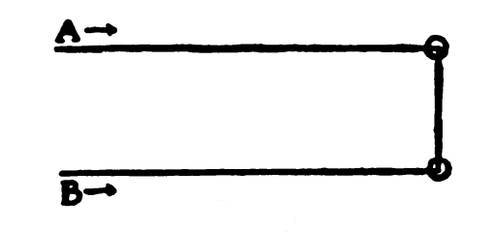
Fig. 24
The nature of this scheme makes it unfit to explain real reproduction, for two reasons:
(1) If a process X, altogether different from A, should happen to be conducted along A’s path to its final nucleus, it would take the line of least resistance from there, spread to the nucleus of B and reproduce it, though X has never occurred together with B a single time. You object, claiming that this scheme was to be applied only to such processes as had occurred simultaneously before? But in the scheme itself such a restriction is not mentioned; in any case we cannot deduce from the scheme why it should be so. Therefore, the scheme will not explain one essential condition of reproduction.
(2) If the process A should happen to start from quite another point of the receptor organ along another path, it will not be conducted to that cerebral cells which have been especially connected with the cerebral nucleus of B. Consequently there is no reason why it should spread to B rather than to any other cells. This means that, in such a case, A will not reproduce B, though it is associated with it. If, under experimental conditions, however, a process A, starting from one region of the retina, has been associated with another process B, a process A (or A1) projected upon quite another part of the retina, will reproduce B without great difficulty. So much has been shown by E. Becher.[73]
If you object that between the new path of A and the cerebral area of B there may also be some highly conductive path, you introduce chance conditions instead of an explanation by definite acquired machine arrangements, i.e., you give up your claim to precise explanation. Moreover, if coming from this new point of origin A should happen to find such readily conductive paths to B, the same might conceivably be true of all possible processes D, E, F and so forth, which, therefore, should “reproduce” B at any time without previous association.
The weakness of the whole scheme is, then, that it makes reproduction depend upon the specific location of paths and nuclei in each particular case, as though such simple location were a true representative of definite process. Only if this were so, might a theory of reproduction become a purely topographical matter. In the optic sector of the nervous system, at least, a given process may be conducted in one bundle of fibers at one time, and another process may be conducted in the same bundle shortly afterwards. Furthermore, the same process may be conducted in certain fibers now, and in other fibers later on. Therefore, the necessary requirement for making the machine theory of reproduction possible is not fulfilled in the case of our most important sense organ. In the optical system the correlation between the different kinds of process and the different localities in which they may occur is very near to zero. This should destroy all hope of treating reproduction exclusively in terms of topographical conditions.
I shall admit at once that, in this respect, we are as yet no better off with the hypothesis about association which was proposed in the last chapter. It is similar to the old view insofar as it assumes a physiological trace of (AB) and insofar as, in each case, this trace must have some place in the nervous system. If, then, the process A enters the nervous system from a different point of origin and along another path, how does it arrive at the specific locus of that trace? One feels inclined to give a dynamical explanation. The similarity between A and its trace might work as though A were attracted to the trace. I shall not venture an explanation here, however, for a very simple reason. The problem is formulated as if automatic reproduction were the simplest and most common event in the world. But we have seen that it probably is not. Perhaps, when we learn a little more about the concrete rules and conditions of reproduction as such, we shall be better able to treat its physiological basis.
BIBLIOGRAPHY
E. Becher: Gehirn und Seele. 1911.
J. von Kries: Die materiellen Grundlagen der Bewusstseinserscheinungen. 1901.
K. Lewin: Psychol. Forsch. 1 and 2. 1921, 1922.
K. Lewin: Vorsatz, Wille und Bedürfnis. 1926.
W. Poppelreuter: Zeitschr. f. Psychol. 61. 1912.