Front matter
Reading edition
Transcriber's Notes
The only minor correction that was noted in converting this document from a printed version into an electronic version was an unpaired parenthesis on the first line of the Title Page.
CHAMBERS'S ELEMENTARY SCIENCE MANUALS.
GEOLOGY
BY
JAMES GEIKIE, LL.D., F.R.S.
OF H.M. GEOLOGICAL SURVEY; AUTHOR OF 'THE GREAT ICE AGE.'

W. & R. CHAMBERS LONDON AND EDINBURGH 1883
Edinburgh: Printed by W. and R. Chambers.
PREFACE.
The vital importance of diffusing some knowledge of the leading principles of Science among all classes of society, is becoming daily more widely and deeply felt; and to meet and promote this important movement, W. & R. Chambers have resolved on issuing the present Series of Elementary Science Manuals. The Editors believe that they enjoy special facilities for the successful execution of such an undertaking, owing to their long experience—now extending over a period of forty years—in the work of popular education, as well as to their having the co-operation of writers specially qualified to treat the several subjects. In particular, they are happy in having the editorial assistance of Andrew Findlater, LL.D., to whose labours they were so much indebted in the work of editing and preparing Chamber's Encyclopædia.
The Manuals of this series are intended to serve two somewhat different purposes:
1. They are designed, in the first place, for Self-instruction, and will present, in a form suitable for private study, the main subjects entering into an enlightened education; so that young persons in earnest about self-culture may be able to master them for themselves.
2. The other purpose of the Manuals is, to serve as Text-books in Schools. The mode of treatment naturally adopted in what is to be studied without a teacher, so far from being a drawback in a school-manual, will, it is believed, be a positive advantage. Instead of a number of abrupt statements being presented, to be taken on trust and learned, as has been the usual method in school-teaching; the subject is made, as far as possible, to unfold itself gradually, as if the pupil were discovering the principles himself, the chief function of the book being, to bring the materials before him, and to guide him by the shortest road to the discovery. This is now acknowledged to be the only profitable method of acquiring knowledge, whether as regards self-instruction or learning at school.
For simplification in teaching, the subject has been divided into sub-sections or articles, which are numbered continuously; and a series of Questions, in corresponding divisions, has been appended. These Questions, while they will enable the private student to test for himself how far he has mastered the several parts of the subject as he proceeds, will serve the teacher of a class as specimens of the more detailed and varied examination to which he should subject his pupils.
NOTE BY THE AUTHOR.
In the present Manual of Geology it has been the aim of the author rather to indicate the methods of geological inquiry and reasoning, than to present the learner with a tedious summary of results. Attention has therefore been directed chiefly to the physical branches of the science—Palæontology and Historical Geology, which are very large subjects of themselves, having been only lightly touched upon. The student who has attained to a fair knowledge of the scope and bearing of Physical Geology, should have little difficulty in subsequently tackling those manuals in which the results obtained by geological investigation are specially treated of.
CONTENTS.
PAGE
INTRODUCTORY7
CLASSIFICATION OF ROCKS8
MINERALOGY12
ROCK-FORMING MINERALS14
PETROLOGY
MECHANICALLY FORMED ROCKS17
CHEMICALLY FORMED ROCKS19
ORGANICALLY DERIVED ROCKS20
METAMORPHIC ROCKS21
IGNEOUS ROCKS23
STRUCTURE AND ARRANGEMENT OF ROCK-MASSES—
Stratification, &c.; Mud-cracks and Rain-prints; Succession of Strata; Extent of Beds; Sequence of Beds—Joints; Cleavage; Foliation; Concretions; Inclination of Strata; Contemporaneous Erosion; Unconformability; Overlap; Faults; Mode of Occurrence of Metamorphic and Igneous Rocks; Mineral Veins26-46
DYNAMICAL GEOLOGY
THE ATMOSPHERE AS A GEOLOGICAL AGENT OF CHANGE46
WATER AS A GEOLOGICAL AGENT OF CHANGE48
GEOLOGICAL ACTION OF PLANTS AND ANIMALS60
SUBTERRANEAN FORCES64
METAMORPHISM72
PHYSIOGRAPHY74
PALÆONTOLOGY77
HISTORICAL GEOLOGY84
QUESTIONS89
INTRODUCTORY.
1. Definition.—Geology is the science of the origin and development of the structure of the earth. It treats of the nature and mode of formation of the various materials of which the earth's crust is composed; it seeks to discover what mutations of land and water, and what changes of climate, have supervened during the past; it endeavours to trace the history of the multitudinous tribes of plants and animals which have successively tenanted our globe. In a word, Geology is the Physical Geography of past ages.
2. Rocks.—Every one knows that the crust of the earth is composed of very various substances, some of which are hard and crystalline in texture, like granite; others less indurated and non-crystalline, such as sandstone, chalk, shale, &c.; while yet others are more or less soft and incoherent masses, as gravel, sand, clay, peat, &c. Now, all these heterogeneous materials, whether they be hard or soft, compact or loose, granular or crystalline, are termed rocks. Blowing sand-dunes, alluvial silt and sand, and even peat, are, geologically speaking, rocks, just as much as basalt or any indurated building-stone. The variety of rocks is very great, but we do not study these long before we become aware that many kinds which present numerous contrasts in detail, yet possess certain characters in common. And this not only groups these diverse species together, but serves also to distinguish them from other species of rock, which in like manner are characterised by the presence of some prevalent generic feature or features.
Classification of Rocks.—All the rocks that we know of are thus capable of being arranged under five classes, as follows:
I.Mechanically formed.
II.Chemically formed.
III.Organically derived.
IV.Metamorphic.
V.Igneous.
3. The Mechanically formed class comprises a considerable variety of rocks, all of which, however, come under only two subdivisions—namely, Sedimentary, and Eolian or Aërial, the former being by far the more important. Of the Sedimentary group, there are three rocks which may be taken as typical and representative—namely, conglomerate or puddingstone, sandstone, and shale. A short examination of the nature of these will sufficiently explain why they come to be grouped together under one head. Conglomerate consists of a mass of various-sized rounded stones cemented together; each stone has been well rubbed, and rolled, and rounded. It is quite obvious that the now solid rock must at one time have existed in a loose and unconsolidated state, like gravel and shingle. Nor can we resist the conclusion that the stones were at one time rolled about by the action of water—that being the only mode in which gravel-stones are shaped. Again, when we have an opportunity of examining any considerable vertical thickness of conglomerate, we shall frequently observe that the stones are arranged more or less definitely along certain lines. These, there can be no question, are lines of deposition—the rounded stones have evidently not been formed and accumulated all at once, but piled up gradually, layer upon layer. And since there is no force in nature, that we know of, save water in motion, that could so round and smooth stones, and spread them out in successive layers or beds, we may now amplify our definition of conglomerate, and describe it as a compacted mass of stones which have been more or less rounded, and arranged in more or less distinct layers or beds, by the action of water.
4. Sandstone may at the outset be described as a granular non-crystalline rock. This rock shews every degree of coarseness, from a mass in which the constituent grains are nearly as large as turnip-seed, down to a stone so fine in the grain that we need a lens to discover what the particles are of which it is composed. When these latter are examined, they are found to exhibit marks of attrition, just like the stones of a conglomerate. Sharp edges have been worn off, and the grains rounded and rubbed; and whereas lines of deposition are often obscure, and of infrequent occurrence in conglomerate—in sandstone, on the contrary, they are usually well marked and often abundant. We can hardly doubt, therefore, that sandstone has also had an aqueous origin, or in other words, that it has been formed and accumulated by the force of water in motion. In short, sandstone is merely compacted sand.
5. If it be easy to read the origin of conglomerate and sand in the external character of their ingredients, and the mode in which these have been arranged, we shall find it not less easy to discover the origin of shale. Shale is, like sandstone, a granular non-crystalline rock. The particles of which it is built up are usually too small to be distinguished without the aid of a lens, but when put under a sufficient magnifying power, they exhibit evident marks of attrition. In structure it differs widely from sandstone. In the latter rock the layers of deposition, though frequently numerous, are yet separated from each other by some considerable distance, it may be by a few inches or by many yards. But in shale the layers are so thin that we may split the rock into laminæ or plates. Now we know that many sedimentary materials of recent origin, such as the silt of lakes, rivers, and estuaries, although when newly dug into they appear to be more or less homogeneous, and shew but few lines of deposition, yet when exposed to the action of the atmosphere and dried, they very often split up into layers exhibiting division planes as minute as any observable in shale. There is no reason to doubt, therefore, that shale is merely compacted silt and mud—the sediment deposited by water. It becomes evident, therefore, that conglomerate, sandstone, and shale are terms of one series. They are all equally sedimentary deposits, and thus, if we slightly modify our definition of conglomerate, we shall have a definition which will include the three rocks we have been considering. For they may all be described as granular non-crystalline rocks, the constituent ingredients of which have been more or less rounded, and arranged in more or less distinct layers, by the action of water.
6. The Eolian or Aërial group of rocks embraces all natural accumulations of organic or inorganic materials, which have been formed upon the land. The group is typically represented by débris, such as gathers on hill-slopes and at the base of cliffs, by the sand-hills of deserts and maritime districts, and by soil. All these accumulations owe their origin to atmospheric agencies, as will be more particularly described in the sequel. As the Sedimentary and Eolian rocks are the results of the mechanical action of water and the atmosphere, they are fitly arranged under one great class—the Mechanically formed Rocks.
7. Chemically formed Rocks constitute another well-marked class, of which we may take rock-salt as a typical example. This rock has evidently been deposited in water, but not in the manner of a sedimentary bed. It is not built up of water-worn particles which have been rolled about and accumulated layer upon layer, but has been slowly precipitated during the gradual evaporation of water in which it was previously held in solution. Its formation is therefore a chemical process. Various other rocks come under the same category, as we shall afterwards point out.
8. The Organically derived class comprises a number of the most important and useful rock-masses. Chalk may be selected as a typical example. Even a slight examination shews that this rock differs widely from any of those mentioned above. Conglomerate, sandstone, shale, &c. are built up of pebbles, particles, grains, &c. of various inorganic materials. But chalk, when looked at under the microscope, betrays an organic origin. It consists, chiefly, of the hard calcareous parts of animal organisms, and is more or less abundantly stocked with the remains of corals, shells, crustaceans, &c. in every degree of preservation; indeed, so abundant are these relics, that they go to form a great proportion of the rock. Coal is another familiar example of an organically derived rock, since it consists entirely of vegetable remains.
9. The Metamorphic class, as the name implies, embraces all those rocks which have undergone some decided change since the time of their formation. This change generally consists in a re-arrangement of their constituent elements, and has frequently resulted in giving a crystalline texture to the rocks affected. Hence certain sedimentary deposits like sandstone and shale have been changed from granular into crystalline rocks, and the like has happened to beds of limestone and chalk. Mica-schist, gneiss, and saccharoid marble are typical of this class.
10. The Igneous rocks are those which owe their origin to the action of the internal forces of the earth's crust. Most of them have been in a state of fusion, and betray their origin by their crystalline and sometimes glassy texture, and also, as we shall see in another section, by the mode of their occurrence. Lava, basalt, and obsidian are characteristic types of this group of igneous rocks. Another group embraces a large variety of igneous rocks which are non-crystalline, and vary in texture from fine-grained, almost compact, bedded masses, like certain varieties of tuff, up to coarse, irregular accumulations of angular stones imbedded in a fine-grained or gritty matrix, like volcanic breccia and volcanic agglomerate.
MINERALOGY.
11. Having learned that all the rocks met with at the surface of the earth's crust are capable of being arranged under a few classes, we have now to investigate the matter more in detail. It will be observed that the classification adopted above is based chiefly upon the external characters of the constituent ingredients of the rocks, and the mode in which these particles have been collected. In some rocks the component materials are crystalline, in others they are rounded and worn; in one case they have been brought together by precipitation from an aqueous solution, or they have crystallised out from a mass of once molten matter; in another case their collection and intimate association is due to the mechanical action of the atmosphere or of water, or to the agency of the organic forces. We have next to inquire what is the nature of those crystals and particles which are the ingredients of the rocks? The answer to this question properly belongs to the science of mineralogy, with which, however, the geologist must necessarily make some acquaintance.
12. Granite—its composition.—It will tend to simplify matters if we begin our inquiry by selecting for examination some familiar rock, such as granite. This rock, as one sees at a glance, is crystalline, nor is it difficult to perceive that three separate kinds of ingredients go to compose it. One of these we shall observe is a gray, or it may be, clear glassy-looking substance, which is hard, and will not scratch with a knife; another is of a pink, red, gray, or sometimes even pale green colour, and scratches with difficulty; while the third shews a glistering metallic lustre, and is generally of a brownish or black colour. It scratches easily with the knife, and can be split up into flakes of extreme thinness. If the granite be one of the coarse-grained varieties, we shall notice that these three ingredients have each more or less definite crystalline forms; so that they are not distinguished by colour and hardness alone. The metallic-looking substance is mica; the hard gray, or glassy and unscratchable ingredient is quartz; and the remaining material is felspar. The mineralogist's analysis of granite ends here. But there is still much to be learned about quartz, felspar, and mica; for, as the chemist will tell us, these are not 'elementary substances.' Quartz is a compound, consisting of two elements, one of which is a non-metallic body (silicon), and the other an invisible gas (oxygen). Felspar[A] is a still more complex compound, being made up of two metals (potassium, aluminium) and one non-metallic body (silicon), each of which is united to an invisible gas (oxygen). Mica, again, contains no fewer than four metals (potassium, magnesium, iron, calcium) and one non-metallic body (silicon), each of which is in like manner chemically united to its share of oxygen. Thus the rock-forming substances, quartz, felspar, and mica, have each a definite chemical composition.
13. Minerals.—Now, any inorganic substance which has a definite chemical composition, and crystallises in a definite crystalline or geometric form, is termed a mineral. Having once discovered that quartz is composed of silicon and oxygen—that is, silica—and that the faces of its crystals are arranged in a certain definite order, we may be quite sure that any mineral which has not this composition and form cannot be quartz. And so on with mica and felspar, and every other mineral. The study of the geometric forms assumed by minerals (crystallography) forms a department of the science of mineralogy. But, in the great majority of cases, the mineral ingredients of the rocks are either so small individually, or so broken, and rounded, and altered, that crystallography gives comparatively little aid to the practical geologist in the field. He has, therefore, recourse to other tests for the determination of the mineral constituents of rocks. Many of these tests, however, can only be applied by those who have had long experience. The simplest and easiest way for the student to begin is to examine the forms and appearance of the more common minerals in some collection, and thereafter to accustom his eye to the aspect presented by the same minerals when they are associated together in rocks, of which illustrative specimens are now to be met with in most museums. The microscope is largely employed by geologists for determining the mineralogical composition of certain rocks; and, indeed, many rocks can hardly be said to be thoroughly known until they have been sliced and examined under the microscope, and analysed by the chemist. But with a vast number such minute examination is not required, the eye after some practice being able to detect all that is needful to be known.
ROCK-FORMING MINERALS.
14. Nearly all the minerals we know of contain oxygen as a necessary ingredient, there being only a very few minerals in which that gas does not occur in chemical union with other elements. Three of these minerals, sulphur, the diamond, and graphite, consist of simple substances, and are of great commercial importance, but none of them is of so frequent occurrence, as a rock constituent, as the minerals presently to be described. Sulphur occurs sometimes in thin beds, but more frequently in small nests and nodules, &c. in other rocks, or in joints, and fissures, and veins. It is frequently found in volcanic districts. The diamond, which consists of pure carbon, is generally met with in alluvial deposits, but sometimes, also, in a curious flexible sandstone, called itacolumite. Graphite is another form of carbon. It occurs both in a crystalline and amorphous form, the latter, or non-crystalline kind, being extensively used for lead-pencils. Rock-salt is a chloride of sodium, and appears sometimes in masses of a hundred feet and more in thickness. Another mineral which contains no oxygen is the well-known fluor-spar. It occurs chiefly in veins, and is often associated with ores. With these, and a few other exceptions, all the minerals hitherto discovered contain oxygen as an essential element; and so large is the proportion of this gas which enters into union with other elements to constitute the various minerals of which the rocks are composed, that it forms at least one-half of all the ponderable matter near the earth's surface. When the student learns that there are probably no fewer than six or seven hundred different minerals, he will understand how impossible it is to do more in a short geological treatise than point out a few of the most commonly occurring ones. And, indeed, a knowledge of the chief rock-forming minerals, which are few in number, is all that is absolutely requisite for geological purposes. Some of these we accordingly proceed to name.[B]
15. Quartz.—This mineral has already been partially described. It is the most abundant of all the rock-forming minerals, and occurs in three forms: (1) crystallised quartz or rock crystal; (2) chalcedony, both of which are composed of silica—that is, silicon and oxygen; and (3) hydrated quartz—that is, silica with the addition of water.
Hematite.—This is an oxide of iron. It occurs in mammillary rounded masses, with a fibrous structure, and a dull metallic lustre. Magnetite or magnetic iron ore, specular iron, and limonite are also oxides of iron. Hematite shews a red streak when scratched with a knife, which distinguishes it from magnetite.
Iron pyrites.—This is a sulphide of iron of very common occurrence. Its crystalline form is cubical. When broken, it emits a sulphurous smell. The brass-yellow coloured cubes so often seen in roofing-slates are familiar examples of the mode of its occurrence. But it is also frequently found in masses having a crystalline surface.
16. Sulphates.—Only two sulphates may be noticed—namely, gypsum, which is a sulphate of lime, with its varieties, selenite, satin-spar, and alabaster; and barytes, a sulphate of baryta. Barytes scratches easily with the knife, and from its great specific gravity is often called heavy-spar. Gypsum is softer than barytes.
Carbonates.—Two of these only need be mentioned: calcite or calc-spar, a carbonate of lime, which scratches with the knife, and effervesces readily with dilute hydrochloric acid; and arragonite, also a carbonate of lime, but denser than calcite.
Silicates.—These are by far the most abundantly occurring minerals. The species are also exceedingly numerous, but we may note here only a few of the more important. They are composed of silica and various bases, such as lime, potash, magnesia, soda, alumina, &c. Augite or pyroxene is a black or greenish-black mineral, found, either as crystals, which are generally small, or as rounded grains and angular fragments, in basaltic and volcanic rocks. It never occurs in granite rocks. It is brittle, and has a vitreous or resinous lustre. There are a number of varieties or sub-species of augite. Hornblende, like augite, also includes a great many minerals. When the crystals are small, it is often difficult to distinguish hornblende from augite. Common hornblende occurs crystallised or massive, and is dark green or black, with a vitreous lustre. It is generally sub-translucent. It usually crystallises in igneous rocks which contain much quartz or silica; while augite, on the other hand, crystallises in igneous rocks which are of a more basic character—that is to say, rocks in which silica is not so abundantly present. Felspar is a generic term which embraces a number of species, such as orthoclase or potash-felspar, albite or soda-felspar, and anorthite or lime-felspar. Orthoclase is white, red or pink, and gray. It is one of the ordinary constituents of granite, and enters into the composition of many rocks. Albite is usually white. It often occurs as a constituent of granite, not unfrequently being associated in the same rock with pink felspar or orthoclase. In syenite and greenstone it occurs more commonly than orthoclase. Anorthite occurs in white translucent or transparent crystals. It is not so common a constituent of rocks as either of the other felspars just referred to. Mica: this term includes several minerals, which all agree in being highly cleavable into thin elastic flakes or laminæ, which have a glistening metallic lustre. Mica is one of the common constituents of granite. Talc is a silvery white, grayish, pale or dark-green coloured mineral, with a pearly lustre. It splits readily into thin flakes, which are flexible, but not elastic, and may be readily scratched with the nail. It is unctuous and greasy to the touch. It occurs in beds (talc-slate), and is often met with in districts occupied by metamorphic crystalline rocks. Serpentine is generally of a green colour, but brown, red, and variously mottled varieties occur. It has a dull lustre, and is soft, and easily cut; it is tough, however, and takes on a good polish. It forms rock-masses in some places. The finer varieties are called noble serpentine. Chlorite is another soft, easily scratched mineral, generally of a dark-green colour. It has a pearly lustre. Sometimes it occurs in beds (chlorite-slate), and is often found coating the walls of fissures in certain rocks. It has a somewhat greasy feel. The three last-mentioned minerals—talc, serpentine, and chlorite—are all silicates of magnesia. Zeolites is a term which comprises a number of minerals of varying chemical composition, all of which tend to form a jelly when treated with acids. When heated by the blow-pipe they bubble up, owing to the escape of water; hence their name zeolites, from zeō, I boil, and lithos, a stone. The zeolites occur very commonly in cavities in igneous rocks, and also in mineral veins.
Having now mentioned the chief rock-forming minerals, we proceed to a brief description of some of the more typical representatives of the five great classes of rocks referred to at page 8.
PETROLOGY.[C]
MECHANICALLY FORMED ROCKS.
17. (A.) Sedimentary Class.—Three of the most commonly occurring rocks of this class have already been described, but a few details are added here.
Conglomerate.—This is a consolidated mass of more or less water-worn and rounded stones. These stones may be of any size. When they are very large, the rock is called a coarse conglomerate; the finer varieties, in which the stones are small, are known as pebbly conglomerates. The ingredients of a conglomerate may consist of any kind of rock, or of a mixture of many different kinds. When they consist entirely of quartz, the rock becomes quartzose. The finer-grained conglomerates usually shew lines of deposition or bedding, but in some of the coarser sorts it is often difficult to detect any kind of arrangement. The stones are usually imbedded in a matrix of quartzose grit and sand, but sometimes this is very scanty. When the nature of the material which binds the stones together is very well marked, the rock becomes ferruginous, calcareous, arenaceous, or argillaceous, according as the binding or cementing material is iron, lime, sand, or clay. Breccia is a rock in which the included fragments are angular.
18. Sandstone is, as already remarked, merely consolidated sand. The coarser varieties, in which the grains are as large and larger than turnip-seeds, are termed grit. From these coarse varieties the rock passes insensibly, in one direction, into a fine or pebbly conglomerate, and in another into a rock, so fine-grained that a lens is needed to distinguish the component particles. Quartz is the prevailing ingredient—sometimes clear, at other times white. Frequently, however, the grains are coated with an oxide of iron, which gives the resulting rock a red colour. The other colours assumed by sandstone—such as yellow, brown, green, &c.—are also in like manner due to the presence of some compound of iron. When mica or felspar occurs plentifully, we have, in the one case, micaceous sandstone, and in the other felspathic sandstone. A sandstone in which the grains are cemented by carbonate of lime is said to be calcareous. Freestone is a sandstone which can be worked freely in any direction. In most sandstones, the lines of bedding are distinct; when they are so numerous as to render the rock fissile, the sandstone is said to be shaly.
Shale is a more or less indurated fissile or laminated clay. When the rock becomes coarse by the admixture of sand, it gradually passes into a shaly sandstone. There are many other varieties of clay-rocks—such as fire-clay, pipe-clay, marl, loam, &c.—which are sufficiently familiar.
19. (B.) Eolian or Aërial Class.—Blown-sand is found at many places on sea-coasts. It generally forms smooth rounded hummocks, which are sometimes arranged in long lines parallel to the trend of the coast, as, for example, in the Tents Moor, near St Andrews. The sand-hills of deserts also belong to this class.
Débris is the loose angular rubbish which collects at the base of cliffs, on hill-tops, and hill-slopes. Immense accumulations of it occur in lofty mountainous districts and in arctic regions. In Nova Zembla, for example, the solid rock of the country is almost concealed beneath a thick covering of débris. But the various kinds of débris will be more particularly described further on.
Soil.—An account of this can hardly be given without entering into the theory of its origin, and therefore we reserve its consideration for the present.
CHEMICALLY FORMED ROCKS.
20. Stalactites and stalagmites are carbonates of lime. They vary in colour, being white, or yellow, or brown. Stalactites are usually found adhering to the roofs of limestone caverns, &c., or depending from limestone rocks; stalagmites, on the other hand, commonly occur on the floors of limestone caverns, where they often attain a thickness of many feet.
Siliceous sinter is silica with the addition of water—in other words, a hydrated quartz. It is not a very abundant rock, and is found chiefly in volcanic countries.
Rock-salt has already been described. It occurs either as thin beds, or in the form of thick cake-like masses, often reaching ninety or one hundred feet in thickness. It is rudely crystalline in texture, and is usually discoloured brown and red with various impurities.
ORGANICALLY DERIVED ROCKS.
21. Limestone consists of carbonate of lime, but usually contains some impurities. The varieties of this rock are numerous; some of them are as follows: Chalk; oolite, a rock built up of little spheroidal concretions, whence its name, egg or roe stone (the coarser oolites are called pisolite, or pea-stone); lacustrine limestone, &c. When much silica is diffused through the rock, we have a siliceous limestone; the presence of clay and of carbonaceous matter gives us argillaceous and carbonaceous limestones. Cornstone is a limestone containing a large quantity of arenaceous matter or sand. Many limestones are distinguished by the different kinds of organic remains which they yield. Thus, we have muschelkalk or shell-limestone, nummulitic, crinoidal, &c. limestone. The crystalline limestones, such as statuary marble, are metamorphosed limestones. Not a few limestones are chemically formed rocks, and many, also, are partly of chemical and partly of organic origin, so that no hard and fast line can be drawn between these two classes of rock.
Dolomite, or magnesian limestone.—This is a compound of carbonate of lime and carbonate of magnesia. Its colour is usually yellow, or yellowish brown, but gray and black varieties are sometimes met with. It is generally fine-grained, with a crystalline texture, and pearly lustre. It effervesces less freely with acids than pure limestone. In many cases dolomite is merely a metamorphosed limestone.
22. Coal is composed of vegetable matter, but usually contains a greater or less percentage of impurities. The varieties of this substance are very numerous, and differ from each other principally in regard to their bituminous or non-bituminous character. Coal is bituminous or non-bituminous according as it is less or more highly mineralised. Bitumen results from the decomposition of vegetable matter; but, when the mineralising process (to which the formation of coal is due) has proceeded far enough, the vegetable matter gradually loses its bituminous character, and the result is a non-bituminous coal. Varieties of coal are the following: Lignite or brown coal; caking coal; cannel, parrot, or gas coal; splint coal; cherry or soft coal; anthracite or blind coal, so called because it burns with no flame. Peat may be mentioned as another natural fuel. It is composed of vegetable matter. In some kinds it is so far decomposed, or mineralised, that the eye does not detect vegetable fibres; when thoroughly dried, such peat breaks like a good lignite, and forms an excellent fuel.
METAMORPHIC ROCKS.
23. Quartz-rock, or quartzite, is an altered quartzose sandstone or grit; it is generally a white or grayish-yellow rock, very hard and compact. The original gritty character of the rock is distinct, but the granules appear as if they had been fused so far as to become mutually adherent. When the altered sandstone has been composed of grains of quartz, felspar, or mica, set in a siliceous, felspathic, or argillaceous base, we get a rock called greywacké, which is usually gray or grayish blue in colour.
24. Clay-slate is a grayish blue, or green, fine-grained hard rock, which splits into numerous more or less thin laminæ, which may or may not coincide with the original bedding. Most usually the 'cleavage,' as this fissile structure is termed, crosses the bedding at all angles.
25. Crystalline limestone is an altered condition of common limestone. Saccharoid marble is one of the fine varieties: it frequently contains flakes of mica. Dolomite, or magnesian limestone, already described, is probably in many cases an altered limestone; the carbonate of lime having been partially dissolved out and replaced by carbonate of magnesia. Serpentine is also believed by some geologists to be a highly metamorphosed magnesian limestone.
26. Schists.—Under this term comes a great variety of crystalline rocks which all agree in having a foliated texture—that is to say, the constituent minerals are arranged in layers which usually, but not invariably, coincide with the original bedding. Amongst the schists come mica-schist (quartz and mica in alternate layers); chlorite-schist (chlorite with a little quartz, and sometimes with felspar or mica); talc-schist (talc with quartz or felspar); hornblende schist (hornblende with a variable quantity of felspar, and sometimes a little quartz); gneiss (quartz, felspar, and mica).
27. General Character of Metamorphic Rocks.—All these rocks betray their aqueous origin by the presence of more or less distinct lines of bedding. They consist of various kinds of arenaceous and argillaceous deposits, which, under the influence of certain metamorphic actions, to be described in the sequel, have lost their original granular texture, and become more or less distinctly crystallised. And not only so, but their chemical ingredients have in many cases entered into new relations, so as to give rise to minerals which existed either sparingly or not at all in the original rocks. Frequently, it is quite impossible to say what was the original condition of some metamorphic rocks; often, however, this is sufficiently obvious. Thus, highly micaceous sandstones, as they are traced into a metamorphic region, are seen to pass gradually into mica-schist. When the bedding of gneiss becomes entirely obliterated, it is often difficult to distinguish that rock from granite, and in many cases it appears to pass into a true granite.
28. Granite is a crystalline compound of quartz, felspar (usually potash-felspar), and mica. Some geologists consider it to be invariably an igneous rock; but, as just stated, it sometimes passes into gneiss in such a way as to lead us to infer its metamorphic origin. There are certain areas of sandstone in the south of Scotland which are partially metamorphosed, and in these we may trace a gradual passage from highly baked felspathic sandstones with a sub-crystalline texture into a more crystalline rock which in places graduates into true granite. Granite, however, also occurs as an igneous rock.
29. Syenite is a crystalline compound of a potash-felspar and hornblende, and quartz is frequently present. Diorite is a crystalline aggregate of a soda-felspar and hornblende. Both syenite and diorite also occur as igneous rocks.
There are a number of other metamorphic rocks, but those mentioned are the most commonly occurring species.
IGNEOUS ROCKS.
30. Subdivisions.—In their chemical and mineralogical composition, igneous rocks offer great variety; but they all agree in having felspar for their base. They may be roughly divided into two classes, distinguished by the relative quantity of silica which they contain. Those in which the silica ranges from about 50 to 70 or 80 per cent. form what is termed the acidic group; while those in which the percentage of silica is less constitute the basic group of igneous rocks, so called because they contain a large proportion of the heavier bases, such as magnesia, lime, oxides of iron and manganese, &c. Igneous rocks vary in texture from homogeneous, compact, and finely crystalline masses up to coarsely crystalline aggregates, in which the crystals may be more than an inch in diameter. Sometimes they are dull and earthy in texture, at other times vesicular. When the vesicles are filled up with some mineral, the rock is said to be amygdaloidal, from the almond shape assumed by the kernels filling the cavities. When single crystals of any mineral are scattered through a rock, so as to be readily distinguished from the compact or crystalline base, the rock becomes porphyritic.
ACIDIC OR FELSPATHIC GROUP.
31. Trachyte (trachys, rough) is a pale or dark-gray rock, harsh and rough to the touch, in which felspar is the predominant mineral. It is a common product of eruption in modern volcanoes.
Clinkstone or phonolite is a greenish-gray, compact, felspathic rock, somewhat slaty or schistose, and weathers with a white crust. It gives a clear metallic sound under the hammer. It is a rock not met with among the older formations of the earth's crust, being confined to Tertiary (see table, p. 85) or still more recent times.
Obsidian or volcanic glass is usually black, brown, or green, and usually resembles a coarse bottle-glass. When it becomes vesicular, it passes gradually into the highly porous rock called pumice. It is eminently a geologically modern volcanic rock.
Felstone is a reddish-gray, bluish, greenish, or yellowish, hard, compact, flinty-looking rock, composed of potash-felspar and silica. It is generally splintery under the hammer. Some varieties are slaty, and are frequently mistaken for clinkstone, which they closely resemble. When the quartz in felstone is distinctly visible either as grains or crystals, the rock passes into a quartz-porphyry.
Granite is recognised as an igneous as well as a metamorphic rock. Sometimes the veins and dykes which proceed from or occur near a mass of granite contain no mica—this kind of rock is called elvan or elvanite.
Porphyrite or felspathite includes a number of rocks which have a felspathic base, through which felspar crystals are scattered more or less abundantly. Sometimes hornblende, or augite, or mica is present. The colour is usually dark—some shade of blue, green, red, puce, purple, or brown—and the texture varies from compact and finely crystalline up to coarsely crystalline. Porphyrites are usually porphyritic, and frequently amygdaloidal.
AUGITIC AND HORNBLENDIC OR BASIC GROUP.
32. Basalt is a dark or almost black compact homogeneous rock, composed of felspar and augite with magnetic iron. An olive-green mineral called olivine is very frequently present. The coarser-grained basalts are called dolerite. The columnar structure is not peculiarly characteristic of basalt. Many basalts are not columnar, and not a few columnar rocks are not basalts.
Greenstone or diorite is usually a dull greenish rock, sometimes gray, however, speckled with green. It is composed of soda-felspar and hornblende. The fine-grained compact greenstones are called aphanite.
Syenite, like granite, is recognised as an igneous as well as a metamorphic rock. There are several other rocks which come into the basic group, but those mentioned are the more common and typical species.
33. Fragmental Igneous Rocks.—All the igneous rocks briefly described above are more or less distinctly crystalline in texture. There is a class of igneous rocks, however, which do not present this character, but when fine-grained are dull and earthy in texture, and frequently consist merely of a rude agglomeration of rough angular fragments of various rocks. These form the Fragmental group of igneous rocks. The ejectamenta of loose materials which are thrown out during a volcanic eruption, consist in chief measure of fragments of lava, &c. of all sizes, from mere dust, sand, and grit, up to blocks of more than a ton in weight. These materials, as we shall afterwards see, are scattered round the orifice of eruption in more or less irregular beds. The terms applied to the varieties of ejectamenta found among modern volcanic accumulations, will be given and explained when we come to consider the nature of geological agencies. In the British Islands, and many other non-volcanic regions, we find besides crystalline igneous rocks, abundant traces of loose ejectamenta, which clearly prove the former presence of volcanoes. These materials are sometimes quite amorphous—that is to say, they shew no trace of water action—they have not been spread out in layers, but consist of rude tumultuous accumulations of angular and subangular fragments of igneous rocks. Such masses are termed trappean agglomerate and trappean breccia. At other times, however, the ejectamenta give evidence of having been arranged by the action of water, the materials having been sifted and spread out in more or less regular layers. What were formerly rude breccias and agglomerates of angular stones now become trappean conglomerates—the stones having been rounded and water-worn—while the fine ingredients, the grit, and sand, and mud, form the rock called trap tuff. Fragmental rocks are often quite indurated—the matrix being as hard as the included stones. But as a rule they are less hard than crystalline igneous rocks, and in many cases are loose and crumbling. When a fragmental rock is composed chiefly of rocks belonging to the acidic group, we say it is felspathic. When augitic and hornblendic materials predominate, then other terms are used; as, for example, dolerite tuff, greenstone tuff.
STRUCTURE AND ARRANGEMENT OF ROCK-MASSES.
34. The student can hardly learn much about the mineralogical composition of rocks, without at the same time acquiring some knowledge of the manner of their occurrence in nature. We have already briefly described certain sedimentary rocks, such as conglomerate, sandstone, and shale, and have in some measure touched upon their structure as rock-masses. These rocks, as we have seen, are arranged in more or less thick layers or beds, which are piled one on the top of the other. Rocks which are so arranged are said to be stratified, and are termed strata. We may also use the word stratum as an occasional substitute for bed. The planes of bedding or stratification are sometimes very close together, in other cases they are wide apart. When the separate beds are very thin, as in the case of shale, it is most usual to term them laminæ, and to speak of the lamination of a shale, as distinguished from the bedding of a sandstone. Planes of bedding are generally more strongly marked than planes of lamination. The laminæ frequently cohere, while beds seldom do. In the above figure, which represents a vertical cutting or section through horizontal strata, the planes of lamination are shewn at l, l, l, and those of stratification at s, s, s. There are hardly any limits to the thickness of a bed—it may range from an inch up to many feet or yards, while laminæ vary in thickness from an inch downwards.
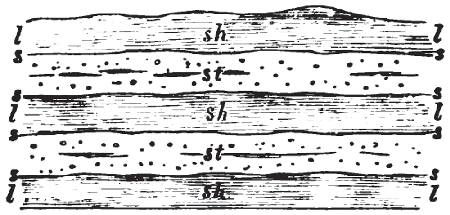
Fig. 1.—st, sandstone, and sh, shale: s, lines or planes of bedding; l, lines or planes of lamination.
35. Hitherto we have been considering the laminæ and strata as lying in an approximately horizontal plane. Sometimes, however, the layers of deposition in a single stratum are inclined at various angles to themselves, as in the following figure. This structure is called false bedding; the layers or laminæ not coinciding with the planes of stratification. It owes its origin to shifting currents, such as the ebb and flow of the tide, and very often characterises deposits which have been formed in shallow water. (Hillocks of drifting sand frequently shew a similar structure, but their false bedding is, as a rule, much more pronounced.)
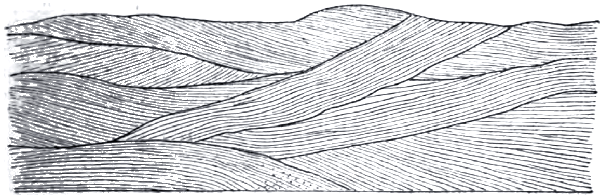
Fig. 2.—False Bedding.
36. Mud-cracks and Rain-prints.—The surfaces of some beds occasionally exhibit markings closely resembling those seen upon a flat sandy beach after the retreat of the tide—hence they are called ripple-marks or current-marks. They are, of course, due to the gentle current action which pushes along the grains of sand, and hence, such marks may be formed wherever a current sweeps over the bottom of the sea with energy just sufficient for the purpose. But since the necessary conditions for the formation of ripple-mark occur most abundantly in shallow water, its frequent appearance in a series of strata may often be taken as evidence, so far, for the shallow-water origin of the beds. Besides ripple-marks we may also detect occasionally on the surfaces of certain strata mud-cracks and rain-prints. These occur most commonly in fine-grained beds, as in flagstones, argillaceous sandstones, shales, &c. The mud-cracks resemble those upon a mud-flat which are caused by the desiccation and consequent shrinkage of the mud when exposed to the sun. The old cracks have been subsequently filled up again by a deposition of mud or sand, usually of harder consistency than the rock traversed by the cracks. Hence, when the bed that overlies the mud-cracks is removed, we find a cast of these projecting from its under surface, or frequently the cast remains in its mould, and forms a series of curious ridges ramifying over the whole surface of the old mud-flat. Rain-prints are the small pits caused by the impact of large drops. They are usually deeper at one side than the other, from which we can infer the direction of the wind at the time the rain-drops fell. Like the mud-cracks, they are most commonly met with in fine-grained beds, and have been preserved in a similar manner. Some geologists have also been able to detect wave-marks, 'faint outlinings of curved form on a sandstone layer, like the outline left by a wave along the limit where it dies out upon a beach.'
37. Succession of Strata.—The succession of strata is often very diversified. Thus, we may observe in one and the same section numberless alternating beds of sandstone and shale from an inch or so up to several feet each in thickness, with seams of coal, fireclay, ironstone, and limestone interstratified among them. In other cases, again, the succession is simpler, and some deep quarries shew only one bed, as is the case with certain limestones, fine-grained sandstones (liver-rock), and many volcanic rocks. Some limestones, indeed, shew small trace of bedding throughout a vertical thickness of hundreds of feet.
38. Beds, their Extent, &c.—Beds of rock are not only of very different thicknesses, but they are also of very variable extent. Some may thin gradually away, or 'die out' suddenly, in a few feet or yards, while others may extend over many square miles. Beds of limestone, for example, can often be traced for leagues in several directions; and if this be the case with certain single beds, it is still more true of groups of strata. Thus the coal-bearing strata belonging to what is called the Carboniferous period cover large areas in Wales, England, Scotland, and Ireland, not less, probably, than 6000 square miles; and strata belonging to the same great period spread over considerable tracts on the Continent, and a very extensive area in North America. It holds generally true that beds of fine-grained materials are not only of more equal thickness throughout, but have also a wider extension than coarser-grained rocks. Fine sandstones, for example, extend over a wider area, and preserve a more equable thickness throughout than conglomerates, while limestones and coals are more continuous than either.
39. When a bed is followed for any distance it is frequently found to thin away, and give place to another occupying the same plane or horizon. Thus a shale will be replaced by a sandstone, a sandstone by a conglomerate, and vice versâ. Sometimes also we may find a shale, as we trace it in some particular direction, gradually becoming charged with calcareous matter, so as by and by to pass, as it were, into limestone. Every bed must, of course, end somewhere, either by thus gradually passing into another, or by thinning out so as to allow beds which immediately overlie and underlie it to come together. Not unfrequently, however, a bed will stop abruptly, as in fig. 3.

Fig. 3.—Sudden ending of Bed at ×.
40. Sequence of Beds.—It requires little reflection to see that the division plane between two beds may represent a very long period of time. Let the following diagram represent a section of strata, s being beds of grit, and a, b, c, beds of sandstone and shale. It is evident that the beds s must have been formed before the strata b were deposited above them. At ×, the beds a and b come together, and were attention to be confined to that part of the section, the observer might be led to infer that no great space of time elapsed between the deposition of these two beds. Yet we see that an interval sufficient to allow of the formation of the beds s must really have intervened. It is now well known that in many cases planes of bedding represent 'breaks in the succession' of strata—'breaks' which are often the equivalents of considerable thicknesses of strata. In one place, for example, we may have an apparently complete sequence of beds, as a, b, c, which a more extended knowledge of the same beds, as these are developed in some other locality, enables us to supplement, as a, s, b, c.
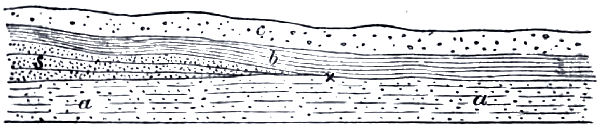
Fig. 4.—Sequence of Beds.
41. Joints.—Besides planes or lines of bedding, there are certain other division planes or joints by which rocks are intersected. The former, as we have seen, are congenital; the latter are subsequent. Joints cut right across the bedding, and are often variously combined, one set of joint planes traversing the rock in one direction, and another set or sets intersecting these at various angles. Thus, in many cases the rocks are so divided as easily to separate into more or less irregular fragments of various sizes. Besides these confused joints there are usually other more regular division planes, which intersect the strata in some definite directions, and run parallel to each other, often over a wide area: these are called master-joints. Two sets of master-joints may intersect the same strata, and when such is the case, the rock may be quarried in cuboidal blocks, the size of which will vary, of course, according as the two sets of joints are near or wide apart. Joints may either gape or be quite close; so close, indeed, as in many cases to be invisible to the naked eye. Certain igneous rocks frequently shew division planes which meet each other in such a way as to form a series of polygonal prisms. The basalt of Staffa and Giants' Causeway are familiar examples of this structure. Jointing is due to the gradual consolidation of the strata, and hence, in a series of strata, we may find the separate beds, according to their composition, very variously affected, some being much more abundantly jointed than others. Master-joints which traverse a wide district in some definite direction probably owe their origin to tension, the strata having been subjected to some strain by the underground forces.
Fig. 5.—Beds of Limestone (a), Sandstone (b), and Shale (c), divided into cuboidal masses by master-joints. Fig. 6.—Columnar Structure.
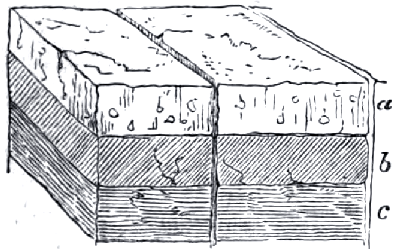
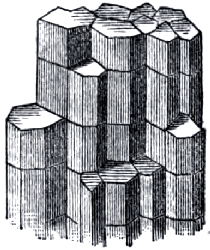
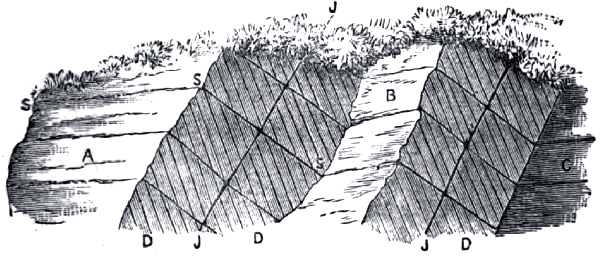
Fig. 7.—Bedding, Joints, and Cleavage (after Murchison).
42. Cleavage.—Fine-grained rocks, more especially those which are argillaceous, occasionally shew another kind of structure, which is called cleavage. Common clay-slate is a type of the structure. This rock splits up into innumerable thin laminæ or plates, the surface of which may either be somewhat rough, or as smooth nearly as glass. The cleavage planes, however, need not be parallel with the planes of bedding; in most cases, indeed, they cut right across these, and continue parallel to each other often over a very wide region. The original bedding is sometimes entirely obliterated, and in most cases of well-defined cleavage is always more or less obscure.
In the preceding diagram, the general phenomena of bedding, jointing, and cleavage are represented. The lines of bedding are shewn at S, S; another set of division-planes (joints) is observed at J, J, intersecting the former at right angles—A, B, C being the exposed faces of joints. The lines of cleavage are seen at D, D, cutting across the planes of bedding and jointing.
43. Foliation is another kind of superinduced structure. In a foliated rock the mineral ingredients have been crystallised and arranged in layers along either the planes of original bedding or those of cleavage. Mica-schist and gneiss are typical examples.
44. Concretions.—In many rocks a concretionary structure may be observed. Some sandstones and shales appear as if made up of spheroidal masses, the mineral composition of the spheroids not differing apparently from that of the unchanged rock. So in some kinds of limestone, as in dolomite, the concretionary structure is often highly developed, the rock resembling now irregular heaps of turnips with finger-and-toe disease, again, piles of cannon-balls, or bunches of grapes, and agglomerations of musket-shot. A spheroidal structure is occasionally met with amongst some igneous rocks. This is well seen in the case of rocks having the basaltic structure, in which the pillars, being jointed transversely, decompose along their division planes, so as to form irregular globular masses. In many cases, certain mineral matter which was originally diffused through a rock has segregated so as to form nodules and irregular layers. Examples of this are chert nodules in limestone; flint nodules in chalk; clay-ironstone balls in shale, &c.
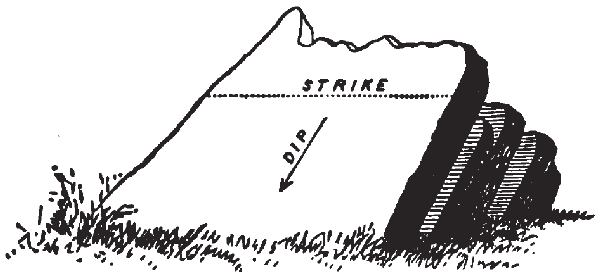
Fig. 8.—Dip and Strike of Strata.
45. Inclination of Strata.—Beds of aqueous strata must have been deposited in horizontal or approximately horizontal planes; but we now find them most frequently inclined at various angles to the horizon, and often even standing on end. They sometimes, however, retain a horizontal position over a large tract of country. The angle which the inclined strata make with the horizon is called the dip, the degree of inclination being the amount of the dip; and a line drawn at right angles to the dip is called the strike of the beds. Thus, a bed dipping south-west will have a north-west and south-east strike. The crop or outcrop (sometimes also, but rarely, called the basset edge) of a bed is the place where the edge of the stratum comes to view at the surface. We may look upon inclined beds as being merely parts of more or less extensive undulations of strata, the tops of the undulations having been removed so as to expose the truncated edges of the beds. In the following diagram, for example, the outcrops of limestone seen at l, l, are evidently portions of one and the same stratum, the dotted lines indicating its former extent. The trough-shaped arrangement of the beds at s is called a synclinal curve, or simply a syncline; the arched strata at a forming, on the contrary, an anticlinal curve or anticline.
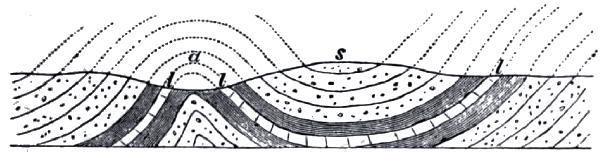
Fig. 9.—Anticlines and Synclines.
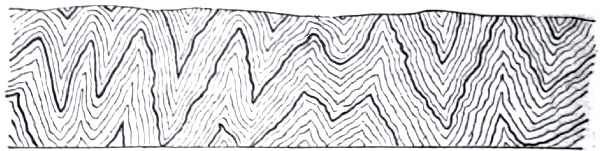
Fig. 10.—Contorted Strata.
When strata shew many and rapid curves, they are said to be contorted. The diagram section (fig. 10) will best explain what is meant by this kind of structure.
46. In certain regions, the strata often dip in one and the same direction for many miles, at an angle approaching verticality, as in the following section. It might be inferred, therefore, that from A to B we had a gradually ascending series—that as we paced over the outcrop we were stepping constantly from a lower to a higher geological horizon. But, in such cases, the dip is deceptive, the same beds being repeated again and again in a series of great foldings of the strata. Such is the case over wide areas in the upland districts of the south of Scotland. The section (fig. 11) shews that the beds are actually inverted, the strata at × × being bent back upon strata which really overlie them.
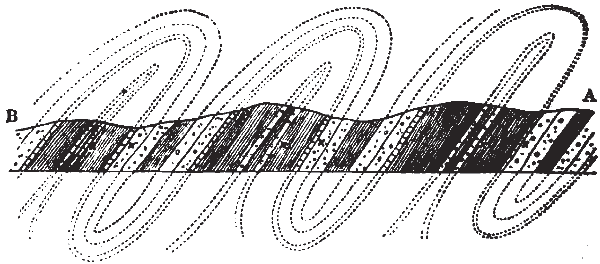
Fig. 11.—Inversion of Strata.
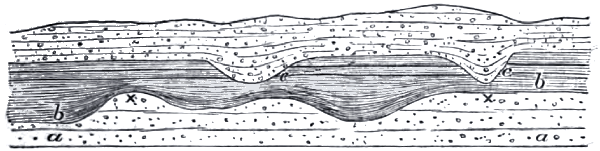
Fig. 12.—Contemporaneous Erosion.
47. Contemporaneous Erosion.—Occasionally a group of strata gives proof that pauses in the deposition of sediment took place, during which running water scooped out of the sediment channels of greater or less width, which subsequently became filled up with similar or dissimilar materials. The diagram (fig. 12) will render this plain. At a we have beds of sandstone, which it is evident were at one time throughout as thick as they still are at × ×. Having been worn away to the extent indicated, a deposition of clay (b) succeeded; and this, in turn, became eroded at c, c, the hollows being filled up again with coarse sand and gravel. In former paragraphs, we found reason to believe that lines of bedding indicated certain pauses in the deposition of strata. Here, in the present case, we have more ample proof in the same direction.

Fig. 13.—Unconformability.
48. Unconformability.—But the most striking evidence of such pauses in the deposition of strata is afforded by the phenomenon called unconformability. When one set of rocks is found resting on the upturned edges of a lower set, the former are said to be unconformable to the latter. In the above section (fig. 13), a, a, are beds of sandstone resting on the upturned edges of beds of limestone, shale, and sandstone, l, s. Figs. 14 and 15 give other examples of the same appearance. It is evident that, in the case of fig. 14, the discordant bedding chronicles the lapse of a very long period. We have to conceive first of the deposition of the underlying strata in horizontal or approximately horizontal layers; then we have to think of the time when they were crumpled up into great convolutions, and the tops of the convolutions (the anticlines) were planed away: all these changes intervened, of course, after the lower set was deposited, and before the upper series was laid down. In the case represented in fig. 15, we have a double unconformability, implying a still more elaborate series of changes, and probably, therefore, a still longer lapse of time.
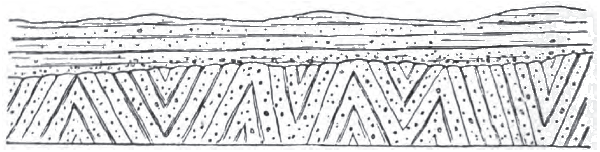
Fig. 14.—Violent Unconformability.
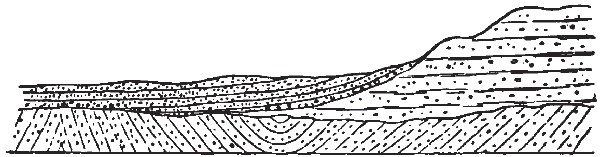
Fig. 15.—Double Unconformability.
49. Overlap.—When the upper beds of a conformable group of strata spread over a wider area than the lower members of the same series, they are said to overlap. The accompanying diagram shews this appearance. An overlap proves that a gradual submergence of the land was going on at the time the strata were being accumulated. As the land disappeared below the water, the sediment gradually spread over a wider area, the more recently deposited sediment being laid down in places which existed as dry land at the time when the earliest accumulations were formed. Thus, in the accompanying illustration (fig. 16), the stratum marked 1, resting unconformably upon older strata, is overlapped by 2, as that is by 3, and so on—all the beds in succession coming to repose upon the older strata at higher and higher levels, as the old land subsided.
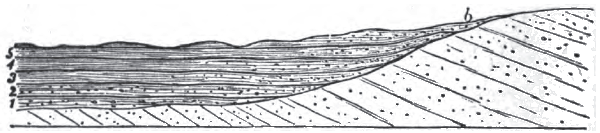
Fig. 16.—Overlap.

Fig. 17.—Fault.
50. Dislocations or Faults.—When strata, once continuous, have been broken across, and displaced or shifted along the line of breakage, they are said to be faulted, the fissure along which the displacement occurs being termed a fault or dislocation. The simplest form of a fault is that shewn in the following diagram, where strata of sandstone and shale, with a coal-seam, S, have been shifted along the line f. The direction in which the fault is inclined[D] is its hade, and the degree of vertical displacement of the beds is the amount of the dislocation. Generally, the beds seem to be pulled down in the direction of the downthrow, and drawn up on the opposite side of the fault, as shewn in the diagram. Sometimes the rocks on each side of a fault are smoothed and polished, and covered with long scratches, as if the two sides of the fissure had been rubbed together. This is the appearance called slickensides. Slickensides, however, may occur on the walls of a fissure which is not a displacement, but a mere joint or crack. A dislocation is spoken of as a downthrow or an upcast, according to the direction in which it is approached. Thus, a miner working along the coal-seam S, from a to b, would describe the fault, f, as an upcast, since he would have to mine to a higher level to catch his coal again. But, had he approached the fault from c to d, he would then have termed it a downthrow, because he would see from the hade of the fault that his coal-seam must be sought for at a lower level. Faults are of all sizes, from a foot or two up to vertical displacements of thousands of feet. Powerful dislocations can often be followed for many miles across a country, running in a more or less linear direction. Thus, one large fault has been traced across the breadth of Scotland, from near St Abb's Head, in the east, to the coast of Wigtown, in the west. Every large throw is accompanied by a number of smaller ones—some of which run parallel to the main fault, while many others seem to run out from this at various angles. Faults are of all geological ages. Some date back to a most remote antiquity, others are of quite recent origin; and no doubt faults are occurring even now. In the following diagram, the strata, a, a, have been faulted and planed away before the strata, b, were deposited. Hence, in this case, it is evident that if we know the geological age of the beds, a and b, we can have an approximation to the age of the fault. If the beds, a, be Carboniferous, and those at b Permian, then we should say the fault was post-Carboniferous or pre-Permian.

Fig. 18.—Ground-plan of Large Main Fault and Minor Displacement Fissures.

Fig. 19.—Faulted Strata covered by undisturbed Strata.
51. Metamorphic and Igneous Rocks—mode of their occurrence.—In the foregoing remarks on the structure and arrangement of rocks we have had reference chiefly to the aqueous strata—that is to say, the mechanically, chemically, and organically formed rocks. We were necessarily compelled, however, to make some reference to, and to give some description of, certain structures and arrangements which are not peculiar to aqueous strata, but characterise many metamorphic and igneous rocks as well. To avoid repetition it was also necessary, while treating of joints, &c., to give some account of certain structures which are the result of metamorphic action. But, for sake of clearness, we have reserved special account of the structure and mode of occurrence of metamorphic and igneous rocks to this place. After what has been said as to the structure and arrangement of aqueous strata, it is hardly needful to say much about the crystalline schists. These the student will understand to be merely highly altered aqueous rocks,[E] in which the marks of their origin are still more or less distinctly traceable. As a rule, metamorphic strata are contorted, twisted, and crumpled, although here and there comparatively horizontal stretches of altered rocks may be observed. The regions in which they occur are often hilly and mountainous, but this is by no means invariably the case. The greater part of the mountainous regions of the British Islands is occupied by rocks which are more or less altered; the more crystalline rocks, such as mica-schist, gneiss, &c., being abundantly developed in the Scottish Highlands, and in the north and west of Ireland; while those which are less altered cover large areas in the south of Scotland, and in Wales and the north-west of England. Throughout these wide areas the rocks generally dip at high angles, and contortion and crumpling are of common occurrence. The finer-grained clay-rocks also exhibit fine cleavage planes, and are in some places quarried for roofing-slates—the Welsh quarries being the most famous. Here and there, bedding is entirely effaced, and the resulting rock is quite amorphous, and, becoming gradually more and more crystalline, passes at last into a rock which in many cases is true granite. The original strata have disappeared, and granite occupies their place, in such a way as to lead to the inference that the granite is merely the aqueous strata which have been fused up, as it were, in situ. At other times the granite would appear to have been erupted amongst the aqueous strata, for these are highly confused, and baked, as it were, at their junction with the granite, from which, also, long veins are seen protruding into the surrounding beds. Metamorphic granite, then, graduates, as a rule, almost imperceptibly into rocks which are clearly of aqueous origin; while on the contrary the junction-line between igneous granite and the surrounding rocks is always well marked. The origin of granite, however, is a difficult question, and one which has given rise to much discussion. Some further remarks upon the subject will be found in the sequel under the heading of Metamorphism.
52. True igneous rocks occur either in beds or as irregular amorphous masses. When they occur as beds interstratified with aqueous strata, they are said to be contemporaneous, because they have evidently been erupted at the time the series of strata among which they appear was being amassed. When, on the other hand, they cut across the bedding, they are said to be subsequent or intrusive, because in this case they have been formed at a period subsequent to the strata among which they have been intruded. The bed upon which a contemporaneous igneous rock reclines, often affords marks of having been subjected to the action of heat; sandstones being hardened, and frequently much jointed and cracked, owing to the shrinking induced by the heat of the once molten rock above, and clay-rocks often assuming a baked appearance. There is generally, also, some discoloration both in the pavement of rock upon which the igneous mass lies, and in the under portions of the latter itself. The beds overlying a contemporaneous igneous rock, however, do not exhibit any marks of the action of heat; the old lava-stream having cooled before the sediment, now forming the overlying strata, was accumulated over its surface. One may often notice how the sand and mud have quietly settled down into the irregular hollows and crevices of the old lava, as in the following section, where i represents the igneous rock; a being the baked pavement of sandstone, &c.; and b the overlying sedimentary deposits. When the igneous rock itself is examined, its upper portions are often observed to be scoriaceous or cinder-like, and the under portions likewise frequently exhibit a similar appearance. It is generally most solid towards the centre of the bed. The vesicles, or pores, in the upper and lower portions are often flattened, and are frequently filled with mineral matter. Sometimes these cavities may have been filled at the time the rock was being erupted, but in most cases the mineral matter would appear to have been introduced subsequently by the action of water percolating through the rock. Occasionally we meet with igneous rocks which are more or less vesicular and amygdaloidal throughout their entire mass. Others, again, often shew no vesicular structure, but are homogeneous from top to bottom. The texture is also very variable, and this even in the same rock-mass; some portions being compact or fine-grained, and others coarsely crystalline. As a rule the rock is most crystalline towards the centre, and gets finer-grained as the top and bottom of the bed are approached. Not unfrequently, however, an igneous rock will preserve the same texture throughout. The jointing is also highly irregular as a rule. But in many cases, especially when the rock is fine-grained, the jointing is very regular. The basaltic columns of the Giants' Causeway and the Isle of Staffa are well-known examples of such regularly jointed masses. Igneous rocks frequently decompose into a loose earthy mass (wacké), and this is most markedly the case with those belonging to the basic group.

Fig. 20.—Contemporaneous Igneous Rock.
53. Contemporaneous igneous rocks are frequently associated with more or less regular beds of breccia, conglomerate, ash, tuff, &c. These are evidently the loose volcanic ejectamenta which accompanied former eruptions of lava, and have been arranged by the action of water. Beds of such materials, however, frequently occur without any accompanying lava-form rocks. Nor are they always arranged in bedded masses. They sometimes appear filling vertical pipes which seem to have been the funnels of old volcanoes. The following section exhibits the general appearance of one of these volcanic necks. They are very common in some parts of Scotland, as in Ayrshire, and are frequently ranged along the line of a fault in the strata. Fig. 21 shews such a neck of ejectamenta, made up of fragments of various kinds of rock, such as sandstone, shale, limestone, coal, &c., sometimes without any admixture of igneous rocks. The strata through which the pipe has been pierced usually dip in towards the latter, and at their junction with the coarse agglomerate often shew marks of the action of heat, coal-seams having sometimes been 'burned' useless for a number of yards away from the 'neck.'
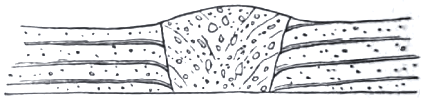
Fig. 21.—Neck filled with Volcanic Agglomerate.
54. Intrusive igneous rocks occur as sheets, dykes, and necks. The sheets frequently conform for long distances to the bedding of the strata among which they occur, and are thus liable to be mistaken for contemporaneous rocks. But when they are closely examined, it will be seen that they not only bake or alter the beds above and below them, but seldom keep precisely to one horizon or level—occasionally rising to a higher, or sinking to a lower position in the strata, as shewn in the following diagram-section. Dykes are wall-like masses of igneous strata which cut across the strata, generally at a high angle (see d, d, fig. 22). In the neighbourhood of a recent volcanic orifice, numerous dykes are seen ramifying in all directions. In the British Islands some dykes have been followed in a linear direction for very long distances. Sometimes these occupy the sites of large dislocations, at other times they have cut through the strata without displacing them. Occasionally they appear to have been the feeders of the great sheets of igneous rock which here and there occur in their vicinity. The phenomena presented by the necks of intrusive rock do not differ from those characteristic of agglomerate or tuff necks. The strata are bent down towards the central plug of igneous rock, and are generally more or less altered at the line of junction.
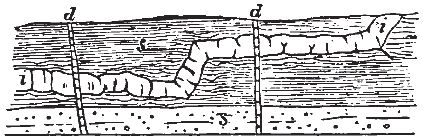
Fig. 22.—Intrusive Sheet and Dykes: i, igneous intrusive sheet; d, d, dykes; s, s, sedimentary strata.
55. Intrusive rocks offer, as a rule, some contrasts in texture to contemporaneous masses. They are seldom amygdaloidal, but when they are so it is generally towards the centre of the mass. The kernels are usually minute and more or less spherical.
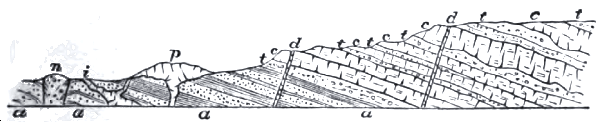
Fig. 23.—Contemporaneous and Intrusive Igneous Rocks: c, c, contemporaneous trap-rocks; t, t, contemporaneous fragmental igneous rocks; i, p, n, d, intrusive igneous rocks.
The diagram (fig. 23) shews the general mode of occurrence of igneous rocks on the large scale. The stratified aqueous deposits are indicated at a, a. These are overlaid by a series of alternating beds of crystalline (c) and fragmental (t) igneous rocks. An irregular intrusive sheet at i cuts across the beds a, a. At p, another intrusive mass is seen rising in a pipe, as it were, and overflowing the beds a, a, so as to form a cap. A volcanic neck filled with angular stones intersects the strata at n, and two dykes, approaching the vertical, traverse the bedded rocks at d, d. It will be noticed that the contemporaneous igneous rocks form a series of escarpments rising one above the other.
The alteration effected by igneous rocks is generally greatest in the case of intrusive masses. This is well seen in some of our coal-fields, where the coal has frequently been destroyed over large areas by the proximity of masses of what was once melted rock. It is curious to notice how the intrusive sheets in a great series of strata have forced their way along the lines of least resistance. Thus, in the Scottish coal-fields, we find again and again that intrusive sheets have been squirted along the planes occupied by coal-seams, these having been more easily attacked than beds of sandstone or shale. The coal in such cases is either entirely 'eaten up,' as it were, or converted into a black soot. At other times, however, it is changed into a kind of coke, while other seams at a greater distance from the intrusive mass have been altered into a kind of 'blind coal' or anthracite.
These remarks on the mode of occurrence of igneous rocks are meant to refer chiefly to those masses which occur in regions where volcanic action has long been extinct, as, for instance, in the British Islands. In the sequel, some account will be given of the appearances presented by modern volcanoes and volcanic rocks.
* It has been usual to apply the term trap or trappean rock to all the old igneous rocks which could neither be classed with the granites and syenites, nor yet with the recent lavas, &c., which are connected with a more or less well-marked volcanic vent. The term trap (Swedish trappa, a flight of steps) was suggested by the terraced or step-like appearance presented by hills which are built up of successive beds of igneous rock. But the passage from the granitic into the so-called trap rocks, and from these into the distinctly volcanic, is so very gradual, that it is impossible to say where the one class ends and the other begins. The term trap, therefore, has no scientific precision, although it is sometimes very convenient as a kind of broad generic term to include a large number of rocks.
MINERAL VEINS.
56. The cracks and crevices and joint planes which intersect all rocks in a greater or less degree, are not unfrequently filled with subsequently introduced mineral matter, forming what are termed veins. This introduced matter may either be harder or less durable than the rock itself; in the former case, the veins will project from the surface of the stone, where that has been subjected to the weathering action of the atmosphere; in the latter case, the veins, under like circumstances, are often partially emptied of their mineral matter. Not unfrequently, however, the more or less irregularly ramifying, non-metalliferous veins appear as if they had segregated from the body of the rock in which they occur, as in the case of the quartz veins in granite. Besides these irregular veins, the rocks of certain districts are traversed in one or more determinate directions by fissures, extending from the surface down to unknown depths. These great fissures are often in like manner filled with mineral matter. The minerals are usually arranged in bands or layers which run parallel to the walls of the vein. Quartz, fluor-spar, barytes, calcite, &c. are among the commonest vein-minerals, and with these are frequently associated ores of various metals. A vein may vary in width from less than an inch up to many yards, and the arrangement of its contents is also subject to much variation. Instead of parallel layers of spars and ores, frequently a confused mass of clay and broken rocks, which are often cemented together with sparry matter, chokes up the vein. The ore in a vein may occur in one or more ribs, which often vary in thickness from a mere line up to masses several yards in width. Sometimes the rocks are dislocated along the line of fissure occupied by a great vein; at other times no dislocation can be observed. Mineral veins, however, do not necessarily occupy dislocation fissures. They often occur in cavities which have been formed by the erosive action of acidulated water, in the way described in pars. 59, 60, and 61. This is frequently the case in calcareous strata. Such veins usually coincide more or less with the bedding of the rocks, but in the case of thick limestones they not unfrequently cut across the bedding in a vertical or nearly vertical direction, forming what are termed pipe-veins.
DYNAMICAL GEOLOGY.
57. Having considered the composition, structure, and arrangement of the rock-masses which form the solid crust of our globe, we have next to inquire into the nature of those physical agencies by the action of which the rocks, as we now see them, have been produced. The work performed by the various forces employed in modifying the earth's crust is at one and the same time destructive and reconstructive. Rocks are being continually demolished, and out of their ruins new rocks are being built. In other words, matter is constantly entering into new relations—now existing as solid rock, or in solution in water, or carried as the lightest dust on the wings of the wind; now being swept down by rivers into the sea, or brought under the influence of subterranean heat—but always changing, sooner or later, slowly or rapidly, from one form to another. The great geological agents of change are these: 1. The Atmosphere; 2. Water; 3. Plants and Animals; 4. Subterranean Forces. We shall consider these in succession.
THE ATMOSPHERE.
58. All rocks have a tendency to waste away under the influence of the atmosphere. This is termed weathering. Under the influence of the sun's heat, the external portions of a rock expand, and again contract when they cool at night. The effect of this alternate expansion and contraction is often strikingly manifest in tropical countries: some rocks being gradually disintegrated, and crumbling into grit and sand; others becoming cracked, and either exfoliating or breaking up all over their surface into small angular fragments. Again, in countries subject to alternations of extreme heat and cold, similar weathering action takes place. The chemical action of the atmosphere is most observable in the case of calcareous rocks. The carbonic acid almost invariably present acts as a solvent, so that dew and rain, which otherwise would in many cases have but feeble disintegrating power, are enabled to eat into such rocks as chalk and limestone, calcareous sandstones, &c. The oxygen of the atmosphere also unites with certain minerals, such as the proto-salts of iron, and converts them into peroxides. It is this action which produces the red and yellow ferruginous discolorations in sandstone. Chemical changes also take place in the case of many igneous rocks, the result being that a weathered 'crust' forms wherever such rocks are exposed to the action of the atmosphere. Of course, the rate at which a rock weathers depends upon its mineralogical and chemical composition. Limestones weather much more rapidly than clay-rocks; and augitic igneous rocks, as a rule, disintegrate more readily than the more highly silicated species. The weathering action of the atmosphere is also greatly aided by frost, as we shall see presently. The result of all this weathering is the formation of soil—soil being only the fine-grained débris of the weathered rocks. The angular débris found at the base of all cliffs in temperate and arctic regions, and on every hill and mountain which is subjected to alternations of extreme heat and cold, is also the effect of weathering. But these and other effects of frost will be treated of under the head of Frozen Water. The hillocks and ridges of loose sand (sand dunes) found in many places along the sea-margin, and even in the interior of some continents, as in Africa and Asia, are due to the action of the wind, which drives the loose grains before it, and piles them up. Sometimes also the wind carries in suspension the finest dust, which may be transported for vast distances before it falls to the ground. Thus, fine dust shot into the air by the volcanoes of Iceland has been blown as far as the Shetland Islands; and in tropical countries the dust of the dried-up and parched beds of lakes and rivers is often swept away during hurricanes, and carried in thick clouds for leagues. Rain falling through this dust soaks it up, and comes down highly discoloured, brown and red. This is the so-called blood-rain. Minute microscopic animal and vegetable organisms are often commingled with this dust, and falling into streams, lakes, or the sea, may thus become eventually buried in sediments very far removed from the place that gave them birth.
WATER.
59. The geological action of water in modifying the crust of the earth is twofold—namely, chemical and mechanical.
Underground Water.—All the moisture which we see falling as rain or snow does not flow immediately away by brooks and rivers to the sea. Some portion of it soaks into the ground, and finds a passage for itself by cracks and fissures in the rocks below, from which it emerges at last as springs, either at the surface of the earth, or at the bottom of the sea. Such are the more obvious courses pursued by the water—it flows off either by sub-aërial or subterranean channels. But a not inconsiderable portion soaks into the solid rocks themselves, which are all more or less porous and pervious. Water thus slowly soaking often effects very considerable chemical changes. Sometimes the binding matter which held the separate particles of the rock together is dissolved out, and the rock is thus rendered soft and crumbling; at other times, the reverse takes place, and the water deposits, in the minute interstitial pores, some binding matter by which the partially or wholly incoherent grains are agglutinated into a solid mass. Thus what were originally hard and tough rocks become disintegrated to such a degree, that they crumble to powder soon after they are exposed to the air; while some again are converted into a clay, and may be dug readily with a spade. And, on the other hand, loose sand is glued into a hard building-stone. There are many other changes effected upon rocks by water, in virtue of the chemical agents which it holds in solution. Indeed, it may be said that there are very few, if any, rocks in which the chemical action of interstitial water has not formerly been, or is not at present being, carried on. Besides that which soaks through the rocks themselves, there is always a large proportion of underground water, which, as we have said above, finds a circuitous route for itself by joints, cracks, and crevices. After coursing for, it may be, miles underground, such water eventually emerges as springs, which contain in solution the various ingredients which the water has chemically extracted from the rocks. These ingredients are then deposited in proportion as the mineral water suffers from evaporation. Water impregnated with carbonate of lime, for example, deposits that compound as soon as evaporation has carried off a certain percentage of the water itself, and the carbonic acid gas which it held. This is the origin of the mineral called travertine or calcareous tufa, which is so commonly met with on the margins of springs, rivers, and waterfalls.
60. Stalactites and stalagmites have been formed in a similar way. Water slowly oozing from the roof of a limestone cavern partially evaporates there, and a thin pellicle of carbonate of lime is formed; while that portion of the water which falls to the ground, and is there evaporated, likewise gives rise to the formation of carbonate of lime. By such constant dropping and evaporating, long tongue-and icicle-like pendants (stalactites) grow downwards from the roof; while at the same time domes and bosses (stalagmites) grow upwards from the floor, so as sometimes to meet the former and give rise to continuous pillars and columns. The great solvent power of carbonated water is shewn first by the chemical analysis of springs, and, secondly, by the great wasting effects which the long-continued action of these has brought about. Thus, it has been estimated that the fifty springs near Carlsbad, which yield eight hundred thousand cubic feet of water in twenty-four hours, contain in solution as much lime as would go to form a mass of stone weighing two hundred thousand pounds. Warm, or, as they are termed, thermal springs, frequently carry away with them, out of the bowels of the earth, vast quantities of mineral matter in solution. The waters at Bath, for instance, are estimated to bring to the surface an annual amount of various salts, the mass of which is not less than 554 cubic yards. One of the springs of Louèche, France, however, carries out with it no less than 8,822,400 pounds of gypsum annually, which is equal to about 2122 cubic yards.
61. It is easy to conceive, therefore, that in the course of ages great alterations must be caused by springs. Caves and winding galleries, and irregular channels, will be worn out of the rocks which are thus being dissolved. Especially will this be the case in countries where calcareous rocks abound. It is in such regions, accordingly, where we meet with the most striking examples of caves and underground river-channels. The largest cave at present known is the Mammoth Cave, in Kentucky. This remarkable hollow consists of numerous winding galleries and passages that cross and recross, and the united length of which is said to be 217 miles. In calcareous countries, rivers, after flowing for, it may be, miles at the surface, suddenly disappear into the ground, and flow often for long distances before they reappear in the light of day. In some regions, indeed, nearly all the drainage is subterranean. The surface of the ground, in calcareous countries, frequently shews circular depressions, caused by the falling in of the roofs of caverns. Sometimes, also, great masses of rock, often miles in extent, get loosened by the dissolving action of subterranean water, and crash downwards into the valleys. Such landslips, as they are called, are not, however, confined to calcareous regions. In 1806, a large section of the Rossberg, a mountain lying to the north of the Righi, consisting of conglomerate overlying beds of clay, rushed down into the plains of Goldau, overwhelming four villages and nearly a thousand inhabitants. The cause of this catastrophe was undoubtedly the softening into mud of the clay-beds on which the conglomerate rested, for the season which had just terminated when the slip took place had been very wet. The mass of material that slid down was estimated to contain upwards of fifty-four millions of cubic yards; it reached not less than two and a half miles in length, by some three hundred and fifty yards wide, and thirty-five yards thick.
62. Surface-water—Rain.—Having now learned something as to the modifications produced by underground water, we turn next to consider the action of surface-water, and the results arising from that action. Rain, when it falls to the ground, carries with it some carbonic acid gas which it has absorbed from the atmosphere. Armed with this solvent, it attacks certain rocks, more especially limestones and chalk, a certain proportion of which it licks up and delivers over to brooks and streams. Under its influence, also, the finer particles of the soil are ever slowly making their way from higher to lower levels. Rocks which are being gradually disintegrated by weathering have their finer grains and particles, thus loosened, carried away by rain. Nor is this rain-action so inconsiderable as might be supposed. In the gentler hollows of an undulating country, we frequently find accumulations of clay, loam, and brick-earth, which often reach many feet in thickness, and which are undoubtedly the results of rain washing down the particles of soil, &c. from the adjacent slopes.
63. River-action.—The water of streams and rivers almost invariably contains in solution one or more chemical compounds, and in this respect does not differ from the water of springs. Of course, this mineral matter is derived in considerable measure from springs, but is also no doubt to a large extent taken up by the rivers themselves, as they wash the rocks and soils on their journey to the sea. The amount of mineral matter thus transported must be something enormous, as is shewn by the chemical analyses of river-water. Bischof calculated that the Rhine carries in solution as much carbonate of lime as would suffice for the yearly formation of three hundred and thirty-two thousand millions of oyster-shells of the usual size—a quantity equal to a cube five hundred and sixty feet in the side, or a square bed a foot thick, and upwards of two miles in the side. But the mechanical erosion effected by running water is what impresses us most with the importance of rivers as geological agencies. This erosive action is due to the gravel, sand, and mud carried along by the water. These ingredients act as files in the hand of a workman, and grind, polish, and reduce the rocks against which they are borne. The beds of some streams that flow over solid rock are often pitted with circular holes, at the bottom of which one invariably finds a few rounded stones. These stones, kept in constant motion by the water, are the means by which the pot-holes, as they are called, have been excavated. When pot-holes are numerous, they often unite so as to form curious smooth-sided trenches and gullies. The same filing action goes on all over the bed of the stream wherever the solid rock is exposed. And while the latter is being gradually reduced, the stones and grit which act as the files are themselves worn and reduced; so that stones diminish in size, and grit passes into fine sand and mud, as they move from higher to lower levels. No doubt the erosive action of running water appears to have but small effect in a short time, and we are apt, therefore, to underestimate its power. But when our observations extend, we see it is quite otherwise, and that, so far from being unimportant, running water is really one of the most powerful of all the geological agencies that are employed in modifying the earth's crust. Even within a comparatively short time, it is able to effect very considerable changes. Thus, the river Simeto, in Sicily, having become dammed by a stream of lava flowing from Etna, succeeded, in two hundred and fifty years, in cutting through hard solid basalt a new channel for itself, which measured from twenty to fifty mètres in depth, and from twelve to eighteen in breadth. When, also, we remember the fact, that no river is absolutely free from mineral matter held in suspension, but that, on the contrary, all running water is more or less discoloured with sediment, which is merely the material derived from the disintegration of rocks, it will appear to us difficult to overestimate the power of watery erosion. To the mineral matter held in suspension, we have to add the coarser detritus, gravel and sand, which is being gradually pushed along the beds of rivers, and which, in the case of the Mississippi, has been estimated to equal a mass of seven hundred and fifty million cubic feet, discharged annually into the Gulf of Mexico. By careful measurements, it has also been ascertained that the same river carries down annually into the sea a weight of mud held in suspension which reaches the vast sum of 812,500,000,000 pounds. The total annual amount of mineral matter, whether held in suspension or pushed along the bottom of this great river, has been estimated to equal a mass 268 feet in height, with an area of one square mile.
64. Alluvium.—The sediment carried along and deposited by a river is called alluvium. Sometimes this alluvium covers wide areas, forming broad flats on one or both sides of a river, and in such cases it is due to the action of the floodwaters of the stream. Every time the river overflows the low grounds through which it passes, a layer of sediment is laid down, which has the effect of gradually raising the level of the alluvial tract. By and by a time comes when the river, which has all the while been slowly deepening its channel, is unable to flood the flats, and thereupon it begins to cut into these, and to form new flats at a somewhat lower level. In this way we often observe a series of alluvial terraces, consisting of gravel, sand, and silt, rising one above another along a river valley. Such are the terraces of the Thames and other rivers in England, and of the Tweed, Clyde, Tay, &c. in Scotland. The great plains through which the Rhine flows between Basel and Bingen, are also well-marked examples of alluvial accumulations. There are very few streams, indeed, which have not formed such deposits along some portion of their course.
65. When a river enters a lake, the motion of the water is of course checked, and hence the heavier detritus, such as gravel and coarse sand, moves more slowly forward, and at last comes to rest on the bed of the lake, at no great distance from the mouth of the river. Finer sand and mud are carried out for some distance further, but eventually they also cease to move, and sink to the bottom. When the lake is sufficiently large, it catches all or nearly all the matter brought down by the river, which, as it issues from the lower end of the lake, is bright and clear. A well-known example of this phenomenon is that of the Rhone, which enters the Lake of Geneva turbid and muddy, but rushes out quite clear at the lower end of the lake. Lakes, therefore, are all being slowly or more rapidly silted up, and this, of course, is most conspicuous at the points where they are entered by rivers. Thus, at the head of the Lake of Geneva, it is manifest that the wide flat through which the river flows before it pours into the lake, has been conquered by the Rhone from the latter. In the times of the Romans, the lake, as we know, extended for more than one mile and a half further up the valley.
66. Deltas.—When there are no lakes to intercept fluviatile sediment, this latter is borne down to the sea, where it is deposited in precisely the same way as in a lake: the heavier detritus comes to rest first, the finer sediment being swept out for some distance further. So that, in passing from the river-mouth outwards, we have at first gravel, which gradually gets finer and finer until it is replaced by sand, while this in turn is succeeded by mud and silt. There is this difference, however, between lacustrine and fluvio-marine deposits, that while the former accumulate in water which is comparatively still, the latter are often brought under the influence of waves and currents, and become shifted and sifted to such a degree that fine and coarse detritus are frequently commingled; and there is, therefore, not the same orderly succession of coarse and fine materials which characterises lacustrine deposits. Often, indeed, the currents opposite the mouth of a river are so strong, that little or no sediment is permitted to gather there. Usually, however, we find that rivers have succeeded in reclaiming more or less wide tracts from the dominion of the waves, or at all events have cumbered the bed of the sea with banks and bars of detritus. The broad plains formed at the mouth of a river are called deltas, from their resemblance to the Greek letter Δ. The deltas of the Nile, Ganges, and Mississippi are among the most noted. The term delta, however, is not exclusively applied to fluvio-marine deposits; rivers also form deltas in fresh-water lakes. It is usual, however, to restrict the term to extensive alluvial plains which are intersected by many winding channels, due to the rapid bifurcation of the river, which begins to take place at the very head of the great flat—that is to say, at the point where the river originally entered the sea (or lake).