Front matter (continued 2)
Reading edition
67. Frozen Water.—We have now seen what can be done by the mechanical action of running water. We have next to consider what modifications are effected by freezing and frozen water. Water, as every one knows, expands in the act of freezing, and in doing so exerts great force. Let the reader bear in mind what has been said as to the passage of water through the minute and often invisible pores of rocks, and to its presence in cracks and crevices after every shower of rain, and he will readily see how excessive must be the waste caused by the action of frost. The water, to as great a depth as the frost extends, passes into the solid state, and in doing so pushes the grains of the rocks asunder, or wedges out large masses. No sooner does thaw ensue than the water, becoming melted, allows the grains of the rock to fall asunder; the outer skin of the rock, as it were, is disintegrated, and crumbles away, while fragments and masses lose their balance in many cases, and topple down. Hence it is, that in all regions where frost acts, the hill-tops and slopes are covered with angular fragments and débris, and a soil is readily formed by the disintegration of the rocks.
River-ice is often a potent agent of geological change. Stones get frozen in along the margins of a river, and often débris falls down from cliff and scaur upon the surface of the ice; when thaw sets in, and the ice breaks up, stones and rubbish are frequently floated for long distances, and may even be carried out to sea before their support fails them, and they sink to the bottom. In some cases, when the ice is very thick, it may run aground in a river, and confuse and tumble up the deposits gathering at the bottom. Ice sometimes forms upon stones at the bottom of a river, and floats these off; and this curious action may take place even although no ice be forming at the time on the surface of the water.
68. Glaciers, Icebergs, and Ice-foot.—In certain mountainous districts, and in arctic and antarctic regions, snow accumulates to such an extent that its own weight suffices to press the lower portions into ice. Alternate thawing and freezing also aid in the formation of the ice, which soon begins to creep down the mountain-slopes into the valleys, where it constitutes what are called glaciers or ice-rivers. These great masses of ice attain often a great thickness, and frequently extend for many miles along the course of a valley. In the Alps they occasionally reach as much as five hundred or six hundred feet in depth. In Greenland, however, there are glaciers probably not less than five thousand feet thick; and the glacier ice of the antarctic continent has been estimated even to reach twelve miles in thickness. Glaciers flow slowly down their valleys, at a rate which varies with the slope of their beds and the mass of the ice. Some move only a few inches, others two or three feet, in a day. Their forward motion is arrested at a point where the ice is melted just as fast as it comes on. A glacier is always more or less seamed with yawning cracks, which are called crevasses. These owe their origin to the unequal rate at which the different parts of the ice flow; this differential motion causing strains, to which the ice yields by snapping asunder. The flanks of a glacier are usually fringed with heaps of angular blocks and débris which fall from the adjacent rocky slopes, and some of this rubbish tumbling into the gaping crevasses must occasionally reach to the bottom of the ice. The rubbish heaps (superficial moraines) travel slowly down the valley on the surface of the ice, and are eventually toppled over the end of the glacier, where they form great banks and mounds. These are called terminal moraines. The rocky bed of a glacier is invariably smoothed and polished, and streaked with coarse and fine striæ, or scratches, which run parallel to the direction of the ice-flow. These are due to the presence, at the bottom of the ice, of such angular fragments as become detached from the underlying rocks, or of boulders and rubbish which have been introduced from above. The stones are ground by the ice along the surface of its bed, causing ruts and scratches, while the finer material resulting from the grinding action forms a kind of polisher. The stones acting as gravers are themselves covered with striæ, and their sharp edges get smoothed away. In alpine districts there is always a good deal of water circulating underneath a glacier, and this washes out the sand and fine clay. Thus it is that rivers issuing from glaciers are always more or less discoloured brown, yellow, green, gray, or blue, according to the nature of the rocks which the ice has pounded down into mud. In Greenland many of the large glaciers go right out to sea, and owing to their great thickness are able to dispossess the sea sometimes for miles. But erelong the greater specific gravity of the sea-water forces off large segments from the terminal front of the ice, which float away as icebergs. Large masses are also always falling down from the ice-front. Occasionally, big blocks and débris are floated away on the icebergs, but this does not appear to be common. In Greenland there is very little rock-surface exposed, from which blocks can be showered down upon the glaciers, and the surface of the latter is therefore generally free from superficial moraines. A kind of submarine terminal moraine, however, gathers in front of some glaciers, made up chiefly of the stones and rubbish that are dragged along underneath the ice, and exposed by the breaking-off of icebergs, but partly composed also of the sand and mud washed out by sub-glacial waters. A narrow belt of ice forms along the sea-coast in arctic regions, which often attains a thickness of thirty or forty feet. This is called the ice-foot. It becomes loaded with débris and blocks, which fall upon it from the cliffs above; and, as large portions are frequently detached from the cliffs in summer-time, they sail off with their cargoes of débris, and drop these over the sea-bottom as they gradually melt away. The ice-foot is the great distributor of erratics or wandered blocks, the part taken in this action by the huge icebergs which are discharged by the glaciers being, comparatively speaking, insignificant. But when these latter run aground, they must often cause great confusion among the beds of fine material accumulating upon the floor of the sea.
69. The Sea.—Sea-water owes its saltness to the presence of various more or less soluble substances, such as common salt, gypsum, Epsom salts, chloride of magnesium, &c. Besides these, there are other ingredients held in solution, which, although they can be detected in only minute quantities in sea-water, are yet of the very utmost importance to marine creatures. This is the case with carbonate of lime, vast quantities of which are carried down by many rivers to the sea. But it must be nearly all used up in the formation of hard shells and skeletons by molluscs, crustaceans, corals, &c., for very little can be traced in the water itself. Silica is also met with sparingly, and is abstracted by some creatures to form their hard coverings.
70. Breaker-action—Currents.—The most conspicuous action of the sea, as a geological agent, takes place along its margin, where the breakers are hurled against the land. Stones and gravel are borne with more or less intense force against the rocks, and by their constant battering succeed eventually in undermining the cliffs, which by and by become top-heavy, and large masses fall down and get broken up and pounded into gravel and sand. The new wall of rock thus exposed becomes in turn assaulted, and in course of time is undermined in like manner. The waste of the cliffs is greatly aided by the action of frost, which loosens the jointed rocks, and renders them an easier prey to the force of the waves. Of course, the rapidity with which a coast-line is eaten into depends very much upon the nature of the rocks. Where these are formed of loose materials like sand, gravel, or clay, considerable inroads are effected by the sea in a comparatively short time. Thus, along some parts of the English coast, as between Flamborough Head and the mouth of the Humber, and between the Wash and the Thames, it is estimated that the land is wasted away at the rate of a yard per annum. Where hard rocks form the coast-line the rate of waste is often exceedingly slow, and centuries may elapse without any apparent change being effected. When the rocks are of unequal hardness the coast-line becomes very irregular, the sea carving out bays and gullies in the softer portions, while the more durable masses stand out as capes and bold headlands. Not unfrequently, such headlands are converted into sea-stacks and rocky islets, as one may observe along the rockier parts of our shore-lines. Close inshore, the bulkier débris derived from the waste of the land often accumulates, forming beds and banks of shingle and gravel. The finer materials are carried farther out to sea, and distributed over the sea-floor by the action of the tide and currents. Tidal and other currents may also have some denuding effect upon the sea-bottom, but this can only be in comparatively shallow water. The great bulk of the material derived from the waste of the coasts by the mechanical action of the breakers, travels for no great distance. But the fine mud brought down by rivers is frequently transported for vast distances before it settles. So fine, indeed, is some of this sedimentary material, that it may be carried in suspension by sea-currents for thousands of miles before it sinks to the bottom.
71. From this short outline it becomes evident, therefore, that the coarser-grained the deposit, the smaller will be the area it covers; while conversely, the finer the accumulation, the more widely will it be distributed. A partial exception to this rule is that of the débris scattered over the bottom of the ocean by icebergs and detached portions of ice-foot. These are often floated for vast distances by currents before they finally melt away, and hence the coarse débris transported by them must be very widely distributed over that part of the sea-bottom which is traversed by currents flowing out of the Arctic and Antarctic Oceans. Although the deeper recesses of the ocean appear to be covered only with ooze and fine mud, yet in some instances coarse sand, and even small stones, have been brought up from depths of a hundred fathoms, so that currents may occasionally carry coarser materials for great distances from the shore. The shifting action of tidal currents succeeds in giving rise to very irregular deposits in shallow seas. The soundings often shew sudden changes from gravel to sand and mud, nor can there be any doubt that, could we lay bare the sea-bottom, we should often observe gravel shading off into sand, and sand into mud, and vice versâ. But as we receded from the shore, and approached areas which were once deeply submerged, we should find that the change of material was generally from coarse to fine.
GEOLOGICAL ACTION OF PLANTS AND ANIMALS.
72. Plants.—The disintegration of rocks is often aided by the action of plants, which force their roots into joints and crevices, and thus loosen blocks and fragments. Carbonic acid, derived from the decay of plants, being absorbed by rain-water, acts chemically upon many rocks, as in the case of limestone (see 59, 60, 61). In temperate regions, vegetation frequently accumulates, under certain conditions, to form very considerable masses. Of such a nature is peat, which, as is well known, covers many thousands of acres in the British Islands. This substance is composed fundamentally of the bog-moss (Sphagnum palustre), with which, however, are usually associated many other marsh-loving plants. The lower parts of bog-moss die and decay while its upper portions continue to flourish, and thus, in process of time, a thickness of peat is accumulated to the extent of six, twelve, twenty-four, or even forty feet. Many of the hill-tops and hill-slopes in Scotland and Ireland are covered with a few feet of peat, but it is only in valleys and hollows where the peat-bogs attain their greatest depth. In not a few cases, the bogs seem to occupy the sites of ancient lakes, shell-marl often occurring at the bottom of these. The trunks and roots of trees are also commonly met with underneath peat, and occasionally the remains of land animals. Frequently, indeed, it would seem as if the overthrow of the trees, by obstructing the drainage of the country, had given rise to a marsh, and the consequent formation of peat. Some of the most valuable peat closely resembles lignite, and makes a good fuel. In tropical countries, the rapidity with which vegetation decays prevents, as a rule, any great accumulation taking place; but the mangrove swamps are exceptions.
73. Animals.—The action of animal life is for the most part conservative and reconstructive. Considerable accumulations of shell-marl take place in fresh-water lakes, and the flat bottoms which mark the sites of lakes which have been drained are frequently dug to obtain this material. But by far the most conspicuous formations due to the action of animal life accumulate in the sea. Molluscs, crustaceans, corals, and the like, secrete from the ocean the carbonate of lime of which their hard shells and skeletons are composed, and these hard parts go to the formation of limestone. The most remarkable masses of modern limestone occur within intertropical regions. These are the coral reefs of the Pacific and Indian Oceans.
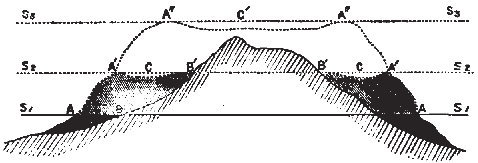
Fig. 24.—Formation of Coral Reefs.
74. Coral is the calcareous skeleton of certain small soft-bodied gelatinous animals called actinozoa. These zoophytes flourish only in clear water, the temperature of which is not below 66°F., and they cannot live at greater depths than one hundred feet. There are three kinds of coral reef—namely, fringing reefs, barrier reefs, and atolls. Fringing reefs occur, as a rule, near to the shore; but if this latter be gently sloping, they may extend for one or even two miles out to sea; as far, indeed, as the depth of water is not too great for the actinozoa. Barrier reefs are met with at greater distances from the land, and often rise from profound depths. The barrier reef which extends along the north-east coast of Australia, often at a distance from the land of fifty or sixty miles, stretches, with interruptions, for about 1250 miles, with a breadth varying from ten to ninety miles. In some places, the depth of the sea immediately outside of this reef exceeds 1800 feet. Sometimes barrier reefs completely encircle an island or islands, which are usually mountainous, as in the case of Pouynipète, an island in the Caroline Archipelago, and the Gambier Islands in the Low Archipelago. Atolls are more or less irregular ring-shaped reefs inclosing a lagoon of quiet water. They usually rise from profound depths; Keeling Atoll, in the Indian Ocean, is a good example. The upper surface of atolls and barrier reefs often peers at separate points above the level of the sea, so as to form low-lying islets. In some cases, the land thus formed is almost co-extensive with the reef, and being clothed with palms and tropical verdure, resembles a beautiful chaplet floating, as it were, in mid-ocean. The rock of a coral reef is a solid white limestone, similar in composition to that of the limestones occurring in this country. In some places, it is quite compact, shewing few or no inclosed shells or other animal remains; in other places, it is made up of broken and comminuted corals cemented together, or of masses of coral standing as they slowly grew, with the spaces between the separate clumps filled up with coral sand and triturated fragments and grit of coral and shell. The thickness of the reefs is often very great, reaching in many cases to thousands of feet. At the Fijis, the reef can hardly be less than 2000 or 3000 feet thick. Below a depth of one hundred feet, all the coral rock is dead, and since the coral zoophytes do not live at greater depths than this, it follows that the bed of the sea in which coral reefs occur must have slowly subsided during a long course of ages. Mr Darwin was the first to give a reasonable explanation of the origin of coral reefs. Briefly stated, his explanation is as follows: The corals began to grow first in water not exceeding one hundred feet in depth, and built up to the surface of the sea, thus forming a fringing reef at no great distance from the land. This initial step is shewn at A, B, in the accompanying section across a coral island. A, A, are the outer edges of the fringing reef; B, B, the shores of the island; and S1 the level of the sea. Subsidence ensuing, the island and the sea-bottom sink slowly down, while the coral animals continue to grow to the surface—the building of the reef keeping pace with the subsidence. By and by the island sinks to the level S2, when B´, B´, represent the shores of the now diminished island, and A´, A´, the outer edges of the reef, which has become a barrier reef; C, C, being the lagoon between the reef and the central island. We have now only to suppose a continuance of the submergence to the level S3, when the island disappears, its site being occupied by a lagoon, C´—the reef, which has at the same time become an atoll, being shewn at A´´, A´´.
75. In extra-tropical latitudes, great accumulations of carbonate of lime are also taking place. The bottom of the Atlantic has been found to be covered, over vast areas, by a fine calcareous sticky deposit called ooze, which would appear to consist for the most part of the skeletons of minute animal organisms, called Foraminifera. This accumulation, when dried, closely resembled chalk, and there can be no doubt that in the deep recesses of the Atlantic we have thus a gradually increasing deposit of carbonate of lime, which rivals, if it does not exceed, in extent the most widely spread calcareous rocks with which we are acquainted. A small percentage of siliceous materials occurs in the ooze, made up partly of granules of quartz, and partly of the skeletons and coverings of minute animal and vegetable organisms. When in process of time the chemical forces begin to act upon the siliceous matter diffused through the Atlantic ooze, segregation, or the gathering together of the particles, may take place, and nodules of flint will be the result, similar to the flint nodules which occur in chalk, and the cherty concretions in limestones. Animalcules with siliceous envelopes and skeletons are by no means so abundant as those that secrete carbonate of lime, but they are very widely diffused through the oceans, and in favourable places are so abundant that they may well give rise eventually to extensive beds of flint. Ehrenberg calculated that 17,946 cubic feet of these organisms were formed annually in the muddy bottom of the harbour at Wismar, in the Baltic.
It would appear from recent observations (Challenger expedition) that the calcareous ooze at the bottom of the Atlantic and Southern Oceans, which occurs at a mean depth of 2250 fathoms, passes gradually as the ocean deepens into a gray ooze, which is less calcareous, and which occurs at a mean depth of 2400 fathoms. At still greater depths this gray ooze also disappears, and is replaced by red clay at a mean depth of 2700 fathoms. The minute creatures (foraminifera and pelagic mollusca chiefly) whose shells go to form the calcareous ooze, live for the most part on the surface, and swarm all over the areas in which ooze and red clay occur at the bottom. Hence it seems probable that the clay is merely the insoluble residue or ash, as it were, of the organisms—the delicate shells, as they slowly sink to the more profound depths, being dissolved by the free carbonic acid, which, as observations would seem to shew, occurs rather in excess at great depths. Thus we see how the organic forces may give rise to extensive accumulations of inorganic matter, closely resembling the finest silt or mud which is carried down to the sea by rivers, and distributed far and wide by ocean currents.
SUBTERRANEAN FORCES.
76. There have been many speculations as to the condition of the interior of the earth. Some have inferred that the external crust of the globe incloses a fluid or molten mass; others think it more probable that the interior is solid, but contains scattered throughout its bulk, especially towards the surface of the earth, irregular seas of molten matter, occupying large vesicles or tunnels in the solid honey-combed mass. At present, the facts known would appear to be best explained by the latter hypothesis. All that we know from observation is, that the temperature increases as we descend from the surface. The rate of increase is very variable. Thus, in the Artesian well at Neuffen, in Würtemberg, it was as much as 1°F. for every 19 feet. In the mines of Central Germany, however, the increase is only 1°F. for every 76 feet; while in the Dukinfield coal-pit, near Manchester, the increase was still less, being only 1°F. in 89 feet. Taking the average of many observations, it may be held as pretty well proved that the temperature of the earth's crust increases 1° for every 50 or 60 feet of descent after the first hundred.
77. The crust of the earth is subject to certain movements, which are either sudden and paroxysmal, or protracted and tranquil. The former are known as earthquakes, which may or may not result in a permanent alteration of the relative level of land and sea; the latter always effect some permanent change, either of upheaval or depression.
78. Earthquakes have been variously accounted for. Those who uphold the hypothesis of a fluid interior think the undulatory motion experienced at the surface is caused by movements in the underlying molten mass—an earthquake being thus 'the reaction of the liquid nucleus against the outer crust.' By others, again, earthquakes are supposed to be caused by the fall of large rock-masses from the roofs of subterranean cavities, or by any sudden impulse or blow, such as might be produced by the cracking of rocks in a state of tension, by a sudden volcanic outburst, or sudden generation or condensation of steam. In support of this latter hypothesis, many facts may be adduced. The undulatory motion communicated to the ground during gunpowder explosions, or by the fall of rocks from a mountain, is often propagated to great distances from the scene of these catastrophes, and the phenomena closely resemble those which accompany a true earthquake. When the level of a district has been permanently affected by an earthquake, the movement has generally resulted in a lowering of the surface. Thus, in 1819, the Great Runn of Cutch, in Hindustan, was depressed over an area of several thousand square miles, so as during the monsoons to become a salt lagoon. Occasionally, however, we find that elevation of the land has taken place during an earthquake. This was the case in New Zealand in 1855, when the ground on which the town of Wellington stands rose about two feet, and a cape in the neighbourhood nearly ten feet. Sometimes the ground so elevated is, after a shorter or longer period, again depressed to its former level. A good example of this occurred in South America in 1835. The shore at Concepcion was raised a yard and a half; and the Isle Santa Maria was pushed up two and a half yards at one end, and three and a half yards at the other. But only a few months afterwards the ground sank again, and everything returned to its old position. The heaving and undulatory motion of an earthquake produces frequently considerable changes at the surface of the ground, besides an alteration of level. Rocks are loosened, and sometimes hurled down from cliff and mountain-side, and streams are occasionally dammed with the soil and rubbish pitched into them. Sometimes also the ground opens, and swallows whatever chances to come in the way. If these chasms close again permanently, no change in the physiography of the land may take place, but sometimes they remain open, and affect the drainage of the country.
79. Movements of Upheaval and Depression.—Besides the permanent alteration of level which is sometimes the result of a great earthquake, it is now well known that the crust of the earth is subject to long-continued and tranquil movements of elevation and depression. The cause of these movements is at present merely matter for speculation, some being of opinion that they may be caused by the gradual contraction of the slowly cooling nucleus of the earth, which would necessarily give rise to depression, while this movement, again, would be accompanied by some degree of elevation—the result of the lateral push or thrust effected by the descending rock-masses. It is doubtful, however, if this hypothesis will explain all the appearances. The Scandinavian peninsula affords a fine example of the movements in question. At the extremity of the peninsula (Scania), the land is slowly sinking, while to the north of that district gradual elevation is taking place at a very variable rate, which in some places reaches as much as two or three feet in a century. Movements of elevation are also affecting Spitzbergen, Northern Siberia, North Greenland, the whole western borders of South America, Japan, the Kurile Islands, Asia Minor, and many other districts in the Mediterranean area, besides various islets in the great Pacific Ocean. The proofs of a slow movement of elevation are found in old sea-beaches and sea-caves, which now stand above the level of the sea. In the case of Scandinavia, it has been noticed that the pine-woods which clothe the mountains are being slowly elevated to ungenial heights, and are therefore gradually dying out along their upper limits. The proofs of depression of the land are seen in submerged forests and peat, which occur frequently around our own shores, and there is also strong human testimony to such downward movements of the surface. The case of Scania has already been referred to. Several streets in some of its coast towns have sunk below the sea, and it is calculated that the Scanian coast has lost to the extent of thirty-two yards in breadth within the past hundred and thirty years. The coral reefs of southern oceans also afford striking evidence of a great movement of depression.
Not long ago a theory was started by a French savant, M. Adhémar, to account for changes in the sea-level, without having recourse to subterranean agency. He pointed out that a vast ice-cap, covering the northern regions of our hemisphere, as was certainly the case during what is termed the glacial epoch, would cause a rise of the sea by displacing the earth's centre of gravity. Mr James Croll has recently strongly supported this opinion; and there can be no doubt that we have here a vera causa of considerable mutations of level. It is unquestionably true, however, that great oscillatory movements, such as described above, and which can only be attributed to subterranean agencies, have frequently taken and are still taking place.
80. Such movements of the earth's crust cannot take place without effecting some change upon the strata of which that crust is composed. During depression of the curved surface of the earth, the under strata must necessarily be subjected to intense lateral pressure, since they are compelled to occupy less space, and contortion and plication will be the result. It is evident also that contortion will diminish from below upwards, so that we can conceive that excessive contortion may be even now taking place at a great depth from the surface in Greenland. During a movement of elevation, on the other hand, the strata are subjected to excessive tension, and must be seamed with great rents: when the elevating force is removed, the disrupted rocks will settle down unequally—in other words, they will be faulted, and their continuity will be broken. But both contortion and faulting may be due, on a small scale, to local causes, such as the intrusion of igneous rocks, the consolidation of strata, the falling in of old water-courses, &c. Cleavage is believed to have been caused by compression, such as the rocks might well be subjected to during great movements of the earth's crust. The particles of which the rock is composed are compressed in one direction, and of course are at the same time drawn out at right angles to the pressure. This is observed not only as regards the particles of the rock themselves, but imbedded fossils also are distorted and flattened in precisely the same way.
81. Volcanoes.—Besides movements of elevation and depression, there are certain other phenomena due to the action of the subterranean forces. Such are the ejection from the interior of the earth of heated matters, and their accumulation upon the surface. The erupted materials consist of molten matter (lava), stones and dust, gases and steam—the lava, ashes, and stones gradually accumulating round the focus of ejection, and thus tending to form a conical hill or mountain. Could we obtain a complete section of such a volcanic cone, we should find it built up of successive irregular beds of lava, and layers of stones and ashes, dipping outwards and away from the source of eruption, but having round the walls of the crater (that is, the cavity at the summit of the truncated cone) a more or less perceptible dip inwards. Fig. 25 gives a condensed view of the general phenomena accompanying an eruption. In this ideal section, a is the funnel or neck of the volcano filled with lava; b, b, the crater. The molten lava is highly charged with elastic fluids, which continually escape from its surface with violent explosions, and rise in globular clouds, d, d, to a certain height, after which they dilate into a dark cloud, c. From this cloud showers of rain, e, are frequently discharged. Large and small portions of the incandescent lava are shot upwards as the imprisoned vapour of water explodes and makes its escape, and, along with these, fragments of the rocks forming the walls of the crater and the funnel are also violently discharged; the cooled bombs, angular stones, and lapilli, as the smaller stones are called, falling in showers, f, upon the exterior parts of the cone or into the crater, from which they are again and again ejected. Most frequently the great weight of the lava inside the crater suffices to break down the side of the cone, and the molten rock escapes through the breach. Sometimes, however, it issues from beneath the base of the cone. At other times, finding for itself some weak place in the cone, it may flow out by a lateral fissure, g. In the diagram, i, i represents the lava streaming down the outward slopes, jets of steam and fumaroles escaping from almost every part of its surface. Forked lightning often accompanies an eruption, and is supposed to be generated by the intense mutual friction in the air of the ejected stones. The trituration to which these are subjected reduces them, first, to a kind of coarse gravel (lapillo); then to sand (puzzolana); and lastly, to fine dust or ashes (ceneri).
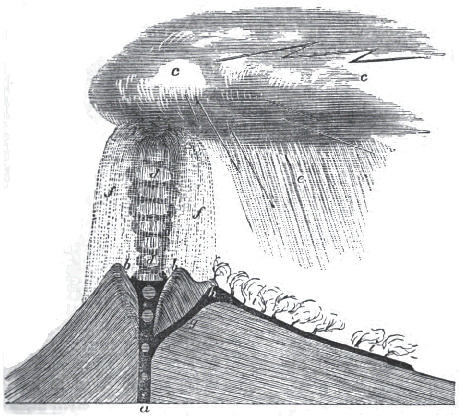
Fig. 25.—Diagrammatic Section of Volcano.
82. Lava.—Any rock which has been erupted from a volcano in a molten state is called lava. Some modern lava-streams cover a great extent of surface. One of two streams which issued from the volcano of Skaptur Jokul (Iceland) in 1783 overflowed an area fifty miles in length, with a breadth in places of fifteen; the other was not much less extensive, being forty miles in length, with an occasional breadth of seven. In some places the lava exceeded 500 feet in thickness. Again, in 1855, an eruption in the island of Hawaii sent forth a stream of lava sixty-five miles long, and from one to ten miles wide. The surface of a stream quickly cools and consolidates, and in doing so shrinks, so as to become seamed with cracks, through which the incandescent matter underneath can be seen. As the current flows on, the upper crust separates into rough ragged scoriform blocks, which are rolled over each other and jammed into confused masses. The slags that cake upon the face or front of the stream roll down before it, and thus a kind of rude pavement is formed, upon which the lava advances and is eventually consolidated. Thus, in most cases, a bed of lava is scoriaceous as well below as above. Other kinds of lava are much more ductile and viscous, and coagulate superficially in glossy or wrinkled crusts. When lava has inclosed fragments of aqueous rocks, such as limestone, clay, or sandstone, these are observed to have undergone some alteration. The sandstone is often much hardened, the clay is porcelainised, and the limestone, still retaining its carbonic acid, assumes a crystalline texture. But the aqueous rock upon which lava has cooled does not usually exhibit much change, nor does the alteration, as a rule, extend more than a few feet (often only a few inches) into the rock. A lava-current which entered a lake or the sea, however, has sometimes caught up much of the sediment gathering there, and become so commingled with it, that in some parts it is hard to say whether the resulting rock is more igneous or aqueous. Lava which has been squirted up from below into cracks and crevices, and there consolidated so as to form dykes, sometimes, but not often, produces considerable alteration upon the rocks which it intersects. The basaltic structure is believed to be due to the contraction of lava consequent upon its cooling. The axes of the prisms are always perpendicular to the cooling surface or surfaces, and in some cases the columns are wonderfully regular. There are numerous varieties of lava, such as basalt, obsidian, pitchstone, pearlstone, trachyte, &c.; some are heavy compact rocks, others are light and porous. Many are finely or coarsely crystalline; others have a glassy and resinous or waxy texture. Some shew a flaky or laminated structure; others are concretionary. Most of the lava rocks, however, are granularly crystalline. In many, a vesicular character is observed. These vesicles, being due to the bubbles of vapour that gathered in the molten rock, usually occur in greatest abundance towards the upper surface of a bed of lava. They are also more or less well developed near the bottom of a bed, which, as already explained, is frequently scoriaceous. Occasionally the vesicles are disseminated throughout the entire rock. As a rule, those lavas which are of inferior specific gravity are much more vesicular than the denser and heavier varieties. The vesicles are usually more or less flattened, having been drawn out in the direction in which the lava-current flowed. Sometimes they are filled, or partially filled, with mineral matter introduced at the time of eruption, or subsequently brought in a state of solution and deposited there by water filtering through the rock: this forms what is called amygdaloidal lava. In volcanic districts, the rocks are often traversed by more or less vertical dykes or veins of igneous matter. These dykes appear in some cases to have been formed by the filling up of crevices from above—the liquid lava having filtered downwards from an overflowing mass. In most cases, however, the lava has been injected from below, and not unfrequently the 'dykes' seem to have been the feeders from which lava-streams have been supplied—the feeders having now become exposed to the light of day either by some violent eruption which has torn the rocks asunder, or else by the gradual wearing away of the latter by atmospheric and aqueous agencies.
METAMORPHISM.
83. Mention has already been made of the fact, that the heated matters ejected from volcanoes, or forcibly intruded into cracks, crevices, &c., occasionally alter the rocks with which they come in contact. When this alteration has proceeded so far as to induce a crystalline or semi-crystalline character, the rock so altered is said to be metamorphosed. Metamorphism has likewise been produced by the chemical action of percolating water, which frequently dissolves out certain minerals, and replaces these with others having often a very different chemical composition. But metamorphism on the large scale—that is to say, metamorphism which has affected wide areas, such as the northern Highlands of Scotland and wide regions in Scandinavia, or the still vaster areas in North America—has most probably been effected both by the agency of heat and chemical action, at considerable depths, and under great pressure. When we observe what effect can be produced by heat upon rocks, under little or no pressure, and how water percolating from above gradually changes the composition of some rock-masses, we may readily believe that at great depths, where the heat is excessive, such metamorphic action must often be intensified. Thus, for example, limestone heated in the usual way gives off its carbonic acid gas, and is reduced to quicklime; but, under sufficient pressure, this gas is not evolved, the limestone becoming converted into a crystalline marble. Some crystalline limestones, indeed, have all the appearance of having at one time been actually melted and squirted under great pressure into seams and cracks of the surrounding strata. Heated water would appear to have been the agent to which much of the metamorphism which affects the rocky strata must be attributed. But the mode or modes in which it has acted are still somewhat obscure; as may be readily understood when it is remembered how difficult, and often how impossible it is to realise or reproduce in our laboratories the conditions under which deep-seated metamorphic action must frequently have taken place. In foliated rocks, the minerals are chiefly quartz, felspar, and mica, talc, or chlorite. The ingredients of these minerals undoubtedly existed in a diffused state in the original rocks, and heated water charged with alkaline carbonates, as it percolated through the strata, either along the layers of bedding or lines of cleavage, slowly acted upon these, dissolving and redepositing them, and thus inducing segregation. There is every kind of gradation in metamorphism. Thus, we find certain rocks which are but slightly altered—their original character being still quite apparent; while, in other cases, the original character is so entirely effaced that we can only conjecture what that may have been. When we have a considerable thickness of metamorphic rocks which still exhibit more or less distinct traces of bedding, like the successive beds of gneiss, mica-schist, and quartz rock of the Scottish Highlands, we can hardly doubt that the now crystalline masses are merely highly altered aqueous strata. But there are cases where even the bedding becomes obliterated, and it is then much more difficult to determine the origin of the rocks. Thus, we find bedded gneiss passes often, by insensible gradations, into true amorphous granite. There has been much difference of opinion as to the origin of granite—some holding it to be an igneous rock, others maintaining its metamorphic origin. It is probably both igneous and metamorphic, however. If we conceive of certain aqueous rocks becoming metamorphosed into gneiss, we may surely conceive of the metamorphism being still further continued until the mass is reduced to a semi-fluid or pasty condition, when all trace of foliation and bedding might readily disappear, and the weight of the superincumbent strata would be sufficient to force portions of the softened mass into cracks and crevices of the still solid rocks above and around it. Hence we might expect to find the same mass of granite passing gradually in some places into gneiss, and in other places protruding as veins and dykes into the surrounding rocks; and this is precisely what occurs in nature.
84. Mineral veins have, as a rule, been formed by water depositing along the walls of fissures the various matters which they held in solution, but certain kinds of veins (such as quartz veins in granite) probably owe their origin to chemical action which has induced the quartz to segregate from the rock mass. Some have maintained that the metallic substances met with in many veins owe their deposition to the action of currents of voltaic electricity; while others have attributed their presence to sublimation from below, the metals having been deposited in the fissures very much as lead is deposited in the chimney of a leadmill. But in many cases there seems little reason to doubt that the ores have merely been extracted from the rocks, and re-deposited in fissures, by water, in the same way as the other minerals with which they are associated.
PHYSIOGRAPHY.
85. Denudation.—By the combined action of all the geological agencies which have been described in the preceding sections, the earth has acquired its present diversified surface. Valleys, lacustrine hollows, table-lands, and mountains have all been more or less slowly formed by the forces which we see even now at work in the world around us. When we reflect upon the fact that all the inclined strata which crop out at the surface of the ground are but the truncated portions of beds that were once continuous, and formed complete anticlinal arches or curves, we must be impressed with the degree of denudation, or wearing-away, which the solid strata have experienced. If we protract in imagination the outcrop of a given set of strata, we shall find them curving upwards into the air to a height of, it may be, hundreds or even thousands of feet, before they roll over to come down and fit on to the truncated ends of the beds on the further side of the anticline (see figs. 9 and 11, pages 33, 34). Dislocations or faults afford further striking evidence in the same direction. Sometimes these have displaced the strata for hundreds and even thousands of feet—that is to say, that a bed occurring at, for example, a few feet from the surface upon one side of a fault, has sunk hundreds or thousands of feet on the other side. Yet it often happens that there is no irregularity at the surface to betray the existence of a dislocation. The ground may be flat as a bowling-green, and yet, owing to some great fault, the rocks underneath one end of the flat may be geologically many hundred feet, or even yards, higher or lower than the strata underneath the other end of the same level space. What has become of the missing strata? They have been carried away grain by grain by the denuding forces—by weathering, rain, frost, and fluviatile and marine action. The whole surface of a country is exposed to the abrading action of the subaërial forces, and has been carved by them into hills and valleys, the position of which depends partly upon the geological structure of the country, and partly upon the texture and composition of the rocks. The original slope of the surface, when it was first elevated out of the sea, would be determined by the action of the subterraneous forces—the dominant parts, whether table-lands or undulating ridges, forming the centres from which the waters would begin to flow. After the land had been subjected for many long ages to the wearing action of the denuding agents, it is evident that the softer rocks—those which were least capable of withstanding weathering and erosion—would be more worn away than the less easily decomposed masses. The latter would, therefore, tend to form elevations, and the former hollows. This is precisely what we find in nature. The great majority of isolated hills and hilly tracts owe their existence as such merely to the fact that they are formed of more durable materials than the rock-masses by which they are surrounded. When a line of dislocation is visible at the surface, it is simply because rocks of unequal durability have been brought into juxtaposition. The more easily denuded strata have wasted away to a greater extent than the tougher masses on the other side of the dislocation. Nearly all elevations, therefore, may be looked upon as monuments of the denudation of the land; they form hills for the simple reason that they have been better able to withstand the attacks of the denuding agents than the rocks out of which the hollows have been eroded.
86. To this general rule there are exceptions, the most obvious being hills and mountains of volcanic origin, such as Hecla, Etna, Vesuvius, &c., and, on a larger scale, the rocky ridge of the Andes. Again, it is evident that the great mountain-chains of the world are due in the first place to upheaval; but these mountains, as we now see them—peaks, cliffs, precipices, gorges, ravines—have been carved out of the solid block, as it were, by the ceaseless action of the subaërial forces. The direction of river-valleys has in like manner been determined in the first place by the original slope of the land; but the deep dells, the broad valleys and straths, have all been scooped out by running water. The northern Highlands of Scotland, for example, evidently formed at one time a broad table-land, elevated above the level of the sea by the subterranean forces. Out of this old table-land the denuding agents, acting through untold ages, have carved out all the numerous ravines, glens, and valleys, the intervening ridges left behind now forming the mountains. It is true that now and again streams are found flowing in the direction of a fault, but that is simply because the dislocation is a line of weakness, along which it is easier for the denuding forces to act. For one fault that we find running parallel to the course of a river, we may observe hundreds cutting across its course at all angles. The great rocky basins occupied by lakes, which are so abundant in the mountainous districts of temperate regions and in northern latitudes, are believed to have been excavated by the erosive power of glacier-ice; and they point, therefore, to a time when our hemisphere must have been subjected to a climate severe enough to nourish massive glaciers in the British Islands and similar latitudes. It may be concluded that the present physiography of the land is proximately due solely to the action of the denuding agents—rain, frost, rivers, and the sea. But the lines along which these agents act with greatest intensity have been determined in the first place by the subterranean forces which upheaved the solid crust into great table-lands or mountain undulations. Both the remote and the proximate causes of the earth's surface-features, however, have acted in concert and contemporaneously, for no sooner would new land emerge above the sea-level than the breakers would assail it, and all the forces of the atmosphere would be brought to bear upon it—rain, frost, and rivers—so that the beginning of the sculpturing of hill and valley dates back to the period when the present lands were slowly emerging from the ocean. So great is the denudation of the land, that in process of time the whole would be planed down to the level of the sea, if it were not for the subterranean forces, which from time to time depress and elevate different portions of the earth's crust. It can be proved that strata miles in thickness have been removed bodily from the surface of our own country by the seemingly feeble agents of denudation. All the denuded material—mud, sand, and gravel—carried down into the sea has been re-arranged into new beds, and these have ever and anon been pushed up to the light of day, and scarped and channelled by the denuding forces, the resulting detritus being swept down as before into the sea, to form fresh deposits, and so on. It follows, therefore, that the present arrangement of land and sea has not always existed. There was a time before the present distribution of land obtained, and a time will yet arrive when, after infinite modifications of surface and level, the continents and islands may be entirely re-arranged, the sea replacing the land, and vice versâ. To trace the history of such changes in the past is one of the great aims of the scientific geologist.
PALÆONTOLOGY.[F]
87. Fossils.—In our description of rock-masses, and again in our account of geological agencies, we referred to the fact that certain rocks are composed in large measure, or exclusively, of animal or vegetable organisms, or of both together; and we saw that analogous organic formations were being accumulated at the present time. But we have deferred to this place any special account of the organic remains which are entombed in rocks. Fossils, as these are called, consist generally of the harder and more durable parts of animals and plants, such as bones, shells, teeth, seeds, bark, and ligneous tissues, &c. But it is usual to extend the term fossil to even the casts or impressions of such remains, and to foot-marks and tracks, whether of vertebrates, molluscs, crustaceans, or annelids. The organic remains met with in the rocks have usually undergone some chemical change. They have become petrified wholly or in part. The gelatine which originally gave flexibility to some of them has disappeared, and even the carbonate and phosphate of lime of the harder parts have frequently been replaced by other mineral matter, by flint, pyrites, or the like. So perfect is the petrifaction in many cases, that the most minute structures have been entirely preserved—the original matter having been replaced atom by atom. As a rule, fossils occur most abundantly and in the best state in clay-rocks, like shale; while in porous rocks, like sandstone, they are generally poorly preserved, and not of so frequent occurrence. One reason for this is, that clay-rocks are much less pervious than sandstone, and their imbedded fossils have consequently escaped in greater measure the solvent powers of percolating water. But there are other reasons for the comparative paucity of fossils in arenaceous strata, as we shall see presently.
88. Proofs of varied Physical Conditions.—Organic remains are either of terrestrial, fresh-water, or marine origin, and they are therefore of the utmost value to the geologist in deciphering the history of those great changes which have culminated in the present. But we can go a step further than this. We know that at the present day the distribution of animal and vegetable life is due to a variety of causes—to climatic and physical conditions. The creatures inhabiting arctic and temperate regions contrast strongly with those that tenant the tropics. So also we observe a change in animal and vegetable forms as we ascend from the low grounds of a country to its mountain heights. Similar changes take place in the sea. The animals and plants of littoral regions differ from those whose habitat is in deeper water. Now, the fossiliferous strata of our globe afford similar proofs of varying climatic and physical conditions. There are littoral deposits and deep-sea accumulations: the former are generally coarse-grained (conglomerates, grit, and sandstone); the latter are for the most part finer-grained (clay, shale, limestone, chalk, &c.); and both inshore and deep-water formations have each their peculiar organic remains. Again, we know that some parts of the sea-bottom are not so prolific in life as others—where, for example, any considerable deposit of sand is taking place, or where sediment is being constantly washed to and fro upon the bottom, shells and other creatures do not appear in such numbers as where there is less commotion, and a finer and more equable deposit is taking place. It is partly for the same reason that certain rocks are more barren of organic remains than others.
89. Fossil Genera and Species frequently extinct.—It might perhaps at first be supposed that similar rocks would contain similar fossils. For example, we might expect that formations resembling in their origin those which are now forming in our coral seas would also, like the latter, contain corals in abundance, with some commingling of shells, crustaceans, fish, &c., such as are peculiar to the warm seas in which corals flourish. And this in some measure holds good. But when we examined carefully the fossils in certain of the limestones of our own country, we should find that while the same great orders and classes were actually present, yet the genera and species were frequently entirely different; and not only so, but that often none of these were now living on the earth. Moreover, if we extended our research, we should soon discover that similar wide differences actually obtained between many of the limestones themselves and other fossiliferous strata of our country.
90. Fossiliferous Strata of Different Ages.—Another fact would also gradually dawn upon us—this, namely, that in certain rocks the fossils depart much more widely from analogous living forms, than the organic remains in certain other rocks do. The cause of this lies in the fact that the fossiliferous strata are of different ages; they have not all been formed at approximately the same time. On the contrary, they have been slowly amassed, as we have seen, during a long succession of eras. While they have been accumulating, great vicissitudes in the distribution of land and sea have taken place, climates have frequently altered, and the whole organic life of the globe has slowly changed again and again—successive races of plants and animals flourishing each for its allotted period, and then becoming extinct for ever.[G] Thus, strata formed at approximately the same time contain generally the same fossils; while, on the other hand, sedimentary deposits accumulated at different periods are charged with different fossils. Fossils in this way become invaluable to the geologist. They enable him to identify formations in separate districts, and to assign to them their relative antiquity.[H] If, for example, we have a series of formations, A, B, C, piled one on the top of the other, A being the lowest, and C the highest, and each charged with its own peculiar fossils, we may compare the fossils met with in other sets of strata with the organic remains found in A, B, C. Should the former be found to correspond with the fossil contents of B, we conclude that the rocks in which they occur are approximately of contemporaneous origin with B, even although the equivalents of the formations A and C should be entirely wanting. Further, we soon learn that the order of the series A, B, C, is never inverted. If A be the lowest, and C the highest stratum in one place, it is quite certain that the same order of succession will obtain wherever the equivalents of these strata happen to occur together. But the succession of strata is not invariably the same all the world over; in some countries, we may have dozens of separate formations piled one on the top of the other; in other countries, many members of the series are absent; in brief, blanks in the succession are of constant occurrence. But by dovetailing, as it were, all the formations known to us, we are enabled to form a more or less complete series of rocks arranged in the order of their age. A little reflection will serve to shew that the partial mode in which the strata are distributed over the globe arises chiefly from two causes. We have to remember, first, that the deposits themselves were laid down only here and there in irregular spreads and patches—opposite the mouths of rivers, at various points along the ancient coast-lines, and over certain areas in the deeper abysses of the ocean—the coarser accumulations being of much less extent than those formed of finer materials. And, second, we must not forget the intense denudation which they have experienced, so that miles and miles of strata which once existed have been swept away, and their materials built up into new formations.
91. Gradual Extinction of Species.—When a sufficient number of fossils has been diligently compared, we discover that those in the younger strata approach most nearly to the present living forms, and that the older the strata are, the more widely do their organic remains depart from existing types of animals and plants. We may notice also, that when a series of beds graduate up into each other, so that no strongly marked line separates the overlying from the underlying strata, there is also a similar gradation amongst the fossils. The fossils in the highest beds may differ entirely from those in the lowest; but in the middle beds there is an intermingling of forms. In short, it is evident that the creatures gradually became extinct, and were just as gradually replaced by new forms, until a time came when all the species that were living while the lowest beds were being amassed, at last died out, and a complete change was effected.
92. Proofs of Cosmical Changes of Climate.—From the preceding remarks it will be also apparent that fossils teach us much regarding the climatology of past ages. They tell us how the area of the British Islands has experienced many vicissitudes of climate, sometimes rejoicing in a warm or almost tropical temperature, at other times visited with a climate as severe as is now experienced in arctic and antarctic regions. Not only so, but we learn from fossils that Greenland once supported myrtles and other plants which are now only found growing under mild and genial climatic conditions; while, on the other hand, remains of arctic mammals are met with in the south of France. Such great changes of climate are due, according to Mr Croll, to variations in the eccentricity of the earth's orbit combined with the precession of the equinox. It is well known that the orbit of our earth becomes much more elliptical at certain irregularly recurring periods than it is at present. During a period of extreme ellipticity, the earth is, of course, much further away from the sun in aphelion[I] than it is at a time of moderate ellipticity, while, in perihelion,[J] it is considerably nearer. Now, let us suppose that, at a time when the ellipticity is great, the movement known as the precession of the equinox has changed the incidence of our seasons, so that our summer happens in perihelion and not in aphelion, while that of the southern hemisphere occurs in aphelion, and not, as at present, in perihelion. Under such conditions, the climate of the globe would experience a complete change. In the northern hemisphere, so long and intensely cold would the winter be, that all the moisture that fell would fall as rain, and although the summer would be very warm, it would nevertheless be very short, and the heat then received would be insufficient to melt the snow and ice which had accumulated during the winter. Thus gradually snow and ice would cover all the lands down to temperate latitudes. In the southern hemisphere, the reverse of all this would obtain. The winter there would be short and mild, and the summer, although cool, would be very long. But such changes would bring into action a whole series of physical agencies, every one of which would tend still further to increase the difference between the climates of the two hemispheres. Owing to the vast accumulation of snow and ice in the northern hemisphere, the difference of temperature between equatorial and temperate and polar regions would be greater in that hemisphere than in the southern. Hence the winds blowing from the north would be more powerful than those coming from the southern and warmer hemisphere, and consequently the warm water of the tropics would necessarily be impelled into the southern ocean. This would tend still further to lower the temperature of our hemisphere, while, at the same time, it would raise correspondingly the temperature at our antipodes. The general result would be, that in our hemisphere ice and snow would cover the ground down to low temperate latitudes—the British Islands being completely smothered under a great sea of confluent glaciers. In the southern hemisphere, on the contrary, a kind of perennial summer would reign even up to the pole. Such conditions would last for some ten or twelve thousand years, and then, owing to the precession of the equinox, a complete change would come about—the ice-cap would disappear from the north, and be replaced by continuous summer, while at the same time an excessively severe or glacial climate would characterise the south; and such great changes would occur several times during each prolonged epoch of great eccentricity. This, in few words, is an outline of Mr Croll's theory. That theory is at present sub judice, but there can be no doubt that it gives a reasonable explanation of many geological facts which have hitherto been inexplicable. Of course, it is not maintained that all changes of climate are due directly or indirectly to astronomical causes. Local changes of climate—changes affecting limited regions—may be induced by mutations of land and sea, resulting in the partial deflection of ocean currents, which are the chief secondary means employed by nature for the distribution of heat over the globe's surface.
From what has been stated in the foregoing paragraphs, it is clear that in our endeavours to decipher the geological history of our planet, palæontological must go hand in hand with stratigraphical evidence. We may indeed learn much from the mode of arrangement of the rocks themselves. But the test of superposition does not always avail us. It is often hard, and sometimes quite impossible, to tell from stratigraphical evidence which are the older rocks of a district. In the absence of fossils we must frequently be in doubt. But physical evidence alone will often afford us much and varied information. It will shew us what was land and what sea at some former period; it will indicate to us the sites of ancient igneous action; it will tell us of rivers, and lakes, and seas which have long since passed away. Nay, in some cases, it will even convince us that certain great climatic changes have taken place, by pointing out to us the markings, and débris, and wandered blocks which are the sure traces of ice action, whether of glaciers or icebergs. The results obtained by combining physical and palæontological evidence form what is termed Historical Geology.
HISTORICAL GEOLOGY.
93. The fossiliferous strata, as they are generally termed, have been chronologically arranged in a series of formations, each of which is characterised by its own peculiar suites of fossils. Their relative age has been determined, as we have indicated above, by their fossils, and also by certain physical tests, the chief of these being superposition. It holds invariably true that a formation, A, found resting upon another series of strata, B, will always occur in precisely the same position, wherever these two deposits occur together. If B should appear in some place as resting upon A, we may be sure that the beds have been inverted during the contortion of the strata consequent upon subterranean action (see fig. 11, page 34). Again, another useful test of the relative age of strata lies in the circumstance that one is often made up or contains fragments of the other. In this case, then, it is quite clear which is the more recent accumulation. These tests have now been applied to the strata in many parts of the world, and the result is that geologists have been able to arrive at a chronological arrangement or classification, and so to construct a table shewing the relative position which would be occupied by all the different formations, if these occurred together in one place. In the British Islands the long series of strata is well developed, but many of the formations are much more meagrely represented than their equivalents in other countries. But even when we attempt to fill up the blanks in our own series by dovetailing with them the strata of foreign countries, there yet remain numerous breaks in the succession, pointing to the fact that the stony record is a very fragmentary one at the best. No doubt there are many large tracts of the earth's surface which have not yet been investigated, and when these are known we may hope to have our knowledge greatly increased. But no one who reflects upon the mode of origin of the fossiliferous strata, and the wonderful mutations which the earth has undergone, can reasonably anticipate that a perfect and complete record of the geological history of our planet shall ever be compiled from the broken and fragmentary testimony of the rocks.
94. The following table gives the names of the different formations arranged in the order of their superposition, the youngest being at the top, and the oldest known at the bottom:
IV.Post-tertiary or Quaternary—
Historical or Recent.
Pleistocene.
III.Tertiary or Cainozoic—
Pliocene.
Miocene.
Eocene.
II.Secondary or Mesozoic—
Cretaceous.
Jurassic.
Triassic.
I.Primary or Palæozoic—
Permian.
Carboniferous.
Devonian and Old Red Sandstone.
Silurian.
Cambrian.
Laurentian or Pre-Cambrian.
95. The Primary formations are so called because they are the oldest known to us: they are not necessarily the first-formed aqueous deposits. Dr Hutton said truly: There is no trace of a beginning, and no signs of an end. In the Primary or Palæozoic (ancient-life) formations are found the earliest traces of life. The forms as a rule depart very widely from those with which we are acquainted now. The Laurentian rocks have yielded only one fossil—a large foraminifer named Eozoon Canadense. The Cambrian formation contains but few fossils—crustaceans, molluscs, zoophytes, and worm-tracks. The Silurian strata are often abundantly fossiliferous. All the great classes of invertebrates are represented, and fish remains also occur. The Devonian and Old Red Sandstone are also characterised by the presence of an abundant fauna. In the Old Red Sandstone are numerous fish remains; it appears to have been an estuarine or lacustrine deposit; the Devonian, on the other hand, was marine, like the Silurian and Cambrian. The Carboniferous formation is the chief repository of coal in Britain. It consists of terrestrial, fresh or brackish water, and marine deposits. The fauna and flora of the Permian, which is partly a marine and partly a fresh-water formation, are allied, upon the whole, to those of the Carboniferous, but offer at the same time many contrasts.
96. The Secondary or Mesozoic (middle-life) formations contain assemblages of fossils which do not depart so widely from analogous living forms as those belonging to Palæozoic times. The Triassic strata yield abundance of rock-salt. In Britain they contain very few fossils, but these are more abundant in the Triassic deposits of foreign countries. The oldest known mammals first appear in this formation. The Jurassic formation is very highly fossiliferous. It is distinguished by the occurrence of numerous reptilian remains. Nearly all the beds of this formation are marine, but there are associated with these the remains of a forest or old land surface, and a considerable accumulation of estuarine or fresh-water deposits; impure coals also occur in this formation. The Cretaceous strata are almost wholly marine, and chiefly of deep-water origin. But some land-plants are found, chiefly ferns, conifers, and cycads. Near the base of the formation occurs a great river deposit (Weald clay) with numerous remains of reptiles.
97. Among the oldest strata of the Tertiary or Cainozoic (recent-life) division we meet with the dawn of the existing state of the testaceous fauna—the Eocene (ēos, dawn, and kainos, recent) containing three and a half per cent. of recent species among its shells. The proportion of recent species increases in the Miocene (meion, less, and kainos, recent), although the majority of the molluscs entombed in that formation belong to extinct species. In the Pliocene (pleion, more, and kainos, recent), however, the extinct species are in a minority.
The Post-tertiary or Quaternary division comprises the concluding chapters of geological history. The Pleistocene (pleistos, most, and kainos, recent) contains no extinct species of shells, but a number of extinct mammalia. In the Recent deposits all the species of animals and plants are living. The Tertiary and Quaternary formations are partly of marine and partly of terrestrial and fresh-water origin. At the close of the Tertiary period the 'glacial epoch' of Pleistocene times began, and the British Islands and a large part of northern Europe and North America were then cased in snow and ice. Traces of glacial conditions have also been met with in the Eocene and Miocene. The evidence furnished by Palæozoic and Mesozoic formations points chiefly to mild, genial, and sometimes tropical conditions. But traces of ice action are occasionally noted (namely, in the Silurian, Old Red Sandstone, Carboniferous, Permian, and Cretaceous formations), pointing, perhaps, in some of the cases, to former alternations of cold and warm periods. Indeed, the belief is now gaining ground, that the so-called glacial epoch of Pleistocene times was not one long continuous age of ice, but rather consisted of an alternation of warm and cold periods. And it is not improbable, but highly likely, that similar alternations of climate have happened during every period of great eccentricity of the earth's orbit.
QUESTIONS.
Section 1. What is Geology?
2. Define the term rock. How many classes of rock are there?
3, 4, 5. Into what groups are the mechanically formed rocks divided? Define the terms conglomerate, sandstone, and shale.
6. What is the nature of the rocks belonging to the Aërial or Eolian group?
7. Give an example of a chemically formed rock.
8. Give examples of organically derived rocks.
9. What kinds of rocks are embraced by the Metamorphic class?
10. What are igneous rocks?
12. What is the mineralogical composition of granite?
13. What is meant by a mineral?
14. Name five minerals which do not contain oxygen. Where does fluor-spar occur? What is the element that enters most largely into the composition of the earth's crust?
15. Name the forms under which the mineral quartz occurs. Name some of the oxides of iron. What is iron pyrites?
16. Name two sulphates. Name two carbonates. Name some of the silicates. In what kinds of rock is augite found? Where does it never occur? In what kinds of rock does hornblende usually occur? Mention three species of felspar. What is one of the most distinguishing characteristics of mica? Name three silicates of magnesia. Mention some of their distinguishing peculiarities. Where do zeolites commonly occur?
17. What is a quartzose conglomerate? What is a calcareous conglomerate?
18. What is grit? What is freestone? To what are the various colours of sandstone due? What is shale?
19. Name some typical Eolian rocks, and tell where they occur.
20. How do stalactites and stalagmites occur? What is siliceous sinter, and how does it occur? How does rock-salt occur?
21. Mention some of the varieties of limestone. What is cornstone? What is the composition of dolomite?
22. Name some of the varieties of coal.
23. What is quartzite?
24. Describe clay-slate.
25. Mention some altered limestones.
26. What are schists? Name and give the mineralogical composition of three schists.
27. What is the general character of metamorphic rocks?
28. How would you classify granite?
29. What is the mineralogical composition of syenite and diorite?
30. How do we distinguish the two groups into which igneous rocks are subdivided? What is meant by the terms amygdaloidal and porphyritic?
31. Name some rocks that belong to the acidic group. What is quartz-porphyry?
32. Give examples of augitic igneous rocks. Name a hornblendic igneous rock.
33. What are fragmental igneous rocks? What is the difference between trappean breccia and trappean conglomerate?
34. What is meant by the terms stratum, strata, and stratified? What is the difference between lamination and bedding? What is a section?
35. What is false bedding?
36. Briefly describe the general appearance of mud-cracks and rain-prints, and say how these have been formed.
37. What is meant by a succession of strata?
38. Which kinds of stratified rocks generally have the greatest extension?
39. How do beds terminate?
40. How may planes of bedding sometimes indicate a break in the succession of strata?
41. What is the nature of joints? What are master-joints, and what is their probable cause?
42. What is cleavage, and what is its effect upon the bedding of rocks?
43. What is foliation?
44. Give examples of concretionary rocks. What is the nature of chert and flint nodules?
45. Define the terms dip and strike. What is the crop of a bed? What are anticlines and synclines?
46. What is meant by an inversion of strata?
47. How does contemporaneous erosion indicate a pause in the deposition of a series of strata?
48. What is meant by unconformability? How does unconformability prove a lapse of time between the accumulation of the underlying and overlying strata?
49. What is overlap?
50. What is a fault? What is hade? How are the strata affected on either side of a fault? What is the appearance called slickensides? Under what circumstances should we term a fault a downthrow? and when should we term it an upcast? How is the approximate age of a fault sometimes shewn?
51. What are metamorphic rocks, and what is their general appearance? In what districts of the British Islands are they most abundantly developed? What are some of the appearances relied upon for distinguishing metamorphic from igneous granite?
52. How do igneous rocks occur? Define what is meant by contemporaneous and subsequent or intrusive igneous rocks. How does a contemporaneous igneous rock affect the beds upon which it rests? What is the character of the bed overlying a contemporaneous rock? What is the general structure of a contemporaneous igneous rock? What is meant by vesicular structure? What is the general texture of a contemporaneous igneous rock? What is the nature of the jointing in igneous rocks? What is wacké?
53. What is the nature of the beds of breccia, conglomerate, ash, and tuff, with which contemporaneous igneous rocks are often associated? What is a neck of volcanic agglomerate? How are the strata affected at their junction with a 'neck'?
54. How do intrusive igneous rocks occur? How do intrusive sheets occur? What effect have they produced upon the strata above and below them? What is a dyke? What relation do they occasionally bear to sheets of igneous rock? What is a neck of intrusive igneous rock, and how have the strata surrounding it been affected?
55. Mention some of the contrasts between intrusive and contemporaneous igneous rocks. What alteration is produced upon coal with which an intrusive sheet has come in contact?
56. What are mineral veins? What is the nature of the quartz veins in granite? How are the minerals usually arranged in the great metalliferous veins? What is a pipe-vein?
57. What are the great geological agents of change?
58. What is meant by weathering? How are rocks affected at the surface in tropical countries? What chemical effect has the atmosphere on calcareous rocks? How is soil formed? How are sand dunes formed? Mention some effects of the transporting power of the atmosphere.
59. Mention some of the chemical effects of interstitial water. What is the origin of travertine or calcareous tufa?
60. How have stalactites and stalagmites been formed? Give some instances of the solvent power of springs.
61. How are caves in limestone formed? Describe some of the appearances of a country composed of calcareous rocks. Describe briefly how a river erodes its channel.
62. Describe the geological action of rain.
63. What do chemical analyses of river-water prove? Give an example. What are pot-holes? Give an example of the erosive power of running water. What amount of mud is carried in suspension by the Mississippi, and discharged annually into the sea? What estimate has been formed of the total amount of mineral matter annually transported by that river?
64. What is alluvium? How is it formed? and mention some examples of its occurrence.
65. How is sediment deposited by a river in a lake?
66. What is the difference between lacustrine and fluvio-marine deposits? What is a delta?
67. Describe the geological action of frost. Describe the geological action of river-ice.
68. What are glaciers? What thickness do they attain in the Alps? What is their rate of motion? What are crevasses, and how do they originate? What are superficial moraines? What are terminal moraines? What changes does a glacier effect upon its bed, and how are these modifications produced? What is the character of a glacial river? What is the origin of icebergs? How is the general absence of blocks and stones in Greenland icebergs to be explained? What is the nature of a submarine terminal moraine? What is the ice-foot? What is the chief agent in distributing erratic stones and blocks over the sea-bottom? What effect upon the sea-bed must stranding icebergs produce?
69. What are some of the chemical compounds held in solution in sea-water? Which of these go to form the shells and skeletons of marine animals?
70. Describe the action of breakers on a sea-coast. How does frost aid the wasting action of breakers? What effect has the nature of the rocks in the production of inequalities in a coast-line? Upon what part of the sea-bottom does the material derived by the action of the breakers chiefly accumulate? What effect have the tides and ocean currents in the distribution of sediment?
71. What is the general rule as regards fine-grained and coarse-grained deposits? Mention a partial exception to this rule. What effect have tidal currents in shallow seas?
72. How are rocks disintegrated through the action of plants? What is peat? What may be inferred from the occurrence of shell-marl underneath peat? What does the appearance of roots and trunks of trees, and of remains of land animals under peat, indicate?
73. What, generally, is the geological action of animal life?
74. What is coral? What is a fringing reef? What is the general character of a barrier reef? Give an example of one. What is an atoll? What is the nature of coral rock? What is Mr Darwin's theory of the formation of coral reefs?
75. What is the nature of the Atlantic ooze? In what respects may it eventually come to resemble chalk and limestone? Mention an instance of the abundant occurrence in the sea of animalcules with siliceous coverings and skeletons. What is the nature of the red clay found at great depths in the Atlantic and Southern Oceans?
76. What are some of the notions held in regard to the internal condition of the earth? At what (average) rate does the temperature of the earth's crust increase as we descend from the surface?
77. What is the nature of the movements to which the earth's crust is subjected?
78. Describe the hypotheses advanced to account for earthquakes. Mention some of the effects of earthquakes—1st, as regards alterations of level; and 2d, as regards modifications of the surface.
79. Mention a good example of tranquil elevation and depression of the earth's crust. Mention some of the proofs of an elevatory movement. Give proofs that shew depression of the land. How may certain former changes of sea-level be accounted for without inferring any movement of the land?
80. What effect must depression have upon the strata forming the earth's crust? What is the result of a movement of elevation? What is the cause of cleavage?
81. What is the nature of the materials thrown out during volcanic eruptions? What is the general structure of a volcanic cone? How does molten rock make its escape from the orifice of eruption? What is the meaning of the terms lapillo, puzzolana, and ceneri?
82. What is lava? Describe the general appearance and mode of progression of a stream of lava. What effect is produced upon fragments of rock caught up and inclosed in lava; and what changes are caused in the pavement upon which it cools? How does a lava stream entering a lake or the sea behave in regard to the sediment gathering therein? To what is the basaltic structure due? How are the axes of the prisms in a columnar igneous rock arranged? Name some of the varieties of lava. What is the origin of the vesicular structure in igneous rocks? What portions of a bed of lava are most frequently scoriaceous? In what kinds of lava is the vesicular structure most abundantly met with? How have the vesicles become flattened? In what manner have they been filled with mineral matter? What is the origin of the dykes of modern volcanic districts?
83. How is metamorphism on the large scale supposed to have been induced? How may granite be at one and the same time a metamorphic and igneous rock?
84. Mention some of the views held with regard to the origin of mineral veins.
85. What is denudation? How do inclined strata prove that the strata have been denuded? How do faults afford proof of denudation? What have been the general effects produced by denudation on the face of the land?
86. What part have the subterranean forces acted in the formation of mountains? To what geological action is the present aspect of these mountains due? What has determined the direction of river valleys? How have the valleys, dells, &c. been formed? What effect have faults had in determining the direction of river valleys? What is supposed to be the origin of the deep rock-basins occupied by many fresh-water lakes? How is the waste of land by denudation compensated?
87. What are fossils? What is meant by petrifaction? In what kind of rocks do fossils occur most abundantly, and in the best state of preservation? and what reason can be given for this?
88. How do fossils afford proof of varied physical conditions? Give a reason for some rocks being more barren of fossils than others.
89. State some of the characters which distinguish broadly the older fossiliferous strata from those similar accumulations which are being formed in our own day.
90. How may we identify formations in separate districts? How is the interrupted and partial distribution of strata to be accounted for?
91. In what respect do the fossils in younger strata differ from those in older strata? What general proof can be adduced to shew that species have become gradually extinct?
92. Give an instance how fossils prove changes of climate in the past. What is supposed to be the cause of great cosmical changes of climate? Describe Mr Croll's theory of cosmical changes of climate.
93. What is the test of superposition? Mention another test of the relative age of strata.
94. Name the four great divisions under which the fossiliferous rocks are arranged.
95. Name the Primary or Palæozoic formations. What are the principal kinds of fossils found in the Old Red Sandstone? Which formation is the chief repository of coal in Britain?
96. In what other formations do coals occur? In which formation do the oldest known mammals occur? Name the Secondary formations.
97. Name the Tertiary formations. What kind of climate characterised the northern hemisphere at the beginning of Pleistocene times? What kinds of climate would appear from the evidence to have chiefly prevailed in Primary, Secondary, and Tertiary ages? Have we any trace of frigid conditions during these ages? What is the growing opinion with regard to the climatic conditions during the glacial period of Pleistocene times?
THE END.
Edinburgh: Printed by W. & R. Chambers.
FOOTNOTES: