DISCUSSION
Reading edition
The preceding definitions only slightly alter the present generic limits of Mexican leptodactylids. Two species, previously regarded as Eleutherodactylus, are transferred to the new genus Hylactophryne. The arrangement of the species of Syrrhophus and Tomodactylus remains the same as concluded by Dixon (1957), Duellman (1958), and Firschein (1954) in their reviews of the genera.
Lumbo-inguinal glands are most prominent in the genera Pleurodema and Tomodactylus. Various nondescript glands are present in many genera, but none is so well developed as those of Pleurodema and Tomodactylus.
At least nine leptodactylid genera are either known or thought to be terrestrial breeders lacking a free-living tadpole stage (Eleutherodactylus, Euparkerella, Hylactophryne, Niceforonia, Noblella, Sminthillus, Syrrhophus, Tomodactylus and Trachyphrynus). Niceforonia and Trachyphrynus, and probably Hylactophryne, are not closely related to the other genera. Direct development probably is an adaptation to adverse environmental conditions since many of the species occur in semi-arid or cold (Andean páramos) areas. Eleutherodactylus is generally thought to be the stock from which Euparkerella, Noblella, and Sminthillus evolved (Griffiths, 1959) and from which Syrrhophus and Tomodactylus are derived (Firschein, 1954).
The present distribution of Hylactophryne (isolated on the Mexican Plateau) and its digital form (like that of Papuan and many primitive South American leptodactylids) suggest that the genus was isolated in México throughout the Tertiary, whereas the other Central American genera are either post-Pliocene derivatives of Eleutherodactylus or invaders of Central America from South America since the mid-Pliocene land bridge was formed (Lloyd, 1963).
Piatt (1934) presented arguments against assigning Eleutherodactylus latrans to the genus Lithodytes and concluded that it was a "true" Eleutherodactylus. Contrary to his arguments, latrans (= augusti of Zweifel) and E. tarahumarensis Taylor differ from all other Eleutherodactylus (and Syrrhophus and Tomodactylus) in the nature of the tips of the digits (external and skeletal). The digits of Hylactophryne are like those of Eupsophus. My study of nearly all genera of leptodactylids indicates that Noble (1925) was correct in suggesting that Borborocoetes (= Eupsophus) is a close relative of Eleutherodactylus latrans, although Noble's arguments were based in part upon false evidence concerning the breeding habits of E. latrans, then thought to have a free-living tadpole.
Kellogg (1932) and Piatt (1934) argued that the terminal phalanges of E. latrans were typically eleutherodactyline. The variation of this character in Eupsophus (see Fig. 4) ranges from knobbed to bifurcate or Y-shaped (T-shaped in Eleutherodactylus, Syrrhophus and Tomodactylus) and encompasses the nature of the character represented in Hylactophryne. Eupsophus differs from Hylactophryne in possessing a frontoparietal fontanelle, in generally having a maxillary-quadratojugal gap, and in having a free swimming tadpole stage.
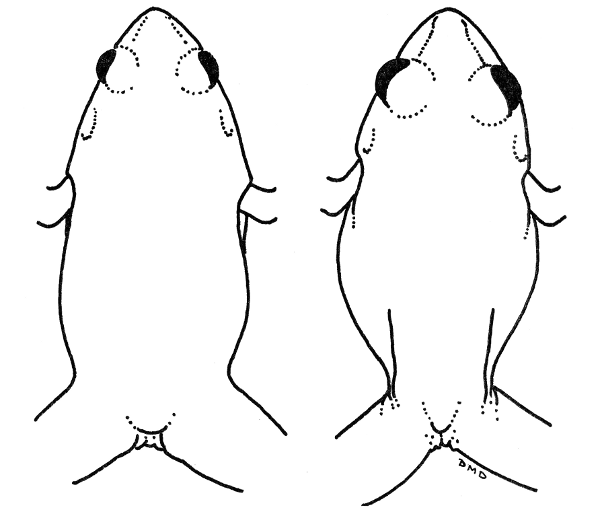
Fig. 5. Outline drawings of Leptodactylus melanonotus (left, KU 65704, × 2) and Eleutherodactylus alfredi (right, KU 93994, × 2).