ANALYSIS OF CHARACTERS
Reading edition
In México and northern Central America approximately 55 species of eleutherodactyline frogs (Eleutherodactylus, Syrrhophus, and Tomodactylus) are known. Four genera can be recognized on the basis of the nature of inguinal glands, morphology of the hands and feet, and certain osteological features.
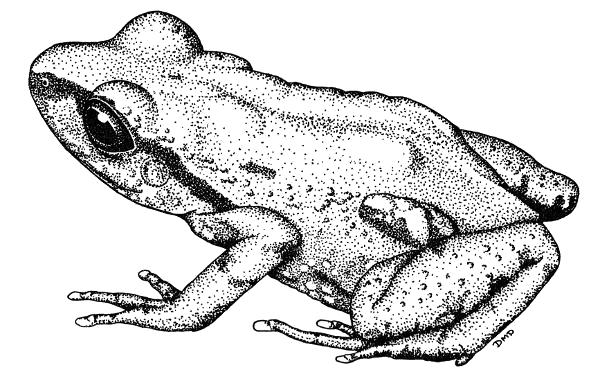
Fig. 1. Tomodactylus angustidigitorum (UMMZ 114305, × 4.5) illustrating the lumbo-inguinal gland typical of members of the genus. From a kodachrome by Wm. E. Duellman.
Glands
Leptodactylids have a variety of glands that have been used as generic characters. Smith and Taylor (1948) regarded the so-called inguinal gland as a generic character in Mexican eleutherodaycty-lines. Lynch (1965) showed that Eleutherodactylus and Microbatrachylus cannot be separated by the nature of the gland or the condition of the prevomers (dentate or not). Syrrhophus and Tomodactylus, as defined by Smith and Taylor (1948), are not generically distinct because of overlap in the condition of the prevomers and in the development of the gland. Firschein (1954) stated that Syrrhophus differed from Tomodactylus by having an axillary gland, but it is now known that one species of Syrrhophus lacks the gland.
The inguinal glands of Eleutherodactylus and Syrrhophus, if present, are diffuse, irregular in outline, and generally not prominent; in Tomodactylus the gland is higher on the body (a lumbo-inguinal gland), compact, oval in outline, and prominent (Fig. 1). Axillary glands occur in most Syrrhophus but are not known in Tomodactylus or Eleutherodactylus.
Hands and feet
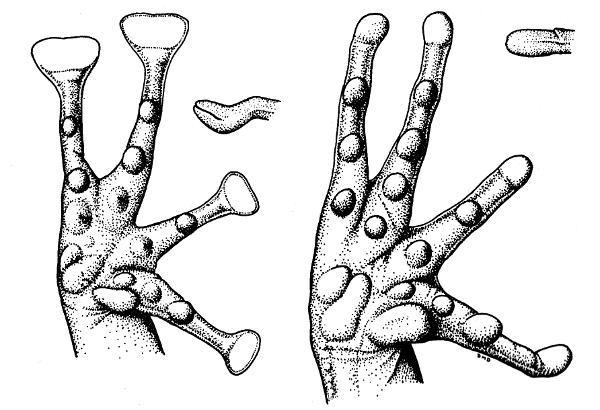
The tips of the digits are laterally expanded in most Eleutherodactylus, Syrrhophus, and Tomodactylus. Two species of Eleutherodactylus (augusti and tarahumarensis) and two Tomodactylus (angustidigitorum and grandis) lack any expansion of the digital tips. All but two of the species of eleutherodactyline frogs (E. augusti and E. tarahumarensis) have a transverse groove across the tips of the digits (Fig. 2).
Fig. 2. Palmar views of the hands and lateral views of the tip of the third digits of Eleutherodactylus alfredi (left, KU 93994, × 5) and Hylactophryne augusti (right, KU 102594, × 3).
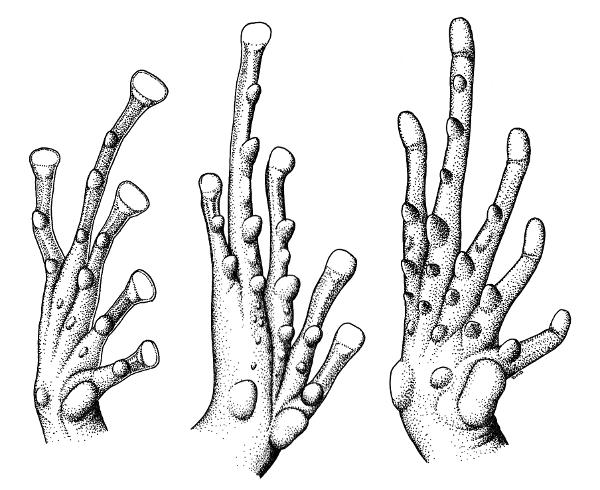
Supernumerary tubercles rarely are present on the feet of Eleutherodactylus, but are present and numerous in every species of Syrrhophus, Tomodactylus, and in the members of the augusti group of Eleutherodactylus (Fig. 3). The tubercles are small and numerous in Syrrhophus and larger in Tomodactylus and the Eleutherodactylus augusti group. Most species of Eleutherodactylus have no plantar supernumerary tubercles; a few species have such tubercles, which never extend between the metatarsal tubercles as in Syrrhophus and Tomodactylus.
Fig. 3. Plantar views of feet of Eleutherodactylus alfredi (left, KU 93994, × 4.5), Syrrhophus pipilans nebulosus (middle, KU 58900, × 7.5), and Hylactophryne augusti (right, KU 102594, × 3) showing differences in size and arrangement of supernumerary tubercles.
Tarsal folds and tubercles are lacking in Syrrhophus, Tomodactylus, and the augusti group of Eleutherodactylus. Several species of Eleutherodactylus lack tarsal folds and tubercles, but in nearly every species group, one or more species possess either an inner tarsal fold, inner tarsal tubercle(s), or outer tarsal tubercles.
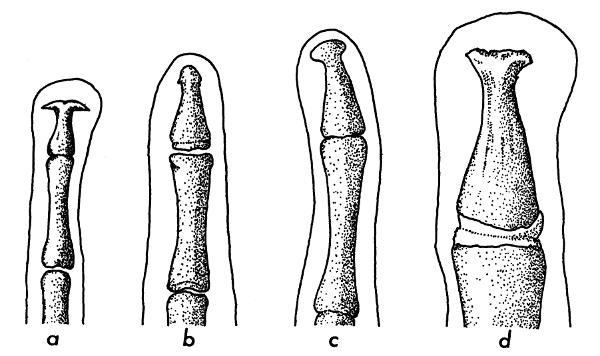
The terminal phalanges of Syrrhophus, Tomodactylus, and all Eleutherodactylus (except the frogs of the augusti group) are distinctly T-shaped. In the latter, the bones are knob-shaped distally (Fig. 4). T-shaped terminal phalanges also are present in Lithodytes and Trachyphrynus but not in other leptodactylid genera. At least one species of Eupsophus (E. quixensis) has terminal phalanges that resemble those of the Eleutherodactylus augusti group. Several species of Eleutherodactylus, Syrrhophus, and Tomodactylus with slender fingers have T-shaped terminal phalanges although the terminal dilations proportionately are only scarcely wider than the finger tips in the Eleutherodactylus augusti group. The presence of a terminal groove at the tip of the finger is an external indicator of the T-shaped terminal phalanges.
Fig. 4. Terminal phalanges of four leptodactylid frogs (all × 13.5). (a) Eleutherodactylus mexicanus, KU 55593; (b) Eupsophus roseus, KU 84731; (c) Eupsophus quixensis, UIMNH 59643; and (d) Hylactophryne augusti, KU 56192.
Skull
All Mexican eleutherodactyline frogs have quadratojugal-maxillary articulations, completely roofed skulls in adults, median contact of the nasals, separated occipital condyles, and large prevomers. The premaxillae of all species are visible when the skulls are viewed from directly above. The pterygoid lacks a medioventral flange and does not meet the palatine. In no species is the anterior arm of the squamosal in contact with the maxillary. Of the numerous species examined (30 Eleutherodactylus, four Syrrhophus, and four Tomodactylus), the species in the Eleutherodactylus augusti group are unique in having a sphenethmoid with a blunt anterior edge.
Pectoral Girdle
All species have large cartilaginous plates in the pectoral girdles; none possesses a bony style. No divergent modifications of the clavicle and coracoid bones are known in the family.