Front matter (continued 3)
Reading edition
SILVER TROUT
(Salmo tahoensis)
In Lake Tahoe there are two varieties of trout that have been given separate specific names. They both belong to the cutthroat series, but vary considerable from the typical form. The one commonly called silver trout is a resident of the deep waters of the lake and grows to a large size, specimens having been taken fully 30 inches long.
Back, dark green; side and sides of head, coppery; lower jaw, yellow. The spots are so profuse that many of them run into each other and form long blotches in many instances. All of the fins are spotted, those on the dorsal and the tail being oblong in shape. The belly also is covered with many small spots.
LAKE TAHOE TROUT
(Salmo henshawi)
The other variety of trout found in Lake Tahoe, and the most common one, is a very handsome fish. Its native habitat is the lakes of Tahoe, Donner, Independence, Webber, Pyramid and others of the high mountains, and the Truckee, Carson and Humboldt rivers. Specimens of this trout have been taken that weighed fully six pounds.
Back, green, varying in depth of color with the water; sides, light, with a strong coppery tinge. The spots on this variety are generally quite large above, but growing smaller below and reaching well onto the belly. Its coppery sides and larger spots should prove a distinguishing feature. Like all the cutthroats it has the red markings below the jaws.
LAKE SOUTHERLAND TROUT
(Salmo jordani)
Another peculiar variety of the cutthroat trout is found in Lake Southerland of Eastern Washington. Its distinguishing features are its orange-red fins and intensely black spots which are very profuse. It is a gamy fish and full of fight to the finish.
In several of the lakes of Washington there are varieties of trout differing in coloration and location of their spots that have been given specific names by the naturalist, such as crescent trout, beardslee trout and bathaecetor trout, all residents of Crescent lake. But as they all belong to the cutthroats and vary each from the other but little, further mention is unnecessary.
RIO GRANDE TROUT
(Salmo spilurus)
The Rio Grande trout, which is also a cutthroat, has a very limited distribution within the territorial scope of this work. It is found in the streams of the eastern slope of the Sierra Madre Mountains of Chihuahua, Mexico. Its head is shorter and more rounded than the other species of the cutthroat, with a mouth also very large. The spots are principally confined to the latter half of the body and most profuse on the tail.
COLORADO RIVER TROUT
(Salmo pleuriticus)
The Colorado river trout, also a cutthroat, is the common trout of Arizona, where it is found in nearly all the mountain streams of the territory which flow to the Colorado river. It differs only from the typical cutthroat by having its spots mostly on that part of the body behind the dorsal fin; and the lower fins strongly marked with red.
DOLLY VARDEN TROUT
(Salvelinus parki)
The dolly varden is the only char native to the Pacific Coast, and like the Eastern brook trout is not properly a trout. They both are chars and belong to the genus Salvelinus—not to the Salmo. The dolly varden often reaches a length of thirty to thirty-six inches, and a weight of twelve pounds. It is a more slender fish than the rainbow and not so rounded on the back. It is very largely a bottom feeder and, therefore, rather of a sluggish nature. It rises but little to the fly and makes a poor fight.
Back, olive green but without the marble markings of the Eastern brook trout. Spots on the back and sides are red, not very close together and about the size of three-fourths of the diameter of the eye. The lower fins have a reddish tinge, of varying hue in different waters. It is a native of the McCloud river and has been little distributed.
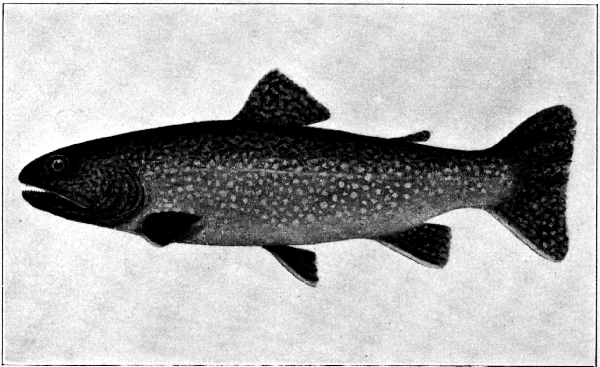
EASTERN BROOK TROUT (Salvalinus fontinalis)
EASTERN BROOK TROUT
(Salvelinus fontinalis)
The Eastern brook trout—properly a char—was introduced into the coast waters several years ago and found our waters so congenial that it must now be considered a resident species, for it is to be met with in many of our streams, and thrives well in any of the higher localities. The brook trout is a handsome fish with its brown and olive marbled back, scarlet spots and salmon-colored sides. Its beauty has challenged the cunning of the painter, and been immortalized by the genius of the poet. Its gamy qualities stood for centuries as beyond comparison until the bended rod and singing reel announced the impalement of the native of the Golden West, with its mad rushes and terrier-like fights; then the rosy beauty of the East had to yield the palm to the rainbow-colored, fighting pirate of the Pacific.
The brook trout may easily be distinguished from any of the other trout of the coast by its marbled back and red spotted sides. Besides this the whole fish is more of a pinkish color. It varies in size like the others of the family, according to the waters it inhabits, attaining about the same size as the rainbow in the same waters.
Tackle and Lure—On account of over fishing the streams, and the very bad habit of killing so many small fish, the majority of the trout caught on the Pacific Coast are small. If there were more sportsmen and less fishermen on our streams this condition would not exist. For the sportsman will throw back all the little babies that are not over six inches in length and allow them another year to grow. And in this connection I want to say to the young boys and girls: be true sportsmen and sportswomen and never fish for trout with anything but artificial flies. You may not catch as many fish while you are learning, but you will soon find that you are having ten times more sport. As to the rod and line, you will never get it too light. The longer you have been a flycaster, the lighter you will want them; and the lighter they are the more sport you will have.
THE SALMON AND TROUT
Order, ISOSPONDYLI
Family, SALMONIDAE Subfamily, SALMONINAE
Genus Species Common Names Range and Breeding Grounds
Oncorhynchus tschawytscha Quinant Chinook From Monterey Bay north.


nerka Blue-back Redfish Sacramento river north.
kisutch Silver salmon From Monterey Bay north. Sacramento river north.
keta gorbuscha Dog salmon Hump-back salmon From Sacramento river north. From Sacramento river north.
Salmo irideus Rainbow trout From Lower California north.
irideus auga bonito Golden trout Western slope of Mt. Whitney.
irideus roosevelti Golden trout Western slope of Mt. Whitney.
rivularis Steel-head trout From Ventura river north.
clarki Cutthroat trout Central California north.
tahoensis Silver trout Lake Tahoe.
henshawi Tahoe trout Lakes Tahoe, Donner, Independence, Webber; Truckee and Carson rivers.
jordani Lake Southerland Lake Southerland, Oregon.
spilurus Rio Grande trout Tributaries of the Rio Grande river.
plueriticus Colorado trout Tributaries of the Colorado river.
Salvelinus parki Dolly Varden trout McCloud river north.
fontinalis Eastern brook trout Acclimatized in many streams of the coast.
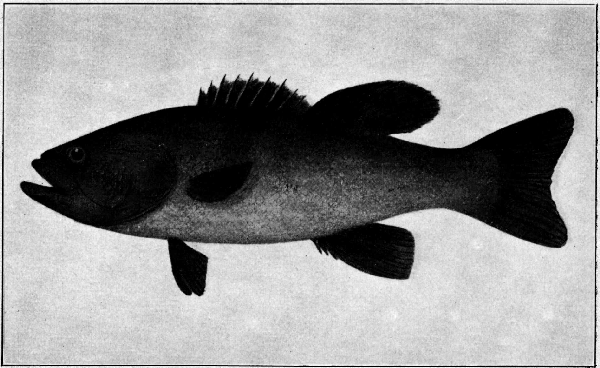
SMALL-MOUTHED BLACK BASS (Micropterus dolomieu)
SMALL-MOUTHED BLACK BASS
(Micropterus dolomieu)
The black bass is not a native of the coast, but both species are now so well established in our waters that they must now be classed as permanent residents, for whether it is the crystal lake, the flowing stream, the little pond, the artesian-fed reservoir or the brackish slough, they thrive equally well and take any lure from the artificial fly to the plebeian angleworm.
Black bass are prolific breeders and rapid growers. A case is on record where eight males and seven females were planted in a pond in May and during the November following over 37,000 young fish were taken from the same pond, each from three to four inches long.
The black bass is a short, deep fish with a double dorsal fin; the front half being stiff and spiney and the latter half soft and rayed. The color is variable, but always dark and from a dirty green to a blackish brown on the back, shading to a dirty white on the belly. The gill covers are pointed at the back, with a darker spot on the point. In the small-mouthed variety the end of the upper bone of the mouth does not quite reach to the back edge of the eye, this with the scales on the cheek numbering from 16 to 18, can always be relied upon as a distinguishing diagnosis from the large-mouthed variety.
LARGE-MOUTHED BLACK BASS
(Micropterus salmoides)
There is but little difference in the habits of the large and small-mouthed black bass, and but little difference in their appearance, but the distinguishing features may easily be known. The end of the upper bone of the mouth of the large-mouthed variety extends behind the eye, and the rows of scales on the cheek number only 10 or 12.
While both species seem to do well any place, the large-mouthed are better adapted to muddy bottomed ponds and sloughs and brackish waters. The average weight of the adults of either species is about three pounds, though individuals are often taken weighing from six to seven. It is reported that specimens have been taken in the state of California that have weighed eight and three-quarters and nine pounds.
Tackle and Lure—The black bass will take any lure from the artificial fly to the plebeian angleworm. In trolling, a medium sized, Kewell spoon is to be preferred. I have always found, however, that the best sport is to be had by casting with a large trout fly—the color varying with the season—close to the edge of lily pads or tules. The tackle for fly-fishing should be the same as for trout. For trolling the rod should be shorter and stiffer.
SACRAMENTO PIKE
(Ptychocheilus oregonensis)
The Sacramento pike, known also by the names chappaul and squawfish, and as lake trout in the San Joaquin Valley, while but little sought after by the angler, can rightfully be classed as a game fish, for it rises to the fly as readily as a trout and often gets cursed for doing so. It is a very common fish in many of the lakes and streams from Washington south to the San Joaquin Valley. Like nearly all fish its size depends very much upon the waters in which it is found. In Washington it has been known to reach a length of four feet, but it is more commonly met with from eight to twenty inches. In shape it resembles a trout, but with a slimmer and more pointed head. The dorsal fin is large and located about midway between the snout and the end of the tail; ventral fins, slightly in front of the dorsal and not as large as the anal which is set about its length from the ventrals; tail, strongly forked.
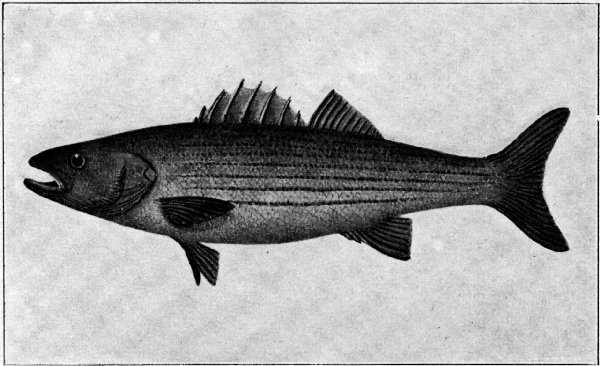
STRIPED BASS (Roccus lineatus)
STRIPED BASS
(Roccus lineatus)
The striped bass, like many people who have crossed the continent to California, readily appreciated the many advantages of a life on the Pacific Coast. From a couple of shipments brought from the East in 1879 and 1882 they have grown to be one of the most important food fishes of the state, about 3,000,000 pounds being annually marketed. They were at first liberated in the Bay of San Francisco, but later some effort has been made to distribute them, with the result that they are now found in small quantities along the coast from Los Angeles to Humboldt.
From their fine size—three to forty pounds—they stand well with the angler as a game fish and furnish good sport if the tackle is light enough. Their rushes are not equal to those of the steelhead or the salmon or the yellow-tail, nor do they fight with the same vigor or with the same persistency.
The striped bass is unlike any other coast fish. Its back is light olive; sides, nearly white with seven or eight longitudinal stripes running the whole length of the body, the dorsal fin is double, but not joined like that of the black bass. The first half is spiny with the after division rayed and soft. It is a salt water fish, making its habitat in and near the mouths of rivers, and often running up them for 100 miles or more. Use the same rod and line as for salmon.
THE GAME FISH OF THE SEA
There certainly is no better sport to be had any place with the trout, salmon and bass than that furnished by the rivers, lakes and bays of the Pacific Coast. To this excellent sport must be added another of the most exciting character, and one distinctly Californian, and that is the capture with rod and reel of the large sea fishes found in the waters of the Santa Barbara Channel, and more especially of Catalina Island. The great variety, gamy qualities and massive size of these fishes furnish a sport at once exciting and exhilarating, and challenging the keenest exercise of the ability of the sportsman.
The world-wide fame of these waters, and the grand sport they furnish have resulted in the establishment on Catalina Island of one of the finest, if not the most perfect and best equipped angler's resort in the world, from its launches and boatmen to its clubhouses and hotels, and made it the Mecca of the expert anglers of the civilized nations of the earth.
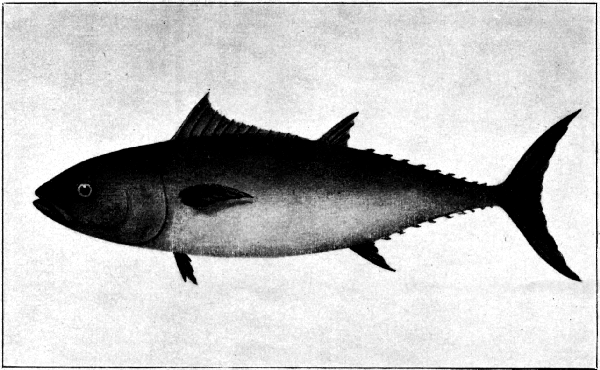
LEAPING TUNA (Thunnus thynnus)
THE TUNA
(Thunnus thynnus)
The leaping tuna is the largest of the great game fishes of the Pacific. It ranges from Monterey Bay, where it is sparingly met with, south to Mexico. About Catalina Island they are found in great numbers and of great size. The excellent sport their capture with rod and reel furnishes, has drawn to the island the expert anglers of the world, and resulted in the formation of the now famous "Tuna Club of Catalina," with its members residing in all parts of the world; and of which no one can become a member until he has landed a tuna of 100 pounds or more with rod and reel and with a line not larger than a 24-thread Cuttyhunk.
Professor Charles F. Holder, an expert angler with a national reputation, and who has angled for all fishes and in all waters, says, "The most sensational fish of these waters is the leaping tuna. It is the tiger of the California seas, a living meteor, which strikes like a whirlwind, and played with a rod that is not a billiard cue or a club in stiffness, will give the average man the contest of his life."
The record for the largest tuna caught with a rod and reel is held at this writing by Col. C. P. Morehouse of Pasadena, who brought to gaff a 251 pound tuna after a six-and-a-half-hours' fight, during which it had towed his boat over ten miles. But even a greater fight than this is recorded, but the fish was not landed. This fish fought for seventeen hours and thirty minutes before its wonderful endurance and splendid courage mastered the skill of the angler. Mr. C. B. Stockton has to his credit a fight which not only shows the great endurance of this angler but the remarkable vitality of these fish. This fight lasted for sixteen hours and fifty-five minutes before the fish was brought to gaff. It weighed 170 pounds and was taken on the regulation tackle.
Body, round and sloping rapidly from the middle to the caudal fin, and very small and round at the base of the tail; tail divided into two long forks; two dorsal fins, the first beginning just behind the gill-covers with the pectoral and ventral fins a trifle farther back; second dorsal fin smaller than the first and located nearly half way between it and the caudal; anal fin midway between the ventral and the caudal; bony, saw-like projections from the second dorsal fin, and from the anal fin to the tail; color, blue on the back and silvery white on the sides.
Tackle and Lure—The flyingfish is about the only bait with which the tuna can be caught. The hook, which must be attached to about 3 1/2 or 4 inches or light chain and with a wire snell, is passed into the mouth and down the belly of the flyingfish, the barb projecting about midway of the fish. A small string is passed through the nose and under lip and tied through a link of the chain to keep the mouth shut. The speed of the boat should be from two to four miles an hour. In the middle of the day, when the tunas are feeding in schools, the sinker should be removed, and the lure skipped along the surface of the water. This effect can be helped by the motion of the rod.
The Catalina Tuna Club has adopted the following tackle specifications:
For Tuna and Swordfish—Rod to be of wood, consisting of a butt and tip, and to be not shorter than 6 feet, 9 inches over all. Tip not less than 5 feet in length, and to weigh not more than 16 ounces. Line not to exceed standard 24-thread.
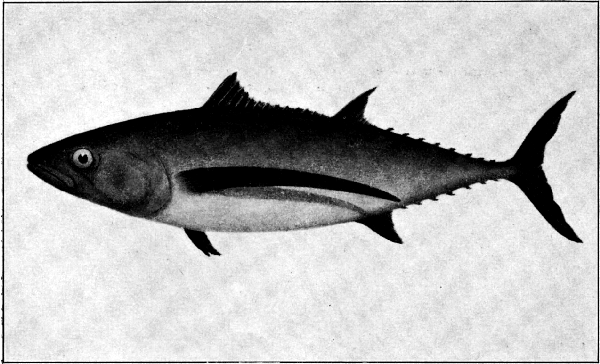
ALBACORE (Germo alalunga)
THE ALBACORE
(Germo alalunga)
The albacore is another genus of the same family, and reaches a weight of 40 to 80 pounds; averaging 25 pounds. It is seldom seen as far north as San Francisco, but is abundant from Santa Barbara south to Central America. Like all of the family it is a gamy fish, and affords good sport to the angler. In general shape and appearance it resembles the tuna, but will always be distinguished by its long, sword-like pectoral fins that start from near the gills, and a trifle lower than the eye, and reach beyond the second dorsal fin.
Tackle and Lure—The albacore will take almost any lure from a sardine to a white rag. The speed of the boat can also be varied very much. I have known them to be caught on a hand line trolled behind a coast steamer. About three miles an hour, however, will give the best results. The following light tackle specifications of the Tuna Club will be found quite satisfactory for the average albacore:
Rod to be of wood, consisting of a butt and tip, and to be not shorter than 6 feet, over all. Butt to be not over 14 inches in length. Tip not less than 5 feet in length, and to weigh not more than 6 ounces. Line not to exceed standard 9-thread.
THE YELLOW-FIN ALBACORE
(Germo microptera)
Another of the Scrombridæ family, and very closely allied to the albacore, is the yellow-fin albacore. This fish has erroneously been called "yellow-fin tuna." It does not belong to the genus Thunnus any more than does the albacore or the bonito. It is only a visitor to the California waters, and often does not make its appearance for one or two seasons at a time. They are common to the coasts of Japan and the Hawaiian Islands, and are supposed to migrate with the Japanese current. This species fights altogether on the surface, but lacks the sterling gamy qualities of the tuna.
In shape it is built very much on the lines of the albacore, but with its pectoral fins only extending back to about half way between the anal and ventral, the other fins are placed the same as the albacore, and all except the pectoral strongly tinged with bright lemon; pectoral fin is more of a bright brown; eye, large and prominent.
A few have been taken weighing as much as 40 pounds and one even 65 pounds. The average, however, is about 30 pounds.
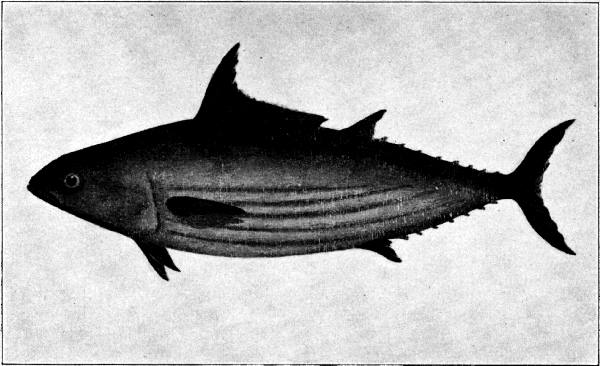
BONITO (Sarda chilensis)
THE BONITO, OR SKIPJACK
(Sarda chilensis)
To the angler who is not looking for the largest of game, the bonito—known as skipjack to the Catalina anglers—is possibly the most interesting of the ocean game fishes. Its beautiful metallic colors, its rapid movements, and pleasing habit of always fighting on the surface, and rarely, if ever sulking, makes it a most attractive game to the discriminating angler.
The bonito also belongs to the Scrombidæ family, and ranges from Point Conception to Mexico and south through the tropics.
Body, rounded, tapering rapidly to the tail, which is strongly forked, but not so much as the albacore; pectoral fins, short and placed opposite the eye; dorsal fin, double, with saw-like ridges from the second dorsal and the anal fins to the tail, the same as in all of this family. Color, dark blue on the back, with a metallic luster; sides, silvery white, with dark longitudinal lines. Weight, from six to twelve pounds.
Tackle and Lure—The light tackle specifications of the Tuna Club, given for albacore cannot be improved upon for these fish.
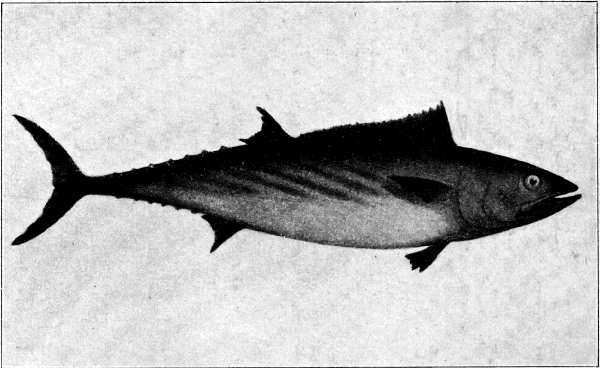
SPANISH MACKEREL (Scomberomorus concolor)
SPANISH MACKEREL
(Scomberomorus concolor)
This is another of the Scrombidæ family. It ranges north to Monterey Bay, where it makes its appearance in September, remaining until November, when it goes south to the Santa Barbara channel; remaining in these waters and about Catalina Island during most of the winter. This fish is called bonito by many of the Catalina anglers, which is a misnomer, as it is a much slimmer fish than the bonito.
The pectoral fins are small and located a little above the center of the body and close to the gill covers; front dorsal starts just above the base of the pectorals and extend along the back for a distance a little more than the length of the head, and nearly meeting the second dorsal, which is about the same width as its heighth; ventral fins, a little in front of the pectorals and rather small; front of the anal fin under the back of the second dorsal. Back, steel blue; sides, silvery. Oblique lines, of the darker color of the back, running forward and downward to a little below the lateral line.
Weight, usually from nine to twelve pounds, though they occasionally attain a weight of eighteen pounds.
Tackle and Lure—The same as for the bonito.
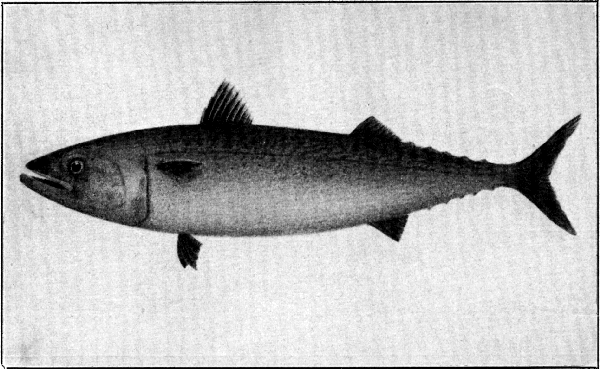
CHUB MACKEREL OR GREEN-BACK (Scomber japonicus)
THE CHUB MACKEREL
(Scomber japonicus)
The chub mackerel, the smallest of the Scombridæ family, approaches very closely the true mackerel of the East. It is hard to find a fish of any variety more delicious than a chub mackerel, caught from the yacht and placed on the broiler as soon as it quits flapping. They are occasionally found as far north as Monterey bay, but their real range is from the Santa Barbara channel south. With reasonably light trout tackle they put up a gamy and interesting fight.
Back, bluish green, mottled with irregular darker streaks, some of which pass below the lateral line; first dorsal fin quite high, and about the distance of its height in front of the second dorsal; second dorsal and anal about the same size and nearly opposite each other; tail forked, but not so broadly as the bonito. Weight, from one-half to three pounds.
Tackle and Lure—Trout tackle and spoon will furnish interesting sport. But they will take any lure.
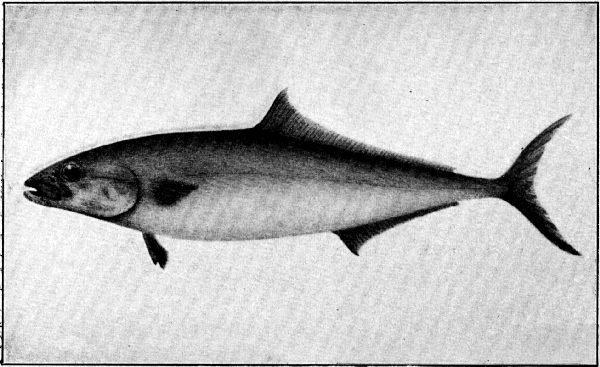
YELLOW-TAIL (Seriola dorsalis)
THE YELLOW-TAIL
(Seriola dorsalis)
The yellow-tail belongs to the family Carangidæ, the same to which belong the pompanos, and is one of the gamiest of sea fishes. In fact, it is generally said by experts who have fished for all varieties and in all waters, both salt and fresh, that the yellow-tail of Catalina is the gamiest fish, pound for pound, that swims. Whether this be true or not, it is certainly one of the hardest and most persistent fighters found anywhere and furnishes the angler with rod and reel from an hour to two hours of lively sport before he can bring it to gaff. One well-known writer on angling subjects says: "It never knows when it is dead." While the average catch will run from ten to thirty pounds, specimens have been taken weighing sixty-five pounds. It is occasionally met with in Monterey bay, but its range is from the Santa Barbara channel south, where it is caught the larger portion of the year.
Order, ACANTHROPTERI.
Family, SCROMBIDAE
Genus Species Common Names Range
Thunnus thynnus Leaping tuna From Coronado Islands to Monterey Bay.
Germo microptera Yellow-fin albacore Irregular visitors to the waters of Catalina Island and adjacent mainland.
alalunga Albacore From Point Conception south.
Sarda chilensis Bonito From Santa Barbara south.
Scomberomorus concolor Spanish mackerel From Monterey Bay south.
Scomber japonicus Chub mackerel From Point Conception south.
Grayish blue on the back; sides, a dull silver, with a yellowish buff stripe along the lateral line; fins, green, with a strong yellowish tinge; tail, yellowish buff. Scales small, with the head bare, except a small patch on the cheeks. Pectoral fin on a level with the eye and small; ventral under the center of the pectoral; caudal, slim and forked. The dorsal fin is double, the front being very small with spines and the second half more than twice as high; dorsal and anal fins continue in a low membrane to very near the tail. Body, elliptical and very small at the base of the caudal fin.
Tackle and Lure—Same as for salmon or albacore.
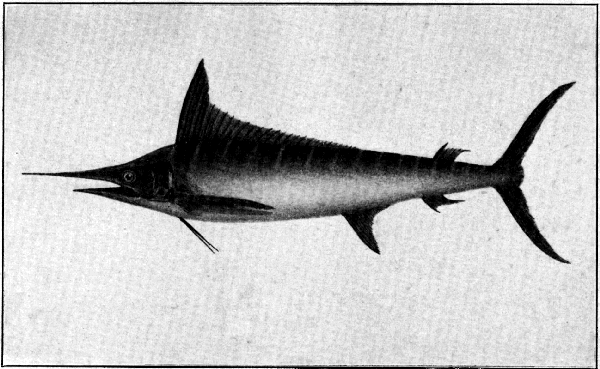
CALIFORNIA SWORDFISH (Tetrapturus mitsukuri)
THE CALIFORNIA SWORDFISH
(Tetrapturus mitsukuri)
By many anglers for large and exciting game, the California swordfish is pronounced the king of all game fishes. Certainly they put up a very determined and exciting fight. In size they average about 180 pounds, though one has been taken at Catalina by W. C. Boschen that weighed 355 pounds. When a swordfish is hooked its rushes are desperate, even reckless, and at times dangerous to the angler. In its determined efforts to free itself from the impaling hook, it threshes the waters into foam, repeatedly leaping into the air, where the sunlight scintillating upon the purple of its back and silvery sides adds the charm of color to the excitement of the contest. It is safe to say that there is no fish, either in the salt or fresh waters, that is so constantly on the surface and in the air during its struggles for freedom as is the California swordfish. Thirty, forty and even fifty clean leaps into the sunlight by the one fish have been recorded in its desperate struggle to baffle the skill of the angler.
The snout of the swordfish is continued into a long, sharp bone, which measured from the back of the mouth is about one-fourth of the length of the fish from the mouth to the base of the tail. The under jaw is also a sharp projecting bone about half the length of the sword. The dorsal fin rises sharply from the top of the head to a height nearly equaling the depth of the body, the latter part curving downward and continuing along the back to nearly the center of the body; tail divided into two long, slim forks; second dorsal and anal near the tail and nearly opposite each other; ventral fin below the terminal of the first dorsal; pectoral fins rather long and located close to the gill-covers; two long, slender feelers projecting from the center of the throat just below the base of the pectorals; eye very large and bright dark blue.
Purplish green on the back, with blue perpendicular stripes fading into the silvery sides; fins, dark purple.
Tackle and Lure—Same as for tuna.
THE BLACK SEA BASS, OR JEW-FISH
(Stereolepis gigas)
This monster of the ocean, commonly called jew-fish, seems to be in all respects a gigantic black bass, closely resembling the small-mouthed of the fresh waters, and no further description will be necessary for anyone who may be fortunate enough to land one to know to what species it belongs. In fact, he will know just what he has hooked long before the monster shows himself on the top of the water. This huge black sea bass seems to have a very restricted range, for it is only known from the Coronado Islands to the Farallones. They are very plentiful around Catalina Island, where they are usually taken with hand lines. They can not be called a game fish, though they are now being taken with rod and reel at Catalina and furnish a kind of "heavy-weight" sport for those who like it. One weighing over 436 pounds has been taken on a tuna rod and twenty-one thread line. The writer saw one several years ago that was taken on a hand line that weighed 720 pounds and was over seven feet in length. They are fish of great strength and will tow a boat with ease at a considerable speed.
Tackle—The same as for tuna, with fish bait.
THE BARACUDA
(Sphyraena argentea)
The baracuda is a common fish from San Francisco south to Mexico. In the Santa Barbara channel and about Catalina and San Diego it is largely taken by trolling with light tackle, when it affords really good sport. It is a long, slim fish, reaching three and even three and a half feet in length, the usual catch being from two to two and a half feet in length.
Head long and slender; eye high up on the head and nearly half way between the snout and the back of the gill covers. Pectoral fin just below the lateral line; first dorsal spinous and nearly opposite the ventral; second dorsal about midway between the first and the tail; anal almost directly under the second dorsal.
Bluish brown on the back, grading into white on the belly.
Tackle and Lure—Same as for bonito.
WHITING and CROAKERS
There are three other species of fish which inhabit the surf of the Pacific from Point Conception, south to Mexico, that, while they can not be properly termed game fishes, furnish the angler fine sport because of the gamy fight they make on light tackle. These are the whiting (Menticirrhus undulatus), the spot-fin croaker (Roncador stearnsi) and the yellow-fin croaker (Umbrina roncador). The first of these is known locally by the names of courbina and surf-fish, which are bad misnomers. The name, surf-fish, is given by the ichthyologist to a species of perch, and the courbina belongs to the genus Pogonias and is not found as far north as the California coast. These names should be abandoned by the anglers and the proper English name of whiting used. The word courbina is Italian and means croaker, from the Latin, corvus, crow.
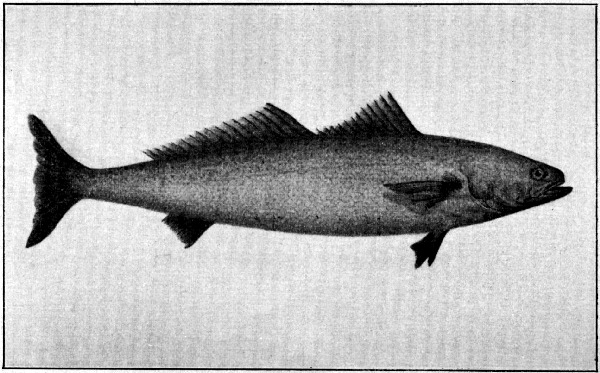
WHITE SEA BASS (Cygonoscion nobilis)
THE WHITE SEA BASS
(Cygonoscion nobilis)
The white sea bass is purely a California species, ranging from the Coronado Islands to about the latitude of San Francisco. They are caught trolling and make a gamy fight on rod and reel. Twenty to forty pound fish are common and they have been caught weighing seventy-five pounds.
Light bluish on the back and white on the sides, with many small specks; dark spot at the base of the pectoral fins. Head, long, with pointed snout, and with the scales of the head running nearly to its end. Dorsal fin double, the first half having ten spines and the latter twenty-one or twenty-two soft rays. Anal with two spines and nine rays. Tail but little forked.
Tackle—The same as for salmon or yellow-tail.
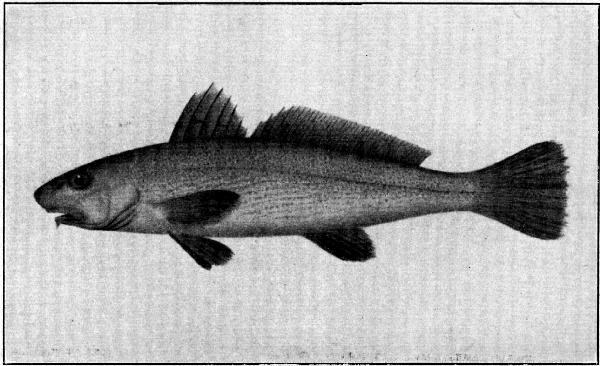
CALIFORNIA WHITING OR SAND SUCKER (Menticirrhus undulatus)
CALIFORNIA WHITING OR SAND-SUCKER
(Menticirrhus undulatus)
This species is common to the sand beaches of the Pacific, from Point Conception south to Guaymas, Mexico. It feeds during the larger part of the year in the surf, and is caught from the wharfs or by long casts with heavy sinkers from the beach. The whiting appears on the California coast in two varieties, the undulatus proper and a subspecies which I think has never been classified. At any rate, the difference seems sufficient to entitle it to a subspecies classification, for the mouth curves strongly downward, and, therefore, does not extend so far back as the undulatus proper. The tail also differs, in having both upper and lower lobes rounded, instead of the upper being square as in the undulatus.
Head, about one-fifth of the entire length; snout, rather pointed, and projecting beyond the mouth; mouth reaching to the center of the eye; small barbel on the lower lip. Dorsal fin, double, the first with from seven to nine spines, the second soft and reaching from the first to within about the length of the head from the tail; pectoral fins near the gills and about the width of the eye below the center of the body; ventral fins, a little behind the pectoral; anal fin under the center of the second dorsal; dorsal fins dark; pectoral, ventral and anal fins, light with darker tips; tail of the undulatus proper, upper lobe square and lower lobe rounded. Back, bluish brown, shading to white on the belly; scales, small. Below the lateral line are a number of small spots forming irregular lines running backward and upward. Size, rarely exceeding eight pounds.
The illustration is of the variety that I have referred to as a subspecies.
Tackle and Lure—The three-six tackle. Rod to be of wood, consisting of a butt and tip, and to be not shorter than six feet over all; weight of entire rod not to exceed six ounces; butt not to be over twelve inches in length. Line not to exceed standard 6-thread. Lure, sandflies, mussels or clams.
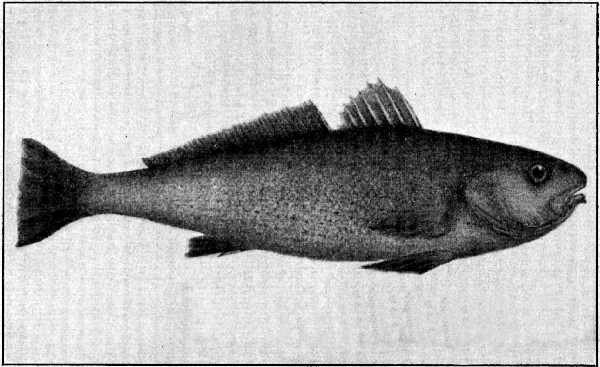
YELLOW-FIN CROAKER (Umbrina roncador)
YELLOW-FIN CROKER
(Umbrina roncador)
The yellow-fin croaker is found in the surf or near it along the sandy beaches from some distance north of Point Conception south to Manzanillo, Mexico, where it is known by the name "corvina con aletas amarillas," or "croaker with yellow fins."
Head, about one-fifth the whole length; snout, very blunt, with a small barbel on the lower lip. Dorsal fin double, the first half with seven or eight spines, the longest about two-thirds the length of the head; second half rayed and about two-thirds the height of the first, and reaching to about half the length of the head from the tail; pectoral fins short, and placed close to the gills and a little below the center of the body; ventral fins just below the pectoral and a trifle longer; anal fin, below the center of the second dorsal; tail, nearly square. Back, greenish brown, with a metallic luster and giving a pinkish tinge in some lights; sides, shading to white on the belly. A few irregular spots on the sides forming faint lines.
SPOT-FIN CROAKER
(Roncador stearnsi)
The spot-fin croaker appears in and near the surf of the Pacific Coast from Point Conception south to Mexico. Roncador is Spanish and signifies snorer. This species resembles the yellow-fin very closely, but is usually lighter in color and more metallic in appearance. It can always be distinguished from the yellow-fin by the distinct black spots at the base of the pectoral fins.
Tackle and Lure—Same as for whiting.
THE TUNA CLUB OF CATALINA ISLAND
I cannot close these articles on fish and fishing without a few words of commendation of the Tuna Club of Catalina Island. From the very inception of this organization it has striven to encourage the use of light tackle by all anglers. To this end, it has adopted three classes of tackle specifications for the taking of the several kinds of fish found in the waters surrounding its island home, and provided a number of cups and buttons to be awarded each year to anglers who land fishes of certain weights, with such tackle as is prescribed therefore by its rules. This campaign, which it has so energetically urged in behalf of scientific angling, has worked wonders in its section of the Coast. The old methods of landing fish, even of the gamiest quality, by the employment of nothing more than brute force at the end of an unbreakable cable, has almost disappeared in its section, and scientific angling with the lightest possible tackle has taken its place. But the good work of the Tuna Club has not been confined to the boundaries of its own section. Anglers from other sections of the country visiting Catalina, and seeing the additional pleasure derived from the use of light tackle, have become enthusiastic advocates of this more scientific means, and returning to their homes have spread the propaganda there.
To the stiff pole and chalk-line fishermen of confirmed habits I have nothing to say. But to the younger generation who have not yet grown grey in the practice of bad habits, I wish to urge upon them the use of the lightest tackle possible, as a means of developing greater skill and deriving greater pleasure from their favorite sport. And this is equally true whether it be a tuna or a trout.
Order, ACANTHROPTERI.
Family, SCIAENIDAE
Genus Species Common Names Range
Menticirrhus undulatus California whiting or sand sucker From Point Conception south to Guaymas, Mexico.
Roncador stearnsi Spot-fin croaker From Point Conception south to Manzanillo, Mexico.
Umbrina roncador Yellow-fin croaker From Point Conception south to Manzanillo, Mexico.
Cygonoscion nobilis White sea bass From San Francisco south to Coronado Islands.
ATTRACTIVE FISHING RESORTS
It is possible that the day may come when man will be so engrossed with the pursuit of the dollar that the call of the wild will no longer quicken the pulsations of his heart. But until that time does come, the wild creatures of nature, whose pursuit affords the most healthful and exhilarating pastime, will continue to lure him to their haunts.
"To sit on rocks and gaze o'er flood and fell; To slowly trace the forest's shady scene, Where things that own not man's dominion dwell, And mortal feet hath ne'er, or rarely, been,"
will long continue to present a charm to all who love the sublimity of the mountains, the beauty of the flower-decked fields, or the awe-inspiring grandeur of the ocean.
To draw a bead on the antlered buck; to stop the flight of the gamy quail; to land the denizen of the mountain stream, or troll the ocean's depth for the tuna, the salmon or the yellow-tail, furnishes a pastime whose recollection draws one back again and again to sit on nature's lap and listen to her teachings. The recollection of these pleasures are locked in the treasure vaults of the memory, where the wearings of time can never erase them; for when the once firm step that carried him proudly up the mountain's side shall falter and become a palsied wreck of time, and the eye, dimmed by the accumulated mists of years, shall see clearly, only in retrospect, he will sit by his fire-side in slippered feet, and, gazing down the long vistas of the past, live over and over again in his reveries the pleasures furnished by the forest, the field, the stream and the ocean.
Nothing would please me better than to describe herein the many places where, during a residence on the Pacific Coast of more than half a century, I have enjoyed these sports in the fullest degree. But even the merest mention of the almost innumerable hunting grounds and trout streams, and the hundreds of mountain and sea-side resorts, from Washington to Mexico, would, of itself, make a volume of no mean size. I am, therefore, restricted to the mention of only a few of the more attractive places where good sea fishing can be found, coupled with such accommodations and surroundings as appeal to the discriminating pleasure seeker.
CATALINA ISLAND.
Almost due south of Los Angeles, and about twenty miles from the mainland, is the far-famed island of Catalina.
It is still a debatable question whether it was the leaping tuna that made Catalina famous, or whether it was its many attractions, its facilities for sea fishing and its splendid accommodations, that gave the sport of tuna fishing a world-wide reputation.
This beautiful island, with its diversified amusements; its grand scenery; its wonderful drives; its surf less sea bathing; its marine views; its perfect equipment for sea fighting, and its splendidly appointed hotel, has made it the Mecca to which the enthusiastic anglers of the world make their regular pilgrimages, for it seems to be the favored habitat of all the game fishes of the ocean, except the salmon and the striped bass.
Catalina is the home of the Tuna Club, the greatest fishing organization of the world, with its international membership pledged to the promotion of scientific angling. It is here where the world's records are made, and the greatest feats in landing the fighting monsters of the sea have been achieved.
In its variety of game fishes I know of no place to equal it. The leaping tuna, the albacore, the Spanish mackerel, the bonito, the chub mackerel, the white sea bass, the yellow-tail, and the California swordfish, the sensational fighter of the ocean, are all here and ready to give the light tackle angler the most exciting contest of his life.
When the angler waits for the tides, he wants some other divertisement to occupy his mind. At Catalina he finds a pastime suitable to every hour, to every fancy, to every mood. He can bathe in its crystal waters; he can stroll along its pebbly beaches or climb its hills in search of wild goats; he can ride through its charming valleys, over its lofty peaks and around the dizzy heights that overlook the ocean; he can increase the elasticity of his step on its tennis courts, or exercise his muscle on its golf links. He can view the ancient relics of a departed people, study the strange and curious forms of ocean life in the extensive aquariums, or comfortably seated in a glass-bottomed boat, marvel at the extravagant splendor of the marine gardens, hundreds of feet below the surface, where sirens sing and mermaids are said to dwell. And, when he has gone the rounds, and longs again for more exciting sport, well—then he can go fishing.
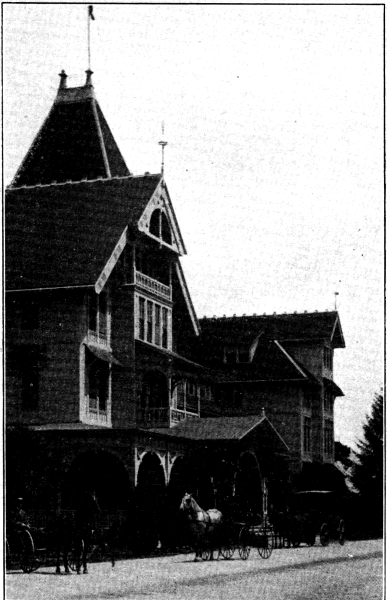
HOTEL DEL MONTE
DEL MONTE
Monterey Bay is pre-eminently the fishing ground for the Pacific salmon. As these gamy fish seek their spawning grounds, after their four-years' sojourn in unknown waters, they enter Monterey Bay at its southern headland and follow around it at varying distances from the shore. During this season the Hotel Del Monte, with its splendid appointments and scenic beauty, is the favored Mecca of the salmon anglers. Here boats with experienced boatmen, and a good supply of tackle and bait are always to be had. The contour of the peninsula, with its high mountain crest, forming the southern shore of the bay, is such that the strong winds of the open ocean is cut off from the Del Monte side, allowing the waters of this side of the bay to retain that smoothness that makes either boating or fishing a delight. This, too, may have something to do with the feeding habits of the salmon, thereby accounting for the usually large catches made by the guests of the hotel.
While the Pacific Coast furnishes fine sport for the angler, both in its fresh and salt waters, with an infinite variety of gamy fishes, salmon fishing must be classed as one of the most satisfying. An angler likes to see his adversary and know with what he is contending. The salmon is a surface fighter, leaping high into the air when he finds himself impaled; and this sight of his beautiful sides, scintillating in the sunlight, quickens the pulsations of the heart of the angler and gives zest to the sport.
Each section of the coast has its fish and fishing peculiar to itself; but I care not from what section the expert angler may come, he will enjoy the salmon fishing of Monterey Bay. He will do more; for the Hotel Del Monte is one of the delightful show places of the Pacific Coast. Space will not admit of an enumeration of the many interesting sights here to be seen. There are glimpses of California life a hundred years ago by the side of picturesque golf links and tennis courts. A modern hostelry hid away in the center of a primeval park. A seventeen-mile drive through shady mountain dells and along weirdly beautiful ocean coves and rocky crags. The marine gardens as seen at the bottom of the ocean through glass-bottomed boats. These, and many other interesting relics and inspiring scenes are the side attractions for the salmon angler who visits Del Monte.
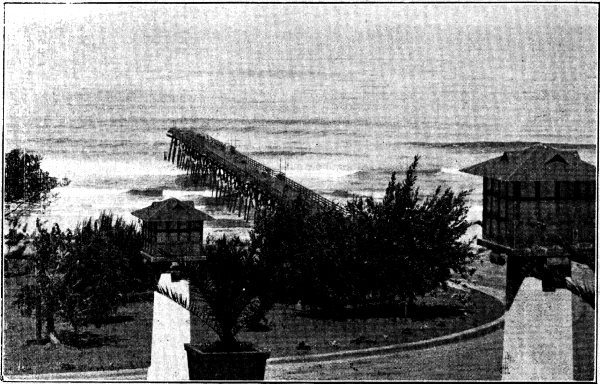
FISHING PIER, DEL MAR
DEL MAR.
Del Mar is one of the few beach resorts where the pleasure-seeker can divide his time among the whole range of out-door amusements. The long pleasure wharf and the miles of just that character of beach where the whiting, the croaker, the chub mackerel and the young sea bass love to feed, offer the finest of still fishing. If he is ambitious for a contest with the big fighting fishes of the deeper waters, he can take a boat and soon be floating over the haunts of the yellow-tail, the albacore and the bonito. If he prefers the report of the gun to the music of the reel, a short walk back from the hotel brings him into the country of the game little quail.
Again, he can, by a short ride to the ponds and lagoons, change from upland to waterfowl shooting.
But the gamut is not yet run; for within easy reach are several mountain streams where he can cast his flies on their waters with good returns. And, if he seeks to pit his cunning and his skill against the watchful deer, a pleasant and interesting ride over a good motor road, takes him into the wilds of the Cuyamaca mountains.
But the sportsman in his outings will always think of his comforts as well as his sports, and for those Del Mar has planned with a lavish hand.
It is not all of the enjoyment of a good meal to have a choice selection of viands, admirably cooked by an experienced chef, and served in the most approved manner. It is not all of a good night's rest, after the fatigue of a day's sport, to have lain on a downy bed in a richly appointed room. Agreeable service; the affability of the management; the pervading air of welcome; the society of congenial companions; the beauty of the situation; the inspiring views; the charm of the many scenes that each day photographs upon the memory, adds a relish to the menu which no chef can compound, and a restfulness to one's slumber that the ingenuity of no upholsterer can supply. For a part of these delightful adjuncts to one's enjoyment, I am willing to give credit to the excellent taste of the founders of Del Mar. But the beauty of its surroundings, the possibility of its charming individuality, must be credited to those exclusive gifts which nature first bestowed upon it.
Del Mar is twenty-two miles from San Diego and 111 from Los Angeles, and can be reached from either of these cities by the Santa Fe railroad, or by a good motor road, distinguished for its many interesting views.

AQUARIUM, VENICE
VENICE
That there is but one Venice in America is the verdict of all who have visited this charming sea-side resort. Its oriental architecture, and its numerous canals, on whose surface floats in Italian ease, real Venetian gondolas, give it an atmosphere suggestive of the Mediterranean. But it is not of its Venetian aspect, nor its endless chain of amusements, from its surf and plunge bathing to its rollicking scenic railroad and hair-raising dash through its cavernous rapids, or its hundred or more interesting pastimes for the pleasure seeker, that the attention of the reader is herein directed.
It is to those forms of sea life that contribute to his pleasure that his attention is called, for the waters of Venice furnish a wonderful variety of these, as will be seen by a visit to the large aquarium maintained on the pier by the University of Southern California. From the wharfs he can angle for smelt, mackerel and perch, as well as for halibut and other bottom fishes. From the beach, by bait-casting into the surf, he is rewarded with croaker, whiting (erroneously called corbina), and young sea bass, locally known as sea trout.
By taking a launch and going out into the open water, his ambition to bring to gaff the larger species of the deeper sea can be gratified with strikes from the tuna, the albacore, the bonito, the mackerel and the yellow-tail that will give him a contest worthy of his metal.
These launch trips upon the bosom of the open ocean, are among the chiefest pleasures of our beach resorts, for the angler not only finds keen sport in the landing of these larger fishes, but an exhilarating recreation, restful to the mind and healthful to the body.
Then, when his day's sport is over, whether his outing is only for a day, or for the several weeks of his vacation, His comforts are to be considered. In these Venice offers as wide a range as it does in its amusements. At the splendidly appointed Hotel St. Marks he can find the most luxurious accommodations; he can dine at one of its deservedly popular cafes; or, if he wants to spend his vacation in restful quietude with his family, he can take a furnished villa on the bank of one of the canals, hidden away in a wealth of flowers and forest trees, with the sea breeze tempered to a balmy zephyr. To this sequestered home he can bring his fish, fresh from the sea, and broiling them to his particular taste, enjoy the last delight of the angler's day of sport.
INDEX TO ILLUSTRATIONS
DOVES—
Mourning Dove, 40
White-winged Dove, 40
DUCKS—
American Golden-eye, 84
American Scaup, 78
Barrow's Golden-eye, 90
Blue-bill, 78
Butter-ball, 86
Canvasback, 74
Gadwall, 56
Harlequin, 86
Mallard, 54
Pin-tail, 66
Red-head, 76
Ring-neck, 80
Ruddy, 82
Scoter, White-winged, 91
Shoveler, 68
Spoon-bill, 68
Sprig, 66
Teal, Blue-winged, 64
Teal, Cinnamon, 62
Teal, Green-winged, 60
Widgeon, 58
Wire-tail, 82
Wood Duck, 70
FISHES—
Albacore, 155
Bass, Small-mouthed, Black, 149
Bass, Striped, 151
Bass, White Sea, 167
Bonito, 157
Croaker, Yellow-fin, 171
Mackerel, Chub, 161
Mackerel, Spanish, 159
Salmon, Chinook, 130
Sand-sucker, 169
Skip-jack, 157
Swordfish, 165
Trout, Eastern Brook, 145
Trout, Rainbow, 135
Tuna, Leaping, 153
Whiting, California, 169
Yellow-tail, 163
GEESE—
Black Brant, 104
Brown Brant, 94
Cackling Goose, 94
Canada Goose, 94
Emperor Goose, 102
Honker, 94
Little White Goose, 98
Ross Goose, 98
Speckle-breast, 100
Snow Goose, 98
White-cheeked Goose, 96
White-fronted Goose, 100
GROUSE—
Oregon Ruffed, 46
Sage Hen, 48
Sharp-tail, 50
Sooty, 42
PHEASANT, Mongolian, 36
PIGEON, Band-tailed, 40
QUAIL—
Arizona, 18
Bobwhite, Virginia, 28
California Valley, 14
Elegant, 22
Gambel, 18
Massena, 26
Montezuma, 26
Mountain, 10
Plumed, 10
Scaled, 20
SHORE BIRDS—
Avocet, 124
Curlew, Sickle-bill, 117
Curlew, Hudsonian, 117
Dowitcher, 111
Godwit, 115
Ibis, White-fronted, Glossy, 107
Marlin, 115
Plover, Black-bellied, 120
Plover, Mountain, 122
Plover, Ring-neck, 122
Plover, Snowy, 122
Snipe, Jack or Wilson, 111
Snipe, Red-Breasted, 111
Yellow-legs, 113
TURKEY, Mexican Wild, 32
INDEX
ANATIDAE, family, 9
ANATINAE, subfamily, 73
ANSERENAE, subfamily, 53
ANSERES, order, 9
BAY AND SEA DUCKS, 75
CHARADRIDAE, family, 11
COLUMBIDAE, family, 11
CYGNINAE, subfamily, 9
DOVES—
Mourning Dove, 41
White-winged Dove, 41
DUCKS—
American Golden-eye, 85
American Scaup, 79
Barrow's Golden-eye, 87
Blue-bill, 79
Butter-ball, 87
Canvasback, 75
Fulvous Tree Duck, 72
Gadwall, 61
Harlequin Duck, 89
Lesser Scaup Duck, 81
Little Blue-bill, 81
Long-tailed Duck, 59
Mallard, 59
Old Squaw, 89
Pin-tail, 69
Red-head, 77
Ring-neck, 81
Ruddy Duck, 83
Scoters, 89
Shoveler, 69
Spoon-bill, 69
Sprig, 69
Subfamily, genus & species, fresh-water ducks, 73
Subfamily, genus & species, salt-water ducks, 92
Teal—
Blue-wing, 67
Cinnamon, 65
Green-wing, 63
Widgeon, 61
Wire-tail, 83
Wood Duck, 71
FISHES—
Albacore, 156
Yellow-fin, 156
Bass—
Black, Large-mouth, 148
Black, Small-mouth, 148
Striped, 150
White Sea, 168
Baracuda, 166
Bonito, 158
Croaker—family, genus and species, 173
Spot-fin, 172
Yellow-fin, 170
Jewfish, 166
Mackerel—family, genus and species, 162
Chub, 160
Green-back, 160
Spanish, 158
Sacramento Pike, 150
Salmon, 131
Salmon—family, genus and species, 162
Blue-back, 133
Chinook, 132
Dog, 134
Hump-back, 134
King, 132
Redfish, 133
Silver, 134
Sock-eye, 133
Sand-sucker, 168
Skip-jack, 158
Swordfish, 164
Trout—family, genus and species, 147
Colorado River, 144
Cutthroat, 142
Dolly Varden, 144
Eastern Brook, 144
Golden, 138
Lake Tahoe, 143
Lake Southerland, 143
Rainbow, 136
Rio Grande, 143
Silver, 142
Steel-head, 140
Tuna, 152
Whiting, California, 168
Yellow-tail, 160
FISHING RESORTS, 174
Catalina Island, 175
Del Mar, 179
Del Monte, 177
Venice, 181
GAME BIRDS OF THE PACIFIC COAST, 9
GAME FISHES OF THE PACIFIC COAST, 129
GAME FISHES OF THE SEA, 152
GEESE OF THE PACIFIC COAST, 93
GEESE, FAMILY, GENUS AND SPECIES, 53
Black Sea Brant, 103
Brown Brant, 97
Cackling Goose, 97
Canada Goose, 93
Emperor Goose, 101
Honker, 93
Hutchins Goose, 97
Little White Goose, 99
Ross Goose, 99
Speckle-breast, 101
Snow Goose, 99
White Goose, 99
White-cheeked Goose, 95
White-fronted Goose, 101
GROUSE—Family, genus and species, 43
Canadian Ruffed, 47
Oregon Ruffed, 45
Sage Hen, 51
Sharp-tail, 52
Sooty, 44
Spruce, 49
PHEASANT, Mongolian, 35
PIGEON, Wild, 39
PIGEONS AND DOVES, 39
QUAIL—Family, genus and species, 11, 30
Arizona, 19
Bobwhite, 27
Bobwhite, Masked, 29
California Valley, 15
Elegant, 24
Gambel, 19
Massena, 25
Montezuma, 25
Mountain, 12
Lower California, 13
Plumed, 12
San Pedro Mountain, 13
Scaled, 21
Chestnut-bellied, 23
SHORE BIRDS—Family, genus and species, 110, 118
Avocet, 125
Cranes, Rails and Gallinules, 109
Curlew, Sickle-bill, 119
Hudsonian, 119
Dowitcher, 112
Godwit, 114
Herons and Ibises, 108
Marlin, 114
Plover, family, genus and species, 126
Black-bellied, 121
Mountain, 121
Ring-neck, 123
Snowy, 123
Wilson, 125
Rails, 109
Sandpiper, Red-backed, 116
Snipe, family, genus and species, 118
Jacksnipe, 110
Red-breasted, 112
Wilson, 110
Stilt, Black-necked, 127
Willet, 116
Yellow-legs, 114
SWANS, 105
TUNA CLUB, 172
TURKEYS, Wild, 31
Mexican, Wild, 31
WATERFOWL, 55
WADERS AND SHORE BIRDS, 106

Manufacturers and Patentees
Trout Flies-Dry & Wet
KEWELL- STEWART SPOON KEWELL- LAFORGE SPINNER

Write for Catalogue P
Tufts-Lyon Arms Co. Sporting Goods GOOD SHOOTING GOODS Special Tuna Swordfish Tackle Los Angeles, California

A FULL LINE OF Sporting Goods SHOTGUNS RIFLES Parker, Ithaca, Hopkins & Allen Remington, Stevens, Winchester Winchester, Marlin, Remington Hopkins & Allen, Stevens Ainsley H. Fox, Savage L. C. Smith, Marlin Marble's Game-Getter Gun REVOLVERS AUTOMATIC PISTOLS Harrington & Richardson Smith & Wesson Hopkins & Allen Savage Smith & Wesson Mouser Iver-Johnson Loger Colts Colts Stevens Target Pistols AMMUNITION U. M. C., Winchester, Selby—Field and Trap Shells Dupont, Ballistite, New E. C., Schultz Powders Blue Rock Traps and Pigeons HUNTING CLOTHING Our Own Make of Khaki, Canvas, Corduroy Suits Hats and Leggins. Shaw-duck Ulsters, Coltskin Reafers, Duluth Mackinaws, Knit Jackets, Webber-stitch Coats, Roughneck Sweaters, Flannel Shirts, Knit Caps, Woolen Socks. Laced Boots and Hunting Shoes. Oiled Clothing, Rubber Suits and Boots. Sleeping Bags, Oregon Blankets, Comforts, Bedding Rolls, Carryall Bags, Ponchos and Knapsacks, Packsaddles, Kyaks, Water Bottles and Canteens. The Wm. H. Hoegee, Inc. 138-40.42 South Park LOS ANGELES, CAL.
I Mounted The African Collection OF Stewart Edward White

If You want high grade taxidermy send me your trophies.
Albert E. Colburn
806 South Broadway
LOS ANGELES, CALIF.
A KODAK
is as necessary to your hunting outfit as your gun, and a shot with it often far more satisfactory because it is
A LASTING PLEASURE
Everything you need in the Kodak Line will be found at the
Earl V. Lewis Company
Two Stores 226 West Fourth St. 306 West Seventh St.
Bring your films for developing and printing
Transcriber's Notes
The text presented here is that contained in the original printed version. Other than the typographical corrections listed below and a number of minor corrections, the following changes were introduced:
1) Paragraphs split by illustrations or tables were rejoined.
2) The illustrations were placed above the section describing the species illustrated.
3) The following errata notes displayed on the bottom of pages 112, 114 and 116 in the original publication have been applied:
"In the make-up of a few pages on the shore birds, the scientific names have become transposed. They should read: Page 112: Dowitcher (Macrohampus scolopaceus). Page 114: Yellow-legs (Totanus melanoleucus). " " : Marlin (Limosa fedora). Page 116: Red-backed sandpiper (Tringa alpina pacifica). " " : Willet (Symphemia Semipalmata inornata)."
4) There appears to be text missing under the description of "WILSON'S PLOVER" in the "Measurements" section on page 125. A note was inserted to that effect
5) The Æ ligature which was used in the caption of the image on page 122 has been changed to the letters "AE" for consistancy with the way those names are displayed elsewhere in the book.
Typographical Corrections
Page Correction
11 Banapart ⇒ Bonapart
61 "Male" added for consistancy
66 Spatula acuta ⇒ Dafila acuta
77 Aythya amaricana ⇒ Aythya americana
98 Chen rossi ⇒ Chen rossii
108 Plegadis gaurauna ⇒ Plegadis guarauna
108 Gaura alba ⇒ Guara alba
109 Grus mericana ⇒ Grus canadensis
109 GALLINUL ⇒ GALLINULES
109 Grus mericana ⇒ Grus americana
121 Charadrous squaterola ⇒ Charadrius squatarola
125 AVOSET => AVOCET
136 Loch Loven ⇒ Loch Leven
167 Cygnocian nobilis ⇒ Cygonoscion nobilis
172 SPOT-FIN CRAOKER ⇒ SPOT-FIN CROAKER