Front matter (continued 2)
Reading edition
Color—Sides of head and neck and lower parts, buff; top of head, back of neck and back, dark brown; wings, dark brown; neck, long and slim; bill, resembles that of a goose very much. Both sexes alike.
Nest and Eggs—The nests are generally built in a hollow tree or stump. The eggs number from ten to fifteen and are of an ochreous white.
Measurements—Wing, about 9 1/2; bill, 1 3/4 inches.
Order, ANSERES Family, ANATIDAE Subfamily, ANATINAE (Fresh water ducks)
Genus Species Common Names Range and Breeding Grounds
Anas boschas Mallard Throughout the scope of this work. Breeds wherever found.


strepera Gadwall From Central California south. Breeds wherever found.
americana Widgeon Baldpate From British America south. Breeds on the mountain lakes from California south.
carolinensis Green-winged teal From British America south. Breeds throughout its range.
cyanoptera Cinnamon teal From Central California south. Breeds from Central California to Central Mexico.
discors Blue-winged teal From Arizona south into Mexico. Breeds throughout lakes from Mexico north.
Spatula clypeata Shoveller or Spoon-bill From British America south. Breeds on the mountain lakes from Mexico north.
Dafila acuta Pin-tail or Sprig From British America south. Breeds from Central California north.
Aix sponsa Wood duck Along the wooded streams from Central California north. Breeds wherever found.
THE BAY and SEA DUCKS
As I have already stated the ducks are divided into two subfamilies, the one the Anatinæ, commonly called fresh-water ducks, the other the Fuligulinæ, commonly known as the salt-water ducks. A distinguishing feature of the salt-water ducks is the little flap or web on the hind toe, which is not seen in the fresh-water varieties.
On our shooting grounds, however, whether the blind is on the salt-water marsh or the fresh-water pond, both kinds are sure to fall to the gun in almost equal numbers. Of the more common of the fresh-water varieties the gadwall and the mallard are seen the least on the salt marshes and the tide overflows, yet even these are quite often met with in these places. So it is with the salt-water species. All except the scoters are frequenters of the mountain lakes, fresh-water ponds and overflows. The red-head, both species of the scaups, the canvasback and the ruddy are commonly found on the fresh-waters. The ring-neck, and, in fact, the red-head are much more common on these waters than on the salt or brackish marshes.
With the exception, therefore, that certain species always predominate at a given place at certain times of the season, the sportsman's aim brings down a well-assorted bag, let him shoot where he may, on marsh, pond or overflow, from Washington to Mexico.
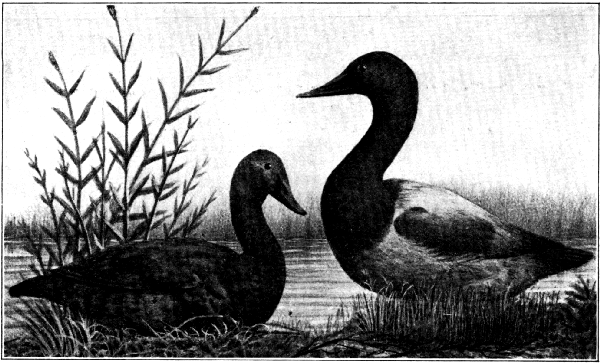
CANVASBACK (Aythya vallisnaria)
THE CANVASBACK
(Aythya vallisneria)
The canvasback, the duck par excellence of the Eastern states, is very plentiful in the more northern portions of the territorial scope of these articles, though I have seen them in good numbers on the lakes of Mexico. It is the general supposition that the canvasback breeds in the far north, but from the fact that they are found on the lakes of Mexico as early as October, they must also breed on the higher lakes of our mountains. On our lower marshes they are a late duck, but they appear on our mountain lakes quite early in the season. Canvasback shooting on our waters affords the finest of sport, as it does not partake so much of flock shooting as it does on the Chesapeake and the Delaware rivers. While I certainly prefer our shooting, by no means do I prefer our ducks. When killed on the mountain lakes, our canvasback possesses nearly if not quite as fine flavor as do those of the Eastern states, but when killed on the bays and salt marshes of California they are fishy and barely palatable. This is caused by the absence of the so-called wild celery, properly tape grass (Vallisneria spiralis), the common food of the Eastern canvasback. Our birds have the habit of feeding largely on the shallow waters of the tide lands and marshes and of consuming large quantities of crustaceans, such as clams, crabs, mussels and the like, and it takes but a few days' diet of this kind to make the canvasback about the poorest of ducks. I have killed these ducks on the high lakes and ponds of Mexico, when, on account of something they fed upon, they were really unfit to eat.
Color—Male—Head and neck, nearly black; back, light gray; bill, black, and forming nearly a straight line from the tip to the crown of the head; belly and flanks, nearly white.
Female—Head and neck, cinnamon brown, paler on the throat; back, dark gray.
Nest and Eggs—The nest of the canvasback is generally found on some little knoll in the marsh, and is lined with dead grass and feathers, and often with considerable down. The eggs, which are about ten in number, are of a dark creamy white.
Measurements—Total length, from 18 to 22 inches; the more northern birds within the territory here covered will always be found considerably larger than those of the more southern latitudes. Wing, 8 to 9 1/2 inches, and bill about 2 1/2 inches.
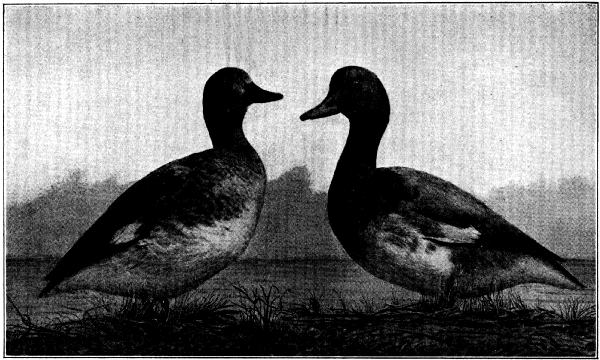
RED-HEAD (Aythya americana)
THE RED-HEAD
(Aythya americana)
The red-head is quite a common duck in the southern sections of the Coast hunting grounds. Though purely a bay or salt-water duck, that is, belonging to the subfamily Fuligulinæ, it is not found to any great extent on the salt-water marshes, preferring the higher lakes, ponds and reservoirs of the mountain valleys and foothills. I found them one season in great numbers on the San Rafael marshes, high up in the mountains of Lower California, and all the shooting two friends and myself wished to do had no effect in driving them away, although the ponds of the marsh were few and small.
Color—Male—Head and neck, reddish chestnut; lower neck and upper breast, sooty brown, a mixture of finely penciled lines of gray and brown; speculum, gray; back, gray; feathers on the top of the head almost form a crest; bill, lead color.
Female—Head and neck, light cinnamon brown, very pale on the sides of the head near the bill, and throat nearly white; breast and shoulders, dirty light brown, and back a darker dirty brown.
Nest and Eggs—The nest, like that of the canvasback, is generally built in the marsh or on the low banks of a lake, usually lined with down and contains about ten eggs of a brownish buff color.
Measurements—Total length, about 20 inches; wing, 8 1/4 to 8 1/2; bill barely 2 1/4 inches.
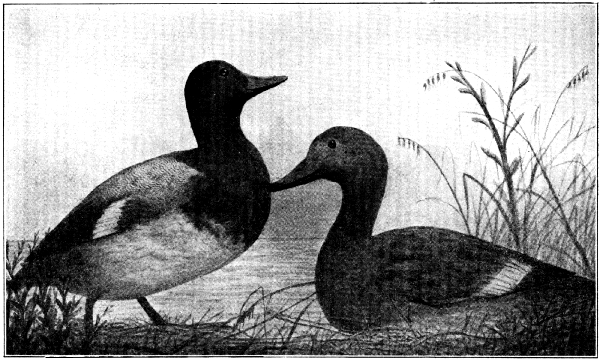
AMERICAN SCAUP DUCK OR BLUE-BILL (Aythya marila neartica)
THE AMERICAN SCAUP, OR BLUE-BILL
(Aythya marila neartica)
The American scaup, or blue-bill, the lesser scaup (Aythya affinis) and the ring-neck (Aythya collaris) are very plentiful from Washington to Mexico. These three species are generally grouped together by the sportsmen of the Coast under the name of black jacks, black ducks, black-heads or blue-bills; all three species being considered as belonging to the one variety, and the lesser scaup (Aythya affinis) as the younger birds. With the males, at least, there should be no excuse for this error, for they can be easily distinguished by the color of the speculum, or bright band on the wings, and by the color of the metallic sheen of the head and neck. The speculum of the American scaup, or larger blue-bill, is white, the head and neck showing a greenish sheen, quite pronounced in the sunlight. The lesser scaup, or little blue-bill (Aythya affinis) has a white speculum also, but the sheen of the head and neck is purple. The ring-neck (Aythya collaris), has a gray speculum, which, though quite light in color, can easily be distinguished from the pure white of the other two. The metallic sheen of the head of the ring-neck is a dark indigo blue. The bill of the ring-neck is quite different from that of the scaups, being much darker in color and more of a sooty tinge and with a faint bluish band across it about half an inch from the end. The females of all three species resemble each other very closely, but the difference in size will generally determine to which species they belong. The two blue-bills can be told from the female ring-neck by their white speculums. The female ring-neck has the gray of the male, but this does not distinguish it from the female red-head. The smaller size of the ring-neck and darker appearance of the head and neck will always indicate to which species the female belongs. The bill of the female red-head meets the skull in quite an abrupt manner, while hat of the ring-neck has more of the sloping character of the canvasback.
Color—Male—Head and neck, black, showing a green luster in the sun; back, gray, finely lined with black; under parts, white; speculum, white.
Female—Head, dead brown, with a light gray patch at the base of the bill blending into the brown of the head; breast and back, dirty brown; under parts, white; speculum, white; bill, bluish.
Nest and Eggs—The nest is a crude affair near the water's edge, containing about ten pale olive-buff eggs.
Measurements—Total length, about 18 inches; wing, 8 1/2, and bill, 1 7/8 inches. The females are but a trifle smaller.
THE LESSER SCAUP, OR LITTLE BLUE-BILL
(Aythya affinis)
The little blue-bill, or lesser scaup, like its larger relative, is a cosmopolitan species, and commonly met with in flocks of the other, which has led to the common error of classing the two together, the one as the elder and the other as the younger birds.
While in general color and markings they are very similar, there is so much difference in their size that they should be easily distinguished. With the males this is very easy for the head of the larger species has a green sheen, the head of the lesser has a purple sheen as shown in the sun. The bill of this species is more of a blue and much smaller, being not over 1 1/2 inches in length.
Color—The color and markings are the same as the American scaup, with the exception that the metallic sheen of the head, as already mentioned, is purple.
Nest and Eggs—The same as the American scaup.
Measurements—Total length, about 16 1/2 inches; wing, 7 1/2, and bill 1 1/2 inches.
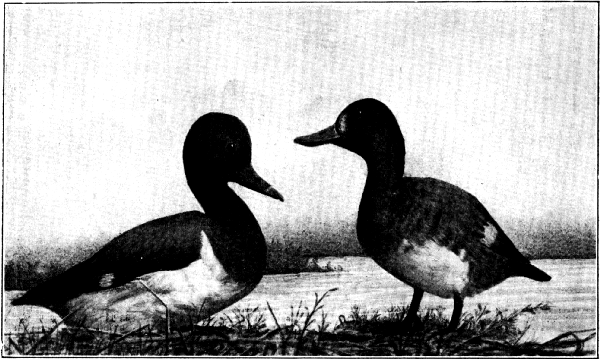
RING-NECK (Aythya collaris)
THE RING-NECK
(Aythya collaris)
In the breeding season the ring-neck male has a dirty orange ring around the neck which disappears wholly, or nearly so, before the beginning of the hunting season. The ring-neck is generally more plentiful on the fresh waters. I have seen great numbers of them at the mouth of the Colorado river. In fact, both the ring-neck and the lesser scaup range much farther south than do the larger species, for while few of the larger scaup are seen in Mexico, great quantities of the little blue-bills are found throughout the republic, especially on the salt marshes of the two coasts. All of these three species breed along the mountain lakes from California north.
Color—Male—Head and neck, black, with an indigo sheen when turned in the sun. This will always distinguish it from the larger blue-bill whose sheen is green and the lesser blue-bill whose sheen is purple. The speculum is gray; bill, bluish with a pale blue band across it about a half inch from the end.
Female—The female of this species resembles the female of the red-head very closely. It is considerable darker, however, and the bill joins the head without the marked indentation seen in the red-head.
Nest and Eggs—The nest and eggs are the same as the scaups.
Measurements—Total length, 17 1/2 inches; wing, 8, and bill, 2 inches.
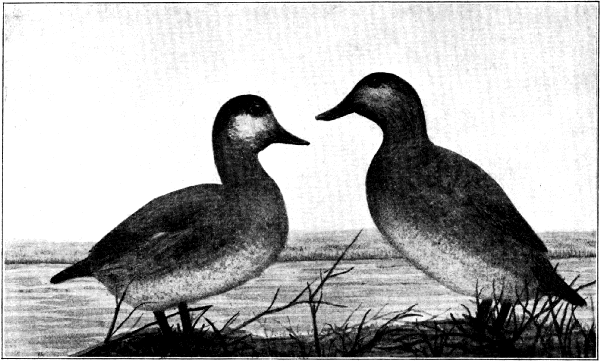
RUDDY DUCK (Erismatura rubida)
THE RUDDY DUCK, OR WIRE-TAIL
(Erismatura rubida)
The ruddy duck is a very common duck on our shooting grounds, from one end to the other, though as a rule it is not much sought after by our sportsmen. When feeding on the salt marshes they are not very palatable, it is true, but when killed on fresh waters they are one of our finest flavored ducks, if properly cooked. After refusing many shots at these little ducks and even many times failing to carry home those I did kill, it remained for Mr. Babcock, then of the Coronado Hotel, of San Diego, California, to demonstrate to me the real value of the ruddy duck. I was one of the party shooting with him on his preserve at Otay dam. When we came into the house after our morning's shoot, a most enjoyable one, he asked each member of the party what kind of duck he wished for his dinner. Mallards, canvasbacks, sprigs and widgeons had been named, so when he came to me I answered that any kind would do me. To this he replied: "Then you shall have one of my favorites." When dinner was ready, before each plate was a beautifully roasted duck of the species chosen by the member of the party for whom that plate was laid, but the plates in front of Mr. Babcock and myself each contained two plump little birds that I did not recognize in their undress uniform. After I had tasted of one, Mr. Babcock asked: "How do you like my selection?" "Very much," I answered, "but what are they? I never ate anything better." "The much despised ruddy," was his reply, "the superior of the canvasback when properly handled." The best evidence that I fully endorsed all that he claimed for the ruddy duck is the fact that there was nothing left of my two birds but well-picked bones. The ruddy duck may well be called a resident species over the whole of the Pacific Coast shooting grounds, for they breed not only on the lakes and streams, but on the lower marshes as well, throughout the whole territory.
The ruddy duck is known by a number of names such as "wire tail," "dipper," "bullet-head," "buffle-head," etc.
Color—Male—Top of head, dark brown; sides of head below the eye, dirty white; upper parts, brown; no speculum on the wing; axillars, very light gray with light brown shafts; tail, broad and stiff with the feathers pointed; under parts, dirty white.
Female—Much the color of the male, but more of a dirty brown. Side of the head and throat, dirty gray.
Nest and Eggs—The nests are usually built on little hillocks in the marshes, and contain from six to eight dirty white eggs.
Measurements—The ruddy is a small duck with a very rounded body. Total length, about 15 inches; wing, 6, and bill, 1 1/2 inches, strongly depressed in the center.
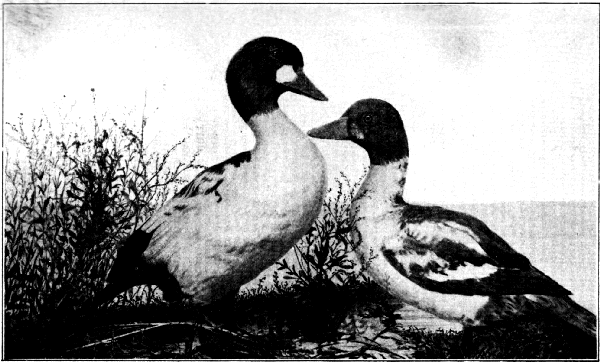
AMERICAN GOLDEN-EYE (Glaucionetta clangula americana)
THE AMERICAN GOLDEN-EYE
(Glaucionetta clangula americana)
The American golden-eye is a visitor from the far north to the northern portions of the territory covered by this work. An occasional straggler is killed as far south as San Francisco, but they are a cold country bird. They are more common in the interior of Washington and Oregon than along the coast.
Color—Male—Head and upper half of neck, dark green with a metallic sheen; a nearly round patch of white between the eye and the base of the bill; lower part of neck, most of the back and the under parts, white; upper part of the back, rump and tail, black; wings, mostly white.
Female—Head and upper neck, brown; gray spot at the base of the bill; breast and under parts, gray; back and most of the wings, brownish black.
Nest and Eggs—The nest is usually built in a hollow tree or stump and contains about ten eggs of a bluish white color.
Measurements—Total length, about 19 inches; wing, 9, and bill, 1 7/8. Female about one-tenth smaller.
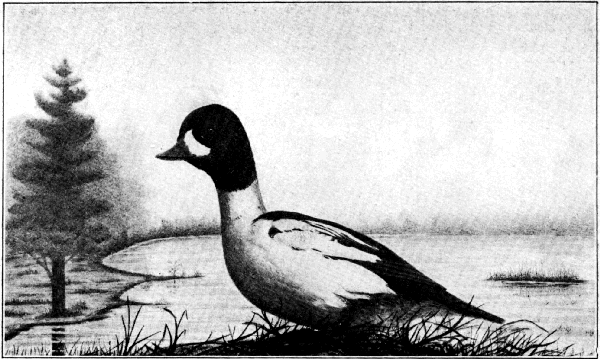
BARROW'S GOLDEN-EYE (Glaucionetta ilandica)
BARROW'S GOLDEN-EYE
(Glaucionetta ilandica)
Barrow's golden-eye is another duck that is seen, but little within the Pacific Coast hunting grounds, and only then near the coast sections of the northern part. They are found more plentiful on the islands along the north Pacific coast.
Color—The male resembles the American golden-eye very closely, except that the head of the Barrow's is more of a purple, or greenish purple. The white at the base of the bill is also different, it being a crescent shape instead of round.
The female differs in the head being more of a cinnamon brown, and the back more of a gray and slightly mottled with brown.
Nest, Eggs and Measurements—The same as the American golden-eye.
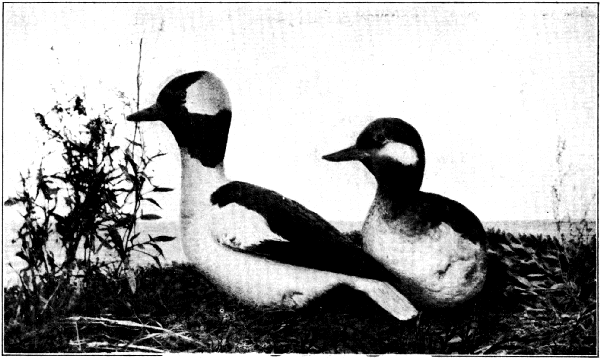
BUTTER-BALL (Charitonetta albeola)
THE BUTTER-BALL
(Charitonetta albeola)
The butter-ball, or buffle-head, is another common duck all over the country. But where we have so many larger and better ducks they are little sought for, and are generally considered poor shooting. Yet I recall one occasion when with a friend I was shooting on a couple of foothill ponds where many of these little ducks had congregated, they furnished us with fine sport. The larger ducks were soon scared away, but the little butter-balls would not leave. One of us was stationed at each pond and we soon had them all in the air.
Color—Male—Head, greenish purple, with a strong metallic luster; white patch running from the eye to the back of the head; feathers of the head long, forming a crest; back, black; under parts white and a broad white patch on the wing.
Female—The female is a very modestly colored bird to have so gaudy a mate. Head and upper parts, a dark, dead brown; under parts, white; speculum, white; a small, elongated white spot on the side of the head.
Nest and Eggs—The nest is usually built on some elevation such as a stump or log; some times in a tree. The eggs, numbering eight to ten, are of a pale buff color.
Measurements—Total length, 11 to 12 1/2 inches; wing, about 6, and bill, 1 inch.
THE OLD SQUAW, OR LONG-TAILED DUCK
(Clangula hyemalis)
The old squaw, or long-tailed duck, comes but little into California, though a few are killed each year in Washington and Oregon. I killed one several years ago as far south as Los Angeles county, California, the only one I have ever known to get that far away from his northern home.
Color—Male—As the winter plumage is the only garb that one of this species will be seen in on these hunting grounds, I will only mention it. Head, white, with a patch of brownish black on the side of the head and side of the neck; breast, black, continuing over the back; belly, white; wings, white; a band of yellow across the bill; central tail feathers, black and very long.
Female—Head, white, with a dark patch on the top and on the side; breast and back, smoky black; under parts, white; no long feathers in the tail.
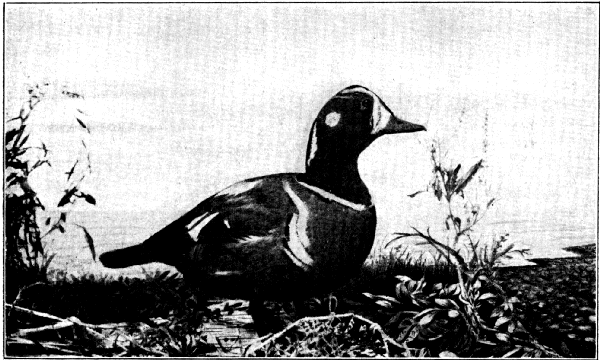
HARLEQUIN DUCK (Histrionicus histrionicus)
THE HARLEQUIN DUCK
(Histrionicus histrionicus)
The harlequin duck is a northern bird that comes but little into the United States on either coast. A few stragglers are met with in Oregon and Washington, and an occasional one is killed in California. These and the old squaw add a pleasing variety to our mounted collections, but nothing to our sport.
Color—The accompanying illustration is the best description of this duck that can be given, as the colors are white and a brownish black. It is about the size of the widgeon.
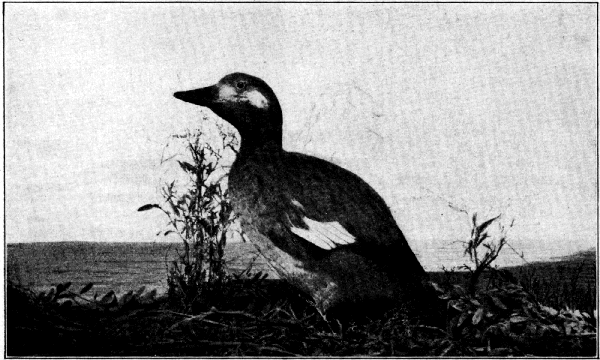
WHITE-WINGED SCOTER (Oidemia deglandi)
THE SCOTERS
(Oidemia deglandi—Oidemia americana)
The scoters, or coots, as they are called on the Atlantic coast, are all found on this coast southward to Mexico. Of these the white-winged scoter (Oidemia deglandi) is the most common, being found in large numbers on all the bays and inlets of the coast as far south as the Magdalena bay, Lower California.
Order, ANSERES Family, ANATIDAE Subfamily, FULIGULINAE. (Bay and sea ducks)
Genus Species Common Names Range and Breeding Grounds
Aythya vallisneria Canvasback From Northern Mexico north. Breeds on the higher lakes from Eastern Oregon to the Arctic.
americana Red-head From Central Mexico north. Breeds on the interior lakes from Eastern Oregon north.
neartica American scaup Blue-bill Black-jack From Central California north. Breeds on the interior lakes from Washington north.
affinis Lesser scaup Blue-bill Black-jack From northern Mexico north. Breeds on the interior lakes from Washington north to the Arctic.
collaris Ring-neck Black-jack From Central California north. More common on fresh waters. Breeds on the interior lakes from Oregon to the Arctic.
Glaucionetta americana American golden-eye Rare south of Oregon. Breeds from northern Washington north.
islandica Barrows golden-eye Very rare south of Puget Sound. Found only along the coast. Breed on the Aleutian Islands and Alaska north.
Charitonetta albeola Buffle-head Butter-ball From Central Mexican coast north. Breeds along the coast from Washington north.
Erismatura rubida Ruddy duck Wire-tail From Central Mexico north. Breeds on the mountain lakes throughout its range.
Oidemia americana Americas scoter Black coot From the Lower California coast north. Breeds on the Aleutian Islands and the Alaska coast.
deglandi White-winged scoter White-winged coot From the Lower California coast north. Breeds on the Aleutian Islands and the Alaska coast.
THE GEESE OF THE PACIFIC COAST
The hunting grounds of the Pacific Coast have a greater variety of geese than any other section of America. Here are to be found every species known to the Eastern states, except the barnacle brant of the Atlantic. But in return for the absence of this species of sea brant we have the black sea brant, the white-cheeked goose, the ross goose, the emperor goose (none of which are found east of the Rocky Mountains) and the hutchins goose, the lesser snow goose, the white-fronted goose and the little brown brant, which are only stragglers east of the Mississippi valley, and only sparingly seen that far east. Thus it will be seen that within the Pacific Coast hunting grounds there are four genera and nine species of the goose family. All of these are found in the northern parts of these hunting grounds, but only about one-half of them visit the southern parts. Increased areas of cultivation, the drainage of vast sections of marshy lands and the absence of laws for their protection have greatly reduced the once wonderful supply.
Acres of geese sounds fabulous, yet miles of geese is the only expression which conveys an adequate idea of the wonderful numbers in which these birds were seen on the Coast half a century ago. The great majority of the geese of the Coast at that time were of the white varieties, and it is a veritable fact that in California, and especially in the Sacramento, San Joaquin and Los Angeles valleys, these geese congregated during the winter months in such numbers as to whiten the plains for miles. Many flocks of honkers were mixed with them, as well as some of the other darker varieties. These darker species of the family, however, were far more plentiful in the northern parts of the State than in the southern. That part of the Sacramento valley known as the Maine Prairies has always been a favorite feeding place for the Canada goose and its subspecies.
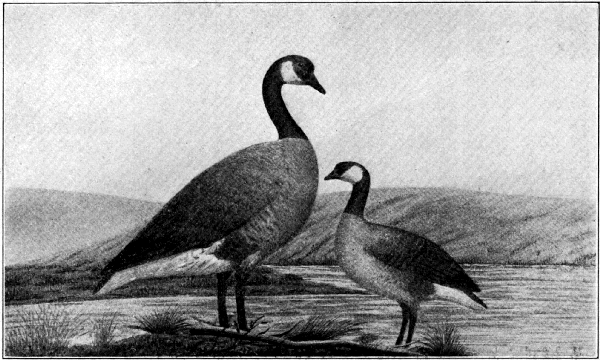
CANADA GOOSE (Branta canadensis) BROWN BRANT (Branta minima)
THE CANADA GOOSE, OR HONKER
(Branta canadensis)
The Canada goose, or honker as it is commonly called, was and is quite common on the Coast. This goose, the largest of the Americans, has a wide distribution, ranging from the Atlantic to the Pacific and from the Arctic to Central America. They breed as far south as southern Oregon, at any rate, and possibly on the higher mountain lakes as far south as Mexico, for they seem to make their appearance on the Coast shooting grounds of Mexico nearly, if not quite, as early as they do here.
The flesh of the Canada goose is the equal if not the superior of the tame goose. Its flight, except when migrating long distances, is generally low, and in such cases it can be called by the hunter to within shooting distance.
Color—Head and neck, black, with a white stripe running from the chin back of the eye to near the top of the head; upper parts, dark brownish gray; breast, dull, light gray, grading into white at the abdomen; tail and wings, black. Both sexes alike.
Eggs and Nest—The nest is generally built of sticks and grass, lined with feathers, and either in the marshes or on the banks of a stream, and rarely if ever contain more than six or seven, and often not more than four, eggs of a very light brownish white.
Measurements—Wing, about 19 inches; bill, about 1 3/4 inches.
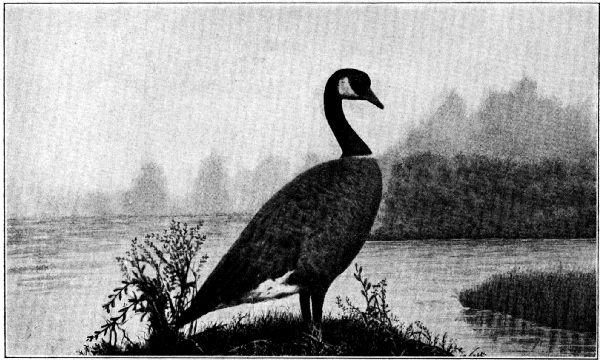
WHITE-CHEEKED GOOSE (Branta canadensis occidentalis)
THE WHITE-CHEEKED GOOSE
(Branta canadensis occidentalis)
The white-cheeked goose, known also as Mexican goose, is found only on the Pacific Coast and never east of the Cascades in Washington and Oregon, or the Sierra Nevadas in California. In fact, they are generally confined to localities not far from the ocean. While both the honker and the Hutchins goose have a white cheek, the white of the honker meets under the chin or blends into a gray, but the white of the white-cheeked variety is separated either with a distinct black stripe under the chin or a mottled black and white one. Also the black of the neck of the white-cheeked goose and the brownish gray of the breast is very generally separated by a white collar, though sometimes this is so faint as to be almost indistinguishable.
The white-cheeked goose is rarely seen south of Monterey Bay, California.
Color—Same as the Canada goose, except that the white on the cheeks is either separated under the chin by a black stripe or by only a very few white feathers in the black. Between the neck and the dull gray of the breast is a narrow white stripe, or collar. This some times is very faint, and, in fact, some times, though very rarely, absent. This absence of the collar is quite likely caused by its inter-grading with the Hutchins goose.
Nest and Eggs—The same as the Canada goose.
Measurements—Wing, never more than 16 inches; bill, not more than 1 1/4 inches.
THE HUTCHINS GOOSE
(Branta canadensis hutchinsii)
We have on the Pacific Coast four varieties of the Branta canadensis, or that species to which belongs the Canada goose, all resembling each other closely except in size. Two of these species are generally considered honkers by most of our sportsmen, while others have two or three local names for them, among which are Mexican goose and Lower California goose. The fact is that while the Canada goose is quite common on the coasts of Mexico, neither the Hutchins goose nor the white-cheeked goose migrate that far south.
The Hutchins goose so closely resembles the Canada goose, or honker as it is popularly called, that it is principally distinguished by its smaller size and a considerable difference in the call. The Hutchins goose ranges as far east as the Mississippi valley, and on the Pacific Coast south only to about Santa Barbara county, California. This is one of the two varieties that is given the local names of Mexican and Lower California goose.
Color—Same as the Canada goose, from which it is only distinguished by its smaller size and a considerable difference in its call.
Nest and Eggs—Same as the Canada goose.
Measurements—Wing, not more than 17 inches; bill, 1 1/2 inches.
THE CACKLING GOOSE, OR BROWN BRANT
(Branta canadensis minima)
The cackling goose, known also as brown brant and gray brant, is the most common of the four varieties and much the smallest. (See illustration.) Its markings are the same as the Canada goose, but its under parts are somewhat darker. While in total length it is fully half that of the honker, in weight it is not more than one-third. The cackling geese are commonly found in flocks of the white geese, both in their feeding and their migrations. This species ranges east as far as the Mississippi valley and south on the Coast as far as the mouth of the Colorado river and to some extent into Lower California. It is more numerous than any other of the dark colored geese of the Pacific Coast.
Color—The same as the Canada goose, with the exception that it is a little darker on the under parts.
Nest and Eggs—The same as the Canada goose, but the eggs number as high as ten.
Measurements—Wing, 13 to 14 1/2 inches; bill, from one to one and one-eighth.
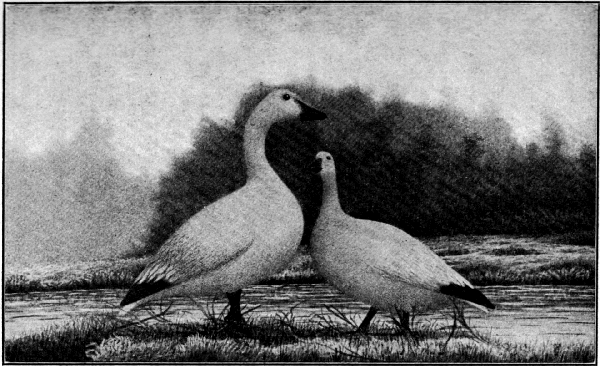
LESSER SNOW GOOSE (Chen hyperborea) ROSS GOOSE (Chen rossii)
THE SNOW GOOSE, OR WHITE GOOSE
(Chen hyperborea)
The lesser snow geese, commonly called white geese, are the larger of the two species of white geese so numerous on the Coast. They not only feed, but migrate in great flocks, and these migrations often take place at night when their sharp cries will be heard high in the air. The lesser snow goose is found as far east as the Mississippi valley and south on the Pacific Coast to San Diego. Occasionally a few are seen at Ensenada and the valley of the Palms in Lower California. The meat is tough and poor in flavor and, therefore, they are hunted but little except by the market hunters, who, somehow, succeed in selling a good number of them to the uninitiated.
Color—Pure white, with black bill and legs; the primaries, or long feathers of the wings, are black.
Nest and Eggs—The nests are made close to the water's edge and contain about ten dirty white eggs.
Measurements—Wing, about 16 inches; bill, 2 1/4 inches.
THE ROSS GOOSE, OR LITTLE WHITE GOOSE
(Chen rossii)
The Ross goose has been given the name of China goose by many who wanted some distinguishing nomenclature for them, when in fact the Ross goose is purely an American Pacific Coast bird. Like the snow goose it is pure white with black primary plumes. Young birds of both species are occasionally seen in the early part of the season more or less mottled on the breast with yellowish gray feathers. The Ross goose is only about half the size of the snow goose. Aside from this it can always be known by the warty appearance of the upper half of the bill. They are commonly seen, both in feeding and in their migrations, mixed in the flocks of the snow geese. Occasionally they are seen as far east as Utah and Montana, but only in small numbers.
The Ross goose migrates as far south as Central Mexico, great numbers of them congregating on Lake Chapala, in the state of Jalisco.
Color—Same as the snow goose.
Measurements—Wing, about 14 inches; bill, 2 1/4, with warty excresences on the upper part.
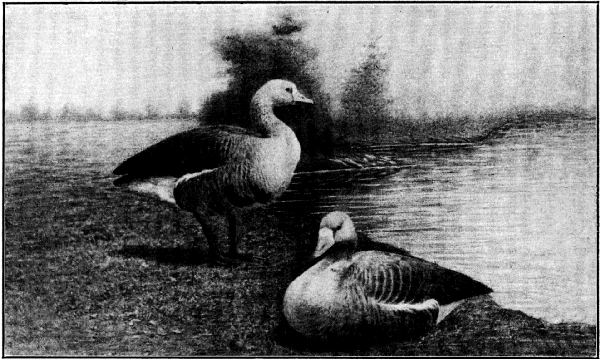
WHITE-FRONTED GOOSE, OR SPECKLE-BREAST (Anser albifrons gambeli)
WHITE FRONTED GOOSE
(Anser albifrons gambeli)
The white-fronted goose, or speckle-breast as it is commonly called, is quite common on the Coast south to Mexico, where great numbers congregate on Lake Chapala, Jalisco. This is another western species, though ranging to some extent as far east as the Mississippi valley and an occasional flock wanders even to the Atlantic coast. The breasts of the old birds are commonly profusely speckled with black feathers. The white-fronted goose is a little more exclusive in its habits than any of the others named, being generally found in flocks by themselves. As a table bird the meat is quite palatable, and large numbers are sold in the markets.
Color—Head, grayish brown, with a white spot at the junction of the bill, but this is absent from the young birds; neck, lighter, shading into white or dull white on the breast, mottled with black; back, ashy gray, edged with brown; shafts of the quills, white; bill and legs, light pink.
Nest and Eggs—The nest is usually well made and lined with feathers and down. The eggs number about seven or eight, and are of a pale greenish white.
Measurements—Wing, 16 inches; bill, 2 inches.
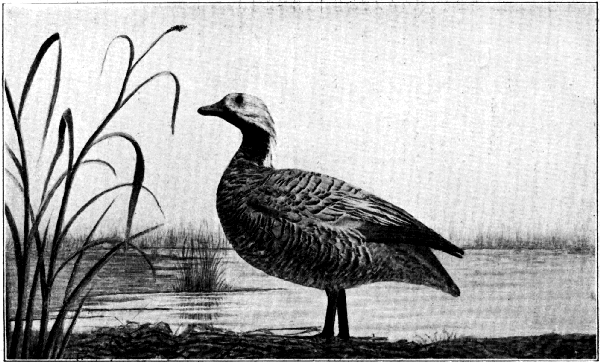
EMPEROR GOOSE (Philacte canagica)
THE EMPEROR GOOSE
(Philacte canagica)
The Emperor goose is a north Pacific species, breeding principally on the islands of the Alaska coast. The great majority of these birds winter well to the north of us, though a number venture southward into California to Humboldt bay and even south of that. A small flock or two is seen almost every winter on the marshes near San Francisco. A close watch of the markets will reveal one or two offered for sale almost every winter.
Color—Head and back of neck, white; throat, brownish gray, shading into light gray on the breast and abdomen; back, a little darker; the feathers being gray, tipped with lighter gray, with a sub-terminal band of brownish gray; legs, flesh color.
Nest and Eggs—The nests are usually found on the small islands of the salt marshes, and contain eight to ten eggs of a dull white color.
Measurements—Wing, about 15 1/2 inches; bill, 1 1/2 inches.
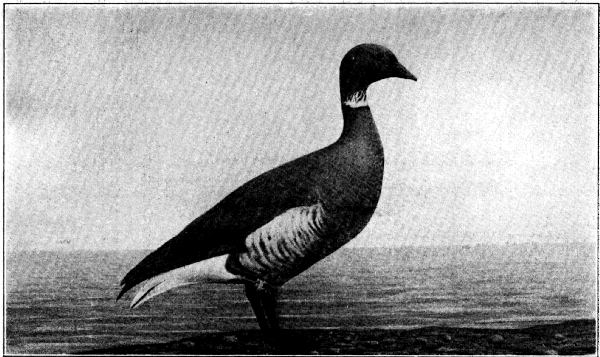
BLACK SEA BRANT (Branta nigricans)
THE BLACK SEA BRANT
(Branta nigricans)
The black sea brant is another purely Pacific Coast species, found nowhere else except as a straggler. They resemble the barnacle brant of the Atlantic (Branta barnicla) except in the shape of the head and bill. A differing characteristic, however, is that the white speckling on the sides of the neck of the barnacle brant extends all around the front of the neck in the case of the black sea brant. As their name implies, these are purely seabirds, rarely flying over the land even, and only found in such bays as produce the eel grass on which they feed almost exclusively. I only know of the following places within the Pacific Coast shooting grounds where the black sea brant is found. These are: Puget sound, Washington; Coos bay, Oregon; Humboldt, Tomales, Moro and San Diego bays, California, and Magdalena bay, Lower California. In most of these places they ate plentiful during the winter season. Of all birds that fall to the aim of the sportsman, the black sea brant is the most difficult to get within range of. This is only accomplished by great caution and a good deal of strategy, but when they are brought to bag the reward is a full compensation, for of all the waterfowl their flesh is the most delicious. The sea brant is rarely found away from the haunts mentioned, yet the bird from which the accompanying illustration was made was killed from a small flock that had strayed into the lower end of San Francisco bay, near Redwood City, and was mounted by that accomplished sportsman and taxidermist, Chase Littlejohn, of that place.
Color—General color, black; throat, with a white or speckled ring all around the neck, except a small portion of the back; flanks, mottled white and black; under tail feathers, white.
Nest and Eggs—The nest is only a depression on the ground, but nicely lined with down. The eggs, numbering six to eight, are of a dull white.
Measurements—Wing, 13 inches; bill, 1 1/2 inches.
THE SWANS
(Olor columbianus) and (Olor buccinator)
(Subfamily, CYGNINAE)
Both the whistling swan (Olor columbianus) and the trumpeter swan (Olor buccinator) were once very plentiful on the Pacific Coast hunting grounds, as far south as central California, and especially so on the Columbia river and the lakes of Oregon and Washington. A few were met with also as far south as San Diego county, California.
I shall never forget the first two swans I ever killed and my experience with them. It was the first winter after I came to California and I was living in Los Angeles, then a little Mexican village, and three of us were doing our own housekeeping. Whatever the reason—most likely from some hallucination of boyhood—I entertained the belief that swans must be exceedingly fine eating. As I prided myself then, just after crossing the plains, upon being a good cook, great preparations were made for an extra fine feast on what I fancied would be a delicious bird. We had a good stove and the first of the two swans was carefully "stuffed" with the choicest dressing, consisting of the combined suggestions of the three of us. It was placed in the oven, the fire carefully tended and the magnificent bird repeatedly "basted." When it was ready and placed on the table it fell to my lot to do the carving. Having drawn my knife across the hunger-producing carcass without making any perceptible impression, I decided that it must be the fault of a dull knife. Among our table furnishings we had no sharpening steel, a scythe stone doing service in its stead. I hunted this up and began on the knife with the "mower's challenge" stroke and soon had an edge that would have cut through anything less than an eighty-pound rail. With no little effort I amputated the legs and the wings, and cutting a generous piece from one side of the breast passed it to one of my companions, who at once began on it with his knife. A few attempts to sever it and he reached for the scythe stone. Then when he began chewing on the segregated piece he declared that it was not cooked enough. A dispute followed as to whether it is over-cooking or under-cooking that makes a bird tough. With this momentous question still unsettled we decided that some of the many ingredients that we had put into the "stuffing" must have given the meat its sole-leather consistency. We had a couple of hounds, whose teeth had been well tested in many a coyote kill, and we passed this first swan up to them.
The next day the other bird was worked into a fine stew and well cooked. When served the stew was fine. The dumplings were light and fairly melted in our mouths; the red peppers were hot; the aroma of onions was just of that degree to suggest the ambrosia of the gods; but the swan! Well, the hounds ate it through the compulsion of hunger.
A half-grown swan, however, is very good eating.
There is very little difference in the two varieties. The whistling swan being more of a northern bird, rarely migrating as far south as central California. About the only noticeable difference is that the whistling swan has a small yellow spot at the V-shaped point of the bill where it meets the eye.
THE WADERS AND SHORE BIRDS
The Pacific Coast is especially rich in waders and shore birds, there being upwards of forty species that are more or less common, with some ten or more that are occasional visitors. Of these few can be considered game birds, while others are so small that they are rarely shot by our sportsmen. Many of both the waders and the shore birds are constant residents. Others come from still farther south for breeding purposes, while still others breed north of us and migrate throughout the territorial scope of these articles to spend their winters.
The shore birds, while very common, are hunted but little by the sportsmen of this region, and many of the smaller species that are considered quite a delicacy by our eastern brethren are passed by entirely by our lovers of the gun. The reasons for this will be obvious to all who have read the preceding pages and noted the abundance and great variety of larger and better game. By better game I mean birds that furnish better sport by requiring more skill in approaching them and better marksmanship in bringing them to bag. The little mountain plover, of the southern part of the Coast, while not surpassed even by the jack snipe as a table delicacy, are hunted but little, even where they are very abundant, because there is little sport to be had in shooting them. And the same is true, in a great measure, of several other species. Sportsmen, therefore, are little acquainted with these birds either as to their names, gastronomic merits or means of identification.
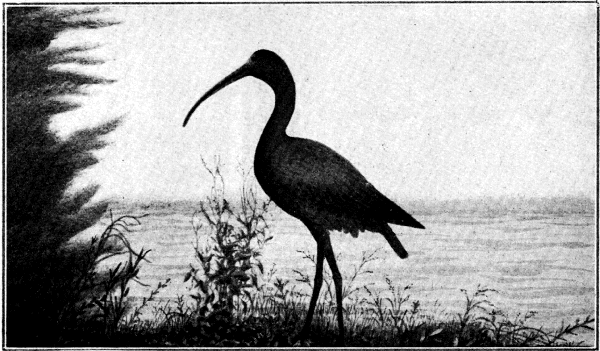
WHITE-FACED GLOSSY IBIS (Plegadis gaurauna)
THE HERONS and IBISES
(Order, Herodiones)
While none of the order Herodiones, which includes the storks, herons, ibises and bitterns, can be considered game birds, they are so common about our waters, and some of them add such a charm to the scene by their beautiful plumage and graceful movement, that mention of some of them here will not be out of place.
The great blue heron (Ardea herodias) is the most common of these waders. With his long, gracefully curved neck and slender legs he wades with stately mien along the shallow waters of the lakes, marshes and streams, both summer and winter, for he is to the manner born and has no desire to seek other lands or other climes. The herons are said to be destructive to fish. This can be to a limited extent only, for they subsist very largely on the enemies of the fish, destroying hundreds of snakes, water lizards and other fish destroyers.
The snowy heron, or white crane as it is commonly called (Ardea candidissima), is another handsome wader that lends a charm to the lakes, ponds and streams from Oregon south through Mexico. Built on the same graceful lines as its blue relative, and with a plumage as white as the purest snow, it never fails to attract attention.
Three representatives of the family Ibididæ are found here and present a pleasing and interesting group.
The white-faced glossy ibis (Plegadis guarauna) ranges over the larger portion of the Coast, but from Lower California north only for breeding purposes. Its long curved bill, slim, gracefully bent neck, shapely body, tall legs and irridescent reflections of its plumage in the sunlight, place it among the most attractive of North American birds. Unlike the herons they are gregarious and are, therefore, seen in flocks of varying size. The glossy ibis is often called bronze curlew, but this is a bad misnomer, as they are in no way related to the curlew.
Another of the family is the white ibis (Guara alba). These are quite common in Lower California and Mexico. They rarely migrate into California, though they venture much to the north of us in a northeastern direction, reaching the shores of the Great Salt Lake, during the breeding season. The scarlet ibis (Guara rubra), the other member of the family, is confined to Mexico, so far as these articles are concerned.
The American egret (Ardea egretta) ranges from Oregon south to South America. It was at one time quite plentiful in California, but its handsome plumes attracted the eye of the milliner, which in turn aroused the cupidity of the market hunter, and these beautiful birds are now rare north of Lower California and Mexico, and are rapidly decreasing even there. The reddish egret (Ardea rufescens) is an inhabitant of Lower California and Mexico, not coming north of these places. Though not as handsome as the white egret, it is also being exterminated for the same purposes.
The birds that I have so far mentioned, while not game birds, are so constantly before the eyes of the sportsmen who engage in waterfowl shooting that they can not help but be interested in them. They add a variety and a beauty to the scene, and many an hour's wait, that otherwise would have been tedious, has passed away pleasantly in watching the graceful movements of some one or more of these stately waders.
THE CRANES, RAILS, GALLINULES
To the order, Paludicolae, belong the cranes, rails, gallinules and coots, or mudhens, as they are commonly called. Of the members of this order we are concerned only with the cranes, rails and coots. The sandhill crane (Grus canadensis) is a common visitor to all parts of the Coast, but more plentiful in the interior valleys than near the seashore. They are generally hard to approach and for that reason they are but little hunted by our sportsmen. The whooping crane (Grus americana) once common throughout the middle states, is still met with to considerable extent in Mexico, but it is by no means a common visitor.
The California clapper rail, known also as the San Mateo rail (Rallus obsoletus), is the largest as well as the most important of the rail family in this section. At one time the clapper rail was very plentiful in certain localities in California and furnished abundant sport, though rather of a tame nature, to those who hunted them. Being an easy bird to kill and unsuspicious, they have been rapidly reduced in numbers until now they are in danger of extinction unless laws are enacted giving them better protection. The clapper is only a straggler south of San Francisco bay.
The Virginia rail (Rallus virginianus), a species not more than half the size of the clapper rail, is found sparingly over the Coast, but principally on the fresh water marshes.
The little yellow rail (Porzana noveboracensis) is found on the fresh waters from central California south, but it is nowhere abundant.
The black rail (Porzana jamaicensis) is another of the smaller rails that are found on the fresh waters to a limited extent. Both this and the last preceding one are so small that they are seldom shot, though as an article of food they are very delicate.
THE SHORE BIRDS
(Order, Limicolae)
The order Limicolae, which is composed of the shore birds proper, is abundantly represented. They are seen wading in the shallow waters, carefully watching for worms, insects and other species of food upon which they live, boring in the soft mud, scurrying in flocks from place to place, or running along the beach as the surf recedes, picking up the jetsam of the sea, then taking wing or running back like a playful child to the higher ground as the foaming crest of the next breaker rushes up the sandy shingle. Or, as is the case of the phalaropes and some others, they may be seen riding lightly upon the restless billows far out at sea. Modest in coloring and plain in plumage, the shore birds seem to belong to the plebeians of the avafauna, for they are constant workers, always busy, always plying their slender legs rapidly as they hurry from one spot to another, never idle, never resting for a moment.
Of the shore birds there are six families and twenty genera represented on the Coast. Most of them are quite abundant from Washington to Mexico on their respective feeding grounds.
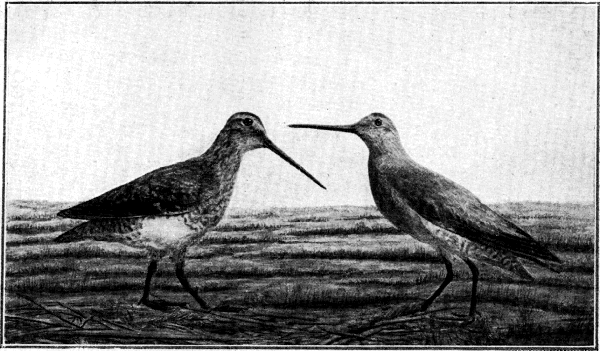
WILSON SNIPE, OR JACK-SNIPE (Gallinago delicata) DOWITCHER (Macrorhamphus scolopaceus)
THE WILSON, OR JACK SNIPE
(Gallinago delicata)
Of all the shore birds the jack snipe, English snipe or Wilson snipe as it is variously called, is the most highly prized as a table delicacy and furnishes the best sport with the dog and gun. Usually lying well for the dog, erratic in its flight and quick on the wing, the Wilson snipe is one of the most difficult birds to bring to bag. It is not only erratic in its flight, but it is erratic in its nature as well. One day it will be found on a given feeding ground in abundance and on the next not one is to be seen, while possibly the day following they are there again in great numbers. To this uncertainty and the corkscrew flight, peculiar to it alone, is due much of the charm that jack snipe shooting affords. While these birds are commonly called jack snipe or English snipe, their proper name is Wilson snipe, but like the rose, no matter what the name, they are just as gamy and just as delicious. The Wilson snipe migrates here to but little extent, and these migrations are altitudinal rather than latitudinal. They breed commonly in all the mountain valleys and even as low down as on the Sacramento marshes south of the city of the same name. I found a pair breeding a few years ago in the low hills of San Luis Obispo county not half a mile from the ocean beach.
Color—Head, black, with a central stripe of brown; back, a mixture of dark brown, pale brown, yellow and dull white; greater wing-coverts, dark brown, tipped with white; throat, dull white, barred with brown; a dark stripe running from the base of the bill across the eye to the occiput; under parts of the wings, dull white, barred with black; tail feathers, dark brown, tipped with white, and with a sub-terminal bar of black. No web between the toes.
Nest and Eggs—The nest is a very crude affair made on the ground and with but little lining of any kind. It contains from three to four grayish eggs, blotched with brown.
Measurements—Total length, 11 inches; wing, 5 1/2; bill, 3 inches.
THE DOWITCHER, OR RED-BREASTED SNIPE
(Macrorhampus scolopaceus)
Though not of the same genus, the closet relative to the Wilson snipe is the dowitcher or red-breasted snipe. By many who are not accustomed to the Wilson snipe and its many vagaries, the red-breasted snipe is often mistaken for the former. The red-breasted snipe may easily be distinguished by the small web between the outer and middle toes. This species of the dowitcher is a western bird, breeding well to the north and migrating south to Mexico.
Color—Head and back, more of a gray than the Wilson snipe, with the feathers edged with a pale buff; light gray stripe running from the base of the bill over the eye to the occiput; chin, dull white; breast, gray, with a tinge of cinnamon red; tail, banded with dark brown; a small web between the outer and middle toes, extending about one-fourth down the outer toe.
Eggs and Nest—Nest made on the ground and containing from three to four dull white eggs.
Measurements—Total length, 10 1/2 inches; wing, 5 3/4; bill, about 2 1/2 inches, and with a considerable swelling at the end.
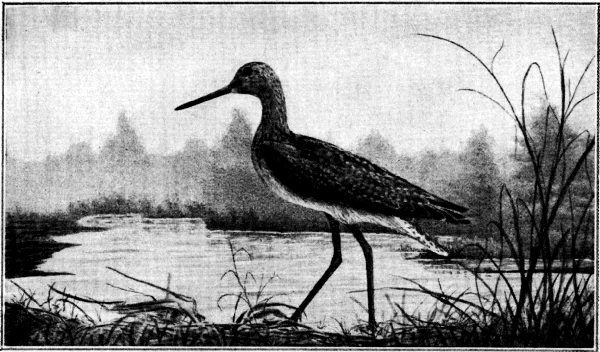
GREATER YELLOW-LEGS (Totanus melanoleucus)
THE GREATER YELLOW-LEGS
(Totanus melanoleucus)
The greater yellow-legs migrates throughout the entire region, being common on the beaches of Washington, Oregon and California during the fall and early winter as it works its way to Lower California and Mexico. It somewhat resembles the godwit in coloring, but it is more of a grayish tinge. Its shorter bill—not over two and a half inches in length—will always distinguish it from the godwit. So, also, will its sharp whistling note. It is nearly as delicate a table bird as the Wilson snipe.
Color—Top of head and neck, brown, with whitish streaks; back, brown, with the feathers edged with white; chin, white; breast, white, lined with narrow streaks of brown; bill, black, and legs, yellow.
Nest and Eggs—The nests are built close to the water's edge, containing four light buff eggs, spotted with brown.
Measurements—Total length, 14 inches; wing, 7 3/4; bill, 2 1/4, to 2 1/2 inches.
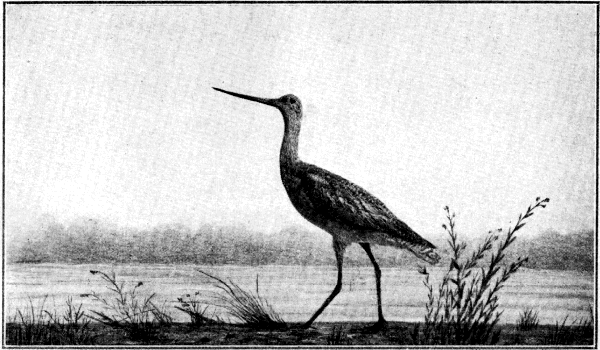
MARLIN OR GODWIT (Limosa fedoa)
THE MARLIN, OR MARBLED GODWIT
(Limosa fedoa)
The marbled godwit, or marlin as it is also called, is one of the largest birds of the Scolopacidæ family. It ranges from Alaska to Central America. This species is seen in large numbers in the early fall along the sea beaches of California as they are working their way south. They spend the winter in great quantities in Lower California and Mexico. There should be no difficulty in distinguishing the godwit from any of the other shore birds, its long upward curved bill and brownish-barred back being features by which it may always be known.
Color—Top of head and back of neck, brown, streaked with paler brown; feathers of the back, brown, with ochreous edges; throat and forehead, pale buff, with faint markings of brown; bill slightly turned upward.
Nest and Eggs—Nest a crude affair on the ground, containing four eggs of an ash color, mottled with a dead brown.
Measurements—Total length, 19 inches; wing, 8 3/4; bill, about 4 inches.
THE RED-BACKED SANDPIPER
(Tringa alpina pacifica)
The red-backed sandpiper, or American dunlin, is one of the larger members of the genus and quite plentiful on the Coast marshes, but it is seldom seen in the interior valleys except during its migrations. In its winter plumage, in which our sportsmen see it, it is of a dull light gray color. A diagnostic feature of this species is the slightly downward curved bill.
Color—Head and upper parts, light gray, with a white stripe over the eye; shafts of the feathers are dark brown, producing a streaky appearance. In its summer plumage the head and back are reddish brown, wings brownish and abdomen black.
Nest and Eggs—Nests on the ground without lining. Eggs, bluish white, with brown spots.
Measurements—Total length, about 8 1/2 inches; wing, 4 3/4; bill, 1 5/8.
THE WILLET
(Symphemia Semipalmata inornata)
The willet, or stone curlew as it is sometimes called, is a resident species, breeding from Washington to Mexico. It is a western bird, ranging eastward to the Mississippi valley, where it is but a straggler. In size it is nearly as large as the marlin. Its black wings, with broad, white patches, and feet webbed for about half the length of the toes, are distinguishing features, easily recognized. It is generally found on the salt marshes.
Color—The general color of the plumage is ashy white or light gray, usually with some light buff markings on the breast. When flying it shows a broad, white patch on the wings, caused by the upper part of the primaries and part of the secondaries being white. Its smoky black axillars will always distinguish it.
Nest and Eggs—The nest is any place on the ground where it can deposit three or four pale buff eggs, spotted with dark brown.
Measurements—Total length, 15 1/2 inches; wing, 8 1/2; bill, 2 1/2 to 2 3/4 inches.
Order, LIMICOLAE
Family SCOLOPACIDAE.
Genus Species Common Names Range and Breeding Grounds
Gallinago delicata Wilson snipe Jack snipe Throughout the marshes of the coast. Breeds in the mountain valleys.
Macrorhamphus scolopaceus Dowitcher Red-breasted snipe Along the fresh waters of the interior valleys. Breeds in British Columbia and Alaska.
Tringa pacifica Red-backed sandpiper From the Central Mexican coast north. Breeds from Washington north.
Limosa fedoa Marble godwit Marlin Early and late migrant along the coast from Mexico north. Breeds in the far north.
Totanus melanoleucus Yellow-legs Early and late migrant along the coast, passing the winter in Southern California and Mexico. Breeds in the mountain valleys.
Symphemia semipalmata inornata Western Willet From Mexico north. Breeds throughout its range.
Numenius longirostris Jack curlew Early and late migrant. Winters in Southern California and Mexico. Breeds throughout its range.
hudsonicus Long-billed curlew Hudsonian curlew Same habits as the long-billed and usually found with it. But breeds farther north.
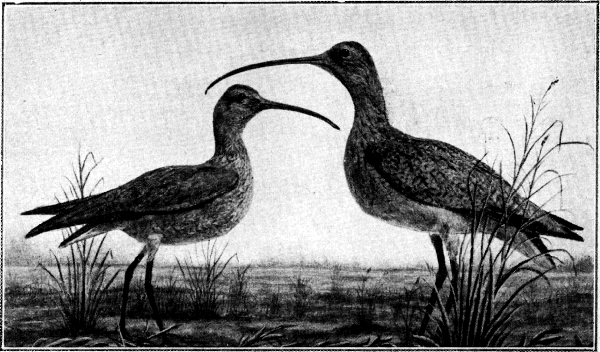
HUDSONIAN CURLEW (Numenius hudsonicus) LONG-BILLED CURLEW (Numenius longirostris)
THE LONG-BILLED CURLEW
(Numenius longirostris)
The long-billed curlew, or sickle bill as it is often called, is a plentiful resident in all suitable localities. The young birds mature early and find their way to the marshes during August, when the season for their killing should begin. At this time and even during the month of September they are quite palatable, but later they become strong in flavor. In these months they feed largely upon the seeds and insects to be found on the plains, but later they confine themselves principally to the marshes. They breed near the mountain lakes and streams and even to considerable extent on the lower grounds. A glance at the accompanying illustration will be sufficient to enable the uninitiated to always know a curlew.
Color—Head, back of neck and back, dark brown, mottled with buff; throat and under parts, pale buff, the feathers on the breast being streaked with brown; axillars, reddish brown.
Nest and Eggs—The nest is usually made on the ground in tall grass and back some distance from the marsh. The eggs are about four and of an olive gray, spotted with brown.
Measurements—Total length, without the bill, which varies very much, about 20 inches; wing, 9 to 11; bill, from four to eight inches, and bent downwards, with nearly as much curve as a sickle; in most specimens the bill will be about six inches in length.
THE HUDSONIAN CURLEW
(Numenius hudsonicus)
The Hudsonian curlew, or jack curlew, by which name it is also known, is also a common visitor to our hunting grounds. It is often seen mixed with flocks of the preceding species, which leads many to suppose that they are the younger birds of that species. Unlike the long-billed, the Hudsonian curlew is not a resident species, or, at least, not to so great an extent, although it makes its appearance on our marshes quite early in the season, even as far south as central California. In markings the two species are almost identical, with the exception that the Hudsonian is somewhat paler in shade. Any doubt arising as to which species a specimen may belong can easily be settled by an examination of the axillar plumes. If a long-bill, these feathers will be a solid reddish-brown, but if a Hudsonian, they will be of a pale buff color barred with a dull-brown, the buff and brown being nearly of the same width. Both species become less common north of southern California during the late winter months.
Color—Same as the long-billed curlew, except that it is a little paler on the under parts, and the mottling shows more distinctly on the back. The axillars are pale buff, distinctly barred with light brown.
Nest and Eggs—The same as the long-billed curlew.
Measurements—Total length, including bill, which varies but little in this species, about 17 inches; wing, 9, and bill about 3 1/2 inches.
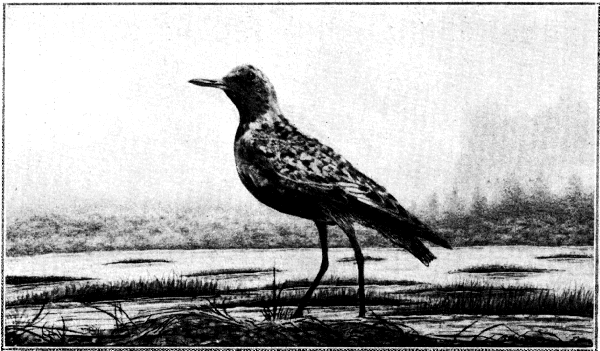
BLACK-BELLIED PLOVER (Charadrius squatarola)
BLACK-BELLIED PLOVER
(Charadrius squatarola)
The largest of the family Charadridæ is the black-bellied plover. In its plumage, both summer and winter, it closely resembles the golden plover, as the black on the sides of the head, front of neck, breast and abdomen disappear from both species in their winter plumage. But, notwithstanding this, they can easily be distinguished by the small rudimentary hind toe of the black-bellied species, the other having but three toes. A few specimens of the golden plover have been taken on the Coast, but it is of rare occurrence. The black-bellied plover is reasonably common along the coast line, but it is not seen to any great extent in the interior valleys.
Color—Upper plumage, dull brown, mottled with gray, the top of the head being somewhat darker; under parts, nearly white and the sides and breast streaked with brown. In the summer the throat and belly are black.
Nest and Eggs—The nest is usually made on the uplands, where four eggs are deposited of a pale olive, spotted with brown.
Measurements—Total length, 11 inches; wing, 7 1/2, and bill, 1 1/4 inches.
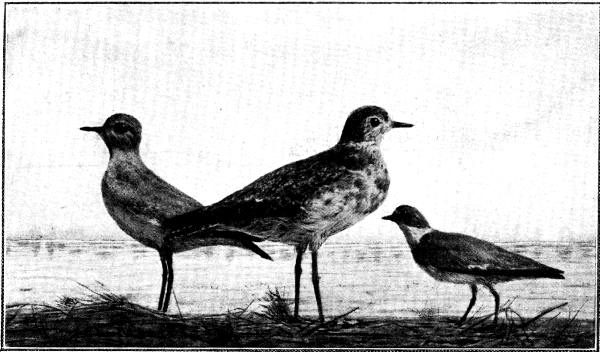
SNOWY PLOVER (AEgialitis nivosa) MOUNTAIN PLOVER (AEgialitis montana) RING-NECK PLOVER (AEgialitis semipalmata)
THE MOUNTAIN PLOVER
(AEgialitis montana)
The mountain plover is very plentiful on the plains of southern California during the winter months. This little bird as a table delicacy is not surpassed by any of the long list of shore birds. In fact it is preferred by many to the far-famed jack snipe. It is an upland bird, feeding largely on insects, and rarely found near the marshes whether salt or fresh-water. In its winter plumage, as seen here, its underparts are white with the breast and upper parts of a brownish gray.
Color—Throat, breast and under parts, white; the rest of the plumage, light buffish gray; sometimes the breast will show a slight tinge of buff; axillars, white; bill, black. Three toes without web.
Nest and Eggs—The nests are placed on the uplands and contain three grayish eggs, spotted with brown.
Measurements—Total length, 8 3/4 inches; wing, 6, and bill, 9/10 of an inch.
THE SNOWY PLOVER
(AEgialitis nivosa)
The snowy plover is quite common from northern California to Mexico. It is a small bird and, while it is hunted but little, its flesh is quite delicate. In its winter plumage it is much lighter in color than any of the others named.
Color—Top of head, back of neck and back, buffish gray; forehead and under parts, white; a patch of dull brown just above the white of the forehead, and another of the same color on each side of the throat. Three toes without web.
Nest and Eggs—The nests are found throughout its range; they are nothing more than a depression in the sand and contain four grayish buff eggs, spotted with black.
Measurements—Total length, about 6 3/4 inches; wing, 4 1/4, and bill 5/8 of an inch.
THE RING-NECKED PLOVER
(AEgialitis semipalmata)
The ring-neck plover is a fairly common visitor during the winter months. It is usually seen on the coast or on other sandy shores. It may be known by its partially webbed feet.
Color—Forehead, chin and neck, white, with a faint streak of dull brown from the bill under the eye to the back of the neck; a band of dull, brownish gray on the breast; back and wings, ashy gray; under parts, white; bill, black with a spot of orange at the base. Three toes which are webbed for about half their length.
Nest and Eggs—Nests are made in the sand and contain from three to four dirty white eggs, spotted with brown.
Measurements—Total length, 6 3/4 inches; wing, 4 3/4, and bill, 3/2 inch.
WILSON'S PLOVER
(AEgialitis wilsonia)
While the Wilson plover is found to some extent on the southern Atlantic Coast, it may properly be said to be a Pacific species. Here it is seen on the beaches in large numbers, just beyond the reach of the surf, picking the insects and minute shellfish as they are washed on the sand, or flying in flocks just above the breakers.
Color—Forehead and stripe over the eye, white; black stripe in front of crown; top of head and stripe from the eye to the bill, black; black band just below the throat; back, gray; under parts, white; bill black, and legs and feet, light pink.
Nest and Eggs—The nest is a mere depression in the ground, with three to four eggs of a pale olive, spotted with dark brown.
Measurements—Total length, 7 to 8 inches; wing, 4 to 5; bill, about 3/4 of an inch. Three toes with a small
[Note: Unfinished sentence above in original printed version.]
There are a number of other plovers on the hunting grounds of the Pacific Coast, but they are either too small or the flesh too poor to interest the sportsman. Of these the killdeer plover is the most common and the best known. A description of these would be of no interest to the sportsman and therefore add nothing to the purposes of this work.
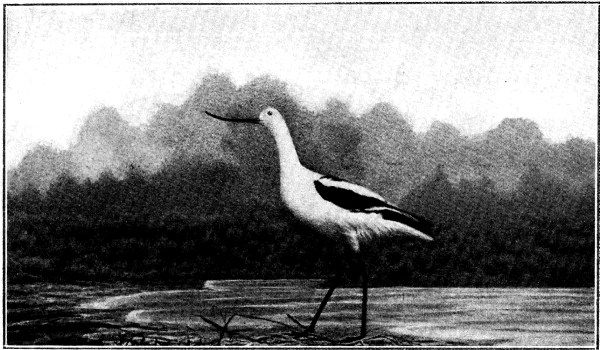
AMERICAN AVOCET (Recurvirostra americana)
THE AVOCET
(Recurvirostra americana)
The family Recurvirostridæ has but two representatives on the Coast. The American avocet breeds from Washington southward and spends its winters from central California south. They are quite plentiful in southern California during the winter months, increasing in numbers in Lower California and Mexico. Its webbed feet and long upward turned bill are features by which it may always be known. It is generally found in flocks and frequents both fresh and salt-waters.
Color—Head and neck, ashy gray; back and under parts, white; the primaries and upper half of the secondaries, black, making the wing about half black; bill, very slender and curved upward; legs, very long and of a lead color; feet, webbed.
Nest and Eggs—The nest contains three to four eggs of a pale olive, spotted with brown.
Measurements—Total length, about 19 inches; wing, 8, and bill, 3 1/2 inches.
THE BLACK-NECKED STILT
(Himantopus mexicanus)
The black-necked stilt is the other representative of the family. The stilt breeds as far north as eastern Oregon, but is little seen north of southern California in the winter. From there south it is plentiful. It may be easily known by the back of its head and neck, its back being black and the rest of the plumage nearly pure white. Its legs are a dark pink.
Color—Wings, back, back of neck and top of head, black; balance of the plumage, white; legs, dark pink and very long. Toes, three and partly webbed.
Nest and Eggs—The nest is rarely anything but bare ground on which is deposited three to four eggs of a pale brown, spotted with dark brown.
Measurements—Total length, about 15 1/2 inches; wing, 9, and bill 2 3/4 inches.
Order, LIMICOLAE
Family CHARADRIDAE - Plovers
Genus Species Common Names Range and Breeding Grounds
Charadrius squatarola Black-bellied plover From Mexico north. Breeds from Oregon north to Alaska.
dominicus Golden plover Only an occasional migrant.
Aegialitis semipalmata Ring-necked plover From Alaska south to Lower California. Breeds in its northern range.
nivosa Snowy plover From Central California south to Lower California and Mexico. Breeds throughout its range.
montana Mountain plover Interior plains of California and Arizona. Breeds in the mountain valleys.
wilsonia Wilson's plover From Oregon south to Mexico. Breeds throughout its range.
Family RECURVIROSTRIDAE - Avocets and Stilts
Genus Species Common Names Range and Breeding Grounds
Recurvirostra americana Avocet From Mexico north to California. Breeds from Eastern Oregon south.
Himantopus mexicanus Black-necked stilt From Mexico to Southern California. Breeds near the mountain lakes.
THE GAME FISHES OF THE PACIFIC COAST
Like in that portion of this work devoted to the game birds, this also is written in popular language, avoiding, as far as possible, all technical words and phrases, with the intention of furnishing a plain description of the game fishes of the Coast which anyone, unlearned in the science of ichthyology, may understand, and by which be able to identify any of the fishes he may capture.
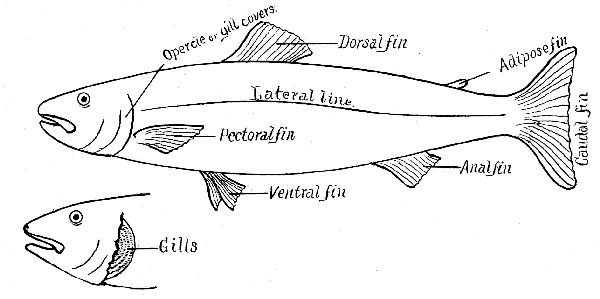
With fishes, like with birds, there are certain parts that must be referred to in order to show wherein one species differs from another. Wherever these parts have a common English name, that name has been used. But as there are a few parts that can only be referred to by their scientific names, a diagram has been added showing the location of all parts referred to in the text.
In scope it treats only of such varieties as rise to the fly or are caught by trolling with rod and reel, whether from the stream, lake, bay or ocean, and furnish sport to the angler who fishes for the exhilarating pleasure their capture affords.
The Pacific Coast is rich in game fishes, not only in the varieties found in its lakes and streams, but as well in its bays and estuaries, while the broad ocean furnishes varieties whose size and fighting qualities are not surpassed, even if equaled, in any other part of the world. To place in the hands of the young angler, and others who may not have given the subject the necessary attention, a convenient handbook by the aid of which even the novice may readily recognize the species of fish he has landed, is the object of these pages.
All of the salmon, the trout, the chars, the white-fish and the lake herring have been classed by the naturalist in one family and given the name, Salmonidæ; but it is only with three genera of the subfamily, Salmoninæ that we are concerned. These are the Pacific salmon (Oncorhynchus), the true trout (Salmo) and the Eastern trout and the dolly varden trout (Salvelinus). The Atlantic salmon belong to the genus Salmo, the same as the true trout, and have but one species (Salmo salar), which partake more of the habits of the trout than do their Pacific cousins.
THE PACIFIC SALMON
(Oncorhynchus)
Notwithstanding the fact that the salmon is one of the most valuable of all the food fishes, but little is known of its habits after it leaves the stream in which it is hatched until it returns to spawn, supposed to be from three to four years afterward. Whether they remain near the mouths of the streams, or whether they migrate to distant feeding grounds are questions that have never been solved. All of the five species are caught with seins in Puget Sound in greater or less numbers all the year round. From the action of those that spawn in the Sacramento river it would seem that they migrate southward and far out to sea, for on their return to spawn they enter Monterey Bay only on its southern side, and following around it at no great distance from the shore, leave it at the northern headlands and skirt the shore northward until they reach the entrance to San Francisco Bay on their way up the Sacramento river. Where the young fish make their habitat from the time they drift down the stream in which they were spawned until they return again to spawn has never been determined. They spawn but once and die soon afterward. As I know that this last statement will be disputed by some, for reasons best known to themselves, I will quote from that excellent work by Evermann and Jordan, "American Food and Game Fishes." "We have carefully," say these gentlemen, "examined the spawning habits of both forms of the red fish and chinook salmon in the head waters of Salmon river, Idaho, during two entire seasons, from the time the fish arrived in July until the end of September, by which time all the fish had disappeared. A number of important questions were settled by these investigations. In the first place it was found that all of the fish arrived upon the spawning grounds in perfect physical condition, so far as external appearances indicated; no sores, bruises or other mutilations showing on any of more than 4000 fish examined. During the spawning, however, the majority became more or less injured by rubbing against the gravel of the spawning-beds, or by fighting with one another. Soon after done spawning every one of them died, not only both forms of the red fish but the chinook salmon as well. The dying is not due to the injuries the fish received on the spawning-grounds; many were seen dying or dead which showed no external or other injuries whatever. The dying of the West Coast salmon is in no manner determined by distance from the sea. Observations made by us and others elsewhere show that the individuals of all species of the Oncorhynchus die after one spawning, whether the spawning-beds are remote from the sea or only a short distance from salt-water."
The angler's concern, however, is not so much with the procreative habits of the salmon as it is with their behavior while feeding and after being hooked.
Salmon are rarely caught by still fishing, but they will take the spoon or a sardine or other small fish impaled upon the hook. They take the bait generally with some hesitation, though at times they strike it with all the impetuosity of the trout. Then the singing reel calls for careful and immediate action on the part of the angler, for the ten to forty pound fish on his light tackle is going to put up a fight worthy of his skill. In his mad rush for liberty the gamy fish gradually rises to the surface, and when at last checked by the skill of the angler, he will often leap out of the water to a height of from four to eight feet, his beautiful sides scintillating in the rays of the sun, forming a picture to gladden the heart of the angler, for if he be a true sportsman he will fish with such tackle only as will give his adversary a fair chance in the fight and require the fullest exercise of his own knowledge and skill to bring his fish to gaff. The salmon is a strong fighter but his rushes do not last long for a fish of its size. For this reason much of the sport of salmon fishing is lost through the use of too heavy tackle. The writer landed one without difficulty weighing 33 1/2 pounds on a nine thread, Cuttyhunk line and a 5 1/2 foot steel rod weighing less than six ounces, and I believe that a fifty pound fish can be landed with the same tackle. Trolling with hand lines for salmon is practiced by some, but such is not angling. Hauling in an impaled fish hand over hand with a small cable is neither sport nor sportsmanlike.
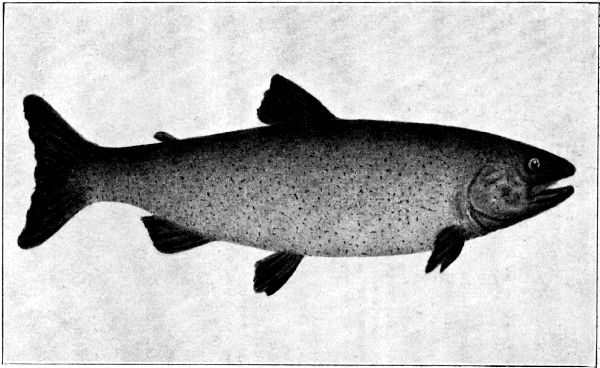
CHINOOK SALMON (Oncorhynchus tschawytscha)
THE CHINOOK, OR KING SALMON
(Oncorhynchus tschawytscha)
This species has a multiplicity of names, being known in different localities as chinook, quinnat, king, Sacramento river and Columbia river salmon, besides half a dozen or more Indian names. Its distribution is the widest of any of the Pacific salmon, ranging on both sides of the ocean from the latitude of Monterey Bay to Behring Straits. The run begins on the Columbia river as early as the latter part of February, many of the fish going up its tributaries 1000 miles or more to spawn. Farther south the run becomes gradually later. The spawning season also varies with the locality, and ranges from the latter part of July to the middle of November. The date of spawning seems to be determined by the temperature of the water, for it is said that the salmon will not spawn, even if on the spawning grounds, until the water has fallen to a temperature of 54 degrees Fahrenheit.
The chinook salmon is the largest of the family, specimens having been taken in Alaska waters that have weighed 100 pounds, while 50 to 60 pound fish are common. Those taken in the Columbia river are said to average 22 pounds, while the average of the Sacramento river catch is 16.
Head, rather pointed; eye, small and situated a little in front of the back of the mouth; body, rounded and full, the deepest part being about midway of its length; pectoral fins, short and situated low and just behind the gills; dorsal fin, nearly midway of the back; ventral fins, a little behind the center of the dorsal; anal fin about half way between the ventral and the tail; adipose fin, a little in front of the rear of the ventrals; caudal fin, or tail, slightly forked.
The back, dorsal fin and tail are generally well covered with dark brownish black spots. There are few spots as a rule on the head, and those are of a slaty color.
There is always some variation in color, but usually the back is quite dark, turning to bluish on the sides and light silver below. As the spawning season approaches, the jaws of the males become lengthened and badly distorted and the color changes to more of a pinkish hue and blotched in appearance. The gills are never alike on both sides, varying from 15 to 19 in number. (See plate giving names of all parts mentioned.)
BLUEBACK, OR SOCK-EYE SALMON, REDFISH
(Oncorhynchus nerka)
This species is next in commercial value to the chinook. It has been taken occasionally in the Sacramento river but it is not common south of the Columbia river. The run of this species begins about the first of April and the fish go as far as Salmon river, Idaho, fully 1000 miles from the sea to spawn. By a peculiar instinct this species only run up such rivers as have lakes at their heads, and spawn in the lakes or at the mouths of little streams emptying into them, in many of the lakes of Oregon and Washington are found the young of the blue-back salmon which are commonly called redfish. These fish never leave these lakes and therefore never attain a size of more than five to seven pounds.
Head, short and pointed and light olive in color; under jaw, white; body, long, slim and rather flattened; back, blue; sides, silver; belly, dull white; dorsal fin, dark; others flesh color; tail, rather narrow and well forked; gills, 13 to 15. As the spawning season approaches the whole fish takes on a decided reddish cast, which sometimes becomes as dark as a brick-red. The jaw becomes very much hooked, and a few spots appear.
THE SILVER SALMON
(Oncorhynchus kisutch)
In line of importance the silver salmon occupies the next place. It is also known by a number of names, among which are koho, skowitz and kisutch. It is a small fish, rarely exceeding 16 inches in length and never reaching more than ten pounds in weight. Its range is from Alaska south to Monterey Bay, where it has recently been planted and seems to flourish. It spawns in the smaller coast streams, never going far from the salt water. Its run begins about the first of September, spawning in October and November.
Head, short with blunt snout; opercles or gill covers, very convex; body, shaped very much like the chinook; back, bluish green; sides, silver white. It has but few spots and these are confined pretty much to the head, upper fins and tail. Gills, 13 or 14.
THE HUMP-BACK SALMON
(Oncorhynchus gorbuscha)
This is another small species, rarely exceeding six pounds in weight but more commonly from three to four. Its range is from the Sacramento river, where it appears in limited numbers, north to Alaska.
Body, slim, scales very small; back, blue and sides silvery white. Profusely spotted on the after part of the back, with large oval spots on the tail. Gills, 11 to 13.
THE DOG SALMON
(Oncorhynchus keta)
The dog salmon rarely exceeds ten pounds in weight Its range is from the Sacramento river north, and its spawning-grounds the small streams up which it never extends any great distance from the salt water.
Head, quite pike-like in shape and therefore much longer and slimmer than the chinook. Back, dirty brown, with the sides of much the same color, but of a lighter tint; fins, very dark; very few distinct spots, with those showing very small; gills, 13 or 14.
Tackle and Lure—The Pacific salmon are only caught by trolling. They will take a spoon, or any live bait. The most successful lure, however, is a sardine, or other small fish of six to eight inches in length. Pass the hook through both eyes, take a half hitch around the head, insert the point of the hook in the gill and by bending the fish in the shape of the hook bring the point out about an inch and a half or two inches from the tail. This allows the fish to remain curved, and gives it a revolving motion while trolling, resembling a live, though disabled fish.
A salmon rod should consist of a butt 14 to 16 inches in length, with a hand piece in front of the reel; tip, 6 feet long and not to weigh more than 7 ounces; line not to exceed standard 12-thread. With fishes weighing from 40 pounds and upward, 300 feet of line can be used to advantage.
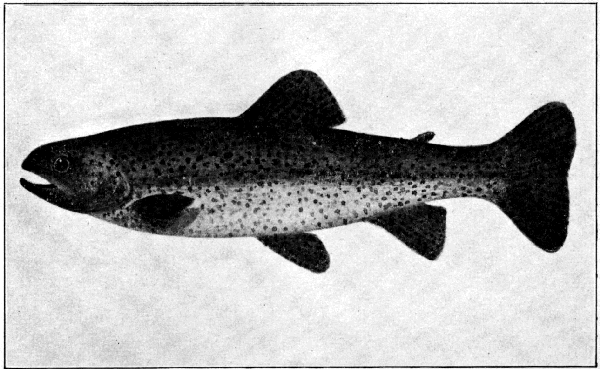
RAINBOW TROUT (Salmo irideus
THE RAINBOW TROUT
(Salmo irideus)
There are at least four distinct species of trout; that is, trout proper and chars, now common to the coast. One of these, the Eastern brook trout, is the result of artificial hatching and distribution. These, as well as the rainbow, and to lesser extent the cutthroat, have been so widely distributed by the state fish commission and private hatcheries that to attempt to give the present habitat of the several species would be sure to result in many errors which might be confounding. The Eastern brook trout has taken kindly to our waters and seem to be doing well in all suitable streams. Several other foreign species of trout have been introduced into our waters as well as these, among which are the Loch Leven, the German brown trout and the Mackinaw, but the success of their acclimatization has yet to be fully determined, though the Loch Leven and German brown seem to be doing well in the higher streams.
The Eastern brook trout and the native species, known as dolly varden, are chars and belong to the genus Salvelinus, but the rainbow and the cutthroat are true trout belonging to the genus Salmo. The rainbow and the cutthroat present a variety of forms in different localities and these have been given separate specific names by the naturalist. With many of these species(?) the only difference seems to be too slight to entitle them to specific or even sub-specific separation; the variation being no more than that found in the color and markings of the same fishes in the same stream, caused by the depth of the water, the food, or other local conditions.
The rainbow trout is now a resident, either through natural or artificial distribution, of nearly all the streams of the Coast from Washington to Lower California. They vary in size, color and number of scales in different localities and have been given distinct specific names in the various sections, those of the Coast streams of California being used as the typical form. These several varieties, even in their natural condition, showed very little, if any positive line of demarkation, but since the establishment of the many hatcheries on the Coast and the wide distribution of the fry hatched from the spawn of the rainbow of the Sacramento and its tributaries, of the steelhead of the Eel river, and of the typical form of the Coast streams, there seems but one course now left, and that is to group them all as one species under the original name of rainbow.
The rainbow is a very handsome trout, varying in size from adults of but a few inches in the smaller Coast streams, to 25 and 30 inches long in the larger rivers and lakes. Its dark spotted back and silvery sides with the rich metallic colors of the rainbow streak gives it a coloration that is at once brilliant and pleasing. As a game fish it has no superior, if indeed an equal. It takes the fly with a rush, often leaping out of the water to seize it as it is descending. Then it fights with a determination, often breaking three or four feet into the air, shaking its head to free the hook like a terrier shakes a rat. It seldom sounds and never sulks. The rainbow trout goes to the sea at varying ages, the same as all other trout that can get there without passing through long stretches of warm and sluggish water. In the salt water it attains a greater size, changes its color in accordance with the length of time it has been there, but on returning again to the stream it soon assumes its original plan of coloring.
Head, about one-fourth of the whole length from the snout to the base of the caudal fin, varying much with age and size. Generally the greatest depth is about one fourth of the length of the fish, but this also varies very much with the character of the waters it inhabits. In rapid running streams the fish are always slimmer than in more sluggish ones. I have known them 20 inches or more in length, when confined in large reservoirs, to become so heavy that they would weigh one pound to every two inches in length. The lateral line, or rainbow varies, in intensity of color, but always showing in varying shades of red, pink, and sometimes blue of a metallic luster. The vertical black blotches seen on the sides are the marks of immature fish.
The snout of the rainbow is considerably more rounding than that of the salmon, and the head larger in proportion. The eye also is much larger and fuller. The shape and position of the fins are almost identical with those of the salmon, but a little larger in proportion to the size of the fish. The tail, however, varies considerably, being more rounded, and showing only a slight indentation in the center.
THE GOLDEN TROUT
(Salmo irideus agua bonita)
If there is any variety of the rainbow trout found on the Coast that is entitled to a sub-specific name it is the golden trout of Mt. Whitney. They were originally found in only a short portion of two little streams fed by the snows of Mt. Whitney, and vary but little from each other. In one stream they have been given the name of Salmo irideus agua bonita, and in the other that of Salmo irideus rooseveltii, after ex-president Roosevelt. They are of a beautiful color with scarlet markings at the base of the fins and with a lateral stripe of bright scarlet blending into a rich orange. One peculiarity of these fish is that the par marks or vertical blotches on the sides of other young fish still show on the adults of these. This form of the rainbow has changed its color through the process of natural selection, caused no doubt, by the color of the rocks in the shallow streams it inhabits. Below on these same streams where the rocks are of a darker color the fish assume the natural color of the rainbow.
The writer is possibly the first white man to ever catch one of the golden trout. They were taken in 1865 with a small piece of the flank of a deer skin slipped over the hook, with the hair clipped to about half an inch in length. No sooner was this improvised fly cast upon the water than it was eagerly seized by one of these beautiful fish. When it was landed the color astonished me, and knowing that it was a trout, I thought it must be a diseased one and threw it back. Making another cast I secured another one as promptly as the first, and it being the same objectionable color and of the same size—about eight inches—I concluded that it was the same fish and this time threw it on the bank. As fast as my deer skin fly would strike the water it would be eagerly seized by one of these game little fellows and all of the same size and color. I was puzzled and called to my companion, who was cooking our supper but a few yards away, to "come and see what was the matter with these fish." Professing some scientific knowledge, he cut one of them open, examined the meat and the intestines and finally pronounced it in a healthy condition, finishing with:
"The coffee is boiling and the bacon is fried; hurry up, and as soon as you get a mess I'll fry them and take all chances."
I soon had a mess for supper and while he was frying them I caught enough for breakfast, for the game little fellows would race for the fly as fast as it struck the water. We ate them with a relish, for we had had nothing but bacon, venison and frying-pan bread for a month. As we found ourselves alive in the morning we increased the prescription to a good alapathic dose for breakfast.
The golden trout are small, rarely reaching a length of more than fifteen inches. The back is olive, sides and belly light orange or golden yellow with a scarlet stripe along the center of the belly and at the base of the pectoral, ventral and anal fins, which are of themselves more or less of a golden color. Tail, olive, grading into orange on the lower part. Few spots in front of the dorsal fin but abundant behind it.
While the rainbow trout of the Coast have been given several sub-specific names, such as masoni for the Coast streams of Oregon and Washington, shasta and stonei for those of the upper Sacramento basin, and gilberti for those of Kern river, there seems to be so very little reason for this distinction beyond the usual variations of color in all trout, spots and size with the changing conditions of water and feed, that I shall make no mention of the very slight variations upon which the ichthyologist has based the claim to a sub-specific nomenclature.
THE STEELHEAD TROUT
(Salmo rivularis)
The history of the so-called steelhead trout and the efforts to class these sea-run fishes as a species separate from the rainbow and the cutthroat, is interesting, if not amusing. No one questioned that they were other than the sea-run of the rainbow or the cutthroat, according to the locality, until Dr. Richardson, mistaking a young blue-back salmon for a so-called steelhead gave it the scientific name of Salmo gairdneri, and the description of this young salmon was recognized as that of the steelhead for years, and under this name it appears in the statutes of California, with a separate season for its protection. In other words the Salmo gairdneri of the laws of California is a young blue-back salmon and not a sea-run trout of any kind. Recently Dr. Ayers to correct the mistake, examined a fish taken from the Sacramento river and said to be a steelhead, gave it the name of Salmo rivularis, and this now stands as the scientific name of the so-called steelhead. Dr. Jordan, in an article recently published in the Pacific Monthly, says: "There has been much discussion as to whether the steelhead is a species really distinct from the rainbow trout, and on this subject the writer (Jordan) has at different times held different opinions."
If one authority bases his reasons for a belief in a specific difference between the rainbow and the steelhead on the fact that he did find a difference between a blue-back salmon and a rainbow, and another authority finds so little difference that he holds different opinions at different times, can there be any wonder that the practical angler, who catches these sea-run fish at the mouths of our rivers in every stage of transition, or gradation, if you please, from the typical rainbow to the Simon pure steelhead, refuses to believe that there is a specific difference?
Then again, Messrs. Jordan and Evermann in bulletin 47 of the United States National Museum, "The Fishes of North and Middle America," say: "In the lower course of the Columbia they (the steelhead) are entirely distinct from the cutthroat or clarki series, and no one would question the validity of the two species. In the lower Snake river and other waters east of the Cascade range, the two forms or species are indistinguishable, being either undifferentiated or else inextricably mixed."
From this it would seem clear that the steelhead of the Columbia, where the cutthroat abounds, are cutthroats that have gone to the sea, grown larger in the larger body of water—a natural condition of all fishes—and changed in color and appearance. That while they are yet in the lower Columbia and only recently from the salt water, they still maintain a sufficient difference to be easily distinguished from the cutthroat; but by the time that they have reached the "Snake river and other waters east of the Cascade range," their long residence in the fresh water has again restored them to their former appearance. The same changes are found with the rainbow and the steelhead of farther south. All trout are anadromous to greater or less extent, unless actually landlocked or living in streams so distant from the sea that they would be compelled to pass through long stretches of warm and sluggish water to reach it. The small trout of the coast streams are compelled to go to the ocean quite early in the season by the falling of the water to such an extent that in many cases the streams go dry before the beginning of the winter rains, and in the larger body of water they rapidly increase in size. The steelhead of the Columbia river always retains the cutthroat sing-manual, to greater or less extent, while the steelhead of the lower coast has no red on the jaw. The claim that the smaller head of the steelhead is a distinguishing mark, fails in effect, for it is an undisputable fact that the older and larger the trout the smaller becomes the relative size of the head. The other claim that the larger scales of the rainbow is a distinguishing feature from the steelhead is not founded on facts. For while the scales of the rainbow counted along the lateral line vary from as low as 120 in the coast streams, they run as high as 150 in the same streams, as high as 160 in the McCloud and 185 in the Kern. The average being 135 in the smaller coast streams, 150 in the Sacramento basin, and 170 in the Kern. The steelhead's scales run from 130 to 155. An average of 145; or exactly an average of those of the coast streams and the Sacramento. Were it possible for the Kern river trout to enter the ocean no doubt we would find steelhead running as high as 185 to the section.
Whatever may be the origin of the large sea-running trout called steelheads, the fact remains that it is a grand fish both in size and fighting qualities. In the ocean it eagerly takes the spoon and fights with a vigor not even surpassed by the rainbow of the streams. After a short sojourn in the fresh waters it rises to a fly just as readily.
Since the above was written Dr. Jordan has made the statement publicly, that he is thoroughly convinced that the rainbow trout and the so-called steelhead are one and the same fish; the only difference being that the latter has grown larger and changed its color during its life in the salt water, this variation of color returning again after a short sojourn in the fresh water streams, giving it all the original appearance of the rainbow, or of the cutthroat, as the case may be.
THE CUTTHROAT TROUT
(Salmo clarki)
The cutthroat trout very largely take the place of the rainbow in the waters of northern California and in Washington and Oregon, and its various forms are more common to the lakes. Like the rainbow they have been artificially distributed to such an extent that they are now found in many of the streams of California and nearly all of Washington and Oregon. As a general rule they are not as keen fighters as the rainbow, but in the cold streams of Oregon and Washington they put up a fight worthy of the most gamy fish. In the lakes of Washington and Oregon, and such as Tahoe, Donner and other large bodies of water in California, they reach a large size; fishes of ten and twelve pounds being not uncommon. When not landlocked they go to the sea the same as the rainbow and return as the steelhead of the Columbia and other northern streams. Like the rainbow the cutthroat has been divided into several subspecies.
General appearance like that of the rainbow. The color on the back is a lighter olive or dark steel color. The upper parts are generally thickly covered with dark spots, varying in color and shape, and the lower fins are also spotted with smaller spots. The inner edge of the lower jaw is strongly marked with deep red and it is from this red mark on the throat that the species takes its name. The sides are generally of a marked pinkish hue or coppery brown. The red mark of the throat will always prove a distinguishing feature.