MISCELLANEOUS RECOLLECTIONS A SUPPLEMENTARY CHAPTER BEGUN IN 1826
Reading edition
In one supplementary chapter to my Memoirs I have endeavoured to preserve the recollection of such foreign anecdotes and personages as accident, credible report, or personal observation have brought within my knowledge. In this, I propose to set down whatever I have learnt worth commemorating concerning those persons who, whether Englishmen or foreigners, have during my time, without immediate connection with politics, acquired or deserved celebrity for genius or talent, learning or wit, in science, in art, in poetry, in literature, or in conversation. With some such I have been intimate, with many others familiarly acquainted. All have, no doubt, had directly or indirectly more or less influence on the taste, temper, and opinions of society. The indistinct manner in which it was exerted would not, indeed, justify the introduction of their names in my narrative of party contentions and political events; but some traits of their characters and lives may not be misplaced on the distant ground of the picture I have attempted to trace. I do not, however, pretend to much accuracy of research, nor do I aspire to the office of biographer of my contemporaries; still less am I qualified to become the historian of literature, arts, or sciences. Mine are notes and reminiscences of an idle, and in some senses ignorant, spectator. They are rambling, desultory, and imperfect, and often more calculated to raise than to satisfy curiosity. But they are true; they relate also to subjects which, having afforded amusement and instruction to the writer in the course of his life, may possibly prove neither unpleasing nor uninstructive to some reader of similar habits and taste after its close.
Though from my family connections I was during my childhood and early education in the habit of seeing many of the leading characters in fashionable and political life, yet I remember meeting but few men of literary celebrity. The truth is, that at that period they were less blended in society with men of business and pleasure than they have been of late years. There was perhaps as much reading, but there was less conversation about books. If equal homage was paid to authors of genius, the intercourse between that class of men and fashionable company was infinitely less than has since been established, to the credit, and I should hope to the advantage, of both. Of course there were exceptions. Some few, like Horace Walpole, Gibbon, Soame Jenyns, Sheridan, and Tickell, had at different epochs of their lives partaken of the character of both. Some others, who from birth and early habits might be deemed to belong to one class, from taste or choice studiously devoted themselves to the other. I had from the earliest youth great curiosity about men remarkable for their literary attainments. My vanity and taste were always gratified by any intercourse with them,
Quotque aderant vates rebar adesse Deos.
Hence I was flattered by occasionally visiting Horace Walpole in London and at Strawberry Hill, at one or two letters I received from him, and at the notice he took of me when I met him in houses which he habitually frequented. His conversation, like his written compositions, displayed a sprightly mind and a memory stored with anecdotes, historical and literary, the result of much antiquarian research and the fruit of a long life spent in the company of statesmen, authors, artists, and wits. In his person he was slender and prim, in his manners extremely artificial, in his temper somewhat susceptible about trifles. His conversation, though much enlivened by fancy and epigram, had great marks of preparation and study, and even effort. These circumstances made Lord Ossory observe in some MS. notes that, “Walpole fell far short of his friend, George Selwyn,” who, let me add, was a friend somewhat unmerciful on the taste and appearance of Horace Walpole, describing Strawberry Hill to me as a catacomb, or at best a museum, rather than a habitation, and the master of it [as] one of the most carefully finished miniatures and best preserved mummies in the whole collection.
But whatever were his peculiarities, Walpole’s published and unpublished works are mines which abound in brilliant, and do not fail in solid, materials for history and biography. No one employed as I have been in editing and, as I now am, in imitating his labours,[315] can seriously wish to disparage one whom he shows himself willing and perhaps unequal to copy and to emulate. The scandalous chronicle reported him to be son of a Lord Hervey.[316] In affected humour, laborious application to trifles, occasional and unprovoked malignity, and whimsical ingenuity of understanding, he certainly bore some resemblance to that family. He felt, or pretended to feel, great disgust at the practice adopted by the bookmaking admirers of Johnson, who scrupled not to commit to print whatever they heard in private conversation. Hence he would suddenly purse up his mouth in a pointed but ludicrous manner whenever Boswell came into the room, and sit as mute as a fish till that angler for anecdote and repartee had left it. It is more than probable that he dreaded and disliked Dr. Johnson himself. Whig principles, Republican affectations, and loose notions of religion, were all likely to invite an attack; and I much suspect that Walpole practised some artifice or resorted to some meanness to elude the notice or disarm the hostility of that formidable enemy of fashionable philosophy. In conversation and private correspondence, as well as in his posthumous works, he was by no means sparing of sneers and sarcasms on the priesthood and the Church. I well remember that, on the publication of The Microcosm,[317] Lady Ossory enclosed to me a letter she had received from Horace Walpole, in which he humorously but earnestly exploded a prevalent notion that the juvenile authors were assisted by the masters. Walpole urged the incapacity, ignorance, and sycophancy of the tutors and parsons in terms highly offensive to clerical ears. I, in truth, did not understand the force of many of his allusions; but, vain of possessing the handwriting of an eminent wit, ran to communicate the panegyric of my schoolfellows to my tutor, Dr. Langford. He, though “Etonian to the backbone,” was far from relishing such a compliment to the scholars, but, nettled at the irreverence or truth of the remarks, made me feel that I had not risen in his favour by becoming the depositary of so heterodox a document.
Walpole’s conjectures were not, however, unfounded, nor his sarcasms unmerited. The fellows, masters, and tutors were in my time, a period of nearly ten years, singularly deficient in common sense and experience, and by no means distinguished even in that narrow path of learning which they are expected most earnestly to pursue. Dr. Goodall[318] was perhaps an exception to the last clause of this censure. He was a showy scholar and quick man, but with as little usage of the world or solidity of judgment as his colleagues. I was diverted, when I met him at our Ambassador’s many years afterwards, at the good-humoured simplicity with which he acknowledged what had delighted him most in Parisian society. It was, forsooth, the precedence given to the Nuncio, the red stockings, imposing dress, and dignified carriage of an ecclesiastic, who from perhaps a pedagogue like himself had risen to be a diplomat and a Cardinal, and walked before nobles, generals, and Princes. Dr. Roberts,[319] the Provost, who for a short time had been tutor to Mr. Fox, was something more of a literary character. He had published a volume of verses, and was supposed to have assisted Dr. Glynn[320] (an abler man than himself) in his Seatonian Prize on the Day of Judgment, which is a poetical composition of unquestionable merit and full of happy imitations both of Milton and of Virgil. I suspect, however, that Dr. Roberts is now better remembered in “Colleges and Halls” for a speech to the King, highly characteristic of his profession, than for the truth or taste of his poetry. In thanking His Majesty for his Provostship, he added, “And I am the more sensible of the favour conferred, Sir, as it is tenable with any other preferment.”
Among the fellows was a Dr. Barford,[321] who passed for a great scholar. I could never discover on what his reputation was founded, except a Greek translation of Gray’s Elegy. The boys affirmed that he could read a newspaper off-hand into classical Greek, a common hyperbole to express a scholar’s familiarity with that language. George Selwyn used the same to me of his Master, Dr. George: he added that he knew the Greek for every English word except Mutton cabobbed, that he had taught his wife also many words, but that he reproved her for using them ungrammatically, as, when in playing whist she said, “I lead ὁ βασιλέυς,” he would turn up his eyes and earnestly exclaim, “τὸν βασιλέα, τὸν βασιλέα, my dear.”[322] I know not why I repeat so silly a story, especially as I cannot vouch for its truth. I might, however, have asked the lady herself, for I remember seeing her at Mrs. Hewitt’s (who was, I think, her granddaughter) at the age of one hundred and one—the oldest person I ever met in company. Of this same Dr. George, it is related, that on hearing the King of Prussia, then a young military hero, extolled for his abilities, he observed, “I should like to have him up in my school to a verb in μί.”
Similar notions of excellence might be brought home to the pedants and masters of my own time. My schoolfellows, however, aspired even during their education to a better kind of literary fame, and not without success. The Microcosm was published while I was at Eton. I was myself too young, idle, and ignorant to contribute to the work. The four chief conductors were John or Joseph Smith, usually called by a nickname Easley; Robert Percy Smith, yet more generally designated by his nickname Bobus—both collegers, but unconnected by blood—and George Canning and John Hookham Frere—Oppidans. Among the occasional contributors were Lord Henry Spencer,[323] who, notwithstanding his constitutional shyness and reserve, would have distinguished himself by his wit and ingenuity, but died at the early age of twenty-four when employed on a mission to Berlin; and Mr. Mellish, who passed an adventurous life chiefly abroad, and translated many German works for the booksellers in London.
The elder Smith, surnamed Easley, was nephew of Sir Nathaniel Grove, the Puisne Judge, and, through the interest of his uncle or of Mr. Canning, obtained some places in the Courts of Justice and the Colonies, in which he silently enjoyed the profits, without offence, but without rising or aspiring to any eminence in his profession or in literature.[324] His numbers, in which there was rather an ostentatious display of learning and a dash of unintelligible metaphysics, were great favourites with the schoolboys. They passed with us for prodigies of learning and profound speculation. Boys generally form a very correct prognostic of the temper, disposition, and courage, and a very erroneous one of the prudence, sense, and abilities of their schoolfellows.
Of Robert Percy Smith,[325] elder brother of Sydney; married to my aunt, Miss Vernon; first, Advocate-General of Calcutta, and afterwards, representative for Lincoln in two successive Parliaments, I shall probably speak more than once in the course of these pages: but, having mentioned him as an Eton boy, I cannot withhold my testimony to his early proficiency and extraordinary promise. He was clearly the soundest scholar of his day; he had not only by his own unaided exertions mastered the Italian language and literature, but had already read and reflected on as many and as profound works, both ancient and modern, on ethics, politics, and divinity, as would have enabled an ordinary student in either of our Universities to set up for an accomplished metaphysician. Yet nature had done more for him than study. He was a descendant of a sister of Sir Isaac Newton, and his powers of application and reasoning, though never directed to science, seemed to claim and justify the relationship. He had, too, a wonderful command of language. If he seldom displayed his pleasantry and imagination, enough escaped him to satisfy even a superficial observer that he had in store, though he perhaps disdained to use it, as much of both of those commodities as glittered in the conversation of his brother and attracted the applause of fashionable society in London. Perhaps the strict discipline to which Robert Smith had inured his mind even at Eton perverted rather than directed, encumbered rather than enriched it. Notions not very friendly to our species and crudely adopted from books when a boy, though quite foreign from his natural character, which was sanguine and gay as well as ambitious, checked him in the career of his profession, aggravated many little unavoidable but not insuperable disappointments, dimmed the brilliancy of his spirits, and though they could not extinguish the native warmth of his heart, confined its influence to too small a circle, and gave up, not to party, but to the parlour and the fireside, what was meant and admirably formed for mankind.
The early inclinations of George Canning destined him to another career than that of letters. His success in it renders it superfluous to say much of him as a writer or companion, though in both those capacities he rose far beyond mediocrity. In all, his quick sense of ridicule, his readiness and exuberance, both in fancy and in expression, were conspicuous. Perhaps his characteristic excellence when a boy, viz., prodigious facility of composition, is more necessary in this country to the success of an orator or a Minister than depth and originality of thought. He was, indeed, when compared with some of his fellow labourers in The Microcosm, more showy than solid, but it does not follow from thence that he was for that early age in any degree superficial. His papers in that work were the most lively, and his verses more easy and sonorous than those of his associates. His Latin exercises and English effusions excelled in splendour of diction and brilliancy of wit, rather than in the expression of passion or truth of poetical feeling.
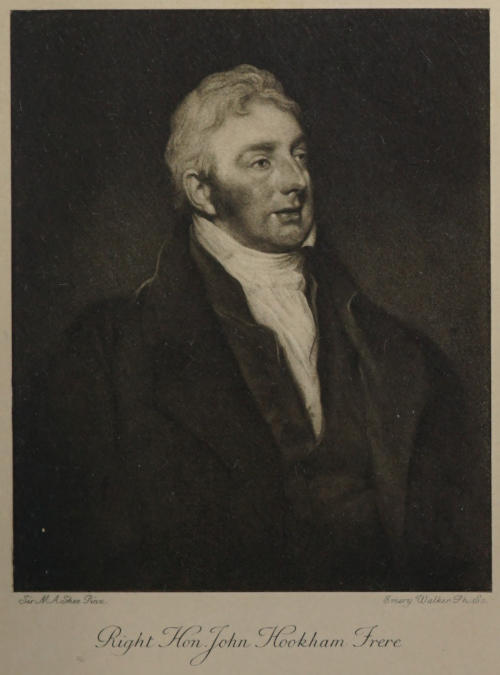
Right Hon. John Hookham Frere
Sir M. A. Shee Pinx. Emery Walker Ph. Sc.
Considering the station[326] he now occupies and the events that are passing, it is curious to reflect that his first copy of English verses (written, as he assured me, before he came to Eton, and consequently ere he was twelve years of age) was on the Slavery of Greece, and contains a fervent exhortation and prayer for the liberation of its inhabitants. It is to be found in the 5th number of The Microcosm.
The least successful in that juvenile work was John Hookham Frere; yet he had a genius better adapted to letters than any of his coadjutors. Although indistinct or, at least, inconsistent in his reasoning, he excelled them all in originality of thought, humour, and expression. His merits (to use a happy phrase of his own) were of a manufacture less suited to foreign export than to home consumption. It was therefore mistaken friendship in Mr. Canning to engage him in diplomacy. His artless temper, his ill-directed suspicions, his absence, occasional rudeness, and habitual indolence and singularity, all obviously disqualified him for that line. Had he been employed in England, his devotion to his friends, the ardour of his mind, and the stores of his memory, but, above all, the originality of his humour, would doubtless have made him a first-rate political writer. Had he yet more fortunately confined himself to literature, his genius might have raised him to the character of an original critic and moralist, and perhaps have placed him on the same form with those poets who have furnished the best models of excellence in our language. As it was, the very habits which disqualified him for serious business added a zest to his conversation and gave a relish to all private intercourse with him in society. You laughed with him when he was facetious, you smiled at him when he was odd. He had warm and generous affections, but it was shrewdly observed of him that his attachments, like those of a cat, were stronger to places than to persons.
He was the only man ever so enamoured of quarantine, as to linger beyond his time in a Lazaretto, and quit it with reluctance and almost by compulsion. I have known him detained in a house for more than a fortnight, by a secret plot with his servant to neglect his orders and not to drive round the carriage, pack up his things, or announce the hour of his departure. He has been in his carriage on the eve of a long journey, and suddenly induced to get out of it in search of a book left behind in the room, where, finding and beginning to read it, he has thrown himself into a chair, and insensibly allowed the day to pass, and almost as imperceptibly postponed his intended departure for a week. The peculiar character of his humour is not easily described. His repartees or sayings, when deliberately recounted, do not preserve it. There was a playful archness in his sarcasms, keen but not offensive. There was a felicity in his phraseology (though he was not fluent) which, without exceeding the tone of familiar conversation, displayed a reach of fancy and strength of feeling delightful and unusual. He was a superstitious admirer of past times. He loved to sneer at the self-complacency with which our generation contemplates its real or supposed improvements in philosophy and the arts of life. When the unproductive state of the Peninsula was objected to his exaggerated praises of Spain and Portugal, he replied that “he loved a country where God Almighty kept large portions of land in his own hands.”
He had read little or nothing systematically, but he devoured every book that fell within his reach, and remembered all he met with in such desultory studies with an accuracy almost miraculous. Such facility of emotion, combined with a strong propensity to exercise his faculties on every subject presented to his mind, made him a very indulgent critic. He not only saw much more in a book than the author ever intended to convey, but he frequently built systems on foundations created by his own imagination and in no degree warranted by the work in which he fancied that he had discovered them.
What Montesquieu said of Voltaire is true of him, “Tous les livres qu’il lit, il les fait; après quoi il approuve ou critique ce qu’il a fait.” Hence he delighted in authors who deal in obscure allusions, whimsical images, and fanciful theories. Rabelais and Aristophanes were among his favourites. He was not only capable of tasting the satire, poetry, and wit of the latter, but he lent most of those qualities to every indifferent passage of his plays, discerning in every word more than struck the ear, and ascribing to the whole composition a systematic and patriotic design which was certainly never professed, and probably never harboured, by the writer. According to Frere, it was not gaiety, vanity, or malignity, which induced the great Athenian comic poet to libel the best man of his country and expose the first tragedian of his time to the ridicule of the rabble; it was, forsooth, a due sense of the pernicious effects of a mistaken theory of morals, and a deliberate apprehension of the consequences of an enervated and effeminate taste in composition. His scurrility and buffoonery were patriotic endeavours to rescue his countrymen from the persuasive philosophy of Socrates and the seductive poetry of Euripides.
In the interval between school and college I made a tour in Scotland, but I missed, on that and some subsequent occasions, the advantage of making acquaintance with the Principal, Robertson, the historian,[327] to whom I had letters of introduction. In truth, I heard very little conversation on literature in that northern land of letters, except strictures on the spirit and criticisms on the details of Dr. Johnson’s Tour to the Hebrides. That work and the poems of Ossian were then comparatively recent publications. They had not ceased to excite, in a different manner though nearly to an equal degree, the passions of the literati in Scotland, where society, though divided on other topics, is and ever will be singularly tenacious on such as in any way affect their national character or reputation. Boswell was accused of having sacrificed his country to his authorship, of having led the English philosopher into the least attractive regions and least polished society he could find, with the view of provoking epigrams and extorting sarcasms wherewith to season his narrative and give a zest to tales otherwise insipid and uninteresting. It was Henry Erskine,[328] afterwards Lord Advocate, who termed Boswell “the Bear Leader,” and pretended that on being introduced to Dr. Johnson in the streets of Edinburgh, he had simply bowed to the stranger, but turned round to his countryman and slipped half-a-crown into his hand with thanks for the show.
In no town in which I ever resided did I see less of men distinguished for learning and literature than in Oxford during the two years I spent in that University. Tom Warton[329] was dead before I was entered, and his place in Trinity College was ill supplied by a gentleman of the name of Kett,[330] as an epigram very current in those days attests, viz.,
The glorious sun of Trinity is set, And naught shines now but farthing candle Kett.
Mr. Crowe,[331] the public orator, a fellow of New College, had more merit. As a Latin scholar he was without a rival, as a poet he was not despicable. Mr. Rogers has so unfeigned an admiration for his works that he seldom travels without a copy of them, as well as of Gray, in his chaise pocket. His verses on the installation of the Duke of Portland[332] contain an invective against war worthy of Milton himself. But his Whig, not to say Republican, propensities, which peep forth in that very poem, were so offensive in Oxford that blemishes in his moral character were remembered, and perhaps invented, to justify the neglect he experienced from successive Governments and the little store set by the University on his productions and lectures. His manners, it must be acknowledged, as well as his habits, were somewhat coarse and unsocial.
Dr. Sibthorp,[333] who, I believe, succeeded his father in the Botanical Chair, and who travelled and died in Greece, had acquired some celebrity in his humble walk of science. An awkward circumstance was said to have occurred on his application for the professorship. To qualify, the candidate must be furnished with testimonials not only of having studied, but of having actually practised, physic. Dr. Sibthorp had, indeed, attended the sick, but then there were none alive to attest it; so that in adducing proof of his having exercised his profession, he was compelled to raise a strong presumption of his unfitness for it, and to divulge the mortifying fact that not one of his few patients had survived his prescriptions.
Dr. Cyril Jackson,[334] Dean of Christ Church, enjoyed and deserved great reputation as the head of a college. He had some general knowledge, was a good scholar, and by some little artifices of manner, as well as by many real acts of benevolence, contrived to excite in the young men much respect for the institutions of the University and great notions of his dignity, abilities, and virtues. He was, in truth, a very honourable, disinterested, and warm-hearted man. He taught, however, and, I believe, felt, so indiscriminate a veneration for all received opinions because they were received, that he became, without meanness, a worshipper of rank, and, although not destitute of sagacity and utterly exempt from the mean passions of envy or jealousy, a favourer of mediocrity. The effect, though not intention, of his system, could it have prevailed, would have been to leave all prejudices unmolested, and thereby to slacken exertion and discourage improvement, to inculcate caution on his pupils till he had damped their genius, and to reduce all political and literary merit to deference for authority and prudent admiration of acknowledged excellence. He had been employed under Markham, Archbishop of York, in the education of the Prince of Wales and Frederick, Duke of York. That circumstance gave him access to both those Princes throughout his life: and he affected more than he actually enjoyed, recounting to his listeners at Oxford, at one time, the blunt reproofs, at others, the friendly advice he had given to his Royal pupils. From compliance with George III.’s partiality, or from a genuine preference of manly character over quickness of parts, he always professed more attachment to the Duke of York than the Prince of Wales. The latter, aware of his predilections and nettled at them, took an odd method of revenging himself by retaliation. In all companies he launched forth in commendation of William Jackson, younger brother of the Dean.[335] He would extol his merits as a companion, friend, and scholar, though he well knew him to be a dull, selfish, and ordinary man; and he studiously represented him as superior to his brother, though he owed to the celebrity and friendship of that brother what little credit or reputation he enjoyed at college, as well as all the preferment, including the Bishopric of Oxford, that he obtained in the Church.
Dr. Beddoes[336] had not closed his lectures when I first went to college, but I never attended them; nor did I become acquainted with the lecturer till he had retired from the University in consequence of some disgust arising either from his opinions in politics and religion, or from the peculiarities of his temper, which was neither conciliatory nor tractable.[337] He was a man of science and of genius, but by no means successful as a lecturer. His figure and delivery were ungraceful, his language inflated and ambitious, and he was so singularly awkward in the mechanical part of his experiments that they generally failed, and he was then compelled to proceed in his discourse on the hypothesis that the result had been the reverse of that which the eyes of his audience would have led them to believe. He contributed, however, to the advancement both of chemistry and medicine, and had the merit of discovering the talents and directing the labours and studies of an indigent youth who afterwards became Sir Humphry Davy. All his writings, whether on politics or science, are eloquent and original, but they betray great want of taste, judgment, and prudence. He was rash and paradoxical in the extreme. He above once announced discoveries which he was obliged to retract; and Dr. Ingenhousz[338] (who somewhat enjoyed his discomfiture) blamed him more for his ignominious candour in abandoning, than his hasty presumption in publishing, such crude and erroneous conjectures. As an instance of his bad taste in language and conversation, I remember that when asked by Lord Lansdown[339] how an election at Bristol was likely to go, he began his reply with these words, “My Lord, when the floodgates of the human mind are once opened....” I believe Lord Lansdown and his audience were not much disposed to await the torrent of eloquence and metaphysical reasoning which was to ensue. In proof of the wildness of his theories, suffice it to mention that he seriously maintained the non-existence of bodily pain. It was the mere effect of education: and a child properly trained for that purpose would find it a pleasurable sensation, and what we consider as pleasurable sensations might, by an opposite system of discipline from that usually practised, be rendered odious and disagreeable and abhorrent to our desires. He afterwards undertook the tuition of young men; and the acquirements of his pupils (of whom Mr. Lambton was one), as well as their attachment to the memory of their preceptor, do much credit to his head and heart.
The same commendation may be bestowed on the person next presented to my recollection, Dr. Parr.[340] Though a Cambridge man, he frequently visited Oxford, where he lodged at the house of his friend Dr. Routh,[341] Principal of Magdalen, a quiet, learned, and benevolent man, a Tory in his principles and a recluse in his habits. Dr. Parr’s reputation for scholarship and his zeal for Whig politics, together with the singularity of his countenance, dress, habits, and manners, rendered him an object of much curiosity and some little dread, both to the tutors and undergraduates. His visits formed a sort of era in Oxford. His sayings were repeated, his appearance, his monstrous wig, his velvet coat, his lisping speech and penetrating eye, his love of smoking, and affected laugh with his shoulders, were the topics of conversation in all the Common rooms and wine parties in the University.
This was precisely what he sought for. It was the sort of celebrity that delighted him. He panted, indeed, for opportunities of conflict with the High Churchmen of the place, with the hope of astonishing the undergraduates by the boldness of his paradoxes, the variety of his quotations, and the wit of his retorts. But the heads of Houses and professors were by no means disposed to indulge him in such intellectual gymnastics. They are seldom inclined to court notoriety, and they seemed somewhat afraid of Dr. Parr. At Christ Church, our superiors refrained from courting him with any ostentation of civility, but they were wonderfully cautious not to offend by any remarks on his maxims in scholarship, politics, and divinity, though printed in sermons and pamphlets and circulated very freely in conversation by his admirers in the University. A distant sneer or an arch inquiry was the utmost symptom of hostility ever hazarded against this active champion of every cause they disapproved.[342]
Among the professors at Oxford there was indeed one who had good cause for fear, and yet more for resentment, against Dr. Parr, had he had the ability to gratify it. This was Dr. White,[343] the Arabic Professor. He had signalised himself a few years before by the publication of his Bampton lectures, which were hailed by the orthodox as a triumph for Christianity over Islamism achieved by a member of the Church of England, and by the Oxonians as a proof of the success with which the Oriental languages were studied in their University.
But short-lived was their exaltation. It was soon discovered that a Nonconformist minister, of the name of Badcock, had, for a stipulated sum (which, I think, the professor in an evil hour disputed with his executors), furnished much of the reasoning and of the Arabic of that vaunted publication. Upon that detection, Dr. Parr, with more eagerness and less generosity than was usual in him, exclaimed, “I, too, could pluck a feather from the crest of that Oxford Phœnix”; and he accordingly made good his claim to several Greek quotations and other admired passages in the lectures. Thus were the hopes of orthodoxy and Oxford suddenly blighted, or rather, the harvest they expected to reap cruelly wrested from them and divided between Nonconformity and Cambridge. Poor Dr. White, stripped of his borrowed plumes, was hooted at and reviled by all the satirists and witlings of the day.
Cui color albus erat, nunc est contrarius albo.
The obvious punning quotation of George Selwyn was repeated by every schoolboy, and the professor, though he had raised himself from a low condition in life by learning only, and was, in truth, a good Arabic scholar, a studious, simple,[344] and inoffensive man, could never re-establish his credit or advance his fortune. He edited, in vain, some Oriental works; he acquired no fame and obtained little preferment.[345]
To return to Dr. Parr, I was introduced to him by Mr. Canning, who had made his acquaintance at Mr. Sheridan’s or at Crewe Hall. I do not enlarge on his moral, intellectual, or political virtues, all which were very great, because the publications devoted to his memory will be full of them. My task is only to preserve some diverting but harmless foibles in his manners and conversation, which the dignity of graver biographers will very probably suppress.
I should, however, be sorry, were my reader to imagine that I was really insensible to Dr. Parr’s many excellent qualities of head and heart, his learning, his eloquence, his political consistency and integrity, his warm affections, disinterestedness, and generosity. Of the latter virtue especially, I have known many instances in his conduct to his pupils. None, however, but such as have seen him in a society of undergraduates, surrounded by old pupils and young admirers over whom he exercised unlimited jurisdiction in all matters of taste and learning, can believe the liberties he took or the absurdities into which his vanity betrayed him. So little was any interchange of ideas necessary to gratify him that he launched forth in praise of the extraordinary erudition of his neighbour at a public dinner on a Gaudy day, who turned out to be neither more nor less than the beadle of the college, admitted by old usage to a seat at the table on such solemn occasions, but aspiring to no further academical attainments than the sweeping[346] the quadrangles, or, at the utmost, writing down the name of the students for whom the gates were opened after sunset. He had, however, no doubt earned the panegyric bestowed upon him, by listening with profound silence and veneration to the Latin and Greek which Dr. Parr had poured into his ears. The Doctor enlarged with great complacency on the effect, as well as Latinity, of his preface to Bellendenus.[347] He had introduced into that work some severe strictures on the character of Mr. Pitt’s eloquence, and he observed that his friend Mr. Horner thought it would “turn that Minister out”; but then he would add, with an appearance of overstrained humility, “But Horner is a sanguine man.”
He told us, I well remember, that he suspected Pitt of a settled design of subverting the idiom of the language, as well as overturning the constitution. “The dog talks grammar,” he said, “but it is an insidious masked battery under which he may better assail our idiom.” Then he would relate how he had sat in the gallery of the House of Commons and thrown his “whole grammatical mind” upon the orator, a process which he acted with most significant gestures, and then added, “The dog caught my eye, and chastised his faulty phraseology.”
There was a report at that time that our late fellow-collegian, Mr. Jenkinson (afterwards Lord Liverpool and Prime Minister), had been entrusted with a mission to the French Princes, who had taken refuge and were then meditating war against their country at Coblentz. Dr. Parr inveighed against such an appointment, but we were all somewhat startled upon discovering that it was not the mission but the choice of the envoy alone which scandalised him. So young a man, he observed, could not be equal to it; and although he would himself never serve Billy (for so he contemptuously termed Mr. Pitt), that Premier would do well to look out for a clergyman of such habits, sagacity, and scholarship as himself, to ascertain the views and fathom the designs of those revolted Princes on the Rhine.
In speaking of living scholars, metaphysicians, and writers, he would frequently name those whom he thought the first and the third in each department of excellence; but he always omitted the second, manifestly reserving that place for himself, and as manifestly pluming himself on his modesty in not asserting his right to the first, which he hoped his auditors would in their hearts assign him. In this scale of excellence he always placed Mr. Porson[348] at the head of our Greek scholars. It was just and prudent to do so. The concurrent testimony of all his contemporaries would have granted to that gentleman the same pre-eminence that Dr. Parr, perhaps rather reluctantly, assigned him.
Porson was in scholarship facile princeps; in memory he was a prodigy; in wit and understanding a much more extraordinary man than such prodigies usually are. Persons intimate with him have assured me that he not only knew most of the ancient poets and all the Greek tragedians by heart, but would repeat nearly verbatim the notes of the most approved editions. He usually did so when any passage was quoted in his presence, specifying the page, the column, and the place of the respective editions, where the passage itself and the notes he had repeated were to be found. His recollection of words was certainly not confined to poetry or eloquence. He could, and did often, recite long and dull comments in Greek, Latin, and English, verbatim. He knew all the notes of Gibbon by heart; and when sentences of the text of that historian or of any of his favourite works (among which Foote’s Farces must be reckoned) were read or alluded to, he usually finished the paragraph or scene without omitting a word. He was not, like Napoleon, a great proficient in mathematics; but he had, like him, a memory as retentive of numbers as of everything else. He occasionally took an unaccountable pleasure in repeating large sums, and had a tiresome trick of counting them aloud, especially after he had drunk much wine, and was disposed by such a test to prove to himself that his faculties were not sensibly impaired thereby.
Such peculiarities did not add to his charms as a companion. I never saw him but twice, and on both occasions in a club, where he was a visitor and not a member,[349] and where he had little opportunity of display, except indeed by long quotations from Hickes’ Thesaurus and other singular rather than agreeable proofs of the extent and accuracy of his memory. When I asked him to my house he peremptorily declined coming; on my repeating my invitation, he sent me word that he had “broken his leg and could not come,” though he was frequently met about the same time walking in the streets. Perhaps he was affronted at my sending the invitation by a common friend, instead of calling myself, or perhaps he was on that, as on other occasions, extremely jealous of being invited as a show. Such, at least, was the interpretation frequently put by him on the marks of homage which slight acquaintances, and even strangers, were naturally disposed to pay to his extraordinary talents and celebrity.
In recording such misplaced pride and false notions of independence, it is just to add that in the more important concerns of life his sense of honour was to the full as susceptible and his spirit as inflexible. He sacrificed without ostentation great advantages of station and prospects of fortune to conscience. Having eluded the manœuvres and rejected the solicitations of those who urged him to qualify for a clerical fellowship in his college, as well as subsequent preferment by taking holy orders, he, from the same scruple and dislike of the Thirty-nine Articles, was willing to forego the favourite object of his ambition, the Greek Professorship at Cambridge. His sarcastic letter to Dr. Postlethwaite,[350] on that occasion, establishes beyond dispute both his disapprobation of those Articles and his conscientious adherence to truth at the expense of interest and advancement. When one reflects that he had no private fortune, no rich connections,[351] no expectations whatever, such inflexibility of principle and self-respect must extort one’s admiration and applause. His conduct is the more praiseworthy, as it was dictated neither by the vanity of fanaticism nor the zeal of making proselytes. What his particular opinions on religion were is not known; at least, he never took much pains to promulgate them. He speaks of himself as not a “sound believer” in the Church sense of that word. Whether he confined his objections to the peculiar creed of the Church of England, or denied revelation altogether, I have never ascertained.
While resident at the University, although avowedly not orthodox, he abstained himself [from], and discountenanced in others, all scoffs at Christianity. His subsequent habits and intimacies must have familiarised him with great freedom of conversation on such topics; and it was generally supposed that he was a sceptic or freethinker. As a scholar and critic, in which capacities his authority will ever be greatest, his testimony was manifestly unfavourable to the Trinitarian interpretation of Scripture. His masterly letters to Archdeacon Travis finally exploded the verse of St. John—the only text approaching to a direct assertion of three persons in the Godhead.[352] His conviction that the New Testament never predicates in positive terms, nor implies by fair inference from language the existence of the Trinity, seems almost acknowledged in his writings. It was not, I apprehend, concealed, much less denied, by him in conversation. The Trinitarians, who are disposed to stigmatise their Arian and Unitarian adversaries as dishonest and ignorant, must be prepared to maintain some strong paradoxes with respect to celebrated men. They must question the sincerity of Lardner, and deny the learning of Milton, Clarke, Porson, and Wakefield.[353]
Porson had more particles of pride than vanity, and more principle than affection, in his composition. But had it not been for the vice of drunkenness in which he indulged in a manner that degraded him, he would have been a respectable man in character as well as abilities and acquirements. He could never have been an amiable one. Yet was he a friend to liberty, and by no means indifferent to the improvement of mankind. In that respect he was the reverse of Swift, whom in other points he resembled and in some little degree rivalled. Swift said he could love Jack or Jem, but hated and despised the human race. Porson, on the contrary, had some benevolence for the species, but seemed incapable of loving Jack, Jem, or any individual. His English verses (fragments rather than poems) seem, from their extreme exactness in rhyme, rhythm, and expression, to have cost as much pains as those of Swift himself. They are to the full as biting and malignant.
In the two most successful efforts of his muse, viz., his verses on the fellows of Trinity College, and his address to Cambridge on the admission of the young Duke of Gloucester, there is so much indecency blended with the satire that, although among the best lampoons in our language, I shall not venture to insert them....
Specimens of his repartees are more common and have more merit; but I am afraid of repeating things elsewhere preserved and generally known. When some enthusiastic admirer of the knot of writers called “Lake Poets,” in extolling Wordsworth, Southey, and the rest qui pauperes esse volunt et pauperes sunt, emphatically predicted that they would be read when Virgil, Milton, Dryden, and Pope were forgotten, “I agree with you, and not till then,” was the dry and contemptuous answer of Porson. When pressed, after a tiresome metaphysical disquisition by Dr. Parr, to give his opinion on the origin of moral and physical evil: “Why, I think,” said he, “Doctor, we should have done very well without them.”
There was a project for sending him with Lord Elgin’s[354] Embassy to Constantinople, in the hope that he might discover, decipher, and elucidate manuscripts, inscriptions, documents, and other remains of antiquity. Whether the objections to such an appointment originated with himself or Lord Elgin, I know not. The latter has been reproached with it. But it is just to remark that Porson, scholar and wit as he was, would, from the intemperance of his habits and the perverse susceptibility of his temper, have been rather a troublesome inmate, especially in a residence where during the war there was no resource for society but within the walls of the Embassy. His place was supplied by Mr. Carlyle[355] and Dr. Hunt. The former translated and published some very pretty specimens of Arabic poetry; the latter, who was afterwards chaplain to the Duke of Bedford in Ireland, became a very useful magistrate in Bedfordshire, without neglecting the studies of antiquity and virtu in which he had made great proficiency in Greece and Asia Minor.
To return to the worthies of Oxford during my residence there. I knew few of the professors, nor did many of them give the undergraduates opportunity or inclination to cultivate their acquaintance by the frequency or excellence of their lectures. Mr. Wooddeson,[356] who filled the Vinerian Chair, had ceased to deliver the lectures (which he published) before my time. They have merit and learning, and though not so complete nor so eloquent as those of his predecessor, Blackstone,[357] they are certainly less tinged with the peculiar tenets of the place in which they were delivered than the commentaries of that perspicuous writer and learned but somewhat obsequious judge.
Dr. Wenman,[358] the professor of Civil Law, both from his connections and his subject, was likely to maintain tenets more congenial to the Metropolis of Toryism. But his lectures attracted so little notice and made so faint an impression on his auditors that I have forgotten their character, and believe that I never heard their merits even discussed.
The Professor of Mathematics was Mr. Robison or Mr. Robinson,[359] a Scotchman. He had taken his degree, or at least had acquired his science, at Glasgow; and Mr. Windham, before his hostility to the French Revolution had weaned him from the practice of irreverent jokes and excited in him some hopes of representing the University in Parliament, used to make himself merry at the expense of his Alma Mater, who, finding such a dearth of science among her own sons, had been compelled to send to a northern and Presbyterian nursery for a mathematician capable of filling her own chair.[360] The duties required, however, by the office were either very light or the northern luminary very scandalously neglected them. I never heard of his lectures, his pupils, or his examinations, and I shrewdly suspect he had none.
Dr. Hornsby,[361] Professor of Astronomy, did give lectures, and they were not ill-attended. Yet they were such as many a lad in a Scotch or foreign University, and many an itinerant teacher unmatriculated in any, could have easily supplied. Those on divinity by Dr. Randolph[362] were probably distinguished by more talent, and certainly possessed learning seldom found and perhaps not often sought for out of the walls of a college. Yet they were no favourites with the public, nor even with those young men who were destined to Holy Orders. This was owing to the slovenly delivery, awkward and obscure phraseology, and rude, unpolished manners of the lecturer. Under that exterior, however, the ungraceful and ungracious priest, narrow-minded Tory as he was, concealed a kind heart and a disinterested, compassionate, and generous disposition. He became first Bishop of Oxford, and afterwards of London, where he died soon after his elevation to the see.
In the Medical or Anatomical Chairs there was no professor of superior, or even equal, eminence. Grosvenor,[363] a very able surgeon, resident in Oxford, was not, I believe, a member of the University, and certainly filled no office in it. Sir Christopher, then Doctor Pegge,[364] is chiefly remarkable for having been the successful competitor of Dr. Vaughan, afterwards Sir Henry Halford.[365] That more distinguished and fortunate man thus owed to defeat the advantage of settling in the only place where practice as extensive as that which he exercised for more than thirty years could have been obtained. If he did not derive from his academical studies that physical activity and cheerfulness and those qualities of sagacity and attractions of manner which were the real causes of his success in London and at Windsor, he at least brought from Oxford that taste for pure Latinity and classical composition, which he loved to display with some degree of self-complacency in the College of Physicians.
In the meanwhile the protection of the Dean and tutors of Christ Church, which had raised Pegge to the Chair, could never render his anatomical school famous beyond the walls of the University or popular with the young men within them.[366] There was a whisper among them that his science was superficial; and even in judging of his diction and delivery, which I am assured were above mediocrity, they unfairly persisted in contrasting them with those of his predecessor, Dr. Thompson, a man who had been expelled the University, but the memory of whose ready eloquence and extraordinary perspicuity survived the ruin of his moral character and his consequent retirement in Italy. He died after a residence of a few years in that country, where his medical attainments so far expiated his religious and other heresies that the Pope condescended to consult him, and, if I mistake not, to appoint him Physician-in-Ordinary. He was a great mineralogist, and left a valuable collection of specimens, which he directed by his will to be, in the first instance, offered to Christ Church, and if refused by that college to be transferred to the University of Glasgow. Christ Church, as he foresaw, declined the bequest. They could not do otherwise. They could not question by implication the justice of that expulsion inflicted by the University, to which their representatives in the Caput had been a party. Glasgow had no reason and probably no inclination to be so scrupulous. She accepted cheerfully a donation from a stranger whose conduct had never either directly or indirectly come under her cognizance.
Respect or gratitude to John Hunter, who came from the neighbourhood of Glasgow, may have induced Dr. Thompson to confer such a favour on that Northern University.[367] Hunter,[368] possibly from reliance on some partial representation or from the prepossessions of friendship, but more probably from a zeal for science, which deemed the protection of its interests and of those capable of promoting it paramount to all other considerations, had loudly arraigned the justice of the proceedings against Thompson at Oxford, had strongly dissuaded and lamented his precipitate retreat, and was, even after that event, hardly prevailed upon to suppress a pamphlet he had written in his vindication. This proceeded from that same ardour or intrepidity of mind, which was the mainspring of John Hunter’s actions throughout life, and the real cause of his inquiries, discoveries, and celebrity; but which nevertheless betrayed him occasionally into acts of imprudence and passion, and subjected him, even in his professional practice, to the imputation of sacrificing his patients to his theory. His enemies, who were many and virulent, no doubt took some pains to blacken him; but there is no denying that his judgment was occasionally clouded by an irascible and tenacious temper.
Even on subjects unconnected with his pursuits, and where he had no right to assume authority, he was apt to be positive, dogmatical, and angry. If such instances of intemperate behaviour had been confined to those which arose from his horror, real or affected, of revolutionary principles, I should not have alluded to them, even though they led him to exclude well-qualified persons from professional advantages and scientific Societies where their merits entitled them to admission. Such prejudices were not only common, but almost universal, during the unhappy epoch of the French Revolution, with all persons who had attained a certain station in society. They were the vices of the time, not of the individual. Every man, especially if not a professed politician, was a tyrant or an incendiary at his heart, either disposed from feverish alarm for his property to restrain, imprison, and persecute his neighbour, or eager from envy, curiosity, or enthusiasm to subvert all established order and to realise the visionary theory of perfect equality among men. If any one had a grain of candour or moderation, it became his interest to conceal it. Consequently those who, like John Hunter, were not opposed to the Government of the day, appeared zealots and partizans in its favour, and from real contagion or selfish compliance exhibited all the symptoms of earnestness and injustice belonging to that character. But such and other defects in John Hunter were deducible from causes not connected with the violence of the times.
Perhaps in his dogmatical spirit, and certainly both in the obscurity of his style and in his unbounded self-applause and vanity, he betrayed the infirmities which are often described as the invariable concomitants of a late education, followed by a sudden elevation to eminence and distinction. He told me once in so many words that he thought himself a greater man than Isaac Newton. The superiority he had acquired in his own branch demanded, he said, a more extraordinary union of qualities than any proficiency in mathematics or astronomy; and discoveries leading to a perfect knowledge of the human frame were infinitely more useful to mankind than any observation of the heavenly bodies could be.
A childish love of paradox, or an obstinate adherence to an opinion hastily enounced, made him deny the efficacy of mineral springs. He contended that an artificial mixture of the same ingredients, or even the pure element alone heated to the same degree of temperature, would produce the same effects as Bath waters taken at the spot. Whenever they failed to do so, it was, he maintained, the fault of imagination. He assured me, in proof of this opinion, that to one patient in London (I think his own wife) he had prescribed common hot water, allowing it to be so, without any success; but that when he had filled Bath bottles with the same water and pretended that they were received by the coach, she, after boiling them, derived all the benefit from them that she had expected from a course of the real waters drunk fresh at the Pump Room.
He had always a large belief in the influence of the mind over the body, and recounted many singular instances within his own observation where physical phenomena were to be traced exclusively to mental weakness or mental exertion. I know not whether he considered the following incident, which I had from his own lips, as any confirmation of his theory in his own person. While engaged in inquiries in Natural History, he kept a tiger or lion (I forget which) chained to a cage or kennel at the bottom of the yard. As he was sitting one hot day, as was his custom, slipshod in his back parlour, with the window door half open before him, he perceived the fierce animal disencumber his neck of his collar, and, finding himself unrestrained, prepared to spring over the wall of the adjoining yard. John Hunter, alarmed at the mischief which might ensue, and without any consideration of what he was doing, issued from the room, seized the beast by his neck or mane, and quietly reconducted him to his place of confinement, where the animal permitted him to refix the chain without the least symptom of resistance. When this feat was thus fortunately accomplished, John Hunter returned to the house; but he had scarcely passed the threshold when the recollection of the danger he had voluntarily encountered and miraculously escaped suddenly rushed on his mind, and overpowered him with such terror and amazement that he fell senseless on the floor, and did not recover for some minutes. He laboured under a disease particularly alarming to a person subject to such violent emotions, viz., an affection of the heart, which he told me and others would one day kill him going upstairs or in a passion. The prediction was, it is said, verified in the latter shape; he expired in the act of repelling a contradiction which had provoked him.[369]
Whatever were his foibles and imperfections as a man, a surgeon, and a writer, his inventive genius and unremitting zeal in the investigation of anatomical truths rendered his life highly useful to the world, and promoted the science which tends more directly than any other to mitigate the sufferings incident to our species. He left several MSS. Many think that they should have been conveyed to Surgeons’ Hall, together with the Museum, and were in equity, at least, included in the purchase. The fact that they have been destroyed has excited some disappointment and more indignation among men of science, some of whom, however, have insinuated that the benefit of any discoveries they may have contained has not been lost to the world, but may be found in the papers and publications of his brother-in-law and executor, who destroyed them in their original shape without any acknowledgment to the inventor.
John Hunter was neither polished in his manner nor refined in his expression, but from originality of thought and earnestness of mind he was extremely agreeable in conversation; at least, to me, in whom he somewhat hastily and very erroneously inferred a turn for studies congenial to his own, from the very unfeigned homage he perceived me to pay to his talents and celebrity. His countenance was indeed full of genius. The observation of Lavater on the engraving from the admirable portrait of him by Sir Joshua Reynolds, “That man thinks for himself,” must have occurred to less professed physiognomists in every casual intercourse with the original.
I visited Lavater himself[370] in 1791 in Switzerland. He then enjoyed great celebrity throughout Europe. His fanciful theories, though never admitted by men of reflection, were yet the subject of some study and more curiosity, especially among artists. If it was a rash attempt in him to reduce physiognomy to a science, he had himself some good personal reasons for inculcating a faith in the impressions produced by the countenance and figure of a man. His own bespoke no little intelligence and yet greater benevolence. He was, I believe, an enthusiast in religion, and probably, in his pretended science, the sincere dupe of his own ingenuity. However, like other professors of similar sciences, he delighted in delineating the characters of those whose qualities had been reported to him by common fame or were actually known to him by familiar intercourse, rather than of those to whose peculiarities he had no guide but such as their features furnished him with. He gave, for instance, a sketch of Mr. Fox, whom he had seen at Berne in 1788; but of Mr. Windham, who was with him at that time, and who was remarkable for a characteristic countenance and appearance, he made no delineation. The fame of Mr. Fox’s eloquence and abilities had reached Lavater, but Mr. Windham’s celebrity as an orator was, at that time, confined to England, and the philosopher thought it indiscreet to trust to his visionary prognostics of disposition and talents, when he had no previous clue from public notoriety or private information to guide him in his researches.
There was, indeed, one celebrated Englishman then resident in the same country, whose appearance would have baffled him—Mr. Gibbon, the historian. His friends, with more zeal to gratify public curiosity than kindness to him, have been at great pains to preserve drawings and descriptions of his disgusting figure and revolting features. They are not caricatures. His countenance expressed neither quickness nor reflection. No man could have surmised from his inanimate yet hideous face that he possessed such powers of application and such faculties of wit and reasoning as his works unquestionably display, and as observant persons might have discovered, though in much fainter lines, in his conversation. His devotion to letters was the most estimable part of his character. It gives great interest to his memoirs, which are entertaining and instructive. As to affections, he seems to have had none. He was more like what he admired and produced, a large book, than a living member of society.
He was affected in his manner and sometimes ludicrously vain. I have been told that he imagined himself handsome. When somebody, presuming on that foible, ventured to try the extent of his conceit by telling him he was like Mr. Fox, whose face, full of kindness and intelligence, had nothing in common with his but a sallow complexion and dark eyebrows, Gibbon pettishly replied, “that any likeness to Mr. Fox in understanding or disposition he should deem an honour, but he could not be flattered with a supposed, and he hoped a mistaken, resemblance to his person.” Even in the latter period of his life he occasionally hinted at his amorous propensities, and invited his friends to banter him on supposed but impossible debaucheries. More human senses than one must have been suspended in his favour, to render his enormous and disgusting complaint imperceptible to his friends and acquaintance.
His want of principle in politics was obvious enough from the incidents of his life, but it was an odd act of friendship in Lord Sheffield[371] to furnish the public with so many proofs of it from his correspondence. There is an anecdote respecting his acceptance of a seat at the Board of Trade, which, though rather of a political than literary cast, I will relate here. Mr. Fox wrote in a presentation copy of the first volume of the Roman History words to this effect: “This gentleman told me on the Monday that no good would be done till the heads of Lord North and his colleagues were laid on the table of the House of Commons, and on the Saturday the same gentleman accepted a place under Lord North.” Some years afterwards an execution took place in Mr. Fox’s house. He had consigned his books to another person; but the creditors contended the books were his, and the question was tried in the Common Pleas, where Lord Loughborough, a particular friend of Mr. Gibbon, presided. The counsel for the creditors argued that the books really belonged to Mr. Fox, from notes in his handwriting being found in the blank leaves. Some question arose on the admissibility of the notes as evidence; the Court seemed inclined to admit them. But when, in the course of the argument, the book had been handed up to Lord Loughborough, the friend prevailed over the judge, and he earnestly, if not peremptorily, prevented the public perusal of them.
The song on Gibbon’s acceptance of office,[372] which begins:
King George in a fright Lest Gibbon should write The story of Britain’s disgrace, etc.
was erroneously ascribed by common report to Mr. Fox. It was, I believe, one among the many effusions of General FitzPatrick, who, if he fell at all short in bitter, sarcastic humour, equalled in wit and excelled in taste and refinement, as well as in harmony, the political poet of the preceding generation, Sir Charles Hanbury Williams.
Gibbon had lived in some familiarity with the society that surrounded Mr. Fox, although they were neither sparing of their censures on his political tergiversation nor very indulgent to his affectations in writing and conversation. It was he who first introduced Mr. Sheridan to Mr. Fox, after the former had written The Rivals.[373]
During the two days I had the advantage of passing with Mr. Gibbon at Lausanne, he dwelt with much complacency on a variety of anecdotes and bon mots of persons with whom I had been familiar from my childhood. Many of them I had heard before from others, and most, if not all of them, I should judge by his studied manner of relating them, adjusting, as he did most carefully, the rap of his snuff-box and the twist of his finger and thumb to the point of the jest, he had been in the habit of frequently repeating. They were, however, diverting, instructive, and well told. I remember that among them he recited some verses of Mr. Hare. Full of vivacity, humour, and fancy as was that most ready and brilliant of all fashionable wits, he seldom committed any specimen of his talents to paper, either in verse or prose.
From the variety, therefore, if not the merit, of such a performance, the rhymes which Gibbon recollected and I afterwards ascertained to be authentic, may be acceptable to my reader. Mr. Hare, from the want of a better office, had been destined by his friend and early schoolfellow, Mr. Fox, during one of his short Ministries, to the mission to Warsaw; and he thereupon vented his sense of the necessity but disagreeableness of the appointment, almost extempore, in the following lines:
Having been born to no land, ’Tis thought that I must go to Poland; So having long exhausted all tick, I soon, alas! must cross the Baltic. Of all the towns I read of or saw, I least expected seeing Warsaw: And now ’tisn’t ten to one[374] I a’nt sick Before I ever get to Dantzic.
With the exception of some very trifling jeux d’esprit, the above are, I believe, the only verses Mr. Hare ever wrote, or at least acknowledged, after he had left school, where, if I mistake not, he distinguished himself by an English exercise.
Having thus incidentally mentioned Mr. Hare, I will endeavour to give some notion of him here, for his wit and bon mots, exquisite and delightful as they were, were not of a kind that bear repetition, nor such as the recollection of the events of the day or the state of parties brings back naturally to one’s mind. He was, indeed, all fire and fancy. His starting eyes and eager countenance seemed animated, and his slender frame emaciated, by the vivacity of his genius [and] his keen sense of ridicule; and the felicity of his language was inspired by the earnestness with which he felt what he expressed. His knowledge was confined to scholarship and belles lettres; his judgment, except in matters of taste and language, was not very remarkable; and his temper was always impetuous, and occasionally fretful. It rarely disfigured his manners, but it not unfrequently gave such an edge of severity to his wit, as raised more sympathy for his victim and perhaps more terror than delight and admiration in his audience. In short, he was occasionally unmerciful. His vanity, disciplined and chastised by good breeding and good taste, never exposed him to ridicule; but when mortified it inflicted, I suspect, some bitter sufferings in private and revenged itself on some subsequent occasion by pitiless retaliation on those who had offended him.
Of his birth and family I knew little. His father, who was, I believe, an apothecary at Bristol,[375] died insolvent before, or soon after, his son had left Eton. He consequently entered life almost without property. He had no connections but such as his merits procured him at school, at college, and in the world. If, as Horace affirms, the favour and friendship of distinguished men constitute no slight commendation, no person in English society ever earned a larger portion of that reward in a manner more honourable to himself than Mr. Hare. He married, indeed, early in life, a lady (Miss Hume) with some money but no beauty, and he was soon separated from her, but on terms which, I believe, even her friends acknowledged to be handsome and liberal on his part. Indeed, in all pecuniary transactions he conducted himself, even in the narrowest circumstances, with great honour and disinterestedness. His figure, without deformity, was neither robust nor elegant. His face, though full of animation and exempt from any bad expression, was not prepossessing. Yet to the honour of female judgment in wit and conversation, more, I fear, than to the happiness of those to whom he devoted his attentions, few men were more successful in gallantry with no external advantages. He dazzled and captivated women of beauty, talent, and condition, by the brilliancy of his wit, the vivacity of his imagination, and a natural, unaffected earnestness of manner, in which there was not the slightest tinge of vulgarity or ill-breeding. But as, with due preservation of the forms of society, he could be unmerciful to men who had offended him, so I am afraid that, without departing from the rules of good company, he was occasionally sarcastic, cutting, and even cruel, to those of the other sex who had had the imprudence of pleasing him too much. He was, in truth, from over refinement, too exquisitely sensitive and fastidious not to tease himself and others with unnecessary reproaches.
In politics he was a follower and almost a worshipper of Mr. Fox.[376] He had himself never thought seriously on matters of State or principles of government, but affection and gratitude attached him to any opinion or party that his friend adopted. He measured all men’s political merits and even talents by the degree of devotion they paid to Mr. Fox. He never attempted to speak in Parliament but once. It was on a point of order, in which his friend had been attacked. Rage almost choked his utterance, and, as he used to relate, Mr. Fox, on his sitting down, greeted him with a remark, more frank and natural than encouraging, “What a fine, passionate fellow you are!”[377]
Nevertheless, the part he took in politics was very far from being indifferent or unuseful to the cause he espoused or the friend he adhered to. He devoted his wit and conversation to their service. The keenness with which he, in private, exposed the fallacies and disparaged the abilities of the adversary, came wonderfully in aid of the public and more serious exertions of the leader, to inspire his followers with zeal for his person and with indignation and even contempt for his most formidable opponents. If many were convinced by Mr. Fox in the House of Commons that the logic of the Minister was inconclusive and the measures of Government pernicious, not a few, especially of the young members of his party, were equally wrought upon at supper at Brookes’, where several of his early friends, and Mr. Hare in particular, were wont to descant on the incidents of the debate, to extol their supporters, and run down their adversaries. How often, heated with the enthusiasm which conviviality, wit, and a common cause inspire, have we left the room half persuaded that Mr. Pitt was an empty declaimer, and his speech of that night beneath criticism or even contempt!
I record these practices, whether laudable or blameworthy, merely to mark the difference which a change in the habits of society has insensibly wrought in political parties. Private dinners, tavern suppers, convivial meetings, perhaps intemperance itself, constituted a large portion of the ways and means of public men some thirty or forty years ago. But our usages have been altered. Social intercourse is no longer confined to those qui idem sentiunt de republicâ. The comparative disuse of men dinners, improving no doubt the intercourse of private life, has nevertheless very sensibly impaired the strength and union of party zeal and connection.
To return to Gibbon. He was naturally a great object of veneration in the small town of Lausanne, in which he resided: and he enjoyed the superiority his celebrity gave him. If he did not positively exact, he very complacently accepted, from all classes, such homage as is rarely offered but to Royalty or power. No amusement commenced where he was expected until he had made his appearance. Poets impatient to read their works, ladies equally so to display their musical talents, and all convened to partake of the Swiss collations called thés or goûtées, generally suspended the indulgence of their respective wishes till the presence and sanction of the great historian allowed them to begin. I have been assured that if the practice was ever departed from, the oracles and responses of the idol never failed to betray, although with becoming gentleness, that he had remarked the omission. Such a life was more suited to his taste, as well as to his bodily powers, than either Parliament or the Militia. He dwells, however, with some complacency on the latter in his memoirs. He manifestly entertained some pompous notions of the military knowledge he had acquired in the country quarters of the Hampshire. Indeed, in the MS., chiefly written in French, he betrayed, according to Lord Sheffield, who showed me the passage, the same predilection for his warlike achievements. On his first acquaintance with Lord Sheffield, then Mr. Holroyd, he writes: “Holroyd est un homme d’esprit, mais un peu suffisant. Il a tous les préjuges de son état (he was a Dragoon officer) contre la Milice.” Some less partial persons might perhaps have thought that the unfavourable clause of the judgment, thus pronounced, was perfectly intelligible without further explanation, but Lord Sheffield himself accounted for it thus. He was fresh from England when he met Gibbon at Paris. The Mayor of Garralt had just come out on the London theatre. Lord Sheffield was full of it. He described Foote in Major Sturgeon, mimicked him in parts of the character, and repeated all the jokes against train bands and Militia, with which the dialogue abounds. Gibbon, still in the Hampshire, grew half angry, inveighed against the licentiousness of the stage, and seriously maintained that such satires on the national force of a free country should not be endured.
It would be hardly just to myself and to my sense of literary merit to close my true though flippant account of Gibbon’s person, manners, and character, without bearing the tribute of my admiration, insignificant as it is, to his immortal work. I have lately (1835) read it for the third time, with some attention; and, in my judgment, his unwearied search for historical truth, and his yet more rare and discriminating impartiality in discerning it, place him in the very first rank of historians. He is one of the chief ornaments of his age and country. To whatever strictures his speculative opinions and somewhat indulgent morality may expose him from the religious and the austere, none can doubt his humanity, question his sincerity, or deny the justness of his views, without betraying their own want [of] candour, sincerity, or judgment.
It is curious that, in the same corps with that great writer and at the same time, another learned, though less eminent, historian was serving as a subaltern. This was Mr. Mitford,[378] elder brother of Lord Redesdale, and author of the History of Greece. He, like Gibbon, was somewhat fatigued with his regimental duties, and consulted him how to dispel his ennui by any rational pursuit. Gibbon advised him to read, study, and write history; I believe he suggested Greece as the subject. The first volume, in point of labour, ingenuity, and critical acumen, does credit to the advice, and may vie with the works of the adviser himself. But before the second was published the French Revolution had intervened. Mitford, though a retired man, was virulent in his politics. His detestation of the Republicans and reformers of his own day, combining with a propensity to paradox inherent in his nature, induced him to extol the tyrants whom the orators and historians of Greece have consigned to the execration of mankind, and to detract from the acts of heroism and models of oratory which the world has been taught for ages to regard as the most signal triumphs of patriotism and genius.
Among the literary anecdotes related to us at Lausanne by Gibbon, there were several that proved the superficial information of modern travellers generally, and of Coxe, of King’s,[379] afterwards known by the nickname of “Quarto” Coxe, in particular. He had been travelling tutor to Lord Pembroke, Mr. Whitbread, and others. The exorbitance of his salaries for such services was a common subject of ridicule in the University of Cambridge. So much so, that in a puppetshow Punch was introduced complaining or bragging of the high price he paid for a fashionable bear-leader. When questioned who he was, he replied, “Who but Cocksh, of King’s!”—a piece of buffoonery which the reverend object of it was so ill-advised as to resent, and he solicited the Vice-Chancellor to put it down by authority. Whatever were his gains as tutor, he was not satisfied with them. He strove to draw from every journey he made fresh profit, by transferring each item of information he picked up, from whatever source derived, into a book of travels. He had as little discrimination and delicacy in collecting as in retailing his intelligence. An anecdote which suited his book was as welcome on the authority of a laquais de place, as from that of a Minister of State: and on the other hand he questioned the latter character, if admitted to his company, with as little scruple as the former.
Gibbon was full of stories of his impudence and of proofs of his inaccuracy. His sins, however, he said, had been visited by a species of retributive justice, which had injured the sale of his books. No sooner had his travels in Russia appeared than they had been abridged and corrected by an abler pen, whose production superseded the original publication; and his book upon Switzerland had been followed by a French translation, with the notes of a well-informed Swiss, which was more convenient to the traveller and more instructive to the student than the English volumes of Coxe. He lived to an advanced age, and continued to the last to load our shelves with compositions or compilations of history and biography; for, being a thoughtless and hospitable man, as well as an intrepid writer, he was compelled, notwithstanding his Archdeaconry and some good Church preferment, to adhere to his trade of bookmaking. In default of judgment he had great experience, some sort of felicity in the choice of his subject, great industry, or rather importunity, in procuring materials, though with an utter want of discrimination in selecting, and yet greater in using or reasoning upon, such facts as he collected. Of his rapidity in determining on laborious works without any previous knowledge of the subjects whatever, and of his activity in begging and purloining documents for his new undertaking, many ludicrous stories are related; of his slender capacity of using them every reader must be aware, and the posthumous production which lies on my table, as I write this in 1829, proves that his judgment did not improve with his years.[380]
That his selection from papers and correspondence was as injudicious as his comment, may be inferred from one fact, that Sir James Mackintosh, who followed him in his researches through many private correspondences, seldom found that Coxe and himself marked the same paper or passage in common for transcription. Yet his labours were not altogether unuseful. His assiduity in discovering hidden or unheeded papers, and his indelicacy in applying for the loan or perusal of them, dragged some valuable documents into light; and the easy access he found to them directed subsequent and better historians to the sources of intelligence yet extant in private and family collections. He never lived with literary men of much note, and his society during his latter years was for the most part within [the] close of Salisbury, of which cathedral he was a Prebendary.
He had seen, however, during his residence, two Bishops, who in different ways were eminent for their scholarship. I mean Dr. Douglas[381] and Dr. Burgess.[382] The last is a mere bookworm; but though a bad critic, he is a laborious and learned man. He is more active in, what they call at college, sporting paradoxes than ingenious in maintaining them. But though singularly tenacious of his opinions, he formed them himself. Narrow as they are, they are his own, and adopted without any suggestion of others, or, I believe, any view of power or profit. He is chiefly remarkable, although little remarked, for publishing a larger number of dull polemical pamphlets in favour of exploded opinions in criticism, politics, and religion than any person of his cloth, and certainly than any or all the Bishops of the Bench. It is fair to add that, if not candid, he is temperate in argument and quite exempt from that irritability which such controversies usually either denote or create.
Dr. Douglas, who was not his immediate predecessor, was a very different and very superior man. He had been private secretary to Pulteney, Lord Bath. His detection of Lauder’s forgeries against Milton is well known. I speak from my own experience when I mention him as liberal in his dealings, and from particular as well as general report when I represent him as amiable, agreeable, and simple, though somewhat irascible in his disposition. His learning was considerable, and he combined with it the taste of a poet and the acumen of a critic. Though in principle and connection rather a Tory than a Whig, he obtained the good opinion of Mr. Fox, who felt for his judgment in literary matters something nearly approaching to admiration. Indeed, his estimation in the club where Mr. Fox occasionally met him, in the company of Dr. Johnson, Mr. Burke, Sir Joshua Reynolds, and Sir William Scott,[383] would raise a fair presumption that he was no ordinary man, even if the direct testimony of his writings and of his son (a person himself of strong understanding) did not abundantly justify my favourable report.
Before I became a member of that celebrated club, he, as well as the yet greater luminaries of it, were no more.[384] But as I had two uncles Mr. Fox and Lord Ossory, who generally attended, and as I was well acquainted in my childhood with Sir Joshua Reynolds, who never missed a meeting, I was familiar with the style and character of the society which composed it from the earliest period of my life. The origin of the institution may be collected from Boswell; Johnson was its founder, object, and oracle. Even now, though dignified by some with a more aspiring title, the members less ostentatiously and more correctly term it “Johnson’s Club.” He attended long as the living idol, and when he was no more it continued to be the favourite shrine at which his worshippers offered, in the shape of anecdotes and quotations, their incense to his memory. In such rites Sir Joshua Reynolds, Mr. Windham, and Sir William Scott successively officiated as High Priests, and the conversation of the two last, in addition to other attractions, derived no little lustre in that place from the knowledge of their early study and admiration of him. Sir Joshua, equally a worshipper, had been long distinguished in one branch of excellence peculiarly and exclusively his own. Being, too, one of the earliest, if not of the original, members of the club, he seemed to depend less on the respect cherished for Johnson than on his own merits as an artist and philosopher.
He was surely the greatest painter England ever produced. Even in his blemishes there was thought, grace, and genius. His pictures, if duly studied, elucidate the great truth which his conversation and writings so earnestly and pleasantly inculcated, namely, that, to attain excellence in the arts of imitation, intellect and fancy as well as observation and diligence, are requisite. Though neither fluent nor grammatically correct in his familiar language, he had acquired a habit from his intimacy with Johnson and Burke that reminded one of the reported conversations of those two extraordinary men, and proved that he was one of their school. This consisted in a perpetual and often successful endeavour to draw some general inference from casual facts or remarks mentioned in conversation. He would account for them by some moral maxim or make them subservient to the proof of some principle. He had not only caught this manner of philosophising, but had studiously imitated it, partly for his instruction and partly for his diversion.
I remember he repeated to me and my sister, in a journey we made with him from Bedfordshire to London, a composition of his own in a supposed dialogue between Johnson and Boswell. The affected simplicity and deference and the real sycophancy of the disciple, as well as the ponderous humour, contemptuous tone, and sterling good sense of the Master, mingled with playful rudeness, were throughout very happily preserved. The topic was the intellectual powers of Garrick. Johnson was made, according to his custom, to disparage them, and yet more those of his injudicious admirer, Boswell, most unmercifully. It ended, I think, nearly thus:
B. “Surely, Sir, he is a great man?”
J. “No, Sir. He is not a great man. Garrick, a great man indeed! Let us have no more of such stuff.”
B. “You will allow him, at least, to be great in one line—a great actor?”
J. “Aye, Sir, but what of that? There are many things great. There are great merchants, great sportsmen, great brewers, great grocers, great actors, and great fools; Davy Garrick for aught I know or care is the last but one, and you, Bozzy (laughing immoderately), may be the last if you like it.”
This propensity in Johnson to detract from the merits of Garrick, to deride and scoff at his profession, and to expose without mercy the infirmities of his character, was well known, and has often been adduced as proofs of his envy, malignity, and ingratitude, by the friends of that lively man and inimitable actor. For Johnson, as they urged, was Garrick’s hero.
Judge, O ye Gods, how dearly Garrick loved him;
and thence they drew an inference that Johnson was a brute to stab him with such merciless severity. John Kemble, however, who never loved Garrick, and suspected him, on very slight grounds, of having been jealous of Mrs. Siddons, pretended that he had frequently insulted his old master and friend by a studious and pompous display of his wealth.
As an instance of this purse-proud insolence and assumed superiority, he related that when Johnson complimented Garrick upon his tea, and owned that he envied his success in nothing more sensibly than in being able to purchase so exquisite a beverage, Garrick not only smiled complacently, but added that the tea so admired was by no means the best he had; he possessed some far more refined, but he reserved it for his fashionable guests (naming Sir John this or Lord that). This affectation of superiority Johnson resented so highly, that he wrote the two hundredth Number of the Rambler the very next day, and he stigmatised therein the folly and insolence of men suddenly enriched, under the character of Prospero, with signal severity, introducing the anecdote of the tea to make the popular player feel that the portrait was intended for him.
Sir Joshua’s Dialogue seems to preserve the recollection without recording the excuse for such a practice in Johnson. It was printed somewhere about the year 1801 by Lady Thomond.[385] It was always the fashion to say that the Discourses of Sir Joshua had been corrected and retouched by Johnson. That great writer died, and the continued beauty of the Discourses confuted the supposition. But the public, ever grudging fame in two lines of excellence at a time, hardily maintained that Burke assisted Sir Joshua Reynolds, and, to borrow a metaphor from art, draped the figures of the artist’s rhetoric.
It is, however, my firm belief that he was less assisted in his writings than in his pictures. In the mechanical and inferior parts of the latter he certainly employed very largely Northcote, Marchi, and other scholars by no means incapable of extending their labours to the more finished portions of the piece—a fact I would not invidiously record, if it were not, I fear, equally true that munificence or even friendliness to such assistants formed no part of his otherwise amiable character. My opinion that his writings are his own is chiefly founded on his conversation. That uniformly bespoke an ingenious and sprightly mind, unwearied in exercising itself in the principles and philosophy of art, and consequently well stored with the materials of which his Discourses are composed. It is true that he did not disdain in talk to give a paradoxical turn to his sound opinions on such subjects. I remember, when fresh from school, I heard with astonishment this great judge, proficient in the “beautiful,” declare that Vanbrugh was, in a painter’s eye, the best of architects, and that Holland, with its dykes and canals, was the most picturesque country in Europe. This way of enforcing just principles by phrases seemingly paradoxical was, no doubt, devised to give point and relish to his conversation, and to invite discussion on his favourite topics. It answered its purpose. The practice taught him an arch, playful, and delicate manner of insinuating philosophical tasks.
When one of his vulgar employers objected to the price of a portrait, saying, “Seventy guineas is a large sum, Sir Joshua, for three or four hours’ labour, and you have not spent five on this picture.” “Not five hours?” (exclaimed he). “Why, I have been nearly all my life about it!”[386] Even in parrying just criticism on his defects, he would contrive to inculcate some maxim generally applicable to his art. I saw his great picture of The Death of Cardinal Beaufort[387] on his easel, and some friends of his availed themselves of the presence of a schoolboy to convey their criticism, by setting me on to ask why he had not shown us King Henry VI.’s face, which is covered by his arm raised to bless the expiring Prelate. He perceived the drift of the question, which I who put it was not aware of, and archly replied, “Aye, now, I’m glad you asked that question, for I shall teach something about art. That very omission which surprises you, the want of the King’s face, is a great part of my skill. Had it been there, you would have looked at him instead of the Cardinal, to whom it was my business to direct your eye. The contrivance how to hide Henry’s face cost me, I can tell you, more trouble and thought than half the picture besides and than the painting twenty such kings would have done.” My prompters were probably not quite satisfied that indolence had no share in the determination, but they laughed at the promptitude with which he detected and answered the censure, and they must have felt the truth of the general principle involved in his ingenious defence.
In that picture is a figure on which Mr. Fox loved to descant whenever he praised Sir Joshua. “None,” he said, “but a man of genius could have conceived, and none but one of consummate skill could have executed, such a design.” It is an inferior attendant looking through the door, whose countenance, on observing the agonies of the Cardinal, expresses forcibly, but almost ludicrously, his persuasion that all is not as it should be, and that, if the truth were known, it is a very bad piece of business. What more natural? What better contrived to tell the story? If the sentiment is somewhat more comic than one should expect on so terrible an occasion, the inferior character, as well as position, of the person expressing it prevents its impairing in the slightest degree the horror and sublimity of the remorse in the principal figure.
The prosperity and cheerfulness of Sir Joshua Reynolds have often been remarked. He was familiar with the great, though no favourite at Court, for the King[388] was too insensible to genius to admire his works, and too deficient in knowledge or philosophy to enjoy his society. But though royal taste patronised other artists, Sir Joshua was honoured by the multitude and intimate with the men of his day most eminent for judgment or acquirements in science, literature, politics, law, or divinity. It was not, therefore, a mere hyperbolical flourish in Mr. Burke, when eulogising him after the funeral at St. Paul’s, to style him the pattern of human happiness in temper, profession, fortune, and fame. It was, on the contrary, natural in the orator, at such an era of political dissension, to contrast the career of an artist, soothed with the breath of flattery and wafted along by rank, fortune, fashion, and talent to prosperity and fame, even to the close of the scene, with the less enviable life of a statesman, too often shattered in its long and lingering decay by the loss of its branches, and exposed with declining strength to the assaults of enmity and detraction.
But such a panegyric, like a good portrait, had on that occasion the merit of particular resemblance as well as of general truth. Reynolds was prosperous in his life and cheerful in his temper. It is possible that he might not be, at all seasons, quite exempt from that jealousy to which artists are so particularly liable. In mitigation, however, if not in contradiction, to such insinuations against him, I can myself bear testimony to his speaking frequently of Gainsborough in terms of kindness and admiration; of Wilson, whom he is supposed to have disliked personally, with high commendation; and even of Romney, whom a set of minor wits were industrious in extolling at his expense, with full acknowledgment of his peculiar merits, and with ample praise of his talents as a draughtsman. It is somewhat strange that neither he nor the connoisseurs of that day, though earnest even to affectation in extolling the genius of Hogarth, ever spoke of that extraordinary man as a great colourist.
It was reserved for the exhibition in Pall Mall about the year 1820[389] to procure him a reputation, which his arrogant pretensions as a critic and his unsuccessful attempt at a yet higher order of excellence in Sigismonda[390] lost him for near fifty years. He was for a long time, though very preposterously, considered as a mere caricaturist, the first, indeed, and father of that line in England, but of the same race as Bunbury, or even Sayer and Gillray, who devoted their skill in that diverting but not difficult branch of art, and furnished our print shops with political caricatures. Neither they nor Bunbury aspired to the character of painters.
The only artist of my time, who could aspire to anything like a competition with Hogarth, was Goya[391] in Spain. There is spirit and even genius in his designs, but they are generally extravagant and sometimes unintelligible. He lacks that inimitable knowledge of human nature and character, which made Horace Walpole class Hogarth with great writers of comedy. Goya’s portraits on canvas are said to be extremely good. In 1809 there existed one at Jadrague, of Don Gaspar Melchior de Jovellanos,[392] who, in addition to his other attainments, was a connoisseur in painting, and has inserted many articles in La Biblioteca de las bellas artes full of interest to the lovers of art or biography.
I first made acquaintance with that remarkable man, in 1793, at Gijon. To that town, his native place, he had been sent with some commission, to an honourable exile, soon after the death of Campomanes. That Minister, himself an Asturian, had not failed to distinguish the rising genius of Jovellanos. Both were proficients in political economy, but it was not in such useful and severe studies alone that Jovellanos acquired a reputation. Works of criticism, a drama of great merit (the Delinquente Honrado), and a satire entitled Pan y Toros, generally ascribed to him, proved the versatility of his talents, the correctness of his taste, and the purity of his style. His conversation was equally delightful—clear, perspicuous, and natural, and though not divested of playfulness and pleasantry, elevated and instructive. There was too much benevolence both of countenance and manner to impose any unpleasant restraint on the company, and yet an unaffected simplicity and a certain dignity and purity, both in language and sentiment, manifestly the offspring of an unblemished character and a philosophical mind, gave a tone of earnestness and propriety to conversation, such as is rarely preserved in the unrestricted dialogue of a southern society.