BOOK THE FOURTH 1815-1821
Reading edition
N.B.—This book contains notes for Memoirs from the summer of 1815 [to the autumn of 1821].
It was not begun till 1830, and many of the facts are from memory, unassisted by notes taken at the time, though refreshed generally by reference to some correspondence or document.—V.H.
When I transcribed my notes for Memoirs in 1825, I meant that they should end at the close of the year 1814. I proposed to confine all my future labours of the kind to the completion of two supplementary chapters already begun, one of which related to foreign characters and events, and is now brought down to the year 1815,[203] and the other,[204] still in hand, relates to such as having fallen within my observation either in England or elsewhere before 1815, seem to me, albeit unconnected with politics, not destitute of interest.
It is not necessary to account, much less to apologise, for having at one time abandoned a task which I had voluntarily imposed upon myself. It may with more reason be expected that I should explain my motives in resuming it now. The truth is, that the third expulsion of the Bourbons from France in July, 1830, has in some little degree revived in my breast the spirits and hopes which animated me at an earlier period of life:
Agnosco veteris vestigia flammæ.
Moreover, the accession of King William, to whom my son[205] is attached both by connection and gratitude, makes it possible that I may be privy to the secret causes of public and party transactions, although neither my age, position, nor inclinations render it likely that I either can or shall take a more active part in them than I have done for fifteen years past.[206] Of the events of these fifteen years my report must be rapid and imperfect. I have taken little share in party councils during that period, and have preserved few memorials of the events, especially of the first five.
I returned to England in the summer of 1815—the day, I believe, that the Emperor Napoleon was brought to our shores in a British man-of-war, and after the second restoration of the Bourbons had been virtually effected. To both those restorations it is strange but true that the personal character and predilections of George IV. had mainly contributed. On the first occasion, without the knowledge of Lord Castlereagh and the Ministers, he connived at, if he did not contrive, the arrival of the Bourbon Princes at Bordeaux and other places in France, and during the negotiations at Chatillon he resorted to many underhand manœuvres to prevent any termination of them which did not include the restoration of the pretended legitimate dynasty.
To the presence, intrigues, and misrepresentations of the almost forgotten faction of the Bourbons, as well as to a variety of mistakes and accidents elsewhere recounted,[207] the result of the Emperor of Russia’s arrival at Paris in 1814 is mainly to be attributed. Austria was averse, Russia was indifferent to, the restoration of the Bourbons, and Prussia was exclusively bent on vengeance and aggrandisement; and the Regent of England was almost the only man in his own councils, as well as the only Prince in the Confederacy, really desirous of accomplishing that object. It is not perhaps equally known, but it is equally true, that there was, in 1815, equal and greater indifference in the Allied Powers, amounting to an unwillingness to confer on Louis XVIII. all the advantages which the prodigious efforts of Europe had wrested from his antagonist. The experiences of one year have given them an insight into the personal character of the restored Princes, and still more of the ungrateful and unreasonable faction which accompanied them. This would have led Austria, Russia, and Prussia to acquiesce in any arrangement cheerfully which afforded a prospect of preserving peace, even though it had altered what is miscalled the legitimate succession of the Monarchy.
The Prince Regent and Duke of Wellington exploded all such notions. They treated the restoration of Louis XVIII. as an indispensable part of the arrangement. The Duke of Wellington asked Louis if he preferred being placed on his throne by Frenchmen or by foreigners. He answered, “Decidedly by Frenchmen.” “Then,” replied Wellington, “there is but one method and one man: you must employ Fouché.”[208] Reluctantly, and with a bad grace, Louis consented. Fouché became Minister. But ere long Fouché and the base, runaway emigrants whom he restored affected to be so national that they treated the foreigners, and even the Duke of Wellington himself, with indignity. The courtiers and the King himself turned their backs upon him in so marked a way that the Duke resented it, and did not return to the Tuileries till Monsieur (Charles X.) conveyed an apology to him.[209] He wrote an account of this transaction home. The letter was among those confided to and printed by Gurwood (from whom I had the relation), but suppressed in the publication.
During my absence from England in 1815, many changes had occurred in the aspect of the party with whom I had uniformly acted. Mr. Whitbread, who had for many years much influence, good and bad, on its fortunes, had recently put a violent termination to his ever-active but useful existence.[210] That lamentable event, as well as many of his defects, might be traced to a restless impatience of contradiction, which, resulting perhaps from physical causes, was unaccountably blended in his very singular character with the earnest affection for individuals and the most unquestionable benevolence towards mankind. Too honourable and too conscientious to do what he thought wrong, he had, nevertheless, such an appetite for applause, and had been so pampered with it by dependants and sycophants, that when he foresaw it was about to cease or to be converted by many who had administered it into censure and resistance, he mistook their discontent with him for self-reproach, and he could not endure it.
Such was the real history of his suicide. He had extraordinary readiness and indefatigable application in business, a warm heart, great decision of character, and a good understanding. Though not without some imagination, he was lamentably deficient in taste; yet by dint of earnestness, assiduity, and practice he had made himself little less than an orator and certainly a very able speaker in Parliament. Vanity often made him impracticable. Flatterers and dependants engrossed his society, and not unfrequently perverted his manners and judgment. His death, though a great loss to the public, and yet more to his neighbourhood and country, was more likely to heal than exasperate any dissension in Opposition, for he loved to mark distinctions favourable to his own popularity, and was, moreover, personally obnoxious to the Grenvilles.
But there were other alterations in the state of the party. Our leaders had espoused very opposite principles on one great branch of commercial policy which was brought into agitation in 1814 and 1815. Lauderdale had been the secret instigator, and was the open champion, of the restrictive Corn Law[211] which Ministers had adopted. Grey’s real opinion, fortified and perhaps inculcated by Lauderdale, leant towards any measure that kept up the price of that article, and prevented any sudden reduction of rents. Lord Grenville and Mr. Horner were decidedly friends to a free trade; and the authority and sound philosophy of such men, coinciding with the natural prejudices of the populace and the mischievous clamour of some seditious writers, constituted a formidable opposition to a very questionable, as well as unpopular, policy. Lord Grey, after hesitating between his own and Lauderdale’s opinion on one side, and a desire of harassing the Ministry under the sanction of Lord Grenville on the other, pressed for a postponement of the question, and steered a course deeply resented by Lauderdale, not quite agreeable to either party, nor perhaps entirely creditable to himself.[212] He and Lord Grenville had differed yet more openly on the war, the latter reverting to his anti-Jacobin prejudices, and Grey maintaining nobly and ably the wisdom and justice of not interfering. But the war was terminated by the victory of Waterloo, the occupation of Paris, the forced restoration of Louis XVIII., and the mass of treaties negotiated by the Prince Regent, Duke of Wellington, and Lord Castlereagh, and vainly denominated by them the final settlement of Europe. That immediate cause of difference was therefore extinct. Yet there remained, in truth, between the Foxite and Grenville branches of Whigs no real bond of union but a concurrence of opinion on the subject of Roman Catholics and Ireland, and the recollection of mutual kindnesses and services during a political connection of ten years.
The latter feeling was, I believe, strong in Lord Grenville’s honourable mind, notwithstanding some tenacity of opinion for which his family has always been remarkable, and from which he is not entirely exempt. It could not be stronger in his mind than it was in mine, but I am aware that many Whigs, and among them persons of importance who differed with him less, felt very soon afterwards much more inclination to separate from him than myself.
Lord Grey did not come up to the meeting of Parliament in 1816. The treaties[213] were discussed in his absence; but Lord Grenville was so little disposed to court the Government that he arraigned without scruple or reserve every fault of omission or commission he could find in the treaty, and proposed an amendment which, while it lamented the power and territory left to France, dwelt yet more emphatically on the impolicy and danger of keeping a foreign force in that kingdom, and deprecated the necessity created by that measure of maintaining vast standing armies during peace. For that amendment, which he had accommodated as far as he could to my views, I voted. I signed, in common with eleven peers, a dissentient to its rejection. I moved no amendment of my own, but having said not content without directing the House to the original address, I embodied in a short protest of my own the main objections to the treaty, namely, that it imposed the Bourbons on France, and sanctioned the principle of guaranteeing hereditary monarchies against the people, for whom and from whom they should alone derive their authority.
Many of the transactions at Paris, as well as the ungenerous treatment of Napoleon, were objectionable on principle and disgusting to the feelings of all who had a nature capable of justice or humanity to a fallen foe. Substantially, if not technically, the merit or guilt of such acts rests with the Prince Regent and the Duke of Wellington. If the removal of the works of art,[214] the demolition of sundry monuments, and other severe retributions of the kind were after the capitulation irregular and questionable; if the judicial murders of Labedoyère and Marshal Ney were direct violations of the articles of that capitulation; and if the detention and transportation of a dethroned and abdicated monarch by a foreign Power be a breach of the Law of Nations, as well as an unusual and harsh exercise of power, they will all be more or less stains on the character of the great General of the Confederacy, as well as on the Governments who sanctioned and the Ministerial agents who counselled or perpetrated such acts of violence or bad faith.
The Duke of Wellington did not, indeed, instigate, possibly he did not approve of, these public crimes, nor was he the official instrument in committing them.[215] Nothing perhaps but a weak reluctance to give advice unpleasant to Royalty restrained him from remonstrating against some of those acts. He must even then have been aware that they would tarnish the lustre of his achievements. He had, indeed, the bad taste on that and many subsequent occasions to speak loudly in disparagement of Frenchmen,[216] but bigotry or fanaticism in a cause he is much too sensible to feel, and personal resentment to Ney or Napoleon he could have none. He is said to have censured in private the appointment of Sir Hudson Lowe to St. Helena, foreseeing from his knowledge of the character of that gaoler that his usage of the illustrious prisoner would be neither humane nor decorous.[217] Such regret, if expressed, was never conveyed to the quarters where it might have rectified the mistake and alleviated the sufferings of the prisoner. Wellington preferred the odium of abetting the oppression of a great man to the hazard of losing Royal favour or incurring the resentment of official pride, by an act of humanity and generosity. He must abide by the consequences. History, if she does not brand him as an accessory in the guilt, will describe him in this instance as deficient in that magnanimity which is incapable of it, and which has been so justly extolled in our Black Prince. That great General, in circumstances not totally dissimilar, respected, soothed, and interceded for a fallen competitor or dethroned usurper,[218] whom the chances of war had placed at his disposal. With whom the cruel expedient of exiling Napoleon originated I do not know. I have reasons to believe that such a destination for him had been contemplated before he left the Isle of Elba.[219] When I, in private, upbraided Lord Liverpool with an act of harshness, so little of a piece with his general character and policy, he defended himself by the extreme difficulty of knowing what to do with such a prisoner.
The Prince Regent subsequently showed himself so full of rancour to the very memory of a man who had eclipsed the glory and assumed, with some of the vices, all the functions of Royalty, without having been born or bred to any such pernicious office, that the suspicion of posterity will fall chiefly upon him. Yet his first feeling, or at least his first exclamation, on receiving the famous letter, by no means bespoke the hatred he afterwards displayed to the writer! He is reported to have said, after glancing his eye over its contents, “Upon my word, a very proper letter: much more so, I must say, than any I ever received from Louis XVIII.” This commendation was extorted neither by the strange singularity of Napoleon’s fate, by the striking and pathetic selection of the topics, the apt allusion to Themistocles, or the short and emphatic style of the epistle, but by the title “Altesse” with which it commenced, and which for some reason or another, to me unknown, our Regent considered as more respectful and more appropriate to the station he then held than “Monseigneur.” But though struck with such profound display of knowledge in etiquette, as none, he deemed, but porphyrogeniti and Germans could possess, it did not soften him, or, if it did, the compassion it excited was very transient indeed. He grudged even the asylum our laws afforded to the persecuted adherents of the fallen Emperor. He was cross at the attentions shown by fashionable society in London to Flahault[220] and other young men of the late Imperial Court, and he was bitterly incensed against me because the Duke of Sussex signed a dissentient to the bill for the detention of Napoleon Bonaparte.
The importance he attached to that incident, and the soreness expressed about it many years afterwards, are proofs, among many, of the very trifling, contracted, and personal view he took of all transactions, as well [as] of the inaccuracy of the reports with which his appetite for gossip was generally supplied. He imagined, or at least asserted, that both Lady Holland and myself had used very earnest persuasions to prevail on his brother Augustus to sign his name, whereas it so happened that from some little personal motives of vanity, and chiefly at the request of Lady Holland, I had taken considerable pains to conceal my entering the protest till it was too late for him or any other peer to add his name. He, however, availed himself, contrary to my wishes,[221] of the third reading to annex by reference his adherence to the opinion I had recorded.
The necessity of any bill implied the irregularity of the whole proceeding. It passed, however, with little debate in the Session of 1816. Our politicians had a feverish dread of incurring odium by a fruitless expression of sympathy for a man, so long the theme of popular execration in the country. Mr. Brougham most unnecessarily expressed some qualified approbation of the measure. I felt on that, as on some other occasions, the full value of our privilege of protesting. One has the consolation of recording one’s principles, without inviting observation to the shades of difference subsisting between one’s self and one’s friends. I was, indeed, told that the step I was taking would be peculiarly offensive to the English public. To the Court it was so, no doubt: to the people, I believe, far the contrary. The dispassionate portion of the community would have been better pleased if a less distant exile and a milder fate had been reserved for their fallen enemy. Our people, on this, as on many other occasions, displayed more delicacy and generosity of sentiment than their representatives either gave them credit for or had the courage to exemplify in their own conduct.
The trial and execution of Marshal Ney and the papers relating to it, though laid before the House of Lords, on the motion of Lord St. John, attracted little notice and no debate in Parliament. It was apprehended by those who reprobated the proceeding, that an unsuccessful attempt to stigmatise it as a crime comparable to that of infamous memory which brought Jerome of Prague to the stake, might invite a vote of actual approbation and stamp permanently on the national character a stain which, as it is, only tarnishes the fame of a few individuals.[222] The thirst for revenge which manifestly actuated Louis XVIII. might perhaps be palliated, and at least was reasonably accounted for by a reference either to the Marshal’s private professions to him and his subsequent violation of them, or to the King’s habitual and unfeeling cruelty. But it is remarkable that the very letters of Lord Bathurst and the Duke of Wellington of July 7 and 15, 1815,[223] which were produced to justify the construction put upon the 12th article of the Capitulation by the victors, distinctly admit and show that a doubt of the meaning of that article had occurred to the Prince Regent himself before he ratified the Convention.
It is equally clear from those letters that such doubt was removed from his mind by the explanation of the Duke of Wellington—that is, by the interpretation put upon it by one of the signing parties without any fresh communication with the other. It results from this simple statement of facts that, by the admission and almost in the judgment of that power to which an appeal was afterwards made to give the milder construction to the 12th article, the said article was ambiguous and susceptible of two interpretations. But another article of the same treaty, namely, the 15th, contains the following words: “If difficulties arise in the execution of any one of the articles of the present Convention, the interpretation of it shall be made in favour of the French Army and of the City of Paris.” Difficulties did arise in the execution of the 12th article. The construction which the ratifying party apprehended was put upon it by one of the weaker party, and the benefit of the doubt under the 15th article was claimed by that party. Yet “the interpretation was not made in favour” of, but to the injury and murder of a Marshal of the Army, and an inhabitant of Paris!
I was, I own, deeply affected by the merits of this case at the time, not only from compassion for the sufferers, but from a sincere dread of the disgrace which would attach to the English General and to the English name, if so just a claim for our intercession were resisted. I ventured to write to Lord Kinnaird,[224] then living in intimacy with the Duke of Wellington, on the subject; and in the persuasion that my letter would arrive long before the irrevocable moment of his execution, I urged him to communicate my reasons and feelings to his powerful friend. The letter is as follows:
Middleton, Dec. 5, 1816.
Dear Kinnaird,
What is passing at Paris annoys me more than I can well describe. For La Valette,[225] on the score of private acquaintance, though slight, I am much concerned; but, from the regard to the character of our country and to that of the Duke of Wellington (in whom, after the great things he has done, even as decided an opponent of the war as myself must feel some national interest), I have conceived more horror at the trials and executions going on in the teeth of our Capitulation than mere humanity could create.
How can such a man as Wellington assert that the impunity for political conduct extends only to impunity from the Allies for offences committed against them? When ships strike, when garrisons surrender, do the captains or commanders stipulate that the foreign conqueror shall not molest them for their political exertions? With or without such stipulations, what shadow of right has a foreign enemy to punish individuals for opinions held or conduct pursued in their own country? It is clear the impunity promised was impunity for crimes, real or supposed, against a French Government. If the French Government was a party to that promise, by that promise it must abide; if not, the other Allies are bound in honour not to deliver over a town taken in virtue of it without exacting the same terms from those to whom they deliver it. Such perhaps is the formal, technical way of putting the argument. Practically and substantially the case, if not more striking, is yet more conclusive to men of justice and honour. The Allies have virtually (I might say formally too) been masters of Paris, while the persons who delivered it to them, on the faith of impunity for political offences,[226] have for political offences been imprisoned, tried, condemned, and executed!
Wellington has himself precluded all doubt on the question. He maintains in his letter to Lord Castlereagh that there is no article in the Capitulation securing to the town of Paris the pictures and statues, and thereupon he argues; and he acts upon his argument that the Allies may seize the pictures, etc., etc., and seize them without any fresh or formal cession from Louis XVIII. Up to that time, then, the Allies, according to him, were in military possession of Paris; and up to that time therefore, even upon his own view of the subject, the inhabitants were entitled to claim impunity for all political opinions and conduct. Those who had the right and the power of taking forcibly from Paris property not specified or disposed of in the Capitulation, notwithstanding the nominal Government of Louis XVIII., must surely have a right to enforce on any such nominal and dependent Government the observance of promises on the faith of which the inhabitants had surrendered the town. Technical arguments may possibly be urged on both sides; and though they appear to me all in favour of Ney’s claim, it is not on them I lay the stress, but on the obvious and practical aspect of the transaction as it must strike impartial men and posterity. The plain relation of the events in history will be this. A promise of security was held out to the inhabitants of Paris: they surrendered the town; and while Wellington and the Allies were still really in possession of it, Labedoyère was executed, and Ney was tried for political opinion and conduct. Even of subsequent executions, and I fear there will be many, it will be said, “The Allies delivered over their authority in Paris to a French Government, without exacting an observance of the stipulations on which they had originally acquired it.”
Had we taken Martinique in ’93 or ’94 on a promise of not molesting individuals for political opinions or conduct, should we have been at liberty to cede it, had Louis XVIII. been then restored, without insisting on the impunity of all political offences, or, at the very least, on the right of leaving the country for such as might have so offended? In Egypt the French stipulated that no natives should be molested for their conduct or opinions during the war. We took military possession of the country on those terms, and then delivered it over to the political authority of the Ottoman Porte. When, however, the Captain Pacha, acting under that authority, began murdering the Beys and proceeding against the adherents of the French, we not only remonstrated and threatened, but actually protected the persecuted men within our lines. Yet by reference to the history of those times, you will find that many blamed Lord Hutchinson,[227] for not having recourse to yet more violent methods to enforce on the “legitimate political authority” the observance of engagements entered into by our military power on taking military possession of the country. Lord Nelson’s conduct at Naples was indeed different: but what is the impression left of those transactions? Will Wellington condescend to accept the only palliation ever offered for Nelson, though a man in all other respects so justly beloved, viz., blind, bigoted zeal and a very narrow capacity on every subject not connected with his own profession. What would Wellington himself have said, if the British troops had surrendered any town in Spain to the French with a similar stipulation, and if on the flimsy and hypocritical subterfuge of a distinction between Joseph’s Spanish Government and the French military authorities, all the Spaniards who had assisted us during the siege had been prosecuted for treason against Joseph? Yet where is the distinction?
The worst is, that as nothing but Wellington’s name could carry down so foul a transaction, so the whole odium of the breach of faith will fall on him and him only. He signed, he interpreted the Capitulation; and when a construction of a doubtful passage might have saved one of the first officers of the age, he gave it the meaning least favourable to the conquered party, and left a man with whom he had once coped in the field of honourable war to be taken off by the hands of the executioner.
The want of principle and consistency and the disgusting changes of the Marshals have, I know, steeled men’s minds to their sufferings. This is natural enough. But when the violence of the times is gone by, and, above all, when the tomb has closed on their offences, the transaction will be judged with reference to the character of Wellington and to the nature of his promise, not to the conduct or misconduct of the sufferers.
Si ego digna in quam faceres, tu tamen indignus qui feceris, Pamphile.
Nor is this all. If we judge by former instances, even the crime itself will be regarded with more indulgence by posterity than any irregular mode of punishing it. Allowance for individuals is made in all great changes. It is difficult in sudden emergencies and great convulsions of State, especially for professional men whose lives have been passed in camps, to weigh maturely all the considerations by which their conduct should, in the strict line of duty, be regulated. Unforeseen cases occur, and men even of good principles and understanding are hurried into acts of inconsistency and political immorality. History is full of such instances, and in our own the name of one, with whom Wellington himself cannot dislike being associated, brings them to our recollection. Marlborough abandoned, in his King, a benefactor and protector, betrayed the person who placed great confidence in him, and did so when the opinions of his friends and party were, to say the least, divided, and not unanimous in favour of the step he took.
These men deserted a standard to which they were recently, reluctantly, and barely reconciled; under which they were regarded with suspicion by their Government, with hatred and reproach by their fellow soldiers, and they went over to their ancient companion in arms and victory—to one from whom they had derived rank, property, character, and importance. They did so, too, when all the military feeling of their country was decidedly in unison with the cause they espoused. A stoic, a philosopher, a man whose public principles are stronger than his private affections, gratitude, or vanity, might perhaps have acted otherwise, and from strict regard to his honour, once given, have sacrificed his fortunes, his favour, and popularity with those to whom he was obliged, to support a cause in which he found himself engaged against his interests and inclinations. I own, however (you will perhaps reckon me lax for thinking so), that any military man who was to lay his hand on his heart and say that he would have done so, would give me a much higher opinion of his present prudence than of his self-knowledge and candour.
In this latter view of the subject, I know I am somewhat singular. Few at present make such allowances for the political tergiversations of the Marshals, and many, more indulgent than I am in their judgment of political apostasy in England, are quite outrageous with Frenchmen for not acting with inflexible principle in the most trying and difficult circumstances. Some, however, among the most indignant at their crimes, yet doubt the justice, policy, and safety of punishing them; and more, especially among the moderate of all parties, think the claim of the Capitulation conclusive, or if not quite so, of a nature questionable enough to induce Wellington, for the preservation of his own and the national character, to give it the construction most favourable to the weaker party. My opinion is of no importance, but it is so strong that I could not resist expressing it to you, who have access to those whose character is most interested in forming a sound one upon this very important subject. I have not spoken of La Valette. All my arguments apply in his favour as strongly as in Ney’s, and surely he is not, as the other may be, any object of a bystander’s indignation. He seems an honourable man throughout.
Yours ever truly,
Vassall Holland.
The above letter arrived too late. Marshal Ney had perished the day before. Lord Kinnaird somewhat injudiciously showed the Duke of Wellington the letter. The truths contained in it were probably by that time, and have been since, very unpleasant to him. He affected to take umbrage at a passage,[228] which he erroneously supposed was intended to convey an imputation upon him as jealous or fearful of the military superiority of Marshal Ney. When I met him two years afterwards at Paris, he would not speak to me. This sort of distance continued, till our common friend, General Alava,[229] persuaded us to renew the slight intercourse which had formerly subsisted between us. We exchanged visits; he dined with me, and subsequent differences in politics have not interrupted the interchange of civility between us.
I remember him, though he is older than myself, at Eton. He was in no way distinguished there. Soon afterwards, both in his regiment and in Ireland, he was, perhaps from contrast with his elder brother, reckoned below mediocrity. In Dublin Castle his companions treated him as a good-humoured, insignificant youth; and in India he was thought to require all Lord Wellesley’s affection and interest to screen him even from disgrace.[230] It is said that the compliance or good nature of Sir John Harris, on one occasion, procured him the peerage, which he certainly owed exclusively to Lord Wellesley’s recommendation. That warning, however, if it was as serious as it is represented, roused the faculties of Arthur Wellesley. From that period he devoted himself to business and his profession. He rose rapidly through the gradations of a good officer and useful man of business to much consideration both in the State and the Army. He showed great discretion, temper, and judgment in defence of his brother against an impeachment in 1806, and in the following year he was designated by Lord Grenville to command a large expedition to Mexico. He soon afterwards began his career in Portugal.
My opinion of him was formed very early. He is not only a very capable and useful, but he is a great, fortunate, and extraordinary man, both in politics and in war. No one ever possessed greater dexterity in adapting his means to his ends. His want of any remarkable exterior accomplishments only renders this faculty more wonderful. It is possible that his wisdom may not be of the most enlarged and comprehensive, and certainly not of the most refined and delicate kind; but it is so unerring on all great occasions that it partakes at least of the character of genius. Then his apprehension is quick, his sagacity marvellous, his application indefatigable, and his decision and courage unfailing. Even his defects turn to account. A certain insensibility, real or assumed, gives his judgment uninterrupted scope for its exertion; and habitual carelessness and inaccuracy in language, disarming criticism in public, has often procured him advantages in his private intercourse with politicians, which are seldom supposed to be attainable but by qualities of a more exceptionable character. It is, indeed, rare for a man of sense, education, and spirit to be more destitute of taste, wit, grace, or imagination. But he affects none of them, and is often humble or adroit enough to profit by the allowance made for their absence. He loves to display a knowledge of details, even when he possesses it very imperfectly; but, in general, his conversation and manners have the ineffable charm of unassuming simplicity. Though he is very close and his designs quite impenetrable, he speaks of past transactions with great readiness and ease, and has all the air of being frank and communicative. He has not quick or delicate feelings, and generosity is not the chief ingredient in his composition.
On the other hand, he has few bad passions, and can subdue them effectually when his interests, or even his convenience, require it. Good-humoured, however, as he seems in social life, he is said to be often indifferent and even harsh to inferiors,[231] which, if true, is a trait not rendered less unamiable by the proof which his demeanour with equals affords, that he can control his dislikes, conceal his chagrin, stifle his resentments, and command his temper when he chooses. His vanity, I have sometimes thought, exceeds his ambition; for he has occasionally seemed to prefer the appearance to the reality of doing whatever he likes. Opinions and principles may possibly sit rather loosely upon a soldier. Like his own warhorse, he may care little what troops he leads or what cause he serves, so that He, richly caparisoned in the front, be the chief pageant of the show and reap the benefit of the victory and the grace of the triumph.
It must be also admitted that all public men who have an appetite for power occasionally cede some portion of consistency and opinion, and some predilections and connections, to expediency and success; but where others have made one sacrifice of the sort, the Duke of Wellington seemed at one time to lead whole hecatombs to the shrine. The cheerfulness with which he went through that unpleasant ceremony created a malicious inference that he did not value the State more, but political principles and friendships somewhat less, than his predecessors and contemporaries. His character was so interpreted during one period of his life, and especially in 1828 and 1829, by many of his contemporaries. But the subsequent publication of his correspondence, as well as his temperate and measured conduct both in and out of office, have since proved that he can sacrifice all selfish views and even his vanity and predilections to public principles, and that although generosity is not supreme she is yet not excluded from the mind where justice and prudence predominate.
He was not, at the time of which I am now treating, connected with the purest or most stoical of public men. Lord Castlereagh perhaps never entirely lost sight of certain good objects he had been taught to value in his Whig or reforming days,[232] but he was at the best but a temporising politician, and the unusual honours he had recently received at Courts and in Congresses had almost turned his head. It required, to use a metaphor of Mr. Frere, the strong currycomb of the House of Commons to scrape off the lacquer with which he had been varnished at Vienna; and there is reason to think that the rough discipline he experienced, on his return, irritated and wounded him so much that he never recovered his natural serenity of temper and that coolness of judgment which had hitherto constituted the chief merit of his character. On his first arrival from abroad the year before, incense such as he was accustomed to in foreign Courts seemed reserved for him here. He was greeted by a long and unusual cheer as he entered the House of Commons. But short lived were such triumphs. The dread of the Property Tax[233] produced innumerable petitions, and the indefatigable genius of Mr. Brougham, who, through the influence of Lord Grey and Lord Thanet, had returned to Parliament, allowed scarce one to be presented without an exposure of the policy and a derision of the capacity of the Minister. House and country were thus enflamed against that great act of confiscation, as it was hyperbolically called in the publications of the day. The Bill was rejected. The Minister, lowered as he was by his inferiority as an orator and the defeat of his great financial measure, yet determined to maintain his post.
Thus a Cabinet was continued, divided in sentiment on the great domestic question of Catholic Emancipation and defeated by a House of Commons on their favourite scheme of finance. Such a surrender of the functions of a Ministry to a Court, combined with such an acknowledgment of their want of authority in Parliament, effected practically a more violent change in the nature of our Government than many measures which lawyers and historians stigmatise as innovations. Whether the result will be beneficial or injurious to the Commonwealth, time alone can show. It would require no great ingenuity to trace many phenomena which have since perplexed, and some which do still perplex, our political system, to that original. But mine is a narrative and not a dissertation.
The fruits of that victory over Ministers, which had been gained in a great measure by the exertions of Mr. Brougham, were thrown away by the imprudence of that same powerful but unmanageable member of Opposition. On some trivial occasion he launched out into an unseasonable invective against the habits, expenses, and personal qualities of the Prince Regent. This diatribe, deserved or undeserved, would, at all times, have been too coarse for the taste of the assembly in which it was delivered; and at that particular period it had the effect of estranging many members, who had been recently softened towards the Whigs by voting with them against the Property Tax. Mr. Ponsonby was grieved, Mr. Tierney appalled, at the fresh instance of indiscretion. It was the more unaccountable because Brougham had during that Session evinced more disposition to concert with the party than he had affected for some years. He had even resumed his habits with me, after an absence from my house of six years, upon an understanding that he should be received as if we had parted in the morning.[234] His jealousy of Mr. Horner had somewhat abated. I should be loth to suspect that he had even then detected the seeds of a disease which were to bring that excellent man shortly to the grave, and that foreseeing the untimely removal of his rival, he was willing to conciliate those whom he had avoided from jealousy of an early friend.
Whatever were his secret motives or public extravagances, he, and still more Sir Samuel Romilly, rose greatly in estimation as Parliamentary speakers in the course of 1816. Lord Castlereagh, who had felt the want of support, was not averse to secure it even in the person of one whom he hated—Mr. Canning. That gentleman had submitted to be employed by him at Lisbon in 1814, tempted, it was said, by large emoluments, and impelled by the vexations which a discontented and precarious set of adherents out of office created him at home.[235] He accepted, on his return, the Board of Control. The selection of that place seemed to indicate that neither he nor his employers thought constant or familiar intercourse any very binding cement to their new connection. The Prince Regent also, in all probability, preferred at that time an arrangement which required no personal interviews between him and the new member of the Cabinet. Mr. Canning had, indeed, advised the Princess of Wales to absent herself, and that absence was agreeable enough to the Prince Regent; but the circumstances which gave any advice from him to the Princess great weight could not be equally so. I have myself heard the Prince Regent more than insinuate causes for such ascendancy, which would not have led him to anticipate much comfort or ease in any frequent intercourse with her adviser.
No man was so well qualified as Mr. Canning to cope in debate with the established as well as rising orators in Opposition. It was prudent, therefore, in Lord Liverpool to suggest, and equally so in Lord Castlereagh to acquiesce in, a junction which placed so brilliant a speaker in the front of their battle; nor was it less so in Mr. Canning to accept of a post on their side, without stickling for what is calling the “lead” in the House of Commons. His talents were sure ere long to overshadow those of his nominal chief but real rival. There was no party of followers who could feel their honour wounded at his taking a station comparatively subordinate, and he had, moreover, already descended from his vantage-ground by the more hazardous acceptance of his Lisbon mission from and under Lord Castlereagh. It is not, however, to be denied that his condescension on those two occasions lowered him for a time in public estimation. It required several fortunate incidents, as well as the resources of application and genius which he had at command, to regain that station to which his abilities and character fairly entitled him.
About the time that he resumed a seat in Council and Parliament, the person whose example and precepts had in earlier days enflamed his ambition and improved his talents, Mr. Sheridan, was closing a career more fit,
To point a moral and adorn a tale,
than to exercise the pen of those who, like myself, have shared some portion of his friendship, enjoyed his society, and retain regard for his memory. Nothing but a sense of justice to others could induce me to inflict any on him. Mr. Canning had the gratification of offering some pecuniary assistance, and what was, in truth, more real service, as well as more agreeable to him, of paying some attention to his early friend in his last sickness and adversity. The want of such attentions from some great names, and from the Prince Regent in particular, no doubt cut him to the quick. It was perhaps a theme on which his biographer was fairly entitled to moralise. But when Mr. Moore censures the opulent and titled companions of Mr. Sheridan’s happier days for not relieving him from his pecuniary embarrassments, I, whom he almost as inaccurately excepts from his censure, am bound to say that it is unjust. To my knowledge, some aid of that nature was offered, and more was possibly accepted than his biographer relates or than his benefactors ever wished to have recorded.
That the real amount of his debts was small is, I believe, correctly true; but that it was so is not less strange than true. The inference that therefore an advance of a sum equal to the debts would have relieved him from his distresses may seem plausible; but a little reflection on the real state of the case and on the character of Mr. Sheridan will show it to be erroneous. His debts, though reported to be enormous, might be of inconsiderable amount,[236] but they were of a most complicated nature, and known only to himself. Without his assistance it would have been impossible, with it not easy, to ascertain their extent. He would never have assisted any inquiry, or complied with any limitation or arrangement to secure the application of the money so raised exclusively to his creditors. Had he even consented to co-operate (which, if my memory does not mislead me, he above once refused to do), his inveterate habits of subterfuges and mis-statement were such that little truth could have been ascertained, and none without affronting and mortifying him.
In such circumstances, to impute want of generosity or dereliction of friendship to those who hesitated to afford him pecuniary aid, and much more to such as merely omitted to come forward for the purpose of incurring expense in a thankless and impracticable undertaking, is manifest and gross injustice. The same man who would cheerfully sacrifice a thousand pounds to save a friend from permanent distress might very consistently withhold a hundred which would merely postpone his arrest for a week. But Sheridan’s mind was so perversely constituted that he would have received without scruple the latter boon from a common acquaintance, but would never have pardoned a brother for conferring the former, if he had exacted any co-operation or any unpleasant acknowledgments as the condition of it.
It is exceedingly painful to chronicle the infirmities of Sheridan’s character and the faults of Mr. Moore’s book. But that lively, popular, and warm-hearted writer, in his zeal to exalt his countryman, takes facts for granted, and then draws hasty conclusions, not only unfair to our aristocracy (in whose defence I am nowise interested), but injurious to that association of public men to whom Mr. Sheridan, as well as myself, professed himself attached, and of whom I have, in a manner, constituted myself the historian. The injustice of those inferences can only be exposed by recording the failings that really disqualified Mr. Sheridan for a station to which his intellectual powers, as well as many other endowments, would have entitled him among his contemporaries.
It was neither Irish birth nor low extraction (as Mr. Moore not very covertly insinuates) that excluded Mr. Burke or Mr. Sheridan from a pre-eminence attained by Lord North, Mr. Fox, and Mr. Pitt, in their respective parties. Mr. Burke, albeit abounding in knowledge, zeal, and genius, and of far less questionable honour and integrity, had yet so little judgment in debate and so little command of his temper in council or in society, that it was at all times a problem whether he did more harm or good to the side which he espoused. Had he been placed at the head of a party, he would have been left without followers in the course of a year. Such is, at least, a fair inference from his mismanagement of the impeachment of Hastings and his conduct during the absence of Mr. Fox, in the King’s illness, in 1788. On the latter occasion, in less than six weeks he had ceased to be on speaking terms with any man of consequence in the party. His intemperate language, more than any other circumstance, enabled Mr. Pitt to rivet his popularity by an unconstitutional restriction on the prerogatives and a personal stigma on the Heir-Apparent of the Crown.
Mr. Sheridan, although far more disposed to covet and better qualified to acquire popularity, was yet less likely to attain the permanent confidence of a body of independent English gentlemen. I do not speak merely of his dissipation and intemperate habits, though towards the close of his life amounting almost to disqualifications; but there were others of a graver nature, such as not even his fascinating manners and exquisite wit (for the attainment of special and immediate purposes almost irresistible) could, in any protracted commerce or relationship with him, counterbalance. Those who enjoyed his society most and knew him best, even while they retained affection for him, were compelled to acknowledge that jealousy of disposition, delight in artifice and contrivance, and a proneness to gratify his own vanity with disregard to the feelings and reputation of other men, and, above all, an occasional indifference to truth, rendered any habitual reliance on his conduct preposterous in the extreme. The irregularities and mortifications of his early life and education may, in a great degree, palliate such defects in his moral character; but there is no denying them, and the injudicious endeavour to ascribe all their consequences to the injustice of others has compelled me to record them. His father,[237] a famous actor, was a harsh, unjust, and needy man, generally negligent and at times vexatious to his children. He seems to have been jealous of his son’s talents. None of them, if we except the power of bitter sarcasm, were inherited from him. That unamiable faculty he must, indeed, have possessed, if it be true that, on its being remarked how wonderful was the delineation of opposite characters in the School for Scandal, he replied: “Richard had only to dip his pen in his own heart, and he had both Joseph and Charles.” His mother,[238] the authoress of Sidney Bidulph, was a gentle, virtuous, clever, and unhappy woman. She died abroad of a consumption; and her sufferings were aggravated by hard usage from her husband and anxiety about her absent and neglected children.
The salary for Richard Brinsley’s education at Harrow, where he had been left, was irregularly paid. He was slighted by the masters and tormented by the boys, as a poor player’s son. I have heard him relate, with tears in his eyes,[239] that he never met with kindness at school but from Dr. Parr.[240] He was soon afterwards removed to Bath. His father had a project of establishing a school of rhetoric there, and destined his son to be one of his ushers. The scheme failed, and the intended usher commenced a man of wit and gallantry.
The adventures of that part of his life are, I believe, correctly recounted by Moore. He used to relate a scene with his father, about this period, somewhat less romantic than ludicrous. The retired actor was in the habit of haranguing his two sons after supper on the consequences of drunkenness and the motives which had induced him to renounce that vice and avoid all excess in wine. To enforce his precepts he denied them all access to his bottle, but he filled and emptied his own glass so frequently in the earnestness of discourse, that ere the lecture on sobriety was finished the two disciples were compelled to convey the professor of that virtue drunk to bed.
His long confinement from illness in Soho Square was the only period of his life in which he devoted himself to reading or study. He had no great appetite for general knowledge. Endowed as he was with the powers of memory and observation, he had less learning than the common run of well-educated men in society. He was conscious of his deficiency; yet he sought to make it appear greater than it really was, and concealed the information he had, with the hopes of giving to his wit and eloquence (often very elaborate) the air of genius and inspiration. He managed this so well that his pleasantry and replies appeared to common acquaintance sudden sallies excited by the occasion, and even to those who suspected them to be studied, tinctured with a sort of archness and complacency at the opportunity of introducing them, which lent them fresh relish, and added to their effect in society.
He was almost as wonderful in his physical constitution as in his intellectual powers. He seemed built for longevity; and no man was better made to bear fatigue, labour, or debauch. Even in hearing and seeing he had the advantage of other people. Vain as he was, he, in words and manner and sometimes in actions, acknowledged the superiority of Mr. Fox,[241] and even liked his society as much as he could that of any man who had advantages over him. He was, in short, less jealous of him than he would have been of another in the same situation. The unaffected admiration which he knew Mr. Fox entertained and professed for his wit, eloquence, and writings, in some measure disarmed his malignity.
The truth is, that although vindictive where his vanity had been wounded, he was not an ill-natured man. He could pardon an injury more readily than a slight, and either, I fear I must add, more easily than a great obligation. To inferiors he was not merely civil and serviceable, but he was kind and considerate. Where his own self-love was no wise concerned, he was disposed to soothe that of others, and that, too, in cases where he could have no view of courting popularity. Even on his death-bed, the old woman put into the house by his creditors was so won by his anxiety lest she should lose her dinner by waiting on him, that she contracted an attachment for him as strong as if she had attended him from his childhood.
I saw him at that period. Enough transpired, even in those moments of distress, to show that any attempt to relieve him from his embarrassments would have been fruitless, all concert with him for such a purpose impracticable, and any reliance on his assertions hazardous in the extreme. Mrs. Sheridan assured me that in his last illness he professed much contrition for his sins, and Dr. Howley, Bishop of London,[242] unquestionably attended and read prayers to him, while he folded his hands, being unable to speak. Mrs. Sheridan, indeed, related other circumstances in proof of the sincerity of his repentance and earnestness for forgiveness; but the Archbishop’s recollection by no means confirmed them, and her anxious wishes or general knowledge of Mr. Sheridan’s opinion might lead her somewhat hastily to believe them. It is true, however, that he always affected a sense of religion, and if some traits of superstition are proofs of such feeling, he was not exempt from them. The pious love to infer the truth of religion from the compunction of persons of irregular habits on their death-beds. Where the case occurs, religion has a right to such argument as it supplies. It would be unjust to withhold any credible testimony to the fact, when it occurs. I believe Mr. Sheridan died with strong religious apprehensions on his mind; but what does that prove? That a sense of religion may exist, where the moral virtues it inculcates are habitually neglected.
Of the brilliancy of wit and fascination of manner, which made one forget in his society so many and such grievous faults, I have spoken more than once in the preceding chapters and elsewhere. My pen has been reluctantly employed here in tracing the darker shades of his portrait, from an apprehension that the false glitter thrown over them might injure the truth of the more general picture of public men, which I have endeavoured faithfully to delineate.
But let me not close so painful a judgment on a man whose genius has often delighted me, without reminding my readers that no Englishman since the time of Edmund Waller has so indisputably attained excellence in the three branches of conversation, composition, and oratory, as the person whose defects I have been thus compelled to recall. His best speeches recalled in fame and effect those of Mr. Fox, Mr. Pitt, Lord North, or Mr. Canning. If they had not the characteristic excellencies of Mr. Burke, Mr. Windham, or Mr. Grattan, they far surpassed in effect, though not in genius, the happiest efforts of those three eccentric men. Many years after the Begum speech in the House of Commons, Mr. Fox pronounced it to be the best ever delivered within the walls of Parliament, and Mr. Pitt is reported to have been of the same opinion.[243] Indeed, he implied as much, by unexpectedly assenting to the motion with which it concluded. Other speakers of his age have shone in written composition; but what modern orator but Sheridan ever produced a masterpiece in any literature? Burke’s best work holds not the same relation to common political pamphlets or ordinary metaphysical disputations, as the School for Scandal bears to the comedies on our stage. If the conversation of Fox, Windham, or Grattan abounded more with philosophy and knowledge, and if it was occasionally as varied and delightful as Mr. Sheridan’s, yet it was not so well adapted to the taste of all classes, nor so remarkable for playful satire and vivacity, for quick discernment and well-bred exposure of individual character. FitzPatrick, Hare, Lord John Townshend, and others more nearly his rivals in that respect, never aspired to the fame of leading orators or classical authors. It was reserved for Sheridan to be brilliant alike in the club, the theatre, and the senate. If we must acknowledge in some features of Pope’s inimitable portrait of Wharton a resemblance to the prominent blemishes of Sheridan, we may yet with confidence aver that the poet, in recording the genius and versatility of the “wonder of the age,” falls far short of the splendour and variety which dazzled and delighted the theatre, the Parliament, and the public in our own contemporary—Mr. Sheridan.
In this same year of 1816 died another friend, whom I had found in the ranks of Opposition, if not in the party of the Whigs, thirty years before—Charles, third Earl Stanhope. I have spoken of him at length in the first Book of these notes.[244] The House of Lords, in spite of his eccentricities, and I, perhaps in consequence of them, regretted his loss, and missed the originality with which he seldom failed to enliven our debates. It fell to my lot as his legatee and executor to compose the inscription on his monument in Chevening, and I have the satisfaction of thinking that I have there recorded the peculiarity for which he would most like to be distinguished, without wounding the feelings of his family who had some reason to be hurt both at his conduct and his will.[245] The present Lord told me very handsomely that he always read it with pleasure, for there was not a word in it that was not true.
The forwardness in person, character, and understanding of the Princess Charlotte of Wales, and the dread lest her mother might contrive for her or she devise for herself an alliance or something worse, induced the Court to look out for a marriage for her, soon after the proposal of the Prince of Orange had been rejected. The alleged motives of that rejection led to the reasonable preference of a Prince unfettered with any duties which would call him away from England. The Duke and Duchess of York and Lord Anglesey suggested, as I believe, the Prince Leopold of Saxe-Coburg; and some pardonable contrivances, powerfully aided by the very handsome person of the Prince himself, secured the full acquiescence of the young lady. Much of the curiosity which the story of his courtship might have excited is destroyed by the death of his Royal consort next year, an event which produced a sensation more flattering to the memory of the young Princess than to her surviving relations, and more illustrative of the strength of the passion of hope than of loyalty.
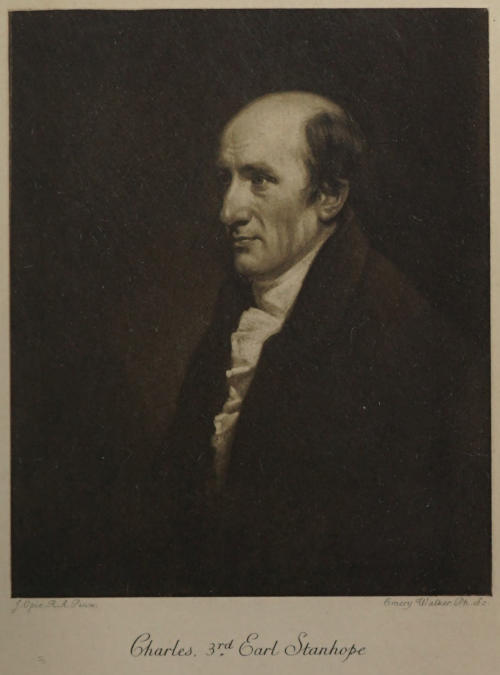
Charles, 3rd Earl Stanhope
J. Opie, R.A. Pinx. Emery Walker Ph. Sc.
Among the marriages of the Royal Family which followed was one between the Duke of Kent and the widowed sister of Prince Leopold. That alliance may in its results revive the importance of Prince Leopold, to all appearance suddenly extinguished in this country in 1817. On his marriage in 1816, an enormous annuity of £50,000 per annum was granted him. He was also given, by an Act of Parliament, all the rights, except that of succession to the throne, which attach to a descendant of the Princess Sophia. He, with over-caution, declined a peerage: George IV. was afterwards little disposed to renew the offer. Personal beauty and circumspection were at that time Leopold’s most vaunted qualifications. The vulgar thought him, in his capacity of needy German Prince, and without much further proof, sordid and rapacious. The visible improvement of his Royal bride, in the course of the few months she was destined to live, gained him the credit of acquiring, by discretion and sagacity, great ascendancy over her mind. Whether his instructions or further experience would ever have enabled her to fulfil the somewhat extravagant expectations entertained by the people may be left to a chapter in that science termed media scientia, which the schoolmen describe as inscrutable to the Deity himself.
The great virtues of Princes and Princesses who die young have frequently been the object of pleasantry, and it cannot be denied that the sudden extinction of an existence full of hope, in the person of a young and pretty bride, was well calculated to mislead the best feelings of the country into such an illusion. Yet, in the judgment of sobriety, little had appeared in this young lady to justify the inordinate grief at her death. She was pretty and she was gay; nor had she betrayed any propensities to remind men of her mother. But, on the other hand, she had shown even in the nursery, and still more in the months preceding her marriage, that she inherited, together with the Prince Regent’s quickness of apprehension and feeling, some of his greatest defects, viz., a love of exaggeration, if not a disregard of truth, in professions and complaints, a passion for tale-bearers and favourites, and all those petty failings and practices which lead to what the French call tracasseries and which rendered the private Court of her father, whether Heir-Apparent, Prince Regent, or King, the abode of uneasy heartburnings and jealousies and the scene of squabbles and scrapes, embarrassing, indeed, to the progress of State affairs, but almost below the notice of politicians, and quite unworthy of the province of history.
I have thus adverted prematurely to the untimely death of the Princess Charlotte, and to what little I knew from report of her character, when the course of my narrative had only brought me to her marriage. To prevent repetition, I will here mention that on my return to England in November, 1817, three days after her death, everybody I met between London and Dover, including post-boys and turnpike men, bore signs of mourning on their persons. Yet so little was this national affection extended to other parts of the family, that calumnies, representing the Regent and Queen Charlotte as rejoiced at the catastrophe, and even guilty of accelerating it, were very generally credited by the vulgar, and not repelled even in better educated circles with that scorn and contempt which justice and truth required.
The extraordinary sensation produced by her death was, indeed, a stronger indication of the unpopularity of the Prince Regent and his brothers than of the childish affection for Royalty, which the people of England so frequently display. The events which had intervened between her marriage and her death, and the tone assumed by the Prince Regent’s Government thereupon, had soured the lower classes of the community, and sensibly lessened the small stock of popularity which the Prince Regent had ever possessed. Although the Alien Bill had been most unnecessarily renewed in 1816, that Session of Parliament closed without any appearance of disaffection in the country or any symptom of ill-humour in Parliament. A bad harvest ensued; the people were distressed. Lord Sidmouth, who held the Seals of the Home Department, listened with inauspicious complacency to every tale which officious magistrates and designing spies brought of conspiracies and impending tumults. The faction of Levellers, Jacobins, or Radicals, which is never formidable, yet never wholly extinct in England or Scotland, resumed their practice of disseminating seditious and blasphemous handbills. They availed themselves of the elaborate blunders of Major Cartwright,[246] the able mischief of William Cobbett,[247] and the brawling eloquence (loquentia potius quam eloquentia) of Hunt,[248] to promote the cry for universal suffrage and annual Parliaments, among a class whose sufferings give to the prospect of change, whatever name it may assume, the pleasing colours of improvement.
The Prince Regent, apt enough to suspect danger, was yet more pleased at encountering it, whether real or imaginary, with arbitrary authority or coercion. Lord Sidmouth, either from sheer credulity or from subserviency, was busy in collecting foolish stories of plots,[249] and earnest in recommending measures of precaution and severity.
On January 28 Parliament met for the dispatch of business. I went down about four o’clock with an intention of reading the King’s Speech (a copy of which is usually lying on the table or the woolsacks, in the interval between its delivery and the resumption of the House) before business began. There were no Lords: there was some difficulty in procuring a copy of the Speech from the Chancellor. He was said to be at dinner, but he was closeted in his own room with Lord Sidmouth. The clerks seemed disconcerted, and everything, if not out of place and in dismay, at a stand and in suspense.
At length the mystery was cleared up. The Duke of Sussex, who arrived before five, told me the Prince Regent had not only been hissed but pelted in his way to and from the House, and he whispered to me significantly, “He himself pretends he was shot at.” Accordingly, on the resumption of the House, before the Select Vestry Bill was moved or the Chancellor had read the Speech from the woolsack, up rose my Lord Sidmouth, and with more than his usual solemnity (sufficient though it be to that or almost any other occasion) stated that the Prince, on his return through the Park, had been grossly insulted and assailed.
The Duke of Montrose (Master of the Horse) then related, in a manner somewhat indistinct and confused, that a stroke had been propelled against the carriage in which he was accompanying the Prince Regent by a force stronger than a man’s arm. Two holes, he added, were made in the glass, and he described their appearance. Lord James Murray, who was in Waiting, was then called to the bar. His evidence led to the inference that a shot had been aimed from one of the trees in the Park, and he conjectured that an air pistol, for he probably perceived that the concealment of an air gun was somewhat difficult, had been the instrument. Lord Grey cross-examined him, which Lord Grenville whispered to me was injudicious. He, Lord Grenville, soon afterwards spoke, as did Lords Eldon and Sidmouth, with becoming horror of such an outrage; but he did not affect, as the others did, great agitation and alarm at the event, which, in spite of his propriety and decorum, he must have deemed questionable. Lord Sidmouth, to vent his feelings of indignation and alarm with an equal attention to pathos and precedent, had the journals of 1795, when a similar event had occurred, spread out before him; and bade the clerk, when one question was disposed of, look out what was to be done next. He was disconcerted at finding that the absence of the Masters-in-Chancery would compel us to convey our horror to the Commons by an inferior servant of the House.
A conference took place. The Houses, as indeed it would appear the conspirators had been also, were strictly regulated by precedent of 1795: the expression of our indignation and the assurances of our loyalty were couched verbatim in the words of the resolution and address of that year, and though the House of Commons did not, as formerly, adjourn the debate on the address, we did. The Prince said, and perhaps thought, it was a shot; so said, and so thought, his father in 1795. But when Lord Onslow stooped in the carriage to look for the stone or bullet which had broken the window, George III. reminded him, saying: “Sit up, my Lord; they will say we are afraid.” In this rehearsal of a stale and insipid comedy the only little incident that marked dignity or presence of mind was omitted. On neither occasion was a shot fired. Lord Eldon assured me that he had in his possession the stone which had broken the window in 1795, and which was found at the bottom of the State carriage. He preserved it, with the dagger produced in the Commons by Mr. Burke,[250] as memorials of those strange times, surely not as marks of the sagacity or honesty of those he affects to admire!
The device this time did not greatly assist Ministers. It made little sensation either way. Government, however, in spite of a good but heavy speech from Lord Grey, with which he was more dissatisfied than his [——], and a spirited one from Lord Wellesley, met with ample support from the House and more countenance from Lord Grenville than was of good omen for the preservation of our party. Some approximation between Burdett and Grey was produced by the recurrence of coercive measures. Cobbett and Hunt took occasion, in letters to Lord Grey and interviews with me, to adhere to a declaration of Lord Cochrane,[251] that the endeavours of the people should be directed to the removal of the Ministry and the elevation of the Whigs to power. It has happened more than once in the course of my life that the party called Jacobins, Levellers, or Radical Reformers, after reviling the Whigs and strengthening the High-Church Party by lowering their opponents, have sought in the hour of danger to shelter themselves under the party they have so traduced. The Whigs, and let it [be] spoken with pride, have on such occasions, though smarting from the recent ingratitude of their suppliants, been ever ready from principle and generosity to stretch their protecting hands to persons calumniated or persecuted by power.
I saw Cobbett twice. His upright figure indicated the drill of a soldier, his ruddy complexion and homely accent the subsequent character of a farmer as well as his original condition. Neither countenance nor conversation (at least at this time) were at all of a piece with the sprightliness of his style, the shrewdness of his remarks, or the closeness of his reasoning in written compositions. His objects were, the co-operation of the Whigs in public meetings for a change of Ministry, and their protection and countenance if he wrote in their favour. In such objects I told him Whigs could not but concur, but I avoided all appearance of any closer connection. He was alarmed at the threatened suspension of the Habeas Corpus.[252] He very unaffectedly acknowledged his distrust of his own nerves, and a dread of behaving meanly and basely if arrested; he, therefore, hinted at an intention, which he afterwards executed, of retiring to America. He earnestly asseverated that he never had, and never would, belong to any political Opposition whatever.
No concert, much less union, with this extreme branch of Radicals ensued. Lord Grey, with the full consent of a large meeting of his Parliamentary friends (called February 24, 1817), engaged on an opposition to the suspension of the Habeas Corpus and to sundry coercive measures resorted to by Government, and in which Lord Grenville and his immediate friends, though disclaiming all rupture with the Whigs and professing undiminished regard, openly acquiesced. Burdett soon and rapidly resumed his old personal habits with many Whigs. Good will and communication between the Whigs and him, as leader of reformers, remained uninterrupted, till his deep but often shaded tinge of Toryism,[253] at last, separated him from all the parties and persons with whom he had ever acted in public. Parliamentary Reform, however, was not yet adopted as an indispensable article in the Whig creed; nor did the Burdettites pledge themselves to act as a party in bringing Whigs into power.
Lord Fitzwilliam,[254] from old affections for many and from recent disgust at the system of espionage so unnecessary and so revolting to a generous and honourable mind, sided without hesitation with us. From this period, he and his large connection became active and important members of the popular division of the Whig party. With little talent and less acquirements, he was, throughout life, one of the most considerable men in the country and a striking instance of that most agreeable truth—that courage and honesty in great situations more than supply the place of policy or talent. It was not his relationship to Lord Rockingham, though no doubt an advantage, nor his princely fortune, though a yet greater, which conferred the sort of importance he enjoyed for half a century in this country. He derived it more directly and more certainly from his goodness and generosity, and from the combination of gentleness and courage which distinguished his amiable and unpretending character. Such unblemished purity and such unobtrusive intrepidity, such generosity of feeling, firmness of purpose, and tenderness of heart, meeting in one of high station and princely fortune, commanded the affection and confidence of the public; and Lord Fitzwilliam enjoyed them, beyond even those of his own class who united much greater reach of understanding and more assiduity of business to superior personal accomplishments and advantages.
He had been named of the Committee,[255] but he fearlessly and publicly condemned the evidence which had there been admitted. The suspension of the Habeas Corpus was, nevertheless, carried in the face of Lord Wellesley’s and Lord Grey’s opposition. Cobbett fled to America, and returned, when the Suspension Act had expired, with the bones of Tom Paine and a stronger disposition than ever to indulge in scurrilous language and factious practices. The Radical party had manifestly decreased in numbers, and the unprovoked measures of 1817 seemed invented for the purpose of reviving its malignity and recruiting its force by persecution. They had in my judgment that effect.
The country this year sustained the loss of Francis Horner, a man whose sobriety of judgment and patient application of considerable powers to the best and wisest purposes of a public life would have placed him ere long at the head of the rational friends of liberty (including Whigs and reformers) in the House of Commons. His constitution was weak, and by neglect of it he had brought on symptoms of atrophy. He repaired, by the advice of physicians and at the earnest entreaty of friends, to a milder climate: but it was too late. He died at Pisa on [February 8], 1817.[256] Could anything connected with such a misfortune (which was to me, personally as well as politically, a very great one) be termed gratifying or satisfactory, the expression of regret at his loss in private, in Parliament, and in public, would deserve those epithets. Lord Morpeth, in moving the writ for St. Mawes, paid a feeling and judicious tribute to his solid virtues and rising merit; he was applauded and supported by many of the most respectable members of both sides of the House, including Mr. Manners Sutton and Sir Samuel Romilly, the last too soon, alas! destined to follow the pupil he so feelingly lamented.
That great lawyer and philosopher was himself improving rapidly in Parliamentary oratory, and yet more rapidly advancing in the estimation and confidence of the people. During the Sessions of 1817 and 1818 he mitigated many parts of the coercive bills. His arguments against capital punishment made slow but deep impression on the public, and, though still a lawyer in the greatest practice, he was at that period more nearly the leader of the Whig party in the House of Commons than any other member. Brougham, who, I fear, from motives of jealousy had much derided the tribute paid to the memory of Horner, yet avowed and felt some deference for Romilly.
It was, I think, in 1817 that I moved an inquiry into the treatment of Napoleon at St. Helena. Information derived from Count Montholon and from the Bonaparte family fully justified my statement; but the injudicious and exaggerated reports printed by a valet-de-chambre[257] enabled Lord Bathurst,[258] by refuting what I did not say and quoting the publication instead of my speech, to assume the appearance of contradicting what I did say. I did not divide, though Lord Darnley, never deficient in natural generosity, showed some disposition to urge it on the House.
In general, my political friends both in the Lords and the Commons,[259] with the exception of Lord Ebrington[260] and Mr. Abercromby[261] (for I do not reckon such a restless busybody as Sir Robert Wilson), were shy of meddling with a subject which they ignorantly deemed unpopular in the public and positively knew to be offensive at Court. I had and have the satisfaction of believing that my motion, ill-supported as it was, had an effect in alleviating the ill-treatment of a great man: but, having recorded all I know of him in another chapter of this work, I pass to other subjects in this.
I spent the summer and autumn of 1817 in Holland and at Paris. It was remarked to me by Mr. A. Baring,[262] and the remark was confirmed by M. Pozzo di Borgo,[263] that the intense application of the Duke of Wellington to the financial parts of the treaty, combined with his known sagacity in adapting his means to his ends, indicated that his views on returning to England would be directed to the Treasury. He did, in truth, devote his mind most earnestly to the financial Committee, and studied most intensely the questions of currency, resumption of cash payments, taxation, expenditure, and exchanges.
During the recess Lord Sidmouth attempted to justify his silly alarms of revolution by yet more silly prosecutions against writings termed seditious and blasphemous. Hone was indicted for an innocent parody.[264] It was hypocritically represented as intended to bring the Scriptures into ridicule, and the Prince Regent affected much sanctimonious resentment at those who abetted blasphemy and profaneness by charitably subscribing to alleviate the sufferings of a persecuted bookseller. Many of them, and the Duke of Bedford particularly, were distinguished in their stations for their attachment and reverence for religion; but it was pretended that disapprobation of so indecorous an act as the relief of a blasphemer was the motive for preferring Lord Grantham,[265] with neither residence nor property and only an expectancy in Bedfordshire, to the Duke, who had the largest property, and Woburn Abbey, in that county. The Duke was more nettled than became him at being so passed over. He wrote the Prince Regent a letter, which, like most from his pen, was well composed. It met with general applause. Yet to me it seemed, in judgment, defective and, in principle, almost indefensible. Not so thought the public. Truth is, the English people love high spirit combined with high rank. Whenever in assertions, even of unreasonable pretensions, a strong feeling of independence is expressed by a man of station and family, not only the multitude and his own party, but the whole community, are ready to applaud, and even his antagonists to respect and admire him.
The vacancy of [the] Lieutenancy in Bedfordshire in February, 1818, was occasioned by the death of my maternal uncle, John, second Earl of Upper Ossory, a man of taste and philosophy, to whom during childhood and youth I was beholden for tenderness and advice almost paternal, and who left me the estate and mansion of Ampthill[266]—a bequest munificent in itself, and to me beyond all value, from the recollection of those who had inhabited it and of the happy hours, days, months, and years I had spent in their society.
Lord Ossory had not that force of mind which public life demands or creates, nor the habits of intense application to any object of ambition or vanity. He had too much respect, not to say awe, of the opinion of the world to make any strong or lasting impression; but he was far from being a common man. In all branches of taste his perceptions were quick and just, and on every question, private and public, his judgment was sound and his expression of it distinct and sincere. No less a person than David Hume predicted of him, when a young man at Paris, that he would distinguish himself as much as Charles Fox. Perhaps the very qualities which captivated that great philosopher, viz., an unusual calmness of judgment, blended with some distrust of anything approaching to vehemence or enthusiasm, extinguished all ambition in Lord Ossory, and taught him to seek refuge in a tame and inglorious, but not unlettered or irrational, life in the country. He was, though not ingenti perculsus amore, a genuine worshipper of the Muses, and far from insensible to the charms of literature or unskilled in the pursuit of many branches of natural philosophy. Not many days before his death, he, to my great satisfaction, expressed, with a warmth unusual in him, his approbation of the tone of indignation and scorn in which I had spoken in the Lords of the hypocrisy of the prosecution against Hone. Such testimony, from a person little disposed to palliate the excesses of the press or to sympathise in the exaggerations of a party, was a proof that Government had assumed the attitude of hostility to the current of popular feeling. To that obvious error much subsequent discontent, as well as many difficulties we had to encounter for years afterwards, were mainly attributable.
During the Session of 1818, and especially on the Indemnity Bill,[267] I acquired by practice more fluency in public speaking than I had hitherto possessed, and got the ear of the House to a degree that placed me higher in the rank of speakers than I had hitherto aspired to be or perhaps could ever really deserve.
That Session commenced in January, 1818. The Ministers, questioned by me, announced an intention of repealing the Suspension Act[268] before the address was moved; and, on the motion of it, Lord Stanhope,[269] the very opposite of his father in political principle and greatly inferior in talent and knowledge, but, like him, suspicious and eccentric, delivered a speech, good in language but strange in conception, in which he lamented that the first sentence in Cæsar had not been made the leading article of the treaty of Peace (Gallia omnis divisa est in partes tres), and much of a like tendency and taste.
Lord Liverpool boggled at the epithet he should use in alluding to his oration, and after some hesitation designated it, as “certainly a remarkable speech.” As Stanhope had called France “a conquered, abject, and despicable country,” it made more sensation in Paris than London. It is said the French Ambassador remonstrated with Lord Liverpool for calling Lord Stanhope his “Noble friend.” It hurried Lady Stanhope from France, where she was then residing, and it required, according to rumour, the good office of friends, as well as some discreet compliances on the part of Lord Stanhope to which his nature had no particular repugnance, to protect him from all personal indignity from French bravos who would be patriots.
The earnest and repeated debates on the Indemnity Bill had some effect on the country, none whatever within the walls of Parliament. The divisions were bad, the Whig party dispirited and disunited. At the close of the Session some little spirit was raised on the renewal of that odious measure, the Alien Act. A method of evading its provisions, by purchasing stock in the Scotch Bank, under an Act of George I., was, at the instigation of Lord Lauderdale (the last expedient, I fear, his ingenuity ever exerted in favour of popular rights) resorted to by General Flahault.[270] A more factious attempt to defeat this manœuvre by an ex post facto clause, moved by Lord Melville, was baffled by myself and others prolonging the debate on the third reading in [the] Lords till the House of Commons was up. There was no time for getting through the formalities of agreement on our amendments without deferring the Commission and the Prorogation, and in the choice of disasters the Government submitted to the dreadful one of having a French officer a naturalised subject of the kingdom in which his wife was a native and a peeress. On this Alien Bill Sir Samuel Romilly had taken a very prominent part, and on the ensuing dissolution he was chosen, against a virulent opposition both of Tories and Radicals, for Westminster: thus commencing to all appearance a career in politics as brilliant as that he had run in his profession. But all these expectations terminated in a scene of distress and horror, such as may, indeed, [have] been found in the theatre or in romance, but rarely in the tragedies of real life. His wife had died after much bodily suffering in the Isle of Wight, and he, being brought up with great difficulty to London in a state of deep melancholy, put an end to his existence two or three days after his arrival in Russell Square.
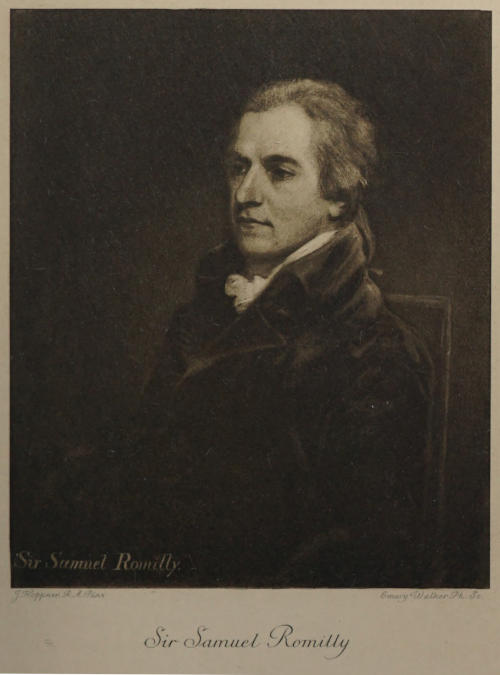
Sir Samuel Romilly
J. Hoppner, R.A. Pinx Emery Walker Ph. Sc.
Mr. Dumont,[271] who accompanied him on his journey, and who endeavoured to relieve him by exciting his tears, told me that on being reminded in passing Holland House that his children were there, he betrayed some symptom of emotion, but rapidly relapsed into the deep depression of spirits which betokened his despair and should have admonished his friend of the consequences of it. It is singular, but true, that an epitaph recording the sudden death[272] (probably the suicide) of an uncle of the same name following that of his wife, was discovered on a tombstone in one of the churches of London.
Romilly was a man of strong sensibility and as strong opinions, indulgent even to tenderness to those he loved. He had neither vanity nor guile; but he was not perhaps entirely exempt from that gall which intense pursuit of an object engenders in a proud and ardent but pure and affectionate mind. His powers of reflection and reasoning were of the very highest order, and he was capable of unbounded devotion to a cause. There have been seasons and countries, in which the elements of which his head and heart were composed would have fermented into zeal and fanaticism. His early admiration of Rousseau, though afterwards checked by the practice of a subtle, discriminating, and distrustful profession on one hand, and counteracted by the more grovelling and selfish maxims of his friend Bentham on the other, had wellnigh moulded his genuine philanthropy into something of that shape and appearance, but did, in fact, leave nothing but the traces of gentle, refined, and over-nice sensibility and extensive philanthropy, more engaging and exemplary perhaps than practicable. Yet no advocate was more apt to persuade himself that his client’s cause was the best in the world, and none certainly was more eager and earnest in enforcing that opinion. In spite of his great legal aptitude of understanding, he formed a striking and honourable exception to the pliability of principle so often and so justly objected [to] in our legal politicians. Far from being too temporising or too accommodating, he was more fixed and invariable in his private and public principles, on both great and small occasions, than is either common or convenient or perhaps desirable in a practical public man.
He has left memoirs of himself; I was permitted to read them in 1835.[273] The portrait, drawn by his own pen, of a mind struggling with adversity and panting not so much for distinction or celebrity as for the reward of self-applause from an approving conscience, forms a valuable and curious piece of biography. Over-scrupulous tenderness for his memory induced his family for a time to withhold it from the public, a production which must raise his moral character and intellectual powers in the estimation of the good and thinking part of mankind. It was the project of Mr. Brougham and others to place him at the head of the party on the meeting of Parliament. It was defeated by the stroke of death. The inconvenience of a mixed and undisciplined band without any positive commander in the Commons was obvious; and our active friends in the House and the busybodies at Brookes’ concerted an offer of the lead to Mr. Tierney.[274] Of this step Lord Sefton[275] and Lord Althorp[276] were, I think, the chief promoters, the members of the House of Cavendish the most earnest, and those of the House of Russell very willing and active supporters.
After some hesitation (for it was hardly in his nature to take any step without some previous hesitation or some subsequent misgivings) he accepted it. His oratory, though of no elevated, commanding, or even brilliant kind, was perhaps the most popular and the most agreeable, and certainly by far the most original, then left in Parliament. His long experience of the House, his conciliatory temper, and above all his shrewdness, sagacity, and diligence seemed to fit him admirably for the station he thus assumed. It was, however, obvious that the general deference to his judgment and the confidence in his principles bore a very unequal proportion to the affection, good will, and delight, with which his conversation and speeches were regarded. Those who loved him best foresaw too clearly that in the essential qualifications of decision and judgment he might prove deficient, and those less aware than his intimate friends of his inflexible integrity not unnaturally attributed the low standard, at which he too frequently rated the public virtue of other politicians, to some crying defect in his own, although the real cause was the inordinate fear he felt of being outwitted and, above all, laughed at for presumption or simplicity.[277]
In truth, his irresolution was fed, if not engendered, by that very sense of humour which enabled him to discern so keenly and to expose so admirably whatever was ridiculous in other public men. His pleasantry and easy manners shed a charm over all intercourse with him, even on the driest matters of business and detail. He meant to be, and he was, courteous to all, and friendly and serviceable to his followers and partisans. He had, moreover, other qualities, or rather an exemption from other qualities, which seemed peculiarly adapted to win the affections of independent men. Though not destitute of spirit, and though his physical courage was redundant rather than deficient, he had perhaps less pride and certainly far less vanity than any man of equal talents and acquirements whom I ever had an opportunity of observing. I must own, however, that in his capacity of leader of a party he was sometimes too readily offended at insignificant deviations, and disproportionately alarmed at the indiscretion of individuals. He was, in truth, always striving to be more circumspect in conducting other men than is compatible with preserving any authority over them at all; and yet by a contradiction not uncommon in the caution which has its source in timidity, he was occasionally so enamoured of some crotchet or refinement of his own that he was hurried into courses hazardous and even rash.
Little incidents and shades of differences at meetings held during 1819 at Burlington House,[278] and attended by most of the Whigs, but not by Mr. Lambton[279] (who had some private quarrel with Lord G. Cavendish), disconcerted Mr. Tierney exceedingly. He was much keener in discerning the existence and foreboding the consequences of accidental dissensions, unavoidable in large bodies of men, than expert in concealing and healing them; and the character of some members of his party, especially Mr. Brougham, was sure to bring these disqualifications into action and notice. They were, however, hardly perceptible to the public during the first part of the Session of 1819.
Several brilliant debates, in which he and Sir James Mackintosh shone greatly, and which were followed by successful divisions, though on matters of small importance, seemed fully to justify the choice which had fallen upon him and promised his leadership no little éclat. But debates under his guidance were too much trials of strength, and too little a manifestation of the conflicting principles of the parties engaged. He always laboured more to obtain wavering votes than to enforce the views or particular course of action recommended by his party. So enamoured was he of such a line of policy that, in an evil hour, he determined to bring the relative strength of Government and Ministry to a direct issue, and on May 18, 1819, he moved a Committee on the state of the nation—a motion equivalent to one for the dismissal of Ministry, and in the then state of parties justly remarked by Lord Castlereagh to convey two distinct propositions: the first, that the Ministry in office had not, and the second, that the gentlemen in Opposition had the confidence of the House. To neither of these propositions was the House, though far from satisfied with the state of public affairs, prepared to assent; and when convinced that the last was virtually involved in the first, did not hesitate to reject the motion by an overwhelming majority. Mr. Tierney was much disconcerted at this result, and it was not, I think, long ere he renounced the leadership which he had assumed.
The guidance of the party thus devolved to the guidance of three or four men of weight (such as Lords Althorp and Tavistock) and others stimulated by Brougham, or to that of chance itself. Parliament was prorogued in July, 1819. During the recess which followed frequent meetings were held in London and other populous towns. The avowed object was to petition against grievances and for Parliamentary Reform, and the representations of magistrates induced Lord Sidmouth, ever on the alert to flatter that consequential class of personages, to press for a sudden meeting of Parliament. His colleagues declined to adopt that inconvenient course. He redoubled his activity in communicating with the busy magistracy and in impressing on their minds the importance of vigilance against riot and sedition. Hence, some from party spirit, and more from that pompous bustle in which provincial authority delights to revel, fed him with idle tales of plots and insurrections, and courted that official applause which he seldom failed to administer.
Atkins, the Lord Mayor, a foolish and violent man, at the risk of provoking a real riot, arrested a brawling parson of the name of Harrison in the very act of talking nonsense to a multitude.[280] This silly zeal was magnified as a feat of prodigious vigour and decision. Many a justice of the quorum waxed emulous of the fame of a Lord Mayor, who, according to his own version of the matter, modestly reported that he had defeated a conspiracy “to burn the Metropolis and to murder the inhabitants.”
At Manchester the magistrates, instigated by one of the name of Fletcher, resolved to eclipse the triumph of Smithfield and arrest Mr. Hunt himself, the demagogue of the day, even before he had uttered a word. He substituted for constables a body of Yeoman Cavalry. They were suddenly let loose on a defenceless multitude of 4,000 men, women, and children to execute the warrant.[281] The crowd, unarmed, had collected in a square near St. Peter’s Church. They were hemmed in by the soldiery, and on the slightest appearance of tumult would have been at the mercy of a military, but irregular and somewhat exasperated, force. As it was, excesses were committed and blood was shed, though more might well have been apprehended. The carnage was probably exaggerated, and could perhaps hardly warrant the designation, given of it to this day by the people, of the “Massacre of Peterloo.” But it was an act of violence, odious, illegal, revolting, unprovoked, and unnecessary. This may be collected from a narrative in my possession, written by Mr. Stanley,[282] afterwards Bishop of Norwich, who surveyed the whole scene from the roof of the houses, and is much too conscientious a man to set down aught in malice, though less willing than many of his cloth to extenuate the excesses of authority. The intemperate eagerness, or, to use Lord Grosvenor’s phrase, the breathless haste of the Home Office in thanking the magistrates for shedding the blood of the people before it had ascertained whether it was in observance or in breach of the law and the nature of the force employed, riveted the recollection of this outrage in the minds of the Manchester public. It rankled for many years. The consequences were very sensibly felt at the time of the Reform Bill; and the name of the “Massacre of Peterloo,” together with those of the persons who were most forward in it, are not forgotten to this day.