FULL SPEED AHEAD (continued 3)
Reading edition
Then at ten o'clock the morning papers came down from a certain great city with a full, detailed account of the raid!
The thing that we have most against it, however, is its conduct during the great offensive of the spring of 1918. The air was resounding with the wireless pæans of the on-rushing Germans; and everybody was worried, and anxious to know the fortunes of our troops. One rushed to breakfast early to have first chance at the press news. Friends gathered behind one's shoulder, and tried to read before sitting down. What's the news? What's the news? This (or something very like it) was the news:
"Dr. Ostropantski, president of the Græco-Lettish Diet, denounced yesterday at a meeting of the Novoe Vremya the German assault on the liberties of Beluchistan."
There was one vast, concerted groan from the sons of the Grand Fleet. Some wondered what the anxious folk far out at sea on the destroyers were saying. Finally the wit of the table shook his head gravely.
"Boys," said he, "where would we be if the civilians refused to tell?"
XXVI MARINES
This paper does not deal with the marines fighting in France, but with the marines such as one finds them on the greater ships. The gallant "devil dogs" now adding fresh laurels to the corps have army correspondents to tell of them, for though they are trained by the Navy and are the Navy's men, the Army has them now under its command. It is rather of the genuine marine, the true "soldier of the sea" that I would speak. Having been myself something of a soldier and a sailor, the marines were good enough to receive me in a friendly fashion when I was a guest on one of the battleships now on foreign service.
Even as the traditional nickname for the sailor is "gob," so is "leatherneck" the seaman's traditional word for the marine. I am guileless enough not to know just how marines take this term, but if there is any doubt, I advise readers to be easy with it, for marines will fight at the drop of a hat. All those aboard declared, by the way, that the antipathy between the sailor and the marine in which the public believes, does not exist, nor do the marines according to the popular notion "police the ship." The marine has his place; the sailor has his, and they do not mix, not because they dislike each other, but simply because the marine and the sailor are the products of two widely different systems of training. Moreover, the marine is bound to his own people by an esprit de corps without equal in the world. It was very fine to see each man's anxiety that the corps should not merely have a good name, but the best of names.
We swopped yarns. In return for my gory tales of shelled cities, gas attacks, and air raids, they gave me gorgeous ... gorgeous tales of the little wars they have fought in the Caribbean. I realized for the first time just what it meant to Uncle Sam to be Central America's policeman. Now, as they spun their yarns, I could see the low, white buildings of a Consulate against the luminous West Indian sky, the boats on the beach, the marines on patrol; now the sugar plantation menaced by some political robber-rebel, the little tents under the trees, the business-like machine gun. A harassed American planter is often the deux ex machina of these tales.
We used to talk in a little office aboard the battleships down by the marines' quarters, which lie aft. I believe it was the sergeant's sanctum sanctorum. There were marine posters on the wall, a neat little stack of the marines' magazines handy by, a few books, and some filing cabinets. Just outside were the marine lockers, each one in the most perfect order, and a gun breech used for loading drills. The sergeant, himself, was a fine, keen fellow who had been in the corps for some time. His men declared themselves, for the most part, city born and bred.
"What happened then?"
"Just as soon as they got the message, a detail was sent into the hills for the defence of the plantation. It was a big sugar plantation. The American manager was seeing red he was so peeved, the harvesting season had come and the help, scared by the insurgents, were beating it off into the hills. What's more, the insurgents had told the manager that if he didn't pony up with five thousand dollars by a certain date, they'd burn the place. Actually had the nerve..."
"In fiction," said I, "a lean, dark, villainous fellow mounted on a magnificent horse which he has looted from some fine stable dashes up to the plantation door, delivers his threat in an icy tone and gallops back into the bush. Or else a message wrapped round a stone crashes through the window onto the family breakfast table. Which was it?"
I think the marine telling the story wanted very much to utter: "How do you get that way?" however, he merely grinned and answered:
"Neither. A big, fat greaser in a dirty, Palm Beach suit came ambling up one morning as if somebody had asked him to chow. This was his game. A holdup? Oh, no! Only his men were getting a bit restless under the neck, about five thousand dollars restless, and if they didn't get it, there's no telling what they wouldn't do. He thought he could restrain them till Tuesday night, of course it would be a pretty stiff job to hold them in, but if something crisp and green hadn't shown up by Tuesday P.M., those devils might actually burn the plantation. Did you ever hear such a line of bull? And that's the honest truth of it, too; none of this stone in the mashed potatoes guff."
"And then," I broke in, "the faithful servant gallops through the valley to the shore; a stray bullet knocks off his hat, but he gets there, and delivers his message to the warship in the bay. A bugle blows, the marines rally, launches take them to the beach; they rush over the hills, and get to the plantation just as Devil's-hoof Gomez or Pink-eyed Pedro has set fire to a corner of the bungalow. Rifles crack, bugles sound a charge, the marines rush the Gomez gang who take to their heels. Brave hearts put out the fire. Isn't there always an exquisitely beautiful señorita to be rescued? There always is in the movies. Now, please don't destroy any more of my illusions."
"The message comes all right, all right, but I doubt very much if that faithful servant comes in a hurry. Down there, if a man goes by in a hurry, everybody in the village will be out to look at him.... The major gets the message, works out his plan of campaign, and away we go. Arrived at the plantation, we pitch camp, establish pickets, and generally get things ready to give the restless greasers a hot time. Sometimes the greasers try their luck at sniping; other times, they go away quietly and don't give you a bit of trouble. There aren't any beautiful señoritas, ... no broken hearts. Yes, it's tough luck."
Thus were my illusions dispelled by a group of Uncle Sam's marines. They forgot to tell me that many members of their little company had been wounded, and seriously wounded in these West Indian shindies. The list of wounds and honours in the records was an impressive roll.
The visitor aboard a warship will see marines acting as orderlies and corporals of the guard and manning the secondary batteries. I attended many of their drills, and never shall forget the snap and "pep," of the evolutions. Nor shall I forget the courtesies and friendly help of the gallant officer under whose command these soldiers of the sea have the good luck to be stationed.
N.B. (Very secret), to Huns only. The marines man the gun in the "Exec's" office and the corresponding one in the line officers' reading room. If you want to get home to the old home canal, ... keep away from their range.
XXVII SHIPS OF THE AIR
After I had been to visit several of the bases, I returned to London, and called at the Navy headquarters. A young officer of the admiral's staff who was always ready and willing to help the writers assigned to the Navy in every possible way, came down to talk with me. "Had I been to Base X? To Base Y? Had I been to see the American submarines? The Naval Aviation?" I grasped at the last phrase.
"Tell me about it," I said. "I had no idea that the sea flyers were over here. Last fall the streets of Boston were so thick with boys of that service that you could hardly move round. And now they are on this side. Where can I find them?"
The officer drew me to a large scale map of the British Isles and the French coast which hung on the wall, plentifully jabbed with little flags. His finger fairly flew from one dot to another.
"Well," said he, "we have a station here, another station here, another station there, ... there's a station on this point of land; right about here we're putting up buildings for a depot but there is nobody at hand yet, here's a big station...." I believe that he could have continued for five minutes.
"You seem to have a big affair well in hand," I suggested, rather surprised.
"No," he corrected, "just beginning. The department scheme for the naval aviation service is one of the big things of the war. It's so big, so comprehensive that people over there haven't woken up to it yet. Aren't you going to Base L next week? Why don't you go down the coast a few miles and see the outfit at Z? Only don't forget that we've 'just begun to fight.' Come upstairs and let me give you a letter." A few days later I ran down to see the aviators in their eyrie.
The naval station lay in a sheltered cove hidden away in a green and ragged coast. Landing at a somewhat tumble-down old pier, I saw ahead of me a gentle slope descending to a broad beach of shingle. Mid-way along this beach, ending under the water, was to be seen a wide concrete runway which I judged to be but newly finished, for empty barrels of cement and gravel separators stood nearby. At the top of the slope, in a great field behind mossy trees, lay the corrugated iron dormitories of a vast, deserted camp once the repose quarters of a famous fighting regiment. There was something of the atmosphere of an abandoned picnic ground to the place. Sailor sentries stood at the entrance of the quiet roads leading to the empty barracks, and directed me to those in authority.
The naval aviation is a new service. For a long time the uniform of the cadets was so unfamiliar that even in their own America the boys used to be taken for foreign officers. It was a case of "I say he's an Italian. No, dear, I'm sure he's a Belgian." A not unnatural mistake, for the uniform has a certain foreign jauntiness. In colour, it is almost an olive green, and consists of a short, high-collared tunic cut snugly to the figure, shaped breeches of the riding pattern, and putties to match. Add the ensign's solitary stripe and star on shoulder and sleeve and you have it.
I found a group of the flyers in one of the tin barracks that did duty as a kind of recreation centre. The spokesman of the party was a serious lad from Boston.
"Fire away," they yelled good-naturedly to my announcement that I was going to bomb with questions.
"First of all, about how many of you are there helping to make it home-like for Fritz in this amiable spot?"
"About fifty of us."
"Been here long?"
"No, just came. You see the station is not really finished yet, but they are hurrying it along to beat the cars. Did you spot that concrete runway as you came up? A daisy, isn't it? Slope just right, and no skimping on the width. Well, that's only one of the runways we're going to have. Over on the other side, the plans call for three or four more."
"And what do these sailors do?" I had noticed a large number of sailors about.
"They look after our machines and the balloons. You see this is a regular aviation section just the same as the army has, and the sailors are trained mechanics, repair men, clerks and so forth. They're rather taking it easy now because the planes have been somewhat slow in reaching us. You know as well as I do the rumpus that's been made in the States over the air program. Things are breezing up mighty fast now, however, and every supply ship that puts into the harbour brings some of our equipment. The Navy's ready, the camps are being organized, the men are trained; it's up to the manufacturers to hustle along our machines. Please try to make them realize that when you write."
"But, say," put in another, "don't, for the love of Pete, run away with the idea that we haven't any equipment. We've got some planes and some balloons. But we want more, more, more. Anything to keep the Germans on the go."
"What do you use?" I asked. "Mostly balloons," put in a third speaker, a quiet young Westerner who had thus far not joined in the conversation. "Most of us are balloon observers, though Jos here," he indicated the Bostonian, "is a sea-plane artist. He runs one of the planes."
"Come," said I, "tell the thrilling story."
"There isn't any story," groaned Jos, "that's just the trouble. I've been fooling round these coasts and out by the harbour mouth in the hope of spotting a sub till I feel as if I'd used up all the gasoline in the British Isles. Those destroyers have spilled the beans. Fritz doesn't dare to come round. Ever try fishing in a place from which the fish have been thoroughly scared away? It's like that. Mine laying submarines used to be round the mouth of the harbour all the time, now Fritz is never seen or heard from.... The destroyers have spilled the beans. The balloon hounds are the whole show here. Tell him about it, Mac. You've taken more trips than any of the others." The disgruntled sea planer knocked a bull-dog pipe on his shoe, and was still.
"I can't tell much," drawled Mac, a wiry, black little Southerner with a wonderful accent. "They fill the balloon up here, take it out to a destroyer or some patrol boat and tie it on, jes like a can to purp's tail. Then you go out in the Irish Sea and watch for subs. If you observe anything that looks like a Hun, you simply telephone it down to the destroyer's deck, and she rushes ahead and investigates. Sometimes the observer in the balloon sees something which can't be seen from the level of the destroyer's bridge, and in that case the balloonist practically steers the vessel, ... so many points to port, so many to starboard, and so on till you land them in the suspected area."
"What's it like up above there in a balloon? From the deck of a battleship or a destroyer, it seems to be a calm matter."
"Don't be too sure of that. I know it looks calm, calm as a regular up-in-the-air old feather baid. And it isn't bad if you have a decent wind with which the course and speed of the ship are in some sort of an agreement. But if the ship's course lies in one direction and the wind is blowing from another, the balloon blows all over the place. When the wind blows from behind, you float on ahead and try to pull the ship after you; if the wind is from ahead, you are dragged along at the end of a chain like a mean dawg. There is always sure to be a party if the ship zigzags. Now you are pulling towards the bow, now you are floating serenely to port, now you are tugging behind, now you are nowhere in particular and apparently standing on yo' haid."
We went to walk in the grounds. I was shown where the balloon shed was to be, the generators, and a dozen other houses. Evidently the station was going to be "some outfit." Already a big gang of civilian labourers, electrified by American energy, were hard at work laying the foundations of a large structure.
"Yes," said one of the boys, "this is going to be a great place. When it's completed we shall have regular sea-plane patrols of this entire coast, and a balloon squadron ready to coöperate with either the British or the American destroyer fleets. Our boys along the French coast have already made it hot for some Huns, and believe me, if there are any subs left, you just bet we want a chance at 'em?"
Such is the spirit that has driven the Germans from the seas.
XXVIII THE SAILOR IN LONDON
The convalescent English Tommy in his sky-blue flannel suit, white shirt, and orange four-in-hand, the heavier, tropic-bred Australian with his hat brim knocked jauntily up to one side, the dark, grey-eyed Scotch highlander very braw and bony in his plaited kilt, these be picturesque figures on the streets of London, but the most picturesque of all is our own American tar. Our "gobs" are always so spruce and clean, and so young, young with their own youth and the youth of the nation. Jack ashore is to be found at the Abbey at almost any hour of the day, he wanders into the National Gallery, and stands before Nelson at St. Paul's; he causes fair hearts to break asunder at Hampton Court. Wherever you go in London, the wonderful wide trousers, and the good old pancake hat, this last worn cockily over one eye, are always to be seen in what nautical writers of the Victorian school call "the offing."
Our boys come in liberty parties of thirty and forty from the various bases, usually under the wing of a chief petty officer very conscious of his responsibility for these wild sailor souls. Accommodations are taken either at a good London hotel with which the authorities have some arrangement, or the personnel is distributed among various huts and hospitable dwellings. The great rallying centre is sure to be the Eagle Hut off the Strand.
This famous hut, which every soldier or sailor who visits London will long remember, is situated, by a happy coincidence, in modern London's most New Yorkish area. It stands, a huddle of low, inconspicuous buildings, in just such a raw open space between three streets as on this side prefigures the building of a new skyscraper; the great, modern mass of Australia House lifts its imposing Beaux Arts façade a little distance above it, whilst the front of a fashionable hotel rises against the sky just beyond. The ragged island, the sense of open space, the fine high buildings, ... "say, wouldn't you think you were back in America again?" Yet only a few hundred feet down the Strand, old St. Clement Danes lies like a ship of stone anchored in the thoroughfare, and Samuel Johnson, LL.D., stands bareheaded in the sun wondering what has happened to the world. The hut within is simply an agglomeration of big, clean, rectangular spaces, reading rooms, living rooms, dormitories, and baths always full of husky, pink figures, steam and the smell of soap. Physically, Eagle hut is merely the larger counterpart of some thousand others. The wonder of the place is its atmosphere. The narrow threshold might be three thousand miles in width, for cross it, and you will find yourself in America. All the dear, distinctive national things for which your soul and body have hungered and thirsted are gathered here. There is actually an American shoe shining stand, an American barber chair, and, Heaven be praised, "good American grub." It is a sight to see the long counter thronged with the eager, hungry bluejackets, to hear the buzz of lively conversation carried on in the pervading aroma of fried eggs, favourite dish or sandwich of apparently every doughboy and tar. One's admiration grows for the Y. workers who keep at the weary grind of washing floors, picking up stray cigarette buts, and washing innumerable eggy plates. I realized to the full what a poor old college professor who "helped" in a hut on the French front meant when he had said to me, "life is just one damned egg after another." Of course sometimes the "hen fruit"—one hears all kinds of facetious aliases at the Hut—gives way to soi disant buckwheat cakes, a dainty, lately honoured by royal attention. Should you stroll about the buildings, you will see sailors and soldiers reading in good, comfortable chairs; some playing various games, others sitting in quiet corners writing letters home. There is inevitably a crowd round the information bureau. Alas, for the poor human encyclopedia, he lives a bewildering life. On the morning that I called he had been asked to supply the address of a goat farm by a quartermaster charged with the buying of a mascot, and he was just recovering from this when a sailor from the Grand Fleet demanded a complete and careful résumé of the British marriage regulations! Everybody seems cheerful and contented; the officials are attentive and kind; the guests good-natured and well-behaved.
Such is the combination of club, restaurant, and hotel to which our Jack resorts. And there he lives content in his islet of America, while London roars about him. During the week, he wanders, as he says himself, "all over the place."
The good time ends with the Saturday ball game. Everybody goes. Posters announce it through London in large black type on yellow paper. "U.S. Army vs. U.S. Navy." The field is most American looking; the "bleachers" might be those in any great American town. The great game, the game to remember, was played in the presence of the king. The day was a good one, though now and then obscured with clouds; a strangely mixed audience was at hand, wounded Tommies, American soldiers speaking in all the tongues of all the forty-eight states, a number of American civilians from the embassy and the London colony, groups of dignified staff officers from the army and the navy headquarters, and even a decorous group of Britons dressed in the formal garments which are de rigueur in England at any high-class sporting event. Then in came the king walking ahead of his retinue, ... a man of medium height with a most kind and chivalrous face. Our admiral walked beside him. The band played, eager eyes looked down, the king, looking up, smiled, and won the good-will of every friendly young heart. A few minutes later, the noise broke forth again, "Oh you Army!" "Oh you Navy," a hullaballoo that culminated in a roar, "Play Ball!"
The Navy men, wearing uniforms of blue with red stripes, walked out first, closely followed by the army in uniforms of grey-green. The admiral, towering straight and tall above his entourage, threw the ball. A pandemonium of yells broke forth. "Now's the time, give it to 'em, boys, soak it to 'em, soak it to 'em, steady Army, give him a can, run Smithie!" In a corner by themselves, a group of bluejackets made a fearful noise with some kind of whirligig rattles. Songs rose in spots from the audience, collided with other songs, and melted away in indistinguishable tunes. British Tommies looked on phlegmatically, enjoying it all just the same. There were stray, mocking cat calls. It was a real effort to bring one's self back to London, old London of decorous cricket, tea, and white flannels.
And of course, the Navy won. Over the heads of the vanishing crowd floated,
Give 'em the axe, the axe, the axe, Where? Where? Where? Right in the neck, the neck, the neck, There! There! There! Who gets the axe? ARMY Who says so! NAVY
It ends with a roar.
Then there is a celebration, and the next morning, his holiday over, Jack is rounded up, and put into a railway carriage. The roofs of London die away, and Jack, dozing over his magazines, sees in a dream the great grey shapes of the battleships that wait for him in the endless northern rain.
XXIX THE ARMED GUARD
When the Germans began to sink our unarmed merchant vessels, and announced that they intended to continue that course of action, it was immediately seen that the only possible military answer to this infamous policy lay in arming every ship. There were obstacles, however, to this defensive programme. We were at the time engaged in what was essentially a legal controversy with the Germans, a controversy in which the case of America and civilization was stated with a clarity, a sincerity, and a spirit of idealism which perhaps only the future can justly appreciate. We could not afford to weaken our case by involving in doubt the legal status of the merchantman. The enemy, driven brilliantly point by point from the pseudo-legal defences of an outrageous campaign, had taken refuge in quibbling, "the ship was armed," "a gun was seen," "such vessels must be considered as war vessels." We all know the sorry story. For a while, our hands were tied. Then came our declaration of war which left our Navy free to take protective measures. The merchantmen were fitted with guns, and given crews of Navy gunners. This service, devoted to the protection of the merchant ship, was known as the Armed Guard.
It was not long before tanker and tramp, big merchantman and grimy collier sailed from our ports fully equipped. Vessels whose helplessness before the submarine had been extreme, the helplessness of a wretched sparrow gripped in the talons of a hawk, became fighting units which the submarine encountered at her peril. Moreover, finding it no longer easy to sink ships with gunfire, the submarines were forced to make greater use of their torpedoes, and this in turn compelled them to attempt at frequent intervals the highly dangerous voyage to the German bases on the Belgian coast. Sometimes the gun crews were British; sometimes American. The coöperation between the two Navies was at once friendly and scientific.
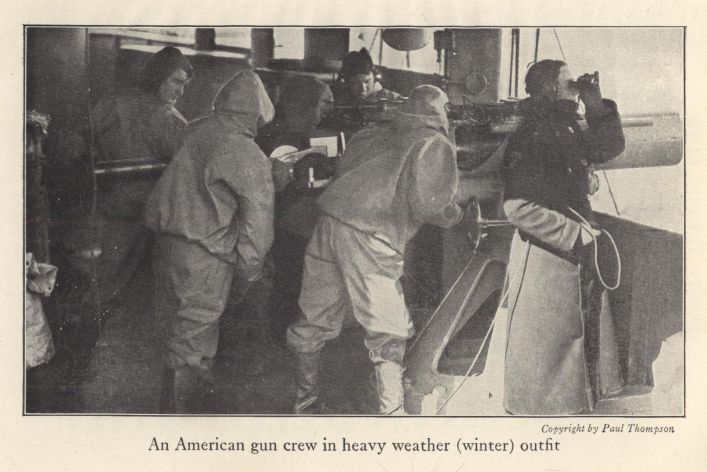
The guns with which the vessels were equipped were of the best, and the gun crews were recruited from the trained personnel of the fleet. One occasionally hears, aboard the greater vessels, lamentations for gunners who have been sent on to the Guard. These crews consisted of some half-dozen men usually under the command of a chief petty officer. A splendid record, theirs. They have been in action time and time again against the Germans, and have destroyed submarines. There is many a fine tale in the records of crews who kept up the battle till the tilt of their sinking vessel made the firing of the gun an impossibility. So far, the gunners on the merchant ships have come in for the lion's share of attention. But there is another and important side of the Armed Guard service which has not yet, I believe, been called to the public notice. I mean the work of the signal men of the Guard.
An American gun crew in heavy weather (winter) outfit
The arming of the merchant ships was the first defensive measure to be adopted; the second, the gathering of merchantmen into escorted groups known as convoys. Now a convoy has before it several definite problems. If it was to make the most of its chances of getting through the German ambush, it must act as a well coördinated naval unit, obeying orders, answering signals, and performing designated evolutions in the manner of a battleship squadron. For instance, convoys follow certain zigzag plans, prepared in advance by naval experts. Frequently these schemes are changed at sea. Now if all the vessels change from plan X to plan Y simultaneously, all will go well, but if some delay, there is certain to be a most dangerous confusion, perhaps a collision. It is no easy task to keep twenty or so boats zigzagging in convoy formation, and travelling in a general direction eastward at the same time. Merchant captains have had to accustom themselves to these strict orders, no easy task for some old-fashioned masters; merchant crews have had to be educated to the discipline and method of naval crews. Moreover, there have been occasional foreign vessels to deal with, and the problem presented by a foreign personnel. In order, therefore, to assure that communication between the guide ship of the convoy and its attendant vessels which is, in the true sense of an abused word, vital to the success of the expedition, the Navy placed one of its keenest signalmen on the vessels which required one. He was there to give and to send signals, by flag, by international flag code, by "blinker" and by semaphore. The wireless was used as little as possible between the various vessels of the merchant fleet, indeed, practically not at all.
The system of signalling by holding two flags at various angles is fairly familiar since a number of organizations began to teach it, and the semaphore system is the same system carried into action by two mechanical arms. The method called "Blinker" has a Morse alphabet, and is sent by exposing and shutting off a light, the shorter exposures being the dots, the longer exposures, the dashes. Sometimes "blinker" is sent by the ship's search light, a number of horizontal shutters attached to one perpendicular rod serving to open and close the light aperture. One used to see the same scheme on the lower halves of old-fashioned window blinds. The international flag code is perhaps the hardest signal system to remember. It requires not only what a naval friend calls a good "brute" memory, but also a good visual memory. Many have seen the flags, gay pieces of various striped, patched, chequered, and dotted bunting reminiscent of a Tokio street fair. The signalman must learn the flag alphabet, committing to memory the colours and their geometric arrangement; he must also learn the special signification of each particular letter. For instance, one letter of the alphabet stands for "I wish to communicate"; there are also numbers to remember, phrases, and sentences. If a signalman cares to specialize, he can study certain minor systems, for instance the one in which a dot and a dash are symbolized by different coloured lights. A signalman must have a good eye, a quick brain, and a good memory. It is a feat in itself to remember what one has already received while continuing to receive a long, perhaps complicated message. Because of these intellectual requirements, you will find among the signalmen some of the cleverest lads in the Navy. "Giles" such a lad, "Idaho," another, and "Pop" was always "on the job."
The Guard has its barracks in a great American port. One saw there the men being sorted out, equipped for their special service, and assigned to their posts. A fine lot of real seafaring youngsters, tanned almost black. The Navy looked after them in a splendid fashion. Said one of the boys to me, "If I had only known what a wonderful place the Navy was, I'd been in it long ago." The boys were sent over in the merchant ships, were cleanly lodged in excellent hotels once they got to land, and were then sent back on various liners. The Armed Guard was a real seafaring service, and its men one and all were touched by the romance and mystery of the sea. They fell in with strange old tramps hurried from the East, they broke bread with strange crews, they beheld the sea in the sullen wrath it cherishes beneath the winter skies. One and all they have stood by their guns, one and all stood by their tasks, good, sturdy, American lads, gentlemen unafraid.
XXX GOING ABOARD
Giles, who had just been sent to the Armed Guard from the fleet, was waiting for orders in a room at the naval barracks. It was early in the spring, the sun shone renewed and clear; a hurdy gurdy sounded far, far away. The big room was clean, clean with that hard, orderly tidiness which marks the habitations of men under military rule. A number of sailors, likewise waiting for their orders, stood about. There was a genuine sea-going quality in the tanned, eager young faces. The conversation dealt with their journeys, with the ships, with the men, the life aboard, the furloughs in London. "Bunch of Danes ... good eats ... chucked Bill right out of his bunk ... regular peach ... saw Jeff at the Eagle Hut..."
Presently a bosun entered. A man somewhere in the thirties, brisk and athletic. One could see him counting the assembled sailors as he came, the numbers forming on his soundless lips. The talk died away.
"How many men here?" said the bosun abruptly.
Several of the sailors began counting. There was much turning round, a deal of whispered estimations. Every one appeared to be looking at everybody else. Finally a deep voice from a corner said:
"Thirty-five."
"Any one down for leave?"
Some half dozen members of a gun crew just home from a long journey, called out that leave had been given them.
"Anybody on sick list?"
There was no answer. In the ensuing silence, the bosun checked off the answers on his list.
"I suppose you all want to go out."
"Sure!"
"Get in line." The bosun backed away, and looked with an official eye at the sturdy group.
"All here, pack up and stand by. At eleven o'clock have all your baggage at the drill office. I'll send a man up to get the mail."
The line broke up, keen for the coming adventure. Giles, the signalman, walked at a brisk pace to his quarters... You would have seen a lad of about twenty-two years of age, between medium height and tall, and unusually well built. Some years of wrestling—he had won distinction in this sport at school—had given him a tremendously powerful neck and chest, but with all the strength there was no suggestion of beefiness. The friendliest of brown eyes shone in the clean-cut, handsome head, he had a delightful smile, always a sign of good breeding. In habit he was industrious and persevering, in manner of life clean and true beyond reproach. Giles is an American sailor lad, a real gob, and I have described him at some length because of this same reality. The sooner we get to know our sailors the better.
Back in his quarters, he busied himself with packing his bag. Now packing one of those cylindrical bags is an art in itself. First of all, each garment must be folded or rolled in a certain way, the sleeve in this manner, the collar in that (it is all patiently taught at training stations) then the articles themselves must be placed within the bag in an orderly arrangement, and last of all, toilet articles and such gear must be stowed within convenient reach. A clean smell of freshly washed clothes and good, yellow, kitchen soap rose from the tidy bundles. In went an extra suit—"those trousers are real broadcloth, don't get 'em nowadays, none of that bum serge they're trying to wish on you," a packet of underwear tied and knotted with wonderful sailor knots, and last of all handkerchiefs, soap, and other minor impedimenta done up in blue and red bandanna handkerchiefs. You simply put the articles on the handkerchiefs and knot the four corners neatly over the top. There you have the sailor. Only at sea does one realize to what an extent the bandanna handkerchief is a boon to mankind. When the bag was packed, it was a triumph of industry and skill. Shouldering it, the sailor walked to the drill office. He was early. A good substantial luncheon had been prepared. There were plates of hearty sandwiches. Just before noon, a fleet of "buses" took them to the pier.
The day was clear but none too warm, and great buffeting salvos of dust-laden wind blew across the befouled and busy waters of the port. A young, almost boyish ensign gave each man his final orders, and a kind of identification slip for their captains. The sailors of the Guard, wearing reefers and with round hats jammed tightly on their heads, stood backed against a wind that curled the wide ends of their blue trousers close about their ankles. Presently, grimy, hot, and pouring out coils of brownish, choking smoke, a big ocean-going tug glided over to the wharf and took them aboard. Then bells ran, the propeller churned, and the tug turned her corded nose down the bay. The convoy lay at anchor at the very mouth of the roads. A miscellaneous lot of vessels, mostly of British registration; some new, some very, very old. The pick of the group was a fine large vessel with an outlandish Maori name; Giles heard later that she had just been brought over from New Zealand. The inevitable grimy-decked tankers and ammoniacal mule boat completed the lot. An American cruiser lay at the very head of the line, men could be seen moving about on her, and there was much washing flapping in the wind. The tug went from vessel to vessel, landing a signalman here, a gun crew there. One by one the lads clambered aboard to shouts of "See you later," and "Soak 'em one for me." Giles was almost the last man left aboard the tug. Presently he darted off busily to a clean little tramp camouflaged in tones of pink, grey, and rusty black. The tug slid alongside caressingly. There were more bells; a noise of churning of water. Over the side of the greater vessel leaned a number of the crew, a casual curiosity in their eyes. Seafaring men in dingy jerseys opening at the throat and showing hairy chests. A putty-faced ship's boy watched the show a little to one side. Presently an officer of the ship, young, deep-chested and with a freshly-healed, puckering, star-shaped wound at the left hand corner of his mouth, came briskly down the deck and stood by the head of the ladder.
Giles caught up his bag, clambered aboard, and reported. The officer brought him to the captain. Then when the formalities were over, the second mate took him in charge, and assigned the lad his quarters and his watches.
The convoy set sail the next morning just as a pale, cold, and unutterably laggard dawn rose over a sea stretching, vast and empty, to the clearly marked line of a distant and leaden horizon. The escorting cruiser, flying a number of flags, was the first to get under way; and behind her followed the merchantmen in their allotted positions, each ship flying its position flag.
Giles watched the departure from the bridge. Behind him the vast city rose silent above the harbour mist; ahead, rich in promise of adventure and romance, lay the great plain of the dark, the inhospitable, the unsullied, the heroic sea.
XXXI GRAIN
This is "Idaho's" story. He told it to me when I met him coming home early this summer. We were crossing in a worthy old transatlantic which has since gone to the bottom, and Idaho, at his ease in the deserted smoking room, unfolded the adventure. "Idaho, U.S.N.," we called him that aboard, is a very real personage. I think he told me that he was eighteen years old, medium height, solidly built, wholesome looking. The leading characteristic of the young, open countenance is intelligence, an intelligence that has grown of itself behind those clear grey eyes, not a power that has grown from premature contact with the world. Until he joined the Navy, I imagine that Idaho knew little of the world beyond his own magnificent West. I consider him very well educated; he declares that preferring life on his father's ranch to knowledge, he cut high school after the second year. He is a great reader, and likes good, stirring poetry. He is an idealist, and stands by his ideals with a fervour which only youth possesses. And I ought to add that Idaho, in the words of one of his friends, is "one first-class signalman." This is Idaho's story, pieced together from his own recital, and from a handful of his letters.
The crowd aboard the naval tug was so festive that morning, and there was such a lot of scuffling, punching, imitation boxing and jollying generally that Idaho did not see the vessel to which he had been assigned till the tug was close alongside. Then, hearing his name called out, the lad caught up his baggage, and walked on into the open side of a vast, disreputable tramp. The lad later learned that she had been brought from somewhere in the China Sea. The Sebastopol, Heaven knows where she originally got the name, was a ship that had served her term in the west, had grown old and out of date, and then been purchased by some Oriental firm. Out there, she had carried on, always seaworthy in an old-fashioned way, always excessively dirty, always a day over due. When the submarine had made ships worth their weight in silver, the Sebastopol must have been almost on the point of giving up the ghost. Presently, the war brought the old ship back to England again. Her return to an English harbour must have resembled the return of a disreputable relative to an anxious family. And in England, in some tremendously busy shipyard, they had patched her up, added a modern electrical equipment and even gone to the length of new boilers. But her engines they had merely tuned up, and as for her ancient hull, that they had dedicated to the mercy of the gods of the sea.
Once aboard, and assigned to his station and watches, the lad had leisure to look over his companions. The Sebastopol carried a crew from Liverpool, and was officered by three Englishmen and a little Welsh third mate. The Captain, a first mate of many years' experience, to whom the war had given the chance of a ship, was in the forties; tall and with a thin, stern mouth under a heavy brown moustache; the first mate was a mere youngster: the second, a middle-aged volunteer, the third, an undersized, excitable Celt with grey eyes and coal black hair touched with snow white above the ears. The Welshman took a liking for Idaho; used to question him in regard to the West, being especially keen to know about "opportunities there after the war." He had a brother in Wales whom he thought might share in a farming venture. Of the captain the lad saw very little; and the first mate was somewhat on his dignity. Practically every man of the crew had been torpedoed at least once, many had been injured, and had scars to exhibit. All had picturesque tales to tell, the gruesomest ones being the favourites. The best narrator was a fireman from London, a man of thirty with a lean chest and grotesquely strong arms; he would sit on the edge of a bunk or a chair and tell of sudden thundering crashes, of the roaring of steam, of bodies lying on the deck over which one tripped as one ran, of water pouring into engine rooms, and of boilers suddenly vomiting masses of white hot coal upon dazed and scalded stokers. It was the melodrama of below the water line. Then for days the narrator would keep silent, troubled by a pain in one of his fragmentary teeth. All the men kept their few belongings tied in a bundle, ready to seize the instant trouble was at hand. The cook complained to Idaho that he had lost a gold watch when the Lady Esther was torpedoed off the coast of France, and advised him paternally to keep his things handy. One of the oilers, a good-natured fellow of twenty-eight or nine, had been a soldier, having been invalided out of the service because of wounds received late in the summer on the Somme. An interesting lot of men for an American boy to be tossed with, particularly for a lad as intelligent and observing as our Idaho. The boy was pleased with his job and worked well. He did not have very much to do. Signalling aboard a convoyed ship, though a frequent business, is not an incessant one. He knew that his work would come at the entrance to the zone. Sometimes he picked up messages intended for others. "Mt. Ida, you are out of line," "Vulcanian, keep strictly to the prescribed zigzag plan." Now he would see the Sicilian asking for advice; now there would be a kind of telegraphic tiff between two of the vessels of the "Keep further away, hang you" order. Twenty ships running without lights through the ambush of the sea, twenty ships, twenty pledges of life, satisfied hunger ... victory. In other days, one's world at sea was one's ship; a convoy is a kind of solar system of solitary worlds. Hour after hour, the assembled ships straggled across the great loneliness of the sea.
The crew had a grievance. It was not against their officers, but against his majesty's government, against "a bloody lot of top hats." A recent regulation had forbidden sailors to import food into the United Kingdom, and all the dreams of stocking up "the missus'" larder with American abundance had come to naught. Idaho says that there was an engineer who was particularly fierce. "Don't we risk our lives, I arsk yer," he would say, "bringing stuff to fill their ruddy guts, and now they won't even let us bring in a bit of sugar for ourselves." The rest of the crew would take up the angry refrain; a mention of the food regulations was enough to set the entire crew "grousing" for hours.
And then came trouble, real trouble.
On the fifth day out Idaho, called for his early watch, found the boat wallowing in a heavy sea. The wind was not particularly heavy, but it blew steadily from one point of the compass, and the seas were running dark, wind-flecked, and high. The Sebastopol, accustomed to the calm of eastern seas, was pitching and rolling heavily. Presently the cargo began to shift. Now, to have the cargo shift is about the most dangerous thing that can happen to a vessel. One never can tell just when the centre of gravity of the mass will be displaced, and when that contingency occurs, the big iron ship will roll over as casually and as easily as a dog before the fire. It takes courage, plenty of courage, to keep such a ship running, especially if you are down by the boilers or in the engine room. You have to be prepared to find yourself lying in a corner somewhere looking up at a ceiling which, strange to say, has a door in it. The Sebastopol leaned away from the wind like a stricken man crouching before a pitiless enemy; the angle of her smokestack more than anything else betraying the alarming list. In her stricken condition, the ship seemed to become more than ever personal and human. Presently her old plates bulged somewhere and she began to leak.
The vessel carried a cargo of grain, in these days more than ever a cargo epical and symbolic; a holdful of rich grain, grain engendered out of fields vast as the sea, bred by the fruitful fire of the sun, rippled by the passing of winds from the mysterious hills, grain, symbolic of satisfied hunger, ... victory. A cargo of grain, life to those on land, to those on board, danger and the possibility of a violent if romantic death. The crew, too occupied with the emergency to curse the stevedores, ran hither and thither on swift, obscure errands. And the weather grew steadily worse, the leak increasing with the advance of the storm. Down below, meanwhile, a force of men hardly able to keep their balance, buffeted here and there by the motion of the ship, and working in an atmosphere of choking dust, transferred a number of bags from one side to another. Unhappily, the real mischief was due to grain in bins, and with this store little could be done. And always the water in the hold increased in depth.
The pumps, orders had been given to start them directly the leak was noticed. Three minutes later, the machinery and the pipes, fouled with grain, refused to work. They saw bubbles, steam, a trickle of water that presently stopped, and lumps of wet grain that some one might have chewed together, and spat forth again. Idaho did a lot of signalling in code to the guide ship of the convoy. The Sebastopol began to drop behind. An order being given to sleep up on the boat deck so as to be ready to leave at any instant, the men dragged their bedding to whatever shelter they could find. The captain appeared never to take any time off for sleep. Day after day, through heavy seas, under a sky torn and dirty as a rag, the old Sebastopol listing badly and sodden as cold porridge, carried her precious cargo to the waiting and hungry east. Giving up all hope of keeping up with her sisters, she fell behind, now straggling ten, now fifteen miles astern. At length the weather changed; the sea became smooth, blue and sparkling, the sky radiant and clear.
Then the destroyers came. There was a parley, and the other vessels of the convoy zigzagged wildly for a while in order to allow the Sebastopol to catch up. But in spite of all attempts, the old ship fell behind again and was suffered to do so, lest the others, compelled to adopt her slow speed, be seriously handicapped in their race down the gauntlet. Then it was discovered that the leak had gained alarmingly; there was even talk of abandoning the vessel and taking to the boats. A try was made to pump out the boat with an ancient hand engine. The contrivance clogged almost at once. According to Idaho, it was much like trying to pump out a thick bran mash such as they give sick calves. And they were only two days from land. Barely afloat, just crawling, and with the submarine zone ahead of them.... But the gods were kind, and the old boat and the solitary destroyer went down the Channel and across the Irish Sea as safely as clockwork toys across a garden pool. Yet they passed quite a tidy lot of wreckage. Nearer ... nearer all the time, till late one afternoon two big tugs raced to meet them at the mouth of a giant estuary. The Sebastopol was at the end of her tether. Another day, and it would have been a case of taking to the boats.
The tugs hurried her into a waiting dry dock.
Idaho, his papers signed, his bag upon his shoulder, got into a little tender which was to take him over to the harbour landing. Looking up, he saw some of the crew leaning over the rail.... They grinned with friendly, soot-streaked faces, waved their arms.... The Sebastopol was safe, the rich cargo of grain, the life-giving yellow grain was safe.... The tug slid off into the busy, noisy riverway.
And thus came Idaho of the Armed Guard to the Beleaguered Isles.
XXXII COLLISION
"......Regret to report collision in latitude x and longitude y between tank steamships Tampico and Peruvian......"—Extract from an Admiralty paper.
When supper was over, the two sailors of the Armed Guard attached to the ship went out on deck for a breath of evening air. It was just after sundown, a clean calm rested upon the monstrous plain of the sea; one golden star shone tranquil and lonely in the west. The convoy was almost at the border of the zone. To the left the lads could see the twin funnels of the big grain ship; the tattered, befouled horse boat, the little, rolling tramp said to be full of T.N.T., and the long low bulks and squat houses of the two tanks.
"Whoever's on that tramp is some bird at signals," said the bigger of the boys, my friend "Pop." "Generally starts to answer my signal before I'm through. Know who's aboard her, Robbie?"
"I think it's that big new guy from the Pennsylvania" answered Robbie, meditatively.
"Dalton's on the horse boat, isn't he?"
"Sure, either he or Ricci. Pete Johnson's on the first tank, and that fresh little Rogers guy's on the other."
There was a pause. Pop spat with unction over the side.
Suddenly their vessel entered a fog bank, passing through a detached island or two of it before plunging on into the central mass. The convoy instantly faded from sight. Every now and then, out of the wall of grey ahead, a little swirl of fog detached itself, and floating down the darkening deck, melted into the opaque obscurity behind. Drops of moisture began to gather on the lower surface of the brass rails of the companion ways; wires grew slippery to the touch; little worm-like trails of over-laden drops slid mechanically down sloping surfaces. The fog, thickening, flowed alongside like a vaporous current. Overhead, however, the sky was fairly clear, though the greater stars shone aureoled and pale. There was very little sound, merely the steady hissing of the calm water alongside, occasional voices heard in a tone of consultation,—the heavy slam of a door. An hour passed. The fog showed no sign of lifting, seeming rather to become of denser substance with the dark. Pop was glad that there was no ship following directly behind, and wondered if the others were dragging fog buoys. The ship's bell rang muffled and morne in the fog. Suddenly, out of the clinging darkness, out of the oppressive obscurity, there came, momentary, brazen, and incredibly distant a dull and muffled sound. So far away and mysterious was its source that the sound might have been imagined as coming from the dark beyond the stars. An instant later, as if the only purpose of its mysterious existence had been to sink a tanker, the fog melted into the night, and a little wind, a little, timid, trembling breath brushed the great plume of smoke from the funnel lightly aside. A bright starlit night came into being as if by enchantment, as if created out of the fog by the intervention of divine will.
The motionless black shapes of the colliding tankers could be seen far, far astern. After the crash, they had drifted apart. The wireless was crackling, blinker lights flashed their dots and dashes of violet white, a whistle blew. "Am standing by," came a message. The chief of the convoy sent out a peremptory command. Presently a light appeared on one of the vessels, a little rosy glow like a Chinese lantern. The glow sank, disappeared, and rose again, having gathered strength. One of the tankers was on fire. Soon a second glow appeared close by its stern. A glow of warm, rosy orange. In a few minutes they could see tongues of fire, and two boats rowing away from the vessel. They did not know that the men in the boats were rowing for their lives through a pool of oil which might take fire at any instant. A few minutes passed; the light grew brighter. Suddenly, there was a kind of flaming burst: a great victory of fire. The tanker, well down by the head, floated flaming in an ocean that was itself a flame, floated black, silent, and doomed to find an ironic grave in the waters under the fire. Great masses of smoke rose from the burning pool into the serene sky, and hid the vessel when she sank. Half an hour later, a little, rosy light lay at the horizon's rim. Suddenly, like a lamp blown out, it died.
XXXIII THE RAID BY THE RIVER
The convoy of merchantmen, after a calm, quite uneventful voyage across the ambushed sea, put into a port on the Channel for the night, and the following morning dispersed to their various harbours. Some sort of coast patrol boat "not much bigger than an Admiral's launch," the words are those of my friend Steve Holzer of the Armed Guard, took the S.S. Snowdon under her metaphorical wing, and brought her up the Thames. This Snowdon was one of a fleet of twelve spry little tramps named for the principal mountains of the kingdom, a smart, well-equipped, well-ordered product of the Tyne. Steve, quick, clever, and alert, had got along capitally with the "limeys." His particular pals were a pair of twin lads about his own age, young, English, blond, and grey-eyed; young, slow to understand a joke, honest, good-tempered, and sincere. I have seen the postcard photograph of themselves which they gave Steve as a parting gift. Steve himself is a Yankee from the word go, a genuine Yankee from somewhere along the coast of Maine. He stands somewhat below medium height, is lean-faced and lean-bodied; his eyes twinkle with a shrewd good humour. A great lad. He tells me that his people have been seafaring folk for generations.
The Snowdon, escorted by her tiny guard, ran down the coast, entered the Thames estuary, passed the barriers, and finally resigned herself to the charge of a tug. Late in the afternoon, the mass of London began to enclose them, they became conscious of strange, somewhat foul, land smells; the soot in the air irritated their nostrils. The ship was docked close after dusk. The feeling of satisfaction which seizes on the hearts of seamen who have successfully brought a ship into port entered into their bosoms; everybody was happy, happy in the retrospect of achievement, in the prospect of peace, security, good pay, and good times.
Their vessel lay in a basin just off a great bend in the river, in a kind of gigantic concrete swimming pool bordered with steel arc-light poles planted in rows like impossibly perfect trees. To starboard, through another row of arc poles and over a wall of concrete, they could see the dirty majesty of the great brown river and the square silhouetted bulks of the tenements and warehouses on the other side. To port, lay a landing stage some two hundred feet wide, backed by a huge warehouse over whose dingy roof two immense chimneys towered like guardians. The space stank of horse; the river had lost the clean smell of the sea, and breathed a reek of humanity and inland mire. A mean cobbled-stone street led from a corner of the landing space past wretched tenements, fried fish shops, and pawnbrokers' windows exhibiting second rate nautical instruments, concertinas, and fraternal emblems. It was all surprisingly quiet.
Steve, hospitably invited to remain aboard, went to the starboard rail and stood studying the river. The last smoky light had ebbed from the sky; night, rich and strewn with autumnal stars, hung over the gigantic city, and a moon just passing the first quarter hung close by the meridian, and shone reflected in the pool-like basin and the river's moving tide. One of the huge chimneys suddenly assumed a great, creamy-curling plume of smoke which dissolved mysteriously into the exhalations of the city. From down in the crew's quarters came the musical squeals of a concertina, and occasional voices whose words could but rarely be distinguished. The arc lights by the basin edge suddenly flowered into a dismal glow of whitish yellow light strangled by the opaque hoods and under cups affixed by the anti-aircraft regulations. Another concertina sounded further down the street. The moonlight, like a kind of supernal benediction, fell on smokestack and funnel, on shining grey wire and solemn, rusted anchor, on burnished capstan and finger smoutched door. Heat haze, flowing in a swift and glassy river, shone above the smokestack in the moon.
Suddenly, Steve heard down the street a sustained note from something on the order of a penny whistle, and an instant later, a window was flung up, and a figure leaned out. It was too dark to see whether it was a man or a woman. Then the same whistle was blown again several times as if by a conscientious boy, and a factory siren with a sobbing human cry rose over the warehouses. At the same moment, the lights about the dock flickered, clicked, and died. There was a confused noise of steps behind, there were voices—"Hey, listen!" "Wot's that?" the last in pure cockney, and a questioning, doubting Thomas voice said: "A raid?" The figure of the captain was seen on the bridge. One of the ships' boys went hurrying round, doing something or other, probably closing doors. The twins strolled over to Steve, and informed him in the most casual manner that they were in for a raid. It was Steve's first introduction to British unemotionalism, and I imagine that it rather let him down. He says that he himself was "right up on his tiptoes." He also had a notion that bombs would begin to rain from the sky directly after the warning. The twins soon made it clear, however, that the warning was given when the raiders were picked up on the east coast, and that there was generally some twenty minutes or half an hour to wait before "the show" began. Every once in a while, somebody in the group would steal a look at the pale worlds beyond the serried chimney pots and at the moon, guiltless accomplice of the violence and imbecilities of men.
Presently, a number of star shells burst in fountains of coppery bronze. Every hatch covered, every port and window sealed, the Snowdon awaited the coming of the raiders. Whistles continued to be heard, faint and far away. From no word, tone, or gesture of that English crew could one have gathered that they were in the most dangerous quarter of the city. For the one indispensable element of a London raid is the attack on the waterfront, the attack on the ships, the ships of wood, the ships of steel, the hollow ships through which imperial Britain lives.
There is little to be seen in a London raid unless you happen to be close by something struck by a bomb. The affair is almost entirely a strange and terrible movement of sound, a rising, catastrophic tide of sound, a flood of thundering tumult, a slow and sullen ebb.
"There! 'Ear that?" said some one.
Far away, on the edge of the Essex marshes and the moon-lit sea, a number of anti-aircraft guns had picked up the raiders. The air was full of a faint, sullen murmur, continuous as the roar of ocean on a distant beach. Searchlight beams, sweeping swift and mechanical, appeared over London, the pale rays searching the black islands between the dimmed constellations like figures of the blind. They descended, rose, glared, met, melted together. The sullen roaring grew louder and nearer, no longer a blend, but a sustained crescendo of pounding sounds and muffled crashes. A belated star shell broke, and was reflected in the river. A police boat passed swiftly and noiselessly, a solitary red spark floating from her funnel as she sped. The roaring gathered strength, the guns on the coast were still; now, one heard the guns on the inland moors, the guns in the fields beyond quiet little villages, the guns lower down the river—they were following the river—now the guns in the outer suburbs, now the guns in the very London spaces, ring, crash, tinkle, roar, pound! The great city flung her defiance at her enemies. Steve became so absorbed in the tumult that he obeyed the order to take shelter below quite mechanically. A new sound came screaming into their retreat, a horrible kind of whistling zoom, followed by a heavy pound. Steve was told that he had heard a bomb fall. "Somewhere down the river." Nearer, instant by instant, crept the swift, deadly menace. A lonely fragment of an anti-aircraft shell dropped clanging on the steel deck.
"You see," explained one of the twins in the careful passionless tone that he would have used in giving street directions to a stranger, "the Huns are on their way up the river, dropping a kettle on any boat that looks like a good mark, and trying to set the docks afire. The docks always get it. Listen!"
There was a second "zoom," and a third close on its heels.
"Those are probably on the Ætna basins," said the other twin. "Their aim's beastly rotten as a rule. If this light were out, we might be able to see something from a hatchway. Mr. Millen (the first mate) makes an awful fuss if he finds any one on deck." "I know what's what, let's go to the galley, there's a window that can't be shut." ... The three lads stole off. Beneath a lamp turned down to a bluish-yellow flame, the older seaman waited placidly for the end of the raid, and discussed, sailor fashion, a hundred irrelevant subjects. The darkened space grew chokingly thick with tobacco smoke. And the truth of it was that every single sailor in there knew that the last two bombs had fallen on the Ætna basins, and that the Snowdon would be sure to catch it next. By a trick of the gods of chance, the vessel happened to be alone in the basin, and presented a shining mark. The lads reached the galley window.
By crowding in, shoulder to shoulder, they could all see. The pool and its concrete wall were hidden; the window opened directly on the river. Presently came a lull in the tumult, and during it, Steve heard a low, monotonous hum, the song of the raiding planes. More fragments of shrapnel fell upon the deck. The moon had travelled westward, and lay, large and golden, well clear of the town. The winter stars, bright and inexorable, had advanced ... the city was fighting on. Suddenly, the three boys heard the ominous aerial whistle, one of the twins slammed the window to, and an instant later there was a sound within the dark little galley as if somebody had touched off an enormous invisible rocket, ... a frightful "zoom," and impact ... silence. They guessed what had happened. A bomb intended for the Snowdon had fallen in the river. Later somewhere on land was heard a thundering crash which shook the vessel violently. A pan or something of the kind hanging on the galley wall fell with a startling crash. "Get out of there, you boys," called the cook. Ship's galleys are sacred places, and are to be respected even in air raids. And then even more slowly and gradually than it had gathered to a flood, the uproar ebbed. The firing grew spasmodic, ceased within the city limits, lingered as a distant rumble from the outlying fields, and finally died away altogether. The sailors, released by a curt order, came on deck. The top of the concrete wall was splashed and mottled with dark puddles and spatters of water. All agreed that the bomb had fallen "bloody close." The peace of the abyss rules above. Far down the river, there was an unimportant fire.
Said Steve—"I certainly was sore when I didn't have any excitement on the way over in the convoy, but after that night in the Snowdon, I decided that being with the Armed Guard let you in for some real stuff. It's a great service."
With which opinion all who know the Guard will agree.
XXXIV ON HAVING BEEN BOTH A SOLDIER AND A SAILOR
When this cruel war is over, and the mad rounds of parades, banquets and reunions begin, I shall immediately set to work to organize the most exclusive of clubs. A mocking and envious friend suggests that our uniform consist of a white sailor hat, a soldier's tunic, British, French, or American according to the flags under which we served, and a pair of sailor trousers with an extra wide flare. For the club is to be composed of those fortunate souls who like myself have seen "the show" on land and on sea. To my mind, however, instead of mixing the uniforms, it would be better to dress in khaki when we feel military; in blue when our temperament is nautical. Think of belonging to a club whose members can dissect a trench mortar with ease and at the same time say: "Three points off the port bow" without turning a hair. I should admit marines only after a special consideration of each case. Not that I don't admire the marines. I do. I yield to no one in my admiration of our gallant "devil dogs." But the applicant for admission to our club must have first served as a bona fide soldier and then as a bona fide sailor or vice versa. Not that I am a sailor or ever was a sailor in Uncle Sam's Navy. All that I can claim to have been is a correspondent attached to the Navy "over there." But four months' service, most of it spent at sea on the destroyers, subs, and battleships entitles me, I think, to membership, consequently, being president, I have admitted myself.
"Well, you've seen the war both on land and on sea; which service do you prefer ... the army or the Navy?" This question is hurled at me everywhere I go. I answer it with deliberation, enjoying the while to the full the consciousness of being an extraordinary person, a sort of literary Æneas, multum jactatus et terris et alto. And I answer briefly:
"The Navy."
I hasten to add, however, that you will find my answer coloured by a passion for the beauty and the mystery of the sea with which some good spirit endowed me in my cradle. I was born in one of the most historic of New England seacoast towns where brine was anciently said to flow through the veins of the inhabitants. On midsummer days the fierce heat distils from the cracked, caked mud of tidal meadows the clean, salty smell of the unsullied sea; dark ships, trailing far behind them long, dissolving plumes of smoke, weave in and out between the tawny, whale-backed islands of the bay, and tame little sea birds almost the colour of the shingle run along at the edge of the in-coming tide. So I admit a bias for the service of the sea.
Does the Navy demand as much of the sailor as the Army does of the soldier? A vexed question. The Army, comparing grimly its own casualty lists with the Navy's occasional roll sometimes imagines naturally enough that the sailor lives, as the old hymn has it, "on flowery beds of ease." As a whole there is no denying that living conditions are far better in the naval service, though much depends on the boat to which the sailor is assigned. A soldier in the trenches sleeps in his clothes, so does a sailor on a destroyer or a patrol boat, and I do not believe that I felt much more comfortable at the end of a long trip in an old destroyer during which the vessel rolled, pitched, tossed, careened, stood on her head, sat on her tail and buckled than I did after a week or so at the front. Certainly, there was little to choose between the overcrowded living quarters of the sailors and a decent "dug-out." True, the "Toto," alias greyback, alias "Cootie" or his occasional but less famous accomplice the "crimson rambler" does not infest a Navy ship. How many times have I not heard Army folk say in heartfelt tones, "Those Navy people can keep clean." But a truce to the Cootie. Much more has been made of him than he deserves. During the first six months of the war the creature was in evidence, but after the hostilities began to limit themselves to the trench swathe, and this localizing war made possible a stable system of hospitals, cantonments and baths, the Cootie became as rare as a day in June and to have such guest was an indication of abysmally bad luck or personal uncleanliness. Moreover, a little gasoline begged from a lorry driver and sprinkled on one's clothes confers unconditional immunity. Consider the crew of a submarine. They do not have to splash about in a gulley of smelly mud the consistency of thick soup, or wander down alleyways of red brown mud, so cheesy that it sticks to the boots till one no longer lifts feet from the ground, but shapeless, heavy, thrice cussed lumps of mire. No one has yet risen to sing the epic of the mud of France; yet 'tis the soul of the war. The submarine sailors are spared the mud, but they live in a sealed cylinder into which sunlight does not penetrate, live in the close atmosphere of a garage; they can not get exercise or change clothes. A submarine crew that has had a hard time of it looks quite as worn out as soldiers just out of battle and their colour is far worse. And if there is a more heroic service than this submarine patrol, I should like to know of it.
And now the army in me rises to protest. "I admit," says the military voice, "that service on ships may be a confounded sight more disagreeable than I had imagined, but the sailor has a chance when he gets to port of changing his uniform, whilst a poor lad of a soldier must fight, eat, and sleep in the same old uniform, and must limit his changes to a change of underclothes."
True, oh military spirit. Civilian, and thou, too, oh sailor, do you know what it is to be confined, to be wedded, without jest, "till death do us part" to one suit. One faithful, persistent, necessary uniform and one only. Two-thirds of the joy of permission is the pleasure of getting out of a dirty, stale, besweated uniform. Heaven bless, Heaven shower a Niagara of happiness on those kindly ladies who sent us supplies of socks and jerseys! Don't be content to knit Johnny socks and a sweater, keep on knitting him a number of them, and send them over at intervals. The dandies of a section used to leave extra clothes in villages behind the lines. Alas, sometimes, the group, after service "aux tranchées" was not marched back to the same village, and it was difficult to get permission to visit the other village, even were it near. Such expedients, however, are for luxurious times. Quite often there are no habitable villages for miles behind the lines, or else the civilian inhabitants have been ruthlessly warned away. In such circumstances there is no clean cache of clothes to be left behind in Madame's closet. But the sailor ... though he returns as grimy as a printers' devil and as bearded as a comic tramp, there is always a clean suit of "liberty blues" in his bag, and to-morrow, clad in the handsomest of all naval uniforms, he will be found ashore, breaking fair British or Irish hearts.
I have tried to show that in the judgment of an ex-soldier, the difference between the life of a sailor in a fighting ship and the life of a soldier in a fighting regiment is by no means as great as it has been imagined. The army, I suppose, will grumble at such a pronunciamento. Let an objector, then, try being a lookout man all winter long on a destroyer ... or try firing a while. All is not quite purgatorial even at the front. Most army men know of quiet places along the line held on our side by rubicund, wine-bibbing, middle-aged French "territoriaux," bons pères de famille who show you pictures of Etienne and Maurice; and garrisoned on the enemy's border by fat old Huns who want very, very much to get home to their great pipe and steaming sauerkraut. In such places each side apologizes for the bad taste of their supporting artillery, whilst grenade throwing is regarded as the bottom level of viciousness. Once in a while people die there of old age, gout, or chronic liver. No one is ever killed. Such "ententes cordiales" were far more frequent than those behind the line have ever suspected. On the other hand, some twenty miles down the trench swathe there may be a hillock constantly contested, a strategic point which burns up the lives of men as casually as the sustaining of a fire consumes faggots. Now it is the quick, merciful bullet in the head, now the hot, whizzing éclat of a high explosive, now the earthquake of the subterranean mine. But after all, a mine at sea is no more gentle than one on land, and to have a mine exploded under him is perhaps the eventuality which a soldier fears more than anything else. On land, the thundering release of a giant breath from out of the earth, a monstrous pall of fragments of soil, stones, and dust ... perhaps of fragments more ghastly, at sea, a thundering pound, a column of water which seems to stand upright for a second or two and then falls crashing on whatever is left of the vessel. Quelle monde!
There is a distinct difference between the psychology of the soldier and that of the sailor. A soldier of any army is sure to be drilled, and drilled, and drilled again till he becomes what he ought to be, a cog in an immense machine scientifically designed for the release of violence; a sailor, drilled scientifically enough but not so machinally, preserves some of the ancient freedom of the sea. Then, too, the soldier with his bayonet is a fighting force; the sailor, though prepared for it, himself rarely fights, but works a fighting mechanism, ... the ship. The battleship X may sink the cruiser Y, but there is rarely a "corps a corps" such as takes place for instance in a disputed shell crater. Thus removed from the baser brutalities of war, the sailor never reveals that vein of Berserker savagery which soldiers will often reveal in a conquered province. As a class, sailors are the best-natured, good-hearted souls in the world. Rough some may be, some may be scamps, but brutal, never. Moreover, living under a discipline easier to bear than the soldiers, Jack has not the sullen streaks that overtake betimes men under arms. Of course, he grumbles, enlisted men are not normal if they don't grumble, but Jack's grumbling is as nothing compared to the fierce, smothered hate for things in general which every soldier sometimes feels.
I would follow the sea, because I am a lover of the mystery and beauty of the sea, and because my comrades would be sailormen. I would knock at the Navy's door because, after all is said and done, the naval power is the ultima ratio of this titanic affair. I have seen many of the great scenes of this war, among them Verdun on the first night of the historic battle, but nothing that I saw on land impressed me as did my first view of the British Grand Fleet in its northern harbour, ... the dark ships, the hollow ships, rulers of the past, rulers of the future, unconquered and unconquerable.
H.B.B.
The Parson Capen House, Topsfield, 1919.
END
THE COUNTRY LIFE PRESS GARDEN CITY, N.Y.