FULL SPEED AHEAD (continued 2)
Reading edition
"That's the function of the Naval Intelligence. Have you realized the immense organization which Britain has created especially to fight the submarine? You'll find it all in the war cabinet report for 1917. Before the war, there were only twenty vessels employed as mine sweepers and on auxiliary patrol duties; to-day the number of such craft is about 3,800, and is constantly increasing. And don't forget the sea planes, balloons, and all the other parts of the outfit. So while our destroyer fisherman is casting about in square x, let us say, all these scouting friends of his are trying to find the 'fish' for him. So every once in a while he gets a message via wireless, 'fish seen off bay blank,' 'fish reported in latitude A and longitude B.' ... If these messages refer to spots in his neighbourhood, you can be sure that he keeps an extra sharp lookout. So no matter where the fish goes, there is certain to be a fisher." During a recent month the mileage steamed by the auxiliary patrol forces in British home waters exceeded six million miles.
"Now while you are beating the waters for them, what about the fish himself?"
"The fish himself? Well, the ocean is a pretty big place, and the fish has the tremendous advantage of being invisible. A submarine need only show three inches of periscope if the weather is calm. She can travel a hundred miles completely submerged, and she can remain on the bottom for a full forty-eight hours. Squatting on the bottom is called "lying doggo." But she has to come up to breathe and recharge her batteries, and this she does at night. Hence the keenness of the night patrol. And here is another parallel to fishing. You know that when the wind is from a certain direction, you will find the fish in a certain pool, whilst if the wind blows from another quarter, you will find the fish in another place? Same way with submarines. Let the wind blow from a certain direction, and they will run up and down the surface off a certain lee shore. You can just bet that that strip of shore is well patrolled. Moreover, submarines can't go fooling round all over the sea, they have to concentrate in certain squares, say the areas which lie outside big ports or through which a great marine highway lies."
"Suppose that you manage to injure a fish, what then?"
"Well, if the fish isn't too badly injured, he will probably make for one of the shallows, and lie doggo till he has time to effect repairs. Result, every shallow is watched as carefully as a miser watches his gold. And sea planes have a special patrol of the coast to keep them off the shallows by the shore."
"Sometimes, then, in the murk of night, a destroyer must bump into one by sheer good luck?"
"Oh, yes, indeed. Not long ago, a British destroyer racing through a pitch dark rainy night cut a sub almost in half. There was a tremendous bump that knocked the people on the bridge over backward, a lot of yelling, and then a wild salvo of rain blotted everything out. I think they managed to rescue one of the Germans. Pity they didn't get the fish itself. You know it's a great stunt to get your enemy's codes. We get them once in a while. Ever seen a pink booklet on any of your destroyer trips? It's a translation of a German book of instructions to submarine commanders. On British boats they call it 'Baby-Killing at a Glance or the Hun's Vade Mecum.' Great name, isn't it? Tells how to attack convoys and all that sort of thing. Lots of interesting tricks like squatting in the path of the sun so that the lookout, blinded by the glare, shan't see you; playing dead and so on. That playing-dead stunt, if it ever did work, which I greatly doubt, is certainly no favourite now."
"Playing dead? Just what do you mean?"
"Why, a destroyer would chase a sub into the shallows and bomb her. Then 'Fritz' would release a tremendous mess of oil to make believe that he was terribly injured, and lie doggo for hours and hours. The destroyer, of course, seeing the oil, and hearing nothing from 'Fritz' was expected to conclude that 'Fritz' had landed in Valhalla, and go away. Then when she had gone away, 'Fritz,' quite uninjured, went back to his job."
"And now that stunt is out of fashion?"
"You bet it is. Our instructions are to bomb until we get tangible results. Before it announces the end of a sub, the Admiralty has to have unmistakable evidence of the sub's destruction. Not long ago, they say a sub played dead somewhere off the Channel, sent up oil, and waited for the fishers to go. In a few seconds, 'Fritz' got a depth bomb right on his ear, and up he came to the top, the most surprised and angry Hun that ever was seen. Bagged him, boat and all. He must have had a head of solid ivory.
"Got to be cruising along, now. It's four o'clock, and our tender must be waiting for me at the pier."
"Going fishing?" I asked politely.
"You bet!" he answered with a grin.
XII AMUSEMENTS
On every vessel in the Navy there is a phonograph, and on some destroyers there are two phonographs, one for the officers, and one for the men. The motion of the destroyer rarely permits the use of the machine at sea, but when the vessel lies quietly at her mooring buoy, you are likely to hear a battered old opera record sounding through the port holes of the ward room, and "When the midnight choo choo leaves for Alabam'" rising raucously out of the crew's quarters. When music fails, there are always plenty of magazines, thanks to good souls who read Mr. Burleson's offer and affix the harmless, necessary two cent stamps. Each batch is full of splendid novelettes. We gloat over the esoteric mysteries of the "American Buddhist," and wonder who sent it, we read the "Osteopath's Quarterly," the "Western Hog Breeder," and "Needlework." Petty officers with agricultural ambitions, and there are always a few on every boat, descend on the agricultural journals like wolves on the fold.
No notice of Queenstown, no history of the Navy would be complete without a word about golf. It is the Navy game. Golf clubs are to be found in every cabin; in the tiny libraries Harry Vardon rubs shoulders with naval historians and professors of thermodynamics. If you take the train, you are sure to find a carriage full of golfers bound for a course on the home side of the river. I remember seeing the captain of an American submarine just about to start upon the most dangerous kind of an errand one could possibly imagine. It was midnight; it was raining, the great Atlantic surges were sweeping into the bay in a manner which told of rough weather outside. Just as he was about to disappear into the clamorous bowels of his craft, the captain paused for an instant on the ladder, and shouted back to us, "Tell Sanderson to put that mashie in my room when he's through with it."
Were it not for the great "United States Naval Men's Club," I fear that Jack ashore would have had but a dull time, for our amusements were limited to a dingy cinema exploiting American "serials" several years old, and a shed in which a company of odd people played pretentious melodramas of the "Worst Woman in London" type on a tiny Sunday school stage. Alas, there were not enough people in the company to complete the cast of characters, so the poor leading lady was forever disappearing into the wings as the wronged daughter of a ducal house, only to appear again in a few minutes as the dark female poisoner, whilst the little leading man with a Kerry Brogue was forever rushing back and forth between the old white-haired servitor and the Earl of Darnleycourt. Once in a while Jack came to these performances, bought the best seat, and left the theatre before the performance was ended. The British Tars, however, sat through it respectably and solemnly to the end.
The Men's Club was to be found at one end of the town close by the water's edge. It was quite the most successful and attractive thing of its kind I have ever visited. The largest building was a factory-like affair of brick which once housed some swimming baths, then became a theatre, and finally failed and lay down to die; the smaller buildings were substantial huts of the Y.M.C.A. kind which had been attached to the original structure. This institution provided some several thousand sailors with a canteen, an excellent restaurant, a theatre, a library, a recreation room, and, if necessary, a lodging. Best of all, one could go to the Club and actually be warm and comfortable in the American style, a boon not to be lightly regarded in these islands where people all winter long huddle in freezing rooms round lilliputian grates. Enlisted men controlled the club, maintained it, and selected their stewards, cooks and attendants from their own ranks. Upon everybody concerned, the Club reflects the highest credit.
There were "movies" every night, and on Saturday night a special concert by the "talent" in the flotilla. The opening number was always a selection by the Club Orchestra, perhaps a march of Sousa's, for the Navy is true to its own, or perhaps Meacham's "American Patrol." Then came a long four-reel movie, "Jim the Penman," "The Ring of the Borgias," "Gladiola" or "Davy Crockett." The last terrifying flickers die away, the footlights become rosy; the curtain rises on "The Musical Gobs." We behold a pleasant room in which two people in civilian clothes sit playing a soft, crooning air on violins. Suddenly a knock is heard at the door. One of the performers rises, goes to the door, then returns and says to his partner:
"There's some sailors out there (great laughter in the audience); they say they can play too. Want to know if they can't come in and play with us."
"Sure, tell 'em to come in."
"Come in, boys."
From behind the back drop, a subdued humming suddenly bursts and blossoms into "Strike up the band; here comes a sailor." Enter now three pleasant looking, amiably grinning lads playing the tune. Chairs are brought out for the newcomers and the "Musical Gobs," genuine artists all, play several airs. Another knock is heard and a singer, a petty officer with a good tenor, also begs to join them. The curtain goes down in a perfect tempest of applause. The screen descends once more, and all present sing together the popular songs whose text is shown, "Gimme a kiss, Mirandy," and "It's a long way to Berlin, but we'll get there." This feature was always a favourite. We then have a clog dancer, two more comic films and the National anthems. When the show is over, almost everybody wandered to the canteen to get "a bite to eat." To o'erleap the bars of the ration system with a real plate of ham and eggs, served club style, was an experience.
So if you were aboard a destroyer that night, you would have heard Jack whistling the new tunes, and his officers discussing golf scores.
XIII STORM
Sooner or later, destroyer folk are sure to say something about the storm. It happened in December and raged for a full three days. Readers will have to imagine what it meant to destroyer sailors; the boat dancing, tipping and rolling crazily without a second's respite; no warm food to eat because a saucepan could not be kept on the stove or liquids in a saucepan; no rest to be had. Imagine being in the lookout's station in such a storm, wondering when the tops of the masts were going to crash down on one's head. It was a hard time. Yet two-thirds of the American flotilla were out in it, and not a single vessel lost an hour from her patrol. Indeed the American vessels were about the only patrol boats to stay out during the tempest.
One day in the wardroom of the good old Z, some of the officers began to tell of it. The first narrator was the radio officer, a tall blond Westerner with big grey eyes, and a little sandy moustache.
"I knew we were in for something when I saw the clouds racing over against the wind. Didn't you notice that, Duke? It kept up for quite a while, and kept getting colder and colder. It wasn't one of these squally storms, but one of these storms that starts with a repressed grouch, nurses it along, and finally decides to have it out. Whoopee! Some night, that first one. Everybody stayed on their feet. Couldn't have slept if you'd had the chance to. To get about, you grabbed the nearest thing handy, hung on for dear life, took a step, grabbed the next thing handy and so on. The old hooker did the darndest stunts I ever saw or felt. I came in to get my coat hanging in that corner, and the first thing I knew I was lying on the floor over in the other corner trying to fight my way to my feet again. One of the men in the boiler room got burned by being thrown against a hot surface. Did I tell you how I tried to lie down? Well, just as I had actually succeeded in getting over to this transom and stretching out preparatory to strapping myself in (you have to strap yourself tight in these destroyer bunks same as in an aeroplane) the old craft sank or swooped or did something more than usually funny, and left me hanging in the air about a foot and a half above the bunk. I must have looked like the subject of an experiment in levitation. A minute later either the bunk came up and caught me a wallop in the back, or I fell down like a ton of brick or we met in mid air, anyway, I thought my spine had been carried away. Then all of a sudden the library door opened and dumped about a hundred pounds of books on me.
"It was really dangerous to go on deck, for the waves could easily have torn one from the life line. One of the boats did, I think, lose a man overboard, but by wonderful luck managed to fish him out again." It is the engineer officer speaking. He is somewhat older than the average destroyer officer; somewhere on the edge of the forties, I should say; of medium height, lean; and with hazel eyes, a thin high nose and a thin, firm mouth. "I was just getting through my watch, had my foot on the ladder, in fact, when the boat that we lost got smashed in. A wave about the size of a young mountain climbed aboard, hit the deck, caught the boat, and then poured off with the kindling wood. Then to make things interesting, right when it was blowing the hardest, the men's dog took it into his head to come on deck. Of course, he was only a three months' pup then, and didn't know any better. (He does now though, he won't stick his nose out when the weather's bad.) Well, he slipped his collar or something, and ran on deck. The water was washing about under the torpedo tubes like the breakers at Atlantic City, and the deck plates were buckling. Takes a destroyer to do that. But I keep forgetting the dog. The little brute backed up between two of the stacks and started yapping out a puppyish bark at the world to starboard. It was funny in a way to see the little brute there with his short hair blown backwards and his feet braced on the wet deck. Everybody yelled, and one of the men ran out hanging on to the life line, and not a minute too soon either, for a second later a big wave came thumping down on us, and there was Maloney, the big dark fellow you were talking to this morning, hanging on to the wire by one arm, with the fool dog squashed under the other, and the whole Irish Sea trying to wash them both overboard. I was afraid he'd lose his balance or have the handle that travels along the wire torn out of his grasp. But he got to shelter all right, the darn dog yapping steadily all the time. We had two, almost three days of it, and it never let up one bit. One of our boats got caught in it with only a meagre supply of oil, but managed to make a French port. I've heard that there actually wasn't enough oil left in her tanks to have taken her three miles further. Other destroyers, too, had boats smashed up, and one of 'em came in with her smokestacks bent up for all the world like the crooked fingers of a hand. Some had depth charges washed overboard. It certainly was the worst blow that I remember."
Here the navigator came over with a twinkle in his eye, and touched me on the shoulder.
"Don't let him fill you with that dope," said he, "that storm wasn't in it with the storms we have on the other side off Hatteras."
"Hatteras, my neck," said the other. "What do you think you are, anyway—Hell-Roaring Jake the Storm King?"
And then the talk shifted to something else.
XIV ON NIGHT PATROL
It was the end of the afternoon, there was light in the western sky and on the winding bay astern, but ahead, leaden, still, and slightly tilted up to a grey bank of eastern cloud, lay the forsaken and beleaguered sea. The destroyer, nosing slowly through the gap in the nets by the harbour mouth, entered the swept channel, increased her speed, and trembling to the growing vibration, hurried on into the dark. High, crumbling, and excessively romantic, the Irish coast behind her died away. Tragic waters lay before her. Whatever illusory friendliness men had read into the sea had vanished; the great leaden disk about the vessel seemed as insecure as a mountain road down whose length travellers cease from speaking for fear of avalanches. "A vast circular ambush." Somehow the beholder cannot help feeling that the waters should show some sign of the horrors they have seen. But the sea has engulfed all, memories as well as living men, engulfing a thousand wrecks as completely as time engulfs a thousand years.
The dark came swiftly, almost as if the destroyer had sailed to find it in that bank of eastern cloud. There was an interval of twilight, no dying glow, but a mere pause in the pale ebb of the day. The destroyer had begun to roll. Looking back from the bridge one saw the lean, inconceivably lean, steel deck, the joints of the plates still visible, the guns to each side with their attendant crews, a machine gun, swinging on a pivot like a weather vane, the gently swaying bulk of the suspended motor dories and life boats, the four great tubes of the funnels rising flush from the plates, and crowned with a tremble of vibration from the oil flames below. And all this lean world swung slowly from side to side, rocking as gently as a child's cradle, swayed as if by some gentle force from within.
The destroyer was out on patrol. A part of the threatened sea had been given to her to watch and ward. She was the guardian, ... the avenger.
The supper hour arrived, men came in groups to the galley door, some to depart with steamy pannikins, there was a smell of good food very satisfying to children of earth. In the officer's wardroom when dinner was over, and the negro mess boys were silently folding the white cloth, securing the chairs, and tidying up, those not on watch settled down to a friendly talk. All the lights except one bulb hanging over the table in a pyramidal tin shade had been switched off. It was very quiet. Now and then one could hear the splash of a wave against the side, a footfall on the deck overhead, or the tinkle of the knives and forks which the steward was putting away in a drawer. The hanging light swayed with the motion of the ship, trailing a pool of light up and down the oaken table. Cigarette smoke rose in wisps and long, languorous oriental coils to the clean ceiling. A sailor or two came in for his orders. Hushed voices talking apart, a direction to do this or that, a respectful business-like "yes, sir," a quiet withdrawal by the only door. It was all very calm, it had the atmosphere of a cruise, yet those aboard might have been torpedoed any minute, struck a mine, crashed into a submarine fooling about too near the surface (this has happened) or been sunk in thirty seconds by some hurrying, furtive brute of a liner which would have ridden over them as easily as a snake goes over a branch. The talk flowed in many channels, on the problems of destroyers, on the adventures of other boats, on members of the crew soon to be advanced to commissioned rating, and under the thought under the words, could be discerned the one fierce purpose of these fighting lives; the will to strike down the submarine and open the lanes of the sea. Oh, the vigilance, the energy, the keenness of the American patrol! There were tales of U-boats hiding in suspected bays, of merchantmen swiftly and terribly avenged, of voices that cried for help in the night, of life boats almost awash in whose foul waters the dead floated swollen and horrible. The war of the destroyer against the submarine is a matter of tragic melodrama.
The wandering glow of the swaying lamp now was reflected from the varnished table to one keen young face, now to another. "Running a destroyer is a young man's game," says the Navy. True enough. Pray do not imagine them, as a crew of "hell-driving boys." The destroyer service is the achievement of the man in the early thirties, of the officer with a young man's vigour and energy and the resolution of maturity. After all, the Navy Department is not yet trusting vessels worth several million dollars and carrying over a hundred men to eager youngsters who have no background of experience to their energy, good-will and bravery. If you would imagine a destroyer captain, take your man of thirty-two or -three, give him blue eyes, a keen, clear-cut face essentially American in its features, a sailor's tan, and a sprinkling of grey hair. A type to remember, for to the destroyer captain more than to any other single figure do we owe our opportunity of winning the war.
The evening waned, the officers who were to go on watch at twelve stole off to get a little sleep before being called. The navigator and the senior engineer slept on the transoms of the wardroom. A junior officer lingered beneath the solitary ever-swinging light, reading a magazine. A little hitch worked itself into the destroyer's motion, a swift upward leap, a little catch in mid air, a descent ending in a quiver. The voice of the waters grew louder, there were hissing splashes, watery blows, bubbly gurgles.
The sleeping officers had not paused to undress. Nobody bothers to strip on a destroyer. There isn't time, and a man has to be ready on the instant for any eventuality.
The door giving on a narrow passageway to the deck opened, and as it stood ajar, the hissing of the water alongside invaded the silent room. A sailor in a blue reefer, a big lad with big hands and simple, friendly face, entered quietly, walked over a transom and said:
"Twelve o'clock, sir."
"All right, Simmons," said the engineer, sitting up and kicking off the clothes at once with a quick gesture. Then he swung his legs over the side of the bunk, pulled on a coat and hat and wandered out to take his trick at the bridge.
He found a lovely, starlit night, a night rich in serenity and promised peace, a night for lovers, a poet's night. There was phosphorescence in the water, and as the destroyer rolled from side to side, now the guns and rails to port, now those to starboard stood shaped against the spectral trail of foam running river-like alongside. One could see some distance ahead over the haunted plain. The men by the guns were changing watch; black figures came down the lane by the funnels. A sailor was drawing cocoa in a white enamel cup from a tap off the galley wall. The hatchway leading to the quarters of the crew was open; it was dark within; the engineer heard the wiry creak of a bunk into which some one had just tumbled. The engineer climbed two little flights of steps to the bridge. It was just midnight. It was very still on the bridge, for all of the ten or twelve people standing by. All very quiet and rather solemn. One can't escape from the rich melodrama of it all. The bridge was a little, low-roofed space perhaps ten feet wide and eight feet long, it had a front wall shaped like a wide, outward pointing V, its sides and rear were open to the night. The handful of officers and men on watch stood at various points along the walls peering out into the darkness. Phosphorescent crests of low, breaking waves flecked the waters about; it was incredibly spectral. In the heart of the bridge burned its only light, a binnacle lamp burning as steadily as a light in the chancel of a darkened church, the glow cast the shadow of the helmsman and the bars of the wheel down upon the floor in radiations of light and shade like the stripes of a Japanese flag. The captain, keeping a sharp lookout over the bow, gave his orders now and then to the helmsman, a petty officer with a sober, serious face.
Suddenly there were steps on the companionway behind, the dark outline of some messenger appeared, a shadow on a background of shades. The sailor peered round for his chief and said, "Mr. Andrews sent me up, sir, to report hearing a depth bomb or a mine explode at 12.25."
"Was it very loud, Williams?"
"Yes, sir, I should have said that it wasn't more than a few miles away. We all heard it quite distinctly down below."
Evidently some devil's work was going on in the heart of the darkness. The vibration had travelled through the water and had been heard, as always, in that part of the ship below the water line.
Williams withdrew. The destroyer rushed on into the romantic night.
"Must have spotted something on the surface," said some one.... A radio operator appeared with a sheaf of telegrams. "Submarine seen in latitude x and longitude y," "Derelict awash in position so and so." "Gun fire heard off Cape Z at half past eleven"—it all had to do with the channel zone to the south. The captain shoved the sheaf into a pocket of his jacket.
Suddenly, through the dark, was heard a hard, thundering pound.
"By jingo, there's another," said somebody. "Nearby, too. Wonder what's up?"
"Sounded more like a torpedo this time," said an invisible speaker in a heavy, dogged voice. A stir of interest gripped the bridge; one could see it in the shining eyes of the young helmsman. Two of the sailors discussed the thing in whispers, fragments of conversation might have been overheard.—"No, I should have said off the port bow." "Isn't this about the place where the Welsh Prince got hers?" "Listen, didn't you hear something then?"
From somewhere in the distance came three long blasts, blasts of a deep roaring whistle.
"Something's up, sure!"
The destroyer, in obedience to an order of the captain, took a sharp turn to port, and turning, left far behind a curving, luminous trail upon the sea. The wind was dying down. Again there were steps on the way.
"Distress signal, sir," said the messenger from the radio room, a shock-haired lad who spoke with the precise intonation of a Bostonian.
The captain stepped to the side of the binnacle, lowered the flimsy sheet into the glow of the lamp, and summoned his officers. The message read: "S.S. Zemblan, position x y z torpedoed, request immediate assistance."
An instant later several things happened all at once. The "general quarters" alarm bell which sends every man to his station began to ring, full speed ahead was rung on in the engine room, and the destroyer's course was altered once more. Men began to tumble up out of the hatchways, figures rushed along the dark deck; there were voices, questions, names. The alarm bell rang as monotonously as an ordinary door bell whose switch has jammed. But soon one sound, the roaring of the giant blowers sucking in air for the forced draught in the boiler room, overtopped and crushed all other fragments of noise, even as an advancing wave gathers into itself and destroys pools and rills left along the beach by the tide. A roaring sound, a deep windy hum. Gathering speed at once, the destroyer leaped ahead. And even as violence overtook the lives and works of men, the calm upon the sea became ironically more than ever assuring and serene.
To enjoy their leisure between watches these officers of an American destroyer lash themselves into their seats. A destroyer travelling at high speed in a heavy sea is like a bucking broncho.
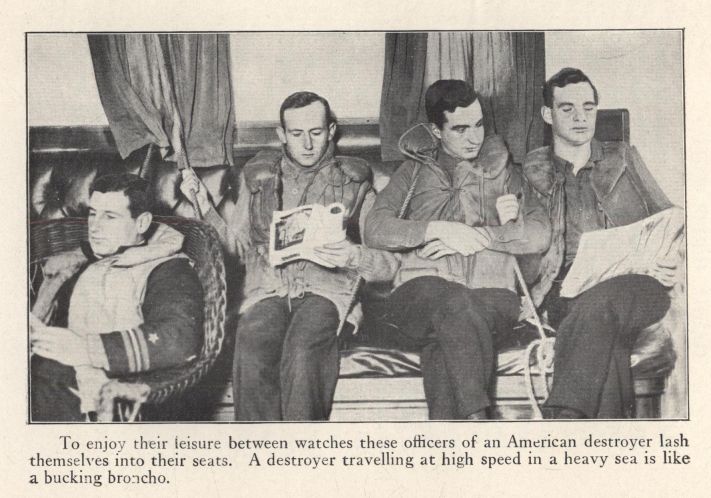
"Good visibility," said somebody on the bridge. "She can't be more than three miles away now. Hello, there's a rocket."
A faint bronzy golden trail, suddenly flowering into a drooping cluster of darting white lights gleamed for a furtive instant among the westering winter stars.
"I saw her, sir!" cried one of the lookouts.
"Where is she, O'Farrell?"
"Quite a bit to the left of the rocket, sir. She's settling by the head."
The beautiful night closed in again. O'Farrell and the engineer continued to peer out into the dark. Suddenly both of them cried out, using exactly the same words at exactly the same time, "Torpedo off the port bow, sir!"
The thing had become visible in an instant. It could be seen as a rushing white streak in the dark water, and was coming towards the destroyer with the speed of an express train, coming like a bullet out of a gun.
The captain uttered a quick word of command. The wheel spun, the roaring, trembling ship turned in the dark. A strange thing happened. Just as the destroyer had cleared the danger line, the torpedo, as if actuated by some malevolent intelligence, porpoised, and actually turned again towards the vessel. The fate of the destroyer lay on the knees of the gods. Those on the bridge instinctively braced themselves for the shock. The affair seemed to be taking a long time, a terribly long time. An instant later, the contrivance rushed through the foaming wake of the destroyer only a few yards astern, and continuing on, disappeared in the calm and glittering dark. A floating red light suddenly appeared just ahead and at the same moment all caught sight of the Zemblan.
She was hardly more than half a mile away. Somebody aboard her had evidently just thrown over one of those life buoys with a self-igniting torch attachment, and this buoy burned a steady orange red just off that side on which the vessel was listing. The dark, stricken, motionless bulk leaned over the little pool of orange radiance gleaming in a fitful pool; round the floating torch one could see vague figures working on a boat by the stern, and one figure walking briskly down the deck to join them. There was not a sign of any explosion, no breakage, no splintered wood. Some ships are stricken, and go to their death in flames and eddying steam, go to their death as a wounded soldier goes; other ships resemble a strong man suddenly stricken by some incurable and mysterious disease. The unhappy Zemblan was of this latter class. There were two boats on the water, splashing their oars with a calm regularity of the college crews; there were inarticulate and lonely cries.
Away from the light, and but vaguely seen against the midnight sky, lay a British patrol boat which had happened to be very close at hand. And other boats were signalling—"Zemblan—am coming." The sloop signalled the destroyer that she would look after the survivors. Cries were no longer heard. Round and round the ship in great sweeps went the destroyer, seeking a chance to be of use,—to avenge. Other vessels arrived, talked by wireless and disappeared before they had been but vaguely seen.
Just after two o'clock, the Zemblan's stem rose in the air, and hung suspended motionless. The tilted bulk might have been a rock thrust suddenly out of the deep towards the starry sky. Then suddenly, as if released from a pose, the stern plunged under, plunged as if it were the last act of the vessel's conscious will.
The destroyer cruised about till dawn. A breeze sprang up with the first glow of day, and scattered the little wreckage which had floated silly-solemnly about. Nothing remained to tell of an act more terrible than murder, more base than assassination.
XV CAMOUFLAGE
In the annals of the Navy one may read of many a famous duel, and if the code duello were in existence to-day, I feel certain that the present would not be less fiery than the past. The subject which stirs up all the discussion is camouflage. To ask at a crowded table: "What do you think of camouflage," is to hurl a very apple of discord down among your hosts. For there will be some who will stand by camouflage to the last bright drop of blood, and strive to win you to their mind with tales that do "amaze the very faculties of eyes and ears." You will hear of ships melting into cloud, of vessels apparently going full speed backward, of ships whose funnels have one and all been rendered invisible. And now the mocker is sure to ask the pro-camouflager in the most serious of tones if he ever saw the ship disguised as a sunset which the Germans unhappily discovered on a rainy day. The signal gun of the anti-camouflage squad now having sounded, the assault begins with a demand of "What's your theory?" The pro's reply something about breaking up spaces of colour, optical illusions—"if you draw horizontal lines along a boat's hull, she will appear longer; if you draw vertical or angular parallels, the vessel will appear shorter." The anti's answer that such an expedient might possibly, just possibly, deceive an idiot child for exactly five and one-eighths seconds, as for deceiving a wily Hun,—Good Night! "Do you mean to tell me," cries the devotee of camouflage, growing angry, "that a ship painted one flat, dead colour is less visible against the sea than one whose surface is broken up into many colours?" "Yes, that's what I mean," retorts the anti. "You know as well as I do that a thing that looks like Vesuvius in eruption is ten times more easily seen than a boat painted a dull neutral grey."
"Yes," cries some one else, "but hasn't camouflage on land proved its utility?" "I'm talking about naval camouflage," answers the anti. "On land your camouflaged object is usually stationary itself, and stands in relation to a surface which is always stationary,—the surrounding landscape. Out here, both surfaces, sea and vessel, are constantly in motion and constantly changing their relation to each other." "But I saw a boat—" begins a pro. "Oh, cut it out," cries somebody else wholeheartedly, and the discussion ends exactly where a thousand others have ended.
Whether camouflage be valuable or not, it certainly is the fad of the hour. The good, old-fashioned, one-colour boat has practically disappeared from the seas, and the ships that cross the ocean in these perilous times have been docked to make a cubist holiday; the futurists are saving democracy. There are countless tricks. I remember seeing one boat with a false water line floating in a painted sea whose roaring waves contrasted oddly with a frightfully placid horizon, and I recall another with the silhouette of a schooner painted on her side. I remember a little tramp remorselessly striped, funnels and all with alternate slanting bands of apple-green and snuff brown; I have an indistinct memory of a terrible mess of milky-pink, lemon-yellow and rusty black, which earned for the vessel displaying it the odious title of "The Boil." We saw the prize monstrosity in midocean. Every school of camouflage had evidently had a chance at her. She was striped, she was blotched; she was painted in curves; she was slashed with jagged angles; she was bone grey; she was pink; she was purple; she was green; she was blue; she was egg yellow. To see her was to gasp and turn aside. We had quite a time picking a suitable name for her, but finally decided on the Conscientious Objector, though her full title was "The State of Mind of a C.O. on Being Sent to the Front."
Finally destiny put in my path just the man I wanted to see, the captain of a British submarine. "What do you think of camouflage?" I asked.
"Well," he answered, after a pause, "I can't remember that it ever hindered us from seeing a ship. Visibility at sea strikes me as being more a matter of mass than of colour. The optical illusion tricks are too priceless silly. Must amuse the Huns. You see if the eye does play him false, Fritz detects the error with his gauges."
The P.C's, I am sure, will put this down as a bit of typical submarine "side." Indignant letters, care H.M.S. X999.
XVI TRAGEDY
Just at the fall of night, three days before, a weak and fragmentary wireless had cried forlornly over the face of the waters for immediate help, and had then ceased abruptly like a lamp blown out by a gust of wind. The destroyers, stationed here and there in the vast loneliness of the gathering dark, had heard and waited for "the position" of the disaster, but nothing more came through the night. Presently, it had begun to rain.
And now for three interminable and tedious days and nights rain had been falling, falling with the monotony and purpose of water over a dam. There being little or no wind the drops fell straight as plummets from a sky flat as a vast ceiling, and the air reverberated with that murmuring hum which is the voice of the rain mingling with the sea. Rain greasy with oil it had gathered from the plates poured in little streams off the deck; drops hissed on the iron of the hot stacks. Clad in stout waterproof clothes, and wearing their waterproof hoods, the crew went casually about their duties, their hardy faces showing no sign of discomfort or weariness.
It was about three o'clock in the afternoon of a January day.
Presently the lookout, from his station on the mast, reported: "Floating object off starboard bow," and a few minutes later one of the watch on the bridge reported two more floating masses, this time visible to port. The destroyer was making her way into a vast field of wreckage. Within the radius of visibility, there lay, drifting silently about in the incessant rain, an incredible quantity of barrels, boxes, bits of wood, crates, vegetables, apples, onions, fragments of coke, life preservers and planks.
"See if you can spot a name on anything," said the destroyer's captain. But though everybody looked carefully, not a sign of a name could be seen. Mile after mile went the destroyer down the rain lashed sea, mile after mile of wreckage opened before her.
"Life boat ahead showing flag!"
The captain raised to his eyes the pair of binoculars he wore hanging from his neck, and peered out of the window by the wheel.
"Found her yet, sir?"
"Yes ... it's a small grey boat. Barely afloat, I guess. They've got a shirt or something tied to a mast or an oar. We'll have a look at it. Tell Mullens to have a couple of men stand by with boat hooks in case we run alongside."
The swamped boat, motionless as a stone in the driving rain, lay no more than half a mile off. Voices eagerly discussed the possibility of finding survivors.
"Alive? Course they ain't. Why, the boat's awash."
"Sure, but look at the flag."
"Those poor guys are gonners long ago."
Handled skilfully the destroyer crept alongside the motionless boat, and presently those on the bridge looked directly down upon it. It lay, floating on even keel, not more than six or seven feet off the starboard side, and was held up by its tanks. A red flannel shirt hung soggily against an upright pole, and coloured the shaft with the drippings of its dye. The interior of the boat was but a deep puddle, a dark puddle into which the rain fell monotonous and implacable. Floating face down and side by side in the water lay the fully clothed bodies of two men, whilst at the stern, sitting on a seat just under water, with his feet in the water and his body toppled over on the gunwale, could be seen a third figure dressed in a kind of seaman's jacket. The wet cloth of his trousers clung lightly to his thin legs and revealed the taut muscles of his thighs. Then boat hooks fished out from the side of the destroyer and drew the heavy craft in. A sailor cried out that all were dead.
"Any name on the boat, Hardy?" asked the officer standing by.
"No, sir."
"Very well. Cast off!" The life boat, watched by some rather horrified eyes, slid alongside the destroyers, and drifted solemnly behind.
"Now," said the captain, who had come on deck, "I want one tidy shot put into that boat, Butler."
Ten seconds later, the roar of the four-inch at the stern burst asunder the murmur of the rain, and the watchers saw the boat of the dead crumple and disappear in the loneliness and rain.
XVII "CONSOLIDATION, NOT COÖPERATION"
Talking one day with an English member of the House of Commons, I asked him what he held to be the most important result of American intervention.
"The spirit of coöperation which you have stirred up among the Allies," he answered. "Not that I mean to say that the Allies were continually quarrelling among themselves; the manner in which Britain has shared her ships with other hard pressed nations would refute any such insinuation, but not until you came on the scene was there a really scientific attempt at the coördination of our various forces. You were quite right to insist on a generalissimo. But of course the great lesson you've given us has been through your Navy. There's been nothing like it in the history of the allied forces. What an extraordinary position Admiral Sims has won in England! His influence is perfectly tremendous; there isn't another allied leader who has a tithe of his power. I really do not think that there is a parallel to it in English history."
Now this is no over-statement of the case. The influence of Admiral Sims over the British people is tremendous. All along he has had but one watchword, "Consolidation, not Coöperation." It is a splendid phrase, and Admiral Sims has turned it into action. The way, I gathered from various members of the Staff and the Embassy, had not been without its obstacles. For instance, once upon a time certain American forces were to be sent into a distant area, and a member of the Allied Naval Council sitting in London had taken the stand that the little force should be supplied from the United States. Immediately Admiral Sims pointed out that these American forces must be considered as allied forces and must be supplied from the nearest and most convenient allied sources of supply. And he carried the day. Not only has the Admiral insisted on the consolidation of material forces; but he has also insisted on a consolidation of the allied spirit. Himself a master of diplomacy and tact, he loses no opportunity of reminding the individual officers under his control to bear in mind the good points of other services and to remember the fact that the success of this work would be directly affected by their relations with their comrades of the Great Cause. And this extraordinary consolidation of force and spirit is precisely the thing which more than anything else takes the attention of the visiting correspondent. "Consolidation, not Coöperation"—it is a phrase that well might have been our allied motto from the first.
While in London, I had several talks with Admiral Sims in his office in Grosvenor Gardens. Of the many distinguished men it has been my lot to interview, Admiral Sims stands first for the ability to put a guest at ease. Tall, spare, erect, and walking with a fine carriage, our Admiral is a personality whom the interviewer can never forget. One has but to talk with him a few minutes to realize the secret of the extraordinary personal loyalty he inspires. And he is as popular in France as he is in England. Speaking French fluently, he is able to carry on discussion with the French members of the Naval Council in their own language.
"Consolidation, not Coöperation." There's a real phrase. And thanks to the great man who said it and insisted upon it, we defeated the common enemy.
XVIII MACHINE AGAINST MACHINE
The year stood at the threshold of the spring; a promise of warmth lay in the climbing sun; on land one might have heard the first songs of the birds. At sea, the mists of winter were lifting from the waters, and the sun, for many months shrunk and silver pale, shone hard and golden bright. A fresh, clear wind was blowing from the west, driving ahead of it a multitude of low foam-streaked waves. There was not a sign of life to be seen anywhere on the vast disk of the sea, not a trail, not a smudge of smoke on the horizon's circle, not even a solitary gull or diver. The destroyer, dwarfed by her world, ran up and down the square she had been chosen to guard. She had the air of performing a casual evolution. There was never anything to be found in this particular square. It lay beyond the great highways; even the sight of a coaster was there something of a rarity. Periscopes were never reported from that area, never had been reported, and probably never would be. Caressed by the sun, enveloped in the serenity of the day as in a mantle, the destroyer went back and forth on her patrol.
The emergence of the periscope a quarter of a mile ahead off the starboard bow had in it something so unattended that the incident had a character of abnormality ... much as if a familiar hill should suddenly turn into a volcano. It is greatly to the honour of the ship's discipline, that those aboard were not staled by months of unfruitful vigil, and acted as swiftly as if the destruction of a submarine were matter of daily practice. There it lay, going steadily along about two hundred yards away, ... a simple, most unromantic black rod rising two feet or so above the waves. A white furrow like a kind of comet's tail, streamed behind it, forever widening at the end. Later on, they asked themselves what the submarine could possibly have been doing. Seeking a quiet place to come up to breathe, to effect repairs, to send out a hurried wireless message?
It might have been a rendezvous between the two vessels. One felt that the gods had brought to pass there no careless drama, but a tragedy long meditated and skillfully prepared. The morning sun watched, a casual spectator, the duel between the two engines of violence.
There had been a command, a call of the summoning bell, a release of power carefully stored for just such an event, and the destroyer leaped ahead like a runner from the starting line. The periscope, meanwhile, continued to plough its way straight ahead almost into the teeth of the wind and the flattened, marbly waves. Presently, either because the destroyer had been seen or heard on the submarine telephone, the submarine began to submerge, sucking in a kind of a foaming hollow as she sank. Aboard the destroyer, they wondered if the keel would clear her, and waited for the shock, the rasping grind. But nothing happened. The first depth bomb fell into the heart of the submarine's swirl even as a well placed stone falls in the heart of a pool. Trembling to the roar of her fans, the destroyer fled across the spot, and turned. The wake of her passing had almost obliterated the platter-shaped swirl the submarine had left behind; one had a vision of the great steel cylinder tumbling, bubbling down through green water to dark, harmless as a spool of thread on the surface, but presently to be changed by the wisdom and cunning of men into monstrous and chaotic strength. One, two, three, four, five ... a thundering pound.... The submarine rose behind them, her bow on the crest of the geyser, an immense, tapering rusty mass, wet and shining in the placid glance of the day. From a kind of hole some distance up the side, a stream of oil ran much like blood from a small deep wound.... A gun spoke, and spoke again, a careening whizz, ... ugly hollow crashes of tearing steel ... the sub heeled far over on her starboard side ... those nearest heard, or thought they heard, screaming ... the bow sank, tilting up the great planes and propellers. A monstrous bubble or two broke on the tormented surface just before she disappeared ... and with her going, the calm of the spring morning, which had been frightened away like a singing bird, returned once more to the tragic and mysterious sea.
XIX THE LEGEND OF KELLEY
Kelley, not Von Biberstein or Hans Bratwurst, is his name, Kelley spelled with an "e." The first destroyer officer whom you question will very possibly have never heard of him, the second will have heard the legend, the third will tell you of a radio officer, a friend of his, who received one of Kelley's messages. So day by day the legend grows apace. Kelley is the captain of a German submarine.
The first time that I heard about him he figured as a young Irishman of good family who had attached himself to the German cause in order to settle old scores. "Lots of people know him in the west of Ireland; he goes ashore there any time he cares to." Another version, perhaps the true one, if there be any truth at all in this fantastic business, is that Kelley is no Irishman but a cosmopolitan, jesting German with a Celtic camouflage. No less a person than Captain James Norman Hall testifies that the Germans in the trenches often tried to anger the British troops by pretending they were disloyal Irish. So perhaps Kelley is Von Biberstein after all. A third version has it that Kelley is a Californian of Irish origin. Those who hold to this last view have it that Kelley spares all American ships but sends the Union Jack to the bottom without mercy.
Many and varied are Kelley's activities. He has penchant for sending messages. "I am in latitude x and longitude y; come and get me—Kelley," has come at the dead of night into the ears of many an astounded radio operator. Others declare that these messages were sent by Hans Rose, the skipper of the submarine which attacked the shipping off Nantucket in 1916. All agree that Kelley was the beau ideal of pirates. He sinks a ship and apologizes for his action, he sees the women passengers into the boats with the grace and urbanity of a Chesterfield, he comes alongside a wretched huddle of survivors, supplies them with food, and sends out notice of their position. When they ask his name, he replies "Captain Kelley," and disappears from view beneath the sea. He goes ashore, and proves his visit with theatre tickets and hotel bills. "London hotel bills made out to Kelley, Esquire." He requests the survivors as a slight favour to tell Captain Nameless of the Destroyer XYZ that his propeller shaft needs repairing; that he, Kelley, has been seriously annoyed by having to listen to the imperfect beat via the submarine telephone. There is certainly a flavour of Celt in this chivalry tinged with mockery.
I could never find anybody who had actually seen him, much to my regret, for I should have been glad to describe so famous a person. Months have passed since last I heard of him. Perhaps he is still in the Irish Sea; perhaps he is now at Harwich, perhaps he has gone aloft to join his kinsman "The Flying Dutchman." If so, let us keep his memory green, for he was a pirate sans peur et sans reproche.
XX SONS OF THE TRIDENT
Any essay on the British sailor must rise from a foundation of wholesome respect. One cannot look at the master of the world without philosophy. And British Jack is the world's master, for he holds in his hands that mastery of the seas which is the mastery of the land. He is a sailor of the mightiest of all navies, an inheritor of the world's most remarkable naval tradition, a true son of Britannia's ancient trident.
What is he like, British Jack? How does he impress those companions who share the vigil of the seas?
To begin with the Briton is, on the average, an older man than our bluejacket. British Jack has not gone into the Royal Navy "for the fun of it" or "to see the world," as our posters say, but as the serious business of his life. His enlistment is an eight-year affair, and by the time that he has completed it, he rarely thinks of returning to a prosaic life ashore. Thus it comes about that whilst our American sailors are usually somewhere in the eager, irresponsible twenties, British tars are often men of sober middle age. One is sure to see, in any of the "home ports," the fleet's married men out walking on Sunday with their wives and children, forming together a number of honest, steady little groups whose hold on the durable satisfactions of life it is a pleasure to see. The "home ports" idea has well proved its value. It is simple enough in operation. Each ship, according to the plan, bases on some definite port, thus permitting poor Jack (who has enough of roaming at sea) to have a steady home on land. In all the great British bases, therefore, you will find these sailor colonies. I was well acquainted with a retired Navy chaplain who ministered to such a group. These families form a distinct group dependent on the Navy. Marriages are performed by the naval chaplain, the ills of the flesh are looked after by the fleet surgeons, and the rare troubles are brought to the judgment of Jack's favourite officers.
Our American crews are gathered together from all over the vast continent, British crews are often recruited from one section of the country. For instance, a ship manned by a crew from "out o' Devon" is known as a "West Country" ship and its sailors as "Westos." A real Royal Navy man knows in an instant the character of any ship which he happens to visit. The drawled "oa's" and oe's" of the West tell the story. I once heard a "Westo" refer to an officious wharf tender as a "bloody to-ad," a phrase that certainly has character. Then there be ships based on Irish ports. Indeed, there are sure to be Irish sailors on every ship, irresponsible, keen-witted Celts to whom all devilment is entrusted.
The war has not been without influence on the naval personnel. British Jack had, in his own social system, a place of his own. He is not looked down upon, for the British bluejacket has been, is, and forever ought to be the best loved of national figures. Sons of "gentlemen," however, I use the word here in its British sense, did not join the Royal Navy as enlisted men. Such a thing would have been regarded as "queer" (no mild word, in Britain), and the crew certainly would have looked upon any such arrival as an intruder. But just as the war has placed University men side by side in the ranks with troopers like Kipling's Ortheris, so has it placed among the enlisted personnel of the Royal Navy a large number of men from the educated and wealthier class. There hung in the Royal Academy this spring a portrait of a British bluejacket, a pleasant-looking lad some nineteen or twenty years of age with blond hair, a long face and honest eyes of English grey. It was entitled "My Son." Almost invariably the older visitors to the exhibition, when looking at this picture, would fall to talking of the change in the social system which the portrait symbolized.
There are always a number of boys on British ships, for the British hold that to be a good sailor, one should early become familiar with the sea. The status of "boy" is a kind of distinct rating, and these youngsters are addressed by their last names, viz., Boy Bumblechook or Boy Stiggins. They have shown up wonderfully well. One has but to recall little Cornell of Jutland to see of what stuff these lads are made.
The British sailor's uniform is picturesque and characteristic, but certainly less attractive than ours. It is cut not of broadcloth or of serge, but of heavy blue worsted, and a detachable collar of blue linen falls back upon the blouse. Our sailors are forever washing the blouses to keep the white stripes of the collar clean; the Briton has only his collar to care for. And there is a difference between the national builds as marked as the difference twixt the uniforms. Our Jack is rangy, lean and quick-moving, the Briton heavier, shorter, and more deliberate. In hours of leisure, the Briton busies himself with knitting, wood-carving or weaving rag rugs; the American, driven by the mechanical genius of the nation, hurries to the ship's machine shop to pound a half-crown into a ring.
The sons of Columbia and the sons of Britannia get on very well together. At the big club house at the Irish base, there are always little groups of British sailors to be seen, quiet, well-behaved fellows who watch everything with British dignity. Our bluejackets, however, are far more chummy with British soldiers than with Britons of their own calling. Navy blue and khaki are forever going down the street arm in arm. The tar is always keen to hear of the front. Tommy does the talking. After all, there is a difference in the vernacular. Witness this poem which I reprint from the August number of Our Navy. It is by a Navy man, Mr. R. P. Maulsley. The word Limey, here shortened to "Lima," means, used as a noun, a British sailorman; used as an adjective, British. The term had its origin in the ancient British custom of giving lime juice to ward off scurvy.
THE LIMA AND THE YANKS
By R. P. Maulsley
It was nice and cozy in the "Pub," And blowing cold outside. By the fireplace sat two gobbies, America's joy and pride.
When a Lima from a cruiser Thought their talk he'd like to hear, And sat down just behind them, With a half o' pint of beer.
And o'er a flowing mug of ale, That held about a quart, He heard them swapping stories About their stay in port.
"Say, this is sure some burg, Tho' it ain't the U.S.A., But did you pipe the classy Jane, That passed us on the quay?
"She gave me some sweet smile, bo, And winked her pretty eye," "Get out, you big hay-maker, It was for me she meant to sigh."
"G'wan you homely piece of cheese, You're talkin' thru' your hat, I'll betsha just ten plasters, It was me she was smiling at."
"I'll take that up old-timer, Why, that's some easy dough, We'll have another round, And then we'll have to blow.
"And if I lamp that broad, kid, And she cottons to me quick, I'll buy her everything in town, And make that ten look sick."
They arose and left the Lima, A gasping in some chairs, And as they left the room, He heard them on the stairs.
"Like candy from a baby, I'll take your coin this day, And have a high old time and— Say, how did you get that way?"
The Lima emptied his tankard, And caught the barmaid's eye, "I 'eard them Yanks a tarkin', But what the bloomin' ell'd they seye?"
XXI THE FLEET
The fleet lay in the Firth of Forth. It was one o'clock in the afternoon, and the little suburban train which leaves and pauses at the Edinburgh Grand Fleet pier had not yet been brought to its platform. The cold sunlight of a northern spring fell upon the vast, empty station, and burnished the lines of rail beyond the entrance arch. Two porters from the adjoining hotel, wearing coats of orange-red with dull brass buttons, stood lackadaisically by a booking office closed for the dinner hour. Presently, after a piercing shriek intensified by the surrounding quiet, the suburban train backed in with a smooth, crawling noise. Various folk began to appear on the platform, a group of young British naval officers, a handful of older sailors, a captain carrying a small leather affair much like a miniature suit-case, a number of civilians, two "Jacks" evidently on furlough, and a young sailor lad with a fine bull terrier bitch on a leash. No one entered to share my compartment. The train left behind the clean, grim town ... rolled on through suburbs and through fields barely awake to the spring ... paused here and there at tidy, little stations ... reached the station above the pier. Somewhat uncertain of my path to the landing, I followed a group of officers. A middle-aged soldier sentry with grey hair and ruddy cheeks held me up for my pass, unfolded and folded it again with extraordinary deliberation, and courteously set me on my way. As yet there was no sign of the sea, nor had it once been visible during the journey. One might have been on the way to play golf at an inland field. The path to the pier descended a great flight of steps and passed a space in which men were playing football.... A turn down a bit of road, and I was looking at the fleet.
It lay in the great firth, in a monstrous estuary enclosed between barren banks rising to no great height. Bare, scattered woodlands were to be seen, a clump of cottages, a castellated house in a solitary spot, a great wharf with a trumpery traveller's bookstall in a wooden shed at its entrance, a huddle of grey roofs at the water's edge on the distant side. Over a spur of land the smoke of a giant dockyard rose in a hazy reek to the obscured and silvery sun. The water in which the squadrons lay was for the moment as calm as a woodland pool; in colour, green-grey.... An incredible number of ships of war lying lengthwise in orderly lines, bows turned to the unseen river of the rising tide, ... row after row, squadron after squadron, fleet after fleet, ships of war, dark, terrible and huge, no more to be counted than the leaves of trees. As far as the eye could reach up and down the firth, ships. One beheld there the mastery of the sea made visible, the mastery of all the highways and the secret paths of the waters of earth. Because of this fleet ships were able to bring grain from distant fields, great hopes were kept aflame, and the life blood of evil ambitions poured upon the ground. A grey haze lay at the mouth of the roads and somewhere in the heart of it was target practice being held, for violent blots of light again and again burst open the dim and veiling fog. Small gulls passed on motionless wings, whistling. Now and then a vessel would run up a tangle of flags. The signal light of a flagship suddenly uttered a message with intermittent flashes of an unnatural violet white glare.
Over earth and sea brooded the peace of empire.
XXII THE AMERICAN SQUADRON
The morning found me a guest aboard the flagship of the American battleship squadron attached to the Grand Fleet. Going on deck, I found the sun struggling through thin, motionless mists. A layer of webby drops lay on wall and rail, on turret and gun. Presently a little cool wind, blowing from the land, fled over the calm water in mottled, scaly spots, bringing with it a piping beat of rhythmic music. Half a mile beyond the flagship, the crew of a British warship were running in a column round and round her decks to the music of the ship's band. An endless file of white clad figures bent forward, a faint regular tattoo of running feet. Round and about several of the giants were signalling in blinker. Beyond us stood a titanic bridge, whose network was here and there smouched with clinging vapour, and beneath this giant, a tanker laden with oil for the fleet passed solemnly, followed by wheeling gulls. Presently two American sailors, lads of that alert, eager type that is so intensely and honestly American, popped out of a doorway and began to polish bright work.
America was there.
Surely it was one of the finest thoughts of the war to send this squadron of ours. Putting aside for the instant any thought of the squadron as a unit of naval strength, Americans and Britons will do well to consider it rather as a splendid symbol of a union dedicated to the most honourable of purposes, to the defence of that ideal of fraternity and international good faith now menaced. They say that when the American squadron came steaming into the fleet's more northern base one bitter winter day, cheer after cheer broke from the British vessels as they passed, till even the forlorn, snow-covered land rang with the shouting.
It has recently been announced that our battleship squadron is under the command of Admiral Hugh Rodman, which announcement the Germans must have taken to heart, for Admiral Rodman is a man of action if ever one there was. Tall, strongly built, vigorous and alert, he dominates whatever group he happens to find himself in by sheer force of personality. It would fare ill with a German who brought his fleet under the sweep of those keen eyes. Admiral Rodman is a Kentuckian, and a union of blue grass and blue sea is pretty hard to beat, especially when accompanied by a shrewd sense of humour.
I talked with Admiral Rodman about the squadron and its work.
"Always remember," said he, "that this squadron is not over here, as somebody put it, 'helping the British.' Nor are we 'coöperating' with the British fleet. Such ideas are erroneous, and would mislead your readers. Think of this great fleet which you see here as a unit of force, controlled by one ideal, one spirit and one mind, and of the American squadron as an integral part of that fleet. Take, as an instance of what I mean, the change in our signalling system. We came over here using the American system of signals. Well, we could not have two sets of signals going, so in order to get right into things, we learned the British signals, and it's the British system we are using to-day.... There are American ships here and British ships but only one fleet.
Everywhere I went, I found both British and American officers keen to emphasize this unity. Said a Briton—-"Why we no longer think of the Americans of 'the Americans'; we think of squadron X of the fleet. It's just wonderful the way your chaps have got down to business and fallen in with the technique and the traditions. We expected to see you spend some time getting into the life of the fleet and all that, you know; the sort of thing that a boy in a public school goes through before he gets the spirit and the ways of the place, but your people came along in the morning and had picked up everything by the afternoon." And I found the Americans proud of the fleet's essential oneness, proud to share in its great tradition, and to be a part of its history. America is taking no obscure place. Her hosts have given her the place of honour in the battle line.
An American battleship fleet leaving the harbor
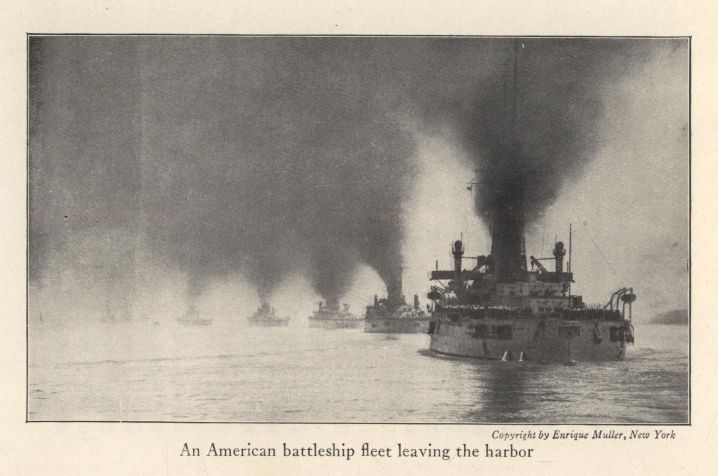
Battle—that was the thought of everybody aboard the fleet. If only the German "High Canal" fleet would really come out and fight it to a finish, or as an American lieutenant put it, "start something." The Germans, however, knew only too well that the famous betoasted Der Tag would turn swiftly into a Dies Iræe and preferred to surrender. So for lack of an antagonist, the fleet had to be content to keep steam up all the time and to know that everything was prepared for a day of battle. But the fleet did far more than wait. No statement of the Germans was more empty of truth than the silly cry that the British fleet lies "skulking in harbour for fear of submarines." The fleet was busy all the time. Again and again, a visible defiance, it swept by the mine sealed mouths of the German bases. For five years now, the fleet has been on a war footing prepared for instant action, a tremendous task this. "If they only had come out, the beggars."
A day with the fleet in port passed casually and calmly enough. There was none of that melodrama which invests the war of the destroyer and the submarine, and human problems seemed to lack importance, for in the fleet man is somewhat shadowed by the immense force he has created. On board there were various drills, perhaps a general quarters practice drill that sends everybody scurrying to his station. Hour after hour, the visitor sees the continuous and multitudinous activity needed to keep a dreadnaught in shape as a fortress, an engine, and a ship. Then, when the evening has come, such officers as are off duty may sit down to a game of bridge or go to their rooms to read or study quietly. There are great days when kings and queens come aboard and are royally entertained. Twice a week the entertainment committee of the fleet sent round a steel box full of "movies." However, everybody enjoys them, and laughs. But it is good to escape on deck again, and see the squadron and the fleet beneath the haloed moon.
The shores about are quite in darkness, though now and then a glow appears over the hidden dockyard as if some one there had opened a furnace door. A little breeze is blowing a thin, flat sheet of cloud across the moon; one can hear water slapping against the sides. The sailors on watch walk up and down the decks, shouldering their guns. In the light one might believe the basketry of the woven masts to be spun of delicate silver bars. Behind us ride the other vessels of the squadron, a row of dark, triangular shapes. The great columnar guns, sealed with a brazen plug, seem mute and dead. The curtain of a hatchway parts, and a little group of officers come on deck to watch a squadron go to sea. One by one the vessels, battleships and attendant destroyers glide past us into the dark, and so swift and silent their motion is that they seem to be less self-propelled than drawn forward by some mysterious force dwelling far beyond in the moonlit sea. A slight hiss of cleaving water, the length of a hurrying grey fortress beneath the moon, and the last of the squadron vanishes down the roads. For a little time one may see the diminishing glares of blinker lights. Squadrons of various kinds are forever leaving a fleet base to go on mysterious errands, squadrons are ever returning home from the mystery and silence of the sea.
A friend comes to tell me that we have been put on "short notice," and may leave at any instant.
XXIII TO SEA WITH THE FLEET
On the morning of the day that the fleet went out, there was to be felt aboard that tensity which follows on a "short notice" warning. Officers rushed into the wardroom for a hasty cup of coffee and hurried back to their beloved engines; the bluejackets, too, knew that something was in the air. A visitor to the flagship will not have to study long the faces of his hosts to see that they are an exceptional lot of men. Whilst among the destroyers there is a good deal of the grey-eyed ram-you, damn-you type; on a battleship there is a union of the elements of thought and action which is very fine to see. Nor is the artist element lacking in many a countenance. I remember a chief engineer whose ability as an engineer was a word in the fleet; it was easy to see, when he took you through his marvellous engine room, that he enjoyed his labour as much for the wonder of the delicacy, the power and the precision of his giant engines as he did for their mere mechanical side of pressures and horsepower. Nor shall I ever see a more perfect example of coördination and competence than a turret drill at which I was invited to assist. From the distinguished young executive to the lowest rated officer in "the steerage," every man brought to his task not only an expert's understanding of it, but a love of his work, which, I think it is Kipling that says it, is the most wonderful thing in all the world. The vessel was very much what Navy folk call a "happy ship." I must say the prospect of going out with the fleet and with such a wonderful crowd did not make me keenly miserable. "If they only would come out, ah, if...!"
"So we are still on an hour's notice," I said to one of my hosts in the hope of getting some information.
"Yes, back again. At two o'clock this morning the time was extended, but after seven we were put back on short time once more."
"I suppose the time is always shifting and changing?"
"Yes, indeed. You know we are always on an hour's notice. Pretty short, isn't it? You see we don't want the Germans to get away with anything if we can help it. Got to be ready to sail right down and smash them. Nobody knows just why the time changes come. Somebody knows something of course. Perhaps one of the British submarines on outpost duty off the German coast has seen something, and sent it along by wireless.
I asked about the German watch on the British bases.
"Subs. Everybody's doing it. I suppose that two or three are hanging off this coast all the time trying to get a squint at the fleet. It's what we call keeping a 'periscope watch' ... run by the naval intelligence. Little good anything they pick up about us does the Germans! Safety first is their daring game. What they are itching to do is to pick off one of our patrol squadrons that's gone on a little prospecting toot all by itself. They'd try, I think, if they weren't mighty well aware that not a single ship of the crowd that did the stunt would ever get back to the old home canal."
Presently a sailor messenger arrived, stood to attention, saluted snappily, and presented a paper. The officer read and signed.
"You're in luck," said he. "We are going out ... due to leave in three hours. Whole fleet together, evidently. Something's on for sure.... Hope they're out." And off he hurried to his quarters. I saw "the exec." going from place to place taking a look at everything. Pretty soon the chaplain of the flagship, an officer to whose friendly welcome and thoughtful courtesy I am in real debt, came looking for me.
"Come along," he cried, "you are missing the show. They're beginning to go out already. You ought to be on deck," and seizing me by the arm, he rushed me energetically up a companionway to the world without. There I learned that the departure of the Grand Fleet was no simultaneous movement such as the start of an automobile convoy, but a kind of tremendous process occupying several hours. The scout vessels, were to go first, then the various classes of cruisers and the destroyer flotillas with whom they acted in concert, last of all the squadrons of battleships. Our own sailing time was three hours distant and the outward movement had already begun.
Even a super-dreadnought is wet at times
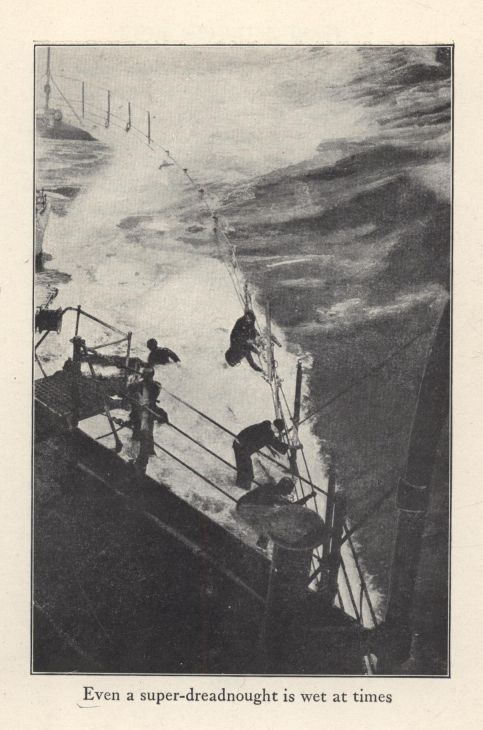
The day was a pleasant one, the sun was shining clear and a fresh salty breeze was blowing down the estuary. The officers, however, shook their heads, talked of "low visibility," and pointed out that an invisible mist hung over the water, whose cumulative effect was not at all to their liking. First there went out a new variety of submarine, steam submarines of extraordinary size and speed; there followed a swift procession of destroyers and lighter cruisers, many signalling with blinker and flag. The outgoing of the destroyers was a sight not to be forgotten, for more than anything else did it impress upon me the titanic character of the fleet. Destroyers passed one every fifty seconds for a space of many hours. You would hear a hiss, and a lean, low rapier of a vessel would pass within a hundred yards of the flagship and hurry on, rolling, into the waiting haze of the open sea, and as you watched this first vessel leave your bow astern, you would hear another watery hiss prophetic of the following boat. On our own vessel all boats had long before been hoisted to their places; there were mysterious crashing noises, bugle calls, a deal of orderly action. Time passed; a long time full of movement and stir. The greater vessels began to go out, titans of heroic name, The Iron Duke, Queen Elizabeth, Lion. A broad swirling road of water lay behind them as one by one they melted into that ever mysterious obscurity ahead. Then with a jar, and a torrent of crashing iron thunder dreadful as a disintegration of the universe itself, our own immense anchor chains rose from the water below, and the American flagship got under way. We looked with a meditative eye on the bare shores of the firth wondering what adventures we were to have before we saw them again. Behind us the mist gathered, ahead, it melted away. And thus we stood out to the open sea. Night came, starlit and cold. Just at sun-down one of the British ships destroyed a floating mine with gun fire. I sought information from an officer friend.
"What about the mine problem?"
"Never bothers us a bit, though the Germans have planted mines everywhere. This North Sea is as full of them as a pudding is of plums."
"Why is it then that the fleet doesn't lose ships when out on these expeditions?"
"Because the British mine sweepers have done so bully a job."
"But once you get beyond the swept channels at the harbour mouths, what then?"
"The mine-sweepers attend to the whole North Sea."
"You mean to say that the Admiralty actually clears an ocean of mines?"
"To all intents and purposes, yes. Haven't you read of naval skirmishes in the North Sea? They are always having them. Many of those skirmishes take place between patrol boats of ours and enemy patrols. Of course it's a task, but the British have done it. One of the most wonderful achievements of the war."
"Suppose the Germans try to reach the British coast?"
"They do their best to find the British path. As a result, the Germans are always either bumping into their own mines or into ours. I feel pretty sure that their loss from mines has been quite heavy."
"Where, then, are the German cruising grounds? Doesn't their fleet get out once in a while?"
"Not to the outer sea. Once in a while they parade up the Danish coast, never going more than two or three hours from their base. Our steady game, of course, is to nab them when they are out, and cut off their retreat. If the weather had held good at Jutland, this would have been done. But the Germans now hardly ever venture out. Destroyers of theirs, based on the Belgian coast, try to mix things up in the Channel once or twice a year, but the fleet seems to stick pretty closely to dear old Kiel."
"Any more information in regard to this present trip?"
"Not a thing. It's always mysterious like this. Yet in twenty minutes we may be right in the thick of the world's greatest naval battle."
The next morning I rose at dawn to see the fleet emerge from the dark of night. A North Sea morning was at hand, cold, windy and clear. Now seas have their characters even as various areas of land, and there is as much difference between the North Sea and the Irish Sea as there is between a rocky New England pasture and a stretch of prairie. The shallow North Sea is in colour an honest salty, ocean green, and its surface is ever in motion; a sea without respite or rest. It has a franker, more masculine character than the beleaguered sea to the west with its mottlings of shadow and shoal and weaving, white-crested tide rips. A great armament, scouts, destroyers, and light cruisers had already passed over the edge of the world, and only a very thin haze revealed their presence. Miles ahead of us in a great lateral line, a number of great warships, vast triangular bulks, ploughed along side by side, then came the American squadron in a perpendicular line, each vessel escorted by destroyers. Behind us, immense, stately, formidable and dark, the second American ship followed down the broad river of our wake which flowed like liquid marble from the beat of the propellers. And behind the American squadron lay other ships, and over the horizon the bows of more ships still were pointing to the mine-strewn German coast. The Grand Fleet line, eighty miles long, rode the sea, a symbol of power, an august and visible defiance. Standing beneath the forward turret, beside the muzzles of the titan guns, I felt that I had at last beheld the mightiest element of the war.
Tightly wrapped in a navy great coat, the young officer whose guest I had been at turret drill walked up and down the deck watching the southeastern horizon. What eagerness lay in his eyes! If we only might then have heard a heavy detonation from over the edge of the dawn-illumined sky! ... All day long we cried our challenge over the sealed waters ahead.
Were "they" out? To this day, I do not know. The ways of the fleet are mysterious. Certainly, none came forth to accept our gage of battle. A time passed, and we were in port again. We saw the vessels we had left behind, the supply ships, tugs, oil tenders, colliers ... all the servants of the fleet.
Down in the wardroom, the tension relaxed. The anchor chain rattled out; once more the universe seemed to part asunder. The mail had arrived, joyous event. Somebody put a roll of music into a rather passé player piano, and let loose an avalanche of horribly orderly chords.
And all the time the Olympians were preparing, not the battle of the ages, but the Great Surrender!
XXIV "SKY PILOTS"
We know him as chaplain, the gobs use the good old term "Sky Pilot," and the British call him "Padre." His task, no light one, is to look after the spiritual and moral welfare of some thousand sailor souls. He is general counsellor, friend in need, mender of broken hearts, counsel for the defence, censor, and show manager. Now he comes to the defence of seaman, first class, Billy Jones, whose frail bark of life has come to grief on the treacherous reef of the installment plan, and for whose misdemeanours a clamouring merchant is on deck threatening to "attach the ship." Now he is assuring the clergyman of the church on the hill that 2nd class petty officer Edgar K. Lee (who is going to marry pretty little Norah Desmond) is not, as far as he knows, committing bigamy. They tell of a chaplain of the destroyer force who, pestered beyond bearing by these demands that the American bridegroom be declared officially and stainlessly single, floored his tormentor by replying: "I've told you that as far as we know the man's unmarried. We can't give you any assurance more official. He may be bigamous, trigamous, quadrugamous, or," here he paused for effect, "pentagamous, but I advise you to risk it." The land sky pilot is said to have collapsed.
Aboard the flagship of the Grand Fleet, the chaplain of the vessel was my guide, counsellor, and friend. In the words of one of the sailors, "Our chaplain is a real feller." And indeed it would have been hard to find a better man for the task than this padre of ours with his young man's idealism, friendliness, and energy. In addition to his welfare work, he had his duties as a de-coder, and his spare time he spent tutoring several of the enlisted personnel who were about to take examinations for higher ratings. It is a great mistake, by the way, to imagine that a violent gulf lies between the commissioned officer and the enlisted man. One finds the higher officer only too glad to help the sailor advance, and many times have they said to me, "Don't write about us, write about the sailors; get to know them; get their story." On this particular ship many of the younger officers were, like the chaplain, giving up their spare time to help the ambitious men along. Correspondence school courses are great favourites in the Navy, and have undoubtedly helped many a sailor on to a responsible rating.
Our flagship chaplain used to make several rounds of the ship every day, "tours of welfare inspection," he used to call them humorously. Everywhere would he go, from wardroom to torpedo station, not neglecting an occasional visit to the boiler room. Friendly grins used to salute him on his passage; as the sailor said he was a "real feller." I often accompanied him on his rounds. When the tour was over, we would go to the chaplain's room for a quiet smoke and a good talk. The chaplain's room was always clean and quiet, and on the bookshelf, instead of weighty books on thermodynamics and navigation, were the pleasant kind of books one found in friendly houses over home.
"Do you know," said the chaplain to me one day, "you have landed here at an interesting time. There's very little shore leave being given because it can't be given, and as a result the life of the ship is thrown back upon itself for all its amusements and social activities. What do you think of the morale here?"
"I think it's very high," I answered. "The men seem very contented and keen. I've talked with a great many of them. How do you keep the morale up?"
"Well, this ship has always been famous as a 'happy ship'" (here I ventured to say that any other condition would be impossible under the captain we had) "and when men get into the habit of working together good-naturedly, that habit is liable to stick. And I find the men sustained by the thought of active service. You may think it calm here, having just arrived from a destroyer base, but think of what it is over on the American coast."
"Calm?" said I. "Don't put that down to me. The very idea of being with the Grand Fleet is thrilling. It's the experience of a lifetime. And let me tell you right from personal experience that no sight of the land war can match the impressiveness and grandeur of the first view of the fleet."
"I feel just as you do. The whole thing is a constant wonder. And some day the Germans may come out. Moreover, summer is now at hand, and we shall have a chance to use the deck more for sports. This long, raw, rainy winter doesn't permit much outdoor exercise. As soon as it gets warm, however, we shall have boxing matches on the deck between various members of the crew and the champions of the different ships. We have some good wrestlers, too. At present we are reduced to vaudeville competitions between our various vessels, and movies. I'm doing my best to get better movies. So we shan't fare badly after all."
"When do you hold Sunday services?"
"I have a service in the morning and another in the evening. Yes, I muster a pretty big congregation. But I'm afraid I've got to be going now, got to ram a little algebra into the head of one of the boys. See you at dinner." And our sky pilot was gone. May good luck go with him, and good friends be ever at hand to return him the friendliness he grants.
They tell a story of a favourite chaplain who retired from the Navy to take charge of a parish on land.
"Good-bye, sir," said one of the old salts to him, as he was leaving the ship. "Good-bye, sir. We'll all look to see you come back with a bishop's rating."
XXV IN THE WIRELESS ROOM
I haven't the slightest idea where the wireless room is or how to find it. All that I remember is that some kind soul took me by the hand, led me through various passages and down several ladders, and landed me in a small compartment which I felt sure must have been hollowed out of the keel. The wireless room of a great ship is, by the way, a kind of holy of holies, and my visit to it more than an ordinary privilege.
There are as many messages in the air these times as there were wasps in the orchard in boyhood days after one had thrown a large, carefully-selected stone into the big nest. Messages in all keys and tunes, messages in all the known languages, messages in the most baffling of codes. Now the operator picks up a merchantman asking for advice in English, this against all rules and regulations; a request once answered by a profane somebody with "Use the code, you damned fool." At intervals the Eiffel Tower signals the time; listening to it, one seems to hear the clear, monotonous tick-tock of a giant pendulum. Now it is a British land station talking to a British squadron on watch in the North Sea, now the destroyers are at it, now one hears the great station at Wilhelmshaven sending out instructions to the submarine fleet in ambush off these isles.
How strange it is to come here at midnight and hear the Germans talking! Germany has been so successfully cut off from contact with the civilization she assaulted that these communications have the air of being messages from Mars. There are times when the radio operator picks up frantic cries sent by one U-boat to another; I have before me as I write a record of such a call. It began at 2.14 A.M., shortly after a certain submarine was depth-bombed by an American destroyer. First to be received was OLN's clear, insistent call for RXK and ZZN, probably the two nearest members of the U-boat fleet. Were they cries for help? Probably. Again and again the spark uttered its despairing message. For some time there was no answer. The other two boats may have been submerged; quite possibly sunk. Then at 2.40 from far, far away came ADL calling OLN. At 2.45 OLN answered very faintly. A minute or two later, ADL tried and tried again to get either RXK and ZZN. But there was no answer. Was she trying to send them to the help of the stricken vessel? At 2.57 ADL tries for the hard pressed OLN, but no answer comes to her across the darkness of the sea.
Night and day, a force of operators sit here taking down the messages, sending important ones directly to the chief officers, and letting unimportant ones accumulate in batches of four and five. The messages are written or typewritten on a form in shape and make-up not unlike that of an ordinary telegram blank. All day and all night long, the messengers hurry through the corridors of the great ship with bundles of these naval signals. And since everything intended for the Navy comes in code, decoders too must be at hand at all hours to unravel the messages. It is no easy task, for the codes are changed for safety's sake every little while. On board the great ship I visited, the chaplain did a big share of this work. I can see him now bent over his table in the wireless room, spelling out sentences far more complicated than the Latin and Greek of his university days.
There is one wireless service which will not be remembered with affection by our sailors over there, the Government Wireless Press Service. I was in the Grand Fleet when that dashing business of the first Zeebrugge raid occurred. The "Press News" on the following morning mentioned it, and warned us impressively to keep our knowledge to ourselves. As a result we spoke of it at breakfast time with bated breath. I myself, a modest person, was stricken with a sudden access of importance at possessing a Grand Fleet secret.