Book III—In the Wild Interior. (continued 2)
Reading edition
“Take down your fiddle, Findlayson, and play a rattling strathspey or reel, that’ll cheer me up more wholesomely than any amount of ‘wee drappies.’”
“Come out o’ doors then.”
It was cool now out there in Findlayson’s garden—it was a real garden too. His garden and his fiddle were Findlayson’s two fads; and that he was master of both, their present surroundings of fern and flower, and delicious scent of wattle-blossom, and the charming strains that floated from the corner where the squatter stood were proof enough. The fiddle in his hands talked and sang, now bold or merrily, now in sad and wailing notes that brought tears to even Archie’s eyes. Then, at a suggestion of Craig’s, Etheldene’s sweet young voice was raised in song, and this was only the beginning of the concert. Conversation filled up the gaps, so that the evening passed away all too soon.
Just as Findlayson had concluded that plaintive and feeling air “Auld Robin Gray,” a little black girl came stealthily, silently up to Etheldene, and placed a little creature like a rabbit in her lap, uttering a few words of Bush-English, which seemed to Archie’s ear utterly devoid of sense. Then the black girl ran; she went away to her own camp to tell her people that the white folks were holding a corroboree.
The gift was a motherless kangaroo, that at once commenced to make itself at home by hiding its innocent head under Etheldene’s arm.
The party soon after broke up for the night, and next day but one, early in the morning, the return journey was commenced, and finished that night; but the sun had gone down, and the moon was shining high and full over the forest, before they once more reached the clearing.
Chapter Twenty Four.
A New Arrival.
Winslow made months of a stay in the Bush, and his services were of great value to the young squatters. The improvements he suggested were many and various, and he was careful to see them carried out.
Dams were made, and huge reservoirs were dug; for, as Winslow said, their trials were all before them, and a droughty season might mean financial ruin to them.
“Nevertheless,” he added one day, addressing Bob, “I feel sure of you; and to prove this I don’t mind knocking down a cheque or two to the tune of a thou or three or five if you want them.
“I’ll take bank interest,” he added, “not a penny more.”
Bob thanked him, and consulted the others that evening. True, Archie’s aristocratic pride popped up every now and then, but it was kept well under by the others.
“Besides, don’t you see, Johnnie,” said Harry, “this isn’t a gift. Winslow is a business man, and he knows well what he is about.”
“And,” added Bob, “the fencing isn’t finished yet. We have all those workmen’s mouths to fill, and the sooner the work is done the better.”
“Then the sheep are to come in a year or so, and it all runs away with money, Johnnie. Our fortunes are to be made. There is money on the ground to be gathered up, and all that Winslow proposes is holding the candle to us till we fill our pockets.”
“It is very kind of him,” said Archie, “but—”
“Well,” said Bob, “I know where your ‘buts’ will end if you are not careful. You will give offence to Mr Winslow, and he’ll just turn on his heel and never see us again.”
“Do you think so?”
“Think so? Yes, Archie, I’m sure of it. A better-hearted man doesn’t live, rough and all as he is; and he has set his mind to doing the right thing for us all for your sake, lad, and so I say, think twice before you throw cold water over that big, warm heart of his.”
“Well,” said Archie, “when you put it in that light, I can see matters clearly. I wouldn’t offend my good old Uncle Ramsay’s friend for all the world. I’m sorry I ever appeared bluff with him. So you can let him do as he pleases.”
And so Winslow did to a great extent.
Nor do I blame Bob and Harry for accepting his friendly assistance. Better far to be beholden to a private individual, who is both earnest and sincere, than to a money-lending company, who will charge double interest, and make you feel that your soul is not your own.
Better still, I grant you, to wait and work and plod; but this life is almost too short for much waiting, and after all, one half of the world hangs on to the skirts of the other half, and that other half is all the more evenly balanced in consequence.
I would not, however, have my young readers misunderstand me. What I maintain is this, that although a poor man cannot leave this country in the expectation that anybody or any company will be found to advance the needful to set him up in the business of a squatter, still, when he has worked hard for a time, beginning at the lowermost ring of the ladder, and saved enough to get a selection, and a few cattle and sheep, then, if he needs assistance to heave ahead a bit, he will—if everything is right and square—have no difficulty in finding it.
So things went cheerily on at Burley New Farm. And at last Winslow and Etheldene took their departure, promising to come again.
“So far, lads,” said Winslow, as he mounted his horse, “there hasn’t been a hitch nowheres. But mind keep two hands at the wheel.”
Mr Winslow’s grammar was not of the best, and his sentences generally had a smack of the briny about them, which, however, did not detract from their graphicness.
“Tip us your flippers, boys,” he added, “and let us be off. But I’m just as happy as if I were a father to the lot of you.”
Gentleman Craig shook hands with Mr Winslow. He had already helped Etheldene into her saddle.
Archie was standing by her, the bridle of his own nag Tell thrown carelessly over his arm; for good-byes were being said quite a mile from the farm.
“I’ll count the days, Etheldene, till you come again,” said Archie. “The place will not seem the same without you.”
Craig stood respectfully aside till Archie had bade her adieu, then, with his broad hat down by his side, he advanced. He took her hand and kissed it.
“Good-bye, Baby,” he said.
There were tears in Etheldene’s eyes as she rode away. Big Winslow took off his hat, waved it over his head, and gave voice to a splendid specimen of a British cheer, which, I daresay, relieved his feelings as much as it startled the lories. The “boys” were not slow in returning that cheer. Then away rode the Winslows, and presently the grey-stemmed gum trees swallowed them up.
Two whole years passed by. So quickly, too, because they had not been idle years. Quite the reverse of that, for every day brought its own duties with it, and there was always something new to be thought about or done.
One event had taken place which, in Bob’s eyes, eclipsed all the others—a little baby squatter saw the light of day. But I should not have used the word eclipsed. Little “Putty-face,” as Harry most irreverently called her, did not eclipse anything; on the contrary, everything grew brighter on her arrival, and she was hailed queen of the station. The news spread abroad like wildfire, and people came from far and near to look at the wee thing, just as if a baby had never been born in the Bush before.
Findlayson dug the child with his forefinger in the cheek, and nodded and “a-goo-ed” to it, and it smiled back, and slobbered and grinned and jumped. Findlayson then declared it to be the wisest “wee vision o’ a thing the warld ever saw.” Sarah was delighted, so was the nurse—a young sonsy Scotch lass brought to the station on purpose to attend to baby.
“But,” said Findlayson, “what about bapteezin’ the blessed wee vision.”
“Oh,” said Bob, “I’ve thought of that! Craig and I are going to Brisbane with stock, and we’ll import a parson.”
It so happened that a young missionary was on his way to spread the glad tidings among the blacks, and it did not need much coaxing on Bob’s part to get him to make a détour, and spend a week at Burley New Farm. So this was the imported parson.
But being in Brisbane, Bob thought he must import something else, which showed what a mindful father he was.
He had a look round, and a glance in at all the shop windows in Queen Street, finally he entered an emporium that took his fancy.
“Ahem!” said Bob. “I want a few toys.”
“Yes, sir. About what age, sir?”
“The newest and best you have.”
“I didn’t refer to the age of the toys,” said the urbane shopkeeper, with the ghost of a smile in his eye. “I should have said, Toys suitable for what age?”
“For every age,” replied Bob boldly.
The shopkeeper then took the liberty of remarking that his visitor must surely be blessed with a quiverful.
“I’ve only the one little girl,” said Bob. “She fills the book as yet. But, you see, we’re far away in the Bush, and baby will grow out of gum-rings and rattles, won’t she, into dolls and dung-carts? D’ye see? D’ye understand?”
“Perfectly.”
It ended in Bob importing not only the parson in a dray, but a box of toys as big as a sea-chest, and only Bob himself could have told you all that was in it. That box would have stocked a toyshop itself and Harry and Archie had the grandest of fun unpacking it, and both laughed till they had to elevate their arms in the air to get the stitches out of their sides.
The amusing part of it was that innocent Bob had bought such a lot of each species.
A brown paper parcel, for example, was marked “1 gross: gum-rings.”
“That was a job lot,” said Bob, explaining. “I got them at a reduction, as the fellow said. Besides, if she has one in each hand, and another in her mouth, it will keep her out of mischief for a month or two to begin with.”
There was no mistake about it, baby was set up; for a time, at all events.
Not only did visitors—rough and smooth, but mostly rough—come from afar, but letters of congratulation also. Winslow said in a letter that Etheldene was dying to come and see “the vision,” and so was he, though not quite so bad. “Only,” he added, “as soon Eth is finished we’ll both run up. Eth is going to Melbourne to be finished, and I think a year will do the job.”
“Whatever does he mean,” said stalwart Bob, “by finishing Eth, and doing the job?”
“Why, you great big brush turkey,” said Sarah, “he means finishing her edication, in coorse!”
“Oh, I see now!” said Bob. “To be sure; quite right. I say, Sarah, we’ll have to send ‘the vision’ to a slap-up lady’s school one of these days, won’t us?”
“Bob,” replied Sarah severely, “tell that lazy black chap, Jumper, to dig some potatoes.”
“I’m off, Sarah! I’m off!”
Both Harry and Archie had by this time become perfect in all a squatter’s art.
Both had grown hard and hardy, and I am not sure that Harry was not now quite as bold a rider as Archie himself, albeit he was a Cockney born, albeit he had had to rub himself after that first ride of his on Scallowa, the “Eider Duck.”
Well, then, both he and Archie were perfectly au fait at cattle work in all its branches, and only those who have lived on and had some interest in farming have an idea what a vast amount of practical work breeding cattle includes. One has really to be Jack-of-all-trades, and a veterinary surgeon into the bargain. Moreover, if he be master, and not merely foreman, there are books to be kept; so he must be a good accountant, and a good caterer, and always have his weather eye lifting, and keeping a long lookout for probable changes in the markets.
But things had prospered well at Burley New Station. One chief reason of this was that the seasons had been good, and that there was every prospect that the colony of Queensland was to be one of the most respected and favourite in the little island.
For most of his information on the management of sheep, Archie and his companions were indebted to the head stockman, Gentleman Craig. He had indeed been a Godsend, and proved himself a blessing to the station. It is but fair to add that he had sacredly and sternly kept the vow he had registered that night.
He did not deny that it had been difficult for him to do so; in fact he often referred to his own weakness when talking to Archie, whose education made him a great favourite and the constant companion of Craig.
“But you don’t feel any the worse for having completely changed your habits, do you?” said Archie one day.
Craig’s reply was a remarkable one, and one that should be borne in mind by those teetotallers who look upon inebriety as simply a species of moral aberration, and utterly ignore the physiology of the disease.
“To tell you the truth, Mr Broadbent, I am both better and worse. I am better physically; I am in harder, more robust, muscular health; I’m as strong in the arms as a kicking kangaroo. I eat well, I sleep fairly well, and am fit in every way. But I feel as if I had passed through the vale of the shadow of death, and it had left some of its darkness on and in my soul. I feel as if the cure had mentally taken a deal out of me; and when I meet, at Brisbane or other towns, men who offer me drink I feel mean and downcast, because I have to refuse it, and because I dared not even take it as food and medicine. No one can give up habits of life that have become second nature without mental injury, if not bodily. And I’m more and more convinced every month that intemperance is a disease of periodicity, just like gout and rheumatism.”
“You have cravings at certain times, then?”
“Yes; but that isn’t the worst. The worst is that periodically in my dreams I have gone back to my old ways, and think I am living once again in the fool’s paradise of the inebriate; singing wild songs, drinking recklessly, talking recklessly, and looking upon life as but a brief unreality, and upon time as a thing only to be drowned in the wine-cup. Yes, but when I awake from these pleasantly-dreadful dreams, I thank God fervidly I have been but dreaming.”
Archie sighed, and no more was said on the subject.
Letters came from home about once a month, but they came to Archie only. Yet, though Bob had never a friend to write to him from Northumbria, nor Harry one in Whitechapel, the advent of a packet from home gave genuine joy to all hands.
Archie’s letters from home were read first by Archie himself, away out under the shade of a tree as likely as not. Then they were read to his chums, including Sarah and Diana.
Diana was the baby.
But they were not finished with even then. No; for they were hauled out and perused night after night for maybe a week, and then periodically for perhaps another fortnight. There was something new to talk about found in them each time; something suggesting pleasant conversation.
Archie was often even amused at “his dear old dad’s” remarks and advice. He gave as many hints, and planned as many improvements, as though he had been a settler all his life, and knew everything there was any need to know about the soil and the climate.
He believed—i.e., the old Squire believed—that if he were only out among them, he would show even the natives (white men born in the Bush) a thing or two.
Yes, it was amusing; and after filling about ten or twelve closely-written pages on suggested improvements, he was sure to finish up somewhat as follows in the postscript:
“But after all, Archie, my dear boy, you must be very careful in all you do. Never go like a bull at a gate, lad. Don’t forget that I—even I—was not altogether successful at Burley Old Farm.”
“Bless that postscript,” Archie would say; “mother comes in there.”
“Does she now?” Sarah would remark, looking interested.
“Ay, that she does. You see father just writes all he likes first—blows off steam as it were; and mother reads it, and quietly dictates a postscript.”
Then there were Elsie’s letters and Rupert’s, to say nothing of a note from old Kate and a crumpled little enclosure from Branson. Well, in addition to letters, there was always a bundle of papers, every inch of which was read—even the advertisements, and every paragraph of which brought back to Archie and Bob memories of the dear old land they were never likely to forget.
Chapter Twenty Five.
The Stream of Life Flows Quietly on.
One day a grand gift arrived from England, being nothing less than a couple of splendid Scotch collies and a pair of Skye terriers. They had borne the journey wonderfully well, and set about taking stock, and settling themselves in their new home, at once.
Archie’s pet kangaroo was an object of great curiosity to the Skyes at first. On the very second day of their arrival Bobie and Roup, as they were called, marched up to the kangaroo, and thus addressed him:
“We have both come to the conclusion that you are something that shouldn’t be.”
“Indeed!” said the kangaroo.
“Yes; so we’re going to let the sawdust out of you.”
“Take that then to begin with!” said Mr Kangaroo; and one of the dogs was kicked clean and clear over a fern bush.
They drew off after that with their tails well down. They thought they had made a mistake somehow. A rabbit that could kick like a young colt was best left to his own devices.
The collies never attempted to attack the kangaroo; but when they saw the droll creature hopping solemnly after Archie, one looked at the other, and both seemed to laugh inwardly.
The collies were placed under the charge of Craig to be broken to use, for both were young, and the Skyes became the vermin-killers. They worked in couple, and kept down the rats far more effectually than ever the cats had done. They used to put dingoes to the rout whenever or wherever they saw them; and as sometimes both these game little animals would return of a morning severely bitten about the face and ears, it was evident enough they had gone in for sharp service during the night.
One curious thing about the Skyes was, that they killed snakes, and always came dragging home with the loathsome things. This was very clever and very plucky; nevertheless, a tame laughing jackass that Harry had in a huge cage was to them a pet aversion. Perhaps the bird knew that; for as soon as he saw them he used to give vent to a series of wild, defiant “ha-ha-ha’s” and “hee-hee-hee’s” that would have laid a ghost.
The improvements on that portion of Burley New Farm more immediately adjoining the steading had gone merrily on, and in a year or two, after fencing and clearing the land, a rough style of agriculture was commenced. The ploughs were not very first-class, and the horses were oxen—if I may make an Irish bull. They did the work slowly but well. They had a notion that every now and then they ought to be allowed to go to sleep for five minutes. However, they were easily roused, and just went on again in a dreamy kind of way.
The land did not require much coaxing to send up crops of splendid wheat. It was a new-born joy to Bob and Archie to ride along their paddocks, and see the wind waving over the growing grain, making the whole field look like an inland sea.
“What would your father say to a sight like that?” said Bob one morning while the two were on their rounds.
“He would start subsoiling ploughs and improve it.”
“I don’t know about the improvement, Archie, but I’ve no doubt he would try. But new land needs little improving.”
“Maybe no; but mind you, Bob, father is precious clever, though I don’t hold with all his ways. He’d have steam-ploughs here, and steam-harrows too. He’d cut down the grain to the roots by steam-machines, or he’d have steam-strippers.”
“But you don’t think we should go any faster?”
“Bob, I must confess I like to take big jumps myself. I take after my father in some things, but after my Scottish ancestors in others. For instance, I like to know what lies at the other side of the hedge before I put my horse at it.”
The first crops of wheat that were taken off the lands of Burley New Farm were gathered without much straw. It seemed a waste to burn the latter; but the distance from the railway, and still more from a market-town, made its destruction a necessity.
Nor was it altogether destruction either; for the ashes served as a fertiliser for future crops.
As things got more settled down, and years flew by, the system of working the whole station was greatly improved. Bob and Harry had become quite the home-farmers and agriculturists, while the cattle partially, and the sheep almost wholly, became the care of Archie, with Gentleman Craig as his first officer.
Craig certainly had a long head on his broad shoulders. He did not hesitate from the first to give his opinions as to the management of the station. One thing he assured the three friends of: namely, that the sheep must be sent farther north and west if they were to do well.
“They want higher and dryer ground,” he said; “but you may try them here.”
I think at this time neither Bob nor Archie knew there was anything more deadly to be dreaded than foot-rot, which the constant attention of the shepherds, and a due allowance of blue-stone, served out from Harry’s stores, kept well under.
They gained other and sadder experience before very long, however.
At first all went as merrily as marriage bells. The first sheep-shearing was a never-to-be-forgotten event in the life of our Bushmen.
The season was October—a spring month in Australia—and the fleeces were in fine form, albeit some were rather full of grass seed. They were mostly open, however, and everyone augured a good clip.
Sarah was very busy indoors superintending everything; for there was extra cooking to be done now. Wee Diana, who had developed into quite a Bush child, though a pretty one, toddled about here, there, and everywhere; the only wonder is—as an Irishman might say—that she did not get killed three or four times a day. Diana had long since abjured gum-rings and rattles, and taken to hoops and whips. One of the collie dogs, and the pet kangaroo, were her constant companions. As previously stated, both collies had been sent to Craig to be trained; but as Bounce had a difference of opinion with one of the shepherds, he concluded he would make a change by the way of bettering himself, so he had taken French leave and come home to the steading. He would have been sent off again, sure enough, if he had not—collie-like—enlisted Sarah herself on his behalf. This he had done by lying down beside little Diana on the kitchen floor. The two kissed each other and fell asleep. Bounce’s position was assured after that.
Findlayson, who did not mean to commence operations among his own fleeces for another month, paid a visit to Burley, and brought with him a few spare hands. Harry had plenty to do both out of doors and in his stores; for many men were now about the place, and they must all eat and smoke.
“As sure as a gun,” said Findlayson the first morning, “that Joukie-daidles o’ yours ’ill get killed.”
He said this just after about three hundred sheep had rushed the child, and run over her. It was the fault of the kangaroo on one hand, and the collie, Bounce, on the other. Findlayson had picked her off the ground, out of a cloud of dust, very dirty, but smiling.
“What is to be done with her?” said Bob, scratching his head.
“Fauld her,” said Findlayson.
“What does that mean?”
Findlayson showed him what “faulding” meant. He speedily put up a little enclosure on an eminence, from which Diana could see all without the possibility of escaping. So every day she, with her dog and the pet kangaroo, to say nothing of a barrow-load of toys, including a huge Noah’s ark, found herself happy and out of harm’s way. Diana could be seen at times leaning over the hurdle, and waving a hand exultingly in the air, and it was presumed she was loudly cheering the men’s performance; but as to hearing anything, that seemed utterly out of the question, with the baa-ing and maa-ing of the sheep.
When the work was in full blast it certainly was a strange sight, and quite colonial. Archie had been at sheep-shearings before at home among the Cheviot Hills, but nothing to compare to this.
There was, first and foremost, the sheep to be brought up in batches or flocks from the distant stations, men and dogs also having plenty to do to keep them together, then the enclosing them near the washing-ground. The dam in which the washing took place was luckily well filled, for rain had fallen not long before. Sheep-washing is hard work, as anyone will testify who has tried his hand at it for even half a day. Sheep are sometimes exceedingly stupid, more particularly, I think, about a time like this. The whole business is objected to, and they appear imbued with the idea that you mean to drown them, and put every obstacle in your way a stubborn nature can invent.
The sheep, after being well scrubbed, were allowed a day to get dry and soft and nice. Then came the clipping. Gentleman Craig was stationed at a platform to count the fleeces and see them ready for pressing, and Archie’s work was cut out in seeing that the fellows at the clipping did their duty properly.
It was a busy, steaming time, on the whole, for everybody, but merry enough nevertheless. There was “lashins” of eating and drinking. Findlayson himself took charge of the grog, which was mostly rum, only he had a small store of mountain dew for his own special consumption.
Harry was quite the Whitechapel tradesman all over, though you could not have told whether the grocer or butcher most predominated in his appearance.
The clipping went on with marvellous speed, a rivalry existing between the hands apparently; but as they were paid by the number of fleeces, there was evident desire on the part of several to sacrifice perfection to rapidity.
When it was all over there was still a deal to be done in clearing up and getting the whole station resettled, one part of the resettling, and the chief too, being the re-establishing of the sheep on their pasturage after marking them.
The wool was pressed into bales, and loaded on huge bullock-waggons, which are in appearance something between an ordinary country wood-cart and a brewer’s dray. The road to the distant station was indeed a rough one, and at the slow rate travelled by the bullock teams the journey would occupy days.
Craig himself was going with the last lot of these, and Archie had started early and ridden on all alone to see to business in Brisbane.
He had only been twice at the town in the course of three years, so it is no wonder that now he was impressed with the notion that the well-dressed city folks must stare at him, to see if he had any hay-seed in his hair.
Winslow was coming round by boat, and Etheldene as well; she had been at home for some time on a holiday.
Why was it, I wonder, that Archie paid a visit to several outfitters’ shops in Brisbane, and made so many purchases? He really was well enough dressed when he entered the town; at all events, he had looked a smart young farmer all over. But when he left his bedroom on the morning of Winslow’s arrival, he had considerably more of the English Squire than the Australian Squatter about his tout ensemble. But he really looked a handsome, happy, careless young fellow, and that bit of a sprouting moustache showed off his good looks to perfection. He could not help feeling it sometimes as he sat reading a paper in the hotel hall, and waiting for his friends, and was fool enough to wonder if Etheldene would think him improved in appearance.
But Archie was neither “masher” nor dandy at heart. He was simply a young man, and I would not value any young man who did not take pains with his personal appearance, even at the risk of being thought proud.
Archie had not long to wait for Winslow. He burst in like a fresh sea-breeze—hale, hearty, and bonnie. He was also a trifle better dressed than usual. But who was that young lady close by his left hand? That couldn’t be—yes, it was Etheldene, and next moment Archie was grasping a hand of each.
Etheldene’s beauty had matured; she had been but a girl, a child, when Archie had met her before. Now she was a bewitching young lady, modest and lovely, but, on the whole, so self-possessed that if our hero had harboured any desire to appear before her at his very best, and keep up the good impression by every means in his power, he had the good sense to give it up and remain his own natural honest self.
But he could not help saying to himself, “What a wife she will make for Rupert! And how Elsie will love and adore her! And I—yes, I will be content to remain the big bachelor brother.”
There was such a deal to ask of each other, such a deal to do and to say, that days flew by before they knew where they were, as Winslow expressed it.
On the fifth day Gentleman Craig arrived to give an account of his stewardship.
Etheldene almost bounded towards him.
But she looked a little shy at his stare of astonishment as he took her gloved hand.
“Baby,” he exclaimed, “I would hardly have known you! How you have improved!”
Then the conversation became general.
When accounts were squared, it was discovered that, by the spring wool, and last year’s crops and bullocks, the young squatters had done wonderfully well, and were really on a fair way to wealth.
“Now, Archie Broadbent,” said Winslow that night, “I am going to put you on to a good thing or two. You are a gentleman, and have a gentleman’s education. You have brains, and can do a bit of speculation; and it is just here where brains come in.”
Winslow then unfolded his proposals, which were of such an inviting kind that Archie at once saw his way to benefit by them. He thanked Winslow over and over again for all he had done for him, and merely stipulated that in this case he should be allowed to share his plans with Bob and Harry.
To this, of course, Winslow made no objection.
“As to thanking me for having given ye a tip or two,” said Winslow, “don’t flatter yourself it is for your sake. It is all to the memory of the days I spent as steward at sea with your good old uncle. Did you send him back his fifty pounds?”
“I did, and interest with it.”
“That is right. That is proper pride.”
Archie and the Winslows spent a whole fortnight in Brisbane, and they went away promising that ere long they would once more visit the station.
The touch of Etheldene’s soft hand lingered long in Archie’s. The last look from her bonnie eyes haunted him even in his dreams, as well as in his waking thoughts. The former he could not command, so they played him all kinds of pranks. But over his thoughts he still had sway; and whenever he found himself thinking much about Etheldene’s beauty, or winning ways, or soft, sweet voice, he always ended up by saying to himself, “What a love of a little wife she will make for Rupert!”
One day, while Archie was taking a farewell walk along Queen Street, glancing in here and there at the windows, and now and then entering to buy something pretty for Sarah, something red—dazzling—for her black servant-maid, and toys for Di, he received a slap on the back that made him think for a moment a kangaroo had kicked him.
“What!” he cried, “Captain Vesey?”
“Ay, lad, didn’t I say we would meet again?”
“Well, wonders will never cease! Where have you been? and what have you been doing?”
“Why I’ve gone in for trade a bit. I’ve been among the South Sea Islands, shipping blacks for the interior here; and, to tell you the truth, my boy, I am pretty well sick of the job from all I’ve seen. It is more like buying slaves, and that is the honest truth.”
“And I suppose you are going to give it up?” The captain laughed—a laugh that Archie did not quite like.
“Yes,” he said, “I’ll give it up after—another turn or two. But come and have something cooling, the weather is quite summery already. What a great man you have grown! When I saw you first you were just a—”
“A hobbledehoy?”
“Something like that—very lime-juicy, but very ardent and sanguine. I say, you didn’t find the streets of Sydney paved with gold, eh?”
“Not quite,” replied Archie, laughing as he thought of all his misery and struggles in the capital of New South Wales.
“But,” he added, “though I did not find the streets paved with gold, I found the genuine ore on a housetop, or near it, in a girl called Sarah.”
“What, Archie Broadbent, you don’t mean to say you’re married?”
“No; but Bob is.”
“What Bob? Here, waiter, bring us drinks—the best and coolest you have in the house. Now, lad, you’ve got to begin at the beginning of your story, and run right through to the end. Spin it off like a man. I’ll put my legs on a chair, smoke, and listen.”
So Archie did as he was told, and very much interested was Captain Vesey.
“And now, captain, you must promise to run down, and see us all in the Bush. We’re a jolly nice family party, I can assure you.”
“I promise, my boy, right heartily. I hope to be back in Brisbane in six months. Expect to see me then.”
They dined together, and spent the evening talking of old times, and planning all that they would do when they met.
Next day they parted.
The end of this spring was remarkable for floods. Never before had our heroes seen such storms of rain, often accompanied with thunder and lightning. Archie happened to be out in the forest when it first came on.
It had been a hot, still, sulphurous morning, which caused even the pet kangaroo to lie panting on his side. Then a wind came puffing and roaring through the trees in uncertain gusts, shaking the hanging curtains of climbing plants, rustling and rasping among the sidelong leaved giant gums, tearing down tree ferns and lovely orchids, and scattering the scented bloom of the wattle in every direction.
With the wind came the clouds, and a darkness that could be felt.
Then down died the fitful breeze, and loud and long roared and rattled the thunder, while the blinding lightning seemed everywhere. It rushed down the darkness in rivers like blood, it glanced and glimmered on the pools of water, and zigzagged through the trees. From the awful hurtling of the thunder one would have thought every trunk and stem were being rent and riven in pieces.
Tell—the horse—seemed uneasy, so Archie made for home. The rain had come on long before he reached the creek, but the stream was still fordable.
But see! He is but half-way across when, in the interval between the thunder peals, he can hear a steady rumbling roar away up the creek and gulley, but coming closer and closer every moment.
On, on, on, good Tell! Splash through that stream quicker than ever you went before, or far down the country to-morrow morning two swollen corpses will be seen floating on the floods!
Bewildered by the dashing rain, and the mist that rose on every side, Archie and his trusty steed had but reached high ground when down came the bore.
A terrible sight, though but dimly seen. Fully five feet high, it seemed to carry everything before it. Alas! for flocks and herds. Archie could see white bodies and black, tumbling and trundling along in the rolling “spate.”
The floods continued for days. And when they abated then losses could be reckoned. Though dead cattle and sheep now lay in dozens about the flat lands near the creek, only a small percentage of them belonged to Burley.
Higher up Findlayson had suffered, and many wild cattle helped to swell the death bill.
But it was bad enough.
However, our young squatters were not the men to sit down to cry over spilt milk.
The damage was repaired, and the broken dams were made new again. And these last were sadly wanted before the summer went past. For it was unusually hot, the sun rising in a cloudless sky, blazing down all day steadily, and setting without even a ray being intercepted by a cloud.
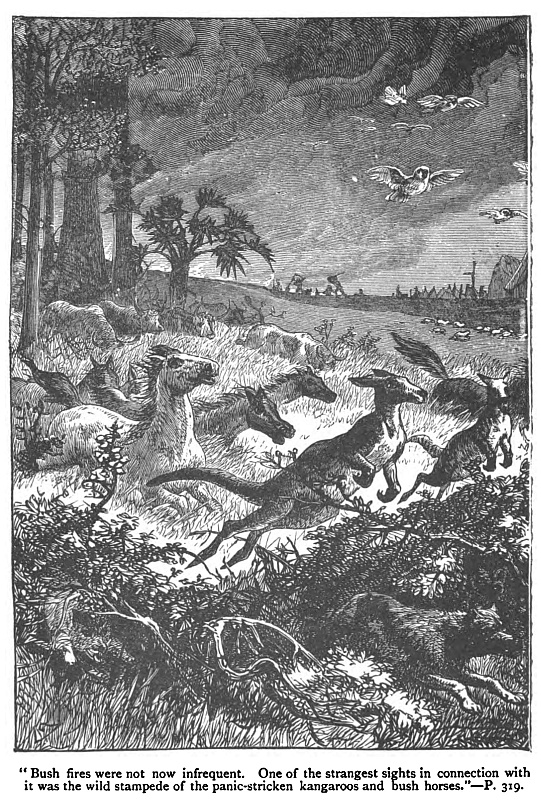
Bush fires were not now infrequent. While travelling in a distant part of the selection, far to the west, in company with Craig, whom he had come to visit, they were witnesses to a fire of this sort that had caught a distant forest. Neither pen nor pencil could do justice to such a scene. Luckily it was separated from the Burley estate by a deep ravine. One of the strangest sights in connection with it was the wild stampede of the panic-stricken kangaroos and bush horses.
To work in the fields was now to work indeed. Bob’s complexion and Archie’s were “improved” to a kind of brick-red hue, and even Harry got wondrously tanned.
There was certainly a great saving in clothes that year, for excepting light, broad-brimmed hats, and shirts and trousers, nothing else was worn by the men.
But the gardens were cool in the evening, in spite of the midday glare of the sun, and it was delightful to sit out in the open for an hour or two and think and talk of the old country; while the rich perfume of flowers hung warm in the air, and the holy stars shimmered and blinked in the dark blue of the sky.
Chapter Twenty Six.
“I’ll Write a Letter Home.”
The summer wore away, autumn came, the harvest was made good, and in spite of the drought it turned out well; for the paddocks chosen for agricultural produce seldom lacked moisture, lying as they did on the low lands near the creek, and on rich ground reclaimed from the scrub.
Our Bushmen were congratulating themselves on the success of their farming; for the banking account of all three was building itself, so to speak, slowly, but surely.
Archie was now quite as wealthy as either of his companions; for his speculations, instigated by his friend Winslow, had turned out well; so his stock had increased tenfold, and he had taken more pasture to the westward and north, near where Bob’s and Harry’s sheep now were; for Craig’s advice had been acted on.
None too soon though; for early in the winter an old shepherd arrived in haste at the homesteading to report an outbreak of inflammatory catarrh among the flocks still left on the lower pastures.
The events that quickly followed put Archie in mind of the “dark days” at Burley Old Farm, when fat beasts were dying in twos and threes day after day. Sheep affected with this strange ailment lived but a day or two, and the only thing to do was to kill them on the very first symptoms of the ailment appearing. They were then just worth the price of their hides and tallow.
Considering the amount of extra work entailed, and the number of extra hands to be hired, and the bustle and stir and anxiety caused by the outbreak, it is doubtful if it would not have been better to bury them as they fell, skin and all.
This was one of the calamities which Winslow had pointed out to Archie as likely to occur. But it was stamped out at last. The sheep that remained were sent away to far-off pastures; being kept quite separate, however, from the other flocks. So the cloud passed away, and the squatters could breathe freely again, and hope for a good lambing season, when winter passed away, and spring time came once more.
“Bob,” said Archie one evening, as they all sat round the hearth before retiring to bed, “that fire looks awfully cosy, doesn’t it? And all the house is clean and quiet—oh, so quiet and delightful that I really wonder anyone could live in a city or anywhere near the roar and din of railway trains! Then our farm is thriving far beyond anything we could have dared to expect. We are positively getting rich quickly, if, indeed, we are not rich already. And whether it be winter or summer, the weather is fine, glorious sometimes. Indeed, it is like a foretaste of heaven, Bob, in my humble opinion, to get up early and wander out of doors.”
“Well,” said Bob, “small reason to be ashamed to say that, my boy.”
“Hold on, Bob, I’m coming to the part I’m ashamed of; just you smoke your pipe and keep quiet. Well, so much in love am I with the new country that I’m beginning to forget the old. Of course I’ll always—always be a true Englishman, and I’d go back to-morrow to lay down my life for the dear old land if it was in danger. But it isn’t, it doesn’t want us, it doesn’t need us; it is full to overflowing, and I daresay they can do without any of us. But, Bob, there is my dear old father, mother, Elsie, and Rupert. Now, if it were only possible to have them here. But I know my father is wedded to Burley, and his life’s dream is to show his neighbours a thing or two. I know too that if he starts machinery again he will be irretrievably lost.”
Archie paused, and the kangaroo looked up into his face as much as to say, “Go on, I’m all attention.”
“Well, Bob, if I make a pile here and go home, I’ll just get as fond of Burley as I was when a boy, and I may lose my pile too. It seems selfish to speak so, but there is no necessity for it. So I mean to try to get father to emigrate. Do you think such a thing is possible, Bob?”
“It’s the same with men as with trees, Archie. You must loosen the ground about them, root by root must be carefully taken up if you want to transplant them, and you must take so much of the old earth with them that they hardly know they are being moved. Sarah, bring the coffee. As for my own part, Archie, I am going back; but it is only just to see the old cottage, the dear old woods, and—and my mother’s grave.”
“Yes,” said Archie, thoughtfully. “Well, root by root you said, didn’t you?”
“Ay, root by root.”
“Then I’m going to begin. Rupert and Elsie will be the first roots. Roup isn’t over strong yet. This country will make a man of him. Bob and you, Harry, can go to bed as soon as you like. I’m going out to think and walk about a bit. Stick another log or two on the fire, and as soon as you have all turned in I’ll write a letter home. I’ll begin the uprooting, though it does seem cruel to snap old ties.”
“Well,” said Harry, “thank goodness, I’ve got no ties to snap. And I think with you, Archie, that the old country isn’t a patch on the new. Just think o’ the London fogs. You mind them, Sarah.”
“I does, ’Arry.”
“And the snow.”
“And the slush, ’Arry.”
“And the drizzle.”
“And the kitchen beetles, boy. It would take a fat little lot to make me go back out o’ the sunshine. Here’s the coffee.”
“Keep mine hot, Sarah.”
Away went Archie out into the night, out under the stars, out in the falling dew, and his kangaroo went jumping and hopping after him.
The sky was very bright and clear to-night, though fleece-shaped, snow-white clouds lay low on the horizon, and the moon was rising through the distant woods, giving the appearance of some gigantic fire as its beams glared red among the topmost branches.
There was the distant howling or yelling of dingoes, and the low, half-frightened bleat of sheep, and there was the rippling murmur of the stream not far off, but all else was still.
It was two hours before Archie found his way back. The kangaroo saw him to the door, then went off to curl up in the shed till the hot beams of the morning sun should lure him forth to breakfast.
And all alone sat Archie, by the kitchen table, writing a letter home by the light of candles made on the steading.
It was very still now in the house—only the ticking of the clock, the occasional whirr of some insect flying against the window, anxious to come into the light and warmth and scratching of the young man’s pen.
Surely the dog knew that Archie was writing home, for presently he got slowly up from his corner and came and leant his head on his master’s knee, in that wise and kindly way collies have of showing their thoughts and feelings. Archie must leave off writing for a moment to smooth and pet the honest “bawsent” head.
Now it would be very easy for us to peep over Archie’s shoulder and read what he was writing, but that would be rude; anything rather than rudeness and impoliteness. Rather, for instance, let us take a voyage across the wide, terribly wide ocean, to pay a visit to Burley Old Farm, and wait till the letter comes.
“I wonder,” said Elsie with a gentle sigh, and a long look at the fire, “when we may expect to hear from Archie again. Dear me, what a long, long time it is since he went away! Let me see, Rupert, it is going on for six years, isn’t it?”
“Yes. Archie must be quite a man by now.”
“He’s all right,” said the Squire.
“That he is, I know,” said Uncle Ramsay.
“He’s in God’s good hands,” said the mother, but her glasses were so moist she had to take them off to wipe them; “he is in God’s good hands, and all we can do now is to pray for him.”
Two little taps at the green-parlour door and enter the maid, not looking much older, and not less smart, than when last we saw her.
“If you please, sir, there’s a gentleman in the study as would like to see you.”
“Oh,” she added, with a little start, “here he comes!”
And there he came certainly.
“God bless all here!” he cried heartily.
“What,” exclaimed the Squire, jumping up and holding out his hand, “my dear old friend Venturesome Vesey!”
“Yes, Yankee Charlie, and right glad I am to see you.”
“My wife and children, Vesey. Though you and I have often met in town since my marriage, you’ve never seen them before. My brother, whom you know.”
Vesey was not long in making himself one of the family circle, and he gave his promise to stay at Burley Old Farm for a week at least.
Rupert and Elsie took to him at once. How could they help it? a sailor and gentleman, and a man of the world to boot. Besides, coming directly from Archie.
“I just popped into the house the very morning after he had written the letter I now hand to you,” said Captain Vesey. “He had an idea it would be safer for me to bring it. Well, here it is; and I’m going straight away out to the garden to smoke a pipe under the moon while you read it. Friend as I am of Archie’s, you must have the letter all to yourselves;” and away went Vesey.
“Send for old Kate and Branson,” cried the Squire, and they accordingly marched in all expectancy.
Then the father unfolded the letter with as much reverence almost as if it had been Foxe’s Book of Martyrs.
Every eye was fixed upon him as he slowly read it. Even Bounder, the great Newfoundland, knew something unusual was up, and sat by Elsie all the time.
Archie’s Letter Home.
“My dearest Mother,—It is to you I write first, because I know that a proposal I have to make will ‘take you aback,’ as my friend Winslow would say. I may as well tell you what it is at once, because, if I don’t, your beloved impatience will cause you to skip all the other parts of the letter till you come to it. Now then, my own old mummy, wipe your spectacles all ready, catch hold of the arm of your chair firmly, and tell Elsie to ‘stand by’—another expression of Winslow’s—the smelling-salts bottle. Are you all ready? Heave oh! then. I’m going to ask you to let Rupert and Elsie come out to me here.
“Have you fainted, mummy? Not a bit of it; you’re my own brave mother! And don’t you see that this will be only the beginning of the end? And a bright, happy end, mother, I’m looking forward to its being. It will be the reunion of us all once more; and if we do not live quite under one roof, as in the dear old days at Burley Old Farm, we will live in happy juxtaposition.
“‘What!’ you cry, ‘deprive me of my children?’ It is for your children’s good, mummy. Take Rupert first. He is not strong now, but he is young. If he comes at once to this glorious land of ours, on which I am quite enthusiastic, he will get as hardy as a New Hollander in six months’ time. Wouldn’t you like to see him with roses on his face, mother, and a brow as brown as a postage stamp? Send him out. Would you like him to have a frame of iron, with muscles as tough as a mainstay? Send him out. Would you like him to be as full of health as an egg is full of meat? and so happy that he would have to get up at nights to sing? Then send him here.
“Take poor me next. You’ve no notion how homesick I am; I’m dying to see some of you. I am making money fast, and I love my dear, free, jolly life; but for all that, there are times that I would give up everything I possess—health, and hopes of wealth—for sake of one glance at your dear faces, and one run round Burley Old Farm with father.”
This part of Archie’s letter told home. There were tears in Mrs Broadbent’s motherly eyes; and old Kate was heard to murmur, “Dear, bonnie laddie!” and put her apron to her face.
“Then,” the letter continued, “there is Elsie. It would do her good to come too, because—bless the lassie!—she takes her happiness at second-hand; and knowing that she was a comfort to us boys, and made everything cheery and nice, would cause her to be as jolly as the summer’s day is long or a gum tree high. Then, mother, we three should work together with only one intent—that of getting you and father both out, and old Kate and Branson too.
“As for you, dad, I know you will do what is right; and see how good it would be for us all to let Roup and Elsie come. Then you must remember that when we got things a bit straighter, we would expect you and mother to follow. You, dear dad, would have full scope here for your inventive genius, and improvements that are thrown away in England could be turned to profit out here.
“We would not go like a bull at a gate at anything, father; but what we do want here is machinery, easily worked, for cutting up and dealing with wood; for cutting up ground, and for destroying tree stumps; and last, but not least, we want wells, and a complete system of irrigation for some lands, that shall make us independent to a great extent of the sparsely-failing rains of some seasons. Of course you could tell us something about sheep disease and cattle plague, and I’m not sure you couldn’t help us to turn the wild horses to account, with which some parts of the interior swarm.”
Squire Broadbent paused here to exclaim, as he slapped his thigh with his open palm:
“By Saint Andrews, brother, Archie is a chip of the old block! He’s a true Broadbent, I can tell you. He appreciates the brains of his father too. Heads are what are wanted out there; genius to set the mill a-going. As for this country—pah! it’s played out. Yes, my children, you shall go, and your father will follow.”
“My dear Elsie and Rupert,” the letter went on, “how I should love to have you both out here. I have not asked you before, because I wanted to have everything in a thriving condition first; but now that everything is so, it wants but you two to help me on, and in a year or two—Hurrah! for dad and the mum!
“Yes, Elsie, your house is all prepared. I said nothing about this before. I’ve been, like the duck-bill, working silently out of sight—out of your sight I mean. But there it is, the finest house in all the district, a perfect mansion; walls as thick as Burley Old Tower—that’s for coolness in summer. Lined inside with cedar—that’s for cosiness in winter. Big hall in it, and all the rooms just facsimile of our own house at home, or as near to them as the climate will admit.
“But mind you, Elsie, I’m not going to have you banished to the Bush wilds altogether. No, lassie, no; we will have a mansion—a real mansion—in Sydney or Brisbane as well, and the house at Burley New Farm will be our country residence.
“I know I’ll have your answer by another mail, and it will put new life into us all to know you are coming. Then I will start right away to furnish our house. Our walls shall be polished, pictures shall be hung, and mirrors everywhere; the floors shall glitter like beetles’ wings, and couches and skins be all about. I’m rather lame at house description, but you, Elsie, shall finish the furnishing, and put in the nicknacks yourself.
“I’m writing here in the stillness of night, with our doggie’s head upon my knee. All have gone to bed—black and white—in the house and round the Station. But I’ve just come in from a long walk in the moonlight. I went out to be alone and think about you; and what a glorious night, Rupert! We have no such nights in England. Though it is winter, it is warm and balmy. It is a delight to walk at night either in summer or winter. Oh, I do wish I could describe to you my garden as it is in spring and early summer! That is, you know, our garden that is going to be. I had the garden laid out and planted long before the house was put up, and now my chief delight is to keep it up. You know, as I told you before, I went to Melbourne with the Winslows. Well, we went round everywhere, and saw everything; we sailed on the lovely river, and I was struck with the wonderful beauty of the gardens, and determined ours should be something like it. And when the orange blossom is out, and the fragrant verbenas, and a thousand other half-wild flowers, with ferns, ferns, ferns everywhere, and a fountain playing in the shadiest nook—this was an idea of Harry’s—you would think you were in fairyland or dreamland, or ‘through the looking-glass,’ or somewhere; anyhow, you would be entranced.
“But to-night, when I walked there, the house—our house you know—looked desolate and dreary, and my heart gave a big superstitious thud when I heard what I thought was a footstep on the verandah, but it was only a frog as big as your hat.
“That verandah cost me and Harry many a ramble into the scrub and forest, but now it is something worth seeing, with its wealth of climbing flowering plants, its hanging ferns, and its clustering marvellous orchids.
“Yes, the house looks lonely; looks haunted almost; only, of course, ghosts never come near a new house. But, dear Elsie, how lovely it will look when we are living in it! when light streams out from the open casement windows! when warmth and music are there! Oh, come soon, come soon! You see I’m still impulsive.
“You, Elsie, love pets. I daresay Bounder will come with you. Poor Scallowa! I was sorry to hear of his sad death. But we can have all kinds of pets here. We have many. To begin with, there is little Diana, she is queen of the station, and likely to be; she is everybody’s favourite. Then there are the collies, and the kangaroo. He is quite a darling fellow, and goes everywhere with me.
“Our laughing jackass is improving every day. He looks excessively wise when you talk to him, and if touched up with the end of a brush of turkey’s feathers, which we keep for the purpose, he goes off into such fits of mad hilarious, mocking, ringing laughter that somebody has got to pick him up, cage and all, and make all haste out of the house with him.
“We have also a pet bear; that is Harry’s. But don’t jump. It is no bigger than a cat, and far tamer. It is a most wonderful little rascal to climb ever you saw. Koala we call him, which is his native name, and he is never tired of exploring the roof and rafters; but when he wants to go to sleep, he will tie himself round Sarah’s waist, with his back downwards, and go off as sound as a top.
“We have lots of cats and a cockatoo, who is an exceedingly mischievous one, and who spends most of his life in the garden. He can talk, and dance, and sing as well. And he is a caution to snakes, I can tell you. I don’t want to frighten you though. We never see the ‘tiger’ snake, or hardly ever, and I think the rest are harmless. I know the swagsmen, and the sundowners too, often kill the carpet snake, and roast and eat it when they have no other sort of fresh meat. I have tasted it, and I can tell you, Rupert, it is better than roasted rabbit.
“I’m going to have a flying squirrel. The first time I saw these creatures was at night among the trees, and they startled me—great shadowy things sailing like black kites from bough to bough.
“Kangaroos are cautions. We spend many and many a good day hunting them. If we did not kill them they would eat us up, or eat the sheep’s fodder up, and that would be all the same.
“Gentleman Craig has strange views about most things; he believes in Darwin, and a deal that isn’t Darwin; but he says kangaroos first got or acquired their monster hindlegs, and their sturdy tails, from sitting up looking over the high grass, and cropping the leaves of bushes. He says that Australia is two millions of years old at the very least.
“I must say I like Craig very much. He is so noble and handsome. What a splendid soldier he would have made! But with all his grandeur of looks—I cannot call it anything else—there is an air of pensiveness and melancholy about him that is never absent. Even when he smiles it is a sad smile. Ah! Rupert, his story is a very strange one; but he is young yet, only twenty-six, and he is now doing well. He lives by himself, with just one shepherd under him, on the very confines of civilisation. I often fear the blacks will bail up his hut some day, and mumkill him, and we should all be sorry. Craig is saving money, and I believe will be a squatter himself one of these days. Etheldene is very fond of him. Sometimes I am downright jealous and nasty about it, because I would like you, Rupert, to have Etheldene for a wife. And she knows all about the black fellows, and can speak their language. Well, you see, Rupert, you could go and preach to and convert them; for they are not half so bad as they are painted. The white men often use them most cruelly, and think no more of shooting them than I should of killing an old man kangaroo.
“When I began this letter, dearest Elsie and old Roup, I meant to tell you such a lot I find I shall have no chance of doing—all about the grand trees, the wild and beautiful scenery, the birds and beasts and insects, but I should have to write for a week to do it. So pray forgive my rambling letter, and come and see it all for yourself.
“Come you must, else—let me see now what I shall threaten. Oh, I have it; I won’t ever return! But if you do come, then in a few years we’ll all go back together, and bring out dad and the dear mummy.
“I can’t see to write any more. No, the lights are just as bright as when I commenced; but when I think of dad and the mum, my eyes will get filled with moisture. So there!
“God bless you all, all, from the mum and dad all the way down to Kate, Branson, and Bounder.
“Archie Broadbent, C.O.B.
“P.S.—Do you know what C.O.B. means? It means Chip of the Old Block. Hurrah!”
Chapter Twenty Seven.
Rumours of War.
As soon as Squire Broadbent read his son’s letter he carefully folded it up, and with a smile on his face handed it to Rupert. And by-and-bye, when Captain Vesey returned, and settled into the family circle with the rest, and had told them all he could remember about Archie and Burley New Farm in Australia, the brother and sister, followed by Bounder, slipped quietly out and told old Kate they were going to the tower. Would she come? That she would. And so for hours they all sat up there before the fire talking of Archie, and all he had done and had been, and laying plans and dreaming dreams, and building castles in the air, just in the same way that young folks always have done in this world, and will, I daresay, continue to do till the end of time.
But that letter bore fruit, as we shall see.
Things went on much as usual in the Bush. Winter passed away, spring came round and lambing season, and the shepherds were busy once more. Gentleman Craig made several visits to the home farm, and always brought good news. It was a glorious time in every way; a more prosperous spring among the sheep no one could wish to have.
On his last visit to the house Craig stayed a day or two, and Archie went back with him, accompanied by a man on horseback, with medicines and some extra stores—clothing and groceries, etc, I mean, for in those days live stock was sometimes called stores.
They made Findlayson’s the first night, though it was late. They found that the honest Scot had been so busy all day he had scarcely sat down to a meal. Archie and Craig were “in clipping-time” therefore, for there was roast duck on the table, and delightful potatoes all steaming hot, and, as usual, the black bottle of mountain dew, a “wee drappie” of which he tried in vain to get either Craig or Archie to swallow.
“Oh, by-the-bye, men,” said Findlayson, in the course of the evening—that is, about twelve o’clock—“I hear bad news up the hills way.”
“Indeed,” said Craig.
“Ay, lad. You better ha’e your gun loaded. The blacks, they say, are out in force. They’ve been killing sheep and bullocks too, and picking the best.”
“Well, I don’t blame them either. Mind, we white men began the trouble; but, nevertheless, I’ll defend my flock.”
Little more was said on the subject. But next morning another and an uglier rumour came. A black fellow or two had been shot, and the tribe had sworn vengeance and held a corroboree.
“There’s a cloud rising,” said Findlayson. “I hope it winna brak o’er the district.”
“I hope not, Findlayson. Anyhow, I know the black fellows well. I’m not sure I won’t ride over after I get back and try to get to the bottom of the difference.”
The out-station, under the immediate charge of Gentleman Craig, was fully thirty miles more to the north and west than Findlayson’s, and on capital sheep-pasture land, being not very far from the hills—a branch ridge that broke off from the main range, and lay almost due east and west.
Many a splendidly-wooded glen and gully was here; but at the time of our story these were still inhabited by blacks innumerable. Savage, fierce, and vindictive they were in all conscience, but surely not so brave as we sometimes hear them spoken of, else could they have swept the country for miles of the intruding white man. In days gone by they had indeed committed some appallingly-shocking massacres; but of late years they had seemed contented to either retire before the whites or to become their servants, and receive at their hands that moral death—temptation to drink—which has worked such woe among savages in every quarter of the inhabitable globe.
As Archie and his companion came upon the plain where—near the top of the creek on a bit of tableland—Craig’s “castle,” as he called it, was situated, the owner looked anxiously towards it. At first they could see no signs of life; but as they rode farther on, and nearer, the shepherd himself came out to meet them, Roup, the collie, bounding joyfully on in front, and barking in the exuberance of his glee.
“All right and safe, shepherd?”
“All right and safe, sir,” the man returned; “but the blacks have been here to-day.”
“Then I’ll go there to-morrow.”
“I don’t think that’s a good plan.”
“Oh! isn’t it? Well, I’ll chance it. Will you come, Mr Broadbent?”
“I will with pleasure.”
“Anything for dinner, George?”
“Yes, sir. I expected you; and I’ve got a grilled pheasant, and fish besides.”
“Ah, capital! But what made you expect me to-day?”
“The dog Roup, sir. He was constantly going to the door to look out, so I could have sworn you would come.”
The evening passed away quietly enough.
Dwelling in this remote region, and liable at any time to be attacked, Gentleman Craig had thought it right to almost make a fort of his little slab hut. He had two black fellows who worked for him, and with their assistance a rampart of stones, earth, and wood was thrown up, although these men had often assured him that “he,” Craig, “was ‘corton budgery,’ and that there was no fear of the black fellows ‘mumkill’ him.”
“I’m not so very sure about it,” thought Craig; “and it is best to be on the safe side.”
They retired to-night early, having seen to the sheep and set a black to watch, for the dingoes were very destructive.
Both Craig and Archie slept in the same room, and they hardly undressed, merely taking off their coats, and lying down on the rough bed of sacking, with collie near the door to do sentry.
They had not long turned in when the dog began to growl low.
“Down charge, Roup,” said Craig.
Instead of obeying, the dog sprang to the door, barking fiercely.
Both Archie and Craig were out of bed in a moment, and handling their revolvers. Craig managed to quieten Roup, and then listened attentively.
The wind was rising and moaning round the chimney, but above this sound they could hear a long-prolonged “Coo—oo—ee!”
“That’s a white man’s voice,” said Craig; “we’re safe.”
The door and fort was at once opened, and a minute after five squatters entered.
“Sorry we came so late,” they said; “but we’ve been and done it, and it took some time.”
“What have you done?” said Craig.
“Fired the woods all along the gullies among the hills.”
“Is that fair to the blacks?”
“Curse them!” exclaimed the spokesman. “Why do they not keep back? The law grumbles if we shoot the dogs, unless in what they please to call self-defence, which means after they have speared our beasts and shepherds, and are standing outside our doors with a nullah ready to brain us.”
Craig and Archie went to the door and looked towards the hills.
What a scene was there! The fire seemed to have taken possession of the whole of the highlands from east to west, and was entwining wood and forest, glen and ravine, in its snake-like embrace. The hills themselves were cradled in flames and lurid smoke. The stems of the giant gum trees alone seemed to defy the blaze, and though their summits looked like steeples on fire, the trunks stood like pillars of black marble against the golden gleam behind them. The noise was deafening, and the smoke rolled away to leeward, laden with sparks thick as the snowflakes in a winter’s fall. It was an appalling sight, the description of which is beyond the power of any pen.
“Well, men,” said Craig when he re-entered the hut, “I don’t quite see the force of what you have done. It is like a declaration of war, and, depend upon it, the black fellows will accept the challenge.”
“It’ll make the grass grow,” said one of the men with a laugh.
“Yes,” said another; “and that grass will grow over a black man’s grave or two ere long, if I don’t much mistake.”
“It wouldn’t be worth while burying the fiends,” said a third. “We’ll leave them to the rooks.”
“Well,” said Craig, “there’s meat and damper there, men. Stir up the fire, warm your tea, and be happy as long as you can. We’re off to bed.”
Gentleman Craig was as good as his word next day. He rode away in search of the tribe, and after a long ride found them encamped on a tableland.
As it turned out they knew him, and he rode quietly into their midst.
They were all armed with spear, and nullah, and boomerang. They were tattooed, nearly naked, and hideous enough in their horrid war-paint.
Craig showed no signs of fear. Indeed he felt none. He told the chief, however, that he had not approved of the action of the white men, his brothers, and had come, if possible, to make peace. Why should they fight? There was room enough in the forest and scrub for all. If they—the blacks—would leave the cattle and flocks of the squatters alone, he—Craig—could assure them things would go on as happily as before.
“And if not?” they asked.
“If not, for one black man there was in the country, there were a thousand white. They would come upon them in troops, even like the locusts; they would hunt them as they hunted the dingoes; they would kill them as dingoes were killed, and before long all the black fellows would be in the land of forgetfulness. What would it profit them then that they had speared a few white fellows?”
Craig stayed for hours arguing with these wild men, and left at last after having actually made peace with honour.
The cloud had rolled away, for a time at all events.
In the course of a few days Archie and his man left on his return journey. Findlayson made up his mind to go on with him to Burley New Farm; for this Scot was very fond of an occasional trip eastwards, and what he called a “twa-handed crack” with Bob or Harry.
Everybody was glad to see him; for, truth to tell, no one had ever seen Findlayson without a smile on his old-fashioned face, and so he was well liked.
Bob came galloping out to meet them, and with him, greatly to Archie’s astonishment, was what he at first took for a black bear.
The black bear was Bounder.
Archie dismounted and threw his arms round the great honest dog’s neck, and almost burst into tears of joy.
For just half a minute Bounder was taken aback; then memory came rushing over him; he gave a jump, and landed Archie on his back, and covered his face and hair with his canine kisses. But this was not enough. Bounder must blow off steam. He must get rid of the exuberance of his delight before it killed him. So with a half-hysterical but happy bark he went off at a tangent, and commenced sweeping round and round in a circle so quickly that he appeared but a black shape. This wild caper he kept up till nearly exhausted, then returned once more to be embraced.
“So they’ve come.” It was all that Archie could say.
Yes, they had come. Elsie had come, Rupert had come, Branson and Bounder had come.
And oh, what a joyful meeting that was! Only those who have been separated for many long years from all they love and hold dear, and have met just thus, as Archie now met his sister and brother, can have any appreciation of the amount of joy that filled their hearts.
The very first overflowing of this joy being expended, of course the next thing for both Archie and the newcomers to say was, “How you’ve changed!”
Yes, they had all changed. None more so than Elsie. She always gave promise of beauty; but now that Archie held her at arms’ length, to look at and criticise, he could not help exclaiming right truthfully:
“Why, Elsie, you’re almost as beautiful as Etheldene!”
“Oh, what a compliment!” cried Rupert. “I wouldn’t have it, Elsie. That ‘almost’ spoils it.”
“Just you wait till you see Etheldene, young man,” said Archie, nodding his head. “You’ll fall in love at once. I only hope she won’t marry Gentleman Craig. And how is mother and father?”
Then questions came in streams. To write one half that was spoken that night would take me weeks. They all sat out in the verandah of the old house; for the night was sultry and warm, and it was very late indeed before anyone ever thought of retiring.
Findlayson had been unusually quiet during the whole of the evening. To be sure, it would not have been quite right for him to have put in his oar too much, but, to tell the truth, something had happened which appeared to account for his silence. Findlayson had fallen in love—love at first sight. Oh, there are such things! I had a touch of the complaint myself once, so my judgment is critical. Of course, it is needless to say that Elsie was the bright particular star, that had in one brief moment revolutionised the existence and life of the ordinarily placid and very matter-of-fact Findlayson. So he sat to-night in his corner and hardly spoke, but, I daresay, like Paddy’s parrot, he made up for it in thinking; and he looked all he could also, without seeming positively rude.
Well, a whole fortnight was spent by Archie in showing his brother and sister round the station, and initiating them into some of the mysteries and contrarieties of life in the Australian Bush.
After this the three started off for Brisbane and Sydney, to complete the purchase of furniture for Archie’s house. Archie proved himself exceedingly clever at this sort of thing, considering that he was only a male person. But in proof of what I state, let me tell you, that before leaving home he had even taken the measure of the rooms, and of the windows and doors. And when he got to Sydney he showed his taste in the decorative art by choosing “fixings” of an altogether Oriental and semi-aesthetic design.
At Sydney Elsie and Rupert were introduced to the Winslows, and, as soon as he conveniently could, Archie took his brother’s opinion about Etheldene.
Very much to his astonishment, Rupert told him that Etheldene was more sisterly than anything else, and he dare say she was rather a nice girl—“as far as girls go.”
Archie laughed outright at Rupert’s coolness, but somehow or other he felt relieved.
First impressions go a far way in a matter of this kind, and it was pretty evident there was little chance of Rupert’s falling in love with Etheldene, for some time at least.
Yet this was the plan of campaign Archie had cut out: Rupert and Etheldene should be very much struck with each other from the very first; the young lady should frequently visit at Burley New Farm, and, for the good of his health, Rupert should go often to Sydney. Things would progress thus, off and on, for a few years, then the marriage would follow, Rupert being by this time settled perhaps, and in a fair way of doing well. I am afraid Archie had reckoned without his host, or even his hostess.
He was not long in coming to this conclusion either; and about the same time he made another discovery, very much to his own surprise; namely, that he himself was in love with Etheldene, and that he had probably been so for some considerable length of time, without knowing it. He determined in his own mind therefore that he would steel his heart towards Miss Winslow, and forget her.
Before Elsie and Rupert came to settle down finally at the farm, they enjoyed, in company with Mr Winslow and his daughter, many charming trips to what I might call the show-places of Australia. Sydney, and all its indescribably-beautiful surroundings, they visited first. Then they went to Melbourne, and were much struck with all the wealth and grandeur they saw around them, although they could not help thinking the actual state of the streets was somewhat of a reproach to the town. They sailed on the Yarra-Yarra; they went inland and saw, only to marvel at, the grandeur of the scenery, the ferny forests, the glens and hills, the waterfalls and tumbling streams and lovely lakes. And all the time Rupert could not get rid of the impression that it was a beautiful dream, from which he would presently awake and find himself at Burley Old Farm.
Chapter Twenty Eight.
The Massacre at Findlayson’s Farm.
By the time Elsie and Rupert had returned from their wanderings winter was once more coming on; but already both the sister and brother had got a complexion.
The house was quite furnished now, guest room and all. It was indeed a mansion, though I would not like to say how much money it had cost Archie to make it so. However, he had determined, as he said himself to Bob, to do the thing properly while he was about it.
And there is no doubt he succeeded well. His garden too was all he had depicted it in his letter home.
That Archie had succeeded to his heart’s content in breaking ties with the old country was pretty evident, from a letter received by him from his father about mid-winter.
“He had noticed for quite a long time,” the Squire wrote, “and was getting more and more convinced, that this England was, agriculturally speaking, on its last legs. Even American inventions, and American skill and enterprise, had failed to do much for the lands of Burley. He had tried everything, but the ground failed to respond. Burley was a good place for an old retired man who loved to potter around after the partridges; but for one like himself, still in the prime of his life, it had lost its charms. Even Archie’s mother, he told him, did not see the advisability of throwing good money after bad, and Uncle Ramsay was of the same way of thinking. So he had made up his mind to let the place and come straight away out. He would allow Archie to look out for land for him, and by-and-bye he would come and take possession. Australia would henceforth reap the benefit of his genius and example; for he meant to show Australians a thing or two.”
When Archie read that letter, he came in with a rush to read it to Bob, Harry, and Sarah.
“I think your father is right,” said Bob.
“I tell you, Bob, my boy, it isn’t father so much as mother. The dear old mummy speaks and breathes through every line and word of this epistle. Now I’m off to astonish Elsie and Roup. Come along, Bounder.”
Meanwhile Findlayson became a regular visitor at the farm.
“Why,” Archie said to him one evening, as he met him about the outer boundary of the farm, “why, Findlayson, my boy, you’re getting to be a regular ‘sundowner.’ Well, Miss Winslow has come, and Craig is with us, and as I want to show Branson a bit of real Australian sport, you had better stop with us a fortnight.”
“I’ll be delighted. I wish I’d brought my fiddle.”
“We’ll send for it if you can’t live without it.”
“Not very weel. But I’ve something to tell you.”
“Well, say on; but you needn’t dismount.”
“Yes, I’ll speak better down here.”
Findlayson sat up on top of the fence, and at once opened fire by telling Archie he had fallen in love with Elsie, and had determined to make her his wife. Archie certainly was taken aback.
“Why, Findlayson,” he said, “you’re old enough to be her father.”
“A’ the better, man. And look here, I’ve been squatting for fifteen years, ever since there was a sheep in the plains almost. I have a nice little nest egg at the bank, and if your sister doesna care to live in the Bush we’ll tak’ a hoose in Sydney. For, O man, man, Elsie is the bonniest lassie the world e’er saw. She beats the gowan (mountain daisy).”
Archie laughed.
“I must refer you to the lady herself,” he said.
“Of course, man, of course—
“‘He either fears his fate too much, Or his deserts are small, Who dares not put it to the test To win or lose it all.’”
So away went Findlayson to put his fate to the test.
What he said or what she said does not really concern us; but five minutes after his interview Archie met the honest Scot, and wondrously crestfallen he looked.
“She winna hae me,” he cried, “but nil desperandum, that’ll be my motto till the happy day.”
The next fortnight was in a great measure given up to pleasure and sport. Both Branson and Bounder received their baptism of fire, though the great Newfoundland was wondrously exercised in his mind as to what a kangaroo was, and what it was not. As to the dingoes, he arrived at a conclusion very speedily. They could beat him at a race, however; but when Bounder one time got two of them together, he proved to everybody’s satisfaction that there was life in the old dog yet.
Gentleman Craig never appeared to such excellent advantage anywhere as in ladies’ society. He really led the conversation at the dinner-table, though not appearing to do so, but rather the reverse, while in the drawing-room he was the moving spirit.
He also managed to make Findlayson happy after a way. The Scotchman had told Craig all his troubles, but Craig brought him his fiddle, on which he was a really excellent performer.
“Rouse out, Mr Findlayson, and join the ladies at the piano.”
“But, man,” the squatter replied, “my heart’s no in it; my heart is broken. I can play slow music, but when it comes to quick, it goes hard against the grain.”
Nevertheless, Findlayson took his stand beside the piano, and the ice thus being broken, he played every night, though it must be confessed, for truth’s sake, he never refused a “cogie” when the bottle came round his way. Towards ten o’clock Findlayson used, therefore, to become somewhat sentimental. The gentleman sat up for a wee half hour after the ladies retired, and sometimes Findlayson would seize his fiddle.
“Gentlemen,” he would say, “here is how I feel.”
Then he would play a lament or a wail with such feeling that even his listeners would be affected, while sometimes the tears would be quivering on the performer’s eyelashes.
At the end of the fortnight Findlayson went to Brisbane. He had some mysterious business to transact, the nature of which he refused to tell even Archie. But it was rumoured that a week or two later on, drays laden with furniture were seen to pass along the tracks on their way to Findlayson’s farm.
Poor fellow, he was evidently badly hit. He was very much in love indeed, and, like a drowning man, he clutched at straws.
The refurnishing of his house was one of these straws. Findlayson was going to give “a week’s fun,” as he phrased it. He was determined, after having seen Archie’s new house, that his own should rival and even outshine it in splendour. And he really was insane enough to believe that if Elsie only once saw the charming house he owned, with the wild and beautiful scenery all around it, she would alter her mind, and look more favourably on his suit.
In giving way to vain imaginings of this kind, Findlayson was really ignoring, or forgetting at all events, the sentiments of his own favourite poet, Burns, as impressed in the following touching lines:
“It ne’er was wealth, it ne’er was wealth, That bought contentment, peace, or pleasure; The bands and bliss o’ mutual love, O that’s the chiefest warld’s treasure!”
His sister was very straightforward, and at once put her brother down as a wee bit daft. Perhaps he really was; only the old saying is a true one: “Those that are in love are like no one else.”
It was the last month of winter, when early one morning a gay party from Burley New Farm set out to visit Findlayson, and spend a week or two in order to “’liven him up,” as Harry expressed it.
Bob was not particularly fond of going much from home—besides, Winslow and he were planning some extensions—so he stopped on the Station. But Harry went, and, as before, when going to the kangaroo hunt, Gentleman Craig was in the cavalcade, and of course Rupert and Elsie.
It would have been no very difficult matter to have done the journey in a single day, only Archie was desirous of letting his brother and sister have a taste of camping out in the Bush.
They chose the same route as before, and encamped at night in the self-same place.
The evening too was spent in much the same way, even to singing and story-telling, and Craig’s lullaby to Baby, when she and Elsie had gone to their tent.
Morning dawned at last on forest and plain, and both Harry and the brothers were early astir. It would have been impossible to remain asleep much after daybreak, owing to the noise of the birds, including the occasional ear-splitting clatter of the laughing jackasses.
Besides, towards morning it had been exceedingly cold. The first thing that greeted their eyes was a thorough old-fashioned hoar frost, the like of which Archie had not seen for many a year. Everything gleamed, white almost as coral. The grass itself was a sight to see, and the leaves on the trees were edged with lace. But up mounted the sun, and all was speedily changed. Leaves grew brightly green again, and the hoar frost was turned into glancing, gleaming, rainbow-coloured drops of dew.
The young men ran merrily away to the pool in the creek, and most effectually scared the ducks.
The breakfast to-day was a different sort of a meal to the morsel of stiff damper and corned junk that had been partaken of at last bivouac. Elsie made the tea, and Etheldene and she presided. The meat pies and patties were excellent, and everyone was in the highest possible spirits, and joyously merry.
Alas! and alas! this was a breakfast no one who sat down to, and who lives, is ever likely to forget.
Have you ever, reader, been startled on a bright sunshiny summer’s day by a thunder peal? And have you seen the clouds rapidly bank up after this and obscure the sky, darkness brooding over the windless landscape, lighted up every moment by the blinding lightning’s flash, and gloom and danger brooding all round, where but a short half hour ago the birds carolled in sunlight? Then will you be able, in some measure, to understand the terribleness of the situation in which an hour or two after breakfast the party found themselves, and the awful suddenness of the shock that for a time quite paralysed every member of it.
They had left the dismal depths of the forest, and were out on the open pasture land, and nearing Findlayson’s house, when Craig and Archie, riding on in front, came upon the well-known bobtailed collie, who was the almost constant companion of the squatter. The dog was alive, but dying. There was a terrible spear-gash in his neck. Craig dismounted and knelt beside him. The poor brute knew him, wagged his inch-long tail, licked the hand that caressed him, and almost immediately expired. Craig immediately rode back to the others.
“Do not be alarmed, ladies,” he said. “But I fear the worst. There is no smoke in Findlayson’s chimney. The black fellows have killed his dog.”
Though both girls grew pale, there were no other signs of fear manifested by them. If Young Australia could be brave, so could Old England.
The men consulted hurriedly, and it was agreed that while Branson and Harry waited with the ladies, Archie and Craig should ride on towards the house.
Not a sign of life; no, not one. Signs enough of death though, signs enough of an awful struggle. It was all very plain and simple, though all very, very sad and dreadful.
Here in the courtyard lay several dead natives, festering and sweltering in the noonday sun. Here were the boomerangs and spears that had fallen from their hands as they dropped never to rise again. Here was the door battered and splintered and beaten in with tomahawks, and just inside, in the passage, lay the bodies of Hurricane Bill and poor Findlayson, hacked about almost beyond recognition.
In the rooms all was confusion, every place had been ransacked. The furniture, all new and elegant, smashed and riven; the very piano that the honest Scot had bought for sake of Elsie had been dissected, and its keys carried away for ornaments. In an inner room, half-dressed, were Findlayson’s sister and her little Scotch maid, their arms broken, as if they had held them up to beseech for mercy from the monsters who had attacked them. Their arms were broken, and their skulls beaten in, their white night-dresses drenched in blood. There was blood, blood everywhere—in curdled streams, in great liver-like gouts, and in dark pools on the floor. In the kitchen were many more bodies of white men (the shepherds), and of the fiends in human form with whom they had struggled for their lives.
It was an awful and sickening sight.
No need for Craig or Archie to tell the news when they returned to the others. Their very silence and sadness told the terrible tale.
Nothing could be done at present, however, in the way of punishing the murderers, who by this time must be far away in their mountain fastnesses.
They must ride back, and at once too, in order to warn the people at Burley and round about of their great danger.
So the return journey was commenced at once. On riding through the forest they had to observe the greatest caution.
Craig was an old Bushman, and knew the ways of the blacks well. He trotted on in front. And whenever in any thicket, where an ambush might possibly be lurking, he saw no sign of bird or beast, he dismounted and, revolver in hand, examined the place before he permitted the others to come on.
They got through the forest and out of the gloom at last, and some hours afterwards dismounted a long way down the creek to water the horses and let them browse. As for themselves, no one thought of eating. There was that feeling of weight at every heart one experiences when first awakening from some dreadful nightmare.
They talked about the massacre, as they sat under the shadow of a gum tree, almost in whispers; and at the slightest unusual noise the men grasped their revolvers and listened.
They were just about to resume their journey when the distant sound of galloping horses fell on their ears. Their own nags neighed. All sprang to their feet, and next moment some eight or nine men rode into the clearing.
Most of them were known to Craig, so he advanced to meet them.
“Ah! I see you know the worst,” said the leader.
“Yes,” said Craig, “we know.”
“We’ve been to your place. It is all right there with one exception.”
“One exception?”
“Yes; it’s only the kid—Mr Cooper’s little daughter, you know.”
“Is she dead?” cried Archie aghast.