Book I—At Burley Old Farm. (continued 2)
Reading edition
“I think I do,” said Squire Broadbent, laughing; “and you want to see my boy?”
“Vot I vants is this ’ere. Johnnie is a rare game un. ’Scuse me, guv’nor, but Johnnie’s got the grit in him, and I vant to say good-bye; nuffink else, guv’nor.”
Here Harry actually condescended to point a finger at his lip by way of salute, and just at the same moment Archie himself came round the corner. He looked a little put out, but his father only laughed, and he saw it was all right.
These were Harry’s last words: “Good-bye, then. You’ve got the grit in ye, Johnnie. And if hever ye vants a friend, telegraph to ’Arry Brown, Esq., of Vitechapel, ’cos ye know, Johnnie, the king may come in the cadger’s vay. Adoo. So long. Blue-lights, and hoff we goes.”
Chapter Seven.
“They’re up to some Black Work To-night.”
Another summer flew all too fast away at Burley Old Farm and Castle Tower. The song of birds was hushed in the wild woods, even the corn-crake had ceased its ventriloquistic notes, and the plaintive wee lilt of the yellow-hammer was heard no more. The corn grew ripe on braeland and field, was cut down, gathered, stooked, and finally carted away. The swallows flew southwards, but the peewits remained in droves, and the starlings took up their abode with the sheep. Squires and sturdy farmers might now have been met tramping, gun in hand, over the stubble, through the dark green turnip-fields, and over the distant moorlands, where the crimson heather still bloomed so bonnie.
Anon, the crisp leaves, through which the wind now swept with harsher moan, began to change to yellows, crimsons, and all the hues of sunset, and by-and-by it was hunting-time again.
Archie was unusually thoughtful one night while the family sat, as of yore, round the low fire in the green parlour, Elsie and Rupert being busy in their corner over a game of chess.
“In a brown study, Archie?” said his mother.
“No, mummie; that is, Yes, I was thinking—”
“Wonders will never cease,” said Rupert, without looking up. Archie looked towards him, but his brother only smiled at the chessmen. The boy was well enough now to joke and laugh. Best of signs and most hopeful.
“I was thinking that my legs are almost too long now to go to the meet on poor Scallowa. Not that Scallowa would mind. But don’t you think, mummie dear, that a long boy on a short pony looks odd?”
“A little, Archie.”
“Well, why couldn’t father let me have Tell to-morrow? He is not going out himself.”
His father was reading the newspaper, but he looked at Archie over it. Though only his eyes were visible, the boy knew he was smiling.
“If you think you won’t break your neck,” he said, “you may take Tell.”
“Oh,” Archie replied, “I’m quite sure I won’t break my neck!”
The Squire laughed now outright.
“You mean you might break Tell’s, eh?”
“Well, dad, I didn’t say that.”
“No, Archie, but you thought it.”
“I’m afraid, dad, the emphasis fell on the wrong word.”
“Never mind, Archie, where the emphasis falls; but if you let Tell fall the emphasis will fall where you won’t like it.”
“All right, dad, I’ll chance the emphasis. Hurrah!”
The Squire and Mr Walton went off early next day to a distant town, and Branson had orders to bring Tell round to the hall door at nine sharp; which he did. The keeper was not groom, but he was the tallest man about, and Archie thought he would want a leg up.
Archie’s mother was there, and Elsie, and Rupert, and old Kate, and little Peter, to say nothing of Bounder and Fuss, all to see “t’ young Squire mount.” But no one expected the sight they did see when Archie appeared; for the lad’s sense of fun and the ridiculous was quite irrepressible. And the young rascal had dressed himself from top to toe in his father’s hunting-rig—boots, cords, red coat, hat, and all complete. Well, as the boots were a mile and a half too big for him—more or less, and the breeches and coat would have held at least three Archie Broadbents, while the hat nearly buried his head, you may guess what sort of a guy he looked. Bounder drew back and barked at him. Old Kate turned her old eyes cloudwards, and held up her palms. Branson for politeness’ sake tried not to laugh; but it was too much, he went off at last like a soda-water cork, and the merriment rippled round the ring like wildfire. Even poor Rupert laughed till the tears came. Then back into the house ran Archie, and presently re-appeared dressed in his own velvet suit.
But Archie had not altogether cooled down yet. He had come to the conclusion that having an actual leg up, was not an impressive way of getting on to his hunter; so after kissing his mother, and asking Rupert to kiss Elsie for him, he bounded at one spring to Branson’s shoulder, and from this elevation bowed and said “good morning,” then let himself neatly down to the saddle.
“Tally ho! Yoicks!” he shouted. Then clattered down the avenue, cleared the low, white gate, and speedily disappeared across the fields.
Archie had promised himself a rare day’s run, and he was not disappointed. The fox was an old one and a wily one—and, I might add, a very gentlemanly old fox—and he led the field one of the prettiest dances that Dawson, the greyest-headed huntsman in the North, ever remembered; but there was no kill. No; Master Reynard knew precisely where he was going, and got home all right, and went quietly to sleep as soon as the pack drew off.
The consequence was that Archie found himself still ten miles from home as gloaming was deepening into night. Another hour he thought would find him at Burley Old Farm. But people never know what is before them, especially hunting people.
It had been observed by old Kate, that after Archie left in the morning, Bounder seemed unusually sad. He refused his breakfast, and behaved so strangely that the superstitious dame was quite alarmed.
“I’ll say naething to the ladies,” she told one of the servants, “but, woe is me! I fear that something awfu’ is gain tae happen. I houp the young laddie winna brak his neck. He rode awa’ sae daft-like. He is just his faither a’ ower again.”
Bounder really had something on his mind; for dogs do think far more than we give them credit for. Well, the Squire was off, and also Mr Walton, and now his young master had flown. What did it mean? Why he would find out before he was many hours older. So ran Bounder’s cogitations.
To think was to act with Bounder; so up he jumped, and off he trotted. He followed the scent for miles; then he met an errant collie, and forgetting for a time all about his master, he went off with him. There were many things to be done, and Bounder was not in a hurry. They chased cows and sheep together merely for mischief’s sake; they gave chase to some rabbits, and when the bunnies took to their holes, they spent hours in a vain attempt to dig them out. The rabbits knew they could never succeed, so they quietly washed their faces and laughed at them.
They tired at last, and with their heads and paws covered with mould, commenced to look for mice among the moss. They came upon a wild bees’ home in a bank, and tore this up, killing the inmates bee by bee as they scrambled out wondering what the racket meant. They snapped at the bees who were returning home, and when both had their lips well stung they concluded to leave the hive alone. Honey wasn’t very nice after all, they said. At sunset they bathed in a mill-dam and swam about till nearly dusk, because the miller’s boy was obliging enough to throw in sticks for them. Then the miller’s boy fell in himself, and Bounder took him out and laid him on the bank to drip, neither knowing nor caring that he had saved a precious life. But the miller’s boy’s mother appeared on the scene and took the weeping lad away, inviting the dogs to follow. She showered blessings on their heads, especially on “the big black one’s,” as the urchin called Bounder, and she put bread and milk before them and bade them eat. The dogs required no second bidding, and just as Bounder was finishing his meal the sound of hoofs was heard on the road, and out bounced Bounder, the horse swerved, the rider was thrown, and the dog began to wildly lick his face.
“So it’s you, is it, Bounder?” said Archie. “A nice trick. And now I’ll have to walk home a good five miles.”
Bounder backed off and barked. Why did his master go off and leave him then? That is what the dog was saying.
“Come on, boy,” said Archie. “There’s no help for it; but I do feel stiff.”
They could go straight over the hill, and through the fields and the wood, that was one consolation.
So off they set, and Archie soon forgot his stiffness and warmed to his work.
Bounder followed close to his heels, as if he were a very old and a very wise dog indeed; and harrying bees’ hives, or playing with millers’ boys, could find no place in his thoughts.
Archie lost his way once or twice, and it grew quite dark. He was wondering what he should do when he noticed a light spring up not far away, and commenced walking towards it. It came from the little window of a rustic cottage, and the boy knew at once now in which way to steer.
Curiosity, however, impelled him to draw near to the window. He gave just one glance in, but very quickly drew back. Sitting round a table was a gang of half a dozen poachers. He knew them as the worst and most notorious evil-doers in all the country round. They were eating and drinking, and guns stood in the corners, while the men themselves seemed ready to be off somewhere.
Away went Archie. He wanted no nearer acquaintance with a gang like that.
In his way home he had to pass Bob Cooper’s cottage, and thought he might just look in, because Bob had a whole book of new flies getting ready for him, and perhaps they were done.
Bob was out, and his mother was sitting reading the good Book by the light of a little black oil lamp. She looked very anxious, and said she felt so. Her laddie had “never said where he was going. Only just went away out, and hadn’t come back.”
It was Archie’s turn now to be anxious, when he thought of the gang, and the dark work they might be after. Bob was not among them, but who could tell that he would not join afterwards?
He bade the widow “Good-night,” and went slowly homewards thinking.
He found everyone in a state of extreme anxiety. Hours ago Tell had galloped to his stable door, and if there be anything more calculated to raise alarm than another, it is the arrival at his master’s place of a riderless horse.
But Archie’s appearance, alive and intact, dispelled the cloud, and dinner was soon announced.
“Oh, by the way,” said Archie’s tutor, as they were going towards the dining-room, “your old friend Bob Cooper has been here, and wants to see you! I think he is in the kitchen now.”
Away rushed Archie, and sure enough there was Bob eating supper in old Kate’s private room.
He got up as Archie’s entered, and looked shy, as people of his class do at times.
Archie was delighted.
“I brought the flies, and some new sorts that I think will do for the Kelpie burn,” he said.
“Well, I’m going to dine, Bob; you do the same. Don’t go till I see you. How long have you been here?”
“Two hours, anyhow.”
When Archie returned he invited Bob to the room in the Castle Tower. Kate must come too, and Branson with his fiddle.
Away went Archie and his rough friend, and were just finishing a long debate about flies and fishing when Kate and Peter, and Branson and Bounder, came up the turret stairs and entered the room.
Archie then told them all of what he had seen that night at the cottage.
“Mark my words for it,” said Bob, shaking his head, “they’re up to some black work to-night.”
“You mustn’t go yet awhile, Bob,” Archie said. “We’ll have some fun, and you’re as well where you are.”
Chapter Eight.
The Widow’s Lonely Hut.
Bob Cooper bade Archie and Branson good-bye that night at the bend of the road, some half mile from his own home, and trudged sturdily on in the starlight. There was sufficient light “to see men as trees walking.”
“My mother’ll think I’m out in th’ woods,” Bob said to himself. “Well, she’ll be glad when she knows she’s wrong this time.”
Once or twice he started, and looked cautiously, half-fearfully, round him; for he felt certain he saw dark shadows in the field close by, and heard the stealthy tread of footsteps.
He grasped the stout stick he carried all the firmer, for the poacher had made enemies of late by separating himself from a well-known gang of his old associates—men who, like the robbers in the ancient ballad—
“Slept all day and waked all night, And kept the country round in fright.”
On he went; and the strange, uncomfortable feeling at his heart was dispelled as, on rounding a corner of the road, he saw the light glinting cheerfully from his mother’s cottage.
“Poor old creature,” he murmured half aloud, “many a sore heart I’ve given her. But I’ll be a better boy now. I’ll—”
“Now, lads,” shouted a voice, “have at him!”
“Back!” cried Bob Cooper, brandishing his cudgel. “Back, or it’ll be worse for you!”
The dark shadows made a rush. Bob struck out with all his force, and one after another fell beneath his arm. But a blow from behind disabled him at last, and down he went, just as his distracted mother came rushing, lantern in hand, from her hut. There was the sharp click of the handcuffs, and Bob Cooper was a prisoner. The lantern-light fell on the uniforms of policemen.
“What is it? Oh, what has my laddie been doin’?”
“Murder, missus, or something very like it! There has been dark doin’s in th’ hill to-night!”
Bob grasped the nearest policeman by the arm with his manacled hands. “When—when did ye say it had happened?”
“You know too well, lad. Not two hours ago. Don’t sham innocence; it sits but ill on a face like yours.”
“Mother,” cried Bob bewilderingly, “I know nothing of it! I’m innocent!”
But his mother heard not his words. She had fainted, and with rough kindness was carried into the hut and laid upon the bed. When she revived some what they left her.
It was a long, dismal ride the unhappy man had that night; and indeed it was well on in the morning before the party with their prisoner reached the town of B—.
Bob’s appearance before a magistrate was followed almost instantly by his dismissal to the cells again. The magistrate knew him. The police had caught him “red-handed,” so they said, and had only succeeded in making him prisoner “after a fierce resistance.”
“Remanded for a week,” without being allowed to say one word in his own defence.
The policeman’s hint to Bob’s mother about “dark doin’s in th’ hill” was founded on fearful facts. A keeper had been killed after a terrible melée with the gang of poachers, and several men had been severely wounded on both sides.
The snow-storm that came on early on the morning after poor Bob Cooper’s capture was one of the severest ever remembered in Northumbria. The frost was hard too all day long. The snow fell incessantly, and lay in drifts like cliffs, fully seven feet high, across the roads.
The wind blew high, sweeping the powdery snow hither and thither in gusts. It felt for all the world like going into a cold shower-bath to put one’s head even beyond the threshold of the door. Nor did the storm abate even at nightfall; but next day the wind died down, and the face of the sky became clear, only along the southern horizon the white clouds were still massed like hills and cliffs.
It was not until the afternoon that news reached Burley Old Farm of the fight in the woods and death of the keeper. It was a sturdy old postman who had brought the tidings. He had fought his way through the snow with the letters, and his account of the battle had well-nigh caused old Kate to swoon away. When Mary, the little parlour maid, carried the mail in to her master she did not hesitate to relate what she had heard.
Squire Broadbent himself with Archie repaired to the kitchen, and found the postman surrounded by the startled servants, who were drinking in every word he said.
“One man killed, you say, Allan?”
“Ay, sir, killed dead enough. And it’s a providence they caught the murderer. Took him up, sir, just as he was a-goin’ into his mother’s house, as cool as a frosted turnip, sir.”
“Well, Allan, that is satisfactory. And what is his name?”
“Bob Cooper, sir, known all over the—”
“Bob Cooper!” cried Archie aghast. “Why, father, he was in our room in the turret at the time.”
“So he was,” said the Squire. “Taken on suspicion I suppose. But this must be seen to at once. Bad as we know Bob to have been, there is evidence enough that he has reformed of late. At all events, he shall not remain an hour in gaol on such a charge longer than we can help.”
Night came on very soon that evening. The clouds banked up again, the snow began to fall, and the wind moaned round the old house and castle in a way that made one feel cold to the marrow even to listen to.
Morning broke slowly at last, and Archie was early astir. Tell, with the Shetland pony and a huge great hunter, were brought to the door, and shortly after breakfast the party started for B—.
Branson bestrode the big hunter—he took the lead—and after him came the Squire on Tell, and Archie on Scallowa. This daft little horse was in fine form this morning, having been in stall for several days. He kept up well with the hunters, though there were times that both he and his rider were all but buried in the gigantic wreaths that lay across the road. Luckily the wind was not high, else no living thing could long have faced that storm.
The cottage in which widow Cooper had lived ever since the death of her husband was a very primitive and a very poor one. It consisted only of two rooms, what are called in Scotland “a butt and a ben.” Bob had been only a little barefooted boy when his father died, and probably hardly missed him. He had been sent regularly to school before then, but not since, for his mother had been unable to give him further education. All their support was the morsel of garden, a pig or two, and the fowls, coupled with whatever the widow could make by knitting ribbed stockings for the farmer folks around. Bob grew up wild, just as the birds and beasts of the hills and woods do. While, however, he was still a little mite of a chap, the keepers even seldom molested him. It was only natural, they thought, for a boy to act the part of a squirrel or polecat, and to be acquainted with every bird’s nest and rabbit’s burrow within a radius of miles. When he grew a little older and a trifle bigger they began to warn him off, and when one day he was met marching away with a cap full of pheasant’s eggs, he received as severe a drubbing as ever a lad got at the hands of a gamekeeper.
Bob had grown worse instead of better after this. The keepers became his sworn enemies, and there was a spice of danger and adventure in vexing and outwitting them.
Unfortunately, in spite of all his mother said to the contrary, Bob was firmly impressed with the notion that game of every kind, whether fur or feather, belonged as much to him as to the gentry who tried to preserve them. The fresh air was free; nobody dared to claim the sunshine. Then why the wild birds, and the hares and rabbits?
Evil company corrupts good manners. That is what his copy-book used to tell him. But Bob soon learned to laugh at that, and it is no wonder that as he reached manhood his doings and daring as a poacher became noted far and near.
He was beyond the control of his mother. She could only advise him, read to him, pray for him; but I fear in vain. Only be it known that Bob Cooper really loved this mother of his, anomalous though it may seem.
Well, the keepers had been very harsh with him, and the gentry were harsh with him, and eke the law itself. Law indeed! Why Bob was all but an outlaw, so intense was his hatred to, and so great his defiance of the powers that be.
It was strange that what force could not effect, a few soft words from Branson, and Archie’s gift of the hare he had shot on his birthday, brought about. Bob Cooper’s heart could not have been wholly adamantine, therefore he began to believe that after all a gamekeeper might be a good fellow, and that there might even exist gentlefolks whose chief delight was not the oppression of the poor. He began after that to seek for honest work; but, alas! people looked askance at him, and he found that the path of virtue was one not easily regained when once deviated from.
His quondam enemy, however, Branson, spoke many a good word for him, and Bob was getting on, much to his mother’s delight and thankfulness, when the final and crashing blow fell.
Poor old widow Cooper! For years and years she had but two comforts in this world; one was her Bible, and the other—do not smile when I tell you—was her pipie.
Oh! you know, the poor have not much to make them happy and to cheer their loneliness, so why begrudge the widow her morsel of tobacco?
In the former she learned to look forward to another and a better world, far beyond that bit of blue sky she could see at the top of her chimney on a summer’s night—a world where everything would be bright and joyful, where there would be no vexatious rheumatism, no age, and neither cold nor care. From the latter she drew sweet forgetfulness of present trouble, and happy recollections of bygone years.
Sitting there by the hearth all alone—her son perhaps away on the hill—her thoughts used oftentimes to run away with her. Once more she would be young, once again her hair was a bonnie brown, her form little and graceful, roses mantling in her cheeks, soft light in her eyes. And she is wandering through the tasselled broom with David by her side. “David! Heigho!” she would sigh as she shook the ashes from her pipie. “Poor David! it seems a long, long time since he left me for the better land,” and the sunlight would stream down the big, open chimney and fall upon her skinny hands—fall upon the elfin-like locks that escaped from beneath her cap—fall, too, on the glittering pages of the Book on her lap like a promise of better things to come.
Before that sad night, when, while sitting up waiting for her son, she was startled by the sudden noise of the struggle that commenced at her door, she thought she had reason to be glad and thankful for the softening of her boy’s heart.
Then all her joy collapsed, her hopes collapsed—fell around her like a house of cards. It was a cruel, a terrible blow.
The policeman had carried her in, laid her on the bed with a rough sort of kindness, made up the fire, then gone out and thought no more about her.
How she had spent the night need hardly be said; it is better imagined. She had dropped asleep at last, and when she awoke from fevered dreams it was daylight out of doors, but darkness in the hut. The window and door were snowed up, and only a faint pale light shimmered in through the chimney, falling on the fireless hearth—a dismal sight.
Many times that day she had tried to rise, but all in vain. The cold grew more intense as night drew on, and it did its work on the poor widow’s weakened frame. Her dreams grew more bright and happy though, as her body became numbed and insensible. It was as though the spirit were rejoicing in its coming freedom. But dreams left her at last. Then all was still in the house, save the ticking of the old clock that hung against the wall.
The Squire speedily effected Bob Cooper’s freedom, and he felt he had really done a good thing.
“Now, Robert,” he told him, “you have had a sad experience. Let it be a lesson to you. I’ll give you a chance. Come to Burley, and Branson will find you honest work as long as you like to do it.”
“Lord love you, sir!” cried Bob. “There are few gentry like you.”
“I don’t know so much about that, Robert. You are not acquainted with all the good qualities of gentlefolks yet. But now, Branson, how are we all to get home?”
“Oh, I know!” said Archie. “Scallowa can easily bear Branson’s weight, and I will ride the big hunter along with Bob.”
So this was arranged.
It was getting gloamed ere they neared the widow’s lonesome hut. The Squire with Branson had left Archie and Bob, and cut across the frozen moor by themselves.
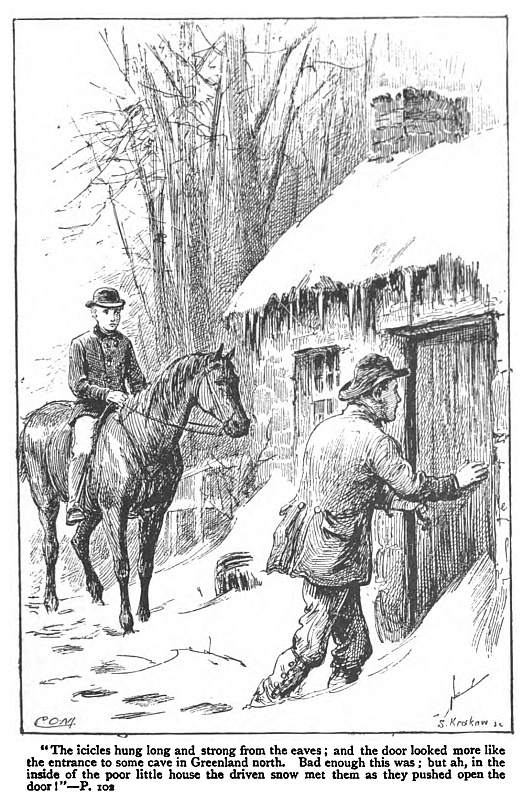
“How glad my mother will be!” said Bob.
And now they came in sight of the cottage, and Bob rubbed his eyes and looked again and again, for no smoke came from the chimney, no signs of life was about.
The icicles hung long and strong from the eaves; one side of the hut was entirely overblown with drift, and the door in the other looked more like the entrance to some cave in Greenland north. Bad enough this was; but ah, in the inside of the poor little house the driven snow met them as they pushed open the door! It had blown down the wide chimney, covered the hearth, formed a wreath like a sea-wave on the floor, and even o’er-canopied the bed itself. And the widow, the mother, lay underneath. No, not dead; she breathed, at least.
When the room had been cleared and swept of snow; when a roaring fire had been built on the hearth, and a little warm tea poured gently down her throat, she came gradually back again to life, and in a short time was able to be lifted into a sitting position, and then she recognised her son and Archie.
“Oh, mother, mother!” cried Bob, the tears streaming over his sun-browned face, “the Maker’ll never forgive me for all the ill I’ve done ye.”
“Hush! Bobbie, hush! What, lad, the Maker no’ forgive ye! Eh, ye little know the grip o’ His goodness! But you’re here, you’re innocent. Thank Him for that.”
“Ye’ll soon get better, mother, and I’ll be so good. The Squire is to give me work too.”
“It’s o’er late for me,” she said. “I’d like to live to see it, but His will be done.”
Archie rode home the giant hunter, but in two hours he was once more mounted on Scallowa, and feathering back through the snow towards the little cottage. The moon had risen now, and the night was starry and fine.
He tied Scallowa up in the peat shed, and went in unannounced.
He found Bob Cooper sitting before the dying embers of the fire, with his face buried in his hands, and rocking himself to and fro.
“She—just blessed me and wore away.”
That was all he said or could say. And what words of comfort could Archie speak? None. He sat silently beside him all that livelong night, only getting up now and then to replenish the fire. But the poacher scarcely ever changed his position, only now and then he stretched out one of his great hands and patted Archie’s knee as one would pet a dog.
A week passed away, and the widow was laid to rest beneath the frozen ground in the little churchyard by the banks of the river. Archie went slowly back with Bob towards the cottage. On their way thither, the poacher—poacher now no more though—entered a plantation, and with his hunting-knife cut and fashioned a rough ash stick.
“We’ll say good-bye here, Master Archie.”
“What! You are not going back with me to Burley Old Farm?”
Bob took a small parcel from his pocket, and opening it exposed the contents.
“Do you know them, Master Archie?”
“Yes, your poor mother’s glasses.”
“Ay, lad, and as long as I live I’ll keep them. And till my dying day, Archie, I’ll think on you, and your kindness to poor poacher Bob. No, I’m not goin’ back to Burley, and I’m not going to the cottage again. I’m going away. Where? I couldn’t say. Here, quick, shake hands, friend. Let it be over. Good-bye.”
“Good-bye.”
And away went Bob. He stopped when a little way off, and turned as if he had forgotten something.
“Archie!” he cried.
“Yes, Bob.”
“Take care of my mother’s cat.”
Next minute he leapt a fence, and disappeared in the pine wood.
Chapter Nine.
The Whole Yard was Ablaze and Burning Fiercely.
One year is but a brief span in the history of a family, yet it may bring many changes. It did to Burley Old Farm, and some of them were sad enough, though some were glad. A glad change took place for instance in the early spring, after Bob’s departure; for Rupert appeared to wax stronger and stronger with the lengthening days; and when Uncle Ramsay, in a letter received one morning, announced his intention of coming from London, and making quite a long stay at Burley, Rupert declared his intention of mounting Scallowa, and riding over to the station to meet him. And the boy was as good as his word. In order that they might be both cavaliers together, Uncle Ramsay hired a horse at D—, and the two rode joyfully home side by side.
His mother did not like to see that carmine flush on Rupert’s cheeks, however, nor the extra dark sparkle in his eyes when he entered the parlour to announce his uncle’s arrival, but she said nothing.
Uncle Ramsay Broadbent was a brother of the Squire, and, though considerably older, a good deal like him in all his ways. There was the same dash and go in him, and the same smiling front, unlikely to be dismayed by any amount of misfortune.
“There are a deal of ups and downs in the ocean of life,” Archie heard him say one day; “we’re on the top of a big wave one hour, and in the trough of the sea next, so we must take things as they come.”
Yes, this uncle was a seafarer; the skipper of a sturdy merchantman that he had sailed in for ten long years. He did not care to be called captain by anyone. He was a master mariner, and had an opinion, which he often expressed, that plain “Mr” was a gentleman’s prefix.
“I shan’t go back to sea again,” he said next morning at breakfast.
“Fact is, brother, my owners think I’m getting too old. And maybe they’re right. I’ve had a fair innings, and it is only fair to give the young ones a chance.”
Uncle Ramsay seemed to give new life and soul to the old place. He settled completely down to the Burley style of life long before the summer was half over. He joined the servants in the fields, and worked with them as did the Squire, Walton, and Archie. And though more merriment went on in consequence, there was nevertheless more work done. He took an interest in all the boys’ “fads,” spent hours with them in their workshop, and made one in every game that was played on the grass. He was dreadfully awkward at cricket and tennis however; for such games as these are but little practised by sailors. Only he was right willing to learn.
There was a youthfulness and breeziness about Uncle Ramsay’s every action, that few save seafarers possess when hair is turning white. Of course, the skipper spent many a jolly hour up in the room of the Castle Tower, and he did not object either to the presence of old Kate in the chair. He listened like a boy when she told her weird stories; and he listened more like a baby than anything else when Branson played his fiddle.
Then he himself would spin them a yarn, and hold them all enthralled, especially big-eyed Elsie, with the sterling reality and graphicness of the narrative.
When Uncle Ramsay spoke you could see the waves in motion, hear the scream of the birds around the stern, or the wind roaring through the rigging. He spoke as he thought; he painted from life.
Well, the arrival of Uncle Ramsay and Rupert’s getting strong were two of the pleasant changes that took place at Burley in this eventful year. Alas! I have to chronicle the sad ones also. Yet why sigh? To use Uncle Ramsay’s own words, “You never know what a ship is made of until stormy seas are around you.”
First then came a bad harvest—a terribly bad harvest. It was not that the crops themselves were so very light, but the weather was cold and wet; the grain took long to ripen. The task of cutting it down was unfortunately an easy one, but the getting it stored was almost an impossibility. At the very time when it was ripe, and after a single fiercely hot day, a thunder-storm came on, and with it such hail as the oldest inhabitant in the parish could not remember having seen equalled. This resulted in the total loss of far more of the precious seed, than would have sown all the land of Burley twice over.
The wet continued. It rained and rained every day, and when it rained it poured.
The Squire had heard of a Yankee invention for drying wheat under cover, and rashly set about a rude but most expensive imitation thereof. He first mentioned the matter to Uncle Ramsay at the breakfast-table. The Squire seemed in excellent spirits that morning. He was walking briskly up and down the room rubbing his hands, as if in deep but pleasant thought, when his brother came quietly in.
“Hullo! you lazy old sea-dog. Why you’d lie in your bed till the sun burned a hole in the blanket. Now just look at me.”
“I’m just looking at you.”
“Well, I’ve been up for hours. I’m as hungry as a Caithness Highlander. And I’ve got an idea.”
“I thought there was something in the wind.”
“Guess.”
“Guess, indeed! Goodness forbid I should try. But I say, brother,” continued Uncle Ramsay, laughing, “couldn’t you manage to fall asleep somewhere out of doors, like the man in the story, and wake up and find yourself a king? My stars, wouldn’t we have reforms as long as your reign lasted! The breakfast, Mary? Ah, that’s the style!”
“You won’t be serious and listen, I suppose, Ramsay.”
“Oh, yes; I will.”
“Well, the Americans—”
“The Americans again; but go on.”
“The Americans, in some parts where I’ve been, wouldn’t lose a straw in a bad season. It is all done by means of great fanners and heated air, you know. Now, I’m going to show these honest Northumbrian farmers a thing or two. I—”
“I say, brother, hadn’t you better trust to Providence, and wait for a fair wind?”
“Now, Ramsay, that’s where you and I differ. You’re a slow Moses. I want to move ahead a trifle in front of the times. I’ve been looking all over the dictionary of my daily life, and I can’t find such a word as ‘wait’ in it.”
“Let me give you some of this steak, brother.”
“My plan of operations, Ramsay, is—”
“Why,” said Mrs Broadbent, “you haven’t eaten anything yet!”
“I thought,” said Uncle Ramsay, “you were as hungry as a Tipperary Highlander, or some such animal.”
“My plan, Ramsay, is—” etc, etc.
The two “etc, etc’s” in the last line stand for all the rest of the honest Squire’s speech, which, as his sailor brother said, was as long as the logline. But for all his hunger he made but a poor breakfast, and immediately after he jumped up and hurried away to the barn-yards.
It was a busy time for the next two weeks at Burley Old Farm, but, to the Squire’s credit be it said, he was pretty successful with his strange operation of drying wheat independent of the sun. His ricks were built, and he was happy—happy as long as he thought nothing about the expense. But he did take an hour or two one evening to run through accounts, as he called it. Uncle Ramsay was with him.
“Why, brother,” said Ramsay, looking very serious now indeed, “you are terribly down to leeward—awfully out of pocket!”
“Ah! never mind, Ramsay. One can’t keep ahead of the times now-a-days, you know, without spending a little.”
“Spending a little! Where are your other books? Mr Walton and I will have a look through them to-night, if you don’t mind.”
“Not a bit, brother, not a bit. We’re going to give a dance to-morrow night to the servants, so if you like to bother with the book-work I’ll attend to the terpsichorean kick up.”
Mr Walton and Uncle Ramsay had a snack in the office that evening instead of coming up to supper, and when Mrs Broadbent looked in to say good-night she found them both quiet and hard at work.
“I say, Walton,” said Uncle Ramsay some time after, “this is serious. Draw near the fire and let us have a talk.”
“It is sad as well as serious,” said Walton.
“Had you any idea of it?”
“Not the slightest. In fact I’m to blame, I think, for not seeing to the books before. But the Squire—”
Walton hesitated.
“I know my brother well,” said Ramsay. “As good a fellow as ever lived, but as headstrong as a nor’-easter. And now he has been spending money on machinery to the tune of some ten thousand pounds. He has been growing crop after crop of wheat as if he lived on the prairies and the land was new; and he has really been putting as much down in seed, labour, and fashionable manures as he has taken off.”
“Yet,” said Walton, “he is no fool.”
“No, not he; he is clever, too much so. But heaven send his pride, honest though it be, does not result in a fall.”
The two sat till long past twelve talking and planning, then they opened the casement and walked out on to the lawn. It was a lovely autumn night. The broad, round moon was high in the heavens, fighting its way through a sky of curdling clouds which greatly detracted from its radiance.
“Look, Walton,” said the sailor, “to windward; yonder it is all blue sky, by-and-by it will be a bright and lovely night.”
“By-and-by. Yes,” sighed Walton.
“But see! What is that down yonder rising white over the trees? Smoke! Why, Walton, the barn-yards are all on fire!”
Almost at the same moment Branson rushed upon the scene.
“Glad you’re up, gentlemen,” he gasped. “Wake the Squire. The servants are all astir. We must save the beasts, come of everything else what will.”
The farm-steading of Burley was built in the usual square formation round a centre straw-yard, which even in winter was always kept so well filled that beasts might lie out all night. To the north were the stacks, and it was here the fire originated, and unluckily the wind blew from that direction. It was by no means high; but fire makes its own wind, and in less than half an hour the whole yard was ablaze and burning fiercely, while the byres, stables, and barns had all caught. From the very first these latter had been enveloped in dense rolling clouds of smoke, and sparks as thick as falling snowflakes, so that to save any of the live stock seemed almost an impossibility.
With all his mania for machinery, and for improvements of every kind possible to apply to agriculture, it is indeed a wonder that the Squire had not established a fire brigade on his farm. But fire was an eventuality which he had entirely left out of his reckoning, and now there was really no means of checking the terrible conflagration.
As soon as the alarm was given every one did what he could to save the live stock; but the smoke was blinding, maddening, and little could be done save taking the doors off their hinges.
Who knows what prodigies of valour were performed that night by the humble cowmen even, in their attempts to drive the oxen and cows out, and away to a place of safety? In some instances, when they had nearly succeeded, the cattle blocked the doorways, or, having got out to the straw-yard, charged madly back again, and prevented the exit of their fellows. Thus several servants ran terrible risks to their lives.
They were more successful in saving the horses, and this was greatly owing to Archie’s presence of mind. He had dashed madly into the stable for his pet Scallowa. The Shetland pony had never looked more wild before. He sniffed the danger, he snorted and reared. All at once it occurred to Archie to mount and ride him out. No sooner had he got on his back than he came forth like a lamb. He took him to a field and let him free, and as he was hurrying back he met little Peter.
“Come, Peter, come,” he cried; “we can save the horses.”
The two of them rushed to the stable, and horse after horse was bridled and mounted by little Peter and ridden out.
But a fearful hitch occurred. Tell, the Squire’s hunter, backed against the stable door and closed it, thus imprisoning Archie, who found it impossible to open the door.
The roof had already caught. The horses were screaming in terror, and rearing wildly against the walls.
Peter rushed away to seek assistance. He met Branson, and in a word or two told him what had happened.
Luckily axes were at hand, and sturdy volunteers speedily smashed the door in, and poor Archie, more dead than alive, with torn clothes and bleeding face, was dragged through.
The scene after this must be left to imagination. But the Squire reverently and fervently thanked God when the shrieks of those fire-imprisoned cattle were hushed in death, and nothing was to be heard save the crackle and roar of the flames.
The fire had lit up the countryside for miles around. The moonlight itself was bright, but within a certain radius the blazing farm cast shadows against it.
Next morning stackyards, barn-yards, farm-steading, machinery-house, and everything pertaining to Burley Old Farm, presented but a smouldering, blackened heap of ruins.
Squire Broadbent entertained his poor, frightened people to an early breakfast in the servants’ hall, and the most cheerful face there was that of the Squire. Here is his little speech:
“My good folks, sit down and eat; and let us be thankful we’re all here, and that no human lives are lost. My good kinswoman Kate here will tell you that there never yet was an ill but there might be a worse. Let us pray the worse may never come.”
Chapter Ten.
“After all, it doesn’t take much to make a Man Happy.”
For weeks to come neither Uncle Ramsay nor Walton had the heart to add another sorrow to the Squire’s cup of misery. They knew that the fire had but brought on a little sooner a catastrophe which was already fulling; they knew that Squire Broadbent was virtually a ruined man.
All the machinery had been rendered useless; the most of the cattle were dead; the stacks were gone; and yet, strange to say, the Squire hoped on. Those horses and cattle which had been saved were housed now in rudely-built sheds, among the fire-blackened ruins of their former wholesome stables and byres.
One day Branson, who had always been a confidential servant, sent Mary in to say he wished to speak to the Squire. His master came out at once.
“Nothing else, Branson,” he said. “You carry a long face, man.”
“The wet weather and the cold have done their work, sir. Will you walk down with me to the cattle-sheds?”
Arrived there, he pointed to a splendid fat ox, who stood in his stall before his untouched turnips with hanging head and dry, parched nose. His hot breath was visible when he threw his head now and then uneasily round towards his loin, as if in pain. There was a visible swelling on the rump. Branson placed a hand on it, and the Squire could hear it “bog” and crackle.
“What is that, Branson? Has he been hurt?”
“No, sir, worse. I’ll show you.”
He took out his sharp hunting-knife.
“It won’t hurt the poor beast,” he said.
Then he cut deep into the swelling. The animal never moved. No blood followed the incision, but the gaping wound was black, and filled with air-bubbles.
“The quarter-ill,” said the cowman, who stood mournfully by.
That ox was dead in a few hours. Another died next day, two the next, and so on, though not in an increasing ratio; but in a month there was hardly an animal alive about the place except the horses.
It was time now the Squire should know all, and he did. He looked a chastened man when he came out from that interview with his brother and Walton. But he put a right cheery face on matters when he told his wife.
“We’ll have to retrench,” he said. “It’ll be a struggle for a time, but we’ll get over it right enough.”
Present money, however, was wanted, and raised it must be.
And now came the hardest blow the Squire had yet received. It was a staggering one, though he met it boldly. There was then at Burley Old Mansion a long picture gallery. It was a room in an upper story, and extended the whole length of the house—a hall in fact, and one that more than one Squire Broadbent had entertained his friends right royally in. From the walls not only did portraits of ancestors bold and gay, smile or frown down, but there hung there also many a splendid landscape and seascape by old masters.
Most of the latter had to be sold, and the gallery was closed, for the simple reason that Squire Broadbent, courageous though he was, could not look upon its bare and desecrated walls without a feeling of sorrow.
Pictures even from the drawing-room had to go also, and that room too was closed. But the breakfast-room, which opened to the lawn and rose gardens, where the wild birds sang so sweetly in summer, was left intact; so was the dining-room, and that cosy, wee green parlour in which the family delighted to assemble around the fire in the winter’s evenings.
Squire Broadbent had been always a favourite in the county—somewhat of an upstart and iconoclast though he was—so the sympathy he received was universal.
Iconoclast? Yes, he had delighted in shivering the humble idols of others, and now his own were cast down. Nobody, however, deserted him. Farmers and Squires might have said among themselves that they always knew Broadbent was “going the pace,” and that his new-fangled American notions were poorly suited to England, but in his presence they did all they could to cheer him.
When the ploughing time came round they gave him what is called in the far North “a love-darg.” Men with teams of horses came from every farm for miles around and tilled his ground. They had luncheon in a marquee, but they would not hear of stopping to dinner. They were indeed thoughtful and kind.
The parson of the parish and the doctor were particular friends of the Squire. They often dropped in of an evening to talk of old times with the family by the fireside.
“I’m right glad,” the doctor said one evening, “to see that you don’t lose heart, Squire.”
“Bless me, sir, why should I? To be sure we’re poor now, but God has left us a deal of comfort, doctor, and, after all, it doesn’t take much to make a man happy.”
Boys will be boys. Yes, we all know that. But there comes a time in the life of every right-thinking lad when another truth strikes home to him, that boys will be men.
I rather think that the sooner a boy becomes cognisant of this fact the better. Life is not all a dream; it must sooner or later become a stern reality. Life is not all pleasant parade and show, like a field-day at Aldershot; no, for sooner or later pomp and panoply have to be exchanged for camp-life and action, and bright uniforms are either rolled in blood and dust, or come triumphant, though tarnished, from the field of glory. Life is not all plain sailing over sunlit seas, for by-and-by the clouds bank up, storms come on, and the good ship has to do battle with wind and wave.
But who would have it otherwise? No one would who possesses the slightest ray of honest ambition, or a single spark of that pride of self which we need not blush to own.
One day, about the beginning of autumn, Rupert and Archie, and their sister Elsie, were in the room in the tower. They sat together in a turret chamber, Elsie gazing dreamily from the window at the beautiful scenery spread out beneath. The woods and wilds, the rolling hills, the silvery stream, the half-ripe grain moving in the wind, as waves at sea move, and the silvery sunshine over all. She was in a kind of a daydream, her fingers listlessly touching a chord on the harp now and then. A pretty picture she looked, too, with her bonnie brown hair, and her bonnie blue eyes, and thorough English face, thorough English beauty. Perhaps Archie had been thinking something of this sort as he sat there looking at her, while Rupert half-lay in the rocking-chair, which his brother had made for him, engrossed as usual in a book.
Whether Archie did think thus or not, certain it is that presently he drew his chair close to his sister’s, and laying one arm fondly on her shoulder.
“What is sissie looking at?” he asked.
“Oh, Archie,” she replied, “I don’t think I’ve been looking at anything; but I’ve been seeing everything and wishing!”
“Wishing, Elsie? Well, you don’t look merry. What were you wishing?”
“I was wishing the old days were back again, when—when father was rich; before the awful fire came, and the plague, and everything. It has made us all old, I think. Wouldn’t you like father was rich again?”
“I am not certain; but wishes are not horses, you know.”
“No,” said Elsie; “only if it could even be always like this, and if you and Rupert and I could be always as we are now. I think that, poor though we are, everything just now is so pretty and so pleasant. But you are going away to the university, and the place won’t be the same. I shall get older faster than ever then.”
“Well, Elsie,” said Archie, laughing, “I am so old that I am going to make my will.”
Rupert put down his book with a quiet smile.
“What are you going to leave me, old man? Scallowa?”
“No, Rupert, you’re too long in the legs for Scallowa, you have no idea what a bodkin of a boy you are growing. Scallowa I will and bequeath to my pretty sister here, and I’ll buy her a side-saddle, and two pennyworth of carrot seed. Elsie will also have Bounder, and you, Rupert, shall have Fuss.”
“Anything else for me?”
“Don’t be greedy. But I’ll tell you. You shall have my tool-house, and all my tools, and my gun besides. Well, this room is to be sister’s own, and she shall also have my fishing-rod, and the book of flies that poor Bob Cooper made for me. Oh, don’t despise them, they are all wonders!”
“Well really, Archie,” said Elsie, “you talk as earnestly as if you actually were going to die.”
“Who said I was going to die? No, I don’t mean to die till I’ve done much more mischief.”
“Hush! Archie.”
“Well, I’m hushed.”
“Why do you want to make your will?”
“Oh, it isn’t wanting to make my will! I am—I’ve done it. And the ‘why’ is this, I’m going away.”
“To Oxford?”
“No, Elsie, not to Oxford. I’ve got quite enough Latin and Greek out of Walton to last me all my life. I couldn’t be a doctor; besides father is hardly rich enough to make me one at present. I couldn’t be a doctor, and I’m not good enough to be a parson.”
“Archie, how you talk.”
There were tears in Elsie’s eyes now.
“I can’t help it. I’m going away to enter life in a new land. Uncle Ramsay has told me all about Australia. He says the old country is used up, and fortunes can be made in a few years on the other side of the globe.”
There was silence in the turret for long minutes; the whispering of the wind in the elm trees beneath could be heard, the murmuring of the river, and far away in the woods the cawing of rooks.
“Don’t you cry, Elsie,” said Archie. “I’ve been thinking about all this for some time, and my mind is made up. I’m going, Elsie, and I know it is for the best. You don’t imagine for a single moment, do you, that I’ll forget the dear old times, and you all? No, no, no. I’ll think about you every night, and all day long, and I’ll come back rich. You don’t think that I won’t make my fortune, do you? Because I mean to, and will. So there. Don’t cry, Elsie.”
“I’m not going to cry, Archie,” said Rupert.
“Right, Rupert, you’re a brick, as Branson says.”
“I’m not old enough,” continued Rupert, “to give you my blessing, though I suppose Kate would give you hers; but we’ll all pray for you.”
“Well,” said Archie thoughtfully, “that will help some.”
“Why, you silly boy, it will help a lot.”
“I wish I were as good as you, Rupert. But I’m just going to try hard to do my best, and I feel certain I’ll be all right.”
“You know, Roup, how well I can play cricket, and how I often easily bowl father out. Well, that is because I’ve just tried my very hardest to become a good player; and I’m going to try my very hardest again in another way. Oh, I shall win! I’m cocksure I shall. Come, Elsie, dry your eyes. Here’s my handkie. Don’t be a little old wife.”
“You won’t get killed, or anything, Archie?”
“No; I won’t get killed, or eaten either.”
“They do tell me,” said Elsie—“that is, old Kate told me—that the streets in Australia are all paved with gold, and that the roofs of the houses are all solid silver.”
“Well, I don’t think she is quite right,” said Archie, laughing. “Anyhow, uncle says there is a fortune to be made, and I’m going to make it. That’s all.”
Archie went straight away down from that boy’s room feeling every inch a man, and had an interview with his father and uncle.
It is needless to relate what took place there, or to report the conversation which the older folks had that evening in the little green parlour. Both father and uncle looked upon Archie’s request as something only natural. For both these men, singular to say, had been boys once themselves; and, in the Squire’s own words, Archie was a son to be proud of.
“We can’t keep the lad always with us, mother,” said Squire Broadbent; “and the wide world is the best of schools. I feel certain that, go where he will, he won’t lose heart. If he does, I should be ashamed to own him as a son. So there! My only regret is, Ramsay, that I cannot send the lad away with a better lined pocket.”
“My dear silly old brother, he will be better as he is. And I’m really not sure that he would not be better still if he went away, as many have gone before him, with only a stick and a bundle over his shoulder. You have a deal too much of the Broadbent pride; and Archie had better leave that all behind at home, or be careful to conceal it when he gets to the land of his adoption.”
The following is a brief list of Archie’s stock-in-trade when he sailed away in the good ship Dugong to begin the world alone: 1. A good stock of clothes. 2. A good stock of assurance. 3. Plenty of hope. 4. Good health and abundance of strength. 5. A little nest egg at an Australian bank to keep him partly independent till he should be able to establish a footing. 6. Letters of introduction, blessings, and a little pocket Bible.
His uncle chose his ship, and sent him away round the Cape in a good old-fashioned sailing vessel. And his uncle went to Glasgow to see him off, his last words being, “Keep up your heart, boy, whatever happens; and keep calm in every difficulty. Good-bye.”
Away sailed the ship, and away went Archie to see the cities that are paved with gold, and whose houses have roofs of solid silver.