COUNTIES OF THE SEVERN VALLEY
Reading edition
Of the counties occupying the Severn basin, three form, in continuation with Cheshire, the Welsh border,—Shropshire, Hereford, and Monmouth. Shropshire, together with the West Midland counties of Worcester and Gloucester, is traversed by the mother stream, but Hereford and Monmouth lie in their respective vales of the tributary Wye and Usk, and Warwickshire, already noted, in the broad basin of the Avon.
In previous summers we had explored, to some extent, Gloucestershire and Worcestershire and the picturesque Wye valley, but we were, except for glimpses from the railway, strangers to Shropshire, and so dropped off the train at Shrewsbury, in a Saturday twilight, with but moderate expectation. Had not the judicious Baedeker instructed us that "not more than half a day need be devoted to Shrewsbury"? What happened was that we lost our hearts to the beautiful old town and lingered there nearly a week without finding time, even so, to do a third of the tourist duty laid down in what a guileless Florentine has called "the red prayer-book of the foreigners." But we would gladly have stayed months longer and listened for the moonlight talk between that lofty Norman castle, "builte in such a brave plot that it could have espyed a byrd flying in every strete," and those fine old houses of the Salop black-and-white whose "curious sculptures and carvings and quirks of architecture" gave such pleasure to Hawthorne. Surely here, in this city of many memories, "a stone shall cry out of the wall, and the beam out of the timber shall answer it."
Shrewsbury is but a little city,—one of the local proverbs runs: "We don't go by size, or a cow would catch a hare,"—but its architectural grace and a certain joyousness of open-air life more French than English endow it with rare charm. It won a fitting praise from its own Tudor poet, Thomas Churchyard:
"Now Shrewsbury shall be honoured (as it ought); The seate deserves a righte greate honour heere; That wallèd town is sure so finely wrought, It glads itself, and beautifies the sheere."
Fortunate in situation, Shrewsbury is enthroned upon twin hills almost surrounded by the Severn. As one of the warders of the Welsh border, it was stoutly fortified, and enough of the old wall remains to make a pleasant promenade. On the only land approach, an isthmus barely three hundred yards broad, stands the square red keep of the castle. The slender spire of St. Mary's is a landmark far and wide. St. Alkmund's, with a sister spire, has a tradition that reaches back to Æthelfreda, daughter of Alfred the Great. Old St. Chad's, a noble church in the days of Henry III, has swayed and sunk into a fragment that serves as chapel for the cemetery where some of the first Salopian families take their select repose. The towered Abbey Church is of venerable dignity, with battered monuments of cross-legged knight and chaliced priest, and a meek, bruised, broken effigy supposed to represent that fiery founder of the abbey, first Earl of Shrewsbury and builder of the castle, Roger de Montgomery, second in command at Hastings to William the Conqueror.
THE SEVERN BELOW THE QUARRY, SHREWSBURY
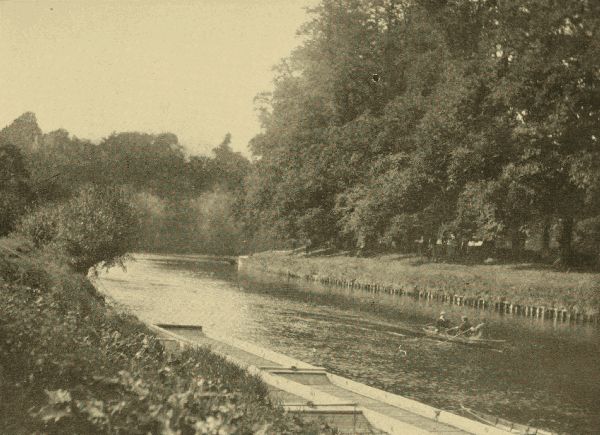
The first known name of Shrewsbury was The Delight, and by that name it may well be remembered of those who have wandered through Wyle Cop and Butchers' Row, past the Raven tavern where Farquhar wrote "The Recruiting Officer" and the old half-timbered house where Richmond, soon to be Henry VII, lodged on his way to Bosworth Field. There are steep streets that, as the proverb has it, go "uphill and against the heart," but carven gables and armorial bearings and mediæval barge-boards tempt one on. There are wild and fierce associations, as that of the Butter Market, where at the High Cross poor Prince David of Wales—who must have had nine lives—after being dragged through the town at a horse's tail, was "hanged, burned and quartered," but in the main it is a city of gracious memories. Its Grammar School, an Edward VI foundation, which in the seventeenth century boasted four masters, six hundred scholars, and a "hansome library," counts on its roll of alumni Charles Darwin, the most famous native of Shrewsbury, the poet Faber, Philip Sidney and his fidus Achates, Fulke Greville, whose tomb in St. Mary's Church at Warwick bears the inscription that he was "Servant to Queen Elizabeth, Counsellour to King James, and Friend to Sir Philip Sidney." It was in 1564, that starry year in English literary annals, that the two lads entered the school. Sidney's father was then Lord President of Wales—one of the best she ever had—and resident at Ludlow Castle, from whose splendid halls Sir Henry and Lady Mary wrote most wise and tender letters to their "little Philip." He must have profited by these, for in after years Fulke Greville extolled him as the paragon of schoolboys:
"Of his youth I will report no other wonder than this, though I lived with him and knew him from a child, yet I never knew him other than a man, with such staidness of mind, lovely and familiar gravity, as carried grace and reverence above great years; his talk ever of knowledge and his very play tending to enrich his mind so that even his teachers found something in him to observe and learn above that which they had usually read or taught."
The school, still flourishing, is now housed in new buildings across the Severn, opposite the Quarry, a spacious park with
"Broad ambrosial aisles of lofty limes."
Here we used to sit on shaded benches and watch the bright-eyed urchins fishing in the river, for Shropshire, as the saying goes, is "full of trouts and tories." Here we would repeat Milton's invocation to the Goddess of the Severn:
"Sabrina fair, Listen where thou art sitting Under the glassy, cool, translucent wave, In twisted braids of lilies knitting The loose train of thy amber-dropping hair,"
and when her "sliding chariot" declined to stay for us
"By the rushy-fringèd bank,"
we would ignobly console ourselves with "a Shrewsbury cake of Palin's own make,"—such a delicious, melting-on-the-tongue concoction as Queen Bess was regaled withal and as suggested to Congreve, in his "Way of the World," the retort: "Why, brother Wilful of Salop, you may be as short as a Shrewsbury cake, if you please." The Simnel cake of which Herrick sings,—
"I'll to thee a Simnel bring, 'Gainst thou goest a mothering,"
is made only in the days approaching Christmas and Easter. It consists of minced fruit in a saffron-coloured crust, said to be exceeding tough, and on Mothering Sunday, in Mid-Lent, is taken as a gift to their mothers by children out at service, who, on this local festival, come home to be welcomed at the cost of the fatted calf, veal and rice-pudding being the regulation dinner. The ancient refrain: "A soule-cake, a soule-cake! Have mercy on all Christen soules for a soule-cake!" refers to yet another specialty of Shropshire ovens. On All Souls' Eve it used to be the custom to set out on the table a tower of these round flat cakes, every visitor reducing the pile by one. The residue, if residue there were, fell to the share of the poor ghosts.
The Quarry, in the bad old times, was often the scene of bull-baitings and bear-baitings and cock-fights. It is better to remember that the Whitsun Plays were performed here, for these were comely and edifying spectacles. In 1568, when Sir Henry Sidney favoured the Grammar School with a visit, there was "a noble stage playe played at Shrewsbury, the which was praysed greately, and the chyffe actor thereof was one Master Aston," being no less a personage than the head master.
A Quarry holiday that, by the grace of Sabrina, fell within the brief limits of our sojourn, was the Shrewsbury Floral Fête, vaunted on the pink program as "The Grandest Fête in the United Kingdom." Our landlady earnestly vouched for the truth of this description. "There is them who would have it as York Gala be the greatest, but York Gala, grand however, ben't so grand as this."
On Wednesday, August twenty-second, we took aristocratic tickets at two and six, for Wednesday is the day of the county families. Thursday is the shilling day, when, by train, by coach, by barge, by wagonette, by farmer's gig and carrier's cart, all the countryside comes streaming in. The weather had been watched with keen anxiety. "Rain spells ruin," the saying went; but it was clear and hot. Men, women, and children lay on the grass around their luncheon baskets—we had hardly expected this of the county families—all through the wide enclosure, making the most of every disk of shade. From the central bandstand and from the encircling tents—refreshment tents, flower tents, fruit tents, vegetable tents, bee-and-honey tents—drooped rows of languid pennons. The fountain in The Dingle sent up a silvery tree of spray, while the white and yellow water-lilies in its little pool blinked like sleepy children. Within the tents the heat was stifling, but a continuous flow of flushed humanity, as whist as in the County Store where even the awed shop girls are instructed to speak with bated breath, passed in admiring review the sumptuous masses of heavily fragrant flowers, the great black grapes almost bursting with wine, the luscious plums and cherries, the amazing platoons of plethoric onions, exaggerated potatoes, and preposterously elongated turnips and carrots, the model beehives and the jars of amber honey. The gold-medal exhibitors, perspiring but beaming, stood by their red-ticketed products, while the silver-medal folk viewed their blue tickets with a pleasant sense of superiority to the subdued white-ticket battalion and the invisible yellow-ticketers who were only "commended."
All the while successive bands—the Shropshire Imperial Yeomanry, His Majesty's Coldstream Guards, and His Majesty's Scots Guards—were merrily playing away, and presently the clamorous ringing of what might have been a sturdy dinner-bell called us to the Acrobatic Stand, about which the crowd soon became so dense, while the somersault artists converted their bodies into giddy playthings, that one rustic philosopher was heard to remark: "Well, we ain't seeing owt, but we're in t' show." Then came the horse-leaping, which was such a favourite feature that not even the miraculous performances of the King of the High Wire, and the ether-dancing feats of the Cee Mee Troupe availed to divide the multitude. When Rufus, to the deep but decorous delight of the Cheshire visitors, had outleaped all the rest, we swarmed across the Quarry and sat down on the grass to wait for the ascent of the monster balloons, those gigantic golden-brown puffs of gas that had been softly tugging at their bonds all the morning. The Shrewsbury had already made a number of captive ascents and finally achieved its "right away" in good order, rising majestically into the upper air until it hung like an orange on our furthest reach of vision, but the wayward Wulfruna broke her ropes on a captive trip and feloniously made off with several astonished passengers, among whose vanishing heads peered out the scared, ecstatic face of a small boy.
As dusk grew on, our ever-greatening host still comported itself with well-bred English quietude. We never forgot what was due to the presence of the county families. Even the lads in Eton jackets tripped one another up softly and engagingly. Bath chairs and baby wagons traversed the thick of the press. The King of the High Wire, who seemed to be made of air and india-rubber, appeared again and performed such impossible antics on his dizzy line that the setting sun rested its chin on the horizon to stare at him, and from a slit in the gaudy trapeze tent half-chalked visages peered out and paid him the professional tribute of envy. The tumblers tumbled more incredibly than before. The Handcuff King shuffled off one mortal coil after another. The Lady Cyclists cycled in an extremely unladylike manner,—a performance punctuated by the impatient yelping of little dogs beneath the stage, eager to show off their own accomplishments. On they came at last, bounding, barking, wagging, tumultuous, all striving to take part in every trick. They quite refused to stop when their respective turns were over, but went on all together excitedly jumping rope and hitting ball long after ropes and balls had disappeared, until they were unceremoniously picked up and bundled down a trap-door, an exit of wagging tail-tips.
As darkness fell, the Severn was all astir with pleasure-boats, while happy ragamuffins, getting their fireworks for nothing, thronged the further bank. Rockets went skittering over our heads, fire-wheels spluttered and whizzed, and as the first of the fire-balloons flashed up, a baby voice behind us piped:
"O mummy, mummy! See! There's a somebody died and going up to heaven."
Altogether the Floral Fête was as sweet-natured and pleasurable a festival as ever we chanced upon and completed our subjugation to this old town that the Severn so lovingly embraces. To quote from a black-letter ballad treasured in the Bodleian:
"The merry Town of Shrowsbury God bless it still, For it stands most gallantly Upon a high hill. It standeth most bravely For all men to see. Then every man to his mind, Shrowsbury for me!"
The county of Shropshire smooths away on the east into a level pasture-land belonging to the central plain of England, but its western portion is roughened by the spurs of the Welsh mountains. Its own mountain is the Wrekin, a solitary height a few miles to the east of Shrewsbury. The summit commands so wide a view that the toast of Salopians everywhere is "All round the Wrekin." South of the Severn run several ranges of hills down toward the hop-gardens and apple-orchards of Hereford and Worcester. Of these, "Clee Hills," the highest of the ranges, "be holy in Shropshire."[7] North Salop has a coal-field, with its accompanying prosperity and disfigurement,—busy factories, belching furnaces, houses that tip and tumble from the hollowing out of the ground beneath. We rioted in our memorable motor car through several of these grimy towns, Wellington among them, and Newport, where the runaway Shrewsbury balloon came safely down. Wellington cherishes a legend relating to a bad old giant of Wales, who, having a spite against the Mayor of Shrewsbury, purposed to choke up the Severn and drown out the town. So he started off with a heavy sack of earth over his shoulder, but lost his way, like the stupid giant he was, and met, near Wellington, a cobbler carrying home a bag of boots and shoes to mend. The giant asked him how far it was to Shrewsbury, and the cobbler, emptying his sack of ragged footwear, declared he had worn out all those boots and shoes on the road. This so discouraged the giant that he flung down his burden of earth, forming the Wrekin, and trudged meekly home again.
Far more delightful than automobiling were the leisurely drives we took in the neighbourhood of Shrewsbury. One fair afternoon we drove five miles southeast to Wroxeter to view the tragic ruins of the Roman city of Uriconium. Here, at the junction of Watling Street with the western Roman road, guarding these communications and the passes of the Severn, stood "The White Town in the Woodland." After the Roman armies were withdrawn, it was stormed and burned by the Saxons. The lapse of fourteen hundred years has not obliterated the traces of that anguish. Only a little below the surface lies earth still black from the heats of the tremendous conflagration; charred bones crackle beneath the tread; in an under-chamber of one of the baths has been found the skeleton of an old man crouched between the pillars, as if seeking refuge from the rage of fire and sword. The skeletons of two women were beside him and, close to his bony hand, his little hoard of coins. There still stands a rugged mass of wall some seventy feet in length, its Roman string-courses of flat red bricks showing bright against the prevailing grey of that jagged, gaping structure. Now birds nest in it, and from the lower heaps and ranges of broken masonry all about springs the wild rose as well as the thistle. Uriconium was larger than Pompeii, and its ruins, said to be the most extensive of their kind in England, smite one with heartache. We roamed about its grassy hollows and thicketed mounds, its bone-strewn forum, and its baths with their patches of mosaic flooring, their groups of little brick columns, and other fragments of a perished luxury. We wondered that the sky above this city left so desolate, a sky of softest azure flecked with cloudlets dazzling white, did not wear perpetual shadow for its sake. But those heavens were as serene as if the dying wail of Uriconium had never pierced them, and the cleft summit of Milton's "blue-topped Wrekin"—a deep, intense, gleaming blue it was that afternoon—kept no memory of the day when the Severn ran red with blood and its own head was veiled with smoke and ashes.
The noble Norman church of Wroxeter, near by, has set at its churchyard gate two Roman pillars with finely sculptured capitals that have been recovered from the river-bed. Its font is hollowed out of another Roman capital and looks only half converted. The church is remarkable for its Easter sepulchre, an arched niche in the north wall of the chancel, and for its altar-tombs. This Easter sepulchre, where the crucifix would have been placed on Good Friday to be raised again with rejoicing on Easter morning, is of creamy stone with ball-flower ornament. Within the niche are reddish traces of a Resurrection fresco. The effigies on the altar-tombs have been singularly preserved from mutilation. Even the rings upon those comely hands that clasp their prayer-books in the centuried trance of their devotions remain intact. Here sleeps a Jacobean baronet splendid in scarlet alabaster robes and broad gilt chain. A peacock is at his head and a lion's claw at his feet. His lady, from gold head-dress to dainty shoon, is no less immaculate. May their rest on their stone pillows be forever unprofaned! In that hushed and almost forgotten sanctuary slumber also Elizabethan knights and ladies whose tombs, wrought about with quaint figures, are peculiarly individual and tempted us to closer study than the waning light allowed.
There were many pilgrimages we longed to make in Shropshire—to the birthplace and burial-place of Lord Clive, her Indian hero, and to the home of Lord Herbert of Chirbury, brother of the Saintly George Herbert, himself a Jacobean courtier only less eminent in letters than in life. Even bluff Ben Jonson hailed him as "All-virtuous Herbert." Other Shropshire worthies, who would hardly so have designated each other, are Richard Baxter and William Wycherley. Two others that I would like, in the interests of a broader charity, to pair together in the procession of great Salopian ghosts, are Bishop Percy of the "Reliques," and Dick Tarlton, lord of mirth, the best-beloved clown of the Elizabethan stage. The queen herself had a good friend in Dick Tarlton, for he told her, says Fuller, "more of her faults than most of her chaplains and cured her melancholy better than all her physicians."
The inexorable almanac urged us on, but one excursion that we could not forego was that to Battlefield Church. Thither we drove through such a tender afternoon, the soft sky brooding close above the earth as if she loved it, that it was hard to realise associations of wrath and war. The sun made golden windows in the clouds. The brown Severn was slyly breaking down its banks as it ran. We took our way through Shropshire lanes whose hawthorn hedges on either side were fringed with yellow wisps of rye scraped off from the harvest loads. Beyond we came upon the harvest fields with their shining stacks. And in Battlefield Church itself we found, almost rough-hewn from the tree-trunk, a mediæval image of Our Lady of Pity.
Here was fought on another summer day, July 21, 1403, the decisive battle between Henry IV and the Percies. Henry had sat but four years upon his troubled throne when these proud nobles of the north, by whose aid he had ousted Richard II, rose against him. Although Richard had been murdered, Edmund Mortimer, the next of blood, was a thorn in Henry's pillow. Mortimer had been taken prisoner by the revolting Welsh leader, Owen Glendower, and Henry, if we may take Shakespeare for our historian, listened coldly and incredulously to Harry Percy's assurances of Mortimer's resistance. In vain did this eloquent Hotspur, Mortimer's brother-in-law, pour forth his impetuous tale—how
"on the gentle Severn's sedgy bank, In single opposition, hand to hand, He did confound the best part of an hour In changing hardiment with great Glendower; Three times they breath'd, and three times did they drink, Upon agreement, of swift Severn's flood; Who then, affrighted with their bloody looks, Ran fearfully among the trembling reeds, And hid his crisp head in the hollow bank Blood-stained with those valiant combatants."
When the king refused to ransom Mortimer, Hotspur's anger bubbled over:
"He said he would not ransom Mortimer, Forbade my tongue to speak of Mortimer, But I will find him when he lies asleep, And in his ear I'll holla 'Mortimer!' Nay, I'll have a starling shall be taught to speak Nothing but 'Mortimer' and give it him."
Thus Hotspur, and his father, the Earl of Northumberland, his uncle, the Earl of Worcester, "the irregular and wild Glendower," and the valiant Douglas of Scotland raised their united banners against the usurper. Many Cheshire gentlemen, to their sorrow, joined Hotspur as he marched through their county. He came in sight of Shrewsbury on the evening of July nineteenth. But Henry was there before him; the royal standard floated over the castle; and it was three or four miles to the north of the town that the shock of battle came. Five thousand of the rebels and three thousand of the loyal forces fell. The Earl of Worcester was slain on the field, and "that spirit Percy" himself, "the theme of honour's tongue," he who had ever been "sweet fortune's minion and her pride," perished there in the toils of his "ill-weav'd ambition." The traditional spot where he fell is pointed out, as also the antique oak from whose leafy top Owen Glendower is fabled to have watched, at a safe distance, the fortunes of the fight.
Battlefield Church was built in gratitude for this victory, and a perpetual chantry of eight canons was endowed to serve it with daily masses "for the king's salvation during his life, and after his death for his soul, and for the souls of his progenitors and of those who were slain in the battle and were there buried, and for the souls of all the faithful departed." The meadow behind the church, which, with its mounds, ridges, and depressions, still bears the battle-scars, is supposed to be the grave of thousands of the soldiers. The masses were duly said for nearly one hundred and fifty years, until the chantry was surrendered to Henry VIII. The church, abandoned after the Dissolution and suffered to fall into decay, has been restored. Its curious image of Our Lady of Pity was an ancient treasure of Albright Hussey, a neighbouring hamlet where we paused on our homeward way to see a veritable moated grange, and was brought to Battlefield early in the fifteenth century, when the church was consecrated. In the vestry are two small windows that keep such bits of the original glass as could be gathered up from the pile of shreds and splinters stored away in a farm-building close by. One of the recovered designs is a figure of Saint Elizabeth of Hungary, vivid, ascetic, with loaf in hand. But more vital yet is the portrait of Henry IV—a royal form robed in such glowing, living crimson as only the old craftsmen knew how to pour into their glass. The face, "wan with care," is earnest and sorrowful.
Many are the battle-tales of these counties on the Welsh marches. William the Conqueror gave leave to certain of his followers to take and hold what land they could in that wild region, and a line of strong castles was erected; but the fierce British, making sudden raids from their mountain fastnesses, were a constant threat and trouble, until Edward I, despite the tuneful curses of all the Welsh bards, reduced them to subjection, putting the last native Prince of Wales to a cruel death at Shrewsbury and transferring the title to his own firstborn son. As the jurisdiction of the Marches became of importance, special courts were held by the Prince of Wales either in person or through a deputy known as the Lord President of Wales,—an office not abolished until 1688. The seat of these courts was Ludlow, a place that even to our partial eyes rivalled Shrewsbury in beauty and is counted by many the banner town of England. It stands in the very south of Shropshire on a commanding height just where the river Teme, which forms the Hereford boundary, is joined by the Corve. The lofty-towered Church of St. Lawrence, only second in praise to St. Mary Redcliffe of Bristol, and the impressive remains of what was once both Castle and Princely Palace crown this precipitous mass of rock, from which broad streets, retaining a goodly number of stately timbered houses dating from the times when the Courts of the Marches gathered illustrious companies at Ludlow, descend to plain and river. No description of this once royal residence, with its pure, bracing atmosphere, can better the honest lines of old Tom Churchyard:
"The towne doth stand most part upon a hill, Built well and fayre, with streates both longe and wide; The houses such, where straungers lodge at will, As long as there the Counsell lists abide. "Both fine and cleane the streates are all throughout, With condits cleere and wholesome water springs; And who that lists to walk the towne about Shall find therein some rare and pleasant things; But chiefly there the ayre so sweete you have As in no place ye can no better crave."
The magnificent old castle has seen strange sights. While undergoing siege by Stephen, in his war against Maud, Prince Henry of Scotland, who accompanied him, was caught up by a long iron hook and all but pulled within the walls. Stephen himself galloped up just in time to cut the cords with his sword and rescue the dangling prince. The redoubtable Sir Hugh de Mortimer, Lord of Wigmore, once lay captive in what is still known as Mortimer's Tower. It cost him three thousand marks of silver, besides all his plate, horses, and hawks, to go free again. Ludlow Castle was, at a later period, added by marriage to the already formidable holdings of the Mortimers. Roger de Mortimer took an active part in the deposition of Edward II and was created Earl of March. In imitation of King Arthur, whose great tradition arches over all that countryside, the ambitious young noble held a Round Table, and conducted Queen Isabella, with whom his relations were not above suspicion, and his boy sovereign, Edward III, to his castles of Wigmore and Ludlow, where he entertained them with "great costs in tilts and other pastimes." There was not room in England for him and for a king, and his arrogant career was ended on the Smithfield gibbet. Marlowe gives him a proud exit from the tragic stage:
"Weep not for Mortimer That scorns the world and, as a traveler, Goes to discover countries yet unknown."
It was his great-grandson, Edmund de Mortimer, who, by marriage with the daughter of Prince Lionel, third son of Edward III, gave that other Edmund Mortimer, his descendant, a better title to the throne than that of Henry IV. This last of the Mortimers was until his death the apparently listless centre of continual conspiracies. When he gave up his ineffectual ghost, his estates passed to his nephew, the vigorous Duke of York, who fixed his chief residence at Ludlow Castle. As the York rebellion gathered force and the Wars of the Roses set in, this neighbourhood became a centre of hostilities. The Lancastrians, in their hour of triumph, wreaked furious vengeance on Ludlow, but Edward IV, on his accession, consoled the town with a liberal charter and selected it as the residence of his sons, the Little Princes of the Tower. It is pleasant to think that before their swift fate came upon them they had a few years of happy childhood playing on the greensward of those spacious courts, perched up with their lesson books in the stone window-seats, and praying their innocent prayers within the arcaded walls of that circular Norman chapel, built on the model of the Church of the Holy Sepulchre and praised by Churchyard as
"So bravely wrought, so fayre and finely fram'd, That to world's end the beauty may endure."
Another princely association, hardly less pathetic, haunts these arched portals and embattled towers. The heir of Henry VII, Prince Arthur, in whom the greatness of Britain's legendary hero was to live again, passed his delicate childhood here, and here, shortly after his marriage to Catherine of Arragon, died suddenly on a spring day of 1502, a lad of sixteen summers. An unknown contemporary tells how letters were hastily despatched from Ludlow to His Majesty's Council, and they, seeking the gentlest bearer of such grievous news, "sent for the King's ghostly father.... He in the morning of the Tuesday following, somewhat before the time accustomed, knocked at the King's chamber door; and when the King understood it was his Confessor, he commanded to let him in. The Confessor then commanded all those there present to avoid, and after due salutation began to say, Si bona de manu Dei suscepimus, mala autem quare non sustineamus? and so showed his Grace that his dearest son was departed to God. When his Grace understood that sorrowful heavy tidings, he sent for the Queen, saying that he and his Queen would take the painful sorrows together. After that she was come, and saw the King her lord and that natural and painful sorrow, as I have heard say, she with full great and constant comfortable words besought his Grace that he would, first after God, remember the weal of his own noble person, the comfort of his realm and of her ... over that how that God had left him yet a fair prince, two fair princesses; and that God is where he was.... Then the King thanked her of her good comfort. After that she was departed and come to her own chamber, natural and motherly remembrance of that great loss smote her so sorrowful to the heart, that those that were about her were fain to send for the King to comfort her."
We saw on a Sunday, in the beautiful Church of St. Lawrence, a dole of bread for the poor, a row of twelve goodly loaves set out on a Tudor monument which is believed to commemorate Prince Arthur, and possibly to cover the ashes of his boyish heart, although the body was buried in Worcester Cathedral, where his chantry stands at the right of the High Altar.
Among the tombs in the rich-windowed choir is one whose inscription reads:
"Heare lyethe the bodye of Ambrozia Sydney, iiii doughter of the Right Honourable Syr Henry Sydney, Knight of the moste noble order of the Garter, Lord President of the Counsell of Wales, etc. And of Lady Mary his wyef, doughter of the famous Duke of Northumberland, who dyed in Ludlow Castell, ye 22nd of Februarie, 1574."
We paused there a moment in reverence to Sir Philip Sidney's mother, "a full fair lady" who lost her beauty by nursing Queen Elizabeth, from whom she took the contagion, through an attack of smallpox, and afterwards "chose rather to hide herself from the curious eyes of a delicate time than come upon the stage of the world with any manner of disparagement."
The last Lord Marcher before the Restoration was the Earl of Bridgwater, whose appointment was most gloriously celebrated by the creation of Milton's "Comus," presented on Michaelmas Night, 1634, in the Great Hall of the castle. The first to hold the office—thenceforth only nominal—after the Restoration was the Earl of Carberry, whose seneschal was one Samuel Butler, a steward who may or may not have kept good accounts, but who used his pen to effective purpose in writing, in a chamber over the gate, the first portion of "Hudibras."
Ludlow is the centre for fascinating excursions. The delicious air and most lovely scenery tempt one forth on roads that run between bird-haunted banks fringed with luxuriant bracken and lined with all manner of trees to whose very tops climbs the aspiring honeysuckle. The glint of red berries from the mountain ash, the drooping sprays of the larches, the silvery glimpses of far vistas framed in leafy green, the spicy forest fragrances, the freshness and buoyancy of the air, all unite to make the spirit glad. From every rise in the road are views that range over a fair outspread of plain and valley, rimmed by gentle hills. All over Worcestershire we looked, and into Wales, and up through Salop to where the Wrekin smiled a gracious recognition. Points of special interest abound,—Haye Wood, where Lady Alice, daughter of the Earl of Bridgwater, and her brothers lost their way and by their little adventure gave young Milton the suggestion for his Masque; St. Mary's Knoll, once crowned by a venerated image of the Virgin; Oakley Park, with its Druid trees; the little church of Pipe Aston, with its curious semi-cirque of Norman carving over the door; Leinthall church, overtopped at either end by lofty yews; British fort; Tudor mansion; storied battlefield.
Our first goal was Richard's Castle in Hereford, dating from the reign of Edward the Confessor,—a Norman keep before the Norman Conquest. Nothing of that brave erection is left save a mound of earth and a bit of broken wall. Near by stands an old church with some remnants of fine glass and with the rare feature, in England, of a detached bell-tower. We lingered in the church yard, looking out from a massive recumbent slab that was cleft from end to end, as if the impatient sleeper could not wait for the Archangel's trump, eastward to the Malvern Hills, whose earthly blue melted as softly into the blue of the sky as life melts into death. But a line of rooks flapping roostward awoke us to the flight of time, and the pensive appeal of that quiet spot, with its lichened crosses and grave-mantling growths of grass and ivy, was dispelled by a donkey who thrust his head through a green casement in the hedge and waggled his long ears at us with a quizzical expression.
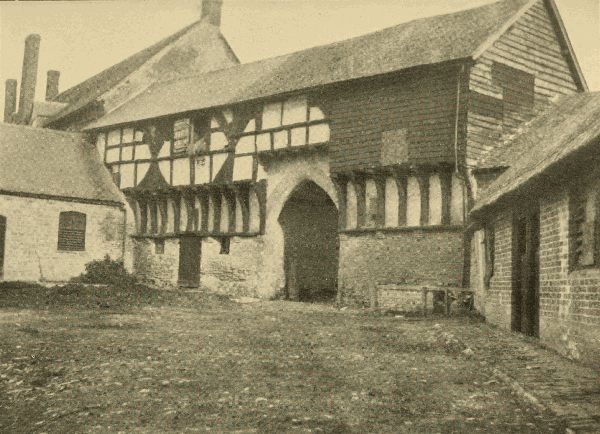
An excursion that could not be foregone, however our consciences pricked us for delay, was that to Wigmore, the once impregnable hold of the Mortimers. As we left Ludlow, we looked back on the looming grey mass of its own still stupendous castle and were hardly prepared to find the rival fortress in such utter desolation of decay. Standing on its sentry height, girdled with its massive walls, it was once a menace to the English throne. Now such towers as yet remain are rent and ragged. Only a curtain of ivy guards the inner gate. Trees have sprung from the dirt-choked embrasures, and purple thistles grow rank in the empty courts. Yet for all the rich cloaking of vine and wall-flower, all the carpeting of moss and blossom, Time has not made peace with this grim ruin. Something sullen and defiant still breathes from those gigantic fragments. Dark openings in the ground give glimpses of stone passages and yawning dungeons that must render the place a paradise for boys. Thence we drove to Wigmore Abbey where the Mortimers lodged the priestly intercessors who had no light task to pray away the sins of that proud and ruthless race. We found a farm resounding with the baaing of sheep and mooing of cows instead of with Latin chants. Wrought into the texture of the grange itself, a weather-stained house of stone, with, as we saw it, a row of decorative pigeons perched on the roof-tree, are remnants of the old carvings and window traceries. At the rear, a long, low building of the Shropshire black-and-white, with a great bundle of straw bulging from an upper window, retains a fine arched gateway. Pleached fruit trees, climbing roses, and purple clematis do their best to console the scene for its lost pieties. On the homeward route, by way of yellow wheat fields, waving woods, and running water, we had a wonderful view of the Welsh mountains bathed in the opalescent hues of sunset, a divine lustre through which rang sweetly the vespers of the thrush, and could hardly persuade ourselves that it was from those glorified heights the wave of war used to rush down to break in blood upon the Marches.
WIGMORE ABBEY—GATE HOUSE AND BARN
Yet even the little round county of Herefordshire, with its soft green levels, its apple orchards and cider-presses, its hop gardens, and those broad fields where graze its famous sheep and cattle, has tragic tales to tell. Wigmore Castle, indeed, is over the Hereford line. A few miles to the northwest are the ruins of Brampton-Bryan Castle, which testifies to the latest war-anguish of these western shires, the struggle to the death between Charles I and Parliament. Here Lady Harley was besieged for over a month by her royalist neighbour, Colonel Lingen, who—ill-done for a cavalier—came up against her, in the absence of her husband and son, with a force of six hundred men. Cheery, gallant, resourceful while the need lasted, Lady Harley gave way when the baffled enemy had withdrawn, and wrote her son that if the castle must undergo another siege, she was sure that God would spare her the seeing it. And having so written, she died the following day. In the spring the royalists returned with cannon and battered down the walls, burning and plundering. At the end of the long strife, Parliament awarded Sir Robert Harley, as some partial recompense for his sorrows and losses, the Lingen lands, but Edward Harley, the son of that brave, tender-hearted mother, called at once on Lady Lingen and presented her with the title-deeds. It may be doubted if all the Herefordshire annals record a nobler victory.
The Wars of the Roses were waged with peculiar ferocity in this section of England. The great battle of Mortimer's Cross, which gave Edward IV his crown, was fought a little to the west of Leominster. Here old Owen Tudor, who had wedded Henry V's French Kate, daughter and widow of kings,—he whose grandson, Henry VII, brought in the Tudor line of English sovereigns, was taken prisoner. He was executed, with all the other prisoners of rank, in Hereford market-place, and his head was "set upon the highest grice of the market cross and a mad woman kemped his hair and washed away the blood from his face, and she got candles and set about him burning, more than one hundred. This Owen Tudor was father unto the Earl of Pembroke, and had wedded Queen Katherine, King Henry VI's mother, weening and trusting always that he should not be beheaded till he saw the axe and block, and when he was in his doublet he trusted on pardon and grace till the collar of his red velvet doublet was ripped off. Then he said, 'That head shall lie on the stock that was wont to lie on Queen Katherine's lap,' and put his heart and mind wholly unto God, and full meekly took his death."[8]
Earlier civil conflicts, that between Edward II and his barons, and that holier war of liberty, won though lost, by Simon de Montfort against his king and prince, have left graphic memories in Herefordshire. But even these strifes seem recent beside the battle-marks of Offa the Saxon, who built an earthen dyke, still in fairly good preservation, from the Severn to the Wye, to keep the Welshmen back; and beside those thick-set British camps and Roman camps that testify to the stubborn stand of Caractacus and his Silures against the all-conquering legions.
We were on a peaceful pilgrimage and could well dispense with visiting Coxwall Knoll, close above Brampton-Bryan, where Caractacus met his crushing defeat, and Sutton Walla, some five miles to the north of Hereford, where Offa, King of the Mercians, betrayed to assassination his guest, King Ethelbert of the East Angles; but we ought to have sought out Holm Lacy, for the sake of the Sir Scudamour of Spenser's "Faery Queene," and to have visited Hope End, near Ledbury, in loving homage to Elizabeth Barrett Browning. And so we might, had it not been for the innate depravity of man as exemplified in the dourest driver that ever handled reins. His one aim throughout that trip was not to go anywhere we wished. He would sometimes seem to hesitate at a parting of the ways, but it was only to find out which road was our desire, when as deaf and dumb to all our protests as if he knew only the Silurian tongue, as impervious to parasol pokes as if he were cased in Roman mail, he would take the other. The only comfort that came to our exasperated souls was the reflection that at sundown we could dismiss Sir Stiffback with his ill-earned shillings and never see his iron phiz again, whereas the unfortunate women of his household, the possible wife, sister, daughter, would have to put up with the unflinching obduracy of that cross-grained disposition until he went the way of Roger de Mortimer. But not even this cromlech of a coachman, though with the worst intentions, could prevent our enjoying the pastoral charm of the quiet land through which we drove, for this county, as Fuller wrote, "doth share as deep as any in the alphabet of our English commodities, though exceeding in the W for wood, wheat, wool, and water." As for wood, we saw in Harewood Park, by which our Clod of Wayward Marl inadvertently drove us, chestnuts and beeches whose height and girth would do credit to California; in point of wheat the county is said to be so fertile that, for all the wealth of cattle, the people have not time to make their own butter and cheese; the wool was reckoned in Fuller's time the finest of all England; and the salmon-loved Wye, which rises, like the Severn, on the huge Plinlymmon mountain, flows with many picturesque turns and "crankling winds" across the county, receiving the Lug, on which Leominster is situate, and further down, the Monnow, which forms the Monmouth boundary.
But if we failed to find the white-rose bower of Mrs. Browning's childhood, and her classic
"garden-ground, With the laurel on the mound, And the pear-tree oversweeping A side-shadow of green air."
—does the turf remember her Hector with "brazen helm of daffodilies" and "a sword of flashing lilies?"—we were on poetic territory in the streets of Hereford. It was here, as Mr. Dobell's happy discovery has shown, that a lyrist, Thomas Traherne, worthy of the fellowship of Herbert and of Vaughan passed his early years, a shoemaker's son, like Marlowe in another cathedral city, Canterbury. If we could have seen Hereford as this humble little lad saw it, it would have been a celestial vision, for truly he said: "Certainly Adam in Paradise had not more sweet and curious apprehensions of the world than I when I was a child." His own description of this radiant star we so blindly inhabit as it first dazzled his innocent senses is too exquisite to be passed over:
"The corn was orient and immortal wheat which never should be reaped nor was ever sown. I thought it had stood from everlasting to everlasting. The dust and stones of the street were as precious as gold; the gates were at first the end of the world. The green trees when I saw them first through one of the gates transported and ravished me; their sweetness and unusual beauty made my heart to leap, and almost mad with ecstacy, they were such strange and wonderful things. The Men! O what venerable and reverend creatures did the aged seem! Immortal Cherubim! And young men, glittering and sparkling angels; and maids, strange seraphic pieces of life and beauty! Boys and girls tumbling in the street were moving jewels: I knew not that they were born or should die. But all things abided eternally as they were in their proper places. Eternity was manifest in the Light of the Day, and something infinite behind everything appeared, which talked with my expectation and moved my desire. The City seemed to stand in Eden or to be built in Heaven."
If this were the Hereford of the first half of the seventeenth century, the city has dimmed a little since, yet we found it a pleasant town enough, with the Wye murmuring beside it, and its ancient cathedral of heroic history reposing in its midst. Garrick was born in Hereford, and poor Nell Gwynne, and in the north transept of the cathedral is a brass to John Philips, who endeared himself to all the county by his poem on "Cyder." We went to see the Preaching Cross that marks the site of a monastery of the Black Friars, neighboured now by the Red Cross Hospital for old soldiers and servants. One of these beneficiaries, in the prescribed "fustian suit of ginger colour," eagerly showed us about and was sorely grieved that we could not wait to hear his rambling chronicle to the end. The rest of our time in Hereford outside our hostelry—the Green Dragon, most amiable of monsters—we spent in the cathedral, an old acquaintance, but so passing rich in beauties and in curiosities that at the end of our swift survey we were hardly more satisfied than at the beginning. We will come back to it some time—to the grave old church that has grown with the centuries and, unabashed, mingles the styles of various periods, the church in which Stephen was crowned and Ethelbert buried; to the croziered bishops in their niches, the two great, thirteenth-century bishops among them, D'Aquablanca, the worst of saints with the loveliest of tombs, and Cantilupe, so godly that he never allowed his sister to kiss him, of such healing virtues that even sick falcons were cured at his shrine; to the Knights Templars, mail-clad, treading down fell beasts; to the wimpled dames with praying hands, shadowed by angel-wings; to the Chapter Library with its chained tomes; and to that mediæval Mappa Mundi (about 1313) showing the earth with its encircling ocean, Eden and Paradise above, and such unwonted geographical features sprinkled about as the Phoenix, Lot's Wife, and the Burial Place of Moses.
Our surly coachman deposited us at Ross, the little border town with houses sloping from the hilltop to the Wye, while behind and above the mall rises a tall grey spire. Here our faith in human nature was promptly restored by that contemplation of the virtues of The Man of Ross which even the public-house signboards forced upon us. This John Kyrle so lauded by Pope, was a cheery old bachelor of modest income, the most of which he expended for the town in works of practical benevolence, planting elms, laying out walks, placing fountains, and caring for the poor.
"Whose cause-way parts the vale with shady rows? Whose seats the weary traveler repose? Who taught that heaven-directed spire to rise? 'The Man of Ross,' each lisping babe replies."
But the lisping babes are wrong as to this last particular, for Kyrle did not build the spire, although he gave the church its gallery and pulpit.
At Ross we ought to have taken to the water, for the scenery of the Lower Wye, with its abrupt cliffs, rich woods, and smiling meadows, is one of the prides of England, but we had run so far behind our dates, by the dear fault of Shropshire, that we went on by train. The rail, however, follows the river, and we had—or thought we had—swift glimpses of the romantic ruins of Wilton Castle, one of the old Border keeps, and of Goodrich castle, where Wordsworth met the little maid of "We are Seven." This valley of the Wye, which was to the poet Gray the delight of his eyes and "the very seat of pleasure," yields striking effects in wooded crag and gorge at Symond's Yat, but we enjoyed hardly less the tranquil reaches of green pasture, where the afternoon sunshine still lay so warm that little groups of sheep were cuddled at the foot of every tree. The ancient town of Monmouth, in its nest of hills, reminded us not merely of its royal native, Henry V,
—"Ay, he was born at Monmouth, Captain Gower"—
but of that twelfth-century romancer, Geoffrey of Monmouth, whose "History of the Britons," with its fluent account of the doings of hitherto unheard-of kings, especially Arthur the Giant Killer and his false queen Guanhumara, so scandalised his contemporaries that they did not scruple to call him a "shameless and impudent liar" and to report that legions of devils had been seen hovering over his manuscript. About seven miles to the southwest of Monmouth is Raglan Castle, where Charles I took refuge after Naseby. Its gallant lord, the Marquis of Worcester, then in his eighty-fourth year, stood a siege of ten weeks, not capitulating until the loyal little garrison, fast diminishing, was reduced to such extremities that the horses ate their halters for want of forage. I had visited, some fifteen years before, those war-scarred towers, tapestried with marvellous masses of ivy, and from the windows of the Royal Apartments had looked out on that lovely western view in which the harassed Stuart took solace. Lord Herbert, son of the staunch old royalist, invented and constructed a machine, the terror of the peasantry, which has a good claim to be counted the first steam-engine. The so-called Yellow Tower was the scene of his wizard craft. The Great Hall now lies open to wind and weather, and but one wall of the chapel stands, its two stone effigies peeping out from their ivy-curtained niches.
We quitted the train at Tintern, where our stay was all too short, notwithstanding the memory of tranquil weeks spent there in a previous summer. The ruins of Tintern Abbey are of a peculiarly austere and noble beauty. Its foundation dates back to 1131, only three years after the coming of the Cistercians into England. It was the third of their English houses, which came to number nearly two hundred. It stood in its full grace, the Gothic style just leaning toward the Decorated, when the Dissolution struck its uses from it and left it to gradual decay. Roofed by the blue skies of a summer noon, with wooded hills looking in through the unglazed mullions of the windows, or in the glory of the moonlight, the silver lustre flooding empty nave and silent cloisters, and illuming with its searching rays rare bits of carven foliage, Tintern wears perhaps a purer loveliness in its desolation than ever before. Our farewell visit was paid in an early morning hour. In that freshness of the day, those slender pillars and arches delicately wrought presented an aspect more than ever grave and melancholy. There is nothing of the grotesque here, and comparatively little of ornamental detail to distract the mind from the impression of the whole. The rooks that peered over from their lofty perch above the great east window, whose remaining traceries were etched in shadow on the turf, and the bright-eyed little red-breasts that hopped fearlessly about did not, it is true, observe the Cistercian rule of silence; but the shining wings of doves fluttering from one grey wall to another might well have been the embodied prayers of those White Monks who so often chanted matins at the long-since fallen altars.
We went from the Abbey to the train. Still the railroad followed the winding river. A fleeting sight of the towering Wyndcliff reminded me of a by-gone afternoon when, unexpectedly bringing up on a ramble at Moss Cottage, I undertook, quite too late for prudence, a solitary ascent of this inviting steep. From the summit I looked out over mellow-tinted autumnal woods to the looping ribbon of the Wye, the white cliffs known as the Twelve Apostles rising beyond, and still beyond the sail-bearing Severn, with villages and church-towers discernible in the far distance and, best of all, the rose of sunset glowing upon the face of the Black Mountains. It was a sublime vision, but when the western flush had faded out and I must needs descend by that ever-darkening path which took its zigzag course among thick yews and down slippery slabs of slate, I came to the conclusion it was not written that my neck should be broken on this side of the Atlantic.
We had only an hour at Chepstow, but the picturesque river-town was not new to us, and the hour sufficed to revive our memories of its rock-based old castle overhanging the Wye, the castle where Jeremy Taylor was once imprisoned, and its Norman church with deeply recessed doorway. At Chepstow we took train for Newport, crossing the strip of garden-land that lies between the Wye, the Gloucestershire boundary, and its almost parallel stream, the Usk. West Monmouth is Black Country, forming a part of the South Wales coal-field, and we were not surprised to find Newport a busy harbour, grimy with its exports of coal and iron. We heard a strange tongue spoken all about us and realised that Monmouthshire, nominally English since the time of Henry VIII, is still largely Welsh in manners and in character. The old Newport is much obscured by the new. The castle, where Simon de Montfort took refuge, is in good part hidden behind a flourishing brewery, but the Church of St. Woollos, built high upon Stow Hill, still dominates the scene. This church has a history even older than its fine Norman architecture, for it is told that Harold once plundered the town, desecrating the original sanctuary and breaking open the cheeses, which he found filled with blood. Then he was aghast and repented, but a month later, according to the monastic record, "for that wickedness and other crimes" he fell at Hastings.
Our goal was Caerleon, three miles up the Usk, a quiet little village that was once the capital of South Wales, once the Isca Silurum of the Romans, and once, in the misty realm of romance, that Caerleon-upon-Usk where Arthur was crowned and where the ninth of his twelve great battles was fought. Tennyson's Lancelot relates to spellbound listeners in the Castle of Astolat how
"at Caerleon had he helped his lord, When the strong neighings of the wild White Horse Set every gilded parapet shuddering."
But the "Mabinogion," that treasury of fanciful old Welsh tales, gives, by way of contrast, a naïve and somewhat gaudy picture of the king enjoying his repose:
"King Arthur was at Caerlleon upon Usk; and one day he sat in his chamber; and with him were Owain the son of Urien, and Kynon the son of Clydno, and Kai the son of Kyner; and Gwenhwyar and her hand-maidens at needlework by the window.... In the center of the chamber, King Arthur sat upon a seat of green rushes, over which was spread a covering of flame-coloured satin; and a cushion of red satin was under his elbow.... And the King went to sleep."
If the ghosts of the Second Augustan Legion could return for an hour to this their frontier station, deep in the British wilds, they would find ranged and labelled in a neat museum shards of their pottery, broken votive tablets, fragments of sculptured figures, among them a Medusa whose stony stare might seem to have taken effect, urns whose ashes were long since scattered, bits of mosaic pavement, coins, lamps, needles, hairpins, waifs and strays of their "unconsidered trifles." But the fainter wraith of King Arthur would discover no more than a weedy mound and hollow in a ragged field, where autumnal dandelions keep the only glints of his golden memory. We met there an old labourer stooping beneath the heavy sack upon his shoulder. He told us that the mound was Arthur's Round Table, but as for the hollow—apparently the site of a Roman open amphitheatre—he could only shake his grey head and confide: "They do say as was a grand palace there long ago and one day it all sunk under,—sunk way down into the ground."
The Usk, which has reflected such lost splendours, empties into the broad estuary of the Severn a little lower down than the Wye which rejoins the greater river at Chepstow. The Severn, which has its rising not two miles from the Wye in the Welsh mountains, makes a wider sweep to the east, crossing Shropshire, Worcester, and Gloucester. Worcester, indeed, mainly consists of the Middle Severn valley, with ranges of low hills on either side. This fertile basin abounds, like the Hereford vale of the Wye, in apple-orchards and pear-orchards, hop-gardens and wheat-fields, but the enterprising little shire has developed, too, a number of manufacturing industries. On the north it runs up into the Black Country of Staffordshire; Dudley, Stourbridge, and Oldbury are murky with the smoke and smudge of factory chimneys. Glass is a specialty of Stourbridge, carpets of Kidderminster, salt of Droitwich, and needles and fishhooks of Redditch. Nail-making used to be the bread and beer of ten thousand cottages at the foot of the Clent and Lickey Hills.
But intermingled with its thriving crafts and trades is another wealth of historic associations and natural beauties. In the dense woods which once covered the county, hostile bands have dodged or sought one another from time immemorial, notably during the Civil Wars of Simon de Montfort and of the Roses. Even so late as the Parliamentary War, there remained forest enough to do good service to a fugitive. It was in an oak of Boscobel Wood, on the Salop border, that after the disastrous battle of Worcester
"the younger Charles abode Till all the paths were dim, And far below the Roundhead rode And hummed a surly hymn."
The points of specific literary interest are not many. Little St. Kenelm underwent his martyrdom by the Clent Hills; Richard Baxter ministered for twenty-two years to a rough flock in Kidderminster; Samuel Butler was born in Strensham-on-the-Avon; Samuel Johnson went to school in Stourbridge; and the Leasowes, near by, was the home of Shenstone, who made it one of the most attractive estates in England. But the Malvern Hills keep a great, dim memory, that of the fourteenth-century visionary associated with the West Midland allegory of "Piers Plowman." We are not sure of his name, though we speak of him as Langland; the rugged, vigorous old poem in its three versions may yet be proved to be of composite rather than single authorship; we ourselves, though of Long Will's discipleship, had not faith enough in the personal tradition to visit the reputed birthplace at Cleobury Mortimer in Shropshire; but on those breezy slopes still seems to linger the wistful presence of a gaunt, "forwandred" clerk who
"In a somer seson whan soft was the sonne, On a May mornynge on Malverne hulles"
dreamed the Easter dream, still unfulfilled on earth, of human brotherhood.
These gracious heights, standing
"Close as brother leans to brother, When they press beneath the eyes Of some father praying blessings From the gifts of Paradise,"
gave hiding for four years to Sir John Oldcastle, the genial Lollard who made merry with Prince Hal, but would not renounce his faith, and was finally given up by the over-orthodox young king to the bishops. Henry V himself was present at the martyrdom, peculiarly revolting, but the worst of it all is that Shakespeare, consciously or unconsciously, endorsed the Roman Catholic caricature and wronged a true and generous spirit in his ineffaceable portrait of Sir John Falstaff, Prince Hal's "old lad of the castle." It must be that Raggedstone Hill, which casts a curse on whomsoever its shadow touches, gloomed with peculiar blackness over the hunted knight. Its ominous shade is said to have stolen on Cardinal Wolsey and on those royal fugitives of the Red Rose, Margaret of Anjou and the hapless young Prince Edward.
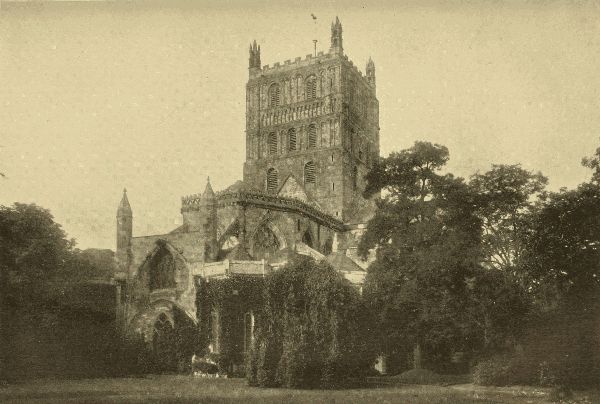
TEWKESBURY ABBEY
From the summit of Worcester Beacon and from other of the higher Malvern crests the view ranges, on a clear day, over some fifteen counties and embraces the six momentous battlefields of Shrewsbury, Mortimer's Cross, Edge Hill, Worcester, Evesham and Tewkesbury, and the three cathedrals of Hereford, Worcester, and Gloucester, besides the remnants of six great religious houses of mediæval England,—Great and Little Malvern, Pershore, Evesham, Deerhurst and Tewkesbury. Little Malvern Priory, established in the twelfth century by a band of Benedictine monks from Worcester who sought the wilds that they might emulate the life of hermits, survives only in fragments, but the church of Great Malvern Priory, an earlier outgrowth from Worcester, keeps its Norman interior, with rich treasures of stained glass and miserere carvings. We had passed through the Vale of Evesham toward the close of our long Midland drive and seen the scant relics of its mitred abbey, but we fail to follow the Avon on to Pershore, one of the richest and most powerful of the old monastic foundations. Not only were these monasteries planted in the fairest and most fruitful lands of the county, but a large portion of Worcestershire was owned by them and by the neighbouring abbeys of Gloucestershire. In all this horde of priests one has a special claim to literary remembrance,—Layamon, who dwelt in the hamlet of Ernley, near the junction of the Severn and the Stour. He constitutes an important link in the passing on of the Arthurian legend, which, first related in Latin prose by that entertaining prelate, Geoffrey of Monmouth, had been already rendered into French verse by Wace, the professional chronicler of the Plantagenets. Layamon retold and amplified the story, using the French poem as his basis, but aided by two other works whose identity is doubtful.
"Layamon these books beheld and the leaves he turned. He them with love beheld. Aid him God the Mighty! Quill he took with his fingers, and wrote on book-skin, and the true words set together, and the three books pressed into one."
We could pay only a flying visit to Malvern this summer, but in other summers have resorted thither again and again for the refreshment of the blithe air and pure water and of walking on those turfy hills where many a grateful sojourner has left path or seat to ease the climber's way.
Worcester, too, was familiar ground, and this time we gave but a few hours to the "Faithful City," which paid so dearly for its steadfast loyalty to Charles I. The unspeakable Parliamentarians proved nearly as destructive as the Danes, who, in the ninth century and again in the eleventh, had sacked it with fire and sword. The militant Presbyterians wreaked their piety most of all upon the Cathedral, leaving it roofless, its splendid glass all shattered, its brasses wrenched away, its altars desecrated and torn down. We found the red-brick town upon the Severn brisk and cheerful, with its proud shop-window display of its own products, from the Royal Worcester China to Worcestershire Sauce, with the deeply laden barges that almost hid the river; its lively hop market; and its grunting sows, each with her litter of recalcitrant little pigs, driven in a meandering course through the main street by ruddy boys and girls. The cathedral, whose memories embrace St. Dunstan and St. Wulfstan and that stout-hearted old martyr of Oxford, Bishop Latimer—who had himself once presided at the burning of a friar—uplifted our hearts with its august vista of nave and choir. The crowned tenant of that choir, King John, ought to be troubled in his gilded rest by the proximity of a Prince Arthur, though not the Arthur to whom he did such grievous wrong. The best of the cathedral is, to my thinking, the solemn grace of the crypt, beneath whose light-pillared arches stand about various stone figures of rueful countenance. After their centuries of sunlight, high-niched on the central tower, the Restorer has scornfully dislodged them and dungeoned them down here.
Just below Worcester the Severn is augmented by the Teme, which has valiantly cut its way through the line of western hills to join the court of Sabrina, and at Tewkesbury, on the Gloucester border, it receives its most famous affluent, Shakespeare's Avon. Tewkesbury was new to us, and we lingered there two days, wishing we might make them twenty. As it was we had to forego the delightful trip on the Severn to Deerhurst, an old monastic town whose pre-Norman church is said to be of extremely curious architecture.
Tewkesbury Abbey, which outranks in size ten of the twenty-eight English cathedrals, is one of the most illustrious churches in the United Kingdom. Unlike most of the larger monastic establishments, it was under the control of a succession of great families whose deeds and misdeeds form no small part of the history of England. Fitz-Hamon, kin to the Conqueror, swept away what buildings of the old Saxon abbey he may have found there, and erected the magnificent Norman church which still awes the beholder. The ashes of Fitz-Hamon, who died in 1107, rest near the High Altar. The next lord of Tewkesbury to be buried in the Abbey was Gilbert de Clare, one of the signers of Magna Charta. The name of his father, Richard de Clare, headed the list, and one of the seven copies of the Great Charter was deposited in the Abbey. Every lord of Tewkesbury after Gilbert de Clare was interred in this church, which, for the next two hundred and fifty years, until the lordship of Tewkesbury was absorbed into the Crown, grew ever more splendid with costly monuments. The widow of Gilbert de Clare married the brother of Henry III, Richard, Duke of Cornwall, but although she thus became a countess of many titles and one of the first ladies of the land, she asked, in dying, to be buried beside the husband of her youth in Tewkesbury. To this her second husband would not agree, but he was magnanimous enough to send her poor, homesick heart back to the Abbey in a silver vase, which was duly placed in Earl Gilbert's marble mausoleum.
The De Clares of Tewkesbury, Earls of Gloucester and Hereford, were a warrior race. The second Gilbert, called the Red Earl, fought both with Simon de Montfort, and against him, and the third Gilbert, his son, fell at Bannockburn. By his early death the lordship of Tewkesbury passed from the De Clares, who had held it for nearly a century, to the young earl's brother-in-law, Hugh le Despencer. This new Earl of Gloucester had succeeded Piers Gaveston in the perilous favour of Edward II. When Roger de Mortimer, by the unhallowed aid of Queen Isabel, triumphed over the king, the elder Despencer, a man of ninety, was hanged at Bristol, and his son, Hugh le Despencer, crowned with nettles, was swung from the gallows fifty feet high, in a hubbub of mockeries and rejoicings, at Hereford. His widow collected the scattered quarters of his body, exposed in various towns, and interred them in the Abbey under a richly carved and coloured monument. The Despencers, though no longer Earls of Gloucester, held the lordship of Tewkesbury for wellnigh another hundred years, cherishing and beautifying the fabric of the church and adding lavishly to its memorials of bronze and marble and to its treasure of chalices, copes, and jewels.
Early in the fifteenth century the male line of the Despencers became extinct, and the Lady Isabel, sister of the last Lord Despencer, succeeded to the ecclesiastical honours of the family. Married in the Abbey at the age of eleven to Richard Beauchamp, Earl of Worcester, she was widowed ten years later and found her solace in building an exquisite chapel, known as the Warwick Chantry, in her husband's memory. Her second husband, cousin to the first, was Richard Beauchamp, Earl of Warwick, whom she commemorated in the still more elaborate Beauchamp Chapel at Warwick; but she herself chose to lie at Tewkesbury. Her daughter married Warwick the King-maker and became the mother of two fair girls of most pathetic story. The elder, Isabel, was wedded to George, Duke of Clarence, brother of Edward III,—"false, fleeting, perjur'd Clarence,"—who is supposed to have been murdered in the Tower through the agency of his brother Richard—drowned, the whisper went, in a butt of Malmsey wine. A fortnight earlier his wife and an infant child had died, probably of poison. A son and daughter survived, who, for the royal blood that flowed in their veins, were regarded with uneasiness by the Tudor kings and ultimately sent to the block. The daughter, Margaret Plantagenet, superintended the education of the Princess Mary, and was once described by Henry VIII himself as "the most saintly woman in England." But she was the mother of Cardinal Pole, who had angered the tyrant and was on the Continent out of his reach; so this reverend and gracious lady, at the age of sixty-eight, had her stately head clumsily hacked off by a prentice executioner on Tower Hill, where her innocent brother had perished forty-two years before. The second daughter of the Countess Isabel had an even more pitiful life than her sister's, for her first husband was Prince Edward, the last Lancastrian, and then, after he had been foully slain, she strangely accepted the hand of one of his murderers, Richard of Gloucester, the worst of the Yorkists, by whom she was soon, it would appear, coolly put out of the world. A favourite saying of the county, probably having reference to the extraordinary number and wealth of its religious houses, runs: "As sure as God is in Gloucestershire," but one can hardly read these tragedies of Tewkesbury without feeling that the Devil has been no infrequent sojourner there.
The lamentable Wars of the Roses, which had drenched England with blood, threw up their last red spray against the Abbey. The resolute Queen Margaret and her son had attempted, with an army raised by the Duke of Somerset, to get possession of Gloucester, but they found it already held by the Yorkists and hastened on to Tewkesbury. Still weary from their forced march, they were attacked by Edward at break of a summer dawn (1471) while the monks were chanting matins in the Abbey, and sustained a signal defeat. The place of slaughter is still known as Bloody Meadow. The Duke of Somerset, with a few knights and squires, took refuge within the sacred walls, but Edward and his followers, hot for vengeance, rushed in to slay them even there. The abbot, who had just been celebrating mass, came from the altar and, holding the consecrated host high in his hands, stood between the furious Yorkists and their prey. The war-wrath was for the moment stayed, and Edward gave his word to respect the peace of the sanctuary. But after a service of thanksgiving, the blood-anointed king and his fierce nobles withdrew to a house hard by, where that unhappy younger Edward, the legitimate heir to the throne, was brought a defenceless prisoner into their presence, insulted, assailed, and slain. The rumour went that the king himself had with his gauntleted hand struck the royal youth across the mouth, and in an instant the others, like wild beasts, were upon him, Richard of Gloucester in the front. It is believed that the mangled, boyish body was buried in the Abbey under the central tower.
But while the lords of Tewkesbury stormed through their brief careers, coming one after another to lie, battle-bruised, stabbed, headless, quartered, even with the halter-mark about the neck, within the holy hush of the great church, its Benedictine monks went on a quiet way, tilling the soil, writing glosses, copying service-books, chanting prayers, exercising a large hospitality and a larger charity. At the Dissolution, the townspeople, who had from time immemorial used the nave as their parochial church, bought the choir and chapels from Henry VIII, so that this noble structure, so significant in English story, escaped the fate of Furness, Tintern, and the many more.
We had ourselves a little difficulty in getting beyond the nave. We had gone in an hour before service on a Sunday evening, hoping to be allowed to walk around the choir, but we incurred scathing rebuke from a red-haired verger, who had practised like eloquence on Sunday automobile parties until his flow of denunciation was Hebraic. We gave way at once, expressed due contrition, and meekly sat down to wait for evensong. Whereupon, after furtively scrutinising us from behind one pillar after another, he cautiously approached and with searching little blue eyes severely inquired if we really intended to stay for the service,—"all through the sermon, ye understand; not just for the music." Our reply so raised us in his opinion that he actually took us on the rounds, proving an intelligent and even jocose conductor, and we, for our part, heard the sermon to the very end, not daring to stir from our places until the last note of "Milton's organ" had died away.
Many visitors come to this attractive old town, with its timbered houses and pleasant river-walks, for the sake of "John Halifax, Gentleman." The scenes of Mrs. Craik's tender romance, Abel Fletcher's dwelling, the mill on the Avon, the tannery, the remains of the famous hedge, the garden where the two lads talked, are pointed out as soberly and simply as that ancient house in Church Street whose floor is said still to keep the stain of princely blood, or the cross where the Duke of Somerset and his companions, dragged from the shelter of the Abbey in violation of the king's own promise, were beheaded.
But the Severn, with ever-broadening flow, a tidal river now that fills and shallows twice a day, bears onward to the sea. Her course lies for a while through orchards and wheat-fields. The Cotswolds, separating the Severn valley from the basin of the Thames and constituting the bulk of Gloucestershire, rise in billowy outlines on the east and, presently, Dean Forest, one of the few remaining patches of England's formerly abundant woods, uplifts its "broad and burly top" on the west. The earth beneath those oaks and beeches has hoards of mineral wealth, and furnaces are scattered through the forest glades. At Gloucester the Severn divides, that
"with the more delight She might behold the towne of which she's wondrous proud."
And a fine old town it is, still keeping, in its four right-angled streets, the original Roman plan. Large vessels can make their way up the Severn as far as Gloucester, which Elizabeth, to Bristol's neighbourly disgust, chartered as a seaport, though the Berkeley Canal, opened in 1827, is now the regular channel. The cathedral stands upon ground hallowed since the seventh century. This building, for all the solemn grandeur of its Norman nave, is of most interest, from an architectural point of view, because of its gradual development of the Perpendicular style, gloriously manifest in choir and cloister. Its masons seem to have been particularly ingenious, for the building abounds in original and fanciful features of which the Whispering Gallery is only an example. Its martyr is John Hooper, Bishop of Gloucester and Worcester. One of Mary's earliest victims, he was sent from London back to Gloucester, where he was greatly beloved, to be burned before the eyes of his own flock. Many royal prayers have been murmured beneath these vaulted roofs, and many royal feasts of Severn salmon and lamprey-pie held in the grey city. The Saxon kings were much at Gloucester; William the Conqueror spent his Yule-tides here whenever he could, and here, in the chapter house, he ordered the compilation of Domesday Book; Rufus, Henry I, Henry II, and John often visited the town, and Henry III, as a boy of ten, was crowned in the cathedral. Parliaments were held in Gloucester by Edward I, Richard II, Henry IV, and Henry V, and from Gloucester Richard III, with whom murder had grown to be a habit, is supposed to have sent secret orders to the Tower for the smothering of his little nephews. In a side-chapel is the tomb of Robert, Duke of Normandy, eldest son of the conqueror. The effigy, of Irish oak, is so instinct with force and vigour in its only half recumbent posture that the iron screen seems really necessary to hold the Norman down. But the royal burial that made the fortunes of the cathedral was that of the wretched Edward II, whose canopied tomb in the choir became a favourite shrine of pilgrimage.
Still the Severn, now with a burden of heavily freighted barges, a mighty flood that has left more than one hundred miles behind the tiny pool, three inches deep, in which it rose, sweeps on, past the stern walls of Berkeley Castle, where Edward II was cruelly done to death, toward the Somerset boundary. Here it receives the waters of the lower Avon, on which the great port of Bristol stands, and so the proud Sabrina leads her retinue of streams into the Bristol Channel,
"Supposing then herself a sea-god by her traine."