A GROUP OF INDUSTRIAL COUNTIES
Reading edition
I. Lancashire
We all know Liverpool,—but how do we know it? The Landing Stage, hotels whose surprisingly stable floors, broad beds, and fresh foods are grateful to the sea-worn, the inevitable bank, perhaps the shops. Most of us arrive at Liverpool only to hurry out of it,—to Chester, to London, to the Lakes. Seldom do the beguilements of the Head Boots prevail upon the impatient American to visit the birthplaces of its two queerly assorted lions, "Mr. Gladstone and Mrs. 'Emans," of whom the second would surely roar us "as gently as any sucking dove." Yet we might give a passing thought to these as well as to the high-hearted James Martineau and to Hawthorne, our supreme artist in romance, four of whose precious years the country wasted in that "dusky and stifled chamber" of Brunswick Street. And hours must be precious indeed to the visitor who cannot spare even one for the Walker Fine Art Gallery, where hangs Rossetti's great painting of "Dante's Dream,"—the Florentine, his young face yearning with awe and grief, led by compassionate Love to the couch of Beatrice, who lies death-pale amid the flush of poppies.
But the individuality of Liverpool is in its docks,—over six miles of serried basins hollowed out of the bank of the broad Mersey, one of the hardest-worked rivers in the world,—wet docks and dry docks, walled and gated and quayed. From the busiest point of all, the Landing Stage, the mighty ocean liners draw out with their throngs of wearied holiday-makers and their wistful hordes of emigrant home-seekers. And all along the wharves stand merchantmen of infinite variety, laden with iron and salt, with soap and sugar, with earthenware and clay, with timber and tobacco, with coal and grain, with silks and woollens, and, above all, with cotton,—the raw cotton sent in not only from our own southern plantations, but from India and Egypt as well, and the returning cargoes of cloth spun and woven in "the cotton towns" of Lancashire. The life of Liverpool is commerce; it is a city of warehouses and shops. The wide sea-range and the ever-plying ferryboats enable the merchant princes to reside well out of the town. So luxurious is the lot of these merchants deemed to be that Lancashire has set in opposition the terms "a Liverpool gentleman" and "a Manchester man," while one of the ruder cotton towns, Bolton, adds its contribution of "a Bolton chap." This congestion of life in the great port means an extreme of poverty as well as of riches. The poor quarters of Liverpool have been called "the worst slums in Christendom," yet a recent investigation has shown that within a limited area, selected because of its squalor and misery, over five thousand pounds a year goes in drink. The families that herd together by threes and fours in a single dirty cellar, sleeping on straw and shavings, nevertheless have money to spend at "the pub,"—precisely the same flaring, gilded ginshop to-day as when Hawthorne saw and pitied its "sad revellers" half a century ago.
THE QUADRANT, LIVERPOOL
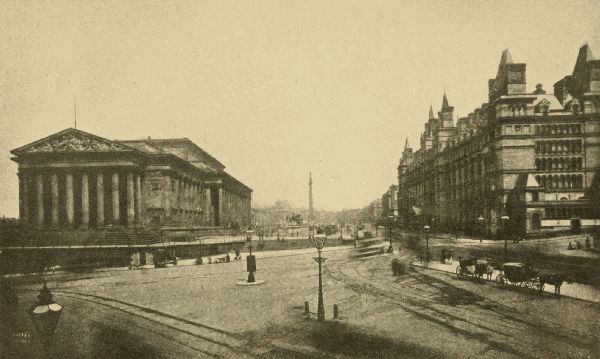
While Liverpool has a sorry pre-eminence for high death-rate and for records of vice and crime, Manchester, "the cinder-heap," may fairly claim to excel in sheer dismalness. The river Irwell, on which it stands, is so black that the Manchester clerks, as the saying goes, run down to it every morning and fill their ink-pots. Not only Manchester, but all the region for ten miles around, is one monster cotton factory. The towns within this sooty ring—tall-chimneyed Bolton; Bury, that has been making cloth since the days of Henry VIII; Middleton on the sable Irk; Rochdale, whose beautiful river is forced to toil not for cotton only, but for flannels and fustians and friezes; bustling Oldham; Ashton-under-Lyme, with its whirr of more than three million spindles; Staley Bridge on the Tame; Stockport in Cheshire; Salford, which practically makes one town with Manchester; and Manchester itself—all stand on a deep coal-field. The miners may be seen, of a Sunday afternoon, lounging at the street corners, or engaged in their favourite sport of flying carrier pigeons, as if the element of air had a peculiar attraction for these human gnomes. If the doves that they fly are white, it is by some special grace, for smut lies thick on wall and ledge, on the monotonous ranks of "workingmen's homes," on the costly public buildings, on the elaborate groups of statuary. One's heart aches for the sculptor whose dream is hardly made pure in marble before it becomes dingy and debased.
Beyond the borders of this magic coal-field, above which some dark enchantment binds all humanity in an intertwisted coil of spinning, weaving, bleaching, printing, buying, selling cotton, are various outlying collieries upon which other manufacturing towns are built,—Warrington, which at the time of our Revolution supplied the Royal Navy with half its sail-cloth; Wigan, whose tradition goes back to King Arthur, but whose renown is derived from its seam of cannel coal; calico Chorley; Preston, of warlike history and still the centre of determined strikes; and plenty more.
The citizens of the cotton towns are proud of their grimy bit of the globe, and with good reason. "Rightly understood," said Disraeli, "Manchester is as great a human exploit as Athens." The swift industrial growth, the vast business expansion of all this region, are to be counted among the modern miracles of progress, barren of beauty and joy as their present stage may seem to be. The heroes held in memory here are plain workingmen whose mechanical inventions resulted in the English spinning-mill,—John Kay of Bury, James Hargreaves of Blackburn, Samuel Crompton of Bolton, and Sir Richard Arkwright, a native of Preston, who began his career as a barber's apprentice and won his accolade by an energy of genius which virtually created the cotton manufacture in Lancashire. The battle legends are of angry mobs and smashed machinery, of garrisoned mills and secret experiments and inventors in peril of their lives. The St. George of Lancashire is George Stephenson, the sturdy Scotchman, who in 1830 constructed that pioneer railway between Liverpool and Manchester,—a road which had to perform no mean exploit in crossing the quaking bog of Chat Moss. Fanny Kemble, when a girl of twenty-one, had the ecstasy of a trial trip with Stephenson himself. She tells with fairy-tale glamour how "his tame dragon flew panting along his iron pathway" at "its utmost speed, thirty-four miles an hour, swifter than a bird flies." Wonder of wonders, this "brave little she-dragon" could "run with equal facility backwards or forwards." This trip took place at the end of August, preliminary to the final opening on September fifteenth, an occasion whose triumph was marred by a fatal mischance, in that a stray dragon ran over a director who was innocently standing on the track. For a patron saint of to-day, Manchester need go no further than to the founder of the Ancoats Brotherhood, Charles Rowley, that cheery philanthropist reminding one of Hawthorne's friend who brightened the dreary visages he met "as if he had carried a sunbeam in his hand"; for the disciples of the Beautiful, the followers of the Golden Rule, are full of courage even here among what the poet Blake would designate as "dark Satanic mills." From out the dirt and din, shrieking engines, roaring furnaces, clattering machinery, chimneys belching smoke by day and flame by night, blithely rises the song of their Holy War:
"I will not cease from mental fight, Nor shall my sword sleep in my hand, Till we have built Jerusalem In England's green and pleasant land."
But this, though the modern reality of South Lancashire, is not what the tourist goes out to see. From Liverpool to Furness Abbey is his natural and joyful route. He steams at full speed up this richest, most prosperous, and well-nigh most unattractive part of England; he has left the Mersey, the county's southern boundary, far behind; he crosses the Ribble, which flows through the centre of Lancashire, and the Lune, which enters it from Westmoreland on the north and soon empties into Morecambe Bay. He has come from a district close-set with factory towns, scarred with mine shafts and slag heaps, into the sweet quietude of an agricultural and pastoral region. But still above and beyond him is Furness, that northernmost section of Lancashire lying between Cumberland and Westmoreland and shut off from the rest of the county by Morecambe Bay and the treacherous Lancaster sands. High Furness is a part of the Lake Country, claiming for Lancashire not only Coniston Lake but even one side of Windermere, which lies on the Westmoreland border. Its Cumberland boundary is the sonneted Duddon. Low Furness, the peninsula at the south of this isolated strip, has a wealth of mineral deposits, especially iron. The town Barrow-in-Furness, which in 1846 consisted of a single hut, with one fishing-boat in the harbour, has been converted, by the development of the mines, into a place of much commercial consequence. Yet the lover of poetry will visit it, not for its steel works, figuring so tragically in Mrs. Humphry Ward's "Helbeck of Bannisdale," nor for its shipbuilding yards and boasted floating docks, nor for the paper works which take in a tree at one end and put it out as boxes of dainty stationery at the other, but in order to reach, by a boat from Peele Pier, Wordsworth's Peele Castle, "standing here sublime,"—that old island fortress which the poet's dream has glorified with
"The light that never was on sea or land."
But it is to Furness Abbey that the throngs of sightseers come, and well they may. Its melancholy grace is one of the treasures of memory. It was thither that Wordsworth as a schoolboy—for Hawkshead is within the limits of Furness—would sometimes ride with his fellows. The "Prelude" holds the picture, as he saw it over a century ago, of
"the antique walls Of that large abbey, where within the Vale Of Nightshade, to St. Mary's honour built, Stands yet a mouldering pile with fractured arch, Belfry, and images, and living trees; A holy scene! Along the smooth green turf Our horses grazed. To more than inland peace Left by the west wind sweeping overhead From a tumultuous ocean, trees and towers In that sequestered valley may be seen, Both silent and both motionless alike; Such the deep shelter that is there, and such The safeguard for repose and quietness."
We lingered there for days, held by the brooding spell of that most lovely ruin. Hour upon hour we would wander about among the noble fragments which Nature was so tenderly comforting for the outrages of His Rapacity Henry VIII. Harebells shone blue from the top of the broken arch of the tall east window, whose glass was long since shattered and whose mullions were wrenched away. Grasses and all manner of little green weeds had climbed up to triforium and clerestory, where they ran lightly along the crumbling edges. Ivy tapestries were clinging to the ragged stone surfaces. Thickets of nightshade mantled the sunken tombs and altar steps. Ferns nodded over the fretted canopies of the richly wrought choir stalls and muffled the mouths of fierce old gargoyles, still grinning defiance at Time. In the blue overhead, which no roof shut from view, a seagull would occasionally flash by with the same strong flight that the eyes of the Vikings, whose barrows once dotted the low islands of this western coast, used to follow with sympathetic gaze. Wrens have built their nests in plundered niche and idle capital. The rooks, arraying themselves in sombre semicircle along some hollow chancel arch, cawed reminiscent vespers. And little boys and girls from Barrow, joyous mites of humanity not yet smelted into the industrial mass, tried leaping-matches from the stumps of mossy pillars and ran races through nave and cloister. The wooden clogs of these lively youngsters have left their marks on prostrate slab and effigy, even on "the stone abbot" and "the cross-legged knight," much to the displeasure of the custodian,—a man who so truly cares for his abbey, the legal property of the Duke of Devonshire, that he has purchased two of the chief antiquarian works upon Furness in order that he may thoroughly acquaint himself with its history. It was he who told us that many of the empty stone coffins had been carried away by the farmers of the neighbourhood to serve as horse-troughs, and that in their barn walls might be seen here and there sculptured blocks of red sandstone quite above the appreciation of calves and heifers. He told how he had shown "Professor Ruskin" about the ruins, and how, at Ruskin's request, Mrs. Severn had sent him from Brantwood seeds of the Italian toad-flax to be planted here. He lent us his well-thumbed folios, West's "Antiquities of Furness" and "Beck's Annales Furnessienses," so that, sitting under the holly-shade in the Abbey Hotel garden, with a "starry multitude of daisies" at our feet, we could pore at our ease over that strange story, a tale of greatness that is told, and now, save for those lofty ribs and arches so red against the verdure, nothing but a tale. Our readings would be pleasurably interrupted toward the close of the afternoon by the advent of tea, brought to us in the garden, and the simultaneous arrival of a self-invited robin.
"Not like a beggar is he come, But enters as a looked-for guest, Confiding in his ruddy breast."
We tossed crumbs to him all the more gaily for the fancy that his ancestors were among the pensioners of the abbey in the day of its supremacy. For the monks of Furness maintained an honourable reputation for hospitality from that mid-thirteenth-century beginning, when the Grey Brothers from Normandy first erected the grave, strong, simple walls of their Benedictine foundation in this deep and narrow vale, to the bitter end in 1537. Meanwhile they had early discarded the grey habit of the Benedictines for the white of the Cistercians, and their abbot had become "lord of the liberties of Furness," exercising an almost regal sway in his peninsula, with power of life and death, with armed forces at command, and with one of the richest incomes of the kingdom under his control. With wealth had come luxury. The buildings, which filled the whole breadth of the vale, had forgotten their Cistercian austerity in a profusion of ornament. Within "the strait enclosure," encompassing church and cloisters, the little syndicate of white-vested monks not only chanted and prayed, transcribed and illuminated manuscripts, taught the children of their tenants and entertained the stranger, but planned financial operations on a large scale. For outside this, the holy wall, was another, shutting in over threescore acres of fertile land which the lay brothers, far exceeding the clerical monks in number, kept well tilled. Here were mill, granary, bakehouse, malt-kiln, brewery, fish-pond; and beyond stretched all Furness, where the abbey raised its cattle, sheep and horses, made salt, smelted its iron, and gathered its rents.
Few of the monastic establishments had so much to lose, but Furness was surrendered to the commissioners of Henry VIII with seemingly no resistance. The Earl of Sussex reported to his greedy master that he found the Lord Abbot "of a very facile and ready mynde," while the prior, who had been a monk in that house for fifty years, was "decrepted and aged." Yet it may be noted that of the thirty-three monks whom Sussex found in possession, only thirty signed the deed of surrender. On the fate of the three history is silent, save for a brief entry to the effect that two were imprisoned in Lancaster Castle. There is no record of their liberation. The monks who made their submission were granted small pensions. The abbot received the rectory of Dalton, so near the desecrated abbey that he might have heard, to his torment, the crash of its falling towers. But there is room to hope that in those cruel dungeons of Lancaster two men died because they would not cringe. We do not know, and it was in vain we hunted through the moonlight for the ghost of that mysterious thirty-third, who, too, might have a gallant tale to tell.
The region abounds in points of interest. Romney, the painter, is buried in the churchyard of Dalton, his native place. Beautiful for situation is Conishead Priory, "the Paradise of Furness," once a house of the Black Canons and now a much-vaunted Hydropathic, for, in the stately language of the eighteenth-century antiquary, Thomas West, "Æsculapius is seldom invited to Furness, but Hygeia is more necessary than formerly."
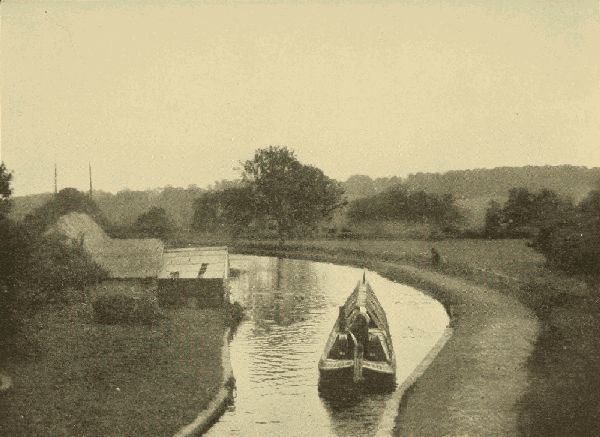
THE TRENT AND MERSEY CANAL
Near the banks of the Duddon stands Broughton Tower, with its legend of how the manor, in possession of the family from time immemorial, was lost by Sir Thomas Broughton—and this was the way of it. In 1487 Lambert Simnel, claiming to be the son of the murdered Clarence, sailed over from Ireland, where he had been crowned by the sister of Richard III, to dispute the new throne of Henry VII. Among his supporters were the Earl of Lincoln, Lord Lovel of Oxfordshire, and Lord Geraldine with an Irish force; but it was the general of his two thousand Burgundian mercenaries, "bold Martin Swart," who is credited with having given name to Swarthmoor, where the invaders encamped. Sir Thomas joined them with a small body of retainers and, in the crushing defeat that followed, was probably left dead upon the field. But legend says that two of the English leaders escaped,—Lord Lovel to his own house in Oxfordshire, where he hid in a secret chamber and perished there of hunger, and Sir Thomas to his faithful tenantry, who for years concealed him in their huts and sheep-folds, and when he died, white-haired, wrapped him in his own conquered banner, and gave him a burial worthy of his race.
But our associations with Swarthmoor were of peace and not of war. Our pilgrimage thither was made for the sake of Mistress Fell of Swarthmoor Hall and of George Fox, her second husband, who established hard by what is said to be the first meeting-house of Friends in England. Quitting the train at Lindal, a few miles above the abbey, we found ourselves in the rich iron country, "the Peru of Furness." It must be the reddest land this side of sunset. Even the turnips and potatoes, we were told, come red out of the ground. I know that we tramped amazedly on, over a red road, past red trees and buildings, with a red stream running below, and the uncanniest red men, red from cap to shoe, rising like Satan's own from out the earth to tramp along beside us. The road was deeply hedged, airless and viewless, and we were glad when we had left three miles of it behind, though the village of Swarthmoor, at which we had then arrived, proved to be one of those incredibly squalid English villages that make the heart sick. Between wide expanses of sweet green pasture, all carefully walled in, with strict warnings against trespass, ran two or three long, parallel stone streets, swarming with children and filthy beyond excuse. The lambs had space and cleanliness about them, soft turf to lie upon, pure air to breathe, but the human babies crawled and tumbled on that shamefully dirty pavement, along which a reeking beer wagon was noisily jolting from "public" to "public." Farther down our chosen street, which soon slipped into a lane, there were tidier homes and more sanitary conditions. Yet even Swarthmoor Hall, the fine old Tudor mansion which rose across the fields beyond, had a somewhat uninviting aspect. There were broken panes in the windows, and the cows had made the dooryards too much their own. The present proprietors, who, we were assured, value the old place highly, and had refused repeated offers for it from the Society of Friends, rent it to a farmer. The housekeeper, not without a little grumbling, admitted us, and showed us about the spacious rooms with their dark oak panelling, their richly carven mantels, their windows that look seaward over Morecambe Bay and inland to the Coniston mountains. The hall which Judge Fell—that wise and liberal man, tolerant beyond his time—allowed the Friends to use for their weekly meetings, is a room of goodly proportions, with flagged floor and timbered roof. In the dining-room window stands a simple deal desk once belonging to George Fox, but that upper door through which he used to preach to the throng in orchard and meadow is now walled up. As we, departing, looked back at the house, large, plain, three-storied, covered with grey stucco, we noted how right up on the chimney, in the alien fellowship of the chimney-pots, flourished a goodly green yew, sown by passing wind or bird. The housekeeper, who had waxed so gracious that she accompanied us for a few steps on our way, said she had lived in Swarthmoor thirty-four years and had always seen the yew looking much as it did now, but that an old man of the neighbourhood remembered it in his boyhood as only finger-long. It had never, so far as she could tell, been provided by mortal hand with earth or water, but grew by some inner grace, a housetop sign and signal.
Many hallowed memories cluster about that old Elizabethan mansion. It was in 1632 that Judge Fell brought thither his bride, Margaret Askew, sixteen years his junior. She was a descendant of Anne Askew, who, a beautiful woman of twenty-four, thoughtful and truthful, had been burned as a heretic,—one of the closing achievements of the reign of Henry VIII. "I saw her," reports a bystander, "and must needs confess of Mistress Askew, now departed to the Lord, that the day before her execution, and the same day also, she had on an angel's countenance, and a smiling face; though when the hour of darkness came, she was so racked that she could not stand, but was holden up between two serjeants."
It was then that the Lord Chancellor—who previously, when even the callous jailer had refused to rack the delicate body further, had thrown off his gown and worked the torture-engine with his own hands—offered her the king's pardon if she would recant, receiving in reply only the quiet words, "I came not hither to deny my Lord and Master."
It is not easy for us who read to echo the prayer of her who suffered:
"Lord, I Thee desyre, For that they do to me, Let them not taste the hyre Of their inyquyte."
No wonder that Margaret Fell, with such a history in her heart, should have lent a ready ear to the doctrines of the "Children of Light," as the people dubbed them, the "Friends of Truth," as they called themselves, the "Quakers," whose prime contention was for liberty of conscience.
She had been married twenty years when George Fox first appeared at Swarthmoor Hall, where all manner of "lecturing ministers" were hospitably entertained. Three weeks later, Judge Fell, a grave man not far from sixty, was met, as he was riding home from circuit, by successive parties of gentlemen, "a deal of the captains and great ones of the country," who had come out to tell him that his family were "all bewitched." Home he came in wrath, but his wife soothed him as good wives know how,—had the nicest of dinners made ready, and sat by him, chatting of this and that, while he ate.
"At night," says her own account, "George Fox arrived; and after supper, when my husband was sitting in the parlour, I asked if he might come in. My husband said yes. So George walked into the room without any compliment. The family all came in, and presently he began to speak. He spoke very excellently, as ever I heard him; and opened Christ's and the Apostles' practices.... If all England had been there, I thought they could not have denied the truth of these things. And so my husband came to see clearly the truth of what he spake."
The next First-day the meeting of the Friends was held at Swarthmoor Hall on Judge Fell's own invitation, though he himself went, as usual, to "the Steeplehouse." The spirit of persecution was soon abroad, and one day, when the Judge was absent on circuit, Fox, while speaking in the church, was set upon, knocked down, trampled, beaten, and finally whipped out of town. On Judge Fell's return, he dealt with the Friend's assailants as common rioters. The Judge held, however, his mother's faith to the end, never becoming a member of the Society. He died in the year of Cromwell's death, 1658, and was buried by torchlight under the family pew in Ulverston church. "He was a merciful man to God's people," wrote his widow, adding that, though not a Friend, he "sought after God in the best way that was made known to him."
Meanwhile Margaret Fell had become a leader among the Children of Light. Twice she wrote to Cromwell in behalf of their cause, and again and again to Charles II, with whom she pleaded face to face. Now that her husband's protection was withdrawn, persecution no longer spared her, and she, like Fox and many another of the Society, came to know well the damp and chilly dungeons of Lancaster Castle,—that stern prison of North Lancashire which may be viewed afar off from the ominous height of Weeping Hill.
"Thousands, as toward yon old Lancastrian Towers, A prison's crown, along this way they passed, For lingering durance or quick death with shame, From this bare eminence thereon have cast Their first look—blinded as tears fell in showers Shed on their chains."
Refusing, as a Quaker must needs refuse, to take the oath of supremacy, Mistress Fell stood her trial in 1663, her four daughters beside her. Her arguments irritated the judge into exclaiming that she had "an everlasting tongue," and he condemned her to imprisonment for life, with confiscation of all her property to the Crown. But after some five years of Lancaster's grim hospitality she was released, and forthwith set out on a series of visits to those English jails in which Quakers were immured. It was not until eleven years after Judge Fell's death that she married George Fox. The courtship is summarised in Fox's "Journal": "I had seen from the Lord a considerable time before that I should take Margaret Fell to be my wife; and when I first mentioned it to her she felt the answer from God thereto." Yet after the marriage, as before, they pursued, in the main, their separate paths of preaching, journeying, and imprisonment. It was seven years before illness brought Fox to Swarthmoor, which had been restored to the family, for a brief rest. About a quarter of a mile from the mansion, stood a dwelling-house in its three or four acres of land. This modest estate Fox purchased and gave it "to the Lord, for the service of his sons and daughters and servants called Quakers.... And also my ebony bedstead, with painted curtains, and the great elbow-chair that Robert Widder sent me, and my great sea case with the bottles in it I do give to stand in the house as heirlooms, when the house shall be made use of as a meeting-place, that Friends may have a bed to lie on, a chair to sit on, and a bottle to hold a little water for drink." He adds: "Slate it and pave the way to it and about it, that Friends may go dry to their meeting. You may let any poor, honest Friend live in the house, and so let it be for the Lord's service, to the end of the world."
A deep hawthorn lane, winding to the left, led us to that apostolic meeting-house, well-nigh hidden from the road by its high, grey, ivy-topped wall. We passed through a grassy outer court into an inner enclosure thick-set with larches, hollies, and wild cherry. The paths are paved. Luxuriant ivy curtains porch and wall, and clambers up over the low tower. Above the door is inscribed:
Ex dono G. F., 1682.
The meeting-room within is of Quaker plainness, with drab-tinted walls. The settees are hard and narrow, though a few "at the top" are allowed the creature comforts of cushions. Only the posts are left of the ebony bedstead, but two elbow-chairs of carven oak, a curiously capacious and substantial travelling-chest, and a Bible still are shown as Fox's personal belongings. The Bible is a black-letter folio of 1541, the Treacle Bible, open at the third chapter of Jeremiah, where, in the last verse, comes the query: "Is not there any tryacle in Gylyad?"
But Lancashire has other saints no less holy than those dear to Protestant and Quaker memory. Surely martyrs, irrespective of the special phase of the divine idea for which they gladly give up their bodies to torture and to death, are the truest heroes of history.
"For a tear is an intellectual thing, And a sigh is the sword of an Angel King, And the bitter groan of the Martyr's woe Is an arrow from the Almighty's bow."
This remote county, especially the north with its perilous bogs and rugged fells, clung to the mother faith. Many of its old families are still Catholic; many a Tudor mansion can show its "priest-hole" from which, perhaps, some hidden Jesuit has been dragged to the dungeon or the scaffold. We journeyed up from Manchester on a sunny afternoon, for love of one of these, to the beautiful valley of the Ribble, rich in manifold traditions. Our time was short, but we climbed to the keep of Clitheroe Castle, ruined for its loyalty to Charles I, and viewed that wide prospect whose most impressive feature is the witch-storied stretch of Pendle Hill. On that long level range the famous witches of Lancashire used to hold their unseemly orgies, hooting and yowling about Malkin Tower, their capital stronghold, whose evil stones were long since cast down and scattered. Peevish neighbours they were, at the best, ready on the least provocation to curse the cow from giving milk and the butter from coming in the churn, but on Pendle Hill the broomstick battalion was believed to dance in uncouth circle about caldrons seething with hideous ingredients and to mould little wax images of their enemies who would peak and pine as these effigies wasted before the flames, or shudder with fierce shoots of agony as red-hot needles were run into the wax. What were honest folk to do? It was bad enough to have the bride-cake snatched away from the wedding-feast and to find your staid Dobbin all in a lather and dead lame at sunrise from his wild gallop, under one of these "secret, black and midnight hags," to Malkin Tower, but when you were saddled and bridled and ridden yourself, when the hare that you had chased and wounded turned suddenly into your own wife panting and covered with blood, when your baby was stolen from the cradle to be served up in the Devil's Sacrament of the Witches' Sabbath, it was time to send for one of King James's "witch-finders." So the poor old crones, doubled up and corded thumb to toe, were flung into the Calder to see whether they would sink or swim, or sent to where the fagot-piles awaited them in the courtyard of Lancaster Gaol, or even—so the whisper goes—flung into their own lurid bonfires on Pendle Hill. But still strange shadows, as of furious old arms that scatter curses, are to be seen on those heather-purpled slopes, and from the summit black thunderstorms crash down with supernatural suddenness and passion.
Our driver was a subdued old man, with an air of chronic discouragement. He met the simplest questions, about trains, about trees, about climate, with a helpless shake of the head and the humble iteration: "I can't say. I'm no scholard. I never went to school. I can't read." He eyed Pendle Hill, standing blue in a flood of sunshine, with obvious uneasiness, and asked if we thought there really were "such folk as witches." As we drove up the long avenues of Stonyhurst, our goal, that imposing seat of learning seemed to deepen his meek despondency. He murmured on his lofty perch: "I never went to school."
Stonyhurst, the chief Catholic college of England, was originally located at St. Omer's in France. Over sea to St. Omer's the Catholic gentry of Elizabethan times used to send their sons. There the exiled lads vainly chanted litanies for England's conversion, their church door bearing in golden letters the fervent prayer: "Jesu, Jesu, converte Angliam, fiat, fiat." The Elizabethan sonneteer, William Habington, who describes "a holy man" as one who erects religion on the Catholic foundation, "knowing it a ruinous madness to build in the air of a private spirit, or on the sands of any new schism," was a St. Omer's boy. Nineteen of those quaintly uniformed lads, blue-coated, red-vested, leather-trousered, afterwards died on the scaffold or in prison, usually as Jesuit priests who had slipped into England against Elizabethan law.
During the latter half of the eighteenth century, when the strong feeling against the Jesuits led to their banishment from France and finally to the temporary suppression of the order, the school began its wanderings,—from St. Omer's to Bruges, thence to Liège, and at last, in 1794, from Liège to England, where one of the alumni presented the homeless seminary with the fine estate of Stonyhurst. In this secluded, healthful situation there now stands a prosperous college, with dormitories for two hundred students, with well-equipped academic buildings, a preparatory school, and a great farm which of itself maintains the institution.
Stonyhurst has many treasures,—illuminated missals, Caxton editions, a St. John's Gospel in Gaelic script said to have been found in the tomb of St. Cuthbert, relics of "Blessed Thomas More," original portraits of the Stuarts,—including the winsome picture of Bonny Prince Charlie as a child,—but the object of our quest was a little manuscript volume of Robert Southwell's poems. Of course the porter knew nothing about it, though he strove to impart the impression that this was the only matter in the universe on which he was uninformed, and "the teaching fathers" were still absent for their summer holiday; but a gentle old lay brother finally hunted out for us the precious book, choicely bound in vellum and delicately written in an unknown hand, with corrections and insertions in the young priest's own autograph. This Stonyhurst manuscript gives the best and only complete text for the strange, touching, deeply devotional poems of Father Southwell,—the text on which Grosart's edition rests. It is supposed that they were written out for him by a friend while he lay a prisoner in the Tower, and that in the intervals between the brutalities of torture to which that most sensitive organism was again and again subjected, he put to his book these finishing touches,—only a few months and weeks before he was executed at Tyburn by a blunderer who adjusted the noose so badly that the martyr "several times made the sign of the Cross while he was hanging."
Our eyes filled as we deciphered the faded Elizabethan script:
"God's spice I was, and pounding was my due; In fading breath my incense savored best; Death was the meane, my kyrnell to renewe; By loppynge shott I upp to heavenly rest. "Rue not my death, rejoice at my repose; It was no death to me, but to my woe; The budd was opened to lett out the rose, The cheynes unloos'd to let the captive goe."
As we were driving on to Whalley, to pay our tribute of honour to yet one shining memory more, the summit of Pendle Hill suddenly wrapped itself in sable cloud, and its haunting vixens let loose upon us the most vehement pelt of rain, diversified with lightning-jags and thunder-crashes, that it was ever my fortune to be drenched withal. One of the Lancashire witches is buried in Whalley churchyard under a massive slab which is said to heave occasionally. I think I saw it shaking with malicious glee as we came spattering up the flooded path, looking as if we had ourselves been "swum" in the Calder.
Whalley church, one of the most curious and venerable parish churches of England, shelters the ashes of John Paslew, last Abbot of Whalley. Upon the simple stone are cut a floriated cross and chalice, with the words "Jesu fili dei miserere mei." Only the fewest traces, chief of which is a beautiful gateway with groined roof, remain of this great abbey, one of the richest in the north of England, charitable, hospitable, with an especially warm welcome for wandering minstrels. Its walls have been literally levelled to the ground, like those of the rival Cistercian foundation at Sawley, a few miles above. But the "White Church under the Leigh," believed to have been originally established by the missionary Paulinus in the seventh century, preserves the abbey choir stalls, whose crocketed pinnacles tower to the top of the chancel. Their misereres are full of humour and spirit. An old woman beating her husband with a ladle is one of the domestic scenes that tickled the merry monks of Whalley. We could have lingered long in this ancient church for its wealth of fine oak carving, its pew fashioned like a cage, its heraldic glass, and, in the churchyard, the three old, old crosses with their interlacing Runic scrolls, one of which, when a witch read it backward, would do her the often very convenient service of making her invisible. But we had time only for the thought of Abbot Paslew, who, refusing to bow to the storm like the Abbot of Furness, had raised a large body of men and gone to arms for the defence of the English monasteries against the royal robber. He was a leader in the revolt of 1537, known as the Pilgrimage of Grace. The Abbot of Sawley, William Trafford, old jealousies forgotten, took the field with him. But monks were no match for Henry VIII's generals, the rebellion was promptly crushed, the Abbot of Sawley was hanged at Lancaster, and Abbot Paslew was taken, with a refinement of vengeance, back to Whalley and gibbeted there, in view of the beautiful abbey over which he had borne sway for thirty years. The country folk had depended upon it for alms, for medical aid, for practical counsel, for spiritual direction, and we may well believe that, as they looked on at the execution, their hearts were hot against the murderers of him who, when he grasped the sword, had assumed the title of Earl of Poverty. The mound where he suffered is well remembered to this day.
The flying hours had been crowded with impressions, tragic, uncanny, pitiful, and we had yet, in going to the station, to run the gantlet of a tipsy town, for it was a holiday. We had found Clitheroe drinking, earlier in the afternoon, and now we found Whalley drunk. One unsteady individual, wagging his head from side to side and stretching out a pair of wavering arms, tried to bar my progress.
"Wh-where be g-goin'?" he asked.
"To the train," I answered curtly, dodging by.
He sat down on the wall and wept aloud.
"T-to the tr-train! Oh, the L-Lord bl-bless you! The g-good L-Lord bl-bless you all the w-way!"
And the last we saw and heard of him, he was still feebly shaking his hands after us and sobbing maudlin benedictions.
II. Cheshire
Drayton the poet once took it upon him to assure Cheshire that what was true of Lancashire was true also of her:
"Thy natural sister shee—and linkt unto thee so That Lancashire along with Cheshire still doth goe."
From that great backbone of England, the Pennine Range, both these counties fall away to the west, but Cheshire quickly opens into the Shropshire plain. At the northeast it has its share in the treasures of the deep coal-field rent across by the Pennines, and here, too, are valuable beds of copper. In this section of the county cluster the silk towns, among them Macclesfield, the chief seat in England of this manufacture, and Congleton, whose character we will trust has grown more spiritual with time. For in 1617 one of the village wags tugged a bear into the pulpit at the hour of service, and it was a full twelvemonth before the church was reconsecrated and worship resumed. Indeed, the Congleton folk had such a liking for bear-baiting or bear-dancing, or whatever sport it was their town bear afforded them, that when a few years later this poor beast died, it is told that
"living far from Godly fear They sold the Church Bible to buy a bear."
The old Cheshire, everywhere in evidence with its timber-and-plaster houses, distracts the mind from this new industrial Cheshire. We visited Macclesfield, but I forgot its factories, its ribbons and sarcenets, silks and satins and velvets, because of the valiant Leghs. Two of them sleep in the old Church of St. Michael, under a brass that states in a stanza ending as abruptly as human life itself:
"Here lyeth the body of Perkin a Legh That for King Richard the death did die, Betray'd for righteousness; And the bones of Sir Peers his sone, That with King Henrie the fift did wonne In Paris."
I have read that Sir Perkin was knighted at Crecy and Sir Peers at Agincourt, and that they were kinsmen of Sir Uryan Legh of Adlington, the Spanish Lady's Love.
"Will ye hear a Spanish Lady, How she wooed an Englishman? Garments gay and rich as may be, Decked with jewels, she had on."
This Sir Uryan was knighted by Essex at the siege of Calais, and it was then, apparently, that the poor Spanish lady, beautiful and of high degree, lost her heart. The Elizabethan ballad, whose wood-cut shows a voluminously skirted dame entreating an offish personage in a severely starched ruff, tells us that she had fallen, by some chance of war, into his custody.
"As his prisoner there he kept her; In his hands her life did lie; Cupid's bands did tie them faster By the liking of an eye. "But at last there came commandment For to set all ladies free, With their jewels still adorned, None to do them injury."
But freedom was no boon to her.
"Gallant Captain, take some pity On a woman in distress; Leave me not within this city For to die in heaviness."
In vain he urges that he is the enemy of her country.
"Blessed be the time and season That you came on Spanish ground; If you may our foes be termed, Gentle foes we have you found."
He suggests that she would have no difficulty in getting a Spanish husband, but she replies that Spaniards are "fraught with jealousy."
"Still to serve thee day and night My mind is prest; The wife of every Englishman Is counted blest."
He objects that it is not the custom of English soldiers to be attended by women.
"I will quickly change myself, If it be so, And like a page will follow thee Where e'er thou go."
But still he makes excuse:
"I have neither gold nor silver To maintain thee in this case, And to travel is great charges, As you know, in every place."
She puts her fortune at his disposal, but he has hit upon a new deterrent:
"On the seas are many dangers, Many storms do there arise, Which will be to ladies dreadful And force tears from watry eyes."
She implies that she would gladly die, even of seasickness, for his sake, and at that the truth breaks forth:
"Courteous lady, leave this folly; Here comes all that breeds this strife:— I in England have already A sweet woman to my wife. "I will not falsify my vow For gold nor gain, Nor yet for all the fairest dames That live in Spain."
Her reply, with its high Spanish breeding, puts his blunt English manners to shame:
"Oh how happy is that woman That enjoys so true a friend. Many happy days God lend her! Of my suit I'll make an end. "Commend me to that gallant lady; Bear to her this chain of gold; With these bracelets for a token; Grieving that I was so bold. "I will spend my days in prayer, Love and all her laws defy; In a nunnery I will shroud me, Far from any company. "But e'er my prayer have an end, Be sure of this,— To pray for thee and for thy Love I will not miss. "Joy and true prosperity Remain with thee!" "The like fall unto thy share, Most fair lady!"
This ballad, which Shakespeare might have bought for a penny "at the Looking-glass on London bridge" and sung to the tune of "Flying Fame," is still a favourite throughout Cheshire.
But we are driving from Macclesfield up into the Cheshire highlands,—velvety hills, green to the top, all smoothed off as trim as sofa-cushions and adorned with ruffles of foliage. Nature is a neat housekeeper even here in the wildest corner of Cheshire. What was once savage forest is now tranquil grazing-ground, and the walls that cross the slopes and summits, dividing the sward into separate cattle-ranges, run in tidy parallels. But most of the county is flat,—so flat that it all can be viewed from Alderly Edge, a cliff six hundred and fifty feet high, a little to the west of Macclesfield. Along the Mersey, the Lancastrian boundary, rise the clustered chimneys of Cheshire's cotton towns. Yet cotton is not the only industry of this northern strip. The neighbourhood of Manchester makes market-gardening profitable; potatoes and onions flourish amain; and Altrincham, a pleasant little place where many of the Manchester mill-owners reside, proudly contributes to their felicity its famous specialty of the "green-top carrot."
I suppose these cotton-lords only smile disdainfully at the tales of the old wizard who keeps nine hundred and ninety-nine armed steeds in the deep caverns of Alderly Edge, waiting for war. What is his wizardry to theirs! But I wonder if any of them are earning a sweeter epitaph than the one which may be read in Alderly Church to a rector, Edward Shipton, M.A.,—it might grieve his gentle ghost, should we omit those letters,—who died in 1630:
"Here lies below an aged sheep-heard clad in heavy clay, Those stubborne weedes which come not of unto the judgment day. Whilom hee led and fed with welcome paine his careful sheepe, He did not feare the mountaines' highest tops, nor vallies deep, That he might save from hurte his fearful flocks, which were his care. To make them strong he lost his strengthe, and fasted for their fare. How they might feed, and grow, and prosper, he did daily tell, Then having shew'd them how to feed, he bade them all farewell."
Good men have come out of Cheshire. In the Rectory House of Alderly was born Dean Stanley. Bishop Heber is a Cheshire worthy, as are the old chroniclers, Higden and Holinshead. Even the phraseology of Cheshire wills I have fancied peculiarly devout, as, for instance, Matthew Legh's, in 1512:
"Imprimis, I bequeath my sole to almightie god and to his blessed moder seynt Mary, and to all the selestiall company in heaven, and my bodi to be buried in the Chappell of Seynt Anne within the parish Church of Handley or there where it shall please almightie god to call for me at his pleasure."
The men of Cheshire have on occasion, and conspicuously during the Civil War, approved themselves for valour. When the royalist garrison of Beeston Castle, the "other hill" of this pancake county, was at last forced to accept terms from the Roundhead troops, there was "neither meat nor drink found in the Castle, but only a piece of a turkey pie, two biscuits, and a live pea-cock and pea-hen."
Yet Cheshire is famed rather for the virtues of peace,—for thrift, civility, and neighbourly kindness. An early-seventeenth-century "Treatise on Cheshire" says: "The people of the country are of a nature very gentle and courteous, ready to help and further one another; and that is to be seen chiefly in the harvest time, how careful are they of one another." A few years later, in 1616, a native of the county wrote of it not only as producing "the best cheese of all Europe," but as blessed with women "very friendly and loving, painful in labour, and in all other kind of housewifery expert."
The accepted chronicler of Cheshire womanhood, however, is Mrs. Gaskell. As we lingered along the pleasant streets of Knutsford—her Cranford—and went in and out of the quiet shops, we blessed her memory for having so delectably distilled the lavender essences of that sweet, old-fashioned village life. She had known it and loved it all the way from her motherless babyhood, and she wrote of it with a tender humour that has endeared it to thousands. Our first Knutsford pilgrimage was to her grave beside the old Unitarian chapel, for both her father and her husband were clergymen of that faith. We had seen in Manchester—her Drumble—the chapel where Mr. Gaskell ministered, and had read her "Mary Barton," that sympathetic presentation of the life of Lancashire mill-hands which awoke the anger and perhaps the consciences of the manufacturers. She served the poor of Manchester not with her pen alone, but when our war brought in its train the cotton famine of 1862-63, she came effectively to their relief by organizing sewing-rooms and other means of employment for women. Husband and wife, fulfilled of good works, now rest together in that sloping little churchyard which we trod with reverent feet.
It must be confessed that Knutsford is becoming villaized. It has even suffered the erection, in memory of Mrs. Gaskell, of an ornate Italian tower, which Deborah certainly would not have approved. It was not May-day, so we could not witness the Knutsford revival of the May-queen court, and we looked in vain for the Knutsford wedding sand. On those very rare occasions when a bridegroom can be found, the kith and kin of the happy pair make a welcoming path for Hymen by trickling coloured sands through a funnel so as to form a pavement decoration of hearts, doves, true-love knots, and the like, each artist in front of his own house. But no minor disappointments could break the Cranford spell, which still held us as we drove out into the surrounding country. How sunny and serene! With what awe we passed the timbered mansions of the county families! What green hedgerows! What golden harvest-fields! What pink roses clambering to the cottage-thatch! What gardens, and what pastures on pastures, grazed over by sleek kine that called to mind Miss Matty's whimsical old lover and his "six and twenty cows, named after the different letters of the alphabet."
Here in central Cheshire we ought not to have been intent on scenery, but on salt, for of this, as of silk, our smiling county has almost a monopoly. And only too soon the blue day was darkened by the smoke of Northwich, the principal seat of the salt trade and quite the dirtiest town in the county. The valley of the Weaver, the river that crosses Cheshire about midway between its northern boundary, the Mersey, and its southern, the Dee, has the richest salt-mines and brine-springs of England. The salt towns, whose chimneys belch blackness at intervals along the course of the stream, are seen at their best, or worst, in Northwich, though Nantwich, an ancient centre of this industry, has charming traditions of the village hymn that used to be sung about the flower-crowned pits, especially the "Old Brine," on Ascension Day, in thanksgiving for the salt. We tried to take due note of railways and canals, docks and foundries, and the queer unevenness of the soil caused by the mining and the pumping up of brine,—such an uncertain site that the houses, though bolted, screwed, and buttressed, continually sag and sink. The mines themselves are on the outskirts of the town, and we looked at the ugly sheds and scaffoldings above ground, and did our best to imagine the strange white galleries and gleaming pillars below. There was no time to go down because it had taken our leisurely Knutsford coachman till ten o'clock to get his "bit of breakfast." Dear Miss Matty would have been gentle with him, and so we strove not to glower at his unbending back, but to gather in what we could, as he drove us to the train, of the beauties by the way.
We left the salt to the care of the Weaver, which was duly bearing it on, white blocks, ruddy lumps, rock-salt and table-salt, to Runcorn and to Liverpool. We put the brine-pits out of mind, and enjoyed the lovely fresh-water meres, social resorts of the most amiable of ducks and the most dignified of geese, which dot the Cheshire landscape. We had visited Rostherne Mere on our way out, and caught a glint from the fallen church-bell which a Mermaid rings over those dim waters every Easter dawn. We paused at Lower Peover for a glimpse of its black-and-white timbered church, deeply impressive and almost unique as an architectural survival. Among its curiosities we saw a chest hollowed out of solid oak with an inscription to the effect that any girl who can raise the lid with one arm is strong enough to be a Cheshire farmer's wife. Sturdy arms they needs must have, these Cheshire women, for the valley of the Weaver, like the more southerly Vale of Dee, is largely given up to dairy farms and to the production of cheeses. A popular song betrays the county pride:
"A Cheshire man went o'er to Spain To trade in merchandise, And when arrived across the main A Spaniard there he spies. "'Thou Cheshire man,' quoth he, 'look here,— These fruits and spices fine. Our country yields these twice a year; Thou hast not such in thine.' "The Cheshire man soon sought the hold, Then brought a Cheshire cheese. 'You Spanish dog, look here!' said he. 'You have not such as these.' "'Your land produces twice a year Spices and fruits, you say, But such as in my hand I bear. Our land yields twice a day.'"
But the best songs of Cheshire go to the music of the river Dee. We have all had our moments of envying its heart-free Miller.
"There was a jolly Miller once Lived on the river Dee; He worked and sang from morn till night, No lark more blithe than he; And this the burden of his song Forever used to be: I care for nobody, no, not I, And nobody cares for me."
Kingsley's tragic lyric of
"Mary, go and call the cattle home Across the sands of Dee,"
reports too truly the perils of that wide estuary where Lycidas was lost. On the corresponding estuary of the Mersey stands Birkenhead, the bustling modern port of Cheshire; but it was at Chester that Milton's college mate had embarked for another haven than the one he reached.
Chester itself is to many an American tourist the old-world city first seen and best remembered. Liverpool and Birkenhead are of to-day, but Chester, walled, turreted, with its arched gateways, its timber-and-plaster houses, its gables and lattices, its quaint Rows, its cathedral, is the mediæval made actual. The city abounds in memories of Romans, Britons, Saxons, of King Alfred who drove out the Danes, of King Edgar who, "toucht with imperious affection of glory," compelled six subject kings to row him up the Dee to St. John's Church, of King Charles who stood with the Mayor on the leads of the wall-tower now called by his name and beheld the defeat of the royal army on Rowton Moor. As we walked around the walls,—where, as everywhere in the county, the camera sought in vain for a Cheshire cat,—we talked of the brave old city's "strange, eventful history," but if it had been in the power of a wish to recall any one hour of all its past, I would have chosen mine out of some long-faded Whitsuntide, that I might see a Miracle pageant in its mediæval sincerity,—the tanners playing the tragedy of Lucifer's fall, perhaps, or the water-carriers the comedy of Noah's flood.
III. Staffordshire
This is the Black Country par excellence,—a county whose heraldic blazon should be the pillar of cloud by day and the pillar of fire by night. It belongs to the central plain of England, save on the northeast, where the lower end of the Pennine chain breaks into picturesque highlands. Its gently undulating reaches are still largely given over to agriculture, but the bulk of its population, the most of its energy and wealth, are concentrated in the manufacturing towns that so thickly stud the surface over its two coal-fields. The northern is the last of that long line of coal-measures running down from Lancashire; the southern is much larger, though not so workable, and extends across all South Staffordshire. Both north and south, iron in rich quantities is found with the coal, so that for many years Staffordshire controlled the iron trade of the world. Of late, South Wales and other regions are successfully disputing its supremacy.
We had, in previous visits to England, crossed Staffordshire several times by train, and memory retained an unattractive impression of netted railways, forests of factory chimneys, and grimy miners sweethearting with rough pitgirls under smoke and cinders. If we must enter it now, the occasion seemed propitious for a trial of the automobile,—a mode of conveyance which we had deemed too sacrilegious for the Border and the Lake Country.
Toward ten o'clock on an August morning—for the chauffeur, like our Cheshire coachman, could not be hurried over his "bit of breakfast"—we tucked ourselves and a confiding Shrewsbury lady into a snug motor-car, and away we sped through northeastern Shropshire across the county line. In a gasp or two the name Eccleshall glimmered through the dust that flew against our goggles. This little town has one of the finest churches in the county, but the frenzy of speed was on us, and we tore by. Suddenly we came upon the Trent, winding along, at what struck us as a contemptibly sluggish pace, down Staffordshire on its circuitous route to the Humber. We tooted our horn and honked up its western side to the Potteries. Here the machine suffered an attack of cramps, and while it was groaning and running around in a circle and pawing the air, we had our first opportunity to look about us.
The region known as the Potteries, the chief seat of the earthenware manufactures of England, consists of a strip of densely populated land in this upper basin of the Trent, a strip some ten miles long by two miles broad, whose serried towns and villages give the aspect of one continuous street. Within this narrow district are over three hundred potteries, whose employees number nearly forty thousand, apart from the accessory industries of clay-grinding, bone-grinding, flint-grinding, and the like. It draws on its own beds of coal and iron, but the china-clay comes from Cornwall by way of Runcorn and the Grand Trunk Canal, while for flints it depends on the south coast of England and on France. Genius here is named Josiah Wedgwood. This inventor of fine porcelains, whose "Queen's ware" gained him the title of "Queen's Potter," was born in 1759 at Burslem, which had been making brown butter-pots as far back as the days of Charles I. When Burslem grew too small for his enterprise, Wedgwood established the pottery village of Etruria, to which the automobile passionately refused to take us. It dashed us into Newcastle-under-Lyme, where we did not particularly want to go, and rushed barking by Stoke-under-Trent, the capital of the Potteries and also—though we had not breath to mention it—the birthplace of Dinah Mulock Craik. In the last town of the line, Longtown, our machine fairly balked, and the chauffeur with dignity retired under it. A crowd of keen-faced men and children gathered about us, while we ungoggled to observe the endless ranks of house-doors opening into baby-peopled passages,—and, looming through the murky air, the bulging ovens of the china factories. At last our monster snorted on again, wiggling up the hill sideways with a grace peculiar to itself and exciting vain hopes of a wreck in the hearts of our attendant urchins. It must have been the Potteries that disagreed with it, for no sooner were their files of chimneys left behind than it set off at a mad pace for Uttoxeter, on whose outskirts we "alighted," like Royalty, for a wayside luncheon of sandwiches, ale, and dust.
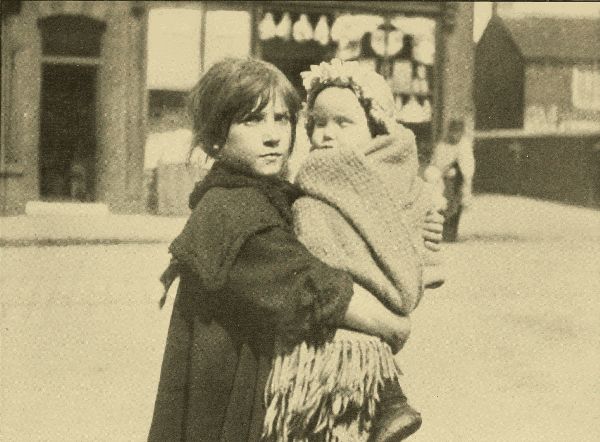
IN THE POTTERIES—A CHILD-MOTHER
Uttoxeter is no longer the idle little town that Hawthorne found it, when he made pilgrimage thither in honour of Dr. Johnson's penance, for the good Doctor, heart-troubled for fifty years because in boyhood he once refused to serve in his father's stead at the market bookstall, had doomed himself to stand, the whole day long, in the staring market-place, wind and rain beating against his bared grey head, "a central image of Memory and Remorse." Lichfield, Dr. Johnson's native city, commemorates this characteristic act by a bas-relief on the pedestal of the statue standing opposite the three-pillared house where the greatest of her sons was born.
While our chauffeur, resting from his labours under the hedge, genially entertained the abuse of a drunken tramp who was accusing us all of luxury, laziness, and a longing to run down our fellowmen, my thoughts turned wistfully to Lichfield, lying due south, to whose "Queen of English Minsters" we were ashamed to present our modern hippogriff. I remembered waking there one autumnal morning, years ago, at the famous old inn of the Swan, and peering from my window to see that wooden bird, directly beneath it, flapping in a rainy gale. The cathedral rose before the mental vision,—the grace of its three spires; its wonderful west front with tiers of saints and prophets and archangels, "a very Te Deum in stone"; the delicate harmonies of colour and line within; the glowing windows of the Lady Chapel; the "heaven-loved innocence" of the two little sisters sculptured by Chantrey, and his kneeling effigy of a bishop so benignant even in marble that a passing child slipped from her mother's hand and knelt beside him to say her baby prayers. What books had been shown me there in that quiet library above the chapter-house! I could still recall the richly illuminated manuscript of the "Canterbury Tales," a volume of Dr. South's sermons with Dr. Johnson's rough, vigorous pencil-marks all up and down the margins, and, treasure of treasures, an eighth-century manuscript of St. Chad's Gospels. For this is St. Chad's cathedral, still his, though the successive churches erected on this site have passed like human generations, each building itself into the next.
St. Chad, hermit and bishop, came from Ireland as an apostle to Mercia in the seventh century. Among his first converts were the king's two sons, martyred for their faith. Even in these far distant days his tradition is revered, and on Holy Thursday the choristers of the cathedral yet go in procession to St. Chad's Well, bearing green boughs and chanting. A century or so ago, the well was adorned with bright garlands for this festival. The boy Addison, whose father was Dean of Lichfield, may have gathered daffodils and primroses to give to good St. Chad.
The ancient city has other memories. Farquhar set the scene of his "Beaux' Stratagem" there. Major André knew those shaded walks. In the south transept of the cathedral is the sepulchre of Garrick, whose death, the inscription tells us, "eclipsed the gaiety of nations and impoverished the public stock of harmless pleasure." It may be recalled that Hawthorne found it "really pleasant" to meet Lady Mary Wortley Montagu's tomb in the minster, and that Scott asserts there used to be, in "moated Lichfield's lofty pile," a monument to Marmion, whose castle stood a few miles to the southeast, at Tamworth.
But the motor-car, full-fed with gasoline, would brook no further pause. As self-important as John Hobs, the famous Tanner of Tamworth whom "not to know was to know nobody," it stormed through Uttoxeter and on, outsmelling the breweries of Burton-on-Trent. Ducks, hens, cats, dogs, babies, the aged and infirm, the halt and the blind, scuttled to left and right. Policemen glared out at it from their "motor-traps" in the hedges. A group of small boys sent a rattle of stones against it. Rocester! Only three miles away were the ruins of the Cistercian Abbey of Croxden. We would have liked to see them, if only to investigate the story that the heart of King John is buried there, for we had never before heard that he had a heart; but while we were voicing our desire we had already crossed the Dove and whizzed into Derbyshire.
Dovedale was our goal. This beautiful border district of Derby and Staffordshire abounds in literary associations. Near Ilam Hall, whose grounds are said to have suggested to Dr. Johnson the "happy valley" in "Rasselas," and in whose grotto Congreve wrote his "Old Bachelor," stands the famous Isaak Walton Inn. The patron saint of the region is the Gentle Angler, who in these "flowery meads" and by these "crystal streams" loved to
"see a black-bird feed her young, Or a laverock build her nest."
Here he would raise his
"low-pitched thoughts above Earth, or what poor mortals love."
On a stone at the source of the Dove, and again on the Fishing-House which has stood since 1674 "Piscatoribus sacrum," his initials are interlaced with those of his friend and fellow-fisherman Charles Cotton, the patron sinner of the locality. In Beresford Dale may be found the little cave where this gay and thriftless gentleman, author of the second part of "The Complete Angler," used to hide from his creditors. At Wootton Hall Jean Jacques Rousseau once resided for over a year, writing on his "Confessions" and amusing himself scattering through Dovedale the seeds of many of the mountain plants of France. In a cottage at Church Mayfield, Moore wrote his "Lalla Rookh," and near Colwich Abbey once stood the house in which Handel composed much of the "Messiah."
We did not see any of these spots. The automobile would none of them. It whisked about giddily half an hour, ramping into the wrong shrines and out again, disconcerting a herd of deer and a pack of young fox-hounds, and then impetuously bolted back to Uttoxeter. There were antiquities all along the way,—British barrows, Roman camps, mediæval churches, Elizabethan mansions,—but the dusty and odoriferous trail of our car was flung impartially over them all.
We shot through Uttoxeter and went whirring on. A glimpse of the hillside ruins of Chartley Castle brought a fleeting sorrow for Mary Queen of Scots. It was one of those many prisons that she knew in the bitter years between Cockermouth and Fotheringay,—the years that whitened her bright hair and twisted her with cruel rheumatism. She was harried from Carlisle in Cumberland to Bolton Castle in Yorkshire, and thence sent to Tutbury, on the Derby side of the Dove, in custody of the unlucky Earl of Shrewsbury and his keen-eyed, shrewish-tongued dame, Bess of Hardwick. But still the poor queen was shifted from one stronghold to another. Yorkshire meted out to her Elizabeth's harsh hospitality at Sheffield, Warwickshire at Coventry, Leicestershire at Ashby-de-la-Zouch, Derbyshire at Wingfield Manor and Chatsworth and Hardwick Hall, even at Buxton, where she was occasionally allowed to go for the baths, and Staffordshire at Tixall and here at Chartley. It was while she was at Chartley, with Sir Amyas Paulet for her jailer, that the famous Babington conspiracy was hatched, and anything but an automobile would have stopped and searched for that stone wall in which a brewer's boy deposited the incriminating letters, read and copied every one by Walsingham before they reached the captive.
At Weston we jumped the Trent again and pounded on to Stafford, the shoemakers' town, where we came near knocking two bicyclists into a ditch. They were plain-spoken young men, and, addressing themselves to the chauffeur, they expressed an unfavourable opinion of his character. Stafford lies half-way between the two coal-fields of the county. Directly south some fifteen miles is Wolverhampton, the capital of the iron-manufacturing district. We remembered that Stafford was the birthplace of Isaak Walton, but it was too late to gain access to the old Church of St. Mary's, which has his bust in marble and, to boot, the strangest font in England. We climbed the toilsome heights of Stafford Castle for the view it was too dark to see, and then once more delivered ourselves over to the champing monster, which spun us back to Shrewsbury through a weird, infernal world flaring with tongues of fire.